79. Summer Reading

I got there at last. Hilary Mantel’s A Place of Greater Safety has been sitting on my book case for the past couple of years. I just never got around to reading it. Her Thomas Cromwell trilogy are among my favourite books, and I was keen to read something else she had written. So, when I found this 874-page 1992 fictionalised account of the events of the French Revolution at a book swap two years ago, I knew this was going to be it.

I decided it would be my 2025 summer book. I just didn’t think it would take me quite this long. I started it in Faro airport on 26 June and I finished it a few minutes ago. I was determined not to have to pack it for our return flight.

I interrupted reading it twice – to read a shorter novel and to read a play – and I’ve had less time to read this summer than I thought I’d have. Still, I’ve read it whenever I could and, like the Thomas Cromwell trilogy, I came to care for the characters, to think about them when I wasn’t reading, and to worry about what would become of them.

The French Revolution is not an era of history that I know a great deal about, so I was a bit lost at times in the intrigue and politics, and had to Google certain events to fill in my rather large gaps in knowledge. But that lack of knowledge didn’t take from my feelings for the characters and what fates awaited them.

In the time it’s taken me to read one book, Katie has read seven and Lily five, so I’m going to be lagging even farther behind in our 2025 reading ladder, when we fill it in once we get back to Sanlúcar.

As for my next reading adventure? A draft of my sister’s latest novel, that I’ve promised to read and give my thoughts on as soon as possible. I’ll begin tomorrow.

21. Thoughts on The Salt Path

I’ve been writing memoir in one form or another for years. Essays published in newspapers, magazines and online, regular blog posts when we lived on the boat, and these more recent offerings. I’ve been working on longer form memoir for some time too – two unfinished memoirs that have now been smashed together into something very different and that I have been working on now for about a year. And then there is my experiment with a fictional screenplay for a six-part dark comedy, every element of which is stuff that happened to me or to people I know, just not in that order, or in that context, or to those people. Unlike my novelist sister, I lack the imagination to make things up, so everything I write is my direct experience. I’ve taken memoir writing courses and I am a member of a memoir-writing group that meets online a couple of times a month.

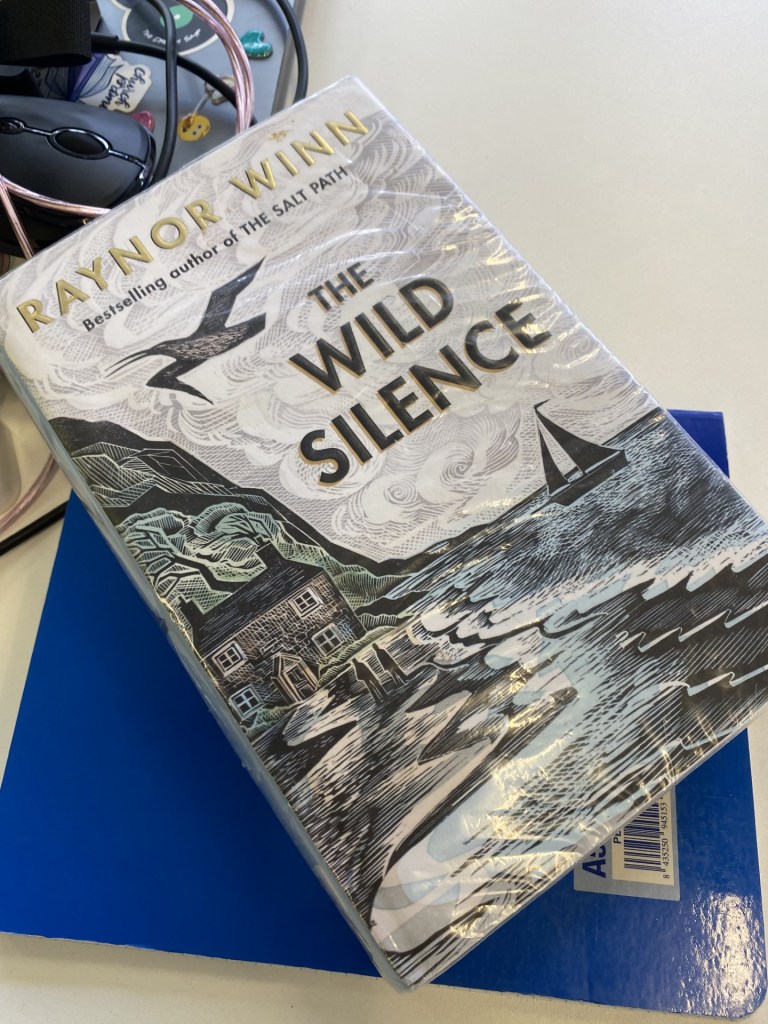
Despite writing memoir myself, I have never been much interested in reading it, much preferring fiction and certain forms of non-fiction (science writing and nature writing, in particular). In my mind, a good memoir should read like good fiction. I have read the work of some great memoirists, however – Maya Angelou, Joan Didion, Helen MacDonald, Frank McCourt, Cheryl Strayed, Suleika Jaouad, Barak Obama. One of the best I’ve read in the past few years was Raynor Winn’s The Salt Path. It was phenomenally written – lyrical and immersive, rocking along with the pace and timing of a great novel. I loved it so much that the day after I finished it, I popped it into an envelope and posted it to my old walking buddy Martha Main (Hello, Martha!), in Arviat, Nunavut. I was then delighted to find out a few weeks ago that it had been made into a film, staring Gillian Anderson and Jason Isaacs (Hello to Jason Isaacs) and, as luck would have it, it’s on in the cinema in Leamington Spa this Thursday morning and I plan to go.

So, imagine my surprise when, yesterday evening when I was watching the BBC news with my father-in-law, it was reported that a story in The Observer claimed that the author had lied about key facts in the book, and some of those lies were related to alleged criminality. I read The Observer article and then Mammy, my sister and I had a long chat about it this morning. My sister has also read the book and we had both recommended it to various people (she to her book club). We both had the same feeling of discomfort and feeling like the rug had been pulled from under our feet. It was hard to describe the feeling.

These allegations don’t in any way take from the amazing writing achievement of The Salt Path. It remains lyrical and immersive, tender and heartbreaking. But certain key elements of the story now may not be true. And that leaves a sour taste in the mouth. I’m now not sure that want to see the film.

This raises a bigger question about the role and the duty of the memoir writer. One of my favourite essayists is David Sedaris who, admittedly, I have listened to reading his essays far more than I have read his work. His writing is hilarious and heartbreaking, so that I find myself roaring laughing in one moment and roaring crying the next. But he faced a backlash about two decades ago concerning, not the writing itself, but rather its marketing as non-fiction, and the argument that it was insufficiently factual to be marketed as such. Sedaris clearly manipulates and exaggerates the things that have happened in his life for comic effect. But isn’t that what makes him a great writer – taking the ordinary, the mundane, and seeing in it something fantastical and outrageous? And boy, is it effective!

So, I don’t have a problem with how Sedaris writes because I know he’s exaggerating the truth. But that feels very different to what Raynor Winn is accused of doing. She is accused of criminal activity and of misrepresenting her husband’s illness. She presents her version of events as fact. Maybe they are. Maybe they’re not. But The Observer article is convincing enough that it has left a sour taste in my mouth. And it makes me think very carefully about the way I write my memories and the difference between a memory being true to me and a memory being true.

Not The Salt Path. When I inquired after the book at the library, I was told it had been borrowed this morning. Here’s a sequel.

1491

Quote

My Friday book review…on Saturday…..via 1491

These are a few of my favourite things

Minimalism is not about getting rid of the things you love. It’s about removing the clutter from your life, so you have more time and space for the things (and people) you love. If your collection of a thousand beer coasters brings you immeasurable joy, and the challenge to increase that collection to two thousand is what gets you out of bed on a Saturday morning, then embrace that. But if you have one hundred beer coasters that have been cluttering up a drawer in each home you’ve lived in since your student days, then it’s time to assess their importance to you and decide if you really need them taking up space in your life.

Of course, sometimes you discover that the things you thought you couldn’t live without are actually completely disposable and that life is, in fact, improved by their disposal.

From childhood I was a hoarder of books. I loved books. I loved reading them, I loved looking at them, I loved seeing them on my bookshelves. I never gave away a book. I only added to my collection. Books loaned and never returned were mourned and my opinion of the rogue borrower significantly diminished.

I lugged books to Japan, added to them, and lugged them back to Ireland again. I did the same in Nunavut, and in the UK, when I moved from house to house from Aberdeen to Cambridge over the space of nine years. Books require their own furniture, so the book cases we bought in Aberdeen were now added to the stuff we had to transport at every house move.

One of the things that attracted me to the house we eventually bought in Cambridgeshire was the potential for a massive built-in bookcase in the dining room, with wall-to-wall, floor-to-ceiling books. When Simon, the carpenter, came around to lay the downstairs floorboards I asked if he’d build the bookcase for me. We planned it together, sitting at my dining table, Simon sketching plans on a scrap of paper as I described what I had in mind. A few weeks later, the bookcases had been built, the dusty blue paint I’d covered it in had dried and I unpacked the many boxes of books onto their rightful home. The sight of it filled me with joy.

A little over a year later, when we made the rather sudden decision to quit our jobs, sell the house and buy a boat, it was obvious that extreme downsizing was called for. I had no problem parting with most of the excess in our lives, but the thought of getting rid of my books was heart-wrenching.

We spent the summer of 2011 drastically downsizing. Every Saturday or Sunday morning Julian drove to car boot sales all around Cambridgeshire, with our Ford Mondeo packed to the roof with all our excess stuff. He usually came home having sold more than half of what he’d packed, £100 in his pocket and the house a little less full of stuff. Each weekend the house grew a little emptier and as the decluttering bug took hold, I was willing to part with more and more stuff that I had previously thought we couldn’t live without.

The only fly in the ointment were the books. At first, I couldn’t bear to part with them. But we had three copies of Moby Dick, two copies of A Short History of Nearly Everything and quite a few books that I didn’t like and would never read again. Two Moby Dicks, one Short History and those books I disliked were the first to go. The next week I put a few more books in the car boot sale box, and then some more, and then some more.

And then I discovered something incredible. On a couple of Saturday mornings Julian stayed home and I went to the car boot sale. I set two boxes of books on the grass next to the collapsible garden table on which I displayed most of the household and garden stuff I was trying to sell. Hardbacks were priced at £1 and paperbacks at 50p. As people browsed at my stall, some stopped to look in my book boxes. Someone might ask if I had any Andy McNab or Cecilia Ahern books. I didn’t, but I would send them in the direction of my neighbour, whose book box I had browsed earlier. Other people were interested in my books and I started to have conversations. If someone showed an interest in Maya Angelou, I would recommend Alice Walker too. If someone liked the blurb on the back of an Isabel Allende, I would also recommend Gabriel Garcia Marquez. I met fellow bibliophiles who wanted to talk about the books I was reluctantly selling. And, because of those conversations, my reluctance evaporated. I now discovered that sending my books out into the world where new readers would potentially experience the same joy as I had brought me greater joy than hoarding them all to myself.

From that point on, I practically ripped books* from their shelves, so eager was I to pass them on to new readers. There were (and still are) books that I would never part with. Most of my academic books were expensive and hard to come by and most non-anthropologists wouldn’t be interested in them anyway, so I’ve kept most of those. I also kept the ones that bring me most joy and books that I have read over and over, and know I will probably read again some day – A Suitable Boy, The Bone People, Lord of the Rings, To Kill a Mockingbird, and a few others.

Since the summer of 2011, with only a few exceptions (Jay Griffith’s Wild, Barry Lopez’ Arctic Dreams)I have never again kept a book once I’ve finished reading it. I now pass books on. Sometimes I pass them on to someone in particular who I think will like the book as much as I do. But more often, I deposit them in book exchanges or charity shops. I still love books as much as always, but I am now a book sharer, rather than a book hoarder.

That one area of my life that I didn’t want minimalism to touch has, in fact, become one of the easier minimalist aspects of my life. And the reward, in conversations and shared thoughts about books, is worth far more than all the dust my books silently gathered on their shelves.

* I said ‘practically’. Clearly, I would never do anything so disrespectful to a book!

The tattooist of Auschwitz

Quote

My Friday book review…..via The tattooist of Auschwitz