48. Weathering

We had already decided to stay an extra night, to hole up here, in a house on a granite cliff, on the far northwest coast of Ireland. Better than running the risk of driving across Donegal and down through the country in the middle of a storm. We’d drive to the shop, get in supplies for the extra day.

Mid-morning, Katie called from the bathroom, ‘Is someone using the water out there?’ The shower wouldn’t heat up. A minute later she appeared wrapped in a towel. ‘The shower’s stopped working.’ Our trip to the shop in Dungloe delayed, we spent the next half hour trying to work out the source of the problem. The safety switch on the electricity junction box kept tripping. By a process of elimination, we realised that certain plug sockets also weren’t working. Michael stood on a kitchen chair, flicking switches on the junction box. ‘Shit. There’s smoke coming out of it,’ he said suddenly. I unlocked the door into the terrace in case we needed a speedy exit. My sister has survived two house fires – one in Ireland, one in Spain – both due to junction box fires, so I knew what could happen next

We ran around, unplugging and turning off lights. The smoke didn’t develop into anything more. Time for a sit down and a chat and decide what to do. It was Sunday morning, a bank holiday weekend. So calling out an electrician would be expensive and possibly not resolve the problem in the short term. Better to leave that til Tuesday and a normal working day. The house belongs to Michael’s aged aunt, so we didn’t want to bother or worry her when, at this moment, nothing could be done. And, the storm was still on its way.

We decided to ride it out here, without electricity. The girls raided the house for candles, torches, matches, while Michael and I figured out how to set up the ancient gas barbecue in a sheltered corner out the back of the house. Our shopping plan changed, as we considered what we could eat in the absence of electricity. We charged our phones as best we could during the drive.

When we got back from the shops, we went for a long walk across the island, still no hint that a storm was on its way. Michael lit the wood burning stove in the house and fired up the barbecue out the back. Up at this latitude at this time of year, it isn’t fully dark til 10:30. We sat chatting by candlelight til close to midnight. Michael was last to bed, leaving only a single (and safe) candle burning in the bathroom.

The wind woke me up around 5am, the back of the house, where I’m sleeping, creaking in its path. I was up at 7am, no longer able to sleep, keen to see what the sea looked like. I’m sitting here now by the big window that takes up half of this little house. Waves smash huge and white against the islands in the farther distance. Closer in, the sea is choppy, with gusts of wind dancing across its surface. A group of cormorants sit on the sea just down from the house, being tossed this way and that. The occasional seagull soars on a current of air, feet splayed as it attempts to land on firm ground

I’m glad we stayed. The lack of electricity gives a Wuthering Heights feel to this storm. We’ll leave later today or, more likely, tomorrow, whenever the storm has passed. All I’m missing is my morning cup of tea. For now, I’m going to sit back and enjoy the stormy sea.
20. Normal England has resumed

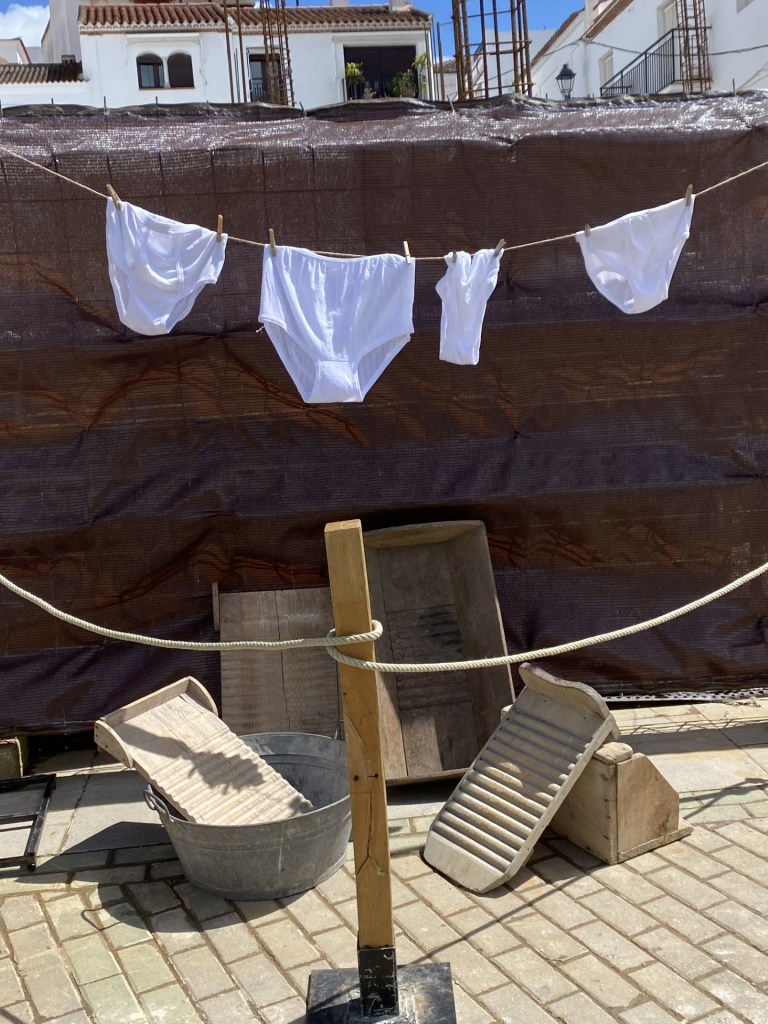
We arrived back to Leamington Spa late on Saturday evening, leaving the girls with a 19 hour turn-around time before leaving for a week in Lymington with their uncle, and leaving me with even less time than that to get the laundry done. It’s all too easy to forget how quickly clothes dry at this time of year in southwest Spain. Hang ’em out and take ’em in again two hours later, hard as boards. Not so in England. But the weather has been unseasonably warm here. We sweltered in 35 degree heat at Wimbledon last week and, if that weather had continued for just one more day, well…I’m just saying, it would have made doing the laundry a little easier. Gaia, why are you toying with me like this?

It was breezy when I woke up yesterday morning, my first task to fill the washing machine and do a quick 30-minute wash. Not that that did me any good. By the time they came out of the machine, the heavens had opened and rain fell at a slant onto my father-in-law’s newly laid patio slabs, and in through the open kitchen window, leaving the window sill and the floor slippery and dangerous. Did I care? Of course not. There’s a tumble drier out in the garage. I don’t like using a tumble drier, but needs must, so out I flitted, my father-in-law stating the glaringly obvious, ‘You’ll get wet.’

Forty minutes at high heat. Out into the rain again. The clothes were still wet in the drier. Another thirty minutes. Then another. No joy. My father-in-law insisted I was doing something wrong. I insisted I wasn’t. We eventually found the culprit – a very dirty filter thing that would need to be taken apart and cleaned out. But neither of us had any idea how and the instruction manual was long gone. Did I have time to go search how to do it online? I did not.

By now, the sun had come out, so I put all the clothes on the clothes horse and moved them to the far end of the north-facing garden to catch the sun shining in over the house. I was taking a shower when the next rain shower came and Lily dashed out to bring the clothes horse in. Then back out when the rain passed. Then in again. Then out again. And always that guessing game of ‘is this item of clothing really dry or am I just wishing it dry?’

Finally, the moment came for the girls to leave. Most of Lily’s stuff was still on the clothes horse and still damp or downright wet. There was nothing for it but to stuff it all into a bag with instructions for her to dry it when she reached her destination. “Don’t forget,” I warned ominously. “It’ll turn sour.”

Now I really feel like I’m back in England.

These are not our giant white knickers…I swear!!!

These are a few of my favourite things

Minimalism is not about getting rid of the things you love. It’s about removing the clutter from your life, so you have more time and space for the things (and people) you love. If your collection of a thousand beer coasters brings you immeasurable joy, and the challenge to increase that collection to two thousand is what gets you out of bed on a Saturday morning, then embrace that. But if you have one hundred beer coasters that have been cluttering up a drawer in each home you’ve lived in since your student days, then it’s time to assess their importance to you and decide if you really need them taking up space in your life.

Of course, sometimes you discover that the things you thought you couldn’t live without are actually completely disposable and that life is, in fact, improved by their disposal.

From childhood I was a hoarder of books. I loved books. I loved reading them, I loved looking at them, I loved seeing them on my bookshelves. I never gave away a book. I only added to my collection. Books loaned and never returned were mourned and my opinion of the rogue borrower significantly diminished.

I lugged books to Japan, added to them, and lugged them back to Ireland again. I did the same in Nunavut, and in the UK, when I moved from house to house from Aberdeen to Cambridge over the space of nine years. Books require their own furniture, so the book cases we bought in Aberdeen were now added to the stuff we had to transport at every house move.

One of the things that attracted me to the house we eventually bought in Cambridgeshire was the potential for a massive built-in bookcase in the dining room, with wall-to-wall, floor-to-ceiling books. When Simon, the carpenter, came around to lay the downstairs floorboards I asked if he’d build the bookcase for me. We planned it together, sitting at my dining table, Simon sketching plans on a scrap of paper as I described what I had in mind. A few weeks later, the bookcases had been built, the dusty blue paint I’d covered it in had dried and I unpacked the many boxes of books onto their rightful home. The sight of it filled me with joy.

A little over a year later, when we made the rather sudden decision to quit our jobs, sell the house and buy a boat, it was obvious that extreme downsizing was called for. I had no problem parting with most of the excess in our lives, but the thought of getting rid of my books was heart-wrenching.

We spent the summer of 2011 drastically downsizing. Every Saturday or Sunday morning Julian drove to car boot sales all around Cambridgeshire, with our Ford Mondeo packed to the roof with all our excess stuff. He usually came home having sold more than half of what he’d packed, £100 in his pocket and the house a little less full of stuff. Each weekend the house grew a little emptier and as the decluttering bug took hold, I was willing to part with more and more stuff that I had previously thought we couldn’t live without.

The only fly in the ointment were the books. At first, I couldn’t bear to part with them. But we had three copies of Moby Dick, two copies of A Short History of Nearly Everything and quite a few books that I didn’t like and would never read again. Two Moby Dicks, one Short History and those books I disliked were the first to go. The next week I put a few more books in the car boot sale box, and then some more, and then some more.

And then I discovered something incredible. On a couple of Saturday mornings Julian stayed home and I went to the car boot sale. I set two boxes of books on the grass next to the collapsible garden table on which I displayed most of the household and garden stuff I was trying to sell. Hardbacks were priced at £1 and paperbacks at 50p. As people browsed at my stall, some stopped to look in my book boxes. Someone might ask if I had any Andy McNab or Cecilia Ahern books. I didn’t, but I would send them in the direction of my neighbour, whose book box I had browsed earlier. Other people were interested in my books and I started to have conversations. If someone showed an interest in Maya Angelou, I would recommend Alice Walker too. If someone liked the blurb on the back of an Isabel Allende, I would also recommend Gabriel Garcia Marquez. I met fellow bibliophiles who wanted to talk about the books I was reluctantly selling. And, because of those conversations, my reluctance evaporated. I now discovered that sending my books out into the world where new readers would potentially experience the same joy as I had brought me greater joy than hoarding them all to myself.

From that point on, I practically ripped books* from their shelves, so eager was I to pass them on to new readers. There were (and still are) books that I would never part with. Most of my academic books were expensive and hard to come by and most non-anthropologists wouldn’t be interested in them anyway, so I’ve kept most of those. I also kept the ones that bring me most joy and books that I have read over and over, and know I will probably read again some day – A Suitable Boy, The Bone People, Lord of the Rings, To Kill a Mockingbird, and a few others.

Since the summer of 2011, with only a few exceptions (Jay Griffith’s Wild, Barry Lopez’ Arctic Dreams)I have never again kept a book once I’ve finished reading it. I now pass books on. Sometimes I pass them on to someone in particular who I think will like the book as much as I do. But more often, I deposit them in book exchanges or charity shops. I still love books as much as always, but I am now a book sharer, rather than a book hoarder.

That one area of my life that I didn’t want minimalism to touch has, in fact, become one of the easier minimalist aspects of my life. And the reward, in conversations and shared thoughts about books, is worth far more than all the dust my books silently gathered on their shelves.

* I said ‘practically’. Clearly, I would never do anything so disrespectful to a book!

Born again minimalist

I used to be a minimalist. I was even recruited by an environmental website to write a series of blog posts about living a minimalist life*. Julian and I chose minimalism when we chose to live on a boat. From that fateful day in April 2011 when we decided to radically change our lives by quitting our jobs, selling our house and buying a boat, minimalism became our goal. Our first symbolic act, that same evening, was to unplug the television, put it in the boot of the car, and take it to the dump the next day. After that, minimalism became a necessity as well as a desire. If our family of four was going to live on a small boat we had to get rid of most of our stuff.

During the summer of 2011, we radically de-cluttered. If we numbered each item we owned, I would make an educated guess that we got rid of over 80% of our belongings. We sold or gave away most of my close to one thousand books, we sold our excess kitchenware, clothing, toys and gardening tools. The things that were meaningful to us, but that we wouldn’t have room for on the boat, went into storage in my parents-in-laws’ houses. When we bought Carina and first moved aboard, we quickly realised we still had too much stuff and at the end of our first sailing season we downsized again.

Each year we have returned to my father-in-law’s loft, and have further pared back what we’ve kept in storage. Some things we simply don’t need any more, such as the cots, children’s beds and toys that Lily and Katie have outgrown. But we have also pared back items that we had stored out of sentimentality, but which now no longer seem so important to us. The pile of truly important material items has decreased over time. We also still have a few large items in my father-in-law’s garage, such as a sofa, a dining table and chairs, a washing machine and our bicycles. I think the time has come to consider selling or donating some or all of those items, if they have not already been damaged by damp or pests.

However, in our life on the boat and now our life back ashore again, the quantity of stuff in our lives has started to creep up again. One of the reasons we moved off the boat was because there wasn’t enough room any more. The lack of room was partly due to two growing girls and two parents who are larger than when we moved aboard, but it is also partly due to creeping quantities of stuff. We moved off the boat and brought all that stuff with us, and for four months we added to it. Our house was cluttered and it made me uneasy. It felt messy and unnecessary.

Early in the new year I watched both the documentary Minimalism and the Marie Kondo series Tidy Up on Netflix. Both reminded me that I once, not so long ago, shared these minimalist ideals and aspirations. And I realised two things. First, that I wanted to return to that simpler way of living and, second, minimalism is an ongoing project and a lifestyle choice. It is not something we do once and forever. In a world bombarded with consumption, we have to work mindfully to keep unwanted stuff out of our lives and to reduce the unwanted stuff in our lives, whether it sneaks in when we are not being mindful or it is once-useful but now obsolete stuff.

In the past couple of months, I have been keeping ‘minimalism’ at the forefront of my mind. The children and I have de-cluttered together and I am being more mindful of my consumer choices. 2019 has become my year to return to my minimalism. Unlike the first time around, I know it is more a process than a project, a lifestyle choice rather than a lifestyle change. I’ll let you know how I get on over the coming months.

*Sadly, this site is no longer available. However, I still have copies of all my posts on that site.