96. A novel sleeping partner

In November 2007, I headed south on a Ken Borrack Air Twin Otter. I’d been waiting all day, with the flight twice delayed owing to bad weather. Both times, I’d been sent home and, each time, got a call a couple of hours later telling me to get myself back to the airport. On the third try, the weather cleared long enough to allow the plane to take off.

Loading the Twin Otter at Arviat airport

The moment had come to fly the sixty miles south of Arviat to the hunting camp, and I boarded the stripped out plane that now only had three passenger seats. The only other human passengers were Nadine, the French-Canadian cook, and Reverend Jimmy Muckpah, minister at Arviat’s Anglican Church. The other passengers were two wooden boxes containing Jimmy’s sled dogs, packed securely for their own safety for the short low altitude flight. What little remaining space was packed to the rafters with a skidoo and some of the boxes of food and other items we’d need.

Lovely, kind Jimmy Muckpah, who knew more about polar bears than anyone I’ve known
Jimmy’s sled dogs, who seemed quite content with their travel arrangements

We flew south along the coast to our camp. The others had flown in on an earlier flight and we all helped to unload the plane before it took off again. It would return for us in two weeks. I was to live for those two weeks with five big game trophy hunters from the US, their five Inuit guides, all from Arviat (including Jimmy), and Nadine. The guides, Nadine and I all knew each other, but the trophy hunters were new to me and, indeed, to all of us. I was here for research. I was studying the relationship between humans and polar bears; specifically, seeking to understand the changing role of polar bears in Inuit culture and economy, as international laws about polar bear hunting was rapidly evolving.

Ryan, the camp outfitter, had generously invited me to the camp. What I learned in those two weeks hugely enriched my anthropological understanding of the role of polar bears in Inuit life and I published my findings in various academic journals and books in the subsequent years. My findings were even presented as evidence at US Congress hearings in 2008 that sought to amend US Fish and Wildlife laws concerning the importation of ‘trophy’ polar bears from other countries.

The camp comprised four cabins. The trophy hunters slept in two of the cabins, the guides all bunked together in another, and the fourth cabin – which was also the camp kitchen and eating quarters – was shared by Nadine and me. Each cabin had a ‘toilet,’ consisting of a ‘honey bucket’ – basically a bucket with a seat and a bin liner that we changed every few days. At those temperatures, anything you did into the honey bucket froze almost immediately. Nadine and I had a small room off the far end of the kitchen that contained a bunkbed. She slept on the top bunk and I on the bottom.

Our little huddle of humanity on the west coast of Hudson Bay

Ryan had built his outfitting camp here because it was situated along the polar bear migration route. Indeed, during the two weeks I was there, more than seventy individual polar bears passed through on their winter migration out onto the sea ice. Many of them came close, attracted by the smells of the camp, and snuffled around. We were under strict orders that no-one was to leave the cabins, or go between cabins, without a rifle and to never go alone. The trophy hunters rarely listened to that advice and took stupid risks by walking from the kitchen cabin to their own in the dark. The local guides, well aware of the realities of living in such close proximity with the world’s largest carnivores, were extremely annoyed by the idiocy of the trophy hunters.

I had various roles during those two weeks. I helped Nadine in the kitchen. I went out on hunting trips with the guides and the hunters in their charge. And I helped with skinning and preparing two of the three bears that were killed. (According to international and local law at the time, each hunter could take one trophy bear (they paid tens of thousands of dollars for the ‘privilege,’ some of which found its way back into the Inuit subsistence economy)). During those two weeks, three of the five hunters got their trophy. The other two went home empty handed.

I remember helping one of the guides, Donald, one day as he skinned a bear that had been shot by the trophy hunter in his care. The hunter was back in the warmth of the cabin, enjoying a hot coffee and some freshly baked cinnamon rolls. I held the bear’s huge heavy legs while Donald did what he had to do. It was cold and he wanted to get the work done quickly. So that he could keep his head down and concentrate on the work, he asked me to keep my eyes on the two polar bears that were circling close by and to let him know if either of them started to move closer. They didn’t, but I was shit scared and so was he.

Polar bears came close to and into the camp every day.

The plywood cabins were reinforced with corrugated metal. They had windows that were too small for a polar bear to get through, and the doors were covered with six inch nails, sharp side out, to discourage any bear that might try to break in. Even so, it was pretty scary at times. One particular day, when the hunters and guides had all left camp to go hunting, and Nadine and I were alone in the cabin, a bear came snuffling around. He stood on his hind legs, making him probably 8 feet tall. He looked in the window into our kitchen (imagine, a polar bear looking in at you!), and repeatedly hit against the side of the cabin with his front paws. He was trying to get in. Nadine and I were terrified. We had a rifle, but I’d only ever used it for target practice. Would I know what to do in a real life-or-death situation? Eventually, he gave up with trying to open the sardine tin that was our cabin and started to play around with the big cylinder of propane gas that was our only source of heat and cooking fuel. One slap with his paw, and he knocked the cylinder loose. Before we knew it, he was rolling it around on the ground, playing with it, and now was 20 or 30 metres away. While we were delighted that he seemed to have lost interest in us, we now had a new problem – it was about -15C and a polar bear was using our only heat source as a toy. Luckily, the hunters and guides came back about an hour later and all was well.

Every night when I went to bed, I could hear snuffling outside the cabin. Sometimes, I’d shine my flash light out the small window and see a pair of eyes reflected back. Lying in my bunk, I’d hear snuffling on the other side of the flimsy wall. Imagine my surprise the first morning I went out and saw a very clear indentation in the snow the size and shaped of a curled up polar bear. It was exactly on the other side of the wall from my bunkbed. The indentation was there every morning; sometimes, like in the photo below, accompanied by claw marks.

I didn’t sleep well for those two weeks, let me tell you, knowing that I was sleeping beside a polar bear, with only a strip of plywood and corrugated metal separating us. But when I looked back on it, I understood what a privilege those two weeks were.

It hard to see the indent of the bear’s body in this one, but the claw-mark is right in the centre.

82. Bog road

‘Turn on Radio 1,’ Niamh said, as we got into our cars to drive in convoy across Kildare. ‘Sunday Miscellany is all about the bog this morning.’

I led the way along the bog road, through Allenwood and Prosperous, past the road down to Coill Dubh, through a landscape I have known all my life, a landscape so densely entwined with memory and meaning.

It’s impossible to come from the midlands of Ireland and not have the boglands seeping through your veins. This great flat landscape, the fuel source around which our year and our society revolved. The footing and the haping, and tea from a milk bottle and sandwiches wrapped in waxed paper. Cold March Saturdays of the men cleaning the turf bank all the way through to warm August Saturdays of bringing the turf home.

And it’s the poetry and the music – Heaney and Christy Moore and Luka Bloom. It’s the dissertation I wrote as an undergrad and the bog PhD I started in my 20s.

As I drove across the bog, I listened to the radio programme, as Niamh suggested. It was filled with the stories, songs, reminiscences of people from the midlands. Some people, like me, who have chosen to live abroad and have never found a way to adequately describe and explain all that the bog is to people who don’t know it. And some people who had lived in the bog their whole lives, who evocatively expressed what the bog meant to them.

To listen to this as I drove across the bog this morning was moving enough. But today also happens to be the 21st anniversary of the day that Daddy died. And for me, above all else, my memories of the bog, and what the bog means to me, are inseparable from my memories of Daddy.

It was, therefore, a bittersweet drive, with the stories and the road and this particular day, all evoking memory and emotion, and tears running down my cheeks, not of sadness, but of gratitude for this place and all that it means to me.

71. Positive

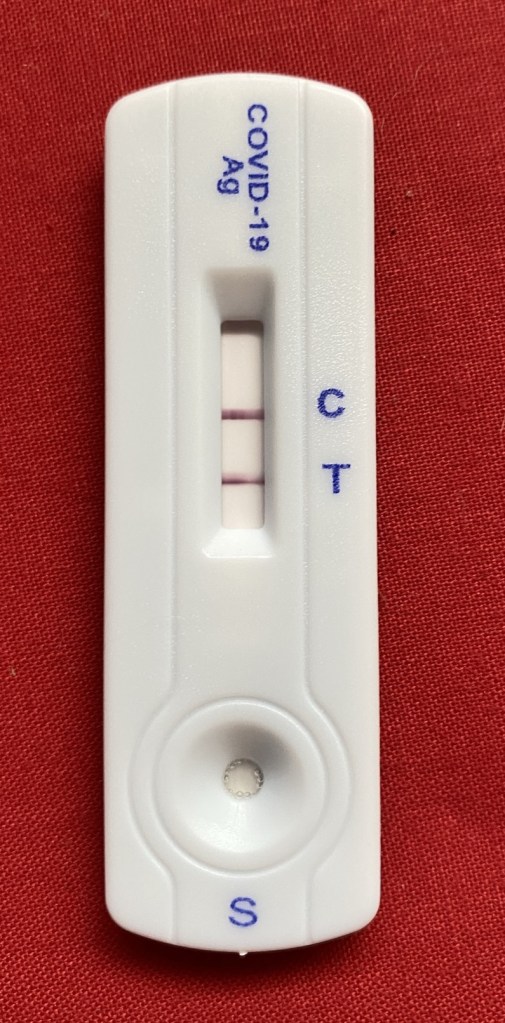
Yep. It was Covid alright. I tested negative late last week, but after a few more days of all three of us having identical symptoms, I decided to test again. If I had it, then we all had it.

There was no messing about with the second test. An immediate strong T line. ‘Half the country has it,’ as everyone keeps telling me. Our Lithuanian friends have been hit with it too. My guess is we caught it in Dublin last week.

We’ve had it worse. Katie, who’s had it five times, has fared best. She’s usually the worst, but this time, she got over it quickly and was back to herself in only a few days. I definitely had it worse the year I had to miss Romería, and I had it way worse the Christmas we went to Tenerife.

This time I’ve had a sore throat and a cough. I’ve felt like the inside of my head is filled with cotton wool and all I want to do is lie around. It’s only Lily’s second time to get it and her symptoms this time are almost exactly matching mine. We felt better yesterday but worse today.

It’s a wonderful opportunity to lounge around in my dressing gown all day, read my book, binge watch The Office (US), be anti-social and not feel guilty about not getting exercise.

But I’m ready to go back out into the world now. I’m going to test again tomorrow afternoon. I’m hoping for but not expecting a negative result.

68. Worse, not better.

Around the clock, the cars whizz by. Breaking the 80km/h speed limit by 20, 40, 60km/h. Early morning is bad – commuters late to work, or timing their commute to perfection only by driving at high speed. You hear them coming at great distance, then drowning out all other sounds as the rush past, leaving a trail of noise in their wake. Sometimes, they overtake each other outside the house – a car doing 120km/h overtaking one doing 100km/h on this narrow little road. Once the commuters have passed, it’s the turn of the lorries. Great, hulking lorries, with ‘Long Vehicle’ signs on the back, made for roads much bigger than this one, they too going at or above the speed limit – lorry after lorry carrying triple, quadruple decks of frightened pigs to the slaughter house a mile farther along the road, or taking goods and supplies to who knows where. Then it’s the commuters again – going in the opposite direction at the end of the day. And then night comes and it’s the racers – joy riding at unimaginable speeds – speeds that I don’t want to imagine. A couple of nights ago, a car stopped in front of the house. It was 9:30 and I hadn’t yet closed the curtains. Odd, I thought. We’re not expecting anyone. Then I thought maybe it was waiting at the bottom of the narrow hill to let an oncoming vehicle pass. But it wasn’t that either. The driver revved and revved and revved the car and then shot away up the road like a bullet. The noise was deafening. I waited for the sound of a collision – with another car, or with the old tree on the bend in the road up at Smith’s house; my heart pounding.

We used to live our lives on this road. Cousins my age lived in the house across the road and in the house down the road; so, as kids, we were constantly going between the three houses. On summer evenings, we’d tie a skipping rope to the gate and stretch it out across the road. Daddy would stand for hours turning the rope, while us kids jumped til it got too dark. Every twenty minutes or half an hour, we’d have to make way for a car to go past.

From an early age, I walked or rode my bike the two miles from home into town, never giving a minute’s thought to my safety because the traffic was limited and no-one drove fast. When I was 12, and started secondary school, I rode my bike, alongside my cousins, to school every day, just like Daddy rode his bike to work every day, and my aunt Lillie and uncle’s Tom and Gerry rode their bikes out to Ballygibbon regularly. The road belonged to the people, not to the cars.

The road was a place for animals too. Our farming neighbours regularly herded their cattle or sheep along the road from one field to another and, on Thursday mornings, farmers from farther afield would herd their livestock down the road towards the cattle mart. We walked our dogs along the road, often not on leads, never giving a moment’s thought to their safety. Lassie, the black labrador my parents gave to me as a puppy for my fourth birthday, got into the habit of crossing the road over to Betty’s house every day for a slice of bread.

There was the summer of 1992, the year of the Barcelona Olympics, when my friend Niamh came to visit from Kilkenny. We wondered how fast we could run, compared to Linford Christie. We measured out 100metres on the road and my neighbour timed us. While Niamh ran her 100m in a handy 12 seconds, I came in at 22 seconds! I wasn’t built for speed!!

I remember a few times in the late 1990s and early 2000s, with my friend Gavin or with Julian, walking the two miles home from the pub in the dead of night. On those nights, with no lights to guide us, I worried only that I might twist my ankle in a pothole or along the side of the road. Meeting traffic was never a major concern.

Not much has changed on this road in the 52 years that I have known it. The signs have improved a bit and the surface on the bridge over the River Boyne is definitely better. Apart from that, it remains the same. The road is as narrow as it always was, with sporadic road markings at best. The same houses line the road – only two new houses have been built in the past 50 years – each house home to succeeding generations of young couples raising their children to adulthood.

The only thing that has changed on this road is the traffic. The road no longer belongs to the people or to the animals. To leave the house now, we must go by car, because it is too dangerous to walk or ride a bike. To walk her dogs, Mammy has to load them into the car and drive them to somewhere else where it is safer to walk. Even driving the car out onto the road is nerve-wracking, as drivers speed up and down the road with little thought for the inhabitants of the houses they pass. Impatient drivers occasionally honk their horns or dangerously overtake when we slow down to turn into the driveway or pull in to open or close the gate. There’s no stopping on the road for a friendly chat with a neighbour in a passing car.

Because of the traffic, the neighbours see less of each other, simply because they stay well away from the road. It’s sad and infuriating to see my lovely townland torn apart by the very road that once brought us all together. Is this progress? I don’t think so.

66. The A Book

At Christmas 1989, I was 16 years old and in my final year of secondary school. In February, I would have to complete my application for university – a centralized system in which I would have to list my choice of institutions and courses from one to ten. In June 1990, I would sit the state Leaving Certificate exam and, in August, I would be offered the highest ranked of the ten courses for which I had gained sufficient accumulated points in my Leaving Cert.

Geography and English were my favourite subjects and I imagined I would do a degree in those two subjects, become a teacher, and then come home to Edenderry and teach for the rest of my life. I didn’t know any better. My teachers were my role models for what could be done with a university degree. I loved Geography, ergo, I would become a geography teacher.

But, while at 16, I couldn’t imagine a life for myself outside of Edenderry, in my mind, I was a citizen of the world. From the age of 11, I’d had pen-pals in Singapore, Australia, Malawi, Egypt, Hong Kong, Spain, Greece (by the way, to this day I’m still friends with Aileen in Singapore and Haitham in Egypt), and spent vast amounts of time – and pocket money on stationary and stamps – telling them all about my life and learning all about their lives. And, shortly after I’d turned 16, I made the difficult decision to stop buying Smash Hits every fortnight and instead save up my pocket money and birthday and Christmas money to subscribe to National Geographic. I’d sit at the kitchen table or lie on my bed here in Ballygibbon, and read National Geographic from cover to cover, even the ads, as the words and photos took me on journeys to places and peoples in lands far from my little corner of Co. Kildare.

That Christmas of 1989, my aunt Marian and uncle Jim came up from west Cork to stay at Nana’s house in Gilroy. We saw them two or three times a year, but this time was a little different. Jim was a primary school headmaster and my parents had asked if he could help me with Maths. The Leaving Cert was only six months away and Maths was, by some measure, my worst subject. Poor Jim, he did his best but, he was fighting a losing battle from the start. Not only was I bad at Maths, I refused to even try to be good. My stubborn mental block took years to shift and it is residually still with me today.

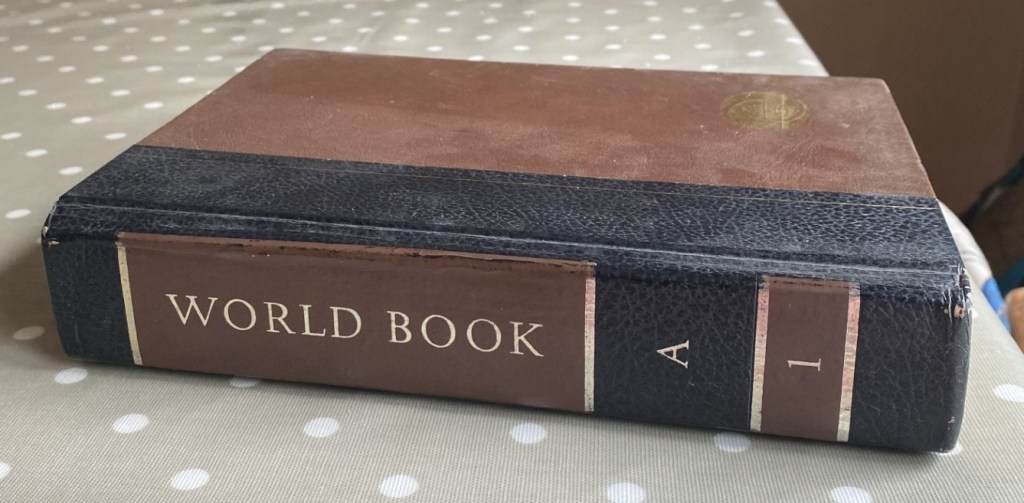
Jim, in his spare time, was also a door-to-door encyclopaedia salesman. On the day they arrived at Nana’s house that Christmas, Mammy and I popped in to visit. ‘Come out to the car,’ Jim said to me. ‘I’ve something for you.’ Out we went. He opened the boot of the car and fished out the A book of the World Book encyclopaedia. I was delighted with this and spent the remainder of the visit at Nana’s house browsing through the pages.

At home that evening, I sat on my bed, a mug of tea on the bedside table, and poured over the A book, page by page. It was filled with all sorts of interesting A things – from Kareem Abdul-Jabbar to Alexander I, from Antarctica to Austria, from Airplane to Audio-visual Materials. And then I came to page 509: Anthropology.

What on earth? There’s this field of study that I’ve never heard of before, that’s combines some of the bits I like best about geography, and that’s all about learning about people who live far away in other parts of the world. Could I do that? It seemed highly unlikely.

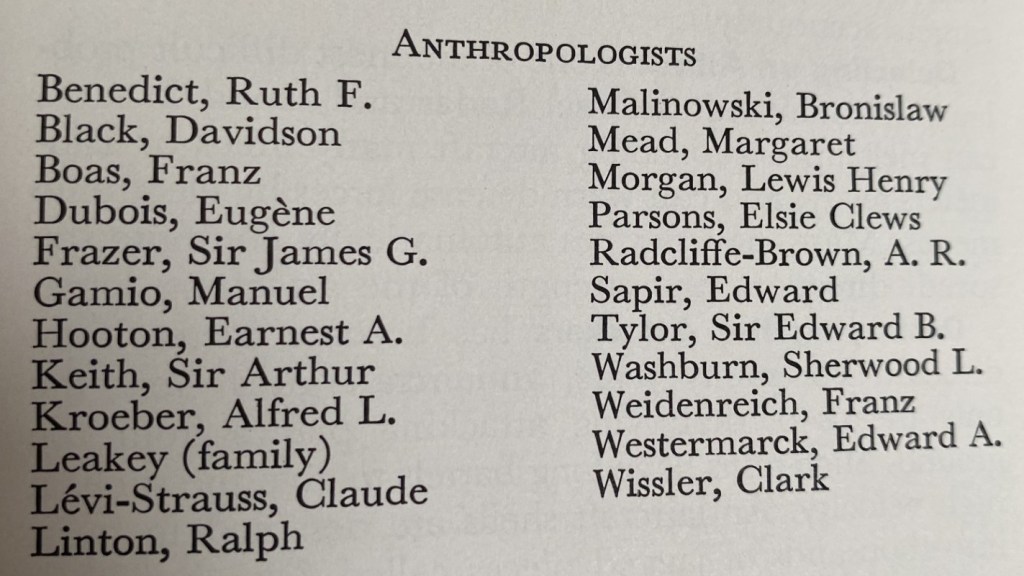
I read and re-read the four and half pages about Anthropology. Among the most renowned were a handful of women – notably Ruth Benedict, Margaret Mead, Elsie Parsons.

And I read that anthropologists did their research by immersing themselves in the lives and cultures of the peoples they studied, learning skills and languages, and then theorized and wrote about what they had learned from those experiences. Surely there were no anthropologists in Ireland! This was far too exotic and exciting!

I thought about anthropology all through the Christmas holidays and, as soon as I the January term started, I made a bee-line for the school career guidance counsellor, convinced that she would tell me she had never heard of this subject or that the nearest place I could do it was somewhere in England. Imagine my surprise when she told me that the only Anthropology department in the Republic of Ireland was in Maynooth – my nearest university! How could this be? How did I not know?

In February, I filled in my university application form, still erring on the side of Geography and English in UCD, but with Arts in Maynooth as my second choice. When I received my Leaving Cert results in August 1990, I knew I had enough points to do Anthropology and Geography at Maynooth.

And did I get my degree and return to Edenderry to become a Geography teacher? Well, I got my degree. And I followed that with a Masters degree in Anthropology. Then I went to live in Japan for three years. Then I moved to the Canadian Arctic. Then I did a PhD in Anthropology, immersing myself for long periods of time in an Inuit community on the west coast of Hudson Bay. Then I worked as an Anthropologist-Geographer in geography departments in Cambridge, Reading and Exeter universities. All thanks to my uncle Jim handing me the A book out of the boot of his car two months before I applied for university.

I was sitting at the kitchen table here in Ballygibbon earlier today. I glanced up towards the bookcase and saw the A book, still sitting there. Coincidentally, today is also the day when tens of thousands of students across Ireland receive their Leaving Cert results. I hope their lives are as unexpected and serendipitous as mine has proven to be up to now.

42. Strangers

I meet Sean again when I go out for an evening walk. This time he’s sitting on a camping chair on the canal bank, beside his boat. He’s with a younger man, who’s sitting on the grass. I shout ‘hello’ over to them and they beckon me over. By the time I walk back to the nearest bridge and cross over to the other side of the canal, Sean has pulled another camping chair out from his boat. His buddy is Carl, a Mancunian. The two met only yesterday, when Carl was taking his daily walk along the canal. I sit with them for a couple of hours, shooting the breeze, sharing stories about where we’ve come from and where we’re going to, the importance of listening, and the power of poetry. I bid them farewell and carry on my way.

••••••

‘I started working with papier-mâché during lockdown,’ Jean tells me. ‘I wanted to make art with what was lying around the house.’ I’ve wandered into her studio and find her sitting at a table, surrounded by papier-mâché spheres and abstractly-shaped boxes, everything looking precarious and on the edge. ‘Everywhere I turned, they were talking about tipping points. Scientists, activists. Tipping points are my great anxiety. So I’m working through that anxiety in my art.’ I ask where she’s from. ‘From Indiana originally, she say, but I’ve lived in England for forty years.’ She shows me how her tactile, playful art moves and explains how she makes it. I wish her luck with her project.

••••••

‘Do you mind if I sit here?’ I ask the man sitting alone at a table who looks like he’s working. I’m here to work too, so this could be a good place to sit. ‘The working end of the cafe,’ I say to him. ‘Yes,’ he smiles. I spot a university logo on the paper in his hand. From this angle, it looks like exam grading criteria. ‘Marking exams?’ I ask him. ‘Job application,’ he says. He’s Mark, an academic at a midlands university, grown tired of his job and applying for a position at a university in eastern Germany. We talk about the state of academia in the UK, the Spanish education system and, before long, an hour has passed and neither of us have done any work. I have a Zoom meeting to prep for and he has a train to catch, so we say goodbye and I get on with my work.

••••••

‘I’m at a stage in my life where friendships with women are most important to me,’ Amanda says. She tells me that she’s only moved to Leamington two days ago. She’s a few years younger than me, has a corporate job, but her real passion is healing. I tell her about a book I’m currently editing, and we discuss the power of stories and how we’re only able to tell our stories once we have worked through our trauma. We’re the only two visitors in a small art gallery and we’ve both arrived at the same time. We start out shadowing each other, a little self conscious in the small rooms. But soon we’re talking about healing and friendship, and what a great place Leamington Spa is, and the fact that we’ve both recently been to Thames Ditton. We leave the gallery together, saying goodbye as we walk away in different directions.

••••••

I find it hard to stay strangers with anyone for long.

25. My dream holiday

There’s an ongoing battle taking place on in a living room in Warwick. My father-in-law insists he will make space for me to use the kitchen. I insist that I have no intention of using the kitchen. In fact, I want to stay as far away from the kitchen for as long as possible. We go through the routine multiple times a day. “I’ll be out of your way soon,” he says. “Take your time,” I say. “You’re not in my way.” He seems desperate to get me into the kitchen to cook elaborate and time consuming meals for myself. But, while he busies himself making batches of hearty barley and vegetable soup and rich meaty liver and sausage stews (in the middle of a heatwave!), that he will freeze for use over the coming weeks, I want to use the kitchen for no more than making a cup of tea or grabbing something quick and easy out of the fridge.

You see, I’m a solo parent. That means that, like so many parents in my position, I am 100% responsible for everything. My kids are great, they help out (when asked or urged) but, ultimately, the buck stops with me and me only. Apart from Sunday lunch at our next door neighbours’ house and the very occasional meal out, I am responsible for planning and making three meals a day, every day of the week, week in and week out. Sure, I take shortcuts such as batch cooking and eating leftovers, but that still requires planning. In addition, we live in a remote place without take-away options or the option of a quick trip to the supermarket to buy something last minute. I’m responsible for making sure the washing up gets done (by me or the girls), that the shopping gets done, that the gas bottle gets replaced for the cooker, and so on. I love cooking and baking, I really do. But the day in day out of it can become monotonous drudgery that takes up far too much time and head space.

So, for me, a holiday is not having to do any of that or, at least, reduce it to an absolute minimum. The girls have been away all week and I’ve only had my own food needs to think about. For me, that was as good as spending a week in one of those 6-star hotels in the Maldives or Dubai. Seriously, it was bliss. I gave absolutely no thought to what I would eat for any of my meals. When I was hungry, I grabbed a piece of fruit from the fruit bowl or popped up to the M&S Simply Food just 200 metres away and bought a yogurt or a meal deal. One night I ate microwavable mac and cheese in front of the TV and it tasted like haute cuisine, simply because I didn’t have to cook it and I didn’t have to clean up after. For lunches, I popped into a bakery near the library and got a spinach and feta roll or a sausage roll.

The break from cooking is part of a larger sense of what ‘holiday’ means to me. As a solo parent, I am constantly in decision-making mode for every single aspect of my life and the lives of my two children (with advice and support coming from wonderful family and friends). Financial decisions, educational decisions, health decisions, house and car decisions, and on and on. So, a holiday for me is also a break from decision-making. When friends and family ask what I want to do when we’re in the UK and Ireland my answer is “I don’t care.” And I really mean it. So long as I don’t have to make a decision about what to do, I’m up for anything. By the end of the past twelve months we’ve just had, I can’t tell you what it’s like to set aside my decision fatigue and rest my tired brain.

The girls are back now from their week away and, boy, did I miss them. But it’s pizza for dinner tonight and maybe a take-away tomorrow. I’m still in holiday mode and, try as he might, my father-in-law is going to fail in his bid to get me into that kitchen.

A bliss-inducing cappuccino that comes with Smarties on the side.

23. Meeting Sean

I’m walking along the Grand Union Canal that runs behind the estate where my father-in-law lives. It’s a glorious evening and I’m on a video call with Katie who is away on the south coast this week with Lily and their uncle and aunt. I walk past four or five narrow boats. On the last boat in the row, a modest white and blue steel boat, a man is standing. I have the phone up, so he thinks I’m filming him or taking his photograph. He gives me a big smile and says something. But I’m talking to Katie, so there’s some confusion. He then realises that I’m not taking his picture and I realise that he’s talking to me. More than that, I hear his Irish accent and he hears mine.

“Where are you from?” he asks. “Kildare,” I reply. “Ah, a Lillywhite,” he says and I know immediately that I am firm ground. Despite his Dublin accent, he tells me he’s from Dungarvan in Co. Waterford. “The husband of one of my best friends is from Dungarvan,” I tell him. I tell Katie I’ll call her later because I have a feeling I might be chatting here for a while.

Sean and I chat for an hour, me standing on the grassy tow-path, he on the open deck of his narrow boat, the air cooled engine exposed to the evening air. We discover we have people and places in common. He pootled a narrow boat up to the harbour in Edenderry in the late 1960s and remembered going for a drink at The Harbour House. That was my uncle Tom’s favourite haunt, owned by Mary O’Connor, my Irish teacher, and her family. I was only in The Harbour House once, for a pint of Guinness with Tom back in the early 1990s. It was everything you would expect of a small Irish pub, all the old men lined up at the bar. It was renowned for its music and for Mary being as strict behind the bar as she was in the classroom.

Sean tells me about his job at Shannon airport and about people from Edenderry he knew there and at Ardnacrusha power station. I mention people I know who he might have known and we laugh when we get a bit tangled in Johns and Seans and who was who.

I tell him I had been a sailor and we talk about the joys of my Westerly Conway. He wonders how a girl from the Bog of Allen and a boy from the housing estate 20 metres from here could have ended up living on a boat and sailing to the places we did. He tells me of his adventures as a sea sailor and as a narrow boat owner and about his sustainable, no-cost approach to life.

At 80 years of age, he is only a few years younger that Daddy would have been. The Cuban Missile Crisis comes up in conversation (he makes me promise not to tell anyone why) and he shares his reminiscences of those few days in 1962 and I tell him what Daddy told me of his memories and fears of those days.

He explains how he has come to have that Dublin accent but says his heart remains firmly rooted in Dungarvan. He already owns a plot in Dungarvan graveyard where he wishes to be buried when his time comes.

“I had a half pint at the Cape of Good Hope a while ago,” he tells me, referring to the pub just a couple of hundred metres away. “When I went to the bar, I heard two men behind me. A Mayo man and a Galway man. Sure, I had to talk to them. The Mayo man was a bull man.”

“A bull man?” I ask, perplexed. “Ah, you’re too young,” he says. He explains what a ‘bull man’ is and realisation dawns. “Ah,” I say, “You mean the AI man. That’s what we call it where I come from.” He laughs and says how funny that we had that in Ireland where the Catholic church didn’t allow such things for humans. AI, for those of you not in the know, means, artificial insemination, and the Bull man or the AI man was, and remains, an integral part of our dairy and beef industries.

My daughters always tease me when I speak to other Irish people, accusing me of changing the way I talk and the way I hold myself. They’re not wrong. But I don’t do it on purpose. When I’m with other Irish people I become the version of myself that is the oldest part of me. I speak in the way I learned to speak as a baby, in the first accent I ever heard from the people and the place where I grew up. It is the accent, grammar, syntax and vocabulary that I am most comfortable with. There’s no modulation, no register change, no code switching. I am me at my most comfortable.

We all change our registers in different contexts. For instance, the way we speak to small children is not the same as the way we speak in the corporate office. The way we speak in church is not the same as on the terraces of the football stadium. But changing accents is something different. Over the years, I have modulated not only my accent, but the words I use when in conversation and the order in which I say them. Why? Well, for two reasons – one that I am comfortable with, the other less so.

For most of my life, I have chosen to live among people for whom English is not a first language. Therefore, to make myself understood among English speakers in Japan, Nunavut, Spain, and elsewhere, I slow down, speak carefully, use very standardized words and phrases to be understood and to make the person I am speaking to feel more comfortable. That is now second nature to me.

The other reason is that, over the years, I have been very aware of people making fun of my Irish accent – people laughing and repeating my pronunciation, my use of certain phrases or my Hiberno-English sentence structures. In order to reduce the feeling of discomfort (and anger) that this fun-making and ridicule causes in me, I modulate and change register. It’s just easier. I don’t like it, but it is how it is. That too is now second nature to me when I am around native English speakers who are not Irish.

But, when I speak to other Irish people, I can feel my body physically relax. I don’t have to think of an alternative phrase or word for ‘give out’, ‘press’, my use of bring/take, my pronunciation of H and th, or a thousand other usages of words and phrases. I’m not going to be laughed at for calling my parents Mammy and Daddy. I can throw in a reference to the GAA or to Eamon Casey or to the Angelus or to a million other things, and no further explanation is required. I can just be.

All migrants, no matter what their language or their circumstances, experience this distance from their first voice. Some people are happy to leave that first voice behind. I am privileged to have had so many opportunities to travel in my life. I have learned so many wonderful ways to speak and to see the world through the eyes of others. But speaking in the way that is oldest to my being is like relaxing into a large warm bath.

Sean is stuck along this stretch of the canal for the time being, as he waits for a lock gate farther along to be repaired. I tell him that if he’s still there the next time I walk that way, I’ll invite him down to the Cape of Good Hope for a beer. Who knows? Maybe the AI man will be there.

Stretch of the Grand Union Canal in Warwick

22. Lovely libraries

“I’m off to the library,” I say to my father-in-law on our first day here in the UK. “The library?” he asks, looking at me like I have two heads. “There are no libraries any more,” he says. “Yes, there are,” I say. “I’m going to Warwick County library, in Shire Hall.” He used to work at Shire Hall and it’s one of his favourite topics of conversation. But he’s convinced there is no library there, that all the libraries in the country have closed down due to lack of interest, lack of funding and, his pet hate, technology. I try to convince him that the library is still there. I know because of…erm…technology. I’ve already done my research online and I know its daily opening hours (extensive) and I even know where I plan to sit when I go there every day to work. He remains perplexed and unbelieving. “Who uses libraries these days?” he asks.

I go to the library that afternoon and have been coming here for a few hours every morning since on those days when we are in Leamington Spa. Who uses the library, indeed? There are old people and young people, babies in strollers and grannies on mobility scooters. There are young frazzled parents and teenagers straight from school still in their uniforms. There are able-bodied people and disabled people. There are school groups and people in residential care. There are people here for parent and child story time and rhyme time and teenagers here for book club. There are people browsing the shelves and people consulting the librarians for help finding specific books. There are people in to renew their library card or to get one for the first time. There are people seeking assistance on matters that have nothing to do with books. And there are people like me, who have come in to use the space to work. A young women is at the table behind me a couple of days a week, writing away on her laptop. One day, a man about my age arrives in, in a business suit and dragging a suitcase behind him. He sits for a couple of hours and works on his laptop as he waits for his train or plane or whatever mode of transport he needs to get to where he’s going.

The library is small. But it’s bright and colourful. There are bright and inviting displays about gardening and, for the children, there’s a summer treasure hunt of herbs, that they have to guess from their scent. There are special displays – of gardening books, LGBTQ+ books, Black history books, summer reading recommendations. The librarians are, to a person, kind and smiling and give the appearance of people who love their jobs. This is not some stern library where people are forced to be silent. Those days, I hope, are long gone for public libraries. I hear the librarians quietly chatting amongst themselves and being friendly to everyone who comes in the door.

I choose to sit at the work/study space towards the back, next to the children’s library, with its snug spaces for kids to get lost in books. Nearer to the front, and I would be distracted by the conversations taking place at the front desk. But here, I am generally not distracted by the sounds of children, or of their mothers reading books to them (except when a mum reads a book that I read to my girls; then, I get a little nostalgic). I was distracted yesterday, however, when the soft-voiced man leading story time read a book to a group of toddlers and their parents about a trip to the zoo. One toddler, clearly not enjoying herself, spent the entire story saying “It’s so boring, it’s so boring.” That made me chuckle.

So, despite lack of funding and the digital world we live in, this small library is bursting at the seams with liveliness and activity. So, here’s to libraries everywhere, and to the librarians who take care of them and to the people who use them and to the taxpayers who fund them and to the civil servants and politicians who budget to keep them open. I wish I could convince my father-in-law to come here and see for himself, but alas, he’s a non-believer.

16. Country mouse

There’s nothing quite like spending a few days in London’s leafy suburbs. My head is spinning from the range of international cuisine to choose from, the delivery to the door of fresh food, the charity shops selling the hand-me-downs of the well-to-do. The easy and regular public transport.

We went to a Japanese fast food place for lunch today. Proper, real, honest to god Japanese food. I haven’t eaten inari in years – it tasted as good as I remembered when I used to buy it in my local supermarket in Sue-machi. The katsu curry brought me back to winter evenings at my friend Takako’s house in Sasaguri-machi. The edamame were a delight. It was all southwest London outside the window – red buses and black cabs going past – but inside it was all Japan. And how happy I was.

Then a spot of shopping. Not much, because we’re travelling light and don’t have much room in our bags when we make the return journey to the midlands in a few days. An independent bookshop was a delight – our second in less than a week. While the range on offer and the hours you can spend in Waterstones – the big book chain store – is amazing, there’s nothing quite like a small independent book shop. They’re always quirky, with friendly staff eager (but not too eager) to help. This one was narrow and tightly packed. We had to squeeze between shelves and step aside to let other customers pass. We all got excited when we saw books that we’ve read or showed each other books we want to read. We oohed and aahed over beautiful cover art and I apologized to the shop assistant for buying nothing more than a greeting card and not supporting her business more.

We browsed a few charity shops. I’ve been looking for a linen shirt, and I found one that, by the looks of it, is brand new and only cost me £3. We were drawn to the books in the charity shops too and to the cute little figurines and ornaments. I offered to buy Lily a measuring tape housed in a crocheted ladybird, but she declined my offer. How strange. Coincidentally, I bought a Ladybird book for myself for nostalgia’s sake and I bought Katie a badge. It takes so little to make us happy.

And then it was a fancy coffee place for salted caramel iced frappes. You don’t get those in Sanlucar, let me tell you! And then it was back to the train and in five minutes we were walking down the tree-lined road back to Sarah’s house.

While I never want to swap rural life for suburban or city life, I still enjoy savouring what this other life has to offer. The katsu curry and salted caramel frappe taste all the better for only being available to this country mouse once in a very very blue moon.

Photo by Emrah Kara on Unsplash