Yep. It was Covid alright. I tested negative late last week, but after a few more days of all three of us having identical symptoms, I decided to test again. If I had it, then we all had it.
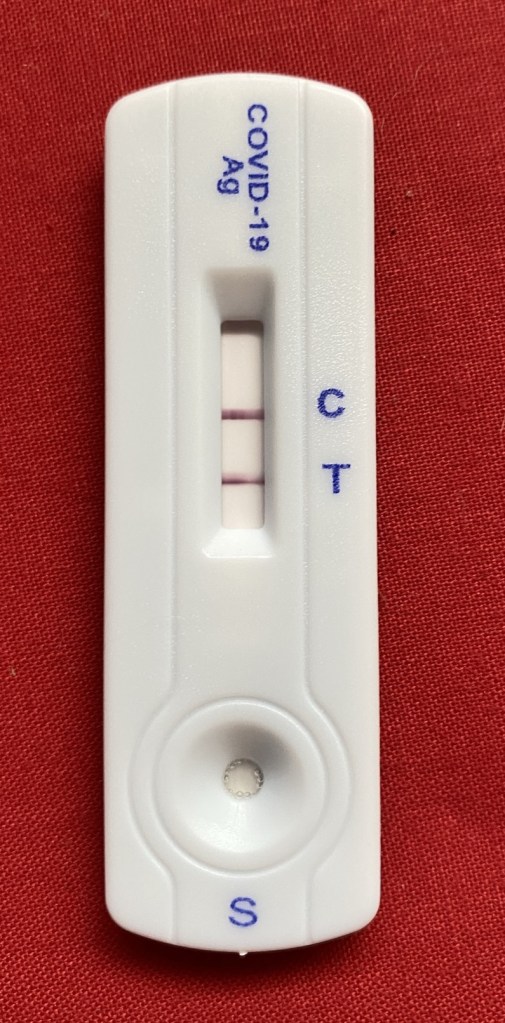
There was no messing about with the second test. An immediate strong T line. ‘Half the country has it,’ as everyone keeps telling me. Our Lithuanian friends have been hit with it too. My guess is we caught it in Dublin last week.
We’ve had it worse. Katie, who’s had it five times, has fared best. She’s usually the worst, but this time, she got over it quickly and was back to herself in only a few days. I definitely had it worse the year I had to miss Romería, and I had it way worse the Christmas we went to Tenerife.
This time I’ve had a sore throat and a cough. I’ve felt like the inside of my head is filled with cotton wool and all I want to do is lie around. It’s only Lily’s second time to get it and her symptoms this time are almost exactly matching mine. We felt better yesterday but worse today.
It’s a wonderful opportunity to lounge around in my dressing gown all day, read my book, binge watch The Office (US), be anti-social and not feel guilty about not getting exercise.
But I’m ready to go back out into the world now. I’m going to test again tomorrow afternoon. I’m hoping for but not expecting a negative result.
Well, I’ve caught something or other. Bad summer cold, Covid, who knows. So, I have my supplies lined up by the bed. Here’s hoping I sleep better tonight than last night.
Two of my cousins dropped in for a cup of tea last night. I’d seen Colette last week, but it was a my first time to see Michael since we arrived in Ireland. Our conversation followed the usual pattern – catching up on local news, who is dead or dying, who is having babies, buying houses, getting married, separating. We shared news of family members and talked about the state of upkeep of various family graves.
Soon, however, the conversation turned to Covid and it followed a pattern that I have increasingly noticed when I am in the company of people I haven’t seen for a long time. I’ve had a version of this conversation with friends in Spain, Portugal, the UK, and Ireland. And I had it again last night.
A year or two ago, I remember the conversation revolving around how we couldn’t really remember much of what had happened. ‘Were the kids really not allowed to leave the house for seven weeks?’ ‘Did the elderly really have to cocoon?’ That can’t be right. There seemed to be a collective amnesia, as we returned to normality (or a new normal, as Colette pointed out last night) and the key social elements of the pandemic were forgotten to us. It was as if we were asking each other, ‘Did it really happen?’
But, I have noticed an evolution in the way we talk about it now. Five years out from that first wave, and we are now telling the stories of what happened to us during that time. We recall the days, weeks and months of isolation, of the measures we took to keep ourselves and our families and friends safe. We have started to tell Covid to each other, affirming that these things happened to us. Last night, Mammy and Colette recalled the shopping that Colette and other family members did for Mammy, driving out to deliver it to her front gate. We all talked of the fear we felt, of our minor indiscretions (Mammy drove into town late one night to get money from the cash machine; I drove to our neighbouring village in Spain to pick up an order of ice cream), and of the more major indiscretions of others (the family caught by the police for turning their garage into an inpromptu bar; the couple who drove across the country to buy a boat).
Telling these stories over and over is a form of catharsis. Together once again, we can now laugh about the fear and the loneliness and the isolation. We can talk about the good memories of those times as well as the bad. Through our shared story-telling – telling the stories of Covid to others but, more importantly, aloud to ourselves – we are laying down the folklore of what happened in 2020. All over the world, wherever people meet, we are telling the story of Covid. Not the story of the disease and the illness and the vaccination, but the stories of how we, isolated but together, found mundane but remarkable ways to keep ourselves and our loved ones going.
I wonder in what directions our telling of Covid will evolve? What will I tell my grandchildren twenty or more years from now? Or what will Lily and Katie tell their grandchildren in turn?


 Me in place