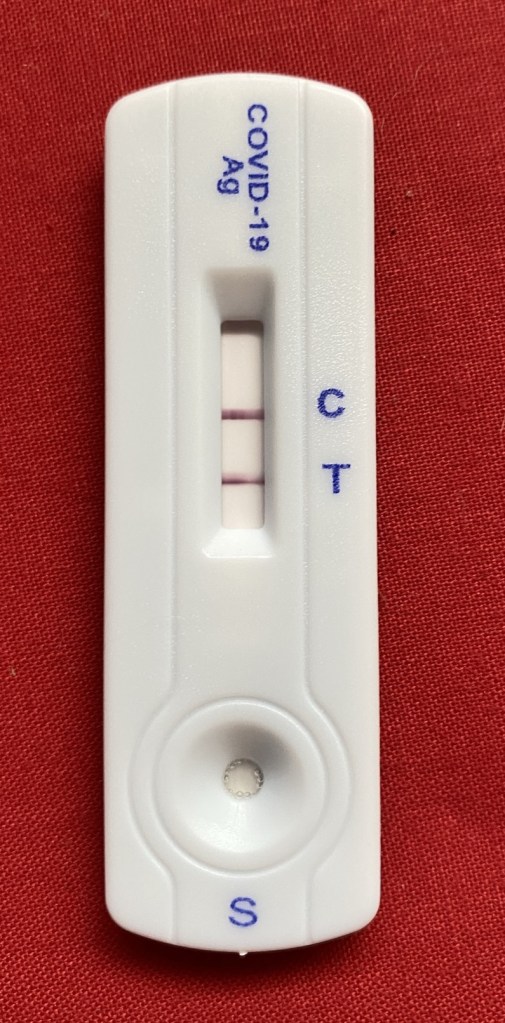
71. Positive

Yep. It was Covid alright. I tested negative late last week, but after a few more days of all three of us having identical symptoms, I decided to test again. If I had it, then we all had it.

There was no messing about with the second test. An immediate strong T line. ‘Half the country has it,’ as everyone keeps telling me. Our Lithuanian friends have been hit with it too. My guess is we caught it in Dublin last week.

We’ve had it worse. Katie, who’s had it five times, has fared best. She’s usually the worst, but this time, she got over it quickly and was back to herself in only a few days. I definitely had it worse the year I had to miss Romería, and I had it way worse the Christmas we went to Tenerife.

This time I’ve had a sore throat and a cough. I’ve felt like the inside of my head is filled with cotton wool and all I want to do is lie around. It’s only Lily’s second time to get it and her symptoms this time are almost exactly matching mine. We felt better yesterday but worse today.

It’s a wonderful opportunity to lounge around in my dressing gown all day, read my book, binge watch The Office (US), be anti-social and not feel guilty about not getting exercise.

But I’m ready to go back out into the world now. I’m going to test again tomorrow afternoon. I’m hoping for but not expecting a negative result.

52. Talking COVID

Two of my cousins dropped in for a cup of tea last night. I’d seen Colette last week, but it was a my first time to see Michael since we arrived in Ireland. Our conversation followed the usual pattern – catching up on local news, who is dead or dying, who is having babies, buying houses, getting married, separating. We shared news of family members and talked about the state of upkeep of various family graves.

Soon, however, the conversation turned to Covid and it followed a pattern that I have increasingly noticed when I am in the company of people I haven’t seen for a long time. I’ve had a version of this conversation with friends in Spain, Portugal, the UK, and Ireland. And I had it again last night.

A year or two ago, I remember the conversation revolving around how we couldn’t really remember much of what had happened. ‘Were the kids really not allowed to leave the house for seven weeks?’ ‘Did the elderly really have to cocoon?’ That can’t be right. There seemed to be a collective amnesia, as we returned to normality (or a new normal, as Colette pointed out last night) and the key social elements of the pandemic were forgotten to us. It was as if we were asking each other, ‘Did it really happen?’

But, I have noticed an evolution in the way we talk about it now. Five years out from that first wave, and we are now telling the stories of what happened to us during that time. We recall the days, weeks and months of isolation, of the measures we took to keep ourselves and our families and friends safe. We have started to tell Covid to each other, affirming that these things happened to us. Last night, Mammy and Colette recalled the shopping that Colette and other family members did for Mammy, driving out to deliver it to her front gate. We all talked of the fear we felt, of our minor indiscretions (Mammy drove into town late one night to get money from the cash machine; I drove to our neighbouring village in Spain to pick up an order of ice cream), and of the more major indiscretions of others (the family caught by the police for turning their garage into an inpromptu bar; the couple who drove across the country to buy a boat).

Telling these stories over and over is a form of catharsis. Together once again, we can now laugh about the fear and the loneliness and the isolation. We can talk about the good memories of those times as well as the bad. Through our shared story-telling – telling the stories of Covid to others but, more importantly, aloud to ourselves – we are laying down the folklore of what happened in 2020. All over the world, wherever people meet, we are telling the story of Covid. Not the story of the disease and the illness and the vaccination, but the stories of how we, isolated but together, found mundane but remarkable ways to keep ourselves and our loved ones going.

I wonder in what directions our telling of Covid will evolve? What will I tell my grandchildren twenty or more years from now? Or what will Lily and Katie tell their grandchildren in turn?

Photo by Fusion Medical Animation on Unsplash

Remember, you’re their parent, not their teacher

Over the next few days (and weeks? months?) I’m going to offer some tips and advice about home educating, working from home, and maintaining positive mental health. In future posts, I’ll focus on more specific topics – to stick to the curriculum or not, educating children of different ages and/or abilities, good communication, home educating older children, etc. Today, I’m going to start with some general thoughts about home education, so that you keep these in mind when you’re planning what to do with your children at home in the days and weeks ahead.

Many home educators resist using the term ‘home schooling’, and for a very good reason. Home is not school. We are not teachers – apart from those of you who are teachers, but even then, you’re generally not your own children’s teachers. Teachers are an incredible bunch of dedicated, hardworking people, who do an amazing job of caring for, educating and socializing our children. However, they are educated and trained to teach children in specific situations, namely, large groups of children, in classrooms, for a specific number of hours each day. They have been trained to follow or adapt a curriculum, and they have been trained to work as part of a larger team of people with a shared vision and commitment to the institution of school (in the general sense) and to their own school institution (in the specific sense). Home is a very different environment, and the dynamic and relationship we have with our children is very different to that between our children and their teachers.

Forget about trying to turn your home into a school. It’s not going to work and you’re going to end up with frustration, anxiety and tears from everyone (and, believe me, no-one wants to see Daddy crying over the conjugation of French verbs).

Instead, create an environment in your home where children are self-motivated to learn and grow:

  • Televisions, tablets and phones are the enemies of imagination and enthusiasm. Turn them all off – and that means you too, Mum and Dad. Set aside long periods of the day when no-one uses these devices. (In a future posts I’ll discuss how to effectively communicate this to children and how to maintain cyber silence while working from home)
  • Be patient. This is new territory for everyone. If your children have always been in formal education, then this is a big change for them too. Reassuring them and caring for their emotional needs is far more important right now than making sure they know their periodic table.
  • Limit the time you spend doing ‘sit-down’ classroom-style educating. My children’s teacher has set up a WhatsApp group and is now sending work for the children to do. In addition, on the last day of school, I asked my girls to bring home their geography, science and maths books, as those were the subjects I think need most work. However, rather than sitting at the kitchen table or wherever for hours on end, limit these sorts of activities to two 20-minute sessions a day. If there’s frustration after 10 minutes, don’t beat yourself up, or get mad at your child/children. Accept that it’s not going to be, and give it another shot later or tomorrow. And if, on the other hand, the 20 minutes turns into half an hour or an hour and the child is wildly enthusiastic – run with it. Because chances are, they won’t show that same enthusiasm tomorrow.
  • Accept slowness. Standing over your child and expecting him or her to complete a task in a set period of time is going to end in frustration. Be present for your child, to help and assist, but accept that it may take the child a long time to complete an activity. We’ve all got extra time on our hands right now, so what does it matter? This doesn’t mean that your child dawdles and draws out 5 minutes of maths homework over two hours. Gently encourage and assist your child, but accept that just because you can write a sentence of five words in five seconds, or can solve 6 x 3 in the blink of an eye, that your child can too. Work at their speed.
  • Accept that things probably won’t work out as you had planned. You know all those awful YouTube videos of people making crafts? You know all those nice cakes in children’s cook books? You know those photos your friends post on Facebook of the amazing things their children have made? Let’s get one thing clear. In 99.9% of cases, your activities with your children are not going to meet the vision you had for them before you started. And that’s perfectly ok. The education, the learning and the fun are to be found in the process, not in the finished product. If you imagine that by the end of a 20-minute history session, your child will know the names of all Henry VIII’s wives, accept that there’s a good chance they won’t. If you imagine that your child is going to build some spectacular castle out of cardboard boxes and toilet roll inserts, accept that it will probably be a spectacular mess and look nothing like the castle of your imagination.
  • Change your expectations. It doesn’t matter that your child knows the names of all of Henry VIII’s wives. What matters is that you sat down together (or stood at the kitchen sink together, or kicked around a football in the back yard together) and talked about Henry VIII and his six wives, and why he had six wives in the first place, and what became of some of them. It doesn’t matter that your imagined castle is a pile of cardboard and PVA glue rubble. What matters is that you and your child planned and made something together, or that you left your child to his or her own devices to plan and make something.
  • Finally, follow their lead. Listen to what they want to do. Find out what interests them. Use this time as an opportunity to learn about things they might not otherwise have time to learn about. Your child is curious about something? Dinosaurs? The First World War? How peanut butter is made? Do the research together and learn together. Many children are asking about the Corona virus right now. Well, there’s a biology lesson in virology right there. Forget about this particular virus, get out your actual or virtual dictionaries, reference books, resources of all kinds and find out what a virus is, how it works, what it does. Rather than being teacher and student, you are learning something new together.

I hope this provides some reassurance that you’re doing just fine. I’ll further unpack these ideas in future posts. Tomorrow I’m going to write about juggling working from home with home educating.

Home education? Check. Working from home? Check. Social isolation? Check.

It will be one week tomorrow since all schools in Spain closed. Schools in Ireland closed the day before and, as I write, schools in the UK are preparing to close tomorrow. I know we’re expected to say we’re bored and fed up and can’t wait for things to get back to normal. But actually, here in my house, we’re having quite a good time. (Am I allowed to say that?) It dawned on me that there are three reasons why we’re doing alright: 1. My daughters were home educated in the past; 2. We lived for six years in the confined space of a 36 foot yacht; and 3. I work from home.

I’ve thought long and hard about whether to blog about life in social isolation. Goodness knows, there is nothing but Corona virus news on every social media platform you turn to. Do I want to add to this relentless and overwhelming mass of information (and misinformation), and people sharing their personal stories?

However, over the past week, a number of friends and family members in far-flung corners of the planet have asked for my advice on home schooling. At the moment, like many others, I am home educating while working from home under conditions of social isolation.

Even though I no longer home educate my daughters (or do I?), I still give the subject a lot of thought. Apart from chocolate, sex and spaghetti bolognaise (not necessarily in that order, and not usually at the same time), education is the thing I think about most. I wrote an anthropology Masters on the subject, and a PhD on the passing on and sharing of environmental knowledge and skill between and across generations (i.e. informal education). This past Christmas, I wrapped Tim Ingold’s Anthropology and/as Education in Christmas wrapping paper and placed it under the tree for myself. That’s how much I love thinking about education. And, although I don’t have as much experience as many home educators who’ve seen their children through from babies until they left for university, I have been through the trials, tribulations and joys of home educating my girls, and what I learned from those years continues to inform how we learn together today, how we approach their school work, and how we think about learning and education in general.

I’ve also worked from home for the past number of years. I’m a freelance editor and writer, and my working life is spent at home, alone, in front of my laptop. Over the years, I’ve also learned by trial and error what works and doesn’t work for me, which practices improve my productivity (and which sound the death knell for productivity), and how to ensure a good work-life balance. What works for me may not work for others, but I have some thoughts and ideas that might be helpful, especially if you’re mixing work and education at home.

Finally, we lived on a boat for six years, so sharing a confined space with my family, while working and getting on with the daily tasks of life, is no news to me.

Therefore, starting from tomorrow, I’m going to write a series of short blog posts with tips about home educating, working from home, and caring for your own and your family’s mental and physical health at this challenging time. These will be based on my own experiences over the years, the experiences of others, and what’s working and not working for my family right now. Of course, what works for me may not work for you, but it might provide you with some food for thought.

If you want to get involved with questions, suggestions for posts, or feedback, then I’d love to hear from you.

I’ll start tomorrow with some basic thoughts and best practices for home education. Hope to see you then.