50. Geography

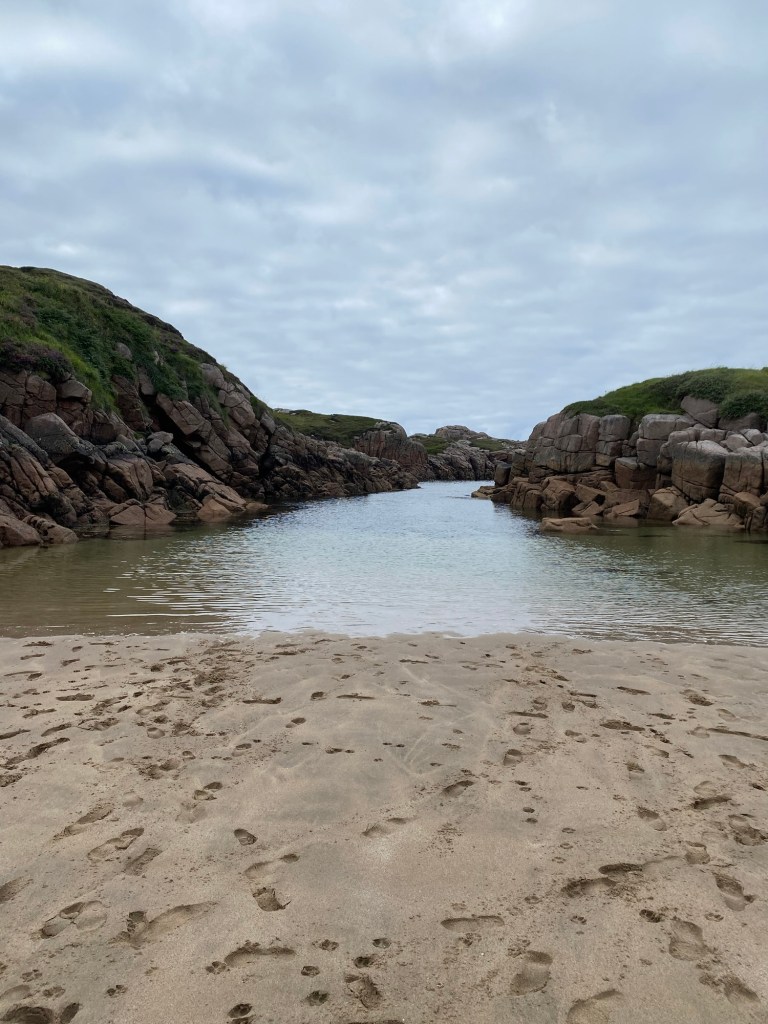
The deep history of Ireland is written in its landscape. In Donegal, the waves crash against the coast, turning cliff to cave, cave to arch, arch to stack, over aeons of time, crashing endlessly; cliff, cave, arch, stack, each a moment in its transformation into what it will become. Imagine speeding this erosive action up, so that these millions of years, tens of millions of years, hundreds of millions of years, can be seen to pass in a time frame that is comprehensible to creatures as short-lived as us.

Or maybe those aeons of time – the mere blip in the history of the universe that it took to transform cliff to cave to arch to stack – is too vast to comprehend. How about a shorter time frame? From Donegal, we drive inland, through the u-shaped valleys, the hanging valleys, the cirques, the scree, the ribbon lakes of the most recent ice age. Shorter time, easier to grasp. 20,000 years. 50,000 years. Time when our ancestors, not yet here, lived and loved and laughed and adapted to (or failed to adapt to) the changing climate. The landscape here is barren, in hues of grey and purple, still in its post-glacial youth.

Down through Monaghan, the road winds through what the glaciers left behind as they retreated in a warming world. Now, we are getting closer to our time. Only 10,000 or 9,000 years ago. The blink of an eye. The drumlins, those hills of glacial debris, all sloping together, like eggs in a basket, their blunt stross ends facing back northwest in the direction of the retreating ice, their more gently sloping lee ends looking southeast to a warmer world. The drumlins are bright green farmland now, criss-crossed with hedges, stone walls and fences. Cattle and sheep graze on the mineral rich grass. We have made them our home.

From the drumlins we drive across the eskers, the long collection of the Eiscir Riada, dried streams of glacial melt water that left behind the stone and sand and gravel that we drive along and extract and graze our animals on.

And now I am home. In the Bog of Allen. The raised bog, so similar and yet so different to the blanket bog I walked across in Donegal. This too is a remnant of the last ice age, the trapped melt water with no escape from the depression at the centre of the island. As the world warmed, trees grew and died and grew and died, over 10,000 years. Heaney wrote of the bog

Missing its last definition

By millions of years.

They’ll never dig coal here,

Only the waterlogged trunks

Of great firs, soft as pulp.

Our ancestors lived here, buried their dead here, punted their boats here. Archaeologists have found hoards of gold buried here and urns of butter still edible after 5000 years.

In the blink of an eye, we have ripped up the Bog of Allen. Heaney was wrong when he wrote ‘The wet centre is bottomless.’ In my lifetime, we have reached the bottom – digging, extracting, exhausting. And what did we find there? An earlier history told in seashells and calcified rock. From a time before. But to comprehend that, we must step back from this moment, to look across millions, tens of millions, hundreds of millions of years.

48. Weathering

We had already decided to stay an extra night, to hole up here, in a house on a granite cliff, on the far northwest coast of Ireland. Better than running the risk of driving across Donegal and down through the country in the middle of a storm. We’d drive to the shop, get in supplies for the extra day.

Mid-morning, Katie called from the bathroom, ‘Is someone using the water out there?’ The shower wouldn’t heat up. A minute later she appeared wrapped in a towel. ‘The shower’s stopped working.’ Our trip to the shop in Dungloe delayed, we spent the next half hour trying to work out the source of the problem. The safety switch on the electricity junction box kept tripping. By a process of elimination, we realised that certain plug sockets also weren’t working. Michael stood on a kitchen chair, flicking switches on the junction box. ‘Shit. There’s smoke coming out of it,’ he said suddenly. I unlocked the door into the terrace in case we needed a speedy exit. My sister has survived two house fires – one in Ireland, one in Spain – both due to junction box fires, so I knew what could happen next

We ran around, unplugging and turning off lights. The smoke didn’t develop into anything more. Time for a sit down and a chat and decide what to do. It was Sunday morning, a bank holiday weekend. So calling out an electrician would be expensive and possibly not resolve the problem in the short term. Better to leave that til Tuesday and a normal working day. The house belongs to Michael’s aged aunt, so we didn’t want to bother or worry her when, at this moment, nothing could be done. And, the storm was still on its way.

We decided to ride it out here, without electricity. The girls raided the house for candles, torches, matches, while Michael and I figured out how to set up the ancient gas barbecue in a sheltered corner out the back of the house. Our shopping plan changed, as we considered what we could eat in the absence of electricity. We charged our phones as best we could during the drive.

When we got back from the shops, we went for a long walk across the island, still no hint that a storm was on its way. Michael lit the wood burning stove in the house and fired up the barbecue out the back. Up at this latitude at this time of year, it isn’t fully dark til 10:30. We sat chatting by candlelight til close to midnight. Michael was last to bed, leaving only a single (and safe) candle burning in the bathroom.

The wind woke me up around 5am, the back of the house, where I’m sleeping, creaking in its path. I was up at 7am, no longer able to sleep, keen to see what the sea looked like. I’m sitting here now by the big window that takes up half of this little house. Waves smash huge and white against the islands in the farther distance. Closer in, the sea is choppy, with gusts of wind dancing across its surface. A group of cormorants sit on the sea just down from the house, being tossed this way and that. The occasional seagull soars on a current of air, feet splayed as it attempts to land on firm ground

I’m glad we stayed. The lack of electricity gives a Wuthering Heights feel to this storm. We’ll leave later today or, more likely, tomorrow, whenever the storm has passed. All I’m missing is my morning cup of tea. For now, I’m going to sit back and enjoy the stormy sea.

46. Lá Lughnasa

We drive west from Derry and across Donegal. Katie comments that it’s the first time since leaving the midlands that the land has changed. She’s right. The spare glaciated landscape of Donegal is in stark contrast to the raised bogs and green fields that fill the middle of the country.

It’s the 1st of August, Lá Lughnasa, the old Irish harvest festival. Suitably, it’s also the start of the FrielDays Festival, a celebration of Ireland’s great playwright, Brian Friel. As I drive through the landscape that inspired so many of Friel’s plays, I have ply Michael with questions.

Years ago, I read some of Friel’s plays and went to an Abbey Theatre production of Dancing at Lughnasa. We talk mostly about Translations, the great play about place and the meaning of place and the colonial endeavour to translate our Irish place names into meaningless English names (for instance, how my town Eadán Doire – the brow of the oak tree – was transliterated into the meaningless Edenderry, or my parish Clough na Rinca – the dancing stones – was transliterated into Cloherinkoe). The same colonial endeavour that occurred all over the world.

Michael reminds me of the story and the characters in Translations, places the play within the context of the land we’re driving through and explains certain criticisms of Friel’s historical inaccuracies.

But more, Michael regales me with stories of Friel himself, of various family members, pointing out houses they lived in, houses that inspired characters in the plays, of his own encounters with Friel over the years.

Brian Friel’s plays are brought to life for me as I drive through this place. I want to read Translations now and think I must find a copy when I return to Edenderry.

We arrive at the house out on the island. ‘I keep Friel here, of course,’ Michael says, ‘and Heaney.’ An early collected works of Friel and one of Heaney too. He leaves the Friel on the table for me.

So, here I am now, reading Translations in a place that hums with Friel, where the shape of the people and the shape of the land run through each play. Where better to rediscover these plays?

45. Cruit

A couple of action packed days and late nights have come between me and writing. I wouldn’t swap these days for anything. I’m in Cruit tonight, back again after three years. This evening’s walk across this island off northwest Donegal was, as always, a delight…

Mt Errigal in the distance