My Christmas Chronicles – Bag man

Each year, on the first (or sometimes the second) Saturday in December, my family would go to Dublin to do our Christmas shopping. It was a huge day out and we would be up and on the road early, like half of the rest of the population of rural Ireland. The traffic was usually heavy, the weather generally bad, and there was always the anxiety that there might not be any parking spaces left for our red Ford Escort in the Penney’s car park (there was always space). We stuck to Henry St. and Mary St., and the futuristic Ilac Centre, when it opened, traipsing from one crowded shop to the next, seeking out new outfits that we would wear on Christmas Day, and new winter coats for my sister and me, if we hadn’t already got them in one of the drapery shops in Edenderry. We each had lists of Christmas presents we wanted to buy – presents for each other, for our friends and other family members. We’d take a break for tea (Daddy), coffee (Mammy) and cake, and Knickerbocker glories (Antoinette and me) at the Soda Fountain in the Ilac Centre (was there ever a place more fabulous?) and a middle of the day dinner in the cafeteria of one of the department stores.

When I say ‘we’ shopped for this and ‘we’ looked for that, what I really mean, of course, is that Mammy, Antoinette and I did. Daddy’s role in all of this was to facilitate our shopping, first as driver and, once the car was parked, as bag carrier. At first, he’d come into the shops with us, look around, offer his advice on an outfit if we asked. But, as the day wore on, and the number of bags he was lugging in each hand grew, it became more cumbersome for him to come into the shops. With all those bags around his thighs and knees, he simply was too bulky to get around the narrow aisles in between rails of clothes. So, he’d stand outside the front door of the shop, a little to the side, so he wasn’t in anyone’s way, in the December cold, weighed down by all those bags, patiently waiting while the three of us tried on clothes and bought presents and browsed through books or records in overheated shops. At some point, he’d make a trip back to the car to dump all the bags and then return to us to start the process again.

He wasn’t alone. Outside every shop on Henry St. were two or three men like Daddy, all in the same boat, all patiently waiting, bag carriers, while their womenfolk were inside enjoying themselves.

That’s one of my abiding memories of the build-up to Christmas. I don’t remember what we tried on, or what we bought, or what we filled those bags with. That was all just stuff. But I do remember Daddy, patiently and good-naturedly standing in the cold, making sure that we were having a good time. Like always, putting ‘the wimmin’, as he called us, first.

53. Blame Colette

I woke up nineteen hours ago, knowing exactly what I was going to write in today’s blog. It just came to me, fully formed. But then I got up, and worked for the day, and went for a walk along the canal with Mammy and Lily and Mammy’s dogs. And then it was time for rosary in the graveyard – the annual gathering of families at the grave’s of our loved ones. Six of my cousins, Mammy, Lily and me stood around our family grave. Our second and third cousins stood at the neighbouring graves, other neighbours at more distant graves. Fr. Maher led us through a decade of the rosary and blessed the graves with holy water. I got a bit giggly with my cousins. The rosary always brings out the giggles in me, taking me back to nights at home here, kneeling on the sitting room floor, my Nana leading the rosary and my sister and me shaking with stifled laughter over some silliness.

When the priest had finished, I went to say hello to the second and third cousins. Seamus is 92 now, Niamh has just had a baby, Michael is about to become a grandfather for the first time. And then it was back to my own gang and down to our house for tea, sandwiches, cake and biscuits.

I don’t really blame Colette for me not writing the blog I was planning to write today. But she is the ring leader of the chat and the stories and the gossip, and if you thought we’d done all the chatting that needed to be done two nights ago, then you’d be very wrong. We’re a noisy bunch when we get together – talking and laughing, sharing stories, reminiscing, enjoying each other’s company. And then it was close to midnight and time for the cousins to leave. Colette couldn’t find the key to her house, so we thought she was going to end up staying the night, likely sharing the bed with me. She found the key in the end – so we missed that opportunity to relive Christmas nights and holidays of old.

In four weeks’ time we’ll all be back here in the living room again, for more tea and sandwiches and cake and chat and laughter. I can’t wait. I’m going to write today’s blog early tomorrow.

9. All the time in the world

I’ve been spending a lot more time with Angela in these last few weeks, since she was given her terminal prognosis. My weekly visits for morning coffee have evolved now into twice or three times a day visits. I know our time is short. I will leave to go to the UK soon and she will simply go. I call in at 11 each morning and again at 1:30 and maybe again at 3pm. Sometimes she’s asleep and I simply check on her and leave again. More often than not, however, she wakes when I come in, I help her to sit up, go to the kitchen to pour her a cold drink and make myself a coffee, and sit with her and chat.

Despite being noticeably more frail with each passing day, her memories are as sharp as ever. She quotes Tennyson and Shakespeare. She recalls a book on Pembrokeshire written by someone called Loxley that she borrowed from the library 61 years ago. She tells me about her first ever time on an aeroplane when she accompanied a patient from London to Trinidad and got drunk on gin and coconut water when she got there. She tells me about being a trainee nurse in London in the late 1950s and writing letters home to her parents in Leicester every day. Despite our weekly get-togethers over the past number of years, I learn more about her every day.

But I’m also in a rush. I’m leaving home soon and I won’t be back for ten weeks, so there are preparations to be made, the fridge to clear out, everything organized for the dog to go spend the summer with friends. I will be working all summer while I’m away, so I need to remember to transfer all my work from my computer onto my laptop. On top of that, I have an unusually large amount of work on my plate with various deadlines looming, so I’m trying to keep four different editing and writing plates spinning at once. Five days before I leave, a neighbour dies and the next day another. That’s two funerals now that I want to attend. On the day the first neighbour dies, another friend is rushed to hospital. Her husband is at a loss and asks me for some help. I wake up the next morning to discover that one of my kayaks has been stolen. I discover the next day that it’s been abandoned over the river, so now I have to go retrieve it. To say things are frantic and chaotic in these final few days is an understatement.

Yet, in the midst of it all, I continue to call to Angela two or three times a day. On Monday, she’s feeling weaker than ever and her every movement is slow and laboured and requiring lots of breaks. When she’s finally sitting up, with a glass of drinking yoghurt in her hand, she smiles at me and says, ‘It’s alright. We have all the time in the world.’ And you know, she’s right.

For all the mad rushing around, the lack of sleep, the ‘not-another-thing-piled-on-top-of-everything-else’ sort of week, here in her bedroom, time is meaningless. It’s just her and me, sharing our stories as always, making each other laugh, making each other think.

On my last day, as I finish up my work, finish packing, finish prepping the house to close it up, and count down the hours till my 7 o’clock departure, I decide to embrace Angela‘s insight that we have all the time in the world. When I visit her mid morning, she’s asleep. I don’t wake her but neither do I go home. Instead, I make a coffee and sit with her for half an hour, feeling time slowing down and my shoulders beginning to relax. When I return a couple of hours later, she’s awake. I help her up so that she’s sitting on the edge of the bed and we talk and talk and talk. For that hour, in that room, we have all the time in the world.

Productive procrastination and the tug of memory

The editing assignment I’m working on at the moment is one of the most interesting, and biggest, I’ve had in the three years I’ve worked as an academic editor. Each new editing assignment, written by academics in China, Japan, Indonesia and elsewhere, is a new and fascinating learning experience for me. But the one I’m currently working on is particularly enjoyable because it is closest to my own research interests and the suggestions I have made to the authors come from my own specific background as an environmental anthropologist, rather than from my usually broader background as a social scientist at the interstices of culture and nature. This week’s assignment is about intangible cultural heritage, about the conservation and transmission of knowledge, skill and memory.

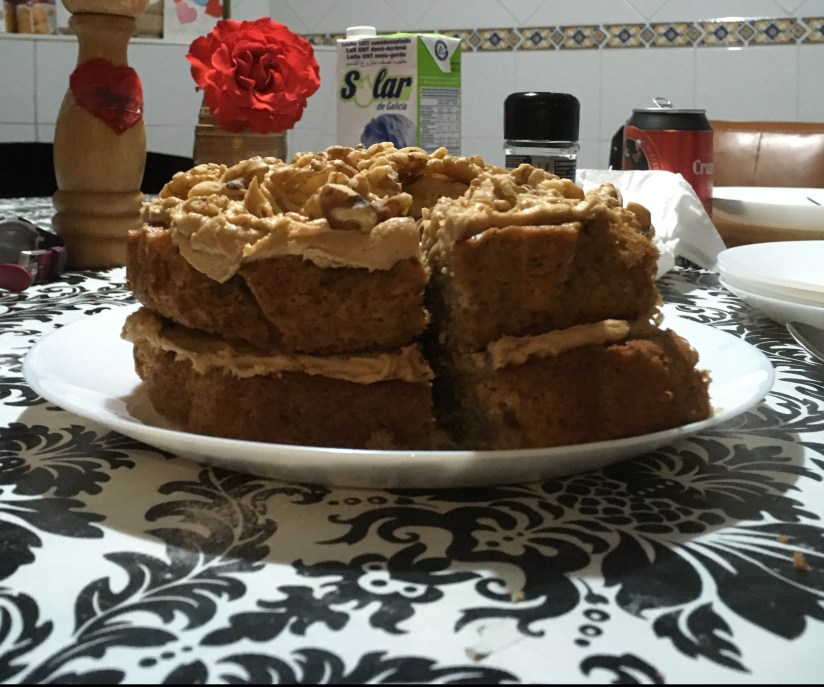
However, despite my enjoyment of this current assignment, I find myself procrastinating. Having done the washing up after lunch today I knew I should return to my office and sit down for an afternoon of editing. Instead, I decided on the spur of the moment to make a coffee cake. I’ve never made a coffee cake before, but I have a hand-written recipe in the little recipe book I’ve been adding to and baking from for years.
img_13721.jpg

My ‘not as good as Cissie’s’ coffee cake

I’ve been craving coffee cake for weeks, probably since the end of March and what would have been my father’s 78th birthday. You see, for me, coffee cake is intimately and indelibly tied up with memories of my father and my aunt Cissie, Daddy’s oldest sister. Coffee cake does not exist in my memory and my imagination independent of those two very important people in my life.

Until I was five years old, I was the only child in a small house in rural Ireland that was home to my mother and father, my paternal grandmother, and my paternal aunt, Cissie. My uncle Tom was there most days too and each weekend, my cousins Sean, Declan and Colette and my aunt Lillie were there too. I grew up in a house filled with love and jokes and an obsession with Gaelic football. I never once questioned my place in that wonderful setting. I was grounded and protected and loved. When I was five years old, my baby sister was added to the mix, and when I was six, my beloved aunt Cissie died of breast cancer.

tyrrell 112

Cissie and me on the lawn in Ballygibbon, summer 1974.

Cissie was 18 or 19 years older than my father, who was the baby in a family of eight children that spanned a 22-year range. They all grew up in that house, as had my grandfather before them, who had died on my father’s first birthday. Cissie was the third oldest in the family, and the oldest girl. In what would be the final years of her life (although none of us could ever have imagined that someone so full of life could die so young), and her most important years from my young perspective, she worked as a housekeeper for a country doctor. Dr. Hill was herself an amazing woman, family doctor to all of us and a woman who had gone to medical school in Ireland in what must have been the 1930s. She and her husband, Ger, who was confined to a wheelchair, lived in a big bright orange farmhouse up a long avenue, a couple of miles from my house. Cissie worked in the kitchen, cooked the meals, baked, helped with Ger and slept in the house a couple of nights a week. I have very strong memories of sleeping in Cissie’s bed in her room at Dr. Hill’s house once and feeling simultaneously thrilled and terrified by the vastness of the house.

Back home in our little two-bedroom, five-person house, I shared a bed with Cissie and we, in turn, shared a room with my grandmother. When I go home to Ballygibbon now I can’t imagine how or where we fit two large old beds, a wardrobe and a chest of drawers in that room. But, somehow, we did (maybe the confined space prepared me for life on a boat).

Cissie’s baking was legendary. She baked all the time and everything was delicious. Cakes, tarts, desserts, she made them all. My father, despite hating coffee, loved his big sister’s coffee cake. And, despite being in his mid-30s in the mid-1970s, when I was a little girl, he was still Cissie’s adored baby brother, Cinn-bán Paddy, blond-headed Paddy, and she indulged and cultivated his sweet tooth at every opportunity.

It would be incorrect to say Daddy loved coffee cake. He loved Cissie’s coffee cake. After she died, in 1979, at a time when I was too young to appreciate the grief of those around me, he rarely ate coffee cake again. On those rare occasions when he conceded to try a slice of coffee cake, his response was always the same, ‘It’s not as good as Cissie’s’. Coffee cake never being as good as Cissie’s became, and still is, a running family joke.

tyrrell 113

With my parents and sister at Dublin Zoo on the day of my First Communion, May 1980, less than a year after Cissie’s death.

My father died fourteen and a half years ago. Although my grief is triggered in often odd and unexpected ways, twice a year, on the anniversaries of his birth (March) and his death (September) I am usually guaranteed to feel his absence particularly acutely. This year I was less sad than usual, but was overcome by an almost madness-inducing craving not only to eat coffee cake, but to bake coffee cake. For weeks the stars have failed to align – not enough eggs in the house one day, not enough of the right type of flour the next, the gas bottle too close to empty to chance baking in the oven. But the craving to make and eat coffee cake never went away.

This morning, I took a mid-morning break from editing, as I had promised Katie I would play padel with her. Padel is a game that’s very similar to tennis, but played on a court that’s some way similar to both a squash and a real tennis court. Katie seems to be a natural at most sports and as we hit the ball back and forth across the padel net, I told her (not for the first time) how much Grandad Pat would have adored her and about all the sports they could have played together. Talking like that set me off and I had to take a little break from padel while my eight-year old daughter comforted me.

IMG_1375[1]

Katie approved!

So, with my head full of ideas of intangible cultural heritage, of memory and skill and the transmission of knowledge, and with my heart full of my long-lost loved ones, my procrastination was inevitable, as I took my recipe book from its shelf. So, I’ve made a coffee cake for the first time for my blond-haired girls, and the cycle of intangible culture, love and belonging goes on.

Would Daddy like the coffee cake I’ve made? Although he would never say so, for fear of hurting my feelings, I’m sure inside he’d be thinking, ‘It’s not as good as Cissie’s’. And I would have to agree!


P.S. Apologies to my mother, sister and any other family members who I have made cry by bringing back these happy memories. We’re a sappy bunch.