I got there at last. Hilary Mantel’s A Place of Greater Safety has been sitting on my book case for the past couple of years. I just never got around to reading it. Her Thomas Cromwell trilogy are among my favourite books, and I was keen to read something else she had written. So, when I found this 874-page 1992 fictionalised account of the events of the French Revolution at a book swap two years ago, I knew this was going to be it.
I decided it would be my 2025 summer book. I just didn’t think it would take me quite this long. I started it in Faro airport on 26 June and I finished it a few minutes ago. I was determined not to have to pack it for our return flight.
I interrupted reading it twice – to read a shorter novel and to read a play – and I’ve had less time to read this summer than I thought I’d have. Still, I’ve read it whenever I could and, like the Thomas Cromwell trilogy, I came to care for the characters, to think about them when I wasn’t reading, and to worry about what would become of them.
The French Revolution is not an era of history that I know a great deal about, so I was a bit lost at times in the intrigue and politics, and had to Google certain events to fill in my rather large gaps in knowledge. But that lack of knowledge didn’t take from my feelings for the characters and what fates awaited them.
In the time it’s taken me to read one book, Katie has read seven and Lily five, so I’m going to be lagging even farther behind in our 2025 reading ladder, when we fill it in once we get back to Sanlúcar.
As for my next reading adventure? A draft of my sister’s latest novel, that I’ve promised to read and give my thoughts on as soon as possible. I’ll begin tomorrow.
The library has become noticeably busier this week, now that schools in England have finally closed for the summer. The girls and I have been feeling very sorry for all these English kids who are still at school six weeks after Spanish summer holidays started. (Irish holidays aren’t much shorter than Spanish holidays. How I relished those long holidays as a child).
With so much going on in the library, I’ve had to move to a different table, this time near the front. I sit at one of two round tables; the other is reserved for signing children up for the Summer Reading Challenge.
All morning, mothers arrive with their kids, mostly in the 5 to 7 age range. There are laid back chilled out mums, frazzled harried mums, mums who’ve been bringing their kids to the library since they were born, mums who’ve only stepped into this library for the first time today.
The young member of staff assigned to the task of signing kids up is great. She focuses on the kids, asks their name and how to spell it, asks if they know their birthday. She finds a point of interest in almost every kid – catches something they say or some object they have – and lets them know she’s their ally. For one kid, it’s Pokémon – asks the kid which is their favourite and then says she likes that one too. For another kid, it’s their favourite colour (green), for another, a book they like. Did I already mention how great libraries and librarians are?
All of this takes me back more than a decade, when we still lived in England and the girls signed up for the Summer Reading Challenge, two years running, if I’m not mistaken. They had to set a goal for how many books they’d read (one six year old this morning said he was going to read six hundred billion million). I can’t remember what the goal was now – five maybe? Or maybe that’s too low. I can’t remember.
Anyway, the point is, Lily was the reader. She’d picked up reading early, read her first Harry Potter book at five. (Looking back now, even I can’t believe that’s true, but it is). So the ‘challenge’ part of the Summer Reading Challenge didn’t really exist for her. But for Katie, it really was a challenge – for her and for me. I despaired of her ever reading. She refused. She wailed. She simply would not read. By the time she was nine, I was resigned to the fact that she was never going to read. I don’t mean she was illiterate, but she was so halting and uncomfortable with reading that I had decided that maybe it just wasn’t for her.
She turned 10, then 11, then 12. Two summers ago, just before she turned 13, she discovered the joy of reading. It started with a graphic novel and then reading a novel by the same author. Once she got going, there was as no stopping her. She now puts Lily and me in the ha’penny place. This year so far, she’s read more than 20 novels. The first place she wanted to go to when we arrived in the UK was a bookshop. Here are her books just for the few weeks we’re here:
The summer reading challenge now? Figuring out how we’ll stay under our luggage limit, thanks to all of Katie’s books!
I’ve been working hard lately. After a rather worrying nine-month work drought, during which my editing and ghostwriting work dropped to half of what I would normally expect, the last three months have been among the best I’ve had since I started freelancing ten years ago. But, over the nine months of the drought, I watched my bank balance dip to a worrying low. I tightened my belt, carefully budgeted for groceries, dropped a number of subscriptions, cut out weekends away and meals out. But those were only mini bites into my outgoings. The big stuff – the mortgage, my monthly self-employed social security payments, and other such things – well there was no budgeting for them.
I wasn’t alone. Creative industries (and, as an editor and writer, I am in that category) have been hit hard by AI. When we thought things couldn’t get worse, Ebron Skunk’s DOGE slashed funding to US government research that accounts for about 40% of my editing work. Was I worried? Hell yes. Very.
At first, I put the slow-down down to it being summer. August is generally a slow month. But when things didn’t pick up in September, October and onwards, I was well and truly sweating. Work was still trickling in, I was still just about keeping my head above water, but at the start of each month I worried that maybe this month would be the month that I wouldn’t be able to pay my mortgage.
I worked just as hard as ever, saying yes to every editing job that came my way, when before I would have been more picky. I had to dismiss my long-held promise to myself and to the kids that I wouldn’t work on weekends or on school holidays (summer excepted…it’s just too damn long). But I had a whole lot of time on my hands when I wasn’t editing or writing for other people, so I used that time to make contact with potential new clients, to make myself more visible on LinkedIn, to update my website and my online profiles. I had numerous Zoom meetings and phone calls with prospective clients that came to dead ends.
But, in spring, a glimmer of light started to appear down that dark tunnel of money worries. I landed a couple of lovely medium and longer term clients and the one-off editing jobs that are my bread and butter have started to creep up again. I diversified my US work and now have a large ongoing project in addition to almost back to normal flow of one-off jobs. Part of this upturn is down to the work I’ve put in to find work. But I also wonder if clients are starting to realise that what we do as professional editors and writers is far more than what AI is capable of, i.e., human understanding, nuance, humour, and so on.
Since April, every month has been a good month. Fingers crossed, it will continue this way. However, that doesn’t mean I’m out of the woods. I’ve got that bank balance to claw back so that next time a slump comes I’m prepared for it. I’m still not in a position to be picky, so I’m still working most weekends and on holidays. I’m hoping I’ll get to a point soon when I can ease off on that again. I’m 52. I don’t have the energy for this.
Which brings me to Gaia. I’ve been working long hours this past week. I had three deadlines for yesterday. Two of those were really complicated and took far longer to complete than anticipated. When I finally turned my computer off at 9:30 last night I was well and truly ready for a break. But I’m someone who can’t sit still for long. I knew that, if the weather was nice, I’d feel the need to go for a long walk today, to fill up my day with action.
When I woke up this morning it was lashing rain. And it has continued to rain for most of today. No going out. No being active. Gaia insisting that I have the break I well and truly need. I started the morning with 40 minutes of gentle yoga, took the dog for a short walk in the rain, got back into my pajamas when I returned home, and here I remain. I have spent the day curled up in an armchair, drinking mugs of tea and reading the book I’ve been dying to read since the day we got here.
Back to work on Monday but, for now, I am relaxed and at ease and, as I look out the window, I see that it has started to rain again. Thank you Mother Earth.
“I’m off to the library,” I say to my father-in-law on our first day here in the UK. “The library?” he asks, looking at me like I have two heads. “There are no libraries any more,” he says. “Yes, there are,” I say. “I’m going to Warwick County library, in Shire Hall.” He used to work at Shire Hall and it’s one of his favourite topics of conversation. But he’s convinced there is no library there, that all the libraries in the country have closed down due to lack of interest, lack of funding and, his pet hate, technology. I try to convince him that the library is still there. I know because of…erm…technology. I’ve already done my research online and I know its daily opening hours (extensive) and I even know where I plan to sit when I go there every day to work. He remains perplexed and unbelieving. “Who uses libraries these days?” he asks.
I go to the library that afternoon and have been coming here for a few hours every morning since on those days when we are in Leamington Spa. Who uses the library, indeed? There are old people and young people, babies in strollers and grannies on mobility scooters. There are young frazzled parents and teenagers straight from school still in their uniforms. There are able-bodied people and disabled people. There are school groups and people in residential care. There are people here for parent and child story time and rhyme time and teenagers here for book club. There are people browsing the shelves and people consulting the librarians for help finding specific books. There are people in to renew their library card or to get one for the first time. There are people seeking assistance on matters that have nothing to do with books. And there are people like me, who have come in to use the space to work. A young women is at the table behind me a couple of days a week, writing away on her laptop. One day, a man about my age arrives in, in a business suit and dragging a suitcase behind him. He sits for a couple of hours and works on his laptop as he waits for his train or plane or whatever mode of transport he needs to get to where he’s going.
The library is small. But it’s bright and colourful. There are bright and inviting displays about gardening and, for the children, there’s a summer treasure hunt of herbs, that they have to guess from their scent. There are special displays – of gardening books, LGBTQ+ books, Black history books, summer reading recommendations. The librarians are, to a person, kind and smiling and give the appearance of people who love their jobs. This is not some stern library where people are forced to be silent. Those days, I hope, are long gone for public libraries. I hear the librarians quietly chatting amongst themselves and being friendly to everyone who comes in the door.
I choose to sit at the work/study space towards the back, next to the children’s library, with its snug spaces for kids to get lost in books. Nearer to the front, and I would be distracted by the conversations taking place at the front desk. But here, I am generally not distracted by the sounds of children, or of their mothers reading books to them (except when a mum reads a book that I read to my girls; then, I get a little nostalgic). I was distracted yesterday, however, when the soft-voiced man leading story time read a book to a group of toddlers and their parents about a trip to the zoo. One toddler, clearly not enjoying herself, spent the entire story saying “It’s so boring, it’s so boring.” That made me chuckle.
So, despite lack of funding and the digital world we live in, this small library is bursting at the seams with liveliness and activity. So, here’s to libraries everywhere, and to the librarians who take care of them and to the people who use them and to the taxpayers who fund them and to the civil servants and politicians who budget to keep them open. I wish I could convince my father-in-law to come here and see for himself, but alas, he’s a non-believer.
I’ve been writing memoir in one form or another for years. Essays published in newspapers, magazines and online, regular blog posts when we lived on the boat, and these more recent offerings. I’ve been working on longer form memoir for some time too – two unfinished memoirs that have now been smashed together into something very different and that I have been working on now for about a year. And then there is my experiment with a fictional screenplay for a six-part dark comedy, every element of which is stuff that happened to me or to people I know, just not in that order, or in that context, or to those people. Unlike my novelist sister, I lack the imagination to make things up, so everything I write is my direct experience. I’ve taken memoir writing courses and I am a member of a memoir-writing group that meets online a couple of times a month.
Despite writing memoir myself, I have never been much interested in reading it, much preferring fiction and certain forms of non-fiction (science writing and nature writing, in particular). In my mind, a good memoir should read like good fiction. I have read the work of some great memoirists, however – Maya Angelou, Joan Didion, Helen MacDonald, Frank McCourt, Cheryl Strayed, Suleika Jaouad, Barak Obama. One of the best I’ve read in the past few years was Raynor Winn’s The Salt Path. It was phenomenally written – lyrical and immersive, rocking along with the pace and timing of a great novel. I loved it so much that the day after I finished it, I popped it into an envelope and posted it to my old walking buddy Martha Main (Hello, Martha!), in Arviat, Nunavut. I was then delighted to find out a few weeks ago that it had been made into a film, staring Gillian Anderson and Jason Isaacs (Hello to Jason Isaacs) and, as luck would have it, it’s on in the cinema in Leamington Spa this Thursday morning and I plan to go.
So, imagine my surprise when, yesterday evening when I was watching the BBC news with my father-in-law, it was reported that a story in The Observer claimed that the author had lied about key facts in the book, and some of those lies were related to alleged criminality. I read The Observer article and then Mammy, my sister and I had a long chat about it this morning. My sister has also read the book and we had both recommended it to various people (she to her book club). We both had the same feeling of discomfort and feeling like the rug had been pulled from under our feet. It was hard to describe the feeling.
These allegations don’t in any way take from the amazing writing achievement of The Salt Path. It remains lyrical and immersive, tender and heartbreaking. But certain key elements of the story now may not be true. And that leaves a sour taste in the mouth. I’m now not sure that want to see the film.
This raises a bigger question about the role and the duty of the memoir writer. One of my favourite essayists is David Sedaris who, admittedly, I have listened to reading his essays far more than I have read his work. His writing is hilarious and heartbreaking, so that I find myself roaring laughing in one moment and roaring crying the next. But he faced a backlash about two decades ago concerning, not the writing itself, but rather its marketing as non-fiction, and the argument that it was insufficiently factual to be marketed as such. Sedaris clearly manipulates and exaggerates the things that have happened in his life for comic effect. But isn’t that what makes him a great writer – taking the ordinary, the mundane, and seeing in it something fantastical and outrageous? And boy, is it effective!
So, I don’t have a problem with how Sedaris writes because I know he’s exaggerating the truth. But that feels very different to what Raynor Winn is accused of doing. She is accused of criminal activity and of misrepresenting her husband’s illness. She presents her version of events as fact. Maybe they are. Maybe they’re not. But The Observer article is convincing enough that it has left a sour taste in my mouth. And it makes me think very carefully about the way I write my memories and the difference between a memory being true to me and a memory being true.
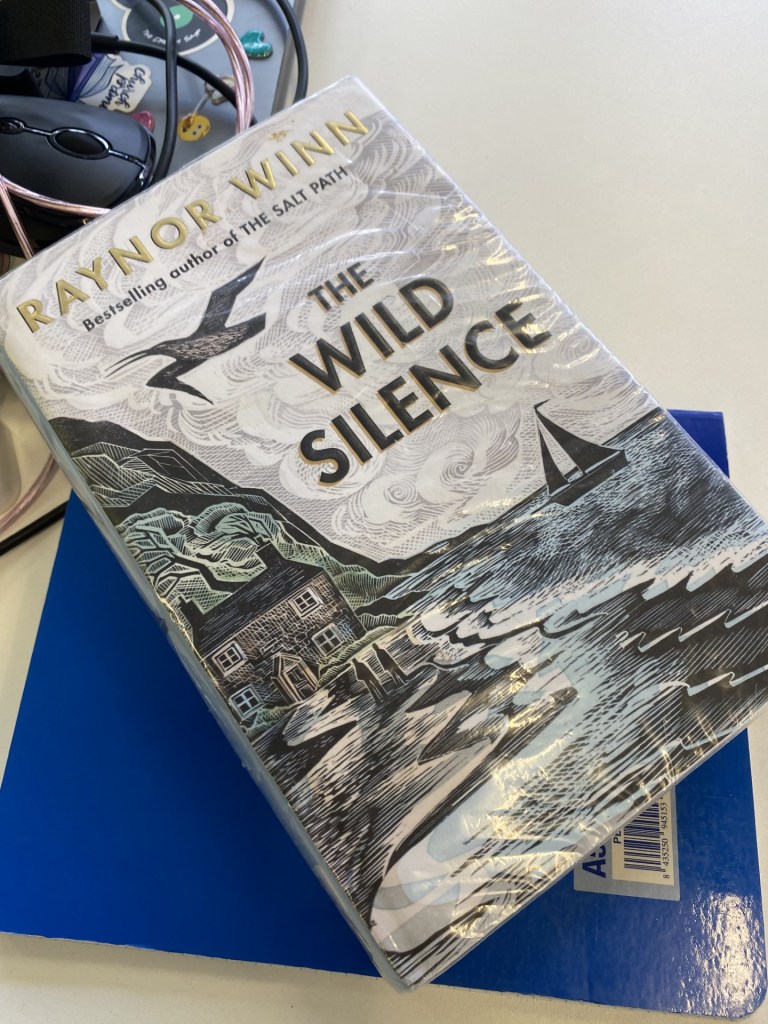
Not The Salt Path. When I inquired after the book at the library, I was told it had been borrowed this morning. Here’s a sequel.




 Me in place