‘Turn on Radio 1,’ Niamh said, as we got into our cars to drive in convoy across Kildare. ‘Sunday Miscellany is all about the bog this morning.’
I led the way along the bog road, through Allenwood and Prosperous, past the road down to Coill Dubh, through a landscape I have known all my life, a landscape so densely entwined with memory and meaning.
It’s impossible to come from the midlands of Ireland and not have the boglands seeping through your veins. This great flat landscape, the fuel source around which our year and our society revolved. The footing and the haping, and tea from a milk bottle and sandwiches wrapped in waxed paper. Cold March Saturdays of the men cleaning the turf bank all the way through to warm August Saturdays of bringing the turf home.
And it’s the poetry and the music – Heaney and Christy Moore and Luka Bloom. It’s the dissertation I wrote as an undergrad and the bog PhD I started in my 20s.
As I drove across the bog, I listened to the radio programme, as Niamh suggested. It was filled with the stories, songs, reminiscences of people from the midlands. Some people, like me, who have chosen to live abroad and have never found a way to adequately describe and explain all that the bog is to people who don’t know it. And some people who had lived in the bog their whole lives, who evocatively expressed what the bog meant to them.
To listen to this as I drove across the bog this morning was moving enough. But today also happens to be the 21st anniversary of the day that Daddy died. And for me, above all else, my memories of the bog, and what the bog means to me, are inseparable from my memories of Daddy.
It was, therefore, a bittersweet drive, with the stories and the road and this particular day, all evoking memory and emotion, and tears running down my cheeks, not of sadness, but of gratitude for this place and all that it means to me.
About this time six years ago, I started to drop in to visit my friend Angela regularly. She was 82 years old at the time. What started as a one-off visit for a gin and tonic one Sunday evening, turned into a weekly affair. I’d pop around at 6 o’clock each Sunday evening (or later during the summer), the gin and tonic on the worktop ready for me to pour. I’d make us a glass each and then we’d sit and chat for the next couple of hours, with Miranda the cat sleeping by the gas fire, Mora the dachshund trying to sneak onto my lap, and Archie the African grey parrot adding his own opinions to the conversation. Our conversations were far-ranging. We talked a lot about the books we were reading, the movies we had watched, with each of us often taking up the others’ recommendations. She frequently quoted poetry to me – long-remembered lines that popped into her conversation, appropriate to whatever we were discussing. We talked politics – from our little village all the way up to the international level. She talked about her childhood during the war, her years in London as a trainee nurse, and then her married life raising her three children in Wales. Being a retired nurse, no topic of conversation was too delicate or too squeamish for our Sunday evenings. With deteriorating eyesight and hearing, she preferred these one-on-one get togethers with friends in the quiet of her own home.
When COVID came the following spring, our Sunday night visits continued via WhatsApp video. We’d each pour a glass of red wine or a gin and tonic in our respective homes, only a few hundred metres away from each other and carry on our conversations are normal. How happy we were when we finally got to meet in person again.
As her eyesight deteriorated, she found ingenious ways to continue reading and watching movies. She turned to Audible and listened to books now and she devised an iPad and magnifying glass set-up to allow her to continue watching movies. For a woman of her years, she was remarkably tech savvy and had a weakness for buying clothes and gadgets and all sorts of wonderful things online.
One Sunday evening in the early summer of 2021, she announced, “I think I’ve gone and something totally mad.” I expected it to be some new online purchase. “What have you done?” I asked. She told me that, at the age of 84, she was tired of living in a house that didn’t have a garden. In whatever remaining years she had, she wanted to grow vegetables again and keep hens. This wasn’t too shocking. After all, at the age of 77, she had decided to sell her home in Wales and moved to Sanlucar de Guadiana. “What are you going to do with this house?” I asked. “I don’t know,” she said. “I haven’t thought about it.” “Would you sell it to me?” I asked. The girls and I were living in a big old rented house at the time and I was despairing of ever having a house of my own. “Yes,” she said, without pausing to think about it. I’d no idea how I was going to afford this house, but was determined to find a way.
And so began the next phase of my relationship with Angela. She was happy to sell me the house, but under certain conditions, the main one being that the girls and I live in it for a year to see if we really liked it. During that year, I would pay her a tiny amount of rent, which would allow me to save up for a deposit for a mortgage. If, at the end of that year, I decided the house wasn’t for us, we could walk away, and she’d put it on the market. A couple of months later, she moved out into her new house – just 50 metres along the same street – and I moved into her old house and she became my landlady. Our weekly get togethers continued, now at her new house and we continued to put the world to rights for those two hours every Sunday evening.
When I quit drinking and she mostly quit drinking, our Sunday evening chats came to an end and I started to drop in to her on Monday or Tuesday mornings instead. I never tired of our conversation and felt something was missing on those occasional weeks when, for one reason or another, I couldn’t make it over to spend time with her.
Almost two years ago she fell in the house, slipping on a piece of plastic on her living room floor. She broke her hip and spent some time in hospital. But soon she was out, valiantly doing her physio exercises and getting her fitness back on a stationary bike that she bought and installed in the spare room. Although she was frustrated with her slow recovery, the rest of us were amazed by her speedy recovery and soon she was out walking the dog again, first using a walker, then crutches, then a walking stick. About six months later, she fell again, this time breaking her wrist, when she got tangled up in the dog’s lead while out walking up a steep hill one morning.
Her eyesight continued to deteriorate and her next ingenious online purchase was a gaming chair and TV. The sight of a tiny 87-year-old woman sitting in a teenager’s gaming chair was something else! I’d drop in and she’d tell me about some 1940s black and white movie she’d watched, recalling Hollywood stars in movies that were old even when I was a kid. She introduced me to The Rest is History podcast and we got great mileage discussing the various episodes we’d listened to.
She remained positive and engaged and witty, despite her body increasingly letting her down. I can’t list all the things she carried on doing – gardening and baking and taking trips back to the UK and just being engaged with the world – that people half her age have already given up on. I thought often of Seamus Heaney’s Field of Vision when I was with her. He might have written the following lines about her:
She was steadfast as the big window itself.
Her brow as clear as the chrome bits of the chair.
She never lamented once and she never
Carried a spare ounce of emotional weight.
She was a loyal friend too, not just to me, but to so many of us in Sanlucar. Every single day, without fail, she had a phone conversation with Val (Honeybunch) her friend back in the UK from her nursing days in London in the late 1950s. That’s friendship for you.
For all her amazing attributes, she was my hero. I don’t aspire to be like her in my 80s; I aspire to be like her now. Her attitude to life was like that of no-one I’ve ever met.
Only four weeks ago, she was diagnosed with incurable cancer. I had the privilege to spend a lot of time with her in the first three of those weeks and, despite her increasingly frail body, we continued to laugh and take an interest in life. On the last day I was with her, when her body seemed to not be able to go on any more, she continued to tell me fascinating stories about her life. When I left to come to England last week, I knew how much I would miss her as we said goodbye for the last time and I knew that she would be sorely missed by all of us who have had the privilege of having her in our lives.
Angela died yesterday afternoon.
Angela handing me the keys three years ago, the day she sold her house to me.
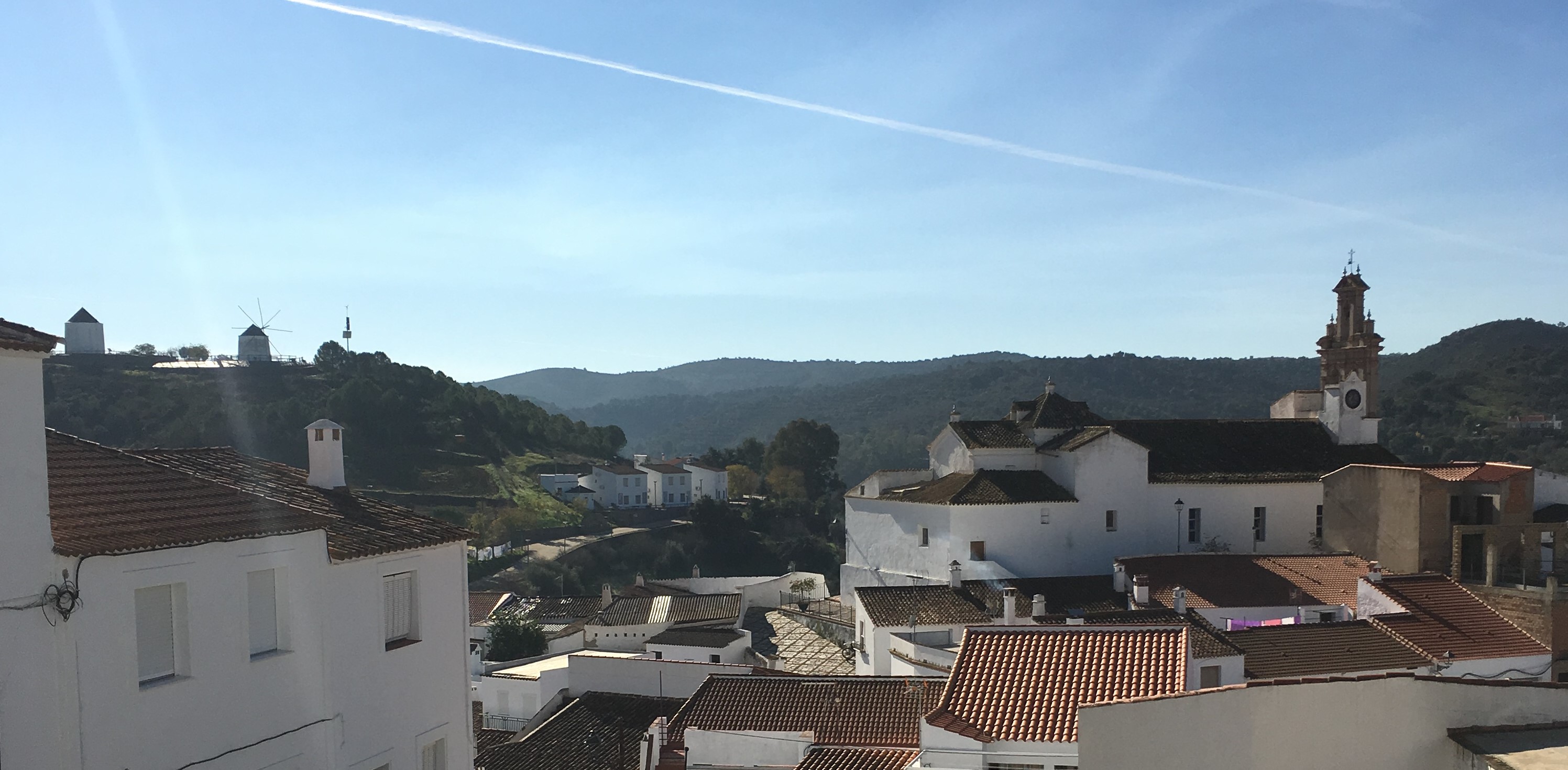
God knows, there are worse views. From high up in the village, our house looks southwest over the orange village rooftops and beyond. Below us lies the whitewashed church, perched on its own hill in the centre of the village, and beyond, up on the next hill, two picturesque windmills and the green field below where white and chestnut horses peacefully graze. I can’t see the river, but the hills of Portugal are almost within touching distance and the river runs between them and the village.
It’s like a scene from a Hollywood movie, a cardboard cutout of an idyllic southern European village. Imagine Mama Mia, or Chocolat, or Jeremy Irons in the final scene of Damage.
It’s just as well that it’s such a pleasant view. Since September I have been staring at that view for more time than I ever could have imagined. To coincide with moving into the house (indeed, because of moving into the house) I slipped a couple of discs in my lower back, leaving me severely incapacitated. I can’t walk very much, I can’t do most of the things I love to do. All those things that draw me to life in the village and the things that make me feel part of village life are, for the moment, out of reach. It’s a strange and unpleasant feeling to be in the village and yet not in the village.
But I have the view. Despite the picture postcard quality of the place, I know this is no cardboard cutout. Behind those pretty whitewashed walls and under those orange roof tiles there is love and laughter, joy and sorrow. And in the hills beyond, the seasons bring change, there are lambs and rock roses and wild flowers.
I am reminded of (though in no way compare myself to) Seamus Heaney’s poem Field of Vision* as I sit looking out on the view from my office desk or from the sitting room. For almost six months I have watched the seasons change, the parched sun-baked golden brown of summer giving way to the bright rain-fed greens of winter and spring. I’ve watched the sky, the bright blue empty sky, and the immense clouds sometimes bringing torrential showers of rain. These mornings I look down on fog, an inversion over the river, like steam rising from a witch’s cauldron.
The changing life of the village is harder to observe from this remove. Like those subtler changes in the landscape, one has to be in the village, rather than observing it from afar, to understand and appreciate its changing moods. I cherish those rare occasions these days, when I get out, when I feel sociable enough to be a part of village life again for an hour or two.
I long for a time when I can once again take a carefree stroll down to the bar and have a coffee or beer with whoever happens to be around, chat with my neighbours when we pass on the street, be spontaneous in my socializing. And I long to get beyond the village, to take long walks in the hills again, to be nose-to-nose with wild flowers, to row across the river in my little red dinghy and walk the smuggler’s trail in Portugal.
I am optimistic that all those things will come my way again. I expect I’ll appreciate them all the more for the months I have spent merely observing life through the frame of my front window.
*Field of Vision Seamus Heaney
I remember this woman who sat for years
In a wheelchair, looking straight ahead
Out the window at sycamore trees unleafing
And leafing at the far end of the lane.
Straight out past the TV in the corner,
The stunted, agitated hawthorn bush,
The same small calves with their backs to wind and rain,
The same acre of ragwort, the same mountain.
She was steadfast as the big window itself.
Her brow was clear as the chrome bits of the chair.
She never lamented once and she never
Carried a spare ounce of emotional weight.
Face to face with her was an education
Of the sort you got across a well-braced gate —
One of those lean, clean, iron, roadside ones
Between two whitewashed pillars, where you could see
Deeper into the country than you expected
And discovered that the field behind the hedge
Grew more distinctly strange as you kept standing
Focused and drawn in by what barred the way.


 Me in place