Unknown's avatar

About martinatyrrell

I am an editor and writer, an anthropologist and human geographer. I am a mother, a sister and a daughter. I'm from Ireland, but my research and longings have led to extended periods of my life lived in Japan, the Canadian Arctic, the UK and, right now, Spain. I am fascinated by our place in the environment and our relationships with other animals.

33. What a good boy!

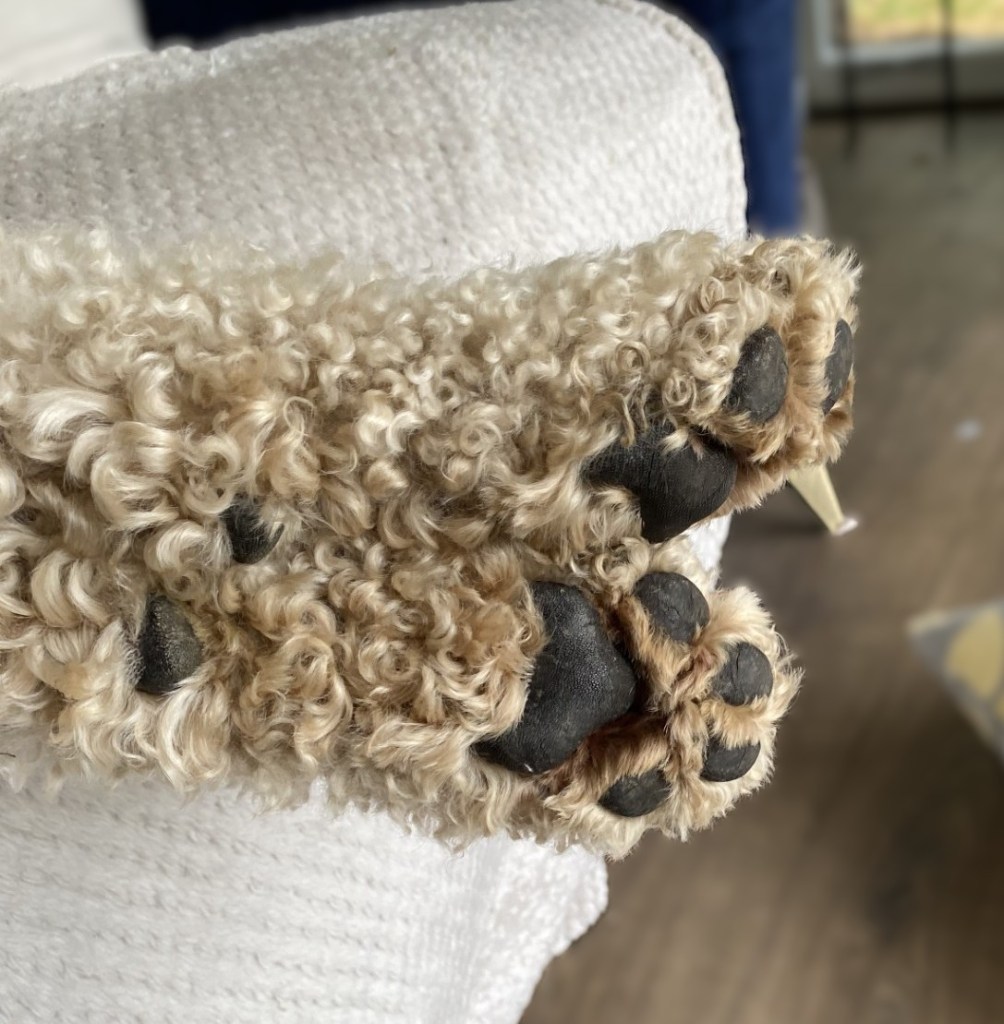
We’ve been looking after Hudson for the past week and we’ll be very sorry to say goodbye to him later today. Is there a better doggy in all of England? I sincerely doubt it. He’s been a joy to look after and a great first experience for us in the world of Trusted House Sitters.

Some friends in Sanlucar are signed up to the Trusted House Sitters app and others to a house swapping app. Both use those apps to travel to interesting places and get their accommodation for free. I’m not yet ready for house swapping – not until I finally get around to installing the new oven that’s been sitting on my kitchen floor for the past six months. Trusted House Sitting seemed like a better fit for us at the moment.

So, a couple of months back, I signed up, paid a small annual fee, got three people to write references for me, created my profile and away I went. This week has been our first dog-sit and I will definitely do it again. We made contact through the app with a couple in a village in the English midlands who needed someone to look after their dog and water a few plants while they were away on vacation. We met briefly by video call and then, last Monday, we arrived.

It has been a perfect experience from start to finish. Hudson is the perfect dog. Giant and gentle, easy going and with (almost) no bad habits (we all have some bad habits after all). He’s a dream dog. The house is like something out of a magazine. A modernized old cottage with an extensive garden that is so easy to live in that, really, I don’t want to leave. All over the house and garden is scattered comfortable furniture where all three of us can find our own space to curl up and read our books. The family photos and grandchildren’s arts and crafts suggest this is a house filled with love. And, there is an amazing office halfway down the garden, where I have been working all week.

The house is situated in a very typical middle class English village, with a decent (if expensive) pub and an amazing village shop. All around are paths and byways through the fields, so there’s no shortage of exercise for Hudson or for us.

Our hosts left easy-to-follow instructions for everything from where to find the doggy treats to how to use the air fryer. A gardener came in one day and a cleaner another. It is no understatement to say that I have been living a lifestyle this week that is so far removed from my normal life.

On this house sit, we didn’t venture far. The house itself and the surrounding are enough of a holiday for us, giving us a chance to experience a different lifestyle. But, already, I’m scrolling the app to look for future house sits in cities or towns that I want to visit and, for some reason, I keep putting in searches in the Alps – I really want to take the girls to the Alps some time.

So now, we will say goodbye to Hudson and to his fabulous home and look forward to more house and doggy-sits to come.

32. Gaia says ‘Take the day off’

Photo by Noah Silliman on Unsplash

I’ve been working hard lately. After a rather worrying nine-month work drought, during which my editing and ghostwriting work dropped to half of what I would normally expect, the last three months have been among the best I’ve had since I started freelancing ten years ago. But, over the nine months of the drought, I watched my bank balance dip to a worrying low. I tightened my belt, carefully budgeted for groceries, dropped a number of subscriptions, cut out weekends away and meals out. But those were only mini bites into my outgoings. The big stuff – the mortgage, my monthly self-employed social security payments, and other such things – well there was no budgeting for them.

I wasn’t alone. Creative industries (and, as an editor and writer, I am in that category) have been hit hard by AI. When we thought things couldn’t get worse, Ebron Skunk’s DOGE slashed funding to US government research that accounts for about 40% of my editing work. Was I worried? Hell yes. Very.

At first, I put the slow-down down to it being summer. August is generally a slow month. But when things didn’t pick up in September, October and onwards, I was well and truly sweating. Work was still trickling in, I was still just about keeping my head above water, but at the start of each month I worried that maybe this month would be the month that I wouldn’t be able to pay my mortgage.

I worked just as hard as ever, saying yes to every editing job that came my way, when before I would have been more picky. I had to dismiss my long-held promise to myself and to the kids that I wouldn’t work on weekends or on school holidays (summer excepted…it’s just too damn long). But I had a whole lot of time on my hands when I wasn’t editing or writing for other people, so I used that time to make contact with potential new clients, to make myself more visible on LinkedIn, to update my website and my online profiles. I had numerous Zoom meetings and phone calls with prospective clients that came to dead ends.

But, in spring, a glimmer of light started to appear down that dark tunnel of money worries. I landed a couple of lovely medium and longer term clients and the one-off editing jobs that are my bread and butter have started to creep up again. I diversified my US work and now have a large ongoing project in addition to almost back to normal flow of one-off jobs. Part of this upturn is down to the work I’ve put in to find work. But I also wonder if clients are starting to realise that what we do as professional editors and writers is far more than what AI is capable of, i.e., human understanding, nuance, humour, and so on.

Since April, every month has been a good month. Fingers crossed, it will continue this way. However, that doesn’t mean I’m out of the woods. I’ve got that bank balance to claw back so that next time a slump comes I’m prepared for it. I’m still not in a position to be picky, so I’m still working most weekends and on holidays. I’m hoping I’ll get to a point soon when I can ease off on that again. I’m 52. I don’t have the energy for this.

Which brings me to Gaia. I’ve been working long hours this past week. I had three deadlines for yesterday. Two of those were really complicated and took far longer to complete than anticipated. When I finally turned my computer off at 9:30 last night I was well and truly ready for a break. But I’m someone who can’t sit still for long. I knew that, if the weather was nice, I’d feel the need to go for a long walk today, to fill up my day with action.

When I woke up this morning it was lashing rain. And it has continued to rain for most of today. No going out. No being active. Gaia insisting that I have the break I well and truly need. I started the morning with 40 minutes of gentle yoga, took the dog for a short walk in the rain, got back into my pajamas when I returned home, and here I remain. I have spent the day curled up in an armchair, drinking mugs of tea and reading the book I’ve been dying to read since the day we got here.

Back to work on Monday but, for now, I am relaxed and at ease and, as I look out the window, I see that it has started to rain again. Thank you Mother Earth.

31. Headstones

It’s been too wet the past couple of mornings to go walking through the fields, so Hudson and I have been taking a route through the village that takes us up to the village church and through the graveyard.

I love old graveyards. There’s something peaceful and soothing and familiar about them. The silence they offer, with their old mature coniferous trees standing stately amongst the graves. I love headstones that are so old and weathered that they are barely legible and that thrill when I squint or run my hands over the inscription or rub it with grass to better see it and discover that it is the grave of someone who died two or three hundred years ago. There is something timeless and beautiful – an unbroken thread of connection – in seeing someone who was buried only yesterday alongside someone buried 300 years ago.

When I was a child, we visited our family grave at least once a week, usually more. My father’s side of the family is buried in the beautiful country graveyard on top of Carrick Hill, in the shadow of the ruins of Carrick Castle. Back then, there was little traffic on the roads, so we regularly walked the mile from home up to the graveyard – on a summer’s evening, after dinner on Sundays in winter – and we always dropped in to the graveyard on the way home from Mass on Sunday mornings or, indeed, any other time we were driving by. As I grew older and more independent, I would often walk or ride my bike up on my own or with friends, and have a picnic amongst the graves. There were usually other people there too, someone tending a family grave or, like us, dropping in on the way past. So, the graveyard was as sociable place, where we caught up with neighbours and people we might not otherwise see much.

I loved wandering amongst the headstones and discovering the history of the place where I lived through the stories that the inscriptions told. The people buried up on Carrick Hill were the parents, grandparents, great grandparents and all the other relatives of people I knew. I guess it was the nascent anthropologist in me that was interested in family lines and family histories, in relationships and kinship, and in what I could discern about the living from the inscriptions of the dead.

Like many rural graveyards, Carrick tells the history of my family and my community; where people are laid down in death is a reflection of where they resided in life. The Tyrrell family grave contains the bodies of my great-grandparents Eliza and William, my grandparents Roseann and Michael, my great-uncle Pat (his arm buried a few months before he was, after it was amputated due to cancer), my aunt Cissie and Daddy, along with the ashes of my uncle Willie, aunt Vera, and Julian. (I never thought Julian would end up there, but Katie and Lily suggested it and I thought, why not).

Immediately next to my family are the graves of our cousins – who are also our immediate neighbours – the Hickeys, the McGlynns, the Mulraneys, the other Tyrrells. All around the graveyard are similar clusters of neighbours and extended families buried in proximity to each other. The graveyard tells the history of my community and of my family in simple metrics – birth dates and death dates, beloved daughter of, father of, grandson of, sometimes a wife’s maiden name. This simple information weaves together a story of community. The graveyard also tells a social history of status and class, from the small simple headstones of the majority of people of lesser means to the few large headstones and even those who, long ago, were placed in tombs. Although those grave markers are the outward representation of social status in life, beneath the ground everyone meets the same fate.

I’ve never thought of graveyards as maudlin or dark places. At times of death, they are a place where community comes together to pay witness to a life lived and to console the bereaved. At different times in my life, I have found it comforting to sit by the grave of a loved one, and feel an ongoing connection. But, most of the time, they are places that instill in me a sense of peace and that intrigue me in the stories they tell and the histories they reveal.

Graveyard on my morning walk

30. Andrea Gibson

Source: Boulder Public Library

The poet Andrea Gibson died on Monday, aged just 49. They were taken far too soon, having lived with ovarian cancer for a number of years. I discovered Andrea Gibson‘s work about a year ago when I briefly dabbled with Instagram. I was immediately moved by this beautiful human being who wrote poetry that by turns made me laugh, cry, get mad and gain understanding. They performed those poems in a way that was profoundly moving, grounded in a life filled with meaning and love, and the knowledge that their time was short. They wrote about life and love, joy and heartbreak.

Andrea Gibson wrote and spoke with clarity of vision and clarity of voice and the world is all the richer for the 49 years that Andrea Gibson spent in it. So, today rather than reading a messy blog post from me, go find something by Andrea Gibson – on Substack, Instagram, YouTube or here, on their website. Savour it.

29. Live Aid…at 40?

Saturday was the 40th anniversary of Live Aid. Forty years! I’ve watched a three-part documentary on the BBC about it origins in Band Aid at Christmas of 1984, the build-up to Live Aid, and it’s ongoing legacy. It’s interesting to see the evolution and maturation in understanding in the likes of Bono from charity and ‘feed the hungry’ to equity and justice and the legacy of colonialism. In addition to that documentary, over the weekend, a two-part, seven hour highlights show was released. The girls and I started watching it two nights ago.

Oh boy oh boy. It’s taken me right back to the 13th of July 1985. 11:55am. Twelve year old me in the sitting room in Ballygibbon, waiting for Live Aid to start. I watched it from start to almost the finish. Katie can’t believe that I sat through 16 hours of TV. ‘You’d never do that now,’ she says. ‘You’ll notice my mother didn’t sit down and watch 16 hours of TV,’ I tell her. ‘Who do you think kept me fed and watered through the entire thing?’

The truth is, however, that I didn’t watch 16 hours of Live Aid. By 2:30am, fourteen and a half hours in, I could no longer keep my eyes open. I tried so hard to stay awake, but I just couldn’t. So, I went to bed and missed the final hour and a half.

Watching it now, I can’t believe that I still know the lyrics to so many songs. Never mind the songs that remain in the zeitgeist – We will rock you, Sunday bloody Sunday, Get into the groove; I remember every lyric to Nik Kershaw’s Wouldn’t it be good and Howard Jones’ Hide and Seek. Where in the depths of my brain have those lyrics been buried all these years?

There are the bands and artists I loved then – Spandau Ballet, U2, Madonna, Paul Young, Queen – and others that I couldn’t stand and was bored to watch back in 1985. It would take another two decades for me to appreciate the genius of Paul Weller, David Bowie, Elton John, and I look at their performances now with delight.

There is a notable lack of women – although more in Philadelphia than in London. We still have a couple of hours to go tonight, but so far, I’ve seen only Sade and Alison Moyet in London, and Madonna, Chrissy Hind and Joan Baez in Philadelphia. (Lily says, of Joan Baez, ‘That lady looks like you mum.’ That makes me happy). Alison Moyet, with that incredible voice, only comes on to support Paul Young. (Ahhh Paul Young. I was in love with him. A couple of months later, when I started secondary school, during a Geography lesson on the Irish fishing industry, my teacher, Mr. Byrne, asked if anyone knew the meaning of the word ‘proximity’. My hand shot up. ‘To be close to something,’ I said. Mr. Byrne asked me to put it in a sentence. ‘I’d like to be in close proximity to Paul Young.’ Mr. Byrne laughed. I laughed. The rest of the class realised they had a nerd on their hands. That was the first of many geography-based jokes that were to pop out of me over the next five years.)

Lily and Katie know a remarkable number of the songs and artists, mainly from watching series like Stranger Things and Glee and from being force-fed this music on car journeys. What is new to them is putting faces to the songs. I am struck that, from my ancient perspective, most of these musicians are barely older than my kids are now. So many of them are fresh-faced and speak with squeaky kid voices when they’re interviewed. I realise that even David Bowie and Bryan Ferry, who seemed ancient to me back then, were younger in 1985 than I am now. That’s sobering!

I’m struck by the simplicity of 1985 cutting edge technology – the giant TV cameras, all the musicians and cameras plugged into the mains and people working specifically to ensure the lines don’t get tangled. The stages in both London and Philadelphia are decorated like a stage at a village fete, and the methods for making donations are so antiquated that I can’t even begin to explain to the kids what bank giros and postal orders are.

But what is most striking are the musicians themselves. They look like normal people in a way that normal people today don’t even look like normal people any more. There are no veneers, no lip fillers, no botox, no hair plugs, no plastic surgery. There are two young women who pick up litter in my little village in Spain who have had more work done on them than all the musicians in Live Aid combined.

No-one appears to have a stylist or a wardrobe assistant. Madonna (Madonna! Have you seen that woman lately?) looks like she washed her hair and perhaps ran a hair dryer over it. No more. (She looks lovely) Steve Norman of Spandau Ballet looks like he’s wearing multiple layers of women’s blouses that he bought at Primark – probably because he did. And no stylist in the world would have let Bono out on the stage in that rig-out! There are mullets galore – I have never seen so many mullets in my life. People I didn’t remember having mullets, have mullets. And, I’m reminded of something I heard some time ago along the lines of ‘there must have been a shortage of conditioner back in the 80s’. There’s so much dry hair on display!

It’s a step back in time for me, to that very hot summer of 1985. It was so hot that we were allowed to not wear our uniforms during the last few weeks of school. It was a summer that I thoroughly enjoyed, and the build up and aftermath of Live Aid was a big part of that. We’ve a couple of hours still to go tonight, when the action will move exclusively to Philadelphia. I can’t remember who’s yet to come, but I’m looking forward to it.

28. Some fields in England

The heatwave has passed for now. It’s windy and the early morning sky threatens rain. I’m wearing my new raincoat that I bought last week in the height of the heatwave. The sales assistant looked at me funny and I said, “Well, this has to end sometime.” It’s certainly ended now.

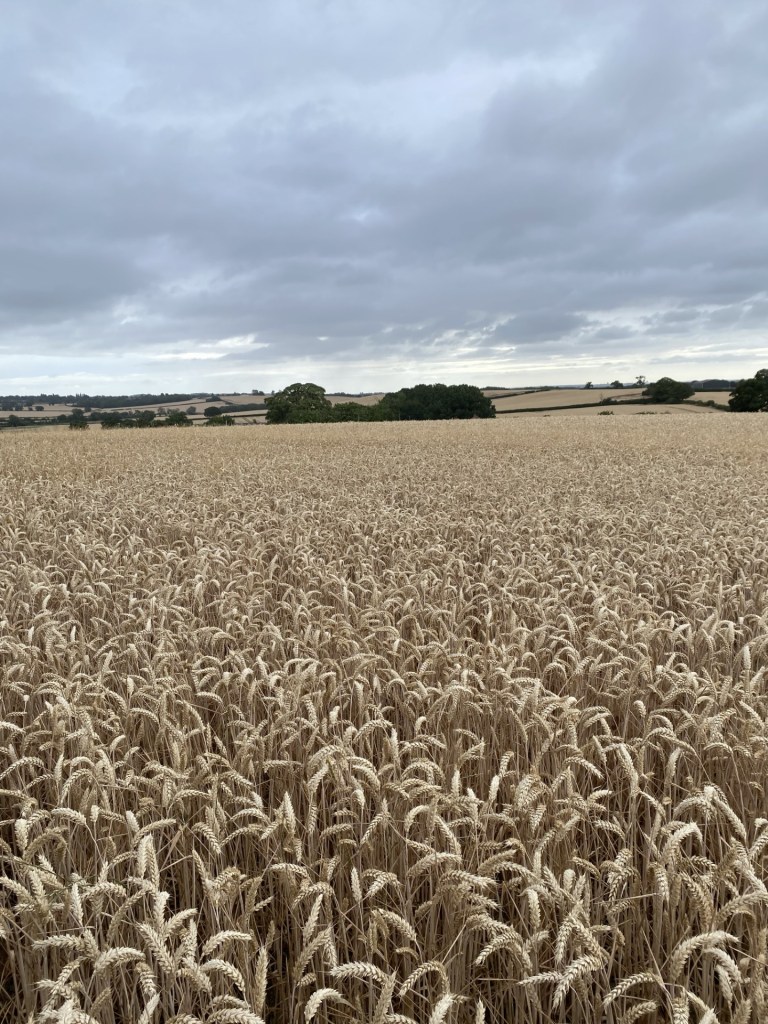
This week, we’re looking after the adorable Hudson (see yesterday’s post) at his home in a little village in the middle of England, while his human parents are away on vacation. It’s 8am and Hudson and I are out for our morning walk. There’s nobody else around, as we walk for a few kilometres along the edges of arable land and across fields of sheep and lambs, from one kissing gate to the next.

One young lamb is curious and tries to come to us, its worried mother keeping pace with it, probably wishing it wasn’t so curious about this big woolly dog and red-raincoated human (what colours can sheep see?). A field of rape seed is half-harvested, a big yellow combine sitting in the middle of the field, ready to resume its work when the rain lets up. I see something move at the wide fallow edge of the field, heads bobbing up and down. I think it is a couple of rabbits at first, but as we get closer, I see that it is a family of grouse. They are disinclined to leave the relative safety of the long grass for the exposed stubble of the field. I think I should turn back and leave them be. But at the exact instant I have this thought, one flies up from right at my feet, completely invisible to me and to Hudson up to now, scaring me and sending all the others into flight too. They fly the 20 or so metres from the grassy verge into the yet unharvested half of the field. I feel bad for them. Hudson is good, though. My own dog, Lady, would be going crazy for them, but Hudson seems oblivious.

A little farther on, I step over a badger sett. It looks neat and tidy and, therefore, in use, and I get a little thrill thinking that, underneath my feet, a family of badgers is likely settling down for the day to sleep. Towards the end of the walk, we pass a small patch of open grassland backing onto a copse of trees. Two hawks circle each other ten or so metres off the ground over the grassland, crying out to each other. One lands in a tree and the other continues to circle, eventually settling on the branch of a nearby tree. Their cries continue to ring out.

I am reminded of other early morning country walks along English pathways – in the Fens and Cambridgeshire, up north in Cumbria and down south in Devon – and of the hares, the muntjac and the red deer, the red squirrels, the badgers and foxes, the eagles and hawks and falcons and owls, of the times I have been privileged enough to see those animals in person and the times when I have found signs and signals that they have been there and may still be there, watching me, the clumsy human, walking through their home.

A grey morning in a wheat field

26. The time John Sweeney asked to see me

From the moment my parents took me to see Bambi when I was about four years old, I’ve been a cinephile. There have been so many phases to my cinema going – with Daddy and/or my cousin Sean, every Tuesday evening with my cousin Colette and her friends when I was still a pre-teen, and then, once I got to university, spending every penny of spare change I had on going to the movies. I’d go with friends and I’d go on my own. Lots of my friends spent their spare money on Silk Cut cigarettes; I spent mine on Kevin Costner.

In my third year of my undergraduate degree, I had a two hour cartography class at 10am every Friday. There were two problems with that. First, found the class boring and, second, midway between my house and the Maynooth Geography department was the bus stop for the number 66 bus into Dublin.

I attended the first few classes of the first term but, as the weeks wore on, I found myself more and more often stepping into the bus if it happened to be there as I walked past. On those days when I got on the bus rather than going to my cartography class, I would arrive in Dublin in time to fit in three films throughout the day. I can’t remember the names of the cinemas or if they’re there any more, but there was one on either side of O’Connell Street and another over on the end of D’Olier Street. Sometimes I’d spend all day in one cinema, other days I’d flit from one to the other and back again, grabbing a cheap sandwich in between. I went to see everything, apart from horror; some films I saw multiple times, even going out at the end of one showing to buy a ticket and go straight back in to the next.

Soon I was hopping on the number 66 bus every Friday morning, not thinking twice about the class I was missing or the assignments I was supposed to be completing and submitting every week.

One week, the bus wasn’t there, so I carried on to the Geography department and into my class. I sat amongst my friends and the class began. About 20 minutes in, there was a knock on the door and Professor John Sweeney asked if he could see me. I got up and went out with him. (My friend Niamh told me later that she thought I was being called out because I was going to get some award for my excellence in geography!! One thing I’ve always loved about Niamh is her blind faith in me!!)

I followed Professor Sweeney up to his office and he sat me down. He seemed very concerned about me. ‘How are you?’ he asked. When I told him I was great, he asked how was my family, how was my health, how were things at home. To all his questions, I told him everything was great. I had no idea where he was going with this.

‘We have students who start out poorly in this cartography course and then drop out. And we have those who start out well, but then their assignment grades drop and then they drop out. But you,’ he said. ‘You started out with good grades and then suddenly stopped submitting your assignments. So I’m worried that something is wrong.’

A smile broke out on my face. Relief. And told him the truth. About my love of cinema. About the timing of the number 66. About how I spent my Fridays. About finding the cartography class a bit boring. My honesty disarmed him or caught him off guard. He was probably relieved that he didn’t have a student in crisis situation on his hands. Whatever it was, he gave me another shot.

Monday was a bank holiday, so he gave me until Tuesday at 10am to submit the seven assignments I’d missed. I returned to class. I spent the next three days catching up (admittedly with a major dollop of help from Niamh’s, Paula’s, Sinead’s and Fionnuala’s assignments) and handed them in on Tuesday morning. I didn’t miss a Friday morning cartography class for the rest of the year.

I thought about all of this at 10:30 this morning when Katie suggested we race into Leamington to catch the 11:10am showing of Jurassic World Rebirth. I sat in the dark at the cinema, my eyes wide, excitement mounting as the trailers rolled. I looked over at Katie, and thought ‘That’s my girl.’

25. My dream holiday

There’s an ongoing battle taking place on in a living room in Warwick. My father-in-law insists he will make space for me to use the kitchen. I insist that I have no intention of using the kitchen. In fact, I want to stay as far away from the kitchen for as long as possible. We go through the routine multiple times a day. “I’ll be out of your way soon,” he says. “Take your time,” I say. “You’re not in my way.” He seems desperate to get me into the kitchen to cook elaborate and time consuming meals for myself. But, while he busies himself making batches of hearty barley and vegetable soup and rich meaty liver and sausage stews (in the middle of a heatwave!), that he will freeze for use over the coming weeks, I want to use the kitchen for no more than making a cup of tea or grabbing something quick and easy out of the fridge.

You see, I’m a solo parent. That means that, like so many parents in my position, I am 100% responsible for everything. My kids are great, they help out (when asked or urged) but, ultimately, the buck stops with me and me only. Apart from Sunday lunch at our next door neighbours’ house and the very occasional meal out, I am responsible for planning and making three meals a day, every day of the week, week in and week out. Sure, I take shortcuts such as batch cooking and eating leftovers, but that still requires planning. In addition, we live in a remote place without take-away options or the option of a quick trip to the supermarket to buy something last minute. I’m responsible for making sure the washing up gets done (by me or the girls), that the shopping gets done, that the gas bottle gets replaced for the cooker, and so on. I love cooking and baking, I really do. But the day in day out of it can become monotonous drudgery that takes up far too much time and head space.

So, for me, a holiday is not having to do any of that or, at least, reduce it to an absolute minimum. The girls have been away all week and I’ve only had my own food needs to think about. For me, that was as good as spending a week in one of those 6-star hotels in the Maldives or Dubai. Seriously, it was bliss. I gave absolutely no thought to what I would eat for any of my meals. When I was hungry, I grabbed a piece of fruit from the fruit bowl or popped up to the M&S Simply Food just 200 metres away and bought a yogurt or a meal deal. One night I ate microwavable mac and cheese in front of the TV and it tasted like haute cuisine, simply because I didn’t have to cook it and I didn’t have to clean up after. For lunches, I popped into a bakery near the library and got a spinach and feta roll or a sausage roll.

The break from cooking is part of a larger sense of what ‘holiday’ means to me. As a solo parent, I am constantly in decision-making mode for every single aspect of my life and the lives of my two children (with advice and support coming from wonderful family and friends). Financial decisions, educational decisions, health decisions, house and car decisions, and on and on. So, a holiday for me is also a break from decision-making. When friends and family ask what I want to do when we’re in the UK and Ireland my answer is “I don’t care.” And I really mean it. So long as I don’t have to make a decision about what to do, I’m up for anything. By the end of the past twelve months we’ve just had, I can’t tell you what it’s like to set aside my decision fatigue and rest my tired brain.

The girls are back now from their week away and, boy, did I miss them. But it’s pizza for dinner tonight and maybe a take-away tomorrow. I’m still in holiday mode and, try as he might, my father-in-law is going to fail in his bid to get me into that kitchen.

A bliss-inducing cappuccino that comes with Smarties on the side.

24. The pear tree

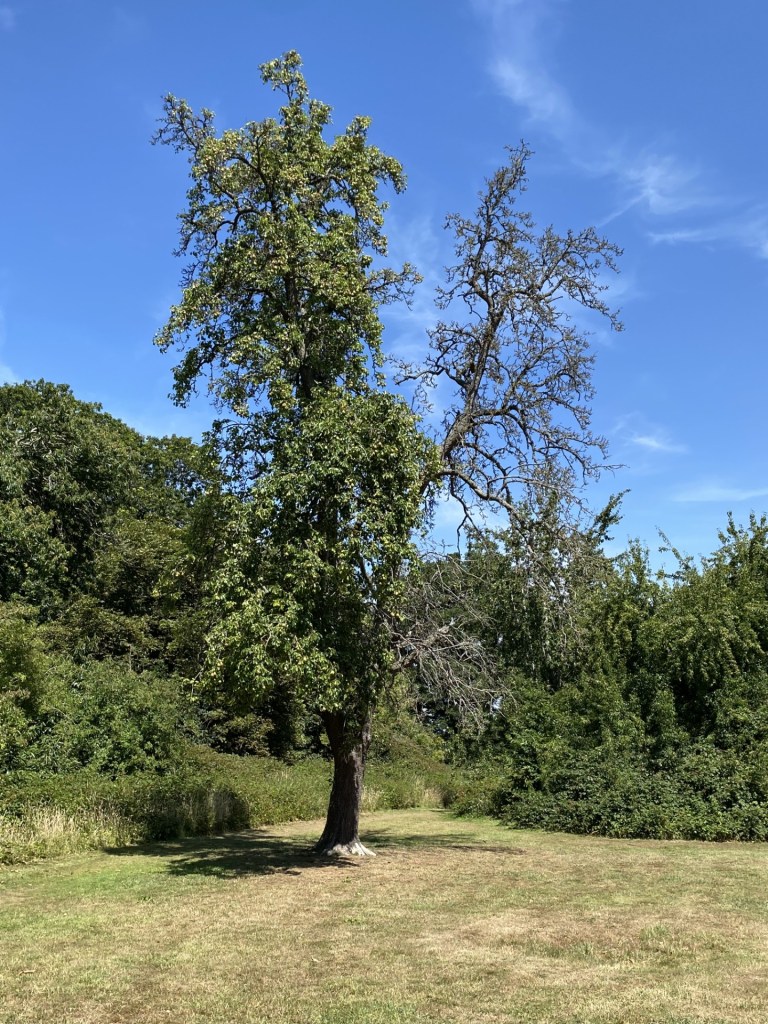
I’ve fallen for this pear tree. In a park full of majestic giant oaks, giant chestnuts, giant sycamores, it is this more modest pear tree that I am drawn to day after day, to sit under to eat my lunch and take a break from staring at my computer screen.

I chose it at random the first day, a little bit off the path and providing just enough dappled shade from the sun. I ate my lunch and then, like Heaney’s threshers in The Wife’s Tale, who “still kept their ease, Spread out, unbuttoned, grateful, under the trees,” I lay down and gazed up through the branches. It was then that I noticed something I hadn’t noticed as I walked past it or under it.

About six feet from the ground, it forks. The branches to one side of the fork are lifeless. No leaves grow, no buds. It is bare but for the lichen that has crept along it. The other side of the fork, in contrast, is heavy with life. The branches sag under the weight of innumerable pears that will be ripe by autumn, food for humans, food for animals, carrying the seeds of the offspring of this tree.

I’m drawn to the perseverance of this pear tree, to its wonky imperfection. Something happened to it – a lighning strike perhaps – that irreparably damaged one half of it, yet the other half carries on steadfast and lively. And I come to see that the damaged part might still have its role to play too, providing balance and stability, helping to anchor the still lively half.

A bumblebee lands on my brightly coloured trousers, resting in the shade of the tree for a moment before going on its way again. There are other insects too, not passing through but living here, making the tree their home. On both forks of the pear tree, I see intricate spider webs and, at the base, a hole made by some small animal. There are rabbit droppings on the ground around me. The tree, as a whole, is a place of liveliness, home to or way point for so many animals, me included.

As I sit up and prepare to return to work, I look around and see, not far away, smaller pear trees and saplings, surely the offspring of this one. The tree, despite its imperfections and its damaged parts, is living its best pear tree life.