We are not alone

These mornings it’s too hot to walk or run. I open the car door and the dog jumps onto the back seat. I drive a couple of kilometres up out of the fishbowl of the village, over the hill and down into the next valley. At this hour, the dog and I are the only domesticates. But we are not alone.
I head for the trail that runs west along the tributary, following it towards the point where it joins the great flow of the main river. The hills rear up all around – the bare grey bedrock, the golden sunburnt undergrowth, the twisted olive and almond trees. Above, like a cutout backdrop, the sky, so tangible in its blueness – surreal, unreal, real.

A rustle in the undergrowth and I catch a brief glimpse of a blackbird. A butterfly, statue-still on a dead leaf, flutters to life, suddenly surprising the dog. Sound and movement – the one indistinguishable from the other – reveals a snake, sluggishly departing the patch of path where it’s been indulging in a morning sun bath. It slithers up the hillside, its tail disappearing under an asparagus bush.

I leave the trail and descend to the riverbank. The dog, ahead of me, turns back and tilts her head, asking if are we going to swim or stay on the path. ‘Go on,’ I say, and I hear her splashing into the water even as I am still gingerly picking my way through the brambles, getting snagged on my shoulder and on my hip, and popping a couple of blackberries in my mouth.

I step out of my shoes and take my dress off over my head. As I step down, feeling the water on my toes, my eyes are drawn upwards to the towering hill on the other side of the river, beyond the narrow floodplain. I hear hooves on rock and see movement. I’m transported back more than twenty years to the Kivalliq, to an evening when I sat on an esker at dusk and heard a chorus of clicking behind me. Before I had a chance to turn around, I was engulfed in a sea of caribou – does and bucks and calves – their hooves click-click-clicking as they gently snorted and snuffled their way past me. I didn’t move for fear of frightening them. I sat and I saw and I heard and I smelled and I felt them. Now, on this little riverbank on the other side of the world, I hear the click of hoofs on rock as a small herd of four slender female deer and two calves high step up the hill.

I fully immerse myself in the warm water that is so refreshing after the heat of even this early hour. I cross the river, the dog swimming alongside or leaving me to swim alone, and coming back to me again. I hear a splash to my right but see nothing. I focus on that patch of river, treading water for twenty, thirty seconds. My concentration is rewarded. A 30 cm silver fish throws itself out of the water, for the briefest of moments suspended in the air, the sun reflecting on its glistening silver side. Then ‘splash’, it is gone. Another thirty seconds pass and it reappears – same arc, same glistening body, a few metres further along its journey.

The dog has had enough of swimming. She goes to the riverbank to torment frogs. I imagine them hiding in the rushes, laughing at her foolishness, laughing at their ability to hide from her. On mornings when the tide is high and the water comes up to the rushes, I hear one or two of them plop into the water. The dog never gives up. She also never catches one.

In addition to the frogs, she likes to vigorously roll around in the silt and sand on the riverbank, turning her white fur a dirty brown, gathering up a collection of grit to deposit in the house later.
When I finish swimming, I step into my shoes and walk for a while in just my swimsuit, drying off before I put my dress back on. There’s a pool of water under the bridge, close to where I’ve parked the car. I’ve seen this whole valley completely submerged but now, at the height of summer, the river has dried up, leaving pools of varying sizes and depths. This one by the bridge is the first and the biggest, occasionally reconnecting to the tributary when the tide is especially high.

I search for a stick to throw so the dog will go in for a final swim to wash off the grit. Before I throw the stick, the pool is still – not a ripple, not a breeze moves it. From the corner of my eye I catch a glimmer. I look down. A crab the size of a saucer, iridescent silver and blue, scuttles along amongst and finally disappears under a rock near my feet. I’ve seen surprisingly large fish in this pool, and snakes, and schools of smaller fish, but I’ve never seen a crab here before and I’ve certainly never imagined there would be one so big. I am in awe.

I throw the stick far out into the middle of the pool. The dog, delighted, swims out to retrieve it. When she brings it back, she drops it and walks away; it is her way of telling me she doesn’t want to play this game anymore. We get in the car and come home.
97. Welcome to the jungle

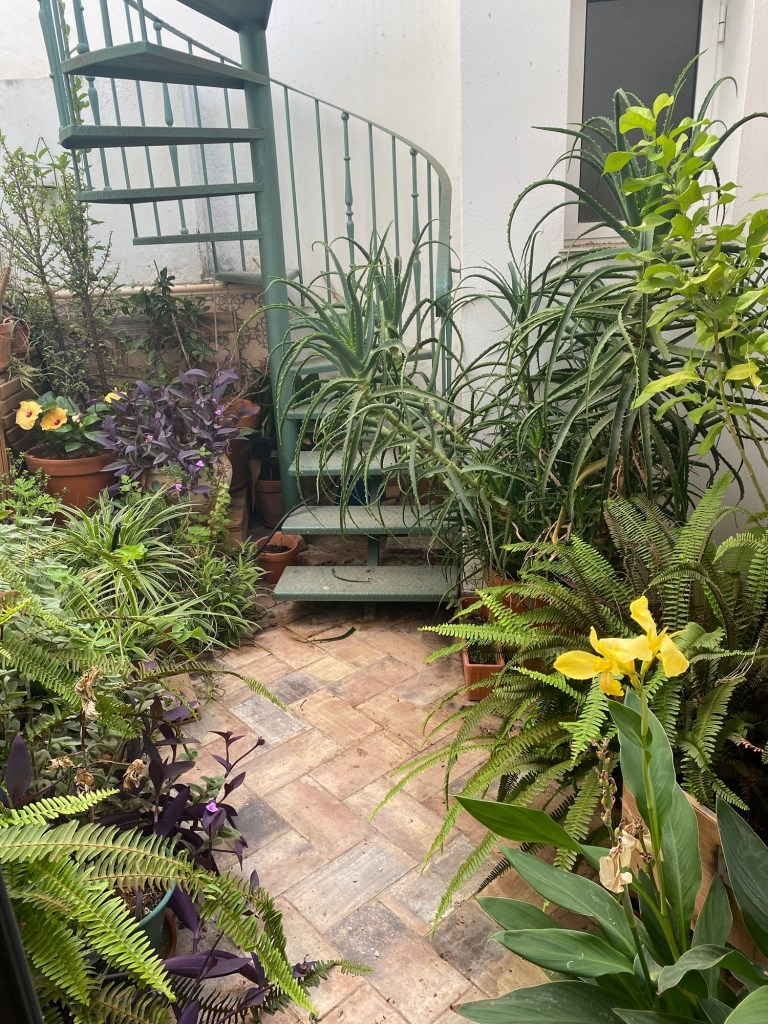
Before we went away for the summer, this was my little patio space, where I had a little table, a couple of chairs, and a love seat. It had a nice number of plants scattered around too. It was a shady space for breakfast or a mid-morning coffee.

But then we were going away for eleven weeks and I needed a keep the plants watered. On the Saturday and Sunday three weeks before we left, I folded away the table and chairs and gathered all the plants from my three outside spaces to here, the shadiest and coolest of my outdoor spaces. They certainly took up a lot of space. I then spent the mornings on the second to last and last weekends (in mid-June) setting up a watering system on a timer. The first of those four mornings was spent just sitting at my kitchen table, reading the instructions, watching YouTube videos and figuring out how to set up an irrigation system.

I got there in the end. It was like putting together some great puzzle, lining up the tubes, inserting the nozzles, plant to plant to plant, until all 50 plants (yep…50…even I was surprised that I had so many) were set up to have a one minute drip feed of water every 24 hours.

What I didn’t have time for was to properly test the system. I should have done it a week or so earlier. That way I’d know if some plants were getting too much or too little water. But I left it too late and just had to hope for the best.

My friends had a key to the house and reported after only a week that some of the plants were being overwatered and they’d turned the individual nozzles down to a mere trickle. Later in the summer they reported that my patio was now like a ‘jungle.’

I was quite dreading how jungle-like it would be on our return. However, I was pleasantly surprised. Sure, many of the plants had grown, but they looked far more lush and healthy than when I’d left them (I wouldn’t be the best at tending to my plants on a regular basis).

A few died. Three owing to a lack of water (the feeder tubes had slipped out of the pots and they didn’t get any water) and another three from overwatering, victims of the success of my irrigation system. When I’d set up the system, those three plants had been exposed to the sun. When I returned I found them in the undergrowth of other plants that had grown furiously, fully shaded and sitting in waterlogged soil.

We’ve been back two weeks already and it still looks like a jungle out there. I’ve gotten rid of the dead ones and I’ve started to move those that don’t belong on the patio back to their usual homes. Some need cutting back. But it’s slow work. One day, in the not too distant future, I hope I’ll have my table and chairs and love seat back again. I hope I won’t have to battle my way up the stairs to the clothesline. I hope I’ll be able to get to the gas bottles when they need to be changed.

But little by little, day by day, I’m getting there. And I’m getting to know my plants all over again in the process.

Lady enjoying the patio in more functional times

24. The pear tree

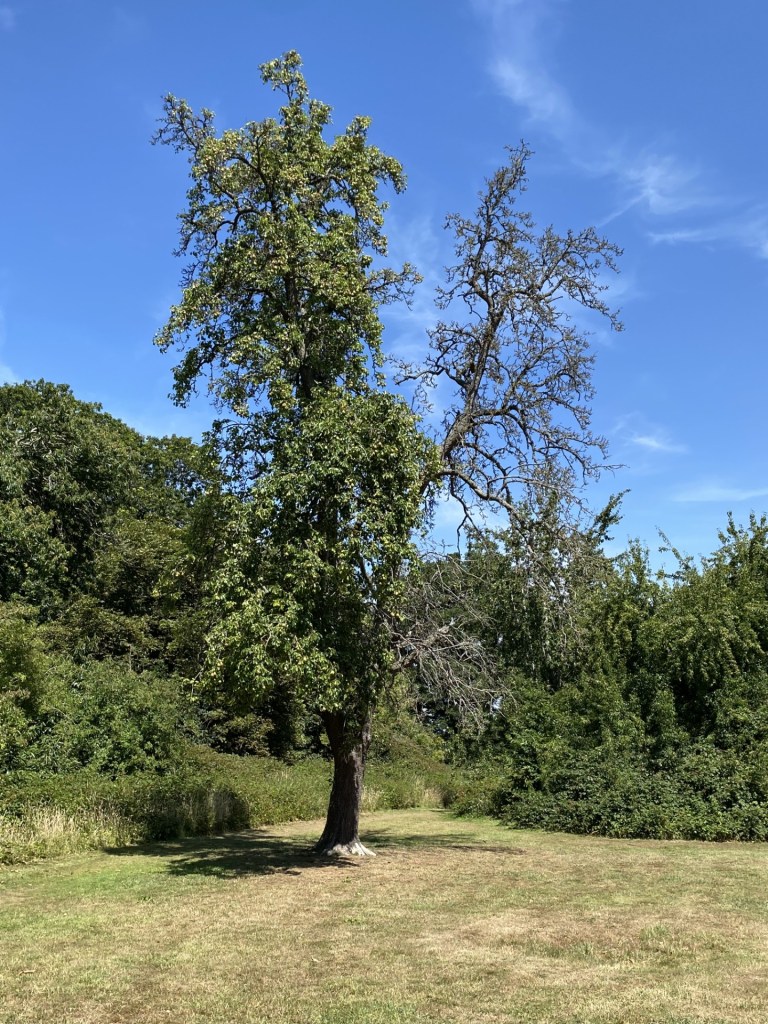
I’ve fallen for this pear tree. In a park full of majestic giant oaks, giant chestnuts, giant sycamores, it is this more modest pear tree that I am drawn to day after day, to sit under to eat my lunch and take a break from staring at my computer screen.

I chose it at random the first day, a little bit off the path and providing just enough dappled shade from the sun. I ate my lunch and then, like Heaney’s threshers in The Wife’s Tale, who “still kept their ease, Spread out, unbuttoned, grateful, under the trees,” I lay down and gazed up through the branches. It was then that I noticed something I hadn’t noticed as I walked past it or under it.

About six feet from the ground, it forks. The branches to one side of the fork are lifeless. No leaves grow, no buds. It is bare but for the lichen that has crept along it. The other side of the fork, in contrast, is heavy with life. The branches sag under the weight of innumerable pears that will be ripe by autumn, food for humans, food for animals, carrying the seeds of the offspring of this tree.

I’m drawn to the perseverance of this pear tree, to its wonky imperfection. Something happened to it – a lighning strike perhaps – that irreparably damaged one half of it, yet the other half carries on steadfast and lively. And I come to see that the damaged part might still have its role to play too, providing balance and stability, helping to anchor the still lively half.

A bumblebee lands on my brightly coloured trousers, resting in the shade of the tree for a moment before going on its way again. There are other insects too, not passing through but living here, making the tree their home. On both forks of the pear tree, I see intricate spider webs and, at the base, a hole made by some small animal. There are rabbit droppings on the ground around me. The tree, as a whole, is a place of liveliness, home to or way point for so many animals, me included.

As I sit up and prepare to return to work, I look around and see, not far away, smaller pear trees and saplings, surely the offspring of this one. The tree, despite its imperfections and its damaged parts, is living its best pear tree life.