We are not alone

These mornings it’s too hot to walk or run. I open the car door and the dog jumps onto the back seat. I drive a couple of kilometres up out of the fishbowl of the village, over the hill and down into the next valley. At this hour, the dog and I are the only domesticates. But we are not alone.
I head for the trail that runs west along the tributary, following it towards the point where it joins the great flow of the main river. The hills rear up all around – the bare grey bedrock, the golden sunburnt undergrowth, the twisted olive and almond trees. Above, like a cutout backdrop, the sky, so tangible in its blueness – surreal, unreal, real.

A rustle in the undergrowth and I catch a brief glimpse of a blackbird. A butterfly, statue-still on a dead leaf, flutters to life, suddenly surprising the dog. Sound and movement – the one indistinguishable from the other – reveals a snake, sluggishly departing the patch of path where it’s been indulging in a morning sun bath. It slithers up the hillside, its tail disappearing under an asparagus bush.

I leave the trail and descend to the riverbank. The dog, ahead of me, turns back and tilts her head, asking if are we going to swim or stay on the path. ‘Go on,’ I say, and I hear her splashing into the water even as I am still gingerly picking my way through the brambles, getting snagged on my shoulder and on my hip, and popping a couple of blackberries in my mouth.

I step out of my shoes and take my dress off over my head. As I step down, feeling the water on my toes, my eyes are drawn upwards to the towering hill on the other side of the river, beyond the narrow floodplain. I hear hooves on rock and see movement. I’m transported back more than twenty years to the Kivalliq, to an evening when I sat on an esker at dusk and heard a chorus of clicking behind me. Before I had a chance to turn around, I was engulfed in a sea of caribou – does and bucks and calves – their hooves click-click-clicking as they gently snorted and snuffled their way past me. I didn’t move for fear of frightening them. I sat and I saw and I heard and I smelled and I felt them. Now, on this little riverbank on the other side of the world, I hear the click of hoofs on rock as a small herd of four slender female deer and two calves high step up the hill.

I fully immerse myself in the warm water that is so refreshing after the heat of even this early hour. I cross the river, the dog swimming alongside or leaving me to swim alone, and coming back to me again. I hear a splash to my right but see nothing. I focus on that patch of river, treading water for twenty, thirty seconds. My concentration is rewarded. A 30 cm silver fish throws itself out of the water, for the briefest of moments suspended in the air, the sun reflecting on its glistening silver side. Then ‘splash’, it is gone. Another thirty seconds pass and it reappears – same arc, same glistening body, a few metres further along its journey.

The dog has had enough of swimming. She goes to the riverbank to torment frogs. I imagine them hiding in the rushes, laughing at her foolishness, laughing at their ability to hide from her. On mornings when the tide is high and the water comes up to the rushes, I hear one or two of them plop into the water. The dog never gives up. She also never catches one.

In addition to the frogs, she likes to vigorously roll around in the silt and sand on the riverbank, turning her white fur a dirty brown, gathering up a collection of grit to deposit in the house later.
When I finish swimming, I step into my shoes and walk for a while in just my swimsuit, drying off before I put my dress back on. There’s a pool of water under the bridge, close to where I’ve parked the car. I’ve seen this whole valley completely submerged but now, at the height of summer, the river has dried up, leaving pools of varying sizes and depths. This one by the bridge is the first and the biggest, occasionally reconnecting to the tributary when the tide is especially high.

I search for a stick to throw so the dog will go in for a final swim to wash off the grit. Before I throw the stick, the pool is still – not a ripple, not a breeze moves it. From the corner of my eye I catch a glimmer. I look down. A crab the size of a saucer, iridescent silver and blue, scuttles along amongst and finally disappears under a rock near my feet. I’ve seen surprisingly large fish in this pool, and snakes, and schools of smaller fish, but I’ve never seen a crab here before and I’ve certainly never imagined there would be one so big. I am in awe.

I throw the stick far out into the middle of the pool. The dog, delighted, swims out to retrieve it. When she brings it back, she drops it and walks away; it is her way of telling me she doesn’t want to play this game anymore. We get in the car and come home.
63. What if it’s poisonous?

Our Lithuanian next door neighbours are visiting. Egle tells me they have spent the summer in Lithuania foraging for and eating wild mushrooms.

The very thought of eating wild mushrooms scares the living daylights out of me. Julian used to forage for mushrooms. I ate them once or twice, but never enjoyed them, too scared that I was going to die. I used to tell him, ‘If you’re still alive in 24 hours, I’ll try them then.’ The only wild mushrooms I’ve ever eaten with confidence are the giant puffball and the chicken of the wood, because no other species can be mistaken for them.

But while I’m scared, I’m also envious that my friends have the foraging skills to distinguish edible mushrooms from poisonous ones.

This evening, we went walking along the canal in Edenderry with Alisa, who’s been foraging for mushrooms with her parents in Lithuania. As soon as we set out on our walk, my daughters descended on the hedge, stuffing blackberries in their mouths as fast as they could pluck them from the brambles.

‘What are you doing?’ Alisa asked, concerned. ‘How do you know they’re not poisonous?’

I had to laugh. There I was, worrying about the safety of her family’s foraging in her country and here she is, worrying about my family’s foraging in our country. Maybe we all know what we’re doing after all, foraging foods we’ve known since childhood. Before long. Alisa was alongside my girls, searching for the juiciest blackberries she could find.

Freelancing, foraging and feminist anthropology

A version of this article was, indeed, published by Green Parent magazine in October 2018.

Foraging: An immersive way to learn about nature

On the morning of the day my younger daughter, Katie, was born, I was out amongst the hedgerows with her big sister, Lily, gathering blackberries. We ate at least half of what we gathered, Lily’s seventeen-month-old face and hands stained purple with blackberry juice, and returned home with the rest in tubs. Two days later we were once again out amongst the hedgerows, blackberry juice staining the sling in which newborn Katie slept. At two days old, this was her introduction to foraging and she’s been at it ever since. By the time she was two-and-a-half, Katie could identify and gather wild carrot, fennel and mint, and recognised a handful of inedible plants.

Besides fantastic opportunities to put healthy, organic, wild and free food on the table, foraging is an active and productive immersion in the natural world. Through foraging, children come to understand ecology and local environments, to learn from and about nature, and to develop a sense of their place in, and obligations to, our planet.

MTyrrell2

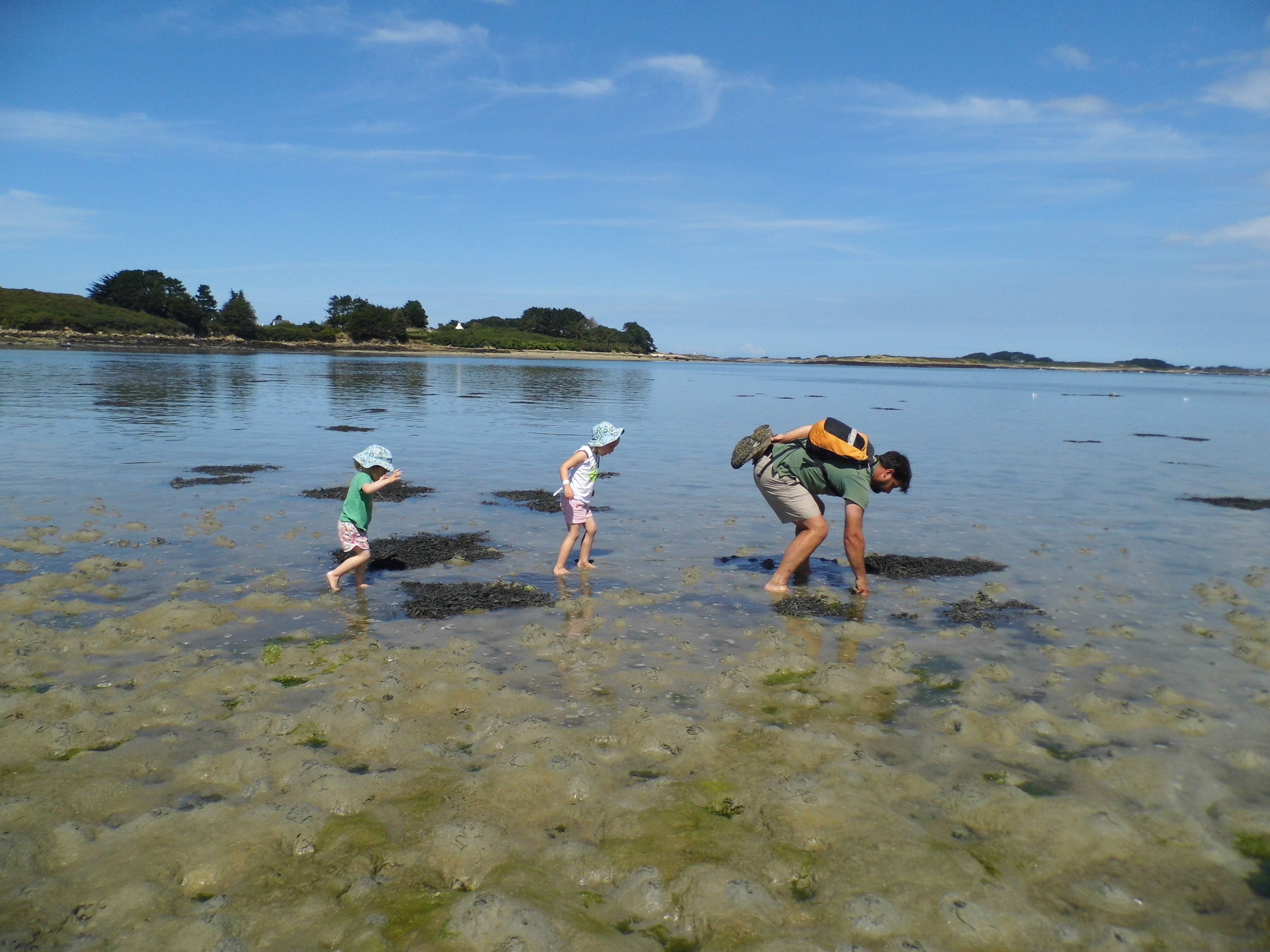
Foraging for clams in Brittany

As a nomadic family, we foraged for food in the middle of England, along the coasts of Devon, Cornwall, Ireland, Brittany and Galicia, and in southern Spain and Portugal. From trees growing in green city spaces to rural woodlands and open countryside, we have gathered almonds, apples, apricots, carobs, figs, hazelnuts, lemons, loquats, olives, oranges, plums and pomegranates. From seashores we have gathered clams, cockles and mussels, sea beet, rock samphire and wild carrot. We have gathered alexanders, asparagus, chard, fennel, lavender, mint, nettles and rosemary from woodlands, scrubland and walking trails, blackberries from hedgerows and camomile from fields. Lily and Katie have accompanied me as I’ve picked prickly pears and their dad as he’s gathered edible mushrooms.

***

As humans, we are increasingly disengaged from the natural world. And the more disengaged we become, the less we appreciate the incredible world around us, or understand our place in it and our obligations to it. Providing our children with opportunities to be immersed in the world helps them to develop that sense of appreciation, understanding and obligation. Immersion helps us to become part of the world again as we learn about the seasons, ecological niches, how plants depend on each other, and the lives and behaviours of animals. When we engage with the world, when we come to know it intimately, we are in a greater position to care for it, and to recognise our obligations to it.

Among the most ancient of ways to engage with the natural world is through foraging for food. Our ancestors have been doing it since before we were human. Until the late 1960s paleo-anthropologists believed that language, tool use and group organisation – those cultural characteristics that make us human – were developed and honed through hunting. The earliest tools, it was believed, were those used to hunt, kill and process wild animals; the earliest forms of communication were in the organisation of hunting parties. But in the late 1960s, female anthropologists began to study the previously ignored lives of women in contemporary hunter-gatherer societies. And what they discovered radically altered our understanding of the development of human culture.

Rather than hunted meat being the mainstay of most hunter-gatherer diets, it is foraged foods – vegetables, tubers, fruit, nuts, eggs, honey, shellfish, grubs and insects – that are the staple and daily elements of the diet. From these observations of contemporary hunter-gatherers, a new theory of the development of human culture emerged. Rather than hunting tools being the first forms of material culture, it was foraging tools – bags for carrying foraged food, and slings and straps for carrying infants. (However, unlike stone tools, these leave almost no trace in the fossil or archaeological record.) Indeed, the organisation required to communally care for infants and young children while women foraged was most likely what necessitated the development of language and complex culture. Forget man the hunter. Human culture blossomed around woman the gatherer.

Our ancient ancestors were intimately acquainted with the world around them. They had to be. Subsisting on foraged food required a deep knowledge of edible and inedible plants, of where, when and how wild foods grew, of how their growth was influenced by the plants and animals sharing that ecosystem, of weather and seasons, and of how foraging practices protected or destroyed plants for future use.

***

While we no longer rely on foraged food to survive, the practice of foraging draws us into the world around us. My family has discovered that the more time we spend in search of wild foods, the more intimately acquainted and attuned we become with the natural world. Not only do my children remember the location of the best patches of asparagus from previous years, for example, but they have learned, through experience, the environmental conditions best suited to this plant and, thus, where and when to look for it in new places. They have grown to know the seasonal changes that plants undergo and the other plants that share and are vital to the health of that habitat.

When we forage, our senses are caressed, challenged and enriched by the landscape. We walk up and down hills, through bright sunshine and dank shade, through woods and across fields, our hearts and breaths racing with exertion, feet slipping on damp rocks as we leap across streams or sinking into muddy tidal flats. Stopping to enjoy the sound of buzzing bees, our children learn from which plants bees forage at different times of year. They learn that other animals like the same foods as we do – wasps and birds on plums and pomegranates, the snuffling marks of a wild boar that got to the delicious asparagus tips before we did, the hollowed circles of grass made by a badger amongst the blackberry brambles, or our horse friend who makes short work of carob seed pods. And they can observe how wasps, ants, bees, birds and other small animals are linked to the life of each plant.

Such observations connect children to the natural world, allowing them to indirectly observe that the wild foods they collect are part of complex ecosystems. Further, they come to understand that they themselves are part of that ecosystem, just like the badger, the ant and the honey bee. They also learn that, to a far greater extent than any of these other animals, humans have the power to nurture or to destroy the environment. We teach our children, by example, to not take more than we need and to take only a little from each individual plant or area. Our children observe for themselves the destruction caused by wanton use and thoughtless disposal of plastics, metals and other industrial products, or by the needless felling of trees.

***

MTyrrell1

Lily in long sleeves and long trousers for the thorny work of asparagus hunting

Foraging is a deeply rewarding activity. We spend quality time with our children, engaged in activity together towards a common goal. The wild foods we bring home are transformed into delicious meals for immediate consumption or preserved or dried for use at some later date. When we return home after a few hours of walking, talking and foraging, we are often tired and grass or mud-stained, but our spirits soar from all we have seen and done, our bodies and minds enriched and enlivened from our immersion in the landscape. And with that immersion comes a stronger sense of care, compassion and empathy for the natural world and its many and varied inhabitants.