So culturally embedded are our death rituals that they are honoured and commemorated in a museum in Waterford city, The Irish Wake Museum. I didn’t know this museum existed until I walked past it a couple of days ago. How could I not take a trip inside?
Housed in an early 15th Century alms house in the heart of Waterford, the museum explores Ireland’s funeral rituals from pre-Christian times, through the Vikings and up to the present day.
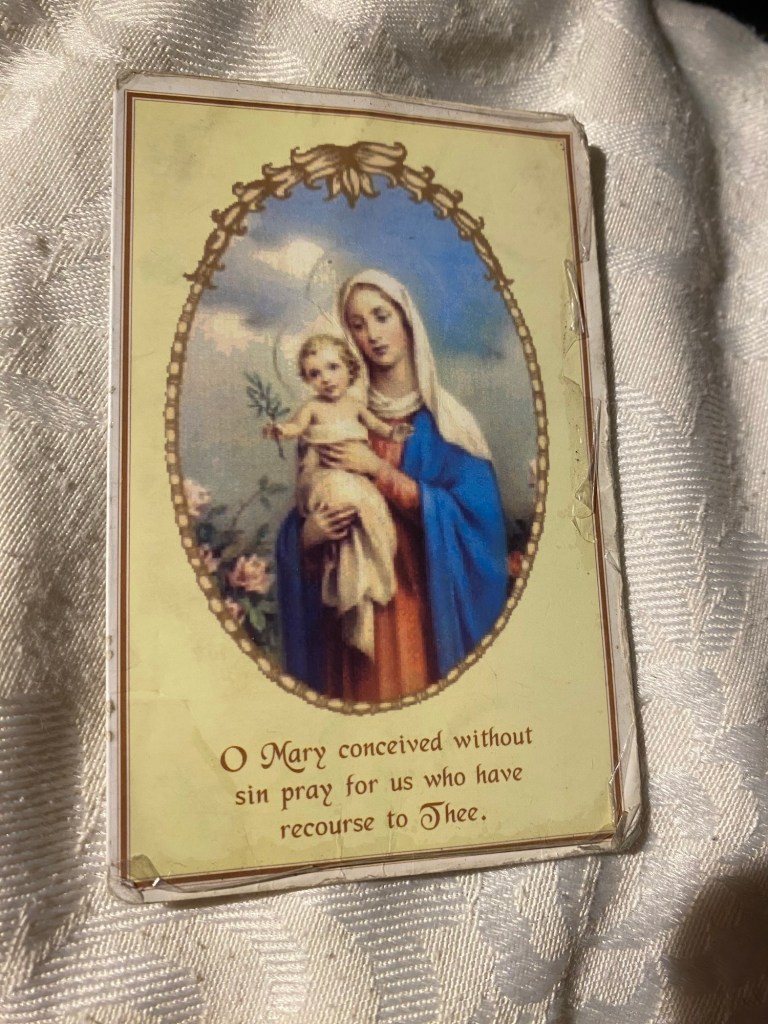
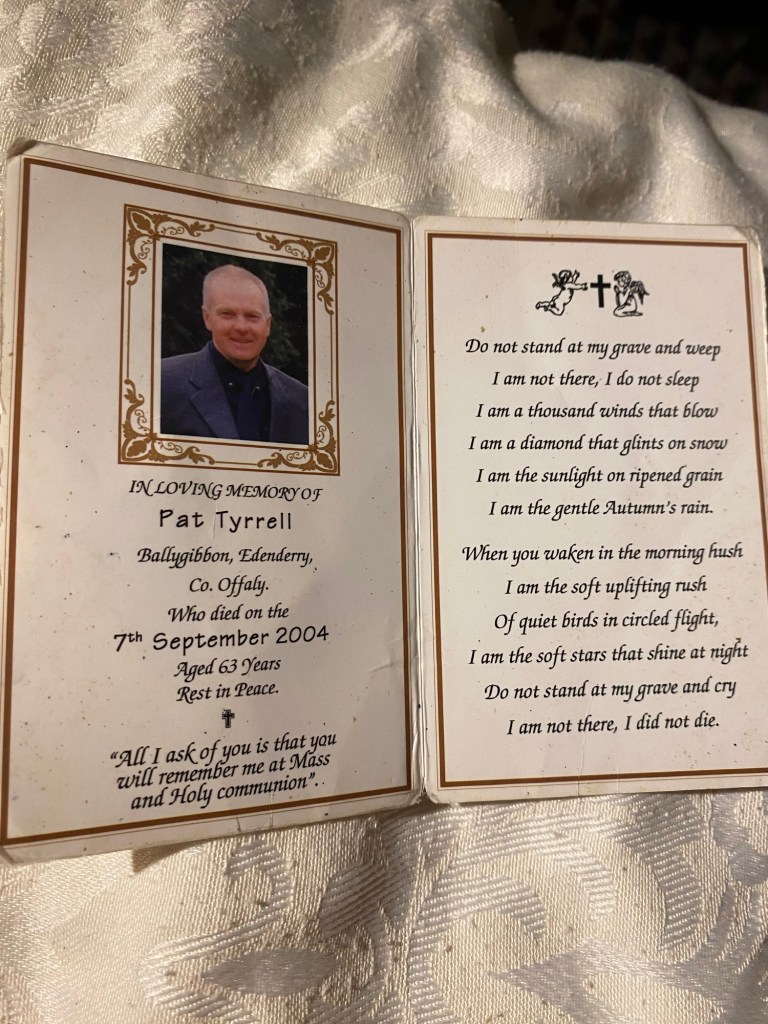
It was easy to see how memorial objects from the 1400s – commemorative pendants, coins and jewellery have been transformed into the memorial cards of the dead that are given out today.
Daddy’s memorial card, one of many I have of various family members and friends.
I was familiar with the origins of the wake and many of the rituals surrounding it. The two or three days of sitting with the dead to ensure they really were dead. The liminality of the wake, when clocks are stopped (literally), mirrors are covered to prevent the spirit of the deceased from getting trapped, and when there is much socialising and, despite the circumstances, merriment. In certain parts of Ireland, keeners were brought in; women who performed highly ritualised keening (from the Irish ag caoineadh – to cry) over the body.
I learned that women were generally the ones who prepared the deceased for the wake because, on account of their ability to give birth, women were more able to defy death.
I learned that, in the old days, the drinking and socialising at wakes so concerned the Catholic church that notices were put up stating that unmarried young men and women who were unrelated were not allowed to be in attendance at a wake from sunset to sunrise!
It was heartwarming to see our death rituals so faithfully rendered and retold, sharing this part of our culture with visitors and instilling a sense of pride and belonging in those of us for whom this is a living and evolving tradition.
Breakfast is generally the most perfunctory of meals. Quick and practical at the start of the day. On Saturday or Sunday, I like to make pancakes or waffles, which we eat lazily with multiple mugs of tea. But still, it’s the meal that, most of the time, I make and eat at home. I always imagine going out for breakfasts, but I’ve never lived anywhere that’s had much in the way of breakfast options.
Visiting a city is always a great opportunity for sampling breakfasts of all sorts. The memory of New York and Toronto diner breakfasts make me drool even now, and I still get nostalgic about breakfasts in Paris, Sydney, Honolulu, Vienna, London, Sevilla. Eggs, bacon, pancakes, mueslis, yogurts; breakfasts of all shapes and sizes; enjoyed with friends or in my own.
This morning, on the way through Derry, I had one such memorable breakfast. Not at a diner or a cafe, but at a friend’s house, made all the more delicious for the care and devotion my friend’s brother and sister put into making it.
The dining table was dressed with food, like that Christmas scene in Greta Gerwig’s Little Women. Eight of us sat around a table laden with rashers, sausages, black pudding, grilled tomatoes, fried potatoes, baked beans; potato farls, brown bread, toast, brioche buns, pancakes; jams, honey, marmalade, maple syrup; tea, coffee, hot chocolate. Every breakfast I love, all there on the table. I could have sat there all day, gorging myself like the Prince Regent.
Alas, we had to get on the road. Home beckoned. So, with a tummy full of food made with care and passion, I set out, another memorable breakfast to fuel my future nostalgia.
In late 2000, I’d already been working as a volunteer teacher at Levi Angmak Elementary School in Arviat, Nunavut, for some months. Kip Gibbons, one of the teachers who had befriended me, offered to show me how to sew my own mittens. She sent me to the Northern Store to buy ukaliq (arctic hare) fur. I duly went a couple of evenings later and bought two ukaliq skins. On Saturday, I went around to Kip’s house and we sat on her floor, where she helped me to cut the pattern and showed me how to stitch the parts together.
I’ve never been much of a crafts person, so I was delighted to be making my own mittens. It was probably -20C or -25C as I walked the snow-covered streets back to my house a few hours later, proudly wearing my new mittens. I would wear them for years, and still have them today, although there isn’t much call for them in southern Spain.
On the Monday after I sewed the mitts, I wore them to school. In the school foyer, I met Peter 2 Aulajoot, an older teacher, who was always friendly and jokey with me. He chuckled when he saw my mitts. I hadn’t cut them badly or sewed them poorly. But Peter 2 noticed something that I hadn’t. While the fur on my left mitt was mostly white with a little smattering of black, the fur on my right mitt was mostly black with a little smattering of white. They looked completely mismatched. How could I not have seen this?
From that day on, Peter 2 always called me Ukaliq – arctic hare. A few other people picked it up too, but it wasn’t a name I was commonly called. But I liked that name for myself. I’d always loved hares, always got a thrill when I’d see them in Ireland. Now that I was in Nunavut, I saw them more often – including one that lived out past the reservoir and seemed as tame as a pet bunny.
I’ve carried that name – Ukaliq – with me ever since, making the frisson of excitement I feel whenever I see a hare all the sharper. So, yesterday when Michael said, ‘There’s the hare,’ I immediately turned to the window. And there she was. At the base of a granite outcrop beside the house, ears up, alert. She paused, nibbled at a hind paw with her teeth, hopped along and then sat, ears back, looking out over the sea.
I was in a state of awe and nostalgia and joy all mingled together, remembering Peter 2 and Kip and that ukaliq by the reservoir and the person I was twenty-five years ago.
It’s been too wet the past couple of mornings to go walking through the fields, so Hudson and I have been taking a route through the village that takes us up to the village church and through the graveyard.
I love old graveyards. There’s something peaceful and soothing and familiar about them. The silence they offer, with their old mature coniferous trees standing stately amongst the graves. I love headstones that are so old and weathered that they are barely legible and that thrill when I squint or run my hands over the inscription or rub it with grass to better see it and discover that it is the grave of someone who died two or three hundred years ago. There is something timeless and beautiful – an unbroken thread of connection – in seeing someone who was buried only yesterday alongside someone buried 300 years ago.
When I was a child, we visited our family grave at least once a week, usually more. My father’s side of the family is buried in the beautiful country graveyard on top of Carrick Hill, in the shadow of the ruins of Carrick Castle. Back then, there was little traffic on the roads, so we regularly walked the mile from home up to the graveyard – on a summer’s evening, after dinner on Sundays in winter – and we always dropped in to the graveyard on the way home from Mass on Sunday mornings or, indeed, any other time we were driving by. As I grew older and more independent, I would often walk or ride my bike up on my own or with friends, and have a picnic amongst the graves. There were usually other people there too, someone tending a family grave or, like us, dropping in on the way past. So, the graveyard was as sociable place, where we caught up with neighbours and people we might not otherwise see much.
I loved wandering amongst the headstones and discovering the history of the place where I lived through the stories that the inscriptions told. The people buried up on Carrick Hill were the parents, grandparents, great grandparents and all the other relatives of people I knew. I guess it was the nascent anthropologist in me that was interested in family lines and family histories, in relationships and kinship, and in what I could discern about the living from the inscriptions of the dead.
Like many rural graveyards, Carrick tells the history of my family and my community; where people are laid down in death is a reflection of where they resided in life. The Tyrrell family grave contains the bodies of my great-grandparents Eliza and William, my grandparents Roseann and Michael, my great-uncle Pat (his arm buried a few months before he was, after it was amputated due to cancer), my aunt Cissie and Daddy, along with the ashes of my uncle Willie, aunt Vera, and Julian. (I never thought Julian would end up there, but Katie and Lily suggested it and I thought, why not).
Immediately next to my family are the graves of our cousins – who are also our immediate neighbours – the Hickeys, the McGlynns, the Mulraneys, the other Tyrrells. All around the graveyard are similar clusters of neighbours and extended families buried in proximity to each other. The graveyard tells the history of my community and of my family in simple metrics – birth dates and death dates, beloved daughter of, father of, grandson of, sometimes a wife’s maiden name. This simple information weaves together a story of community. The graveyard also tells a social history of status and class, from the small simple headstones of the majority of people of lesser means to the few large headstones and even those who, long ago, were placed in tombs. Although those grave markers are the outward representation of social status in life, beneath the ground everyone meets the same fate.
I’ve never thought of graveyards as maudlin or dark places. At times of death, they are a place where community comes together to pay witness to a life lived and to console the bereaved. At different times in my life, I have found it comforting to sit by the grave of a loved one, and feel an ongoing connection. But, most of the time, they are places that instill in me a sense of peace and that intrigue me in the stories they tell and the histories they reveal.
From the moment my parents took me to see Bambi when I was about four years old, I’ve been a cinephile. There have been so many phases to my cinema going – with Daddy and/or my cousin Sean, every Tuesday evening with my cousin Colette and her friends when I was still a pre-teen, and then, once I got to university, spending every penny of spare change I had on going to the movies. I’d go with friends and I’d go on my own. Lots of my friends spent their spare money on Silk Cut cigarettes; I spent mine on Kevin Costner.
In my third year of my undergraduate degree, I had a two hour cartography class at 10am every Friday. There were two problems with that. First, found the class boring and, second, midway between my house and the Maynooth Geography department was the bus stop for the number 66 bus into Dublin.
I attended the first few classes of the first term but, as the weeks wore on, I found myself more and more often stepping into the bus if it happened to be there as I walked past. On those days when I got on the bus rather than going to my cartography class, I would arrive in Dublin in time to fit in three films throughout the day. I can’t remember the names of the cinemas or if they’re there any more, but there was one on either side of O’Connell Street and another over on the end of D’Olier Street. Sometimes I’d spend all day in one cinema, other days I’d flit from one to the other and back again, grabbing a cheap sandwich in between. I went to see everything, apart from horror; some films I saw multiple times, even going out at the end of one showing to buy a ticket and go straight back in to the next.
Soon I was hopping on the number 66 bus every Friday morning, not thinking twice about the class I was missing or the assignments I was supposed to be completing and submitting every week.
One week, the bus wasn’t there, so I carried on to the Geography department and into my class. I sat amongst my friends and the class began. About 20 minutes in, there was a knock on the door and Professor John Sweeney asked if he could see me. I got up and went out with him. (My friend Niamh told me later that she thought I was being called out because I was going to get some award for my excellence in geography!! One thing I’ve always loved about Niamh is her blind faith in me!!)
I followed Professor Sweeney up to his office and he sat me down. He seemed very concerned about me. ‘How are you?’ he asked. When I told him I was great, he asked how was my family, how was my health, how were things at home. To all his questions, I told him everything was great. I had no idea where he was going with this.
‘We have students who start out poorly in this cartography course and then drop out. And we have those who start out well, but then their assignment grades drop and then they drop out. But you,’ he said. ‘You started out with good grades and then suddenly stopped submitting your assignments. So I’m worried that something is wrong.’
A smile broke out on my face. Relief. And told him the truth. About my love of cinema. About the timing of the number 66. About how I spent my Fridays. About finding the cartography class a bit boring. My honesty disarmed him or caught him off guard. He was probably relieved that he didn’t have a student in crisis situation on his hands. Whatever it was, he gave me another shot.
Monday was a bank holiday, so he gave me until Tuesday at 10am to submit the seven assignments I’d missed. I returned to class. I spent the next three days catching up (admittedly with a major dollop of help from Niamh’s, Paula’s, Sinead’s and Fionnuala’s assignments) and handed them in on Tuesday morning. I didn’t miss a Friday morning cartography class for the rest of the year.
I thought about all of this at 10:30 this morning when Katie suggested we race into Leamington to catch the 11:10am showing of Jurassic World Rebirth. I sat in the dark at the cinema, my eyes wide, excitement mounting as the trailers rolled. I looked over at Katie, and thought ‘That’s my girl.’
I’m walking along the Grand Union Canal that runs behind the estate where my father-in-law lives. It’s a glorious evening and I’m on a video call with Katie who is away on the south coast this week with Lily and their uncle and aunt. I walk past four or five narrow boats. On the last boat in the row, a modest white and blue steel boat, a man is standing. I have the phone up, so he thinks I’m filming him or taking his photograph. He gives me a big smile and says something. But I’m talking to Katie, so there’s some confusion. He then realises that I’m not taking his picture and I realise that he’s talking to me. More than that, I hear his Irish accent and he hears mine.
“Where are you from?” he asks. “Kildare,” I reply. “Ah, a Lillywhite,” he says and I know immediately that I am firm ground. Despite his Dublin accent, he tells me he’s from Dungarvan in Co. Waterford. “The husband of one of my best friends is from Dungarvan,” I tell him. I tell Katie I’ll call her later because I have a feeling I might be chatting here for a while.
Sean and I chat for an hour, me standing on the grassy tow-path, he on the open deck of his narrow boat, the air cooled engine exposed to the evening air. We discover we have people and places in common. He pootled a narrow boat up to the harbour in Edenderry in the late 1960s and remembered going for a drink at The Harbour House. That was my uncle Tom’s favourite haunt, owned by Mary O’Connor, my Irish teacher, and her family. I was only in The Harbour House once, for a pint of Guinness with Tom back in the early 1990s. It was everything you would expect of a small Irish pub, all the old men lined up at the bar. It was renowned for its music and for Mary being as strict behind the bar as she was in the classroom.
Sean tells me about his job at Shannon airport and about people from Edenderry he knew there and at Ardnacrusha power station. I mention people I know who he might have known and we laugh when we get a bit tangled in Johns and Seans and who was who.
I tell him I had been a sailor and we talk about the joys of my Westerly Conway. He wonders how a girl from the Bog of Allen and a boy from the housing estate 20 metres from here could have ended up living on a boat and sailing to the places we did. He tells me of his adventures as a sea sailor and as a narrow boat owner and about his sustainable, no-cost approach to life.
At 80 years of age, he is only a few years younger that Daddy would have been. The Cuban Missile Crisis comes up in conversation (he makes me promise not to tell anyone why) and he shares his reminiscences of those few days in 1962 and I tell him what Daddy told me of his memories and fears of those days.
He explains how he has come to have that Dublin accent but says his heart remains firmly rooted in Dungarvan. He already owns a plot in Dungarvan graveyard where he wishes to be buried when his time comes.
“I had a half pint at the Cape of Good Hope a while ago,” he tells me, referring to the pub just a couple of hundred metres away. “When I went to the bar, I heard two men behind me. A Mayo man and a Galway man. Sure, I had to talk to them. The Mayo man was a bull man.”
“A bull man?” I ask, perplexed. “Ah, you’re too young,” he says. He explains what a ‘bull man’ is and realisation dawns. “Ah,” I say, “You mean the AI man. That’s what we call it where I come from.” He laughs and says how funny that we had that in Ireland where the Catholic church didn’t allow such things for humans. AI, for those of you not in the know, means, artificial insemination, and the Bull man or the AI man was, and remains, an integral part of our dairy and beef industries.
My daughters always tease me when I speak to other Irish people, accusing me of changing the way I talk and the way I hold myself. They’re not wrong. But I don’t do it on purpose. When I’m with other Irish people I become the version of myself that is the oldest part of me. I speak in the way I learned to speak as a baby, in the first accent I ever heard from the people and the place where I grew up. It is the accent, grammar, syntax and vocabulary that I am most comfortable with. There’s no modulation, no register change, no code switching. I am me at my most comfortable.
We all change our registers in different contexts. For instance, the way we speak to small children is not the same as the way we speak in the corporate office. The way we speak in church is not the same as on the terraces of the football stadium. But changing accents is something different. Over the years, I have modulated not only my accent, but the words I use when in conversation and the order in which I say them. Why? Well, for two reasons – one that I am comfortable with, the other less so.
For most of my life, I have chosen to live among people for whom English is not a first language. Therefore, to make myself understood among English speakers in Japan, Nunavut, Spain, and elsewhere, I slow down, speak carefully, use very standardized words and phrases to be understood and to make the person I am speaking to feel more comfortable. That is now second nature to me.
The other reason is that, over the years, I have been very aware of people making fun of my Irish accent – people laughing and repeating my pronunciation, my use of certain phrases or my Hiberno-English sentence structures. In order to reduce the feeling of discomfort (and anger) that this fun-making and ridicule causes in me, I modulate and change register. It’s just easier. I don’t like it, but it is how it is. That too is now second nature to me when I am around native English speakers who are not Irish.
But, when I speak to other Irish people, I can feel my body physically relax. I don’t have to think of an alternative phrase or word for ‘give out’, ‘press’, my use of bring/take, my pronunciation of H and th, or a thousand other usages of words and phrases. I’m not going to be laughed at for calling my parents Mammy and Daddy. I can throw in a reference to the GAA or to Eamon Casey or to the Angelus or to a million other things, and no further explanation is required. I can just be.
All migrants, no matter what their language or their circumstances, experience this distance from their first voice. Some people are happy to leave that first voice behind. I am privileged to have had so many opportunities to travel in my life. I have learned so many wonderful ways to speak and to see the world through the eyes of others. But speaking in the way that is oldest to my being is like relaxing into a large warm bath.
Sean is stuck along this stretch of the canal for the time being, as he waits for a lock gate farther along to be repaired. I tell him that if he’s still there the next time I walk that way, I’ll invite him down to the Cape of Good Hope for a beer. Who knows? Maybe the AI man will be there.
“I’m off to the library,” I say to my father-in-law on our first day here in the UK. “The library?” he asks, looking at me like I have two heads. “There are no libraries any more,” he says. “Yes, there are,” I say. “I’m going to Warwick County library, in Shire Hall.” He used to work at Shire Hall and it’s one of his favourite topics of conversation. But he’s convinced there is no library there, that all the libraries in the country have closed down due to lack of interest, lack of funding and, his pet hate, technology. I try to convince him that the library is still there. I know because of…erm…technology. I’ve already done my research online and I know its daily opening hours (extensive) and I even know where I plan to sit when I go there every day to work. He remains perplexed and unbelieving. “Who uses libraries these days?” he asks.
I go to the library that afternoon and have been coming here for a few hours every morning since on those days when we are in Leamington Spa. Who uses the library, indeed? There are old people and young people, babies in strollers and grannies on mobility scooters. There are young frazzled parents and teenagers straight from school still in their uniforms. There are able-bodied people and disabled people. There are school groups and people in residential care. There are people here for parent and child story time and rhyme time and teenagers here for book club. There are people browsing the shelves and people consulting the librarians for help finding specific books. There are people in to renew their library card or to get one for the first time. There are people seeking assistance on matters that have nothing to do with books. And there are people like me, who have come in to use the space to work. A young women is at the table behind me a couple of days a week, writing away on her laptop. One day, a man about my age arrives in, in a business suit and dragging a suitcase behind him. He sits for a couple of hours and works on his laptop as he waits for his train or plane or whatever mode of transport he needs to get to where he’s going.
The library is small. But it’s bright and colourful. There are bright and inviting displays about gardening and, for the children, there’s a summer treasure hunt of herbs, that they have to guess from their scent. There are special displays – of gardening books, LGBTQ+ books, Black history books, summer reading recommendations. The librarians are, to a person, kind and smiling and give the appearance of people who love their jobs. This is not some stern library where people are forced to be silent. Those days, I hope, are long gone for public libraries. I hear the librarians quietly chatting amongst themselves and being friendly to everyone who comes in the door.
I choose to sit at the work/study space towards the back, next to the children’s library, with its snug spaces for kids to get lost in books. Nearer to the front, and I would be distracted by the conversations taking place at the front desk. But here, I am generally not distracted by the sounds of children, or of their mothers reading books to them (except when a mum reads a book that I read to my girls; then, I get a little nostalgic). I was distracted yesterday, however, when the soft-voiced man leading story time read a book to a group of toddlers and their parents about a trip to the zoo. One toddler, clearly not enjoying herself, spent the entire story saying “It’s so boring, it’s so boring.” That made me chuckle.
So, despite lack of funding and the digital world we live in, this small library is bursting at the seams with liveliness and activity. So, here’s to libraries everywhere, and to the librarians who take care of them and to the people who use them and to the taxpayers who fund them and to the civil servants and politicians who budget to keep them open. I wish I could convince my father-in-law to come here and see for himself, but alas, he’s a non-believer.
A conversation I had while out walking the other evening with Sarah threw up a memory of the summer of 1988, when I 15 years old.
We were having major renovations done to our house. A central heating system was being installed throughout, and the sitting room was being made a little bigger by the removal of a storage room (the cubby hole) in one corner. The contractor, Henry, had delayed starting the job so that his eventual start coincided with the start of the summer Olympics in Seoul. Daddy and I, sports fanatics, were not impressed. Neither was Mammy, when Daddy decided the large television on its wheeled stand would have to be moved to the kitchen for the duration of the renovation work. The kitchen was small enough as it was; negotiating a large clunky television in the middle of it would be most inconvenient.
The house, built in the late 19th century, had originally been a three room cottage – two bedrooms and a kitchen. The first two generations of Tyrrells lived there without electricity or plumbing. In the late 1950s, the house got electricity and Daddy was the first person on the road to have both a radio and, later, a television. In 1971/72, just before my parents got married and Mammy moved into the house, Daddy built an extension that included a new kitchen and, for the first time, indoor plumbing and a bathroom. The old kitchen now became the sitting room and it was this room that Henry was ripping up and reshaping during the Seoul Olympics.
In 1971/72, the new kitchen had been built onto the back of the house and what had been a small window now became a hatch between the kitchen and sitting room. The walls of the old house were thick, so this hatch was almost two feet deep, with a door that could be opened from either side. We used it to pass things between kitchen and sitting room and the newspapers that Daddy bought every day were stored there until they were burned or repurposed.
It was the late 80s, and the hatch just didn’t seem trendy, so it was decided to fill it in. In hindsight, it could have been made into shelf space, but then where was hindsight when we needed it?
And so to the Seoul Olympics. Being on the other side of the world, all the action was taking place in the middle of the night, our time. There was mounting excitement in the build up to the men’s 100m final. There was the great Carl Lewis of course, but also this new guy, the Canadian Ben Johnson, muscular and stocky and not built at all like the other sprinters. But he’d come through the heats impressively and we knew he was one to watch.
Because of the renovations, my sister and I were sleeping in our parents’ bedroom and they were in our rooms, which were the other side of the rubble. Before the 100m final, Daddy planned to wake me up so we could watch it together. I remember groggily stumbling into the kitchen at about 2 in the morning and Daddy and I watching, open mouthed, as Ben Johnson smashed the world record and left Carl Lewis and everyone else in his wake. We couldn’t believe what we had just witnessed.
I went back to bed then. When I got up the next morning, Daddy was eating breakfast at the kitchen table. He told me the news. Shortly after his unbelievable win, Johnson had failed a drug test. He was pumped full of steroids. This was shocking. These were the days before Lance Armstrong, before the East Germans, before accusations against Michelle Smith, before doped up horses. Performance enhancing drug use was unheard of – at least in our innocent little kitchen in Ballygibbon. It was all we could talk about for days. Indeed, it was all the media could talk about for days and Ben Johnson’s photo was splashed across every newspaper in the world.
When it came time for Henry to inset a plaster board wall in the hatch space a few days later, I suggested we put a newspaper into the space for posterity. So, we carefully placed a newspaper from a couple of days earlier, one with Ben Johnson on the front page, and columns of space devoted to what had occurred, in there. That newspaper is still there.
In 10 or 50 or 100 years time, when the house is knocked down or refurbished again or meets whatever fate awaits it, I wonder what they will think when they find that meaningless newspaper and all the kerfuffle about Ben Johnson. For us, it meant everything for those few weeks; for the discoverers of the newspaper, it will mean nothing.
There’s nothing quite like spending a few days in London’s leafy suburbs. My head is spinning from the range of international cuisine to choose from, the delivery to the door of fresh food, the charity shops selling the hand-me-downs of the well-to-do. The easy and regular public transport.
We went to a Japanese fast food place for lunch today. Proper, real, honest to god Japanese food. I haven’t eaten inari in years – it tasted as good as I remembered when I used to buy it in my local supermarket in Sue-machi. The katsu curry brought me back to winter evenings at my friend Takako’s house in Sasaguri-machi. The edamame were a delight. It was all southwest London outside the window – red buses and black cabs going past – but inside it was all Japan. And how happy I was.
Then a spot of shopping. Not much, because we’re travelling light and don’t have much room in our bags when we make the return journey to the midlands in a few days. An independent bookshop was a delight – our second in less than a week. While the range on offer and the hours you can spend in Waterstones – the big book chain store – is amazing, there’s nothing quite like a small independent book shop. They’re always quirky, with friendly staff eager (but not too eager) to help. This one was narrow and tightly packed. We had to squeeze between shelves and step aside to let other customers pass. We all got excited when we saw books that we’ve read or showed each other books we want to read. We oohed and aahed over beautiful cover art and I apologized to the shop assistant for buying nothing more than a greeting card and not supporting her business more.
We browsed a few charity shops. I’ve been looking for a linen shirt, and I found one that, by the looks of it, is brand new and only cost me £3. We were drawn to the books in the charity shops too and to the cute little figurines and ornaments. I offered to buy Lily a measuring tape housed in a crocheted ladybird, but she declined my offer. How strange. Coincidentally, I bought a Ladybird book for myself for nostalgia’s sake and I bought Katie a badge. It takes so little to make us happy.
And then it was a fancy coffee place for salted caramel iced frappes. You don’t get those in Sanlucar, let me tell you! And then it was back to the train and in five minutes we were walking down the tree-lined road back to Sarah’s house.
While I never want to swap rural life for suburban or city life, I still enjoy savouring what this other life has to offer. The katsu curry and salted caramel frappe taste all the better for only being available to this country mouse once in a very very blue moon.
Later today, I will close my front door behind me as the girls and I leave home for 10 weeks. We’ve never been away from Sanlucar for so long before. At first, we will spend a few weeks in the UK and then we will go home to Ireland. We have a wonderful summer ahead of us, packed with family and close friends and trips to all sorts of wonderful places and events.
But I have mixed emotions about leaving. I am saying goodbye to a close friend who, owing to illness, will likely no longer be with us when I return. At the same, I am excited to spend time with my family and dear friends, the people who have known me longer and who know me better than anyone.
I’m taking the girls away from a summer by the pool and at the beach, and being with their friends. I’m also taking them away from Lady. But then I remind myself of how hot it’s going to be and how we’ll be stuck inside the house most of each day in +40C heat. So, I’m looking forward to taking the girls to cooler beaches and to places familiar to them that they want to visit again and places new that they have never been to. And I’m excited about the time they will get to spend with friends in the UK, starting on Sunday, when we travel to London to visit their oldest friends.
While I have adapted to many aspects of Spanish culture, after ten years I have yet to adapt to staying out so late at night. I can do it once or twice in the entire summer. But, in general, when Sanlucar comes alive at night in the summertime, when many of our friends and neighbours are out strolling the streets, or at one of the bars, or sociably sitting outside their houses, the girls and I have already gone to bed. I have tried to adapt, but I can neither stay awake that late at night nor get by on so little sleep the next day when I need to be up at 6am to get my work done before it gets too hot. Lots of people have managed to adapt to it. Sadly, I’m not one of them. So, I’m looking forward to cooler weather in the UK and Ireland (despite a heatwave in the former at the moment) and sticking to my normal bedtime.
For all of that, for all the wonderful things I have planned, I know that when I am at home* in Ireland I will miss my home in Spain. I will be looking forward to coming home in September, batteries charged, feeling refreshed and renewed, and feeling love and longing for both the home I will be leaving behind and the home I will be returning to. I am grateful for both.
*I don’t actually own a home in Ireland. We’ll be couch and spare-bed surfing for the entire summer. It’s more that home owns me.
An aerial photo of my home in Ireland, taken sometime in the 1960s.



 Me in place