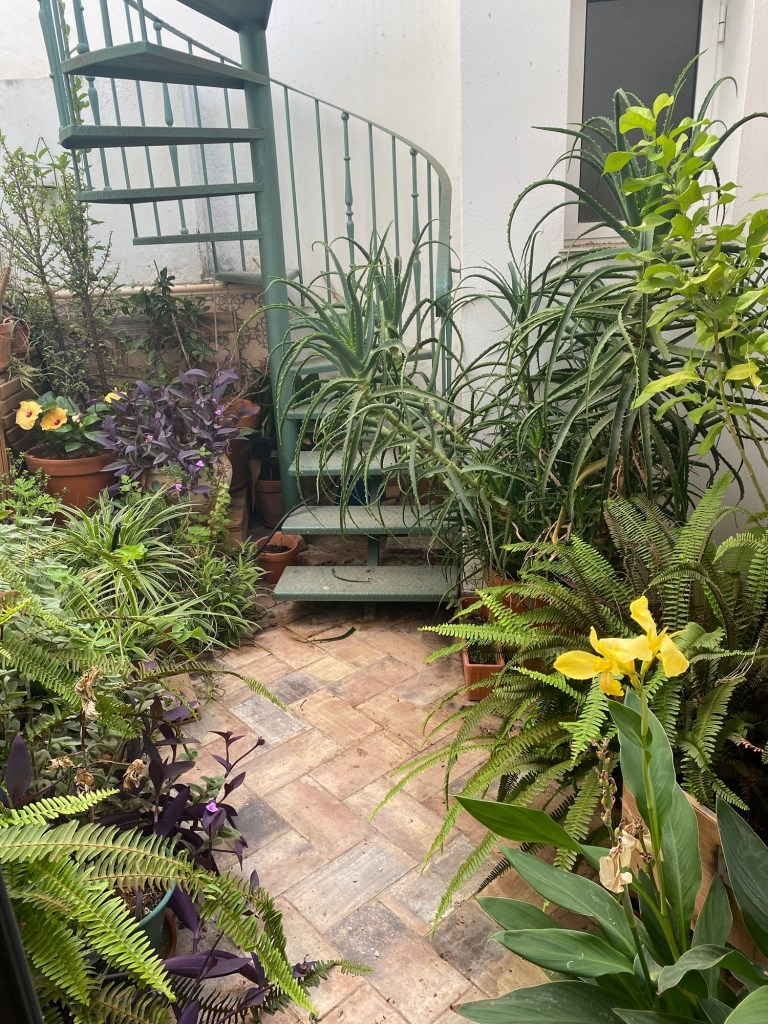
97. Welcome to the jungle

Before we went away for the summer, this was my little patio space, where I had a little table, a couple of chairs, and a love seat. It had a nice number of plants scattered around too. It was a shady space for breakfast or a mid-morning coffee.

But then we were going away for eleven weeks and I needed a keep the plants watered. On the Saturday and Sunday three weeks before we left, I folded away the table and chairs and gathered all the plants from my three outside spaces to here, the shadiest and coolest of my outdoor spaces. They certainly took up a lot of space. I then spent the mornings on the second to last and last weekends (in mid-June) setting up a watering system on a timer. The first of those four mornings was spent just sitting at my kitchen table, reading the instructions, watching YouTube videos and figuring out how to set up an irrigation system.

I got there in the end. It was like putting together some great puzzle, lining up the tubes, inserting the nozzles, plant to plant to plant, until all 50 plants (yep…50…even I was surprised that I had so many) were set up to have a one minute drip feed of water every 24 hours.

What I didn’t have time for was to properly test the system. I should have done it a week or so earlier. That way I’d know if some plants were getting too much or too little water. But I left it too late and just had to hope for the best.

My friends had a key to the house and reported after only a week that some of the plants were being overwatered and they’d turned the individual nozzles down to a mere trickle. Later in the summer they reported that my patio was now like a ‘jungle.’

I was quite dreading how jungle-like it would be on our return. However, I was pleasantly surprised. Sure, many of the plants had grown, but they looked far more lush and healthy than when I’d left them (I wouldn’t be the best at tending to my plants on a regular basis).

A few died. Three owing to a lack of water (the feeder tubes had slipped out of the pots and they didn’t get any water) and another three from overwatering, victims of the success of my irrigation system. When I’d set up the system, those three plants had been exposed to the sun. When I returned I found them in the undergrowth of other plants that had grown furiously, fully shaded and sitting in waterlogged soil.

We’ve been back two weeks already and it still looks like a jungle out there. I’ve gotten rid of the dead ones and I’ve started to move those that don’t belong on the patio back to their usual homes. Some need cutting back. But it’s slow work. One day, in the not too distant future, I hope I’ll have my table and chairs and love seat back again. I hope I won’t have to battle my way up the stairs to the clothesline. I hope I’ll be able to get to the gas bottles when they need to be changed.

But little by little, day by day, I’m getting there. And I’m getting to know my plants all over again in the process.

Lady enjoying the patio in more functional times

61. Playful weather

The last time I came home to Ireland for an extended summer visit – 2023 – it rained every day but two of the almost four weeks we were here. Not always heavily and not always prolonged. But every day but two it rained at least for some part of the day.

I wouldn’t really have minded. We live in a hot, dry country after all, and coming home to Ireland’s more temperate climate doesn’t really bother us. We’re here for family and friends, really. So what if there’s some rain? We just don our rain coats and sturdy shoes and get on with it.

Except that I came home for those four weeks in the summer of 2023 on a mission. I’d planned it in advance, discussed it with Mammy and with my sister. I was here to work. The wrought iron gates and garden furniture needed to be painted and the two sheds needed to be cleared out. On my first day or two home, I went to the hardware shop in Edenderry and bought the paint, brushes, rubber gloves and whatever else I needed. I was going to spend much of those four weeks out of doors, getting these much needed jobs done.

But it rained and rained. Day after day. What could I do? If the painting didn’t get done now, the gates and furniture would be facing into another winter of damage. So, I painted in the gaps in the rain, glancing worryingly at the sky and willing the rain to hold off for a few hours to let the paint dry. It rarely did. The painting got done, but the gates still carry the pock marks of raindrops on not quite dry paint.

The garden furniture was easier. We could haul it into the shed to paint it. But first the shed had to be cleared. I did that over two rainy days – clearing the contents of the shed, loading them into the boot and back of Mammy’s car to take them to the recycling centre, then back home to fill up another load. There were decades worth of old stuff to be thrown out – old paint cans, old rusty tools, old broken bits and bobs from the house and the garden. All hauled away in the rain. And then I tidied up what was left and now had space to paint the garden furniture.

Two days without rain that whole summer in Ireland. And it was cold too. We had to light the fire in July to keep warm.

I arrived in Ireland this year with no plans to do any outdoor work around the house. Well, you can guess what’s happened. Glorious weather most of the time, barely a cloud in the sky. The odd day or rain here and there. We’re dining al fresco for breakfast, lunch and dinner. I could be out painting the gates, or cutting back the hedges, or weeding the patio. Instead, I’m sitting inside at the kitchen table, a warm breeze wafting through the French doors, the light too bright for me to work outside on my laptop.

Maybe if I want a break in this glorious summer weather, I should plan to do a bit of painting.

11. The artist formerly known as…

When she was in her early 50s, my mother decided to take up painting. She joined an art class, bought art supplies and painted some lovely landscapes and rustic urban scenes that still grace the walls of her house.

The Christmas after she took up painting, I arrived home from somewhere, I can’t now remember where. The presents were all under the tree – all except Mammy’s present to me. One of my and my sister’s favourite pastimes in the days leading up to Christmas Eve was to sit by the tree, examining all the carefully wrapped presents with our names on and guess the contents, comparing the size and weight of our respective presents. Mammy explained that she hadn’t put my present under the tree yet, because I would immediately know what it was and the surprise would be ruined. She planned to only put it under the tree in the moments before we unwrapped our presents after tea on Christmas Eve. I had no idea what it might be.

The next day, I went in to Gilroy to see Nana. She made me a mug of coffee and put a plate of biscuits on the coffee table beside the bowl of Quality Street chocolates that was already there. We chatted about this and that. After a while, and seemingly apropos to nothing, she said, “What do you think of it?” “Hmmm?” I said, too busy deciding whether to have another Quality Street or another biscuit. “I don’t think it looks anything like you, do you?” she asked. “Erm, no,” I replied, with genuinely not a clue what she was talking about, but also still too distracted by the chocolate to find out more. And the conversation moved on to other things.

Christmas Eve evening arrived. We ate our tea and then went to light the Christmas candle on the hall table. Daddy lit the candle and the four of us bowed our heads and said a prayer. The moment to open our presents had come. In the middle of tea, Mammy had slipped out to put her present to me under the tree. As soon as I walked into the sitting room and saw it under the tree, I knew that it was a painting of some sort.

We opened our presents one by one, each of us waiting to see what everyone else had received and watching their reactions. The moment came to unwrap my painting from Mammy. I carefully removed the wrapping to reveal…a portrait of ME! Well, sort of a portrait of me. I tried hard not to burst out laughing and one look at Daddy’s and my sister’s faces let me know that they were struggling not to laugh too. But, she’d put so much effort into it and none of us wanted to hurt her feelings. But, God, it was hard.

“I couldn’t get the lips right,” she said. I thought to myself ‘And that’s not all!’. I could see that the lips and been drawn, erased and redrawn many times in pencil, as she tried and failed to get the shape right. My nose was very long and narrow, my eyes strangely slanted and wide-set and my hair sat on top of my head like a helmet. My shoulders were heavy and, although the portrait stopped above my chest, it gave the impression that I had the huge heavy breasts of a seventy year old. “It’s lovely,” I said.

I don’t remember what happened next, but by the next day, Mammy’s portrait of me had turned into a highlight of our Christmas. The first to see it was my uncle Tom, when he arrived out for Christmas Day dinner, and then my uncles and cousins who came out for tea later that evening. Mammy was very quickly in on the joke, realising that this was perhaps not her best work and that the portrait had value of a different kind – it made us all silly with laughter. We discovered the best thing about the portrait was showing it to people with straight faces, pretending that we thought it was brilliant and watching as the cogs moved in their heads as they tried to find something polite to say about it.

The portrait came with me to the UK and, when I met Julian, it came with us to the many houses we lived in over the years. I’d sometimes arrive home late at night to find Julian in bed with the portrait on my pillow, delighted with his little joke. He carried on the tradition started by my own family of showing it to his family and our friends with a straight face and waiting for their reactions.

When we moved onto the boat, there was no room for the portrait, so we put it up in my father-in-law’s loft in Coventry. I imagined it doing a Dorian Grey on me but, I’ve grown older and it continues to not look at all like me! A little over a year ago, my father-in-law downsized to a smaller house and I travelled to the UK to deal with what was left of our stuff up in his loft. There I found the portrait, which I hadn’t seen in years. There was only one place for it – on the wall of the spare room (Lily and Katie’s room) at my father-in-law’s new house.

Lily and I are sleeping in that room at the moment, with Katie relegated to the sofa in the living room. Every time we look up at that portrait we giggle. Who could have guessed that that heartfelt and earnestly created piece of art would have such an unexpected life out in the world.

These are a few of my favourite things

Minimalism is not about getting rid of the things you love. It’s about removing the clutter from your life, so you have more time and space for the things (and people) you love. If your collection of a thousand beer coasters brings you immeasurable joy, and the challenge to increase that collection to two thousand is what gets you out of bed on a Saturday morning, then embrace that. But if you have one hundred beer coasters that have been cluttering up a drawer in each home you’ve lived in since your student days, then it’s time to assess their importance to you and decide if you really need them taking up space in your life.

Of course, sometimes you discover that the things you thought you couldn’t live without are actually completely disposable and that life is, in fact, improved by their disposal.

From childhood I was a hoarder of books. I loved books. I loved reading them, I loved looking at them, I loved seeing them on my bookshelves. I never gave away a book. I only added to my collection. Books loaned and never returned were mourned and my opinion of the rogue borrower significantly diminished.

I lugged books to Japan, added to them, and lugged them back to Ireland again. I did the same in Nunavut, and in the UK, when I moved from house to house from Aberdeen to Cambridge over the space of nine years. Books require their own furniture, so the book cases we bought in Aberdeen were now added to the stuff we had to transport at every house move.

One of the things that attracted me to the house we eventually bought in Cambridgeshire was the potential for a massive built-in bookcase in the dining room, with wall-to-wall, floor-to-ceiling books. When Simon, the carpenter, came around to lay the downstairs floorboards I asked if he’d build the bookcase for me. We planned it together, sitting at my dining table, Simon sketching plans on a scrap of paper as I described what I had in mind. A few weeks later, the bookcases had been built, the dusty blue paint I’d covered it in had dried and I unpacked the many boxes of books onto their rightful home. The sight of it filled me with joy.

A little over a year later, when we made the rather sudden decision to quit our jobs, sell the house and buy a boat, it was obvious that extreme downsizing was called for. I had no problem parting with most of the excess in our lives, but the thought of getting rid of my books was heart-wrenching.

We spent the summer of 2011 drastically downsizing. Every Saturday or Sunday morning Julian drove to car boot sales all around Cambridgeshire, with our Ford Mondeo packed to the roof with all our excess stuff. He usually came home having sold more than half of what he’d packed, £100 in his pocket and the house a little less full of stuff. Each weekend the house grew a little emptier and as the decluttering bug took hold, I was willing to part with more and more stuff that I had previously thought we couldn’t live without.

The only fly in the ointment were the books. At first, I couldn’t bear to part with them. But we had three copies of Moby Dick, two copies of A Short History of Nearly Everything and quite a few books that I didn’t like and would never read again. Two Moby Dicks, one Short History and those books I disliked were the first to go. The next week I put a few more books in the car boot sale box, and then some more, and then some more.

And then I discovered something incredible. On a couple of Saturday mornings Julian stayed home and I went to the car boot sale. I set two boxes of books on the grass next to the collapsible garden table on which I displayed most of the household and garden stuff I was trying to sell. Hardbacks were priced at £1 and paperbacks at 50p. As people browsed at my stall, some stopped to look in my book boxes. Someone might ask if I had any Andy McNab or Cecilia Ahern books. I didn’t, but I would send them in the direction of my neighbour, whose book box I had browsed earlier. Other people were interested in my books and I started to have conversations. If someone showed an interest in Maya Angelou, I would recommend Alice Walker too. If someone liked the blurb on the back of an Isabel Allende, I would also recommend Gabriel Garcia Marquez. I met fellow bibliophiles who wanted to talk about the books I was reluctantly selling. And, because of those conversations, my reluctance evaporated. I now discovered that sending my books out into the world where new readers would potentially experience the same joy as I had brought me greater joy than hoarding them all to myself.

From that point on, I practically ripped books* from their shelves, so eager was I to pass them on to new readers. There were (and still are) books that I would never part with. Most of my academic books were expensive and hard to come by and most non-anthropologists wouldn’t be interested in them anyway, so I’ve kept most of those. I also kept the ones that bring me most joy and books that I have read over and over, and know I will probably read again some day – A Suitable Boy, The Bone People, Lord of the Rings, To Kill a Mockingbird, and a few others.

Since the summer of 2011, with only a few exceptions (Jay Griffith’s Wild, Barry Lopez’ Arctic Dreams)I have never again kept a book once I’ve finished reading it. I now pass books on. Sometimes I pass them on to someone in particular who I think will like the book as much as I do. But more often, I deposit them in book exchanges or charity shops. I still love books as much as always, but I am now a book sharer, rather than a book hoarder.

That one area of my life that I didn’t want minimalism to touch has, in fact, become one of the easier minimalist aspects of my life. And the reward, in conversations and shared thoughts about books, is worth far more than all the dust my books silently gathered on their shelves.

* I said ‘practically’. Clearly, I would never do anything so disrespectful to a book!