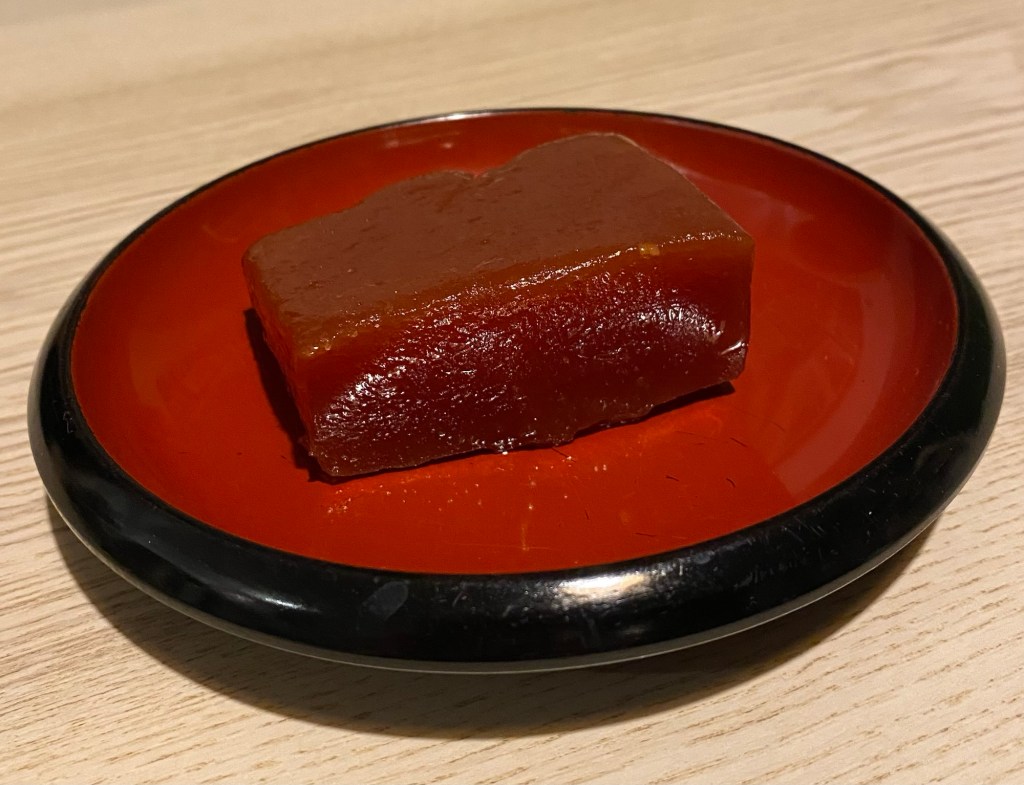
I thought we’d missed the season. I was disappointed. I’ve been parsing out the last bit of membrillo (quince jelly) to Lily and Katie to eat with cheese. ‘Is there any more?’ they ask, when faced with the thin sliver of fragrant amber jelly on their plates. ‘That’s it,’ I say. ‘It’s nearly all gone.’
Since moving to Sanlúcar a decade ago, I have made quince jelly pretty much every year in late summer. First, I pick a large bagful from a couple of trees by the river on the land tended by lovely old Juan de Correos (who sadly passed away this summer), or I get some from the land of my friends, Paul and Diana.
Turning the hard pale green fruits into dark orange deliciousness is a Saturday morning’s work – washing the growth of fuzz off each fruit, peeling and coring them (they have nasty black sticky cores), chopping them into the saucepan and adding sugar and the tiniest bit of water. And then the magic happens. The quince gradually transform from something more akin to a potato than a pear in look and texture into the most fragrant, most floral, deepest orange mush. A quick blitz with the hand blender once the mush has reached setting temperature, and then I pour it into two trays to set. As it cools, it solidifies to a jelly and turns translucent. It’s magical. And the taste is heavenly. When it cools and sets, I cut it into blocks and store it for use throughout the year.
The last of last year’s membrillo
In my house, we eat it with cheese or sometimes on toast. I put it as a middle layer in homemade oat bars, and I even add it to apple pies.
So, imagine how I felt when I thought I’d missed the season. We’d been away for so long and I’m still kind of settling back in to life here, so making membrillo had slipped my mind. Until I realised we were down to our last block. A whole year without membrillo? Unimaginable!
This evening, Lady and I went out for our evening walk and I came to a membrillo tree, branches sagging under the weight of a healthy fruit crop. And then I remembered. This was the very tree that I had picked the quince from last year. This tree comes into fruit later than the other trees that I usually pick from and the fruit last year was much better – no rotten bits, no waspy bits, just perfect quinces.
The tree is on the edge of a field, with half its branches hanging out over the fence and over the edge of the road. It was ftom these branches that I picked last year. This evening, I made a mental note to come back tomorrow with my backpack and take what I need.
As I walked past the tree on the return leg of my walk, the man who owns the field was there. I asked if I could take some quinces tomorrow and told him I’d taken some last year. We got into a conversation about membrillo and it’s many delicious uses and he told me to take what I need.
So, tomorrow I’ll be back by the tree to forage some fruit and, although I’d planned to do something else, Saturday will be my annual membrillo-making day.
We’ve been looking after Hudson for the past week and we’ll be very sorry to say goodbye to him later today. Is there a better doggy in all of England? I sincerely doubt it. He’s been a joy to look after and a great first experience for us in the world of Trusted House Sitters.
Some friends in Sanlucar are signed up to the Trusted House Sitters app and others to a house swapping app. Both use those apps to travel to interesting places and get their accommodation for free. I’m not yet ready for house swapping – not until I finally get around to installing the new oven that’s been sitting on my kitchen floor for the past six months. Trusted House Sitting seemed like a better fit for us at the moment.
So, a couple of months back, I signed up, paid a small annual fee, got three people to write references for me, created my profile and away I went. This week has been our first dog-sit and I will definitely do it again. We made contact through the app with a couple in a village in the English midlands who needed someone to look after their dog and water a few plants while they were away on vacation. We met briefly by video call and then, last Monday, we arrived.
It has been a perfect experience from start to finish. Hudson is the perfect dog. Giant and gentle, easy going and with (almost) no bad habits (we all have some bad habits after all). He’s a dream dog. The house is like something out of a magazine. A modernized old cottage with an extensive garden that is so easy to live in that, really, I don’t want to leave. All over the house and garden is scattered comfortable furniture where all three of us can find our own space to curl up and read our books. The family photos and grandchildren’s arts and crafts suggest this is a house filled with love. And, there is an amazing office halfway down the garden, where I have been working all week.
The house is situated in a very typical middle class English village, with a decent (if expensive) pub and an amazing village shop. All around are paths and byways through the fields, so there’s no shortage of exercise for Hudson or for us.
Our hosts left easy-to-follow instructions for everything from where to find the doggy treats to how to use the air fryer. A gardener came in one day and a cleaner another. It is no understatement to say that I have been living a lifestyle this week that is so far removed from my normal life.
On this house sit, we didn’t venture far. The house itself and the surrounding are enough of a holiday for us, giving us a chance to experience a different lifestyle. But, already, I’m scrolling the app to look for future house sits in cities or towns that I want to visit and, for some reason, I keep putting in searches in the Alps – I really want to take the girls to the Alps some time.
So now, we will say goodbye to Hudson and to his fabulous home and look forward to more house and doggy-sits to come.
I’ve been working hard lately. After a rather worrying nine-month work drought, during which my editing and ghostwriting work dropped to half of what I would normally expect, the last three months have been among the best I’ve had since I started freelancing ten years ago. But, over the nine months of the drought, I watched my bank balance dip to a worrying low. I tightened my belt, carefully budgeted for groceries, dropped a number of subscriptions, cut out weekends away and meals out. But those were only mini bites into my outgoings. The big stuff – the mortgage, my monthly self-employed social security payments, and other such things – well there was no budgeting for them.
I wasn’t alone. Creative industries (and, as an editor and writer, I am in that category) have been hit hard by AI. When we thought things couldn’t get worse, Ebron Skunk’s DOGE slashed funding to US government research that accounts for about 40% of my editing work. Was I worried? Hell yes. Very.
At first, I put the slow-down down to it being summer. August is generally a slow month. But when things didn’t pick up in September, October and onwards, I was well and truly sweating. Work was still trickling in, I was still just about keeping my head above water, but at the start of each month I worried that maybe this month would be the month that I wouldn’t be able to pay my mortgage.
I worked just as hard as ever, saying yes to every editing job that came my way, when before I would have been more picky. I had to dismiss my long-held promise to myself and to the kids that I wouldn’t work on weekends or on school holidays (summer excepted…it’s just too damn long). But I had a whole lot of time on my hands when I wasn’t editing or writing for other people, so I used that time to make contact with potential new clients, to make myself more visible on LinkedIn, to update my website and my online profiles. I had numerous Zoom meetings and phone calls with prospective clients that came to dead ends.
But, in spring, a glimmer of light started to appear down that dark tunnel of money worries. I landed a couple of lovely medium and longer term clients and the one-off editing jobs that are my bread and butter have started to creep up again. I diversified my US work and now have a large ongoing project in addition to almost back to normal flow of one-off jobs. Part of this upturn is down to the work I’ve put in to find work. But I also wonder if clients are starting to realise that what we do as professional editors and writers is far more than what AI is capable of, i.e., human understanding, nuance, humour, and so on.
Since April, every month has been a good month. Fingers crossed, it will continue this way. However, that doesn’t mean I’m out of the woods. I’ve got that bank balance to claw back so that next time a slump comes I’m prepared for it. I’m still not in a position to be picky, so I’m still working most weekends and on holidays. I’m hoping I’ll get to a point soon when I can ease off on that again. I’m 52. I don’t have the energy for this.
Which brings me to Gaia. I’ve been working long hours this past week. I had three deadlines for yesterday. Two of those were really complicated and took far longer to complete than anticipated. When I finally turned my computer off at 9:30 last night I was well and truly ready for a break. But I’m someone who can’t sit still for long. I knew that, if the weather was nice, I’d feel the need to go for a long walk today, to fill up my day with action.
When I woke up this morning it was lashing rain. And it has continued to rain for most of today. No going out. No being active. Gaia insisting that I have the break I well and truly need. I started the morning with 40 minutes of gentle yoga, took the dog for a short walk in the rain, got back into my pajamas when I returned home, and here I remain. I have spent the day curled up in an armchair, drinking mugs of tea and reading the book I’ve been dying to read since the day we got here.
Back to work on Monday but, for now, I am relaxed and at ease and, as I look out the window, I see that it has started to rain again. Thank you Mother Earth.
The heatwave has passed for now. It’s windy and the early morning sky threatens rain. I’m wearing my new raincoat that I bought last week in the height of the heatwave. The sales assistant looked at me funny and I said, “Well, this has to end sometime.” It’s certainly ended now.
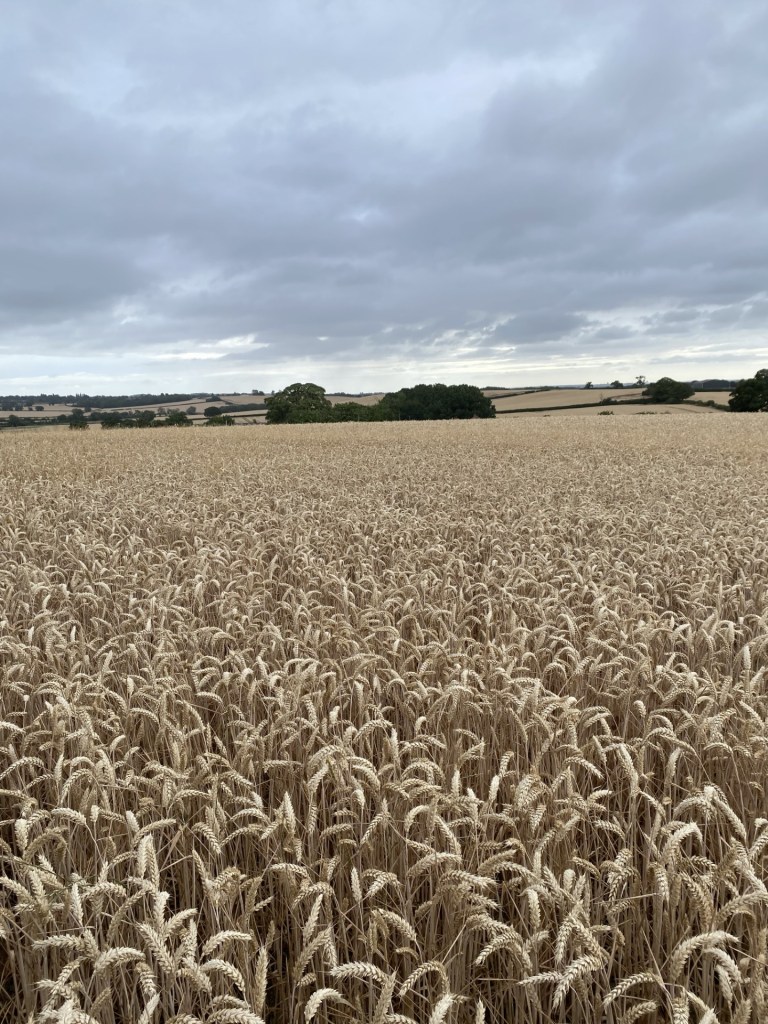
This week, we’re looking after the adorable Hudson (see yesterday’s post) at his home in a little village in the middle of England, while his human parents are away on vacation. It’s 8am and Hudson and I are out for our morning walk. There’s nobody else around, as we walk for a few kilometres along the edges of arable land and across fields of sheep and lambs, from one kissing gate to the next.
One young lamb is curious and tries to come to us, its worried mother keeping pace with it, probably wishing it wasn’t so curious about this big woolly dog and red-raincoated human (what colours can sheep see?). A field of rape seed is half-harvested, a big yellow combine sitting in the middle of the field, ready to resume its work when the rain lets up. I see something move at the wide fallow edge of the field, heads bobbing up and down. I think it is a couple of rabbits at first, but as we get closer, I see that it is a family of grouse. They are disinclined to leave the relative safety of the long grass for the exposed stubble of the field. I think I should turn back and leave them be. But at the exact instant I have this thought, one flies up from right at my feet, completely invisible to me and to Hudson up to now, scaring me and sending all the others into flight too. They fly the 20 or so metres from the grassy verge into the yet unharvested half of the field. I feel bad for them. Hudson is good, though. My own dog, Lady, would be going crazy for them, but Hudson seems oblivious.
A little farther on, I step over a badger sett. It looks neat and tidy and, therefore, in use, and I get a little thrill thinking that, underneath my feet, a family of badgers is likely settling down for the day to sleep. Towards the end of the walk, we pass a small patch of open grassland backing onto a copse of trees. Two hawks circle each other ten or so metres off the ground over the grassland, crying out to each other. One lands in a tree and the other continues to circle, eventually settling on the branch of a nearby tree. Their cries continue to ring out.
I am reminded of other early morning country walks along English pathways – in the Fens and Cambridgeshire, up north in Cumbria and down south in Devon – and of the hares, the muntjac and the red deer, the red squirrels, the badgers and foxes, the eagles and hawks and falcons and owls, of the times I have been privileged enough to see those animals in person and the times when I have found signs and signals that they have been there and may still be there, watching me, the clumsy human, walking through their home.
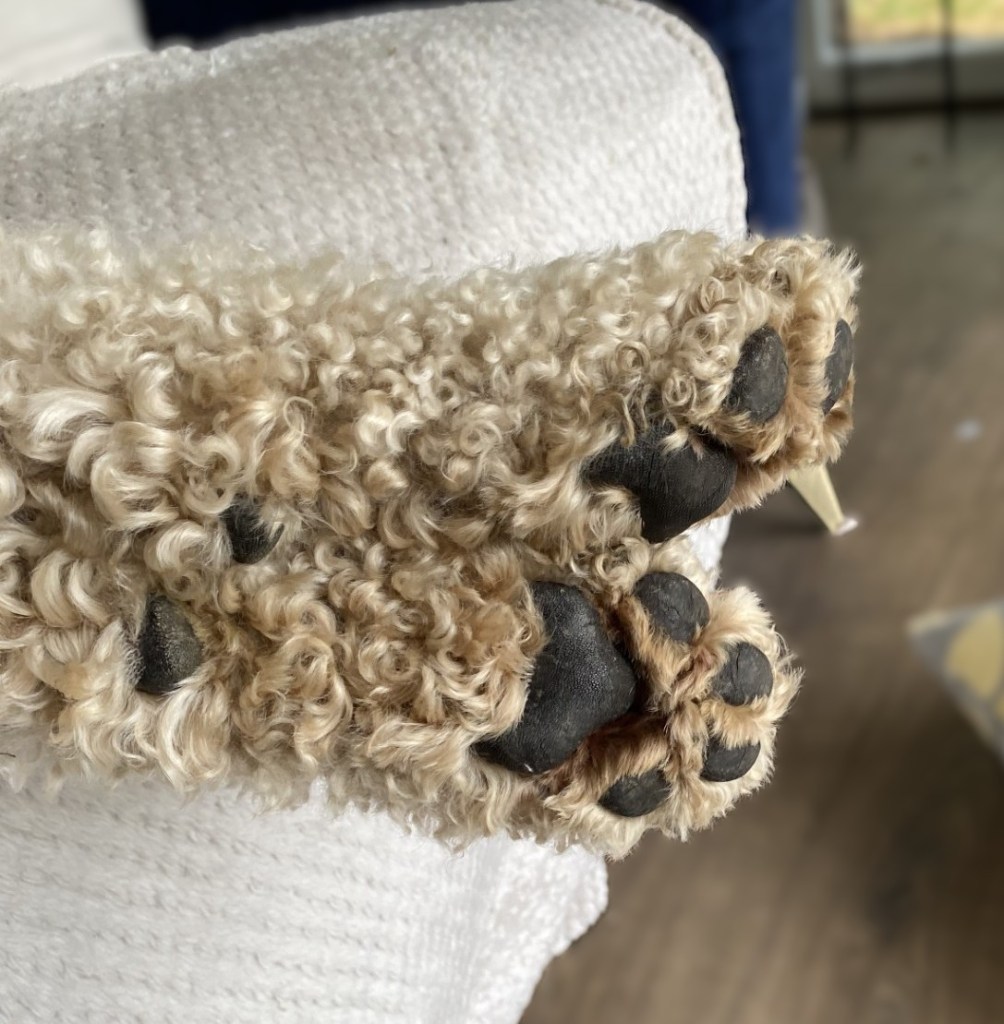
This is Hudson. Look at that cute face. Look at those long legs. Look at that soft fur. He’s the reason I haven’t had time to post a blog today! I’ll be back tomorrow though!
A few days ago, when it was too hot for Lady’s little paws to be on the road, I took her down to the river for a swim. When I got there, I spotted a yacht on the pontoon called Sedna. I got very excited. Sedna (or Nuliajuq in the Kivalliq region of Nunavut) is the supreme goddess of Inuit mythology. Goddess of the sea, she hides and protects the marine animals in her long flowing seaweedy hair, only revealing them to hunters who prove themselves deserving. How does she decide who’s deserving? It’s those hunters and, more importantly, their wives, who generously share the meat and fur and other parts taken in the hunt. In the old days (and in some quarters still today), Inuit believed that animals, once released from Sedna’s hair, gave themselves to generous hunters.
So, I got very excited when I saw this boat. The way I got excited in the past to see a boat called Aarluk (orca) or one called Nanuq (polar bear). One doesn’t expect to see Inuktitut words in southern Europe! I couldn’t resist popping down to the pontoon to say hi and inquire as to why the owner had named his boat after the Inuit goddess of the sea. I mean, a goddess of the sea I get; but the Inuit one specifically?
I saw that the boat was flying a Spanish flag and had a Spanish registration mark printed on the hull. There was a man in his seventies in the cockpit. ‘Buenas tardes,’ I said, assuming that he, like his boat, was Spanish. When he replied in English with a British accent, I said hi, and told him, perhaps a little over-enthusiastically, that I’d noticed his boat was called Sedna.
‘Oh yeah,’ he said, distinctly less enthusiastic than I was. ‘Why did you call it that?’ I asked. ‘That’s what the previous owner called it and I didn’t bother to change it.’ He seemed not curious, not interested, not bemused, not annoyed that I’d bothered him. Indeed, he seemed not really anything at all that this overly-exuberant Irish dog-walker on the Spanish border was trying to make conversation about the name of his boat.
‘Do you know what it means?’ I asked.
‘Nope,’ he replied.
‘She’s the Inuit goddess of the sea,’ I started, but he cut me short and asked, ‘Do you live here?’ He was completely disinterested and my little bubble of excitement at having found someone who might share my interest in Inuit mythology and Inuit culture was immediately burst.
I laughed at my silliness after. At how I had imagined our conversation would go and at how the conversation actually went. I chatted with him for a few minutes more, answering his questions about life in the village, and whether I still owned a boat, and whether the schools around here are any good. Then I said goodbye, wished him luck on his sailing trip and Lady and I carried on on our merry way.
In late December, I set myself a challenge to walk 200km in January.
2023 had been an exceptional year for me. I was joyful and exuberant in turning 50 and everything about my life seemed to glow. That was until the end of the year, when it felt as if someone let the air out of my balloon. From early December, I felt lost, drained, living in a cloud of cotton wool, from which I neither could nor desired to work, be with other people, or drag myself out of the house.
Happiness and contentment are my default modes. If chemical imbalances play a role in the onset of depression, then I often think that I have chemical imbalances in the other direction. I’m chronically happy. I’m annoyingly upbeat. My glass is always way more than half full.
Except at the end of 2023, when it wasn’t. I had no reason to feel down, and yet I did. A weekend in Sevilla uplifted me momentarily but, even there, I was unusually sharp with my daughters and, at times, felt the strain of being in a city more acutely than usual. Then I came down with COVID and a week in Tenerife over Christmas that was supposed to relight my lamp instead left me feeling even more down in the dumps. I returned home to Sanlúcar COVID-free but feeling flat.
Then one day, in the last week of December, I set out to walk the dog. Not an ‘oh god, I’ve got to walk the dog’ sort of walk, the kind that had become my default over the past year, when I’ve increasingly cited lack of time, but a ‘let’s see how far we can go’ sort of walk, with a backpack on my back, containing my water bottle, a notebook and pen, and my phone to take photos. I walked north, along the path that leads up the river, stopping to allow myself to be enveloped in the silence, to watch a raft of canes drift down the river, to marvel at the orogeny on a wall of rock. The dog, of course, loved it too, walking farther than she had in months. At the farthest point from home, I decided to set myself the challenge of walking 200km in January.
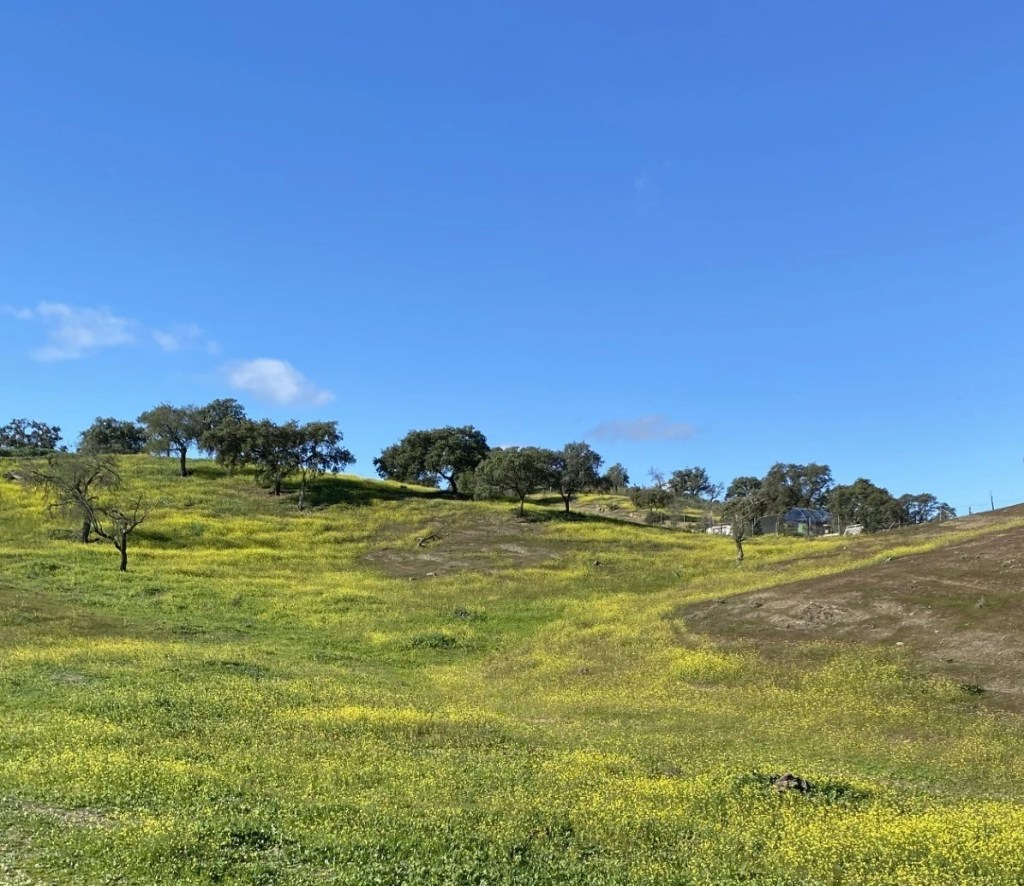
I walked for the first few days of January, recording the distance so that I had a sense of how far I might walk in a certain amount of time and considering how I could make space in my work day for this challenge. On each walk, I was uplifted. The land was brightly green, decorated with patches of wildflowers, yellow and white. It was a balm to the eyes and to the soul. Each day, though my spirits descended again when I returned from my walks, the troughs were not so deep. By the second week of January, I felt like myself again.
Some days I walked 10km or more, one day I only managed 1km. I walked at all times of the day – in cold early morning mist in jacket and woolly hat, bright afternoon sunshine in t-shirt and sunglasses, at sunset, carefully picking my way along rocky paths in the dark; Lady always my faithful companion, the land I walked through nourishing and uplifting me.
By the end of the month, I had walked 201km, along paths leading out in a radius from my house. I became reacquainted with places I hadn’t walked in years, just as I became reacquainted with why I love living here in the first place – the immensity of the land, the stories it tells of the people who lived here before, if only you take the time to read those stories in the landscape, the other creatures nourished by the land, and the river that brought me here snaking through it all; the vastness of the sky, at times a blue so deep as to seem unreal, at times ominous shades of grey, at night the riot of stars a glorious reminder of my insignificance, the Milky Way mirroring the route of our little river.
Over the course of the month, I observed changes taking place – sudden changes brought about by a heavy rain shower, slower changes as grasses grew, the number of lambs in a herd of sheep increased dramatically, the oranges continued to ripen and fall from the trees. I have found one, two, or even three hours in each day to walk. Those hours were there for the taking all along, I just failed to see them. Walking became the fulcrum of my day throughout January, uplifting me, soothing my soul, reassuring me that in the face of such ordinary magnificence, it is only to be expected that happiness is my default mode.
As for February? I’m back on the tracks and trails again, mostly in the lengthening evenings, challenging myself to another 200km. It hardly feels like a challenge. It’s starting to feel more like a drug.
The road was dark and empty. Lonely. I wondered how long someone – me – might lie there unaided if their car ran off the road. How long before another car would come along. It could be hours. I knew I was driving too fast, the fall-away at the side of the road and the deer signs telling me I should slow down. But my tiredness and desire to get home pushed me on. What would the consequences be if I crashed? I could die. I could cause myself life-changing injuries. I could kill the dog.
I’d very nearly killed the dog once already today. That was why we were on this lonely road after midnight, with the Google maps woman telling me where to go long after I knew where I was and didn’t need her anymore. This lonely stretch of 16km, another lonely stretch of 13km, then the final lonely stretch of 8km.
I’d laid an old bedsheet on the back seat of the car in case Lady vomited. It had been a last-minute decision. She was already in the car; I’d packed what I was taking with me and I was about to get in when I thought about the potential for vomit. So, I ran back into the house and grabbed a sheet from the box of painting supplies on the high shelf in the utility room.
I expected her to vomit because, in the past hour, I’d force fed her 40mls of extremely salty water and, before that, 10mls of olive oil. She was miserable from all this manhandling and force feeding. Why was she being so horribly punished?
She’d be dying unbeknownst to me right now if I hadn’t spotted her eating what I at first thought was a stolen slice of chorizo. Naughty girl, I thought, but I left her to it. Then I saw she had another one – or was it the same one? I couldn’t be sure. It seemed to be wrapped in plastic. I called her to me, prized it from her clenched jaws and started to remove what I thought was a plastic wrapper only, to my horror, to read the words, in Spanish, ‘raticida’. Rat poison. I took it to the bin and, as I did, she went back to the source, behind the bin, and found another one. I made her drop it and I wondered what to do. Had she eaten one already? Or was the one I removed from her mouth the first one? My walking buddy Jennifer calmly Googled what to do and said, ‘She needs Vitamin K.’ I left my half-full glass of beer on the table and walked home, calling the vet along the way.
The vet advised 10mls of olive oil, which should stop her absorbing the poison if there was any in her system. “Keep an eye on her,” she told me, “And if you see any changes in her, call me.”
I forced the olive oil into her and then Googled ‘My dog ate rat poison’. Without exception, every site urged going to the vet immediately: ‘Do not waste your time trying home remedies’.
I called the 24-hour emergency vet in Huelva for a second opinion. She advised me to force feed her very salty water. With a syringe. Sideways into her mouth so it wouldn’t go into her lungs. Based on how far away I live from Huelva and how long it had been since she’d possibly eaten the poison, if she didn’t vomit in an hour, I was to take her in. It’s critical that you don’t let too much time pass, she said.
I didn’t have a syringe. Someone with a small child is bound to have syringe, I thought. I phoned Egle because she has a three-year old son. Soon I had a syringe and I managed to get 40mls of water into Lady in the face of major opposition. Katie held her. I held her. I chased her around the kitchen table. She wriggled backways out of Katie’s grasp and under the table. Was 40mls enough? The vet hadn’t said how much was enough.
I didn’t want to wait to see if she’d vomit. I made supper for the girls, packed a few things in a bag – my book, wallet, doggy passport. My head was pounding and I could feel the world closing in around me in what felt like the start of a panic attack. I couldn’t imagine how bereft we’d be if the dog died. She’s been our rock of joy through so much in her short three and a bit years of life.
Forty minutes after I’d forced the salt water into her there was still no sign of her vomiting. I got in the car, grabbing the old sheet for the back seat, and set out on the one-hour drive to Huelva. It was a horrible night for driving. Rain on the windscreen, the inside of my old car misty with condensation, the roads wet and a seemingly endless stream of headlights of cars coming from the opposite direction.
The Google maps woman took me on a route that ultimately got me lost. I was losing precious minutes. I would have found the building easily on my own, had I looked at a map and not relied on that Google wan.
When I finally parked up, Lady jumped gleefully out of the car, expecting a walk. Her glee was short-lived, however, when she realized we were going to the vet. She’d never been to this vet before, so what was it about the place that made her stick her tail between her legs and try to escape back out the door? The vet’s clothes? The smell of the place? Whatever it was, Lady knew trouble was in store and I had to drag her in the door against her will.
“I’m going to give her an injection that will force her to vomit,” the kindly-faced vet said. Lady struggled and screamed while one woman held her and the other stuck a long needle in the scruff of her neck.
“Where should we go?” I asked.
“Stay here. She can vomit on the floor. Animals are always vomiting on the floor here,” the vet said matter-of-factly. I sat on the long blue bench, and looked around at the blue plastic floor, imagining a room full of animals of all shapes and sizes simultaneously vomiting. Lady sat beside me, glued to my leg.
Two women came in, a mother and daughter, and natives of South America, I guessed. The older woman, red-eyed and still crying, carried in her arms a cat on a cat bed. The vet saw them into her office.
And that was when the vomiting started. Lady started to retch, making a hideous noise as she did so. First out of her mouth and onto the blue plastic floor were two packets of rat poison, still intact, both with the word ‘raticida’ still clear. The woman at reception came from behind her desk with a roll of paper towels, a bottle of bleach and a bin liner. We hunkered down together and peered at the vomit. The two sachets of poison certainly looked intact, but it was hard to tell if they’d been breached. Meanwhile, Lady was retching again and this time produced the chicken she’d had for lunch. As I cleaned up one pile of vomit, she produced another. I left the first pile where it was, for the vet to see when she came out.
The door to the consulting room opened and out came the vet and the two women, both sobbing, tears streaming down their cheeks, the cat nowhere in sight. The vet hunkered down and inspected the contents of the first pile of vomit.
Behind me I could hear the two women making arrangements for their dead cat with the woman at reception. “What name do you want?” she asked. Both women said the cat’s name a few times, but the receptionist couldn’t get it right. “I don’t want to get it wrong,” she said gently and handed the older woman a piece of paper. “You write it down.” Meanwhile, Lady stood by the legs of the younger woman, wretched and retching, and I thought, with horror, about to vomit onto the woman’s shoe. That’s all the poor woman needed – being vomited on by some stupid dog minutes after her cat had been put to sleep.
I grabbed Lady by the collar and pulled her to me, trying to keep her close – or at least away from the mother and daughter – while I cleaned up the vomit. As soon as I cleaned up one pile, Lady produced another.
The two women stood around, while the receptionist completed their paperwork. I didn’t know how to react to their grief. I wanted to console them, to say I was sorry for their loss, but the proper words in Spanish deserted me and all I could do was clean up and feel awful that they were grieving for their cat on a dog vomit-covered blue plastic floor.
“When should we come back?” the older woman asked the vet. “It’ll take a few days,” the vet said. “I’ll call you when it’s ready.” The ‘it’ I presumed referred to the cat’s ashes. The pair left, the cat basket under the older woman’s arm, empty. Their loneliness for the cat was palpable.
The vet gave Lady a second injection to quell the nausea and gave me a prescription for Vitamin K. I got lost twice or three times trying to find my way out of Huelva, despite (or because of) the Google woman. It was almost 2am by the time we got back to Sanlúcar.
In the days that followed, Lady showed no ill effects of the poison. It is likely she vomited it all up. For the next ten days, I forced her to take Vitamin K four times a day and an anti-nausea table to counteract the Vitamin K twice a day. She really hated me for those ten days, eying me suspiciously every time I went into the kitchen, for fear I’d return with the syringe or the pills.
Has she learned her lesson? Of course not. She’s a dog.






 Me in place