What’s your favourite smell? Freshly mown grass? Fresh coffee? That smell when you nuzzle your face into a baby? Why is it your favourite smell? Do you know?
I was sitting at my desk yesterday morning, the window open to cool the house down before the heat of the day kicked in. That’s when the smell came tumbling in and nostalgia stroked my face like a feather. One of the council workers was strimming the strip of grass that runs the length of my street. And there it was: The smell of exhaust from a 2-stroke engine. There’s comfort in that smell for me and it’s deeply entwined with so many good memories.
We’re living on Carina of Devon. Me and Julian and the girls. The smell of a 2-stroke engine is us leaving Carina to head off on an adventure in the rubber dinghy. Maybe it’s all of us, going ashore to explore a new place or to wander up a river that’s too shallow for Carina‘s draught. Or I’m on my own, the freedom of having the outboard tiller in my hand, setting out to go for a solitary walk or to go shopping or do the laundry. Or it’s Julian, taking the girls across the Rio Guadiana to school. Or it’s all the other yachties we met over the years, the smell and sound of a 2-stroke outboard motor signalling their arrivals and departures from their anchored yachts. It’s adventure and freedom.
Strip that layer away, and I’m living in Arviat. It’s summer, with open sea and lake-pocked land. I have my own quad bike and I zip around town in the near 20-hour daylight, picking my friend Crystal up at 3am, so we can go check the fishing net we’re sharing for the summer, or meeting Frank at 5am to go beluga hunting. His quad has Arden’s boat trailer attached on the back, so I hop on and reverse the quad into the sea under Frank’s guidance; he offloads the boat, as I park the quad and trailer. Or I’m out along the road to the dump, or the road past the reservoir, at twilight or after dark, speeding along way too fast, sometimes alone, sometimes not. In my mind, I’m a badass. In reality, probably not.
Strip that layer away, and I’m living in Arviat. It’s spring, and I’m at the floe edge with Arden. We’ve come by skidoo; him driving, me sitting in the qamutik (sled), facing back towards Arviat, back towards the direction we’ve come from, to shield myself from the powdery snow blown up by the skidoo runners. I’m surrounded by the immense beautiful whiteness of the west coast of Hudson Bay. We’ll stop when we get to the floe edge. Arden will talk to me and teach me, I’ll try to remember everything; we’ll drink tea and eat the bannock Theresa has made for us.
Strip away that layer and I’m at home in Ballygibbon. I could be 10 or 20 or 25. The 2-stroke exhaust is Daddy mowing the lawn. It’s the ease and efficiency of the first petrol-powered lawn mower after years of a small, manual one. It’s me spending summer evenings following Daddy round the garden – at 10 or 20 or 25 – just for his company and the important things we have to talk about – Gaelic football and films and music, a bit of politics and other sports.
When I catch a whiff of 2-stroke exhaust, it doesn’t conjure any one of these times in my life in particular. Rather, it mashes them all up, and loosens something in me, a knot unravels, and a feeling of belonging rushes through my veins. Now, I am here, with a view out my window that’s as green as I could ever have hoped for. And a new layer is added to my love of that smell.
‘Turn on Radio 1,’ Niamh said, as we got into our cars to drive in convoy across Kildare. ‘Sunday Miscellany is all about the bog this morning.’
I led the way along the bog road, through Allenwood and Prosperous, past the road down to Coill Dubh, through a landscape I have known all my life, a landscape so densely entwined with memory and meaning.
It’s impossible to come from the midlands of Ireland and not have the boglands seeping through your veins. This great flat landscape, the fuel source around which our year and our society revolved. The footing and the haping, and tea from a milk bottle and sandwiches wrapped in waxed paper. Cold March Saturdays of the men cleaning the turf bank all the way through to warm August Saturdays of bringing the turf home.
And it’s the poetry and the music – Heaney and Christy Moore and Luka Bloom. It’s the dissertation I wrote as an undergrad and the bog PhD I started in my 20s.
As I drove across the bog, I listened to the radio programme, as Niamh suggested. It was filled with the stories, songs, reminiscences of people from the midlands. Some people, like me, who have chosen to live abroad and have never found a way to adequately describe and explain all that the bog is to people who don’t know it. And some people who had lived in the bog their whole lives, who evocatively expressed what the bog meant to them.
To listen to this as I drove across the bog this morning was moving enough. But today also happens to be the 21st anniversary of the day that Daddy died. And for me, above all else, my memories of the bog, and what the bog means to me, are inseparable from my memories of Daddy.
It was, therefore, a bittersweet drive, with the stories and the road and this particular day, all evoking memory and emotion, and tears running down my cheeks, not of sadness, but of gratitude for this place and all that it means to me.
I remember I was eight or nine years old. Daddy had dropped Mammy, my little sister and me to the train station, to get the train down to Cork. We were coming here. I was wearing a new summer dress. It was so pretty – a pastel flower pattern. It was my first time to wear it. I’d been saving it for a special occasion and this was it. As we waited for the train, I squatted down and sat on my hunkers on the platform. Not realising that the hem was caught under the heels of my sandals, I stood up again as the train approached. I heard the fabric tear. I was horrified. My gorgeous dress ripped across the back, along the hem. I felt so sad. Something had been done that couldn’t be undone. I wished I could turn the clock back just a few seconds. The next week, my dress was mended, but the line where it had ripped and been restitched remained, visible if you knew what to look for. To an onlooker, it might have seemed like a trifling thing. But I never forgot that dress and that instant when I ripped it.
There are moments, brief, precious, rare moments, when the thunderous roar of anxiety, and obsessive compulsion, and the abuse of substances quietens, and he and I find common ground. I lean into those moments, for the ten or twenty minutes they last, catching the briefest glimpse of him underneath the sedimentary layers of trauma laid down over seven decades.
I’ve been writing today’s blog post all day. It wasn’t very long. Only about 200 words. But when the moment came, I simply couldn’t post it. I felt it would probably offend people, or make people mad at me. Not you out there, who read my blog. But a few very specific people, who I suspect never read my blog.
But what if they do? I ask myself. What if they get mad at me? What indeed? You see, try as I might, I’m a people pleaser. It’s the part of my personality that I like least. I can’t bear to think that people are mad or upset with me, or that they think bad of me. I fear confrontation and conflict. Always have.
The good side of that part of me is that I like people very much. I get a kick out of people. I enjoy the company of people. I want to help out the people I love and also people I don’t know.
But the flip side is that I can get in a knot about getting on the wrong side of people I neither like nor respect.
So, today’s blog was going to be about how good this trip to the UK has been. About how the usual triggers of palpitations and panic attacks have not triggered me this time. I couldn’t post that. Because the triggers might read it. But, while I’m not ready to take that step, I know that a big part of not having panic attacks this time around is because, sometime in the past year, I decided I’m too old for people pleasing.
About this time six years ago, I started to drop in to visit my friend Angela regularly. She was 82 years old at the time. What started as a one-off visit for a gin and tonic one Sunday evening, turned into a weekly affair. I’d pop around at 6 o’clock each Sunday evening (or later during the summer), the gin and tonic on the worktop ready for me to pour. I’d make us a glass each and then we’d sit and chat for the next couple of hours, with Miranda the cat sleeping by the gas fire, Mora the dachshund trying to sneak onto my lap, and Archie the African grey parrot adding his own opinions to the conversation. Our conversations were far-ranging. We talked a lot about the books we were reading, the movies we had watched, with each of us often taking up the others’ recommendations. She frequently quoted poetry to me – long-remembered lines that popped into her conversation, appropriate to whatever we were discussing. We talked politics – from our little village all the way up to the international level. She talked about her childhood during the war, her years in London as a trainee nurse, and then her married life raising her three children in Wales. Being a retired nurse, no topic of conversation was too delicate or too squeamish for our Sunday evenings. With deteriorating eyesight and hearing, she preferred these one-on-one get togethers with friends in the quiet of her own home.
When COVID came the following spring, our Sunday night visits continued via WhatsApp video. We’d each pour a glass of red wine or a gin and tonic in our respective homes, only a few hundred metres away from each other and carry on our conversations are normal. How happy we were when we finally got to meet in person again.
As her eyesight deteriorated, she found ingenious ways to continue reading and watching movies. She turned to Audible and listened to books now and she devised an iPad and magnifying glass set-up to allow her to continue watching movies. For a woman of her years, she was remarkably tech savvy and had a weakness for buying clothes and gadgets and all sorts of wonderful things online.
One Sunday evening in the early summer of 2021, she announced, “I think I’ve gone and something totally mad.” I expected it to be some new online purchase. “What have you done?” I asked. She told me that, at the age of 84, she was tired of living in a house that didn’t have a garden. In whatever remaining years she had, she wanted to grow vegetables again and keep hens. This wasn’t too shocking. After all, at the age of 77, she had decided to sell her home in Wales and moved to Sanlucar de Guadiana. “What are you going to do with this house?” I asked. “I don’t know,” she said. “I haven’t thought about it.” “Would you sell it to me?” I asked. The girls and I were living in a big old rented house at the time and I was despairing of ever having a house of my own. “Yes,” she said, without pausing to think about it. I’d no idea how I was going to afford this house, but was determined to find a way.
And so began the next phase of my relationship with Angela. She was happy to sell me the house, but under certain conditions, the main one being that the girls and I live in it for a year to see if we really liked it. During that year, I would pay her a tiny amount of rent, which would allow me to save up for a deposit for a mortgage. If, at the end of that year, I decided the house wasn’t for us, we could walk away, and she’d put it on the market. A couple of months later, she moved out into her new house – just 50 metres along the same street – and I moved into her old house and she became my landlady. Our weekly get togethers continued, now at her new house and we continued to put the world to rights for those two hours every Sunday evening.
When I quit drinking and she mostly quit drinking, our Sunday evening chats came to an end and I started to drop in to her on Monday or Tuesday mornings instead. I never tired of our conversation and felt something was missing on those occasional weeks when, for one reason or another, I couldn’t make it over to spend time with her.
Almost two years ago she fell in the house, slipping on a piece of plastic on her living room floor. She broke her hip and spent some time in hospital. But soon she was out, valiantly doing her physio exercises and getting her fitness back on a stationary bike that she bought and installed in the spare room. Although she was frustrated with her slow recovery, the rest of us were amazed by her speedy recovery and soon she was out walking the dog again, first using a walker, then crutches, then a walking stick. About six months later, she fell again, this time breaking her wrist, when she got tangled up in the dog’s lead while out walking up a steep hill one morning.
Her eyesight continued to deteriorate and her next ingenious online purchase was a gaming chair and TV. The sight of a tiny 87-year-old woman sitting in a teenager’s gaming chair was something else! I’d drop in and she’d tell me about some 1940s black and white movie she’d watched, recalling Hollywood stars in movies that were old even when I was a kid. She introduced me to The Rest is History podcast and we got great mileage discussing the various episodes we’d listened to.
She remained positive and engaged and witty, despite her body increasingly letting her down. I can’t list all the things she carried on doing – gardening and baking and taking trips back to the UK and just being engaged with the world – that people half her age have already given up on. I thought often of Seamus Heaney’s Field of Vision when I was with her. He might have written the following lines about her:
She was steadfast as the big window itself.
Her brow as clear as the chrome bits of the chair.
She never lamented once and she never
Carried a spare ounce of emotional weight.
She was a loyal friend too, not just to me, but to so many of us in Sanlucar. Every single day, without fail, she had a phone conversation with Val (Honeybunch) her friend back in the UK from her nursing days in London in the late 1950s. That’s friendship for you.
For all her amazing attributes, she was my hero. I don’t aspire to be like her in my 80s; I aspire to be like her now. Her attitude to life was like that of no-one I’ve ever met.
Only four weeks ago, she was diagnosed with incurable cancer. I had the privilege to spend a lot of time with her in the first three of those weeks and, despite her increasingly frail body, we continued to laugh and take an interest in life. On the last day I was with her, when her body seemed to not be able to go on any more, she continued to tell me fascinating stories about her life. When I left to come to England last week, I knew how much I would miss her as we said goodbye for the last time and I knew that she would be sorely missed by all of us who have had the privilege of having her in our lives.
Angela died yesterday afternoon.
Angela handing me the keys three years ago, the day she sold her house to me.
I’ve been spending a lot more time with Angela in these last few weeks, since she was given her terminal prognosis. My weekly visits for morning coffee have evolved now into twice or three times a day visits. I know our time is short. I will leave to go to the UK soon and she will simply go. I call in at 11 each morning and again at 1:30 and maybe again at 3pm. Sometimes she’s asleep and I simply check on her and leave again. More often than not, however, she wakes when I come in, I help her to sit up, go to the kitchen to pour her a cold drink and make myself a coffee, and sit with her and chat.
Despite being noticeably more frail with each passing day, her memories are as sharp as ever. She quotes Tennyson and Shakespeare. She recalls a book on Pembrokeshire written by someone called Loxley that she borrowed from the library 61 years ago. She tells me about her first ever time on an aeroplane when she accompanied a patient from London to Trinidad and got drunk on gin and coconut water when she got there. She tells me about being a trainee nurse in London in the late 1950s and writing letters home to her parents in Leicester every day. Despite our weekly get-togethers over the past number of years, I learn more about her every day.
But I’m also in a rush. I’m leaving home soon and I won’t be back for ten weeks, so there are preparations to be made, the fridge to clear out, everything organized for the dog to go spend the summer with friends. I will be working all summer while I’m away, so I need to remember to transfer all my work from my computer onto my laptop. On top of that, I have an unusually large amount of work on my plate with various deadlines looming, so I’m trying to keep four different editing and writing plates spinning at once. Five days before I leave, a neighbour dies and the next day another. That’s two funerals now that I want to attend. On the day the first neighbour dies, another friend is rushed to hospital. Her husband is at a loss and asks me for some help. I wake up the next morning to discover that one of my kayaks has been stolen. I discover the next day that it’s been abandoned over the river, so now I have to go retrieve it. To say things are frantic and chaotic in these final few days is an understatement.
Yet, in the midst of it all, I continue to call to Angela two or three times a day. On Monday, she’s feeling weaker than ever and her every movement is slow and laboured and requiring lots of breaks. When she’s finally sitting up, with a glass of drinking yoghurt in her hand, she smiles at me and says, ‘It’s alright. We have all the time in the world.’ And you know, she’s right.
For all the mad rushing around, the lack of sleep, the ‘not-another-thing-piled-on-top-of-everything-else’ sort of week, here in her bedroom, time is meaningless. It’s just her and me, sharing our stories as always, making each other laugh, making each other think.
On my last day, as I finish up my work, finish packing, finish prepping the house to close it up, and count down the hours till my 7 o’clock departure, I decide to embrace Angela‘s insight that we have all the time in the world. When I visit her mid morning, she’s asleep. I don’t wake her but neither do I go home. Instead, I make a coffee and sit with her for half an hour, feeling time slowing down and my shoulders beginning to relax. When I return a couple of hours later, she’s awake. I help her up so that she’s sitting on the edge of the bed and we talk and talk and talk. For that hour, in that room, we have all the time in the world.
I’ve been thinking a lot about ritual lately and, in particular, the comfort and familiarity of ritual at liminal and transformational times, such as death. I think back to twenty-one years ago, when my father was in his last days. One of the lovely palliative care nurses suggested that, as the inevitable approached, we talk to the undertaker so that, when the time came, he knew and we knew what to do. My mother, sister and I considered cremation, based on something brief and passing that Daddy had said many years before, when he was in the full of his health. But cremation wasn’t our tradition, none of us had ever been to a cremation and we were pretty sure that none of the other mourners at Daddy’s eventual funeral would ever have been to one either.
A couple of days later, I met the undertaker for a coffee and a chat. We went to school together, so I’ve known him most of my life. He was kind and caring. He said that of course he could undertake a cremation, but it would not be like the funerals we were so familiar with. It would have to take place at the crematorium in Dublin and it would be a number of weeks before we had a date for it. While we could still have a funeral in our parish church in Cloherinkoe, there wouldn’t be that moment of burial that is the final and closing act of all the funerals we had ever been to. He advised against it, saying that, for us, for our extended family and friends, and for the many other mourners, the familiarity of the Catholic funeral and burial would be a greater comfort than doing something very novel, such as a cremation. We weren’t bent on a cremation, and we didn’t think Daddy would be either, so when I returned home to report on my conversation with the undertaker, my mother, sister and I decided to go with a traditional and familiar funeral.
A few days later, when the moment finally came, I remember how easy it was to slip into the role that that ritual expected of me. We all knew what to do, how to behave. The mourners who came to our house for the wake knew what to do, what to say to us. We all knew the protocol for saying the rosary, for sitting up with him through the night, for his removal to the church the next evening, for Mass the following morning, and for his final journey to Carrick graveyard. And we all knew the hundreds of tiny rituals within all of that – the brief words, the gestures, the tea and the ham sandwiches. Decisions were lifted from our shoulders, because we simply did things the way they had always been done, all the steps unchanged. But it wasn’t only that we knew what to do. It was that we were doing it in community with others. Hundreds of people filed through our house in the two days of Daddy’s wake, hundreds more came to the funeral. And because we all knew what to do, people were relaxed and at ease, with us and with each other. Familiar ritual gave us space to express and to sit with the profound grief we carried in those few days immediately after Daddy’s death.
I’ve been moved to think about this lately. In the past couple of days, I’ve attended two funerals in our tiny village. On Sunday, it was the funeral of Juan, in his late 90s, the oldest man in the village, who had suffered an illness in recent months, at the end of a long and active life. On Monday, it was the funeral of Maria, from the village shop, in her 80s, who died after a very brief illness. Both were very much loved and well respected members of Sanlucar, still out and about in the village until close to their final days. Our village has had a tough few days, with these two deaths and the sudden illnesses of other members of the community.
As I attended those familiar Catholic funerals on Sunday and Monday, I thought about how easy it was to fall into that transitional ritual, to take on the role of bereavement or of supporter for those who have been bereaved. Despite a few minor differences between the funeral ritual in Ireland and Spain, they are essentially the same, from the wake, to the removal to the church, and then the walk to the cemetery, the way the bereaved and all the other mourners behave. Everyone knew their role. And there was comfort in that.
Even though my religious faith lapsed decades ago, my faith in religious community remains strong, and I continue to find immense comfort in the familiarity of the rituals that I grew up with, no more so than at that most difficult of transitions, death. Whatever your religious or non-religious background, being able to simply slip into a role and perform a role at a time when everything around you feels chaotic and overwhelming is a gift. During my family’s own difficult time, when my father and his siblings and my godfather and my aunt all died in the space of only a few months and years, and my family was rocked to it’s core, I found comfort in being together, even with people I barely knew who attended those funerals, to engage in a ritual that we all knew. I hope that my grieving neighbours in Sanlucar, who have lost their beloved family members in the past few days, have also found comfort in that familiar ritual.
In a time of grief and anxiety, I created my own retreat at home.
My next-door neighbour, Alfredas Chmieliauskas, posts on Instagram on issues related to health and well-being, sobriety and detoxing. I occasionally send him links to podcasts, articles, or other media that I think might interest him. Recently, I sent him links to episodes from two podcasts.
One was from Maya Shankar’s A Slight Change of Plans on the theme of awe and the other was from Laurie Santos’s The Happiness Lab on aligning one’s personal actions against climate change with activities that make us happy. My podcast tastes are catholic, to say the least, and I have a tendency to fall down a rabbit hole of one and listen to nothing else for weeks on end. When new episodes of both A Slight Change of Plans and The Happiness Lab popped up on my podcast app a few weeks ago, I started to dip into them again.
Both podcasts were key elements of my pathway through grief and overcoming the panic attacks and anxiety that I experienced after Julian died in September 2021. My grief was messy and complicated, owing to our recent separation and his subsequent sudden death from a heart attack. In the weeks that followed, as I mourned his loss, thought deeply about his life, supported our daughters through the loss of their dad, and worried about the effect his death would have on them, I started to have panic attacks. At the time, I didn’t know what was happening to me, only that my heart was fluttering uncomfortably, sometimes pounding like it would jump out of my chest, I was short of breath, the world was closing in around me, black and hazy in my peripheral vision. Each night, I’d go to bed terrified that I wouldn’t wake up in the morning, panicking even more that the girls would find me dead and that they’d have lost both parents in a short space of time. I would fall asleep quickly, but wake up an hour or two later, in full panic attack mode, and then spend hours scrolling through my phone to take my mind off the flutters in my chest, eventually falling back to sleep, and then waking up in the morning exhausted.
I realized that there was a psychological element to this, because when I was with other people – with friends, doing the shopping, or when I was out walking the dog over the hills, I didn’t have these sensations. Ever. Only when I was alone, or just with the children, did I get these awful and terrifying sensations.
I made an appointment to see the GP one Wednesday morning in late November 2021 and, perhaps as luck would have it, all of these sensations came on at once while I was sitting on my own in the waiting room. I thought I would faint and that the GP would find me in a heap on the floor. I didn’t. But he only had to hear a couple of my symptoms and learn my very recent history to diagnose panic attack. “This is a panic attack?” I asked him. He was sure of it. But my heart was fluttering, so, he sent me down the hall to the nurse for an ECG, told me to come back in a couple of days for blood tests, and made an appointment for me to see a cardiologist. He was, however, pretty confident that these were panic attacks and nothing more sinister. Oh, and he prescribed Xanax, and told me only to take one when I felt these symptoms coming on.
I went home relieved that I had a diagnosis and made up my mind to do something about it. I decided to create therapy conditions in my own home, to find ways to walk through my grief and release my anxiety. The first thing I did was improve my sleep hygiene. At night, I banned my mobile phone to the kitchen with the sound turned off. I bought an alarm clock, so I no longer needed the phone alarm to wake me up. Before going to bed, I kept the lights in my bedroom low and practiced yoga for 10 minutes (with the wonderful Kassandra on YouTube) followed by 10 minutes of silent meditation. Once in bed, I would read my book for a few minutes before turning the lights out. When a panic attack came on in the middle of the night, I took a Xanax[1] and read my book. I fell back asleep much more quickly from reading my book than from scrolling my phone. Each morning, I would again practice yoga for 10 minutes and meditate for 10 minutes before going downstairs to start my day.
I found time each day to write and poured my complicated messy grief out onto the page. Stuff came out that I didn’t even know was in there. I never want to share what I wrote with anyone; indeed, I’ve yet to read it again myself. But I needed to get it out in order to work through it. I went for long solitary walks with the dog, giving free rein to my emotions. For weeks, maybe even months, every single time I went for a walk on my own, I cried. I can only imagine what the other walkers I occasionally met on the trails must have thought of me, tears and snot streaming down my face.
And, I discovered these two amazing podcasts. In The Happiness Lab, Dr Laurie Santos, a Yale University professor of psychology, explores the science of happiness and provides practical advice on how to improve your wellbeing. A Slight Change of Plans is hosted by Dr Maya Shankar, a cognitive scientist who was a senior mental health advisor in the Obama White House. In each episode, a different guest shares their personal story of a sudden and unexpected event that dramatically altered their lives. Guests have stories about accidents and illnesses, being kidnapped or held at gunpoint, or receiving a piece of news that changed the direction of their lives. With great empathy, Dr Shankar interrogates how these ‘slight change of plans’ have altered peoples’ perceptions of themselves and others, of their place in the world, and of their value to the world.
Both of these podcasts had a profound impact on me as I travelled through my grief and anxiety and figured out how best to support my girls as they travelled through their own. I found fellowship among strangers who had experienced and could now reflect on their life-changing experiences and I learned about practices I could enact in my own life to support my wellbeing. I guess you could say I created a retreat in my own home – one where I could turn to these two experts and their guests at a moment’s notice, where I could roll out my mat as often as I wanted to practice yoga and meditation, where I wrote my grief onto the pages of my notebook, and where I created and stuck to healthy sleep routines.
By the time I had my cardiology appointment a couple of months later, the panic attacks were behind me and my home retreat practices had become routine. I haven’t looked back. The following summer, ten months after Julian died, the panic attacks returned. This time I knew what they were, I knew what had triggered them and, though they scared me still, I knew how to take care of myself through them. Grief evolves rather than disappears and I know that my home-made retreat is not the same as speaking to a professional therapist. Maybe I will go down that road some day too.
This is the first time I’ve publicly written about Julian’s death – even though this has been about my reaction to it, rather than about Julian himself. It’s taken me a long time to get to the point where I wanted to share anything, even with those closest to me. I’ve chosen not to write about my daughters here – their stories and their grief are theirs alone to tell.
[1] The GP prescribed me 30 Xanax in November 2021. When I threw the box away last month, three Xanax remained. I used them sparingly.
The road was dark and empty. Lonely. I wondered how long someone – me – might lie there unaided if their car ran off the road. How long before another car would come along. It could be hours. I knew I was driving too fast, the fall-away at the side of the road and the deer signs telling me I should slow down. But my tiredness and desire to get home pushed me on. What would the consequences be if I crashed? I could die. I could cause myself life-changing injuries. I could kill the dog.
I’d very nearly killed the dog once already today. That was why we were on this lonely road after midnight, with the Google maps woman telling me where to go long after I knew where I was and didn’t need her anymore. This lonely stretch of 16km, another lonely stretch of 13km, then the final lonely stretch of 8km.
I’d laid an old bedsheet on the back seat of the car in case Lady vomited. It had been a last-minute decision. She was already in the car; I’d packed what I was taking with me and I was about to get in when I thought about the potential for vomit. So, I ran back into the house and grabbed a sheet from the box of painting supplies on the high shelf in the utility room.
I expected her to vomit because, in the past hour, I’d force fed her 40mls of extremely salty water and, before that, 10mls of olive oil. She was miserable from all this manhandling and force feeding. Why was she being so horribly punished?
She’d be dying unbeknownst to me right now if I hadn’t spotted her eating what I at first thought was a stolen slice of chorizo. Naughty girl, I thought, but I left her to it. Then I saw she had another one – or was it the same one? I couldn’t be sure. It seemed to be wrapped in plastic. I called her to me, prized it from her clenched jaws and started to remove what I thought was a plastic wrapper only, to my horror, to read the words, in Spanish, ‘raticida’. Rat poison. I took it to the bin and, as I did, she went back to the source, behind the bin, and found another one. I made her drop it and I wondered what to do. Had she eaten one already? Or was the one I removed from her mouth the first one? My walking buddy Jennifer calmly Googled what to do and said, ‘She needs Vitamin K.’ I left my half-full glass of beer on the table and walked home, calling the vet along the way.
The vet advised 10mls of olive oil, which should stop her absorbing the poison if there was any in her system. “Keep an eye on her,” she told me, “And if you see any changes in her, call me.”
I forced the olive oil into her and then Googled ‘My dog ate rat poison’. Without exception, every site urged going to the vet immediately: ‘Do not waste your time trying home remedies’.
I called the 24-hour emergency vet in Huelva for a second opinion. She advised me to force feed her very salty water. With a syringe. Sideways into her mouth so it wouldn’t go into her lungs. Based on how far away I live from Huelva and how long it had been since she’d possibly eaten the poison, if she didn’t vomit in an hour, I was to take her in. It’s critical that you don’t let too much time pass, she said.
I didn’t have a syringe. Someone with a small child is bound to have syringe, I thought. I phoned Egle because she has a three-year old son. Soon I had a syringe and I managed to get 40mls of water into Lady in the face of major opposition. Katie held her. I held her. I chased her around the kitchen table. She wriggled backways out of Katie’s grasp and under the table. Was 40mls enough? The vet hadn’t said how much was enough.
I didn’t want to wait to see if she’d vomit. I made supper for the girls, packed a few things in a bag – my book, wallet, doggy passport. My head was pounding and I could feel the world closing in around me in what felt like the start of a panic attack. I couldn’t imagine how bereft we’d be if the dog died. She’s been our rock of joy through so much in her short three and a bit years of life.
Forty minutes after I’d forced the salt water into her there was still no sign of her vomiting. I got in the car, grabbing the old sheet for the back seat, and set out on the one-hour drive to Huelva. It was a horrible night for driving. Rain on the windscreen, the inside of my old car misty with condensation, the roads wet and a seemingly endless stream of headlights of cars coming from the opposite direction.
The Google maps woman took me on a route that ultimately got me lost. I was losing precious minutes. I would have found the building easily on my own, had I looked at a map and not relied on that Google wan.
When I finally parked up, Lady jumped gleefully out of the car, expecting a walk. Her glee was short-lived, however, when she realized we were going to the vet. She’d never been to this vet before, so what was it about the place that made her stick her tail between her legs and try to escape back out the door? The vet’s clothes? The smell of the place? Whatever it was, Lady knew trouble was in store and I had to drag her in the door against her will.
“I’m going to give her an injection that will force her to vomit,” the kindly-faced vet said. Lady struggled and screamed while one woman held her and the other stuck a long needle in the scruff of her neck.
“Where should we go?” I asked.
“Stay here. She can vomit on the floor. Animals are always vomiting on the floor here,” the vet said matter-of-factly. I sat on the long blue bench, and looked around at the blue plastic floor, imagining a room full of animals of all shapes and sizes simultaneously vomiting. Lady sat beside me, glued to my leg.
Two women came in, a mother and daughter, and natives of South America, I guessed. The older woman, red-eyed and still crying, carried in her arms a cat on a cat bed. The vet saw them into her office.
And that was when the vomiting started. Lady started to retch, making a hideous noise as she did so. First out of her mouth and onto the blue plastic floor were two packets of rat poison, still intact, both with the word ‘raticida’ still clear. The woman at reception came from behind her desk with a roll of paper towels, a bottle of bleach and a bin liner. We hunkered down together and peered at the vomit. The two sachets of poison certainly looked intact, but it was hard to tell if they’d been breached. Meanwhile, Lady was retching again and this time produced the chicken she’d had for lunch. As I cleaned up one pile of vomit, she produced another. I left the first pile where it was, for the vet to see when she came out.
The door to the consulting room opened and out came the vet and the two women, both sobbing, tears streaming down their cheeks, the cat nowhere in sight. The vet hunkered down and inspected the contents of the first pile of vomit.
Behind me I could hear the two women making arrangements for their dead cat with the woman at reception. “What name do you want?” she asked. Both women said the cat’s name a few times, but the receptionist couldn’t get it right. “I don’t want to get it wrong,” she said gently and handed the older woman a piece of paper. “You write it down.” Meanwhile, Lady stood by the legs of the younger woman, wretched and retching, and I thought, with horror, about to vomit onto the woman’s shoe. That’s all the poor woman needed – being vomited on by some stupid dog minutes after her cat had been put to sleep.
I grabbed Lady by the collar and pulled her to me, trying to keep her close – or at least away from the mother and daughter – while I cleaned up the vomit. As soon as I cleaned up one pile, Lady produced another.
The two women stood around, while the receptionist completed their paperwork. I didn’t know how to react to their grief. I wanted to console them, to say I was sorry for their loss, but the proper words in Spanish deserted me and all I could do was clean up and feel awful that they were grieving for their cat on a dog vomit-covered blue plastic floor.
“When should we come back?” the older woman asked the vet. “It’ll take a few days,” the vet said. “I’ll call you when it’s ready.” The ‘it’ I presumed referred to the cat’s ashes. The pair left, the cat basket under the older woman’s arm, empty. Their loneliness for the cat was palpable.
The vet gave Lady a second injection to quell the nausea and gave me a prescription for Vitamin K. I got lost twice or three times trying to find my way out of Huelva, despite (or because of) the Google woman. It was almost 2am by the time we got back to Sanlúcar.
In the days that followed, Lady showed no ill effects of the poison. It is likely she vomited it all up. For the next ten days, I forced her to take Vitamin K four times a day and an anti-nausea table to counteract the Vitamin K twice a day. She really hated me for those ten days, eying me suspiciously every time I went into the kitchen, for fear I’d return with the syringe or the pills.
Has she learned her lesson? Of course not. She’s a dog.


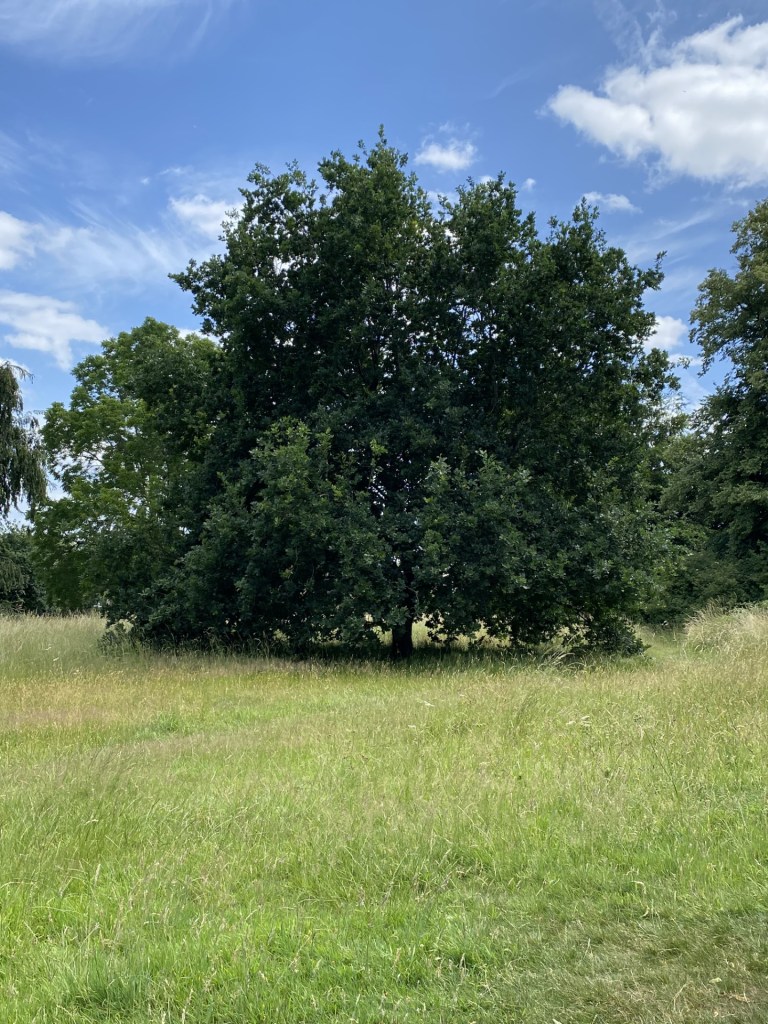

 Me in place