83. Dublin Airport…again

Organised mayhem

Here we are, back at Dublin airport again, but this time we are the ones departing. After eleven weeks away, we are going home to Sanlúcar. I am returning with mixed feelings – sad to leave this home, excited to return to that home.

This trip to the airport has been preceded by methodical packing over the course of 24 hours. We’re returning with a lot more than we left with – books mostly, and they’re heavy. Irish people, please don’t judge me for the Tetley tea. It’s a compromise and easier to buy in bulk than Irish brands.

Unlike the quiet evening at the airport 12 days ago to pick up my sister, the airport today is crowded, full of hustle and bustle. It seems as if every childless adult in Ireland has decided to go on holidays today, now that the school holidays are over and families are no longer travelling. The crowdedness has made it all a little overwhelming – sensory overload on top of the usual departure sensations regarding baggage weight, and security and so on.

But here we are, and in a few hours we will be home and returning to our own term-time routine.

82. Bog road

‘Turn on Radio 1,’ Niamh said, as we got into our cars to drive in convoy across Kildare. ‘Sunday Miscellany is all about the bog this morning.’

I led the way along the bog road, through Allenwood and Prosperous, past the road down to Coill Dubh, through a landscape I have known all my life, a landscape so densely entwined with memory and meaning.

It’s impossible to come from the midlands of Ireland and not have the boglands seeping through your veins. This great flat landscape, the fuel source around which our year and our society revolved. The footing and the haping, and tea from a milk bottle and sandwiches wrapped in waxed paper. Cold March Saturdays of the men cleaning the turf bank all the way through to warm August Saturdays of bringing the turf home.

And it’s the poetry and the music – Heaney and Christy Moore and Luka Bloom. It’s the dissertation I wrote as an undergrad and the bog PhD I started in my 20s.

As I drove across the bog, I listened to the radio programme, as Niamh suggested. It was filled with the stories, songs, reminiscences of people from the midlands. Some people, like me, who have chosen to live abroad and have never found a way to adequately describe and explain all that the bog is to people who don’t know it. And some people who had lived in the bog their whole lives, who evocatively expressed what the bog meant to them.

To listen to this as I drove across the bog this morning was moving enough. But today also happens to be the 21st anniversary of the day that Daddy died. And for me, above all else, my memories of the bog, and what the bog means to me, are inseparable from my memories of Daddy.

It was, therefore, a bittersweet drive, with the stories and the road and this particular day, all evoking memory and emotion, and tears running down my cheeks, not of sadness, but of gratitude for this place and all that it means to me.

80. Skyscape

The morning started out sunny and warm. We’d planned to spend the day on the beach but, as usual, we slept in too late and spent half the morning in our pyjamas, drinking tea and chatting around the kitchen table. By the time we were ready to go out, close to lunchtime, it had begun to cloud over.

For our tardiness we were rewarded with this incredible skyscape, the dark grey clouds reaching out across the sea, the rain falling in a sheet a mile or more out to sea. I thought it was coming towards us, that we’d get soaked even as we set the picnic out on a towel on the beach. The rain shower moved from west to east, appearing to approach, but instead moving away to the southeast over Galley Head.

By the time we’d finished our picnic, the sky had cleared and we were warmed by the sun. The sea was inviting but, in the few minutes it took to change into our swimsuits, another bank of clouds had rolled in, another shower of rain fell to the south and we were chilled by the wind as we braved seawater that was the coldest we’d experienced this year.

But as quickly as those clouds came, they went again, and again we were in the sun. And so it was for the afternoon, the mood of the sky changing by the minute, tempting and teasing us, and delighting us with its constantly evolving shapes and colours.

78. Genius neighbours

I leave the house by the back door to walk up to the village shop to buy a couple of items to complete our picnic. The patio slabs are strewn with rotting food. Slices of greying white bread turned to mush, slimy pepper, faded to a pale green. Lettuce, tomatoes, onions, all slime and mush. These are the offerings of the previous occupants of the house, thrown directly into the small brown food waste bin and not yet put out for refuse collection. The compostable bag of food waste we have placed in the bin is on the ground too, ripped open, its contents still inside. The ground is a mess.

‘Come look at this,’ I call back into the house to Mammy. We suspect a fox, maybe a badger. A rat perhaps?

‘Buy me rubber gloves,’ Mammy says as I leave for the shop. I walk out the back gate. My eyes are drawn upwards by the noise overhead. Two jackdaws are sitting on the electricity line running behind the row of houses, in loud conversation. ‘Was it you?’ I ask, looking up at them. One of them flies off, ignoring my question.

Twenty minutes later, rubber gloved, Mammy clears up the mess, returns it all to the food bin, and places a large flat stone on top of the closed lid. Secure.

Later, on the path that runs along the back of the beach, a jackdaw flies past at my eye level. It has something in its mouth. I watch it go, see it drop whatever was in its mouth. The bird circles back, lands, picks up what it’s dropped, flies again, drops it again. Repeats. And repeats. This is no accident. It knows exactly what it’s doing, dropping the object on the thin strip of stony path in between the sandy beach on one side and the grass-covered sand dune on the other. With each drop, the object cracks a little more. It’s a mussel. The jackdaw is on top of it now, holding the cracked shell firm with one foot while it pulls out the tasty flesh with its beak. As we walk along the path, I see it is strewn with cracked and crushed mussel shells. Previous meals. Smart jackdaw.

Still, it’s hard to believe that the two jackdaws near the house were the culprits of the knocked over bin. Dropping a mussel shell is one thing. Knocking over a bin is quite another. Maybe I’m accusing them in the wrong. Maybe they were simply taking advantage of another animal’s handiwork.

The next morning, Mammy is first out the door. She can’t believe it. It’s a mess again. The bin lying on its side, the stale bread, slimy vegetables and our compost bag pouring out. The large flat stone she has placed on top has, somehow, been knocked off. And in the middle of it all? The two jackdaws. They fly away when they see her, hurling abuse at her in their language, not at all happy that she has disturbed their hard work. Clever birds.

She’s put two rocks on top of the bin now. Let’s see if they can figure that out.

77. West Cork scenes

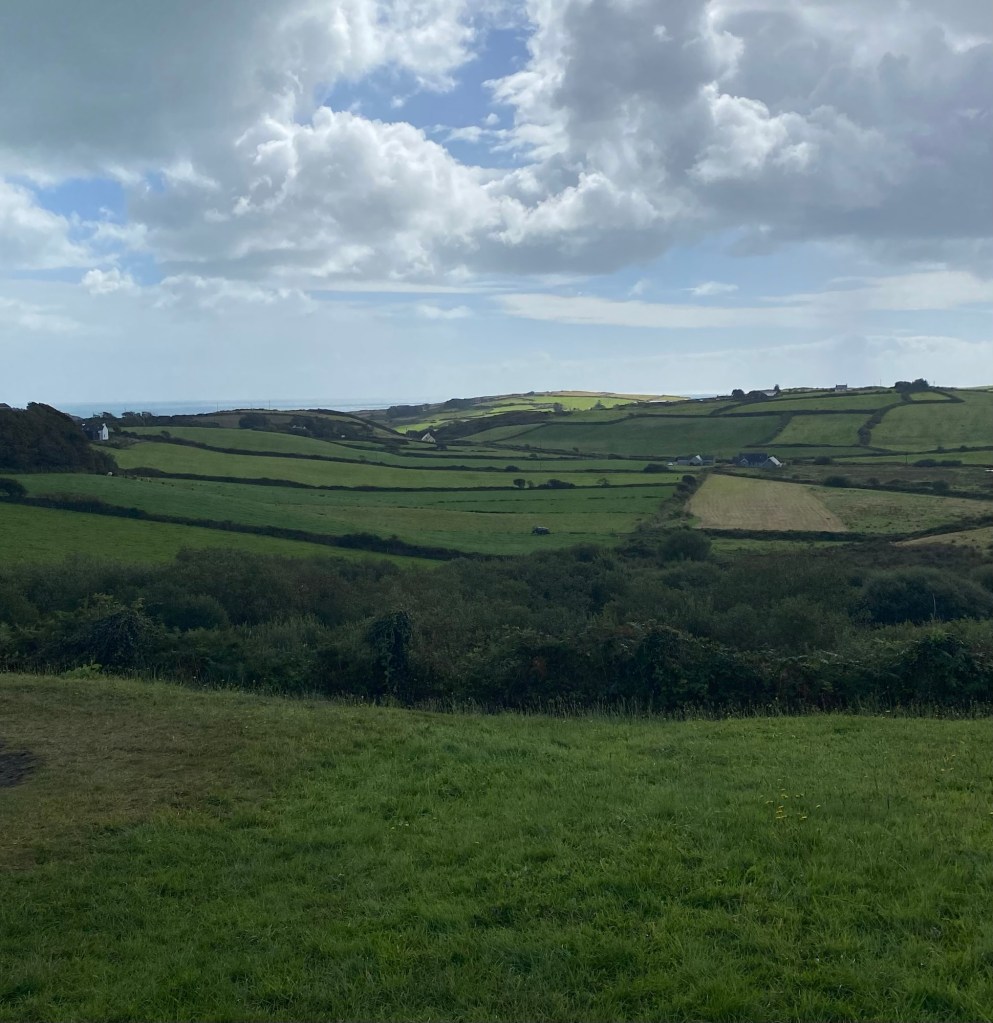
The last couple of days in west Cork have been a delight. Here are a few photos….

View from Glandore
Adam and Eve islands
The Warren, Roscarbery
The Warren from the cliff walk
Evening swimmers
Silliness on the beach

76. Drombeg

Drombeg stone circle

I visit Drombeg every time I come to west Cork. And each time, I feel a connection to the people who lived here 3000 years ago. Not some hokey connection, like these people were somehow more spiritual or more vital or more at one with nature than us. No. I feel a connection because they were people just like us, breathing in this same air, looking out over the view of the sea cradled in the V of the valley. These clouds hung over them, this rain fell on them, this wind chilled them, this sun shone on them.

While Newgrange or Stonehenge are huge and majestic monuments, stone circles such as Drombeg and the others that dot the landscape of southwest Cork feel much more intimate and ordinary. As astounding as the stone circle is, with its orientation based on deep astronomy, it is the more intimate and domestic elements of this site that move me. It is knowing that the body of a youth was found at the centre of the circle. It is the rectangle water pit, where water was boiled using stones first heated in a fire. Maybe the pit was used for cooking. Maybe it was used for dyeing or some other purpose. We simply don’t know. It doesn’t really matter. It’s that people – men, women, children – sat and walked and played and loved and argued and laughed here 3000 years ago. Ordinary people who couldn’t imagine that 3000 years into the future people would visit what remains of their home and wonder at what they did.

75. A summer dress

I remember I was eight or nine years old. Daddy had dropped Mammy, my little sister and me to the train station, to get the train down to Cork. We were coming here. I was wearing a new summer dress. It was so pretty – a pastel flower pattern. It was my first time to wear it. I’d been saving it for a special occasion and this was it. As we waited for the train, I squatted down and sat on my hunkers on the platform. Not realising that the hem was caught under the heels of my sandals, I stood up again as the train approached. I heard the fabric tear. I was horrified. My gorgeous dress ripped across the back, along the hem. I felt so sad. Something had been done that couldn’t be undone. I wished I could turn the clock back just a few seconds. The next week, my dress was mended, but the line where it had ripped and been restitched remained, visible if you knew what to look for. To an onlooker, it might have seemed like a trifling thing. But I never forgot that dress and that instant when I ripped it.

74. Like summer holidays past

The rain fell sideways as we packed the car this morning. Mammy had moved the car to as close to the door as she could get it. Still, we swopped bags of food and our mini suitcases for water and leaves trailed into the house underfoot.

It was a tight squeeze, five of us and all our stuff filling up the boot and obscuring the rear window. I remember rainy Saturday mornings just like this, in the early 1980s, Daddy hoisting the suitcase, the wind break, the deck chairs, onto the roof rack of the Ford Escort, covering the lot with the blue tarpaulin from an old tent, securing it with rope.

I had the playlist ready for today’s drive to Cork – 80s hits, of course, that we sang along to in between bursts of conversation.

The rain continued – sporadic heavy showers – and wind buffeted the car sideways. We pulled in to the Rock of Cashel for lunch – ham sandwiches made from yesterday’s boiled ham and Brennan’s bread washed down with sweet black tea from a flask. We stood around the picnic table in the rain, the hoods of our raincoats up, as a sudden heavy shower chased away the slash of blue sky that had briefly appeared. I couldn’t have been happier. Few things in the world taste as great as ham sandwiches and tea from a flask on a wet day, memory and nostalgia adding magical flavour to the food.

We reached our destination late afternoon and quickly unpacked the car. My sister started to make dinner and realized she was two ingredients short. Lily and I walked the couple of hundred metres up to the shop in the village square. On the walk back, we were blown down the hill by the strong wind, rain hitting us on the back. ‘This is perfect,’ I said to Lily. A seaside holiday in Ireland isn’t complete unless you get at least one wild night like this.’ The wind, the rain, the slight bite in the air, took me back 30, 40, 45 years, to family vacations here in west Cork, in Kerry, in Wexford, in Mayo.

Tomorrow we plan to go to the beach – in our raincoats, most likely.

73. Squeezing the last drops out of summer

Autumn is definitely here. It’s raining more and it’s colder. We lit the fire in the kitchen yesterday. And still, the girls and I remain in Ireland, squeezing every last drop out of this long long summer. In the eleven years we’ve lived in Spain, we’ve never been away this long. Usually, we’d be back by now, going to the pool after our mid-afternoon siesta, or taking the dog down to the dog friendly beach in Isla Cristina.

Yet, here we are, still in Ireland, and one final adventure awaits before we return to Spain. Tomorrow morning, we are driving down to west Cork for a week in Roscarbery. It’s one of my favourite places in Ireland – a picturesque village by the sea, with an amazing beach, great walks – a simply lovely place. Because my aunt, uncle and cousins live there, we’ve been visiting Roscarbery since I was a small child, so it is infused with memories from so many different stages of my life.

Our bags are packed, the makings of the picnic are in the fridge, and we’ll be ready to hit the road after breakfast tomorrow. Forecast? Autumn showers and autumn temperatures. It’ll be lovely.

72. Dublin Airport

I’m at Dublin airport, waiting for my sister to come through arrivals. The airport is quiet tonight, a few families, a couple of guys with bunches of flowers, people hanging around on their phones or with paper cups of coffee.

A group of Spanish teenagers comes through the sliding doors, welcomed by an exuberant Dublin woman who bundles them together for a photo before ushering them towards the exit.

Groups of holiday makers arrive home from warmer climes, tanned and dressed inappropriately for the wet August night that awaits them outside the terminal.

Over the course of about twenty minutes, three middle aged women come through, Eastern European and Asian, greeted with hugs and kisses by their children and their tiny Irish grandchildren.

I could spend all evening here, watching these arrivals and reunions.

Dublin Airport is special to me. The scene of so many of my own departures and arrivals over the years. My first ever solo trip abroad (only my second trip ever in a plane), aged 16, when I went to central France for a few weeks to au pair and improve my French. How scared I was, and how scared my parents were, but I wanted to go and they didn’t hold me back.

Three years later, I was away again, this time to the Netherlands with my friend Louise; my aunt Catherine’s tent strapped to my huge rucksack. Mammy drove us to the airport that morning. We had no jobs, no clue what were doing, but we were youthfully optimistic that we’d find work for the summer. And we did.

I remember a big gang of family and friends coming to see me off when I departed for Japan, aged 22. My biggest trip yet. A year away, and so far away. I remember how we all tried to keep a brave face on things as we sat in one of the airport restaurants, waiting for the moment when I would have to say goodbye and take that lonely walk through to security. And I remember Daddy telling me that it would be ok if I didn’t like it and wanted to come home. We had no way of knowing how much I’d love it and that I’d end up staying for three years. And after that, there would be the multiple departures to the Canadian Arctic; all those journeys starting in Dublin Airport.

I remember the arrivals too. The time I came home from Japan with a shaved head and blue fingernails, and Mammy didn’t know what to think. The first time I travelled alone with Lily in her sling. And all those times I came home at short notice, for Jerry’s, Jimmy’s, Lillie’s, Nana’s funerals, cousins or uncles or my brother-in-law picking me up and often driving me directly to a wake late at night.

I remember the much more frequent arrivals during Daddy’s final seven or eight months, when I flew home from Aberdeen every few weeks. I no longer expected anyone to meet me at the airport. I’d take the bus home or I’d hop on a bus into the city and meet Daddy and Mammy at the hospital.

Tonight, I sit and look at the people waiting and arriving and departing and I wonder where they have come from, why they have flown into Dublin on this particular evening, and what awaits them when they pass through the doors and head for their destinations, each with their own fears and hopes, loves and losses, their own adventures and stories, pasts and futures.