100. And finally.…

A few things happened to get me to this point.

About eight months ago, I read Suleika Jaouad’s memoir, Between two kingdoms, a beautiful account of her life with leukemia when she was in her 20s. In one part of the book, she describes how she and her parents undertook a 100-day project – each of them committing to one act of creativity every day for 100 days. Her mother painted one ceramic tile a day, her father wrote one memory a day from his childhood in Tunisia, and Suleika, too weak to do much of anything, journaled. That’s a nice idea, I thought at the time, and didn’t think any more about it.

A few months later, I was thinking of ways to reduce my outgoings. Work had dried up and my bank balance was plummeting at an alarming rate (I’ve come out of that slump for now, thank goodness). I started to cancel subscriptions – Apple Music, Amazon Prime, that sort of thing. I hadn’t posted a blog on WordPress for over a year, yet I still had my subscription set to autopay. Two things bothered me about this. First, I knew it was a waste of money to have this subscription but not use it. Second, I wanted to write blogs, yet I never did. When I went to my WordPress account, I saw that my subscription was active until January 2026 – over seven months away. I could leave it sitting there and do nothing, or I could use that time to actually write something.

There and then, I set myself a challenge to write ten blog posts, starting that very day. I’d number them, for myself, as a reminder that I was doing it and how far along I was in the challenge. On the 18th of June I wrote the first one, about how busy life was in the last few days before the end of the girls’ school year. The next day, at the same time, I wrote another and then another. As I crept closer to number ten, I knew I wanted to keep going, so I committed to twenty. By the time I reached day fifteen I had committed, privately, to myself, that I would write 100. So I did. Every day, without fail, I wrote and published a blog. And today is day 100.

It wasn’t always easy. Ideas were never a problem. Every day I found something to write about, generally without even searching for it. Something always popped into my head. Indeed, there were quite a few days when I drafted something in the morning, but it was superseded by something else later in the day. Those drafts are still lying dormant in my drafts folder.

Instead, what got in the way or caused resistance was tiredness. I was travelling all summer, visiting family and friends in the UK and Ireland, and working at the same time. When I was in the UK, it was generally easy for me to get my blog written and out into the world by mid-morning. Things changed when I went to Ireland, where I spent so much time in conversation with family and friends that the day would slip away and the blog wouldn’t get written until I was already in bed, very late and feeling very sleepy. Occasionally, all I had the energy for at that time of night were a few photos of the day with a brief excuse for why I couldn’t write more.

But I was called back to write again, create again, share again every day. I saw that people were engaging with me – sending me messages, liking my posts – but I rarely had time to respond. I hope to respond to everyone in time. But seeing all that support was a marvelous motivator. I didn’t write to get likes or gain followers. My reasons for posting were more personal, for two reasons. First, I write all the time, but often lack the confidence, the courage, the self-belief to share what I’ve written or, indeed, to complete something I’ve started. Posting every day, without having the time for too much self-criticism or interrogation, was an act of forcing myself to put my writing out into the world without overthinking it. The positive responses I’ve received have been nothing but encouraging. Second, like many people, I so often start things that are for me and me alone, and then drop them because I prioritize the needs of others. How many times have I started a new routine – yoga, a commitment to exercise, a writing practice – only to let it slip because ‘I just don’t have time.’ This time, I made the time and I reached the finish line and, you know what, it feels great!

Writing something every day for these 100 days has reminded me to be more observant – to pay attention to the words people use, to see the colours and shapes in the world around me, to really see the material things around me.

So, where do I go from here? I will certainly continue to blog, but I’m giving myself a break from doing it every day. During these past 100 days, I’ve written a lot of rambling fluff. But I’ve also written some pieces that I think are rather good. I’d like to return to those now, maybe expand on some of them, share them on other platforms, such as Substack or Medium, and maybe even see if I can revise them and submit them for publication or writing contests. There are also pieces that I’ve written over the past 100 days that will definitely find their way into my memoir, which I have been writing for a little over a year now (I have to finish it!).

The past 100 days have taught me that I can do it, that my nearest and dearest will get used to it as part of our daily routine, and that no matter what your intention when you make a piece of writing public, readers will never cease to surprise you in the way they interpret it.

Thank you everyone who has been with me for the past 100 days. The silent ones and those who have sent me comments via social media or who have emailed me, and those who have stopped me in the supermarket or at a funeral to say they’re reading along. See you all soon!

96. A novel sleeping partner

In November 2007, I headed south on a Ken Borrack Air Twin Otter. I’d been waiting all day, with the flight twice delayed owing to bad weather. Both times, I’d been sent home and, each time, got a call a couple of hours later telling me to get myself back to the airport. On the third try, the weather cleared long enough to allow the plane to take off.

Loading the Twin Otter at Arviat airport

The moment had come to fly the sixty miles south of Arviat to the hunting camp, and I boarded the stripped out plane that now only had three passenger seats. The only other human passengers were Nadine, the French-Canadian cook, and Reverend Jimmy Muckpah, minister at Arviat’s Anglican Church. The other passengers were two wooden boxes containing Jimmy’s sled dogs, packed securely for their own safety for the short low altitude flight. What little remaining space was packed to the rafters with a skidoo and some of the boxes of food and other items we’d need.

Lovely, kind Jimmy Muckpah, who knew more about polar bears than anyone I’ve known
Jimmy’s sled dogs, who seemed quite content with their travel arrangements

We flew south along the coast to our camp. The others had flown in on an earlier flight and we all helped to unload the plane before it took off again. It would return for us in two weeks. I was to live for those two weeks with five big game trophy hunters from the US, their five Inuit guides, all from Arviat (including Jimmy), and Nadine. The guides, Nadine and I all knew each other, but the trophy hunters were new to me and, indeed, to all of us. I was here for research. I was studying the relationship between humans and polar bears; specifically, seeking to understand the changing role of polar bears in Inuit culture and economy, as international laws about polar bear hunting was rapidly evolving.

Ryan, the camp outfitter, had generously invited me to the camp. What I learned in those two weeks hugely enriched my anthropological understanding of the role of polar bears in Inuit life and I published my findings in various academic journals and books in the subsequent years. My findings were even presented as evidence at US Congress hearings in 2008 that sought to amend US Fish and Wildlife laws concerning the importation of ‘trophy’ polar bears from other countries.

The camp comprised four cabins. The trophy hunters slept in two of the cabins, the guides all bunked together in another, and the fourth cabin – which was also the camp kitchen and eating quarters – was shared by Nadine and me. Each cabin had a ‘toilet,’ consisting of a ‘honey bucket’ – basically a bucket with a seat and a bin liner that we changed every few days. At those temperatures, anything you did into the honey bucket froze almost immediately. Nadine and I had a small room off the far end of the kitchen that contained a bunkbed. She slept on the top bunk and I on the bottom.

Our little huddle of humanity on the west coast of Hudson Bay

Ryan had built his outfitting camp here because it was situated along the polar bear migration route. Indeed, during the two weeks I was there, more than seventy individual polar bears passed through on their winter migration out onto the sea ice. Many of them came close, attracted by the smells of the camp, and snuffled around. We were under strict orders that no-one was to leave the cabins, or go between cabins, without a rifle and to never go alone. The trophy hunters rarely listened to that advice and took stupid risks by walking from the kitchen cabin to their own in the dark. The local guides, well aware of the realities of living in such close proximity with the world’s largest carnivores, were extremely annoyed by the idiocy of the trophy hunters.

I had various roles during those two weeks. I helped Nadine in the kitchen. I went out on hunting trips with the guides and the hunters in their charge. And I helped with skinning and preparing two of the three bears that were killed. (According to international and local law at the time, each hunter could take one trophy bear (they paid tens of thousands of dollars for the ‘privilege,’ some of which found its way back into the Inuit subsistence economy)). During those two weeks, three of the five hunters got their trophy. The other two went home empty handed.

I remember helping one of the guides, Donald, one day as he skinned a bear that had been shot by the trophy hunter in his care. The hunter was back in the warmth of the cabin, enjoying a hot coffee and some freshly baked cinnamon rolls. I held the bear’s huge heavy legs while Donald did what he had to do. It was cold and he wanted to get the work done quickly. So that he could keep his head down and concentrate on the work, he asked me to keep my eyes on the two polar bears that were circling close by and to let him know if either of them started to move closer. They didn’t, but I was shit scared and so was he.

Polar bears came close to and into the camp every day.

The plywood cabins were reinforced with corrugated metal. They had windows that were too small for a polar bear to get through, and the doors were covered with six inch nails, sharp side out, to discourage any bear that might try to break in. Even so, it was pretty scary at times. One particular day, when the hunters and guides had all left camp to go hunting, and Nadine and I were alone in the cabin, a bear came snuffling around. He stood on his hind legs, making him probably 8 feet tall. He looked in the window into our kitchen (imagine, a polar bear looking in at you!), and repeatedly hit against the side of the cabin with his front paws. He was trying to get in. Nadine and I were terrified. We had a rifle, but I’d only ever used it for target practice. Would I know what to do in a real life-or-death situation? Eventually, he gave up with trying to open the sardine tin that was our cabin and started to play around with the big cylinder of propane gas that was our only source of heat and cooking fuel. One slap with his paw, and he knocked the cylinder loose. Before we knew it, he was rolling it around on the ground, playing with it, and now was 20 or 30 metres away. While we were delighted that he seemed to have lost interest in us, we now had a new problem – it was about -15C and a polar bear was using our only heat source as a toy. Luckily, the hunters and guides came back about an hour later and all was well.

Every night when I went to bed, I could hear snuffling outside the cabin. Sometimes, I’d shine my flash light out the small window and see a pair of eyes reflected back. Lying in my bunk, I’d hear snuffling on the other side of the flimsy wall. Imagine my surprise the first morning I went out and saw a very clear indentation in the snow the size and shaped of a curled up polar bear. It was exactly on the other side of the wall from my bunkbed. The indentation was there every morning; sometimes, like in the photo below, accompanied by claw marks.

I didn’t sleep well for those two weeks, let me tell you, knowing that I was sleeping beside a polar bear, with only a strip of plywood and corrugated metal separating us. But when I looked back on it, I understood what a privilege those two weeks were.

It hard to see the indent of the bear’s body in this one, but the claw-mark is right in the centre.

91. Too far away

I remember the phone ringing down the hall. Mammy got up from the kitchen table to answer it. ‘It’s for you,’ she said, coming back to sit down. ‘Someone from Canada.’ I walked down the hall to the table by the hall window and put the receiver to my ear.

‘Hello?’ I said.

‘Huvi?’ came the reply. Frank. Dear Frank. My friend, my teacher, my hunting buddy. One of my primary research participants in Arviat, it was Frank who had taught me to skin and butcher caribou, and to get it right by doing it over and over; Frank who had taught me how to drive a boat amongst pods of beluga whales in the shallow waters close to shore, so he could harpoon them from the bow; Frank who put me on polar bear patrol while he collected the arctic char that had swum into his fishing net; Frank who I spent hours and days with, far inland on our quad bikes, out at sea at first light. He and Martha welcomed me into their home, made me tea, fed me biscuits and bannock, took me out on the land and to their cabin with their daughters. Frank made me laugh and made me think. How at ease I felt in his company.

And now, he was on the phone. He on the tundra, on the western shore of Hudson Bay; I in the Bog of Allen, in the middle of Ireland. And the distance between us seemed vast. Vaster than the Atlantic Ocean, and maritime Canada and the width of Hudson Bay that separated us. All that we talked about with such ease when we were together dissolved now across the expanse.

He asked about the weather and I told him. But what was Irish weather to him? What was the Irish autumn, with leaves changing colour and falling off the trees, the rain and the mud, when he lived in a place with no trees, where autumn meant the ground covered in snow and the sea gradually turning to ice, travel by boat giving way to skidoos. My autumn meant nothing to him and, from this distance, his autumn was starting to dim for me.

I asked what he’d been doing and he told me where he’d been seal hunting the previous day, who he’d gone with and the other hunters he’d met when he was out. I smiled as he spoke. In my mind’s eye, I could see where he’d been and who he’d been with. I had been there with him, and with his brother-in-law Arden, just a few weeks earlier.

He asked what I’d been up to. It was September and in Ireland there was only Gaelic football in the air. How could I tell him about the match I had been to on Sunday? About the crowds, the excitement, how important football was to my life here? Or that the turf was home and there were still a couple of loads to be thrown in the shed. My voice sounded strange in my ears as I tried to talk to him about my life here.

I’d lived in his world and loved it. He was interested in my world, but had no experience of it. The ease we felt in each other’s company was made jagged by the cultural distance that now lay between us.

We continued to speak on the phone occasionally and I got to spend another summer with him a few years later. It’s a few years now since he passed away. I wish I had been better able to bridge that distance when he called.

89. Back to school

The girls have been on summer holidays now for about one-fifth of the year. It’s been a glorious summer. Despite some loss – or perhaps because of it, making us realise how fleeting and precious life is – we have had an amazing summer, during which we got to do some incredible things. Twelve hours from now, the new school year starts.

They’re both a little nervous – a new school for Lily, a new class for Katie. They will both have new classmates and new teachers and, in the case of Lily, new subjects that she’s never studied before.

I’m a little nervous too, as I always am at the start of the school year, hoping they will have positive experiences and will enjoy themselves.

They’ve got their bags packed, their clothes ready, and we’re in bed early tonight. The house is going to be very quiet tomorrow!

64. Ballygibbon

‘My surname is Walsh,’ I hear a man with an American accent tell the librarian. I’m at Edenderry library, supposedly working, but the conversation going on behind me distracts me. The man tells the librarian that his family came from somewhere around Edenderry, but he doesn’t know where. ‘There’s a place called Walsh Island a few miles from here,’ the librarian tells him, but then admits that she’s not from here and doesn’t know much about local history. She offers to go get one of her colleagues who is from here.

At this point, I can’t stop myself. ‘Excuse me,’ I say, getting up from my desk and walking over. ‘I couldn’t help but overhear your conversation.’ I could help, of course, if I was less nosy. ‘I might be able to help you out a bit,’ I tell the man. The librarian leaves us to it, while she goes off to gather up an armful of local history books that might be of interest to him. He and I start talking and, within a couple of minutes, I’ve invited him to come sit at my desk, because I feel we might have a lot to talk about.

He tells me his people are from Georgia, by way of other places in the US that I wish I had paid attention to – Indianapolis, maybe, or Indiana? And did he mention New York? He’s here with his half-brother, who is English. The two were unaware of each other’s existence until a few years ago (the English brother a war-time baby) and now the two are here tracing their roots. While the American brother is here in the library, the English brother is up at the parish office, looking at the parish records of births, deaths and marriages.

‘Have you been to Walsh’s bridge?’ I ask him, and tell him that the Walsh family lived in a house by the bridge. I know of three brothers – Pascal was my science teacher at school, Andy is an auctioneer, and John recently deceased. He tells me he’s met some Walshes, has looked at headstones in the graveyard in Monesteroris and went knocking on doors at houses he thought once belonged to Walshes. His phone rings and he answers it. It’s Andy Walsh, the very man I have just mentioned, who tells him that his son is interested in genealogy and might be able to help him out.

When the call ends, he tells me that he and his brother have been here for a few days and are leaving tomorrow and they haven’t confirmed any relationships with the places or the Walshes they’ve met. I ask him where they’re staying. He tells me they’re at an AirB&B called Rushbrooke, a few kilometres outside of town. The name rings a bell and I’m pretty sure it’s a house near my house. ‘Who owns it?’ I ask. ‘Young guy. Arthur,’ he says. ‘Can’t remember his surname.’ He rings Arthur. ‘What’s your surname?’ he asks. ‘Arthur Stones,’ Arthur replies.

I almost do a comical forehead slap. ‘Arthur Stones is a distant relative of mine,’ I tell him. ‘He lives down the road from me. My grandmother and Arthur’s great-grandmother were first cousins.’ He shows me a photo of Rushbrooke, where he and his brother are staying, and now I know exactly what house it is. ‘It’s Billy Mather’s house,’ I say. ‘Up Mather’s lane.’ This is no more than 500 metres from my house, up the lane from Arthur’s home (which, coincidentally, is the house my grandmother grew up in).

Mr Walsh (I can’t believe I didn’t catch his name) opens the folder he’s carrying. He shows me photos from 150 years ago and then produces a most remarkable document. A photocopied letter sent from an aunt in Ireland to her niece in America in 1925. The niece is Mr. Walsh’s paternal great-aunt or great-great-aunt. What is so remarkable about this letter is the sender’s address: Ballygibbon.

Ballygibbon is where I come from. Ballygibbon is where Arthur Stones comes from. Ballygibbon is where Rushbrooke House is situated. And, in the back of my mind, I remember that, when my father was young, before Arthur Stones owned Rushbrooke, before Tim Mann owned Rushbrooke, before Billy Mathers owned Rushbrooke, it was owned by the Walsh family. This can’t be real!!

I phone Mammy and ask her if she can remember which house up Mather’s Lane was originally Walshes. She narrows it down to two possibilities. I phone my cousin Colette, holder of so much family and local lore. Colette is on holidays in Lanzarote and can’t say for sure which house it is.

I turn to my laptop and the 1901 and 1911 census. I search Kildare, Ballygibbon West, and there they are – the entire Walsh family – the brother of the man who emigrated to America and who Mr Walsh is directly descended from. There he is, Patrick Walsh, with his wife and six children in 1901 and with four adult children in 1911 – the other two likely married and moved away. One of the female children is the author of the letter that Mr Walsh is holding in his hands.

As the realisation dawns, we are both giddy with excitement. Through a complete coincidence, a random search for an AirB&B in Edenderry, these two long-lost brothers are staying in the very house their great-grandfather lived in and left for America in the 1850s. ‘You’re searching the wrong records,’ I tell him. The brothers have been looking for evidence of their family in County Offaly (King’s County, as it was then) and in Edenderry parish. But Ballygibbon is across the border in County Kildare and in Balyna Parish.

I phone Balyna Parish office and Fr. Maher answers the phone. The parish secretary is away on holidays. He tells me that Mr. Walsh needs to email the secretary and she will see what she can dig up in the parish records. But, he says, the records don’t go back very far, so she might not find much. I assure Mr. Walsh that they go back at least until 1918, having done a bit of digging around into my own family a few years ago. Fr. Maher suggests that the brothers go to Carrick cemetery, the most likely location of the Walsh family graves.

Mr. Walsh packs up, we shake hands and say goodbye. I assume that’s the end of it, but half an hour later he’s back, this time with his brother. He wants to take photos of all the census information I found on my laptop. I end up drawing a map of Ballygibbon and showing them who lived in all the various houses over the years. The brothers head off to do some headstone detective work at Carrick graveyard.

It’s hard to believe this happened today. That, on the very last day of their trip to Edenderry, this man should come into the library, and I should overhear him, and he should show me, by chance, a letter, and the address on that letter should be my townland, and I should trawl back through my memory to something my father had told me about neighbours of ours when he was young, and I should find a trace of them online, and they should live in the very house that this man is now staying at, owned now by a distant cousin of mine!

Isn’t life full of wonder and possibility!

42. Strangers

I meet Sean again when I go out for an evening walk. This time he’s sitting on a camping chair on the canal bank, beside his boat. He’s with a younger man, who’s sitting on the grass. I shout ‘hello’ over to them and they beckon me over. By the time I walk back to the nearest bridge and cross over to the other side of the canal, Sean has pulled another camping chair out from his boat. His buddy is Carl, a Mancunian. The two met only yesterday, when Carl was taking his daily walk along the canal. I sit with them for a couple of hours, shooting the breeze, sharing stories about where we’ve come from and where we’re going to, the importance of listening, and the power of poetry. I bid them farewell and carry on my way.

••••••

‘I started working with papier-mâché during lockdown,’ Jean tells me. ‘I wanted to make art with what was lying around the house.’ I’ve wandered into her studio and find her sitting at a table, surrounded by papier-mâché spheres and abstractly-shaped boxes, everything looking precarious and on the edge. ‘Everywhere I turned, they were talking about tipping points. Scientists, activists. Tipping points are my great anxiety. So I’m working through that anxiety in my art.’ I ask where she’s from. ‘From Indiana originally, she say, but I’ve lived in England for forty years.’ She shows me how her tactile, playful art moves and explains how she makes it. I wish her luck with her project.

••••••

‘Do you mind if I sit here?’ I ask the man sitting alone at a table who looks like he’s working. I’m here to work too, so this could be a good place to sit. ‘The working end of the cafe,’ I say to him. ‘Yes,’ he smiles. I spot a university logo on the paper in his hand. From this angle, it looks like exam grading criteria. ‘Marking exams?’ I ask him. ‘Job application,’ he says. He’s Mark, an academic at a midlands university, grown tired of his job and applying for a position at a university in eastern Germany. We talk about the state of academia in the UK, the Spanish education system and, before long, an hour has passed and neither of us have done any work. I have a Zoom meeting to prep for and he has a train to catch, so we say goodbye and I get on with my work.

••••••

‘I’m at a stage in my life where friendships with women are most important to me,’ Amanda says. She tells me that she’s only moved to Leamington two days ago. She’s a few years younger than me, has a corporate job, but her real passion is healing. I tell her about a book I’m currently editing, and we discuss the power of stories and how we’re only able to tell our stories once we have worked through our trauma. We’re the only two visitors in a small art gallery and we’ve both arrived at the same time. We start out shadowing each other, a little self conscious in the small rooms. But soon we’re talking about healing and friendship, and what a great place Leamington Spa is, and the fact that we’ve both recently been to Thames Ditton. We leave the gallery together, saying goodbye as we walk away in different directions.

••••••

I find it hard to stay strangers with anyone for long.

23. Meeting Sean

I’m walking along the Grand Union Canal that runs behind the estate where my father-in-law lives. It’s a glorious evening and I’m on a video call with Katie who is away on the south coast this week with Lily and their uncle and aunt. I walk past four or five narrow boats. On the last boat in the row, a modest white and blue steel boat, a man is standing. I have the phone up, so he thinks I’m filming him or taking his photograph. He gives me a big smile and says something. But I’m talking to Katie, so there’s some confusion. He then realises that I’m not taking his picture and I realise that he’s talking to me. More than that, I hear his Irish accent and he hears mine.

“Where are you from?” he asks. “Kildare,” I reply. “Ah, a Lillywhite,” he says and I know immediately that I am firm ground. Despite his Dublin accent, he tells me he’s from Dungarvan in Co. Waterford. “The husband of one of my best friends is from Dungarvan,” I tell him. I tell Katie I’ll call her later because I have a feeling I might be chatting here for a while.

Sean and I chat for an hour, me standing on the grassy tow-path, he on the open deck of his narrow boat, the air cooled engine exposed to the evening air. We discover we have people and places in common. He pootled a narrow boat up to the harbour in Edenderry in the late 1960s and remembered going for a drink at The Harbour House. That was my uncle Tom’s favourite haunt, owned by Mary O’Connor, my Irish teacher, and her family. I was only in The Harbour House once, for a pint of Guinness with Tom back in the early 1990s. It was everything you would expect of a small Irish pub, all the old men lined up at the bar. It was renowned for its music and for Mary being as strict behind the bar as she was in the classroom.

Sean tells me about his job at Shannon airport and about people from Edenderry he knew there and at Ardnacrusha power station. I mention people I know who he might have known and we laugh when we get a bit tangled in Johns and Seans and who was who.

I tell him I had been a sailor and we talk about the joys of my Westerly Conway. He wonders how a girl from the Bog of Allen and a boy from the housing estate 20 metres from here could have ended up living on a boat and sailing to the places we did. He tells me of his adventures as a sea sailor and as a narrow boat owner and about his sustainable, no-cost approach to life.

At 80 years of age, he is only a few years younger that Daddy would have been. The Cuban Missile Crisis comes up in conversation (he makes me promise not to tell anyone why) and he shares his reminiscences of those few days in 1962 and I tell him what Daddy told me of his memories and fears of those days.

He explains how he has come to have that Dublin accent but says his heart remains firmly rooted in Dungarvan. He already owns a plot in Dungarvan graveyard where he wishes to be buried when his time comes.

“I had a half pint at the Cape of Good Hope a while ago,” he tells me, referring to the pub just a couple of hundred metres away. “When I went to the bar, I heard two men behind me. A Mayo man and a Galway man. Sure, I had to talk to them. The Mayo man was a bull man.”

“A bull man?” I ask, perplexed. “Ah, you’re too young,” he says. He explains what a ‘bull man’ is and realisation dawns. “Ah,” I say, “You mean the AI man. That’s what we call it where I come from.” He laughs and says how funny that we had that in Ireland where the Catholic church didn’t allow such things for humans. AI, for those of you not in the know, means, artificial insemination, and the Bull man or the AI man was, and remains, an integral part of our dairy and beef industries.

My daughters always tease me when I speak to other Irish people, accusing me of changing the way I talk and the way I hold myself. They’re not wrong. But I don’t do it on purpose. When I’m with other Irish people I become the version of myself that is the oldest part of me. I speak in the way I learned to speak as a baby, in the first accent I ever heard from the people and the place where I grew up. It is the accent, grammar, syntax and vocabulary that I am most comfortable with. There’s no modulation, no register change, no code switching. I am me at my most comfortable.

We all change our registers in different contexts. For instance, the way we speak to small children is not the same as the way we speak in the corporate office. The way we speak in church is not the same as on the terraces of the football stadium. But changing accents is something different. Over the years, I have modulated not only my accent, but the words I use when in conversation and the order in which I say them. Why? Well, for two reasons – one that I am comfortable with, the other less so.

For most of my life, I have chosen to live among people for whom English is not a first language. Therefore, to make myself understood among English speakers in Japan, Nunavut, Spain, and elsewhere, I slow down, speak carefully, use very standardized words and phrases to be understood and to make the person I am speaking to feel more comfortable. That is now second nature to me.

The other reason is that, over the years, I have been very aware of people making fun of my Irish accent – people laughing and repeating my pronunciation, my use of certain phrases or my Hiberno-English sentence structures. In order to reduce the feeling of discomfort (and anger) that this fun-making and ridicule causes in me, I modulate and change register. It’s just easier. I don’t like it, but it is how it is. That too is now second nature to me when I am around native English speakers who are not Irish.

But, when I speak to other Irish people, I can feel my body physically relax. I don’t have to think of an alternative phrase or word for ‘give out’, ‘press’, my use of bring/take, my pronunciation of H and th, or a thousand other usages of words and phrases. I’m not going to be laughed at for calling my parents Mammy and Daddy. I can throw in a reference to the GAA or to Eamon Casey or to the Angelus or to a million other things, and no further explanation is required. I can just be.

All migrants, no matter what their language or their circumstances, experience this distance from their first voice. Some people are happy to leave that first voice behind. I am privileged to have had so many opportunities to travel in my life. I have learned so many wonderful ways to speak and to see the world through the eyes of others. But speaking in the way that is oldest to my being is like relaxing into a large warm bath.

Sean is stuck along this stretch of the canal for the time being, as he waits for a lock gate farther along to be repaired. I tell him that if he’s still there the next time I walk that way, I’ll invite him down to the Cape of Good Hope for a beer. Who knows? Maybe the AI man will be there.

Stretch of the Grand Union Canal in Warwick

22. Lovely libraries

“I’m off to the library,” I say to my father-in-law on our first day here in the UK. “The library?” he asks, looking at me like I have two heads. “There are no libraries any more,” he says. “Yes, there are,” I say. “I’m going to Warwick County library, in Shire Hall.” He used to work at Shire Hall and it’s one of his favourite topics of conversation. But he’s convinced there is no library there, that all the libraries in the country have closed down due to lack of interest, lack of funding and, his pet hate, technology. I try to convince him that the library is still there. I know because of…erm…technology. I’ve already done my research online and I know its daily opening hours (extensive) and I even know where I plan to sit when I go there every day to work. He remains perplexed and unbelieving. “Who uses libraries these days?” he asks.

I go to the library that afternoon and have been coming here for a few hours every morning since on those days when we are in Leamington Spa. Who uses the library, indeed? There are old people and young people, babies in strollers and grannies on mobility scooters. There are young frazzled parents and teenagers straight from school still in their uniforms. There are able-bodied people and disabled people. There are school groups and people in residential care. There are people here for parent and child story time and rhyme time and teenagers here for book club. There are people browsing the shelves and people consulting the librarians for help finding specific books. There are people in to renew their library card or to get one for the first time. There are people seeking assistance on matters that have nothing to do with books. And there are people like me, who have come in to use the space to work. A young women is at the table behind me a couple of days a week, writing away on her laptop. One day, a man about my age arrives in, in a business suit and dragging a suitcase behind him. He sits for a couple of hours and works on his laptop as he waits for his train or plane or whatever mode of transport he needs to get to where he’s going.

The library is small. But it’s bright and colourful. There are bright and inviting displays about gardening and, for the children, there’s a summer treasure hunt of herbs, that they have to guess from their scent. There are special displays – of gardening books, LGBTQ+ books, Black history books, summer reading recommendations. The librarians are, to a person, kind and smiling and give the appearance of people who love their jobs. This is not some stern library where people are forced to be silent. Those days, I hope, are long gone for public libraries. I hear the librarians quietly chatting amongst themselves and being friendly to everyone who comes in the door.

I choose to sit at the work/study space towards the back, next to the children’s library, with its snug spaces for kids to get lost in books. Nearer to the front, and I would be distracted by the conversations taking place at the front desk. But here, I am generally not distracted by the sounds of children, or of their mothers reading books to them (except when a mum reads a book that I read to my girls; then, I get a little nostalgic). I was distracted yesterday, however, when the soft-voiced man leading story time read a book to a group of toddlers and their parents about a trip to the zoo. One toddler, clearly not enjoying herself, spent the entire story saying “It’s so boring, it’s so boring.” That made me chuckle.

So, despite lack of funding and the digital world we live in, this small library is bursting at the seams with liveliness and activity. So, here’s to libraries everywhere, and to the librarians who take care of them and to the people who use them and to the taxpayers who fund them and to the civil servants and politicians who budget to keep them open. I wish I could convince my father-in-law to come here and see for himself, but alas, he’s a non-believer.

5. Sedna

Sedna/Nuliajuq by Brian Arualak, Arviat, 20003

A few days ago, when it was too hot for Lady’s little paws to be on the road, I took her down to the river for a swim. When I got there, I spotted a yacht on the pontoon called Sedna. I got very excited. Sedna (or Nuliajuq in the Kivalliq region of Nunavut) is the supreme goddess of Inuit mythology. Goddess of the sea, she hides and protects the marine animals in her long flowing seaweedy hair, only revealing them to hunters who prove themselves deserving. How does she decide who’s deserving? It’s those hunters and, more importantly, their wives, who generously share the meat and fur and other parts taken in the hunt. In the old days (and in some quarters still today), Inuit believed that animals, once released from Sedna’s hair, gave themselves to generous hunters.

So, I got very excited when I saw this boat. The way I got excited in the past to see a boat called Aarluk (orca) or one called Nanuq (polar bear). One doesn’t expect to see Inuktitut words in southern Europe! I couldn’t resist popping down to the pontoon to say hi and inquire as to why the owner had named his boat after the Inuit goddess of the sea. I mean, a goddess of the sea I get; but the Inuit one specifically?

I saw that the boat was flying a Spanish flag and had a Spanish registration mark printed on the hull. There was a man in his seventies in the cockpit. ‘Buenas tardes,’ I said, assuming that he, like his boat, was Spanish. When he replied in English with a British accent, I said hi, and told him, perhaps a little over-enthusiastically, that I’d noticed his boat was called Sedna.

‘Oh yeah,’ he said, distinctly less enthusiastic than I was. ‘Why did you call it that?’ I asked. ‘That’s what the previous owner called it and I didn’t bother to change it.’ He seemed not curious, not interested, not bemused, not annoyed that I’d bothered him. Indeed, he seemed not really anything at all that this overly-exuberant Irish dog-walker on the Spanish border was trying to make conversation about the name of his boat.

‘Do you know what it means?’ I asked.

‘Nope,’ he replied.

‘She’s the Inuit goddess of the sea,’ I started, but he cut me short and asked, ‘Do you live here?’ He was completely disinterested and my little bubble of excitement at having found someone who might share my interest in Inuit mythology and Inuit culture was immediately burst.

I laughed at my silliness after. At how I had imagined our conversation would go and at how the conversation actually went. I chatted with him for a few minutes more, answering his questions about life in the village, and whether I still owned a boat, and whether the schools around here are any good. Then I said goodbye, wished him luck on his sailing trip and Lady and I carried on on our merry way.

3. W.W.A.D.

My next-door neighbor Alfredas has quite an impressive social media following given that, until recently, his content was exclusively presented in Lithuanian. He posts daily videos about sobriety, quitting smoking, sleep health, mental health, and so on, tracking his own journey and sharing what he has learned with others. His videos are well informed and based on peer reviewed science. I know this because I get the omnibus edition when my family has lunch with his family every Sunday. He’s less the man who wants to live forever and more the man who wants to live his remaining years on the planet in the best way possible.

Last year, he returned home to Lithuania for a few months to organize Sober Summer. He recruited thousands of people, mostly young and middle-aged, to quit alcohol for the summer. To party, have fun, be active, be engaged, and do it all without alcohol. His Sober Summer events were featured widely on Lithuanian social and traditional media.

This summer, he’s returned to Lithuania with a new plan: 90 X 90. He’s encouraging everyone to be active for one hour every day for the ninety days of summer. 90 X 90 officially started on 1 June and, well, I couldn’t pass up the opportunity to join in.

Doing one hour of activity is not a problem for me. I regularly walk the dog for an hour or more, do housework for an hour or play pádel with Katie for an hour. However, I lack the consistency of engaging in a continuous hour of activity every single day. So that’s my challenge.

I started on day one and, twenty days in, I haven’t missed a day yet. I’ve been walking the dog and playing sports as usual. I’ve even started jogging a little, which is something I haven’t done since I was pregnant with Lily. It’s extremely hot these days (40C yesterday), so I leave the house with the girls in the morning when they go to catch the school bus and get my active hour in then. It feels great to do this consistently.

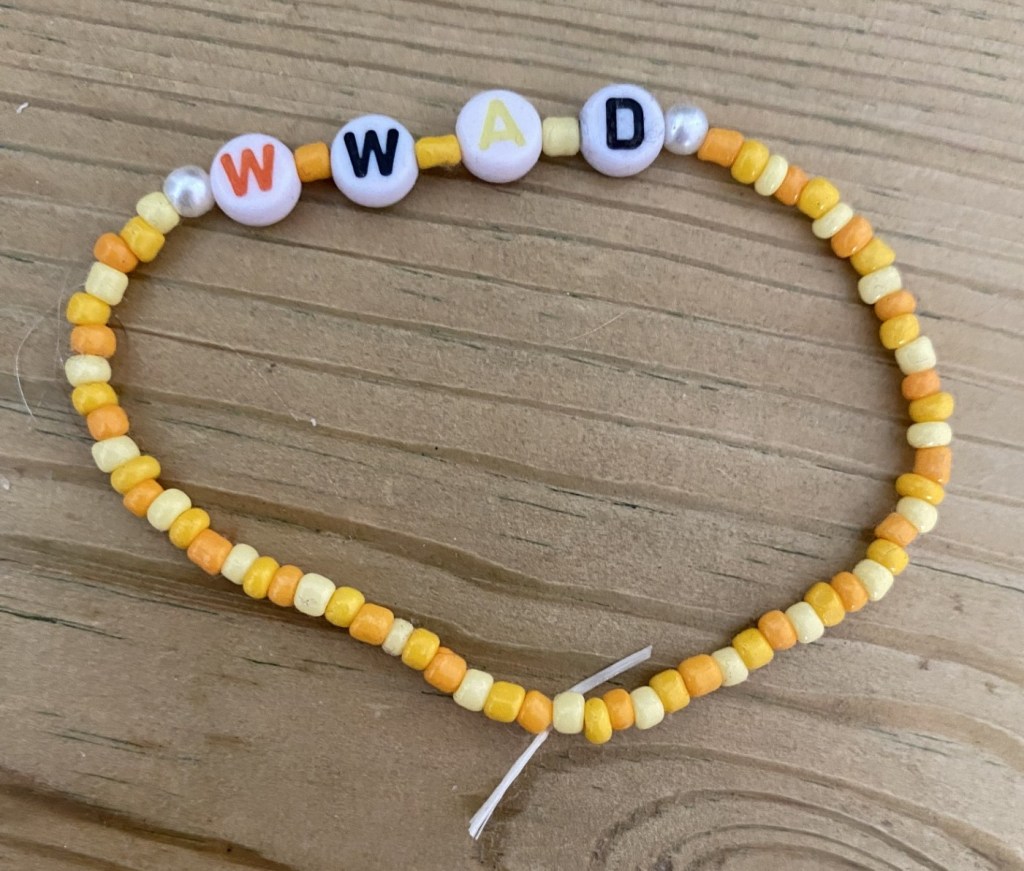
Alfredas is a man of action and, for some time, my family and his family have had a running joke: ‘Ask yourself, what would Alfredas do?’ So, Lily, crafty kid that she is, made W.W.A.D. bracelets for all of us! And that’s my motto on days when I think ‘maybe I don’t have an hour to spare today’. What would Alfredas do? He’d put on his running shoes and go.