7. Ritual

I’ve been thinking a lot about ritual lately and, in particular, the comfort and familiarity of ritual at liminal and transformational times, such as death. I think back to twenty-one years ago, when my father was in his last days. One of the lovely palliative care nurses suggested that, as the inevitable approached, we talk to the undertaker so that, when the time came, he knew and we knew what to do. My mother, sister and I considered cremation, based on something brief and passing that Daddy had said many years before, when he was in the full of his health. But cremation wasn’t our tradition, none of us had ever been to a cremation and we were pretty sure that none of the other mourners at Daddy’s eventual funeral would ever have been to one either.

A couple of days later, I met the undertaker for a coffee and a chat. We went to school together, so I’ve known him most of my life. He was kind and caring. He said that of course he could undertake a cremation, but it would not be like the funerals we were so familiar with. It would have to take place at the crematorium in Dublin and it would be a number of weeks before we had a date for it. While we could still have a funeral in our parish church in Cloherinkoe, there wouldn’t be that moment of burial that is the final and closing act of all the funerals we had ever been to. He advised against it, saying that, for us, for our extended family and friends, and for the many other mourners, the familiarity of the Catholic funeral and burial would be a greater comfort than doing something very novel, such as a cremation. We weren’t bent on a cremation, and we didn’t think Daddy would be either, so when I returned home to report on my conversation with the undertaker, my mother, sister and I decided to go with a traditional and familiar funeral.

A few days later, when the moment finally came, I remember how easy it was to slip into the role that that ritual expected of me. We all knew what to do, how to behave. The mourners who came to our house for the wake knew what to do, what to say to us. We all knew the protocol for saying the rosary, for sitting up with him through the night, for his removal to the church the next evening, for Mass the following morning, and for his final journey to Carrick graveyard. And we all knew the hundreds of tiny rituals within all of that – the brief words, the gestures, the tea and the ham sandwiches. Decisions were lifted from our shoulders, because we simply did things the way they had always been done, all the steps unchanged. But it wasn’t only that we knew what to do. It was that we were doing it in community with others. Hundreds of people filed through our house in the two days of Daddy’s wake, hundreds more came to the funeral. And because we all knew what to do, people were relaxed and at ease, with us and with each other. Familiar ritual gave us space to express and to sit with the profound grief we carried in those few days immediately after Daddy’s death.

I’ve been moved to think about this lately. In the past couple of days, I’ve attended two funerals in our tiny village. On Sunday, it was the funeral of Juan, in his late 90s, the oldest man in the village, who had suffered an illness in recent months, at the end of a long and active life. On Monday, it was the funeral of Maria, from the village shop, in her 80s, who died after a very brief illness. Both were very much loved and well respected members of Sanlucar, still out and about in the village until close to their final days. Our village has had a tough few days, with these two deaths and the sudden illnesses of other members of the community.

As I attended those familiar Catholic funerals on Sunday and Monday, I thought about how easy it was to fall into that transitional ritual, to take on the role of bereavement or of supporter for those who have been bereaved. Despite a few minor differences between the funeral ritual in Ireland and Spain, they are essentially the same, from the wake, to the removal to the church, and then the walk to the cemetery, the way the bereaved and all the other mourners behave. Everyone knew their role. And there was comfort in that.

Even though my religious faith lapsed decades ago, my faith in religious community remains strong, and I continue to find immense comfort in the familiarity of the rituals that I grew up with, no more so than at that most difficult of transitions, death. Whatever your religious or non-religious background, being able to simply slip into a role and perform a role at a time when everything around you feels chaotic and overwhelming is a gift. During my family’s own difficult time, when my father and his siblings and my godfather and my aunt all died in the space of only a few months and years, and my family was rocked to it’s core, I found comfort in being together, even with people I barely knew who attended those funerals, to engage in a ritual that we all knew. I hope that my grieving neighbours in Sanlucar, who have lost their beloved family members in the past few days, have also found comfort in that familiar ritual.

Photo by Meizhi Lang on Unsplash
Remembering Lahaina

I spent less than a month of my life in Lahaina, but the town had a profound and lasting impact on me. It wouldn’t be an exaggeration to say that the two visits I made to Lahaina shaped the direction of my life.

I first went to Lahaina just a couple of weeks before my 23rd birthday. It was spring vacation in Japan, and my Portuguese-Australian friend, Liliane, and I booked a two-week holiday in the Maui tourist town. At the time, going on vacation to Hawaii from Japan was equivalent to northern Europeans vacationing in the Canary Islands. We booked the holiday through a travel agent (remember them?) who travelled from school to school, booking holidays for busy teachers, and in March we flew east from Japan, across the Pacific Ocean, to Hawaii. It was my first grown-up holiday, and the first time I ever flew somewhere to take a break from work.

Lahaina was beautiful, full of low wooden buildings, palm trees, and artists. The mountains behind the town were deep green and, from the perspective of a boat at sea, dotted with rainbows. The streets were lined with artists’ galleries selling art inspired by the sea – humpback whales, turtles, fish as paintings, sculptures, silk prints, photographs. The sunsets each evening were mesmerizing and, as many nights as I could, I found a wall to sit on, where I could look west over the ocean, and bathe in those sunsets.

It was in Lahaina that I first ate mango, first ate Mexican food, first ate macadamia nuts and macadamia nut ice cream. Ah, the ice cream. I wasn’t much of a fan of ice cream, having mostly only ever eaten tasteless blocks of HB vanilla that we had in the freezer back in Ireland. The ice cream in Lahaina was like nothing I’d ever tasted and I soon discovered the best ice cream shop, on a corner just by the banyan tree. That banyan tree, claimed to be the largest in the western hemisphere, covering over an acre of land. It was the first thing I thought about when I first heard about the fire – that vast tree and all of the activities that took place under its shade – family gatherings, markets, people raising awareness for their important causes, buskers making music.

Lahaina was also my first time in the US and I was unprepared for how friendly all the service staff were. Shop assistants, waiters, bar staff were all so NICE. It took a little getting used to walking into a shop and the shop assistant telling me how much she loved my dress or my sunglasses or my accent. I’d never before encountered such fresh and unabashed complements and I quickly grew to love that attitude.

My lasting impression of the local people I encountered was that they were fiercely unique and independent. On that trip, and when I returned a couple of years later, I met aging hippies and flower children now in their sixties, and Vietnam vets from the US mainland; I met native Hawaiians and people of Japanese descent and I spent a memorable night sitting in a diner with a 76-year-old jazz musician, getting endless top-ups of coffee, as he told me of the amazing life he’d led. I’d never met people so keen to tell their life stories. As a recently graduated anthropology student, I was hypnotized.

But the biggest impact that Lahaina had on me was in the ocean that surrounded it. As part of that vacation, I had decided that I wanted to learn to scuba dive. In the first couple of days, I found a dive shop and signed up to do the PADI open water course. The three-day course involved classroom work, four open water dives to practice and test skills, and a classroom exam. The instructor was a huge red-headed Midwesterner called Gary Bluhm, who had only recently moved to Lahaina after 25 years as a dive instructor on Lake Michigan. I felt in safe hands.

Scuba diving was a transformative experience for me and something I continued to do regularly for many years afterwards. I put a tank on my back again a few months ago after a break of almost a decade, when I took 12-year-old Katie for her first dive in the Mediterranean. I was delighted that she loved the experience as much as me.

Lilian and I took a boat trip one day to a humpback whale research station along the coast. On the way, we saw humpback whales breaching, diving, breathing. That first experience of seeing whales in their natural habitat had a profound impact on me. The waters off Lahaina are a humpback whale nursery, where pregnant females, who have spent the summer in Alaska, migrate to Lahaina to give birth and raise their calves, preparing them for the arduous migration north in spring.

From that first moment, I decided I wanted to learn more about humpback whales and whales in general. I returned home to Japan and dug into the natural history of humpback whales, into the history of whaling, into the science of studying whales. Two years later, in 1995, I returned to Lahaina as a volunteer humpback whale researcher, joining Dr Adam Pack and Professor Louis Herman and their team of post-grads and PhD students, for two weeks of research. I was almost as much in awe of the dedicated scientists and the work they did as I was of the humpback whales that I had the privilege of seeing while assisting in their work.

For those two weeks, I lived in a rented house in the suburbs of Lahaina with the scientists and two other volunteers. Each morning, we’d quickly make our lunch for the day (peanut butter and jelly for me…another first and another revelation), hop in the van and head off for a long day’s work. Some days, I was up on a hill overlooking the ocean, from where we had a panoramic view of where the whales were and the direction they were travelling. We recorded their movements – coordinates of where we saw them and what behaviours they were exhibiting (spouting, breaching, slapping, deep diving), whether they were mother-calf pairs, or were in larger groups. We radioed their location to the boat team, who we could also see from our lookout point.

Other days I was on the boat, and those were the best days of all. Based on our own observations and on those radioed down from the hill, the skipper (one of the post-docs) would manoeuvre the 15-foot Boston Whaler into the vicinity of some whales. And then he’d cut the motor and we’d wait. I remember whales breaching so close that we got wet from the splash, and the fishy smell when they came up to breathe right beside us. I remember a calf with its mother, lying sideways in the water, as it looked up at us with one huge eye, full of youthful curiosity. One day, a young male whale swam under the boat. I could see his pectoral fins, like wings, either side of the boat. He remained perfectly still underneath us and sang. I felt his song more than heard it, as it reverberated up through the hull, up through my feet and legs, and up to my heart and head. I can still feel that vibrating sound in my body to this day, 25 years on.

My job, as a volunteer, was to keep my eyes peeled for whales, to help the scientists as they prepared to do their work, and then to take precise written notes of what was going on. Meanwhile, the real scientists did their work. Some took photographs of flukes (fluke matching is the primary way to identify individual humpbacks, as each fluke is unique). Others dived in with underwater cameras to film whale behavior. Microphones were dropped overboard to record songs and calls.

The days were long and, without a loo onboard, a moment would come each day when we’d have a mass evacuation into the sea. Anyone who needed to relieve themselves would jump into the 5,000 metre deep Pacific Ocean, knowing there were humpback whales and tiger sharks and who knew what else, in there too. I’d jump in but, the thought of the depth of the water beneath me and what might brush against my leg…or worse…left me with stage fright and no matter how much I needed a wee before jumping in, it always took longer than I hoped. I’d haul myself back onto the boat as quickly as possible and we’d be on our way again.

Each evening after supper (everyone took their turn to do the cooking), we’d pour over piles of photo albums, filled with page after page of black and white photographs of humpback whale flukes, trying to match up a fluke from one year with one from a different year. Did a fluke from 1982, with no other identifying notes, match one from 1994, this time with a calf and, therefore, clearly identified as female?

From those couple of weeks learning about humpback whales and about marine biology, my love of whales and of the sea deepened. It wouldn’t be a stretch to say that I pursued a PhD into the anthropology of the sea and how humans relate to the sea and acquire their sea-related knowledge and skill because of those two weeks, or that my postdoctoral research was about the relationship between humans and beluga whales, or that I became a sailor and took to the sea. That I got a tattoo of a humpback whale doesn’t require too deep a psychological investigation. For years, I had a recurring dream about humpback whales. At times of stress in my life, they came to my rescue and brought me safely to shore.

And so, when I woke one morning last week to the news that Lahaina was on fire, I was deeply saddened. My first thought was of the banyan tree but, as the days wore on and news of the fire grew grimmer and more desperate, with more deaths and more destruction, I thought of all the incredible people I met these in 1993 and 1995 – the marine biologists, the hippies, the Vietnam vets, the artists, the scuba divers, the sales assistants and waiters, the dancers and performers. They are in my thoughts, wherever they are now.

Materiality and nostalgia

Last week, I spent a few days in Coventry city centre. It’s not a particularly pleasant or pretty city, but I had reason to be there and some time on my hands. Seeking refuge from the excessive noise and busyness of the city, I took myself to Coventry Cathedral and, later, to The Herbert Museum.

Having wandered around the shell of the old cathedral, St. Michael’s, which was bombed almost to oblivion by the Luftwaffe on 14 November 1940, I proceeded to the new cathedral, also St. Michael’s, which opened in 1962. From the first time I visited this cathedral, twelve or more years ago, I have loved its modernist architecture, sharp edges and industrial style, so unlike the medieval cathedrals one is more likely to encounter in British and other European cities.

I was already in a reflective and somewhat melancholic mood when I entered the cathedral, and the sparse grandeur of it moved me even more. The Peace Chapel, to the left of the entrance, caught my attention. I saw, through the open doors, long strings of colourful origami tsuru (orizuru), paper cranes, hanging almost to the floor. I was drawn to them, nostalgia for Japan rising in me as I walked across the nave of the cathedral towards them.

The small side chapel had chairs arranged in a circle, with the altar and the hanging strings of tsuru completing the circle. I reached out and ever so gently ran my fingers through them, and I was swept back a quarter century to Japan, to first learning to make tsuru with my students, to visiting shrines and temples with my friends and colleagues, with my kind taiko teacher and his wife (whose names, I am ashamed to say, now escape me – Lisa McClintock, if you’re reading this, please remind me), and to visiting the memorials at Nagasaki and Hiroshima. Waves of nostalgia washed over me and suddenly tears were streaming down my cheeks and my throat was constricted around sobs desperate to get out. I sat on one of the chairs in the circle, overwhelmed by a sense of loss for a part of my life that is no more. I have no great yearning to return to Japan, although I would love to take my daughters there some day. This was not a nostalgia (or natsukashii, as they say in Japan) brought about by a longing to be in that place again in the future, but rather to be back in the past, in a place and at a time to which I can never return.

I composed myself, spent some more time sitting in reflection in the nave of the cathedral, and then walked the 50 metres to The Herbert Museum. I knew the museum well, having often taken Lily and Katie there when we visited their grandad in Coventry when they were younger. The museum was a little shabbier than I remembered it, some of the exhibits a little worse for wear. I made my way upstairs and into the permanent Elements exhibition, only remembering it as I walked through it. It contains some beautiful natural objects – shells, crystals, fossils and, against the back wall, mounted vertically and side-by-side, two narwhal tusks. Like the tsuru in the cathedral, I was drawn to the tusks. I stood in front of them, running my hand over the swirling lines, reveling in the cold hardness of them.

I’ve never seen a narwhal, alive or dead, but they are so indelibly connected with the Arctic, that they swept me away to the winter sea ice of Hudson Bay, to Arvia’juaq and Huluraq, to beluga whale hunting in summer with Arden and Frank, to arctic char fishing with my ataata Pemik. Once again, I was a blubbering wreck, clinging to the larger of the two tusks like a drowning woman. Again, nostalgia for a time and place overcame me and I was momentarily grief-stricken. Unlike Japan, Nunavut (and, specifically, Arviat) is a continuing presence in my life, through my research, my on-going relationships with people there (one of the great positives of social media), through my daughter’s name, and through the way my lived experiences and academic research of Inuit life have changed forever the way I interact with humans and other animals and with the world around me. But the Arviat I knew has changed. Some of the people most important to me are no longer there – passed on or moved on – and I too am changed.

I composed myself for the second time in so many hours, continued my exploration of the museum and then sat in the museum café with a pot of tea and toasted crumpet. As I sat, I reflected on how the materiality of those objects had drawn out this nostalgia in me. Two objects, one removed from its cultural setting and the other from its natural setting, and set in a different context thousands of miles away. The cultural distance the tsuru had travelled was, perhaps, less great, as these delicate paper cranes have come to symbolize peace, the anti-war movement and nuclear disarmament throughout the world. But, just as the tusk of an Arctic marine mammal was far from the place and context of its origin, so too, the tsuru, placed in an Anglican cathedral in the middle of England, had been decontextualized from Japan’s long history of origami and other delicate crafts. It was the sudden and unexpected encounter with these objects out of place that caused them to grab me by the wrist and pull me back to the places of their origin, places that, for half of my life, have had meaning for me.

But my encounters with those objects also caught me at a moment when I was feeling particularly melancholic. Another day, in a different mood, nostalgia brought about by the tsuru and the narwhal tusks might have caused me to laugh aloud with joyful reminiscences of the same times, places and people. I was reminded of this a few days later when, back home again in Sanlúcar de Guadiana, I caught the smell and texture of spring in the air, and it brought me back to the springs of my childhood in Ireland. This time, in a buoyant mood, I grinned from ear to ear.

Productive procrastination and the tug of memory

The editing assignment I’m working on at the moment is one of the most interesting, and biggest, I’ve had in the three years I’ve worked as an academic editor. Each new editing assignment, written by academics in China, Japan, Indonesia and elsewhere, is a new and fascinating learning experience for me. But the one I’m currently working on is particularly enjoyable because it is closest to my own research interests and the suggestions I have made to the authors come from my own specific background as an environmental anthropologist, rather than from my usually broader background as a social scientist at the interstices of culture and nature. This week’s assignment is about intangible cultural heritage, about the conservation and transmission of knowledge, skill and memory.

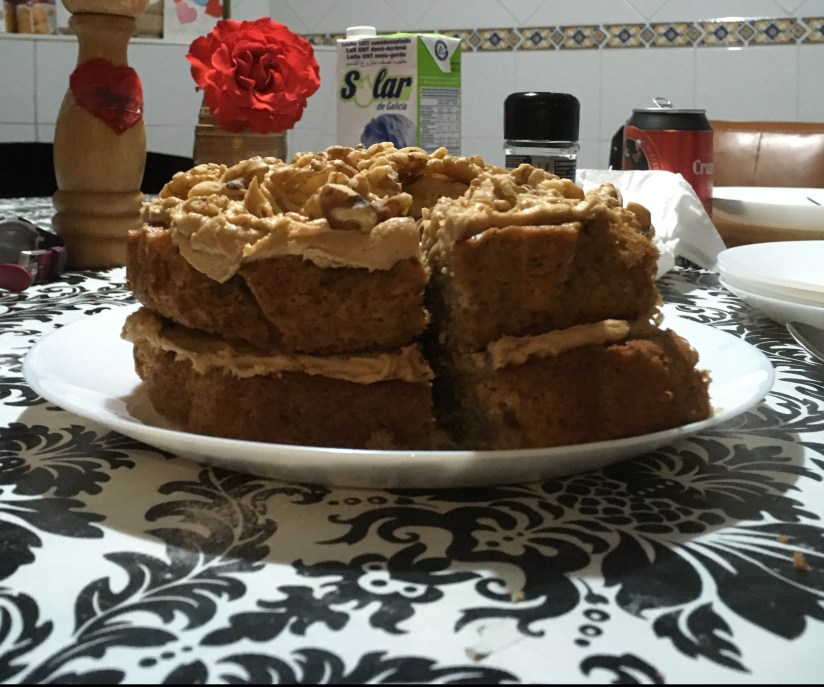
However, despite my enjoyment of this current assignment, I find myself procrastinating. Having done the washing up after lunch today I knew I should return to my office and sit down for an afternoon of editing. Instead, I decided on the spur of the moment to make a coffee cake. I’ve never made a coffee cake before, but I have a hand-written recipe in the little recipe book I’ve been adding to and baking from for years.

img_13721.jpg

My ‘not as good as Cissie’s’ coffee cake

I’ve been craving coffee cake for weeks, probably since the end of March and what would have been my father’s 78th birthday. You see, for me, coffee cake is intimately and indelibly tied up with memories of my father and my aunt Cissie, Daddy’s oldest sister. Coffee cake does not exist in my memory and my imagination independent of those two very important people in my life.

Until I was five years old, I was the only child in a small house in rural Ireland that was home to my mother and father, my paternal grandmother, and my paternal aunt, Cissie. My uncle Tom was there most days too and each weekend, my cousins Sean, Declan and Colette and my aunt Lillie were there too. I grew up in a house filled with love and jokes and an obsession with Gaelic football. I never once questioned my place in that wonderful setting. I was grounded and protected and loved. When I was five years old, my baby sister was added to the mix, and when I was six, my beloved aunt Cissie died of breast cancer.

tyrrell 112

Cissie and me on the lawn in Ballygibbon, summer 1974.

Cissie was 18 or 19 years older than my father, who was the baby in a family of eight children that spanned a 22-year range. They all grew up in that house, as had my grandfather before them, who had died on my father’s first birthday. Cissie was the third oldest in the family, and the oldest girl. In what would be the final years of her life (although none of us could ever have imagined that someone so full of life could die so young), and her most important years from my young perspective, she worked as a housekeeper for a country doctor. Dr. Hill was herself an amazing woman, family doctor to all of us and a woman who had gone to medical school in Ireland in what must have been the 1930s. She and her husband, Ger, who was confined to a wheelchair, lived in a big bright orange farmhouse up a long avenue, a couple of miles from my house. Cissie worked in the kitchen, cooked the meals, baked, helped with Ger and slept in the house a couple of nights a week. I have very strong memories of sleeping in Cissie’s bed in her room at Dr. Hill’s house once and feeling simultaneously thrilled and terrified by the vastness of the house.

Back home in our little two-bedroom, five-person house, I shared a bed with Cissie and we, in turn, shared a room with my grandmother. When I go home to Ballygibbon now I can’t imagine how or where we fit two large old beds, a wardrobe and a chest of drawers in that room. But, somehow, we did (maybe the confined space prepared me for life on a boat).

Cissie’s baking was legendary. She baked all the time and everything was delicious. Cakes, tarts, desserts, she made them all. My father, despite hating coffee, loved his big sister’s coffee cake. And, despite being in his mid-30s in the mid-1970s, when I was a little girl, he was still Cissie’s adored baby brother, Cinn-bán Paddy, blond-headed Paddy, and she indulged and cultivated his sweet tooth at every opportunity.

It would be incorrect to say Daddy loved coffee cake. He loved Cissie’s coffee cake. After she died, in 1979, at a time when I was too young to appreciate the grief of those around me, he rarely ate coffee cake again. On those rare occasions when he conceded to try a slice of coffee cake, his response was always the same, ‘It’s not as good as Cissie’s’. Coffee cake never being as good as Cissie’s became, and still is, a running family joke.

tyrrell 113

With my parents and sister at Dublin Zoo on the day of my First Communion, May 1980, less than a year after Cissie’s death.

My father died fourteen and a half years ago. Although my grief is triggered in often odd and unexpected ways, twice a year, on the anniversaries of his birth (March) and his death (September) I am usually guaranteed to feel his absence particularly acutely. This year I was less sad than usual, but was overcome by an almost madness-inducing craving not only to eat coffee cake, but to bake coffee cake. For weeks the stars have failed to align – not enough eggs in the house one day, not enough of the right type of flour the next, the gas bottle too close to empty to chance baking in the oven. But the craving to make and eat coffee cake never went away.

This morning, I took a mid-morning break from editing, as I had promised Katie I would play padel with her. Padel is a game that’s very similar to tennis, but played on a court that’s some way similar to both a squash and a real tennis court. Katie seems to be a natural at most sports and as we hit the ball back and forth across the padel net, I told her (not for the first time) how much Grandad Pat would have adored her and about all the sports they could have played together. Talking like that set me off and I had to take a little break from padel while my eight-year old daughter comforted me.

IMG_1375[1]

Katie approved!

So, with my head full of ideas of intangible cultural heritage, of memory and skill and the transmission of knowledge, and with my heart full of my long-lost loved ones, my procrastination was inevitable, as I took my recipe book from its shelf. So, I’ve made a coffee cake for the first time for my blond-haired girls, and the cycle of intangible culture, love and belonging goes on.

Would Daddy like the coffee cake I’ve made? Although he would never say so, for fear of hurting my feelings, I’m sure inside he’d be thinking, ‘It’s not as good as Cissie’s’. And I would have to agree!


P.S. Apologies to my mother, sister and any other family members who I have made cry by bringing back these happy memories. We’re a sappy bunch.


The tattooist of Auschwitz

Quote

My Friday book review…..via The tattooist of Auschwitz

Snow memory

I remember this time of year about a decade ago. We were living in rural Cambridgeshire, about four miles from Cambridge. It had snowed heavily overnight and the flat southeast English landscape was blanketed in white. I couldn’t wait to get out of the house and go for a walk. I left by the back gate and headed across the fields. The land around our house was owned by Trinity College, one of the Cambridge University colleges. It was heavily cultivated and, although the fields were accessible, walking was restricted to signposted tracks or to field perimeters. As I walked, the sky grew more overcast and it started to snow again. After twenty minutes I was well out of sight of my house and the quiet country road on which we lived.

Instead of the joy I had anticipated feeling at being out in the snowy landscape, I felt unease. This walk along the familiar hedgerows was one I took regularly, and it was not uncommon for me to encounter a hare or a deer. Indeed, on this particular day I found fresh hare prints in the snow. But, somehow, I felt decidedly uncomfortable. I was on a circular walk and at this point I was equidistant between going on or turning back.

I was aware that I had quickened my pace and I was perspiring under my winter clothes. I had the sensation of being a hunted animal as I kept furtively glancing around. Suddenly, the reason for my fear became clear to me – polar bears! There, in the bucolic, highly-managed, symmetrical landscape of rural Cambridgeshire, something had subconsciously brought me back to the Kivalliq. It wasn’t simply the snow. I had been in the snow at least a couple of times since I had last lived in Arviat, and I hadn’t feared an encounter with a bear. But that day, there was a certain quality to the light, a certain texture to the air that tricked my brain into thinking there might be a bear around.

Despite being in a landscape where the largest carnivore I could possibly encounter was a badger, I found myself feeling the way I had that spring day seven or eight years earlier when I had walked out to Huluraq. Arviat was more than a 40 minute walk behind me and all around was the flat west Hudson Bay landscape, where the undulating snow-covered land reached a snow-covered finger, Huluraq, out onto the frozen seascape of Hudson Bay. As I turned to make the slow snow-hampered walk back home I saw two sets of prints in the snow – a mother polar bear and her cub. My blood ran cold. I was unarmed – although I doubt that, armed, I would have stood any better chance. I had no idea how old the prints were. They looked fresh enough, clearly defined and without an accumulation of blowing snow.

The walk back to Arviat was the longest of my life. I expected at any moment that the last sound I would hear would be the fluey-sounding grunt of a mother bear coming up behind me, turning me into a meal for her cub. I walked as fast as my cumbersome clothes and boots and the terrain would allow me. There had been other encounters with bears, some where I’d felt threatened and some where I’d felt awe and gratitude for being in the presence of such a creature. But no encounter was as frightening as that non-encounter that day near Huluraq.

And then, years later, what should have been a pleasant walk across a snowy English landscape turned into an anxiety-filled power walk, as I raced to escape from my subconscious fear. I realized at the time how ridiculous I was being and I forced myself to slow down, relax, bring myself back into the moment. But in a very short time I found myself once again anxiously speed walking towards my little chocolate-box English cottage.

I’ve often thought of that snowy day in Cambridgeshire and the subtle sensations that caused my mind and body to subconsciously make connections between past and present. We all subconsciously make these connections all the time as our senses trick us into time travel. The smell of a 2-stroke engine immediately transports me to the west coast of Hudson Bay; the theme music to BBC Sports Roundup puts me back in the busy little kitchen of my childhood at 5pm on a Saturday evening, me, my cousins, our parents, aunt and granny and the smell and texture of fried bread; tin-foil wrapped ham sandwiches take me back to the Canal End of Croke Park.

It’s not simply memory or nostalgia. Rather, it is a triggering of the senses that awakens reaction, muscle memory, feeling, sensation, emotion. Perhaps it’s the closest we get to time travel as we are transported backwards through time to catch glimpses of what were, perhaps, the moments that defined us. We may not have known at the time but those would be the moments that would remain, imprinted on our souls.