I remember the phone ringing down the hall. Mammy got up from the kitchen table to answer it. ‘It’s for you,’ she said, coming back to sit down. ‘Someone from Canada.’ I walked down the hall to the table by the hall window and put the receiver to my ear.
‘Hello?’ I said.
‘Huvi?’ came the reply. Frank. Dear Frank. My friend, my teacher, my hunting buddy. One of my primary research participants in Arviat, it was Frank who had taught me to skin and butcher caribou, and to get it right by doing it over and over; Frank who had taught me how to drive a boat amongst pods of beluga whales in the shallow waters close to shore, so he could harpoon them from the bow; Frank who put me on polar bear patrol while he collected the arctic char that had swum into his fishing net; Frank who I spent hours and days with, far inland on our quad bikes, out at sea at first light. He and Martha welcomed me into their home, made me tea, fed me biscuits and bannock, took me out on the land and to their cabin with their daughters. Frank made me laugh and made me think. How at ease I felt in his company.
And now, he was on the phone. He on the tundra, on the western shore of Hudson Bay; I in the Bog of Allen, in the middle of Ireland. And the distance between us seemed vast. Vaster than the Atlantic Ocean, and maritime Canada and the width of Hudson Bay that separated us. All that we talked about with such ease when we were together dissolved now across the expanse.
He asked about the weather and I told him. But what was Irish weather to him? What was the Irish autumn, with leaves changing colour and falling off the trees, the rain and the mud, when he lived in a place with no trees, where autumn meant the ground covered in snow and the sea gradually turning to ice, travel by boat giving way to skidoos. My autumn meant nothing to him and, from this distance, his autumn was starting to dim for me.
I asked what he’d been doing and he told me where he’d been seal hunting the previous day, who he’d gone with and the other hunters he’d met when he was out. I smiled as he spoke. In my mind’s eye, I could see where he’d been and who he’d been with. I had been there with him, and with his brother-in-law Arden, just a few weeks earlier.
He asked what I’d been up to. It was September and in Ireland there was only Gaelic football in the air. How could I tell him about the match I had been to on Sunday? About the crowds, the excitement, how important football was to my life here? Or that the turf was home and there were still a couple of loads to be thrown in the shed. My voice sounded strange in my ears as I tried to talk to him about my life here.
I’d lived in his world and loved it. He was interested in my world, but had no experience of it. The ease we felt in each other’s company was made jagged by the cultural distance that now lay between us.
We continued to speak on the phone occasionally and I got to spend another summer with him a few years later. It’s a few years now since he passed away. I wish I had been better able to bridge that distance when he called.
I’m at Dublin airport, waiting for my sister to come through arrivals. The airport is quiet tonight, a few families, a couple of guys with bunches of flowers, people hanging around on their phones or with paper cups of coffee.
A group of Spanish teenagers comes through the sliding doors, welcomed by an exuberant Dublin woman who bundles them together for a photo before ushering them towards the exit.
Groups of holiday makers arrive home from warmer climes, tanned and dressed inappropriately for the wet August night that awaits them outside the terminal.
Over the course of about twenty minutes, three middle aged women come through, Eastern European and Asian, greeted with hugs and kisses by their children and their tiny Irish grandchildren.
I could spend all evening here, watching these arrivals and reunions.
Dublin Airport is special to me. The scene of so many of my own departures and arrivals over the years. My first ever solo trip abroad (only my second trip ever in a plane), aged 16, when I went to central France for a few weeks to au pair and improve my French. How scared I was, and how scared my parents were, but I wanted to go and they didn’t hold me back.
Three years later, I was away again, this time to the Netherlands with my friend Louise; my aunt Catherine’s tent strapped to my huge rucksack. Mammy drove us to the airport that morning. We had no jobs, no clue what were doing, but we were youthfully optimistic that we’d find work for the summer. And we did.
I remember a big gang of family and friends coming to see me off when I departed for Japan, aged 22. My biggest trip yet. A year away, and so far away. I remember how we all tried to keep a brave face on things as we sat in one of the airport restaurants, waiting for the moment when I would have to say goodbye and take that lonely walk through to security. And I remember Daddy telling me that it would be ok if I didn’t like it and wanted to come home. We had no way of knowing how much I’d love it and that I’d end up staying for three years. And after that, there would be the multiple departures to the Canadian Arctic; all those journeys starting in Dublin Airport.
I remember the arrivals too. The time I came home from Japan with a shaved head and blue fingernails, and Mammy didn’t know what to think. The first time I travelled alone with Lily in her sling. And all those times I came home at short notice, for Jerry’s, Jimmy’s, Lillie’s, Nana’s funerals, cousins or uncles or my brother-in-law picking me up and often driving me directly to a wake late at night.
I remember the much more frequent arrivals during Daddy’s final seven or eight months, when I flew home from Aberdeen every few weeks. I no longer expected anyone to meet me at the airport. I’d take the bus home or I’d hop on a bus into the city and meet Daddy and Mammy at the hospital.
Tonight, I sit and look at the people waiting and arriving and departing and I wonder where they have come from, why they have flown into Dublin on this particular evening, and what awaits them when they pass through the doors and head for their destinations, each with their own fears and hopes, loves and losses, their own adventures and stories, pasts and futures.
At Christmas 1989, I was 16 years old and in my final year of secondary school. In February, I would have to complete my application for university – a centralized system in which I would have to list my choice of institutions and courses from one to ten. In June 1990, I would sit the state Leaving Certificate exam and, in August, I would be offered the highest ranked of the ten courses for which I had gained sufficient accumulated points in my Leaving Cert.
Geography and English were my favourite subjects and I imagined I would do a degree in those two subjects, become a teacher, and then come home to Edenderry and teach for the rest of my life. I didn’t know any better. My teachers were my role models for what could be done with a university degree. I loved Geography, ergo, I would become a geography teacher.
But, while at 16, I couldn’t imagine a life for myself outside of Edenderry, in my mind, I was a citizen of the world. From the age of 11, I’d had pen-pals in Singapore, Australia, Malawi, Egypt, Hong Kong, Spain, Greece (by the way, to this day I’m still friends with Aileen in Singapore and Haitham in Egypt), and spent vast amounts of time – and pocket money on stationary and stamps – telling them all about my life and learning all about their lives. And, shortly after I’d turned 16, I made the difficult decision to stop buying Smash Hits every fortnight and instead save up my pocket money and birthday and Christmas money to subscribe to National Geographic. I’d sit at the kitchen table or lie on my bed here in Ballygibbon, and read National Geographic from cover to cover, even the ads, as the words and photos took me on journeys to places and peoples in lands far from my little corner of Co. Kildare.
That Christmas of 1989, my aunt Marian and uncle Jim came up from west Cork to stay at Nana’s house in Gilroy. We saw them two or three times a year, but this time was a little different. Jim was a primary school headmaster and my parents had asked if he could help me with Maths. The Leaving Cert was only six months away and Maths was, by some measure, my worst subject. Poor Jim, he did his best but, he was fighting a losing battle from the start. Not only was I bad at Maths, I refused to even try to be good. My stubborn mental block took years to shift and it is residually still with me today.
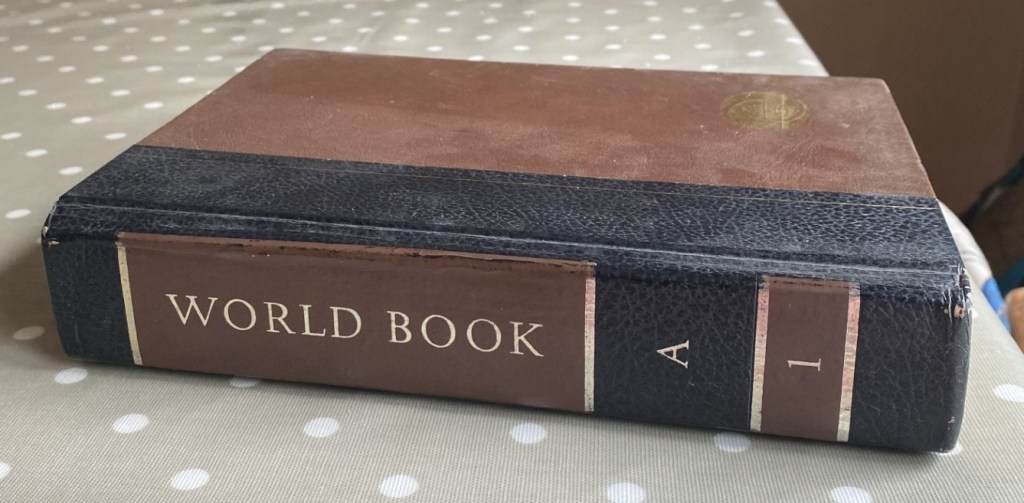
Jim, in his spare time, was also a door-to-door encyclopaedia salesman. On the day they arrived at Nana’s house that Christmas, Mammy and I popped in to visit. ‘Come out to the car,’ Jim said to me. ‘I’ve something for you.’ Out we went. He opened the boot of the car and fished out the A book of the World Book encyclopaedia. I was delighted with this and spent the remainder of the visit at Nana’s house browsing through the pages.
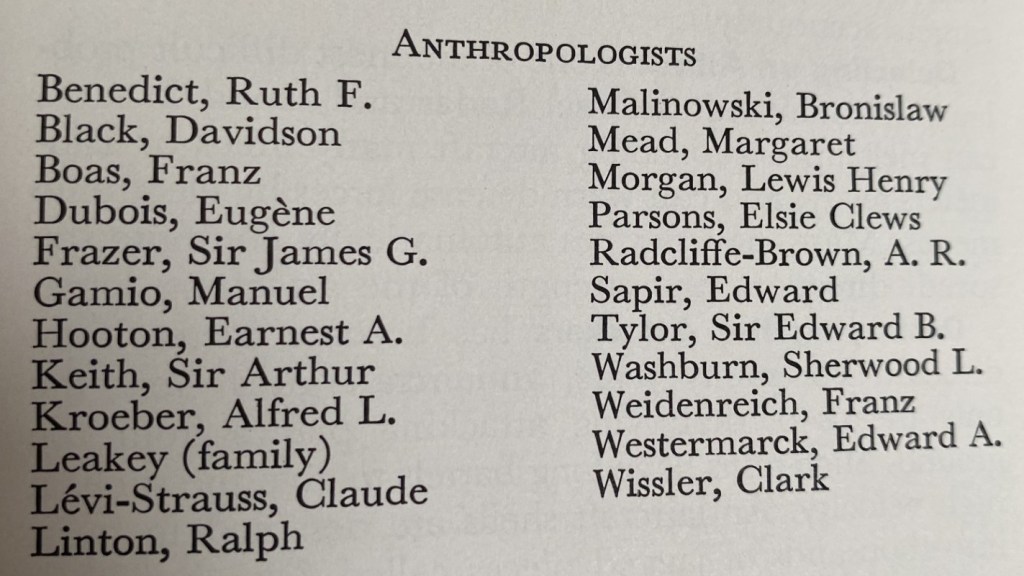
At home that evening, I sat on my bed, a mug of tea on the bedside table, and poured over the A book, page by page. It was filled with all sorts of interesting A things – from Kareem Abdul-Jabbar to Alexander I, from Antarctica to Austria, from Airplane to Audio-visual Materials. And then I came to page 509: Anthropology.
What on earth? There’s this field of study that I’ve never heard of before, that’s combines some of the bits I like best about geography, and that’s all about learning about people who live far away in other parts of the world. Could I do that? It seemed highly unlikely.
I read and re-read the four and half pages about Anthropology. Among the most renowned were a handful of women – notably Ruth Benedict, Margaret Mead, Elsie Parsons.
And I read that anthropologists did their research by immersing themselves in the lives and cultures of the peoples they studied, learning skills and languages, and then theorized and wrote about what they had learned from those experiences. Surely there were no anthropologists in Ireland! This was far too exotic and exciting!
I thought about anthropology all through the Christmas holidays and, as soon as I the January term started, I made a bee-line for the school career guidance counsellor, convinced that she would tell me she had never heard of this subject or that the nearest place I could do it was somewhere in England. Imagine my surprise when she told me that the only Anthropology department in the Republic of Ireland was in Maynooth – my nearest university! How could this be? How did I not know?
In February, I filled in my university application form, still erring on the side of Geography and English in UCD, but with Arts in Maynooth as my second choice. When I received my Leaving Cert results in August 1990, I knew I had enough points to do Anthropology and Geography at Maynooth.
And did I get my degree and return to Edenderry to become a Geography teacher? Well, I got my degree. And I followed that with a Masters degree in Anthropology. Then I went to live in Japan for three years. Then I moved to the Canadian Arctic. Then I did a PhD in Anthropology, immersing myself for long periods of time in an Inuit community on the west coast of Hudson Bay. Then I worked as an Anthropologist-Geographer in geography departments in Cambridge, Reading and Exeter universities. All thanks to my uncle Jim handing me the A book out of the boot of his car two months before I applied for university.
I was sitting at the kitchen table here in Ballygibbon earlier today. I glanced up towards the bookcase and saw the A book, still sitting there. Coincidentally, today is also the day when tens of thousands of students across Ireland receive their Leaving Cert results. I hope their lives are as unexpected and serendipitous as mine has proven to be up to now.
I meet Sean again when I go out for an evening walk. This time he’s sitting on a camping chair on the canal bank, beside his boat. He’s with a younger man, who’s sitting on the grass. I shout ‘hello’ over to them and they beckon me over. By the time I walk back to the nearest bridge and cross over to the other side of the canal, Sean has pulled another camping chair out from his boat. His buddy is Carl, a Mancunian. The two met only yesterday, when Carl was taking his daily walk along the canal. I sit with them for a couple of hours, shooting the breeze, sharing stories about where we’ve come from and where we’re going to, the importance of listening, and the power of poetry. I bid them farewell and carry on my way.
••••••
‘I started working with papier-mâché during lockdown,’ Jean tells me. ‘I wanted to make art with what was lying around the house.’ I’ve wandered into her studio and find her sitting at a table, surrounded by papier-mâché spheres and abstractly-shaped boxes, everything looking precarious and on the edge. ‘Everywhere I turned, they were talking about tipping points. Scientists, activists. Tipping points are my great anxiety. So I’m working through that anxiety in my art.’ I ask where she’s from. ‘From Indiana originally, she say, but I’ve lived in England for forty years.’ She shows me how her tactile, playful art moves and explains how she makes it. I wish her luck with her project.
••••••
‘Do you mind if I sit here?’ I ask the man sitting alone at a table who looks like he’s working. I’m here to work too, so this could be a good place to sit. ‘The working end of the cafe,’ I say to him. ‘Yes,’ he smiles. I spot a university logo on the paper in his hand. From this angle, it looks like exam grading criteria. ‘Marking exams?’ I ask him. ‘Job application,’ he says. He’s Mark, an academic at a midlands university, grown tired of his job and applying for a position at a university in eastern Germany. We talk about the state of academia in the UK, the Spanish education system and, before long, an hour has passed and neither of us have done any work. I have a Zoom meeting to prep for and he has a train to catch, so we say goodbye and I get on with my work.
••••••
‘I’m at a stage in my life where friendships with women are most important to me,’ Amanda says. She tells me that she’s only moved to Leamington two days ago. She’s a few years younger than me, has a corporate job, but her real passion is healing. I tell her about a book I’m currently editing, and we discuss the power of stories and how we’re only able to tell our stories once we have worked through our trauma. We’re the only two visitors in a small art gallery and we’ve both arrived at the same time. We start out shadowing each other, a little self conscious in the small rooms. But soon we’re talking about healing and friendship, and what a great place Leamington Spa is, and the fact that we’ve both recently been to Thames Ditton. We leave the gallery together, saying goodbye as we walk away in different directions.
••••••
I find it hard to stay strangers with anyone for long.
I’m walking along the Grand Union Canal that runs behind the estate where my father-in-law lives. It’s a glorious evening and I’m on a video call with Katie who is away on the south coast this week with Lily and their uncle and aunt. I walk past four or five narrow boats. On the last boat in the row, a modest white and blue steel boat, a man is standing. I have the phone up, so he thinks I’m filming him or taking his photograph. He gives me a big smile and says something. But I’m talking to Katie, so there’s some confusion. He then realises that I’m not taking his picture and I realise that he’s talking to me. More than that, I hear his Irish accent and he hears mine.
“Where are you from?” he asks. “Kildare,” I reply. “Ah, a Lillywhite,” he says and I know immediately that I am firm ground. Despite his Dublin accent, he tells me he’s from Dungarvan in Co. Waterford. “The husband of one of my best friends is from Dungarvan,” I tell him. I tell Katie I’ll call her later because I have a feeling I might be chatting here for a while.
Sean and I chat for an hour, me standing on the grassy tow-path, he on the open deck of his narrow boat, the air cooled engine exposed to the evening air. We discover we have people and places in common. He pootled a narrow boat up to the harbour in Edenderry in the late 1960s and remembered going for a drink at The Harbour House. That was my uncle Tom’s favourite haunt, owned by Mary O’Connor, my Irish teacher, and her family. I was only in The Harbour House once, for a pint of Guinness with Tom back in the early 1990s. It was everything you would expect of a small Irish pub, all the old men lined up at the bar. It was renowned for its music and for Mary being as strict behind the bar as she was in the classroom.
Sean tells me about his job at Shannon airport and about people from Edenderry he knew there and at Ardnacrusha power station. I mention people I know who he might have known and we laugh when we get a bit tangled in Johns and Seans and who was who.
I tell him I had been a sailor and we talk about the joys of my Westerly Conway. He wonders how a girl from the Bog of Allen and a boy from the housing estate 20 metres from here could have ended up living on a boat and sailing to the places we did. He tells me of his adventures as a sea sailor and as a narrow boat owner and about his sustainable, no-cost approach to life.
At 80 years of age, he is only a few years younger that Daddy would have been. The Cuban Missile Crisis comes up in conversation (he makes me promise not to tell anyone why) and he shares his reminiscences of those few days in 1962 and I tell him what Daddy told me of his memories and fears of those days.
He explains how he has come to have that Dublin accent but says his heart remains firmly rooted in Dungarvan. He already owns a plot in Dungarvan graveyard where he wishes to be buried when his time comes.
“I had a half pint at the Cape of Good Hope a while ago,” he tells me, referring to the pub just a couple of hundred metres away. “When I went to the bar, I heard two men behind me. A Mayo man and a Galway man. Sure, I had to talk to them. The Mayo man was a bull man.”
“A bull man?” I ask, perplexed. “Ah, you’re too young,” he says. He explains what a ‘bull man’ is and realisation dawns. “Ah,” I say, “You mean the AI man. That’s what we call it where I come from.” He laughs and says how funny that we had that in Ireland where the Catholic church didn’t allow such things for humans. AI, for those of you not in the know, means, artificial insemination, and the Bull man or the AI man was, and remains, an integral part of our dairy and beef industries.
My daughters always tease me when I speak to other Irish people, accusing me of changing the way I talk and the way I hold myself. They’re not wrong. But I don’t do it on purpose. When I’m with other Irish people I become the version of myself that is the oldest part of me. I speak in the way I learned to speak as a baby, in the first accent I ever heard from the people and the place where I grew up. It is the accent, grammar, syntax and vocabulary that I am most comfortable with. There’s no modulation, no register change, no code switching. I am me at my most comfortable.
We all change our registers in different contexts. For instance, the way we speak to small children is not the same as the way we speak in the corporate office. The way we speak in church is not the same as on the terraces of the football stadium. But changing accents is something different. Over the years, I have modulated not only my accent, but the words I use when in conversation and the order in which I say them. Why? Well, for two reasons – one that I am comfortable with, the other less so.
For most of my life, I have chosen to live among people for whom English is not a first language. Therefore, to make myself understood among English speakers in Japan, Nunavut, Spain, and elsewhere, I slow down, speak carefully, use very standardized words and phrases to be understood and to make the person I am speaking to feel more comfortable. That is now second nature to me.
The other reason is that, over the years, I have been very aware of people making fun of my Irish accent – people laughing and repeating my pronunciation, my use of certain phrases or my Hiberno-English sentence structures. In order to reduce the feeling of discomfort (and anger) that this fun-making and ridicule causes in me, I modulate and change register. It’s just easier. I don’t like it, but it is how it is. That too is now second nature to me when I am around native English speakers who are not Irish.
But, when I speak to other Irish people, I can feel my body physically relax. I don’t have to think of an alternative phrase or word for ‘give out’, ‘press’, my use of bring/take, my pronunciation of H and th, or a thousand other usages of words and phrases. I’m not going to be laughed at for calling my parents Mammy and Daddy. I can throw in a reference to the GAA or to Eamon Casey or to the Angelus or to a million other things, and no further explanation is required. I can just be.
All migrants, no matter what their language or their circumstances, experience this distance from their first voice. Some people are happy to leave that first voice behind. I am privileged to have had so many opportunities to travel in my life. I have learned so many wonderful ways to speak and to see the world through the eyes of others. But speaking in the way that is oldest to my being is like relaxing into a large warm bath.
Sean is stuck along this stretch of the canal for the time being, as he waits for a lock gate farther along to be repaired. I tell him that if he’s still there the next time I walk that way, I’ll invite him down to the Cape of Good Hope for a beer. Who knows? Maybe the AI man will be there.
There’s nothing quite like spending a few days in London’s leafy suburbs. My head is spinning from the range of international cuisine to choose from, the delivery to the door of fresh food, the charity shops selling the hand-me-downs of the well-to-do. The easy and regular public transport.
We went to a Japanese fast food place for lunch today. Proper, real, honest to god Japanese food. I haven’t eaten inari in years – it tasted as good as I remembered when I used to buy it in my local supermarket in Sue-machi. The katsu curry brought me back to winter evenings at my friend Takako’s house in Sasaguri-machi. The edamame were a delight. It was all southwest London outside the window – red buses and black cabs going past – but inside it was all Japan. And how happy I was.
Then a spot of shopping. Not much, because we’re travelling light and don’t have much room in our bags when we make the return journey to the midlands in a few days. An independent bookshop was a delight – our second in less than a week. While the range on offer and the hours you can spend in Waterstones – the big book chain store – is amazing, there’s nothing quite like a small independent book shop. They’re always quirky, with friendly staff eager (but not too eager) to help. This one was narrow and tightly packed. We had to squeeze between shelves and step aside to let other customers pass. We all got excited when we saw books that we’ve read or showed each other books we want to read. We oohed and aahed over beautiful cover art and I apologized to the shop assistant for buying nothing more than a greeting card and not supporting her business more.
We browsed a few charity shops. I’ve been looking for a linen shirt, and I found one that, by the looks of it, is brand new and only cost me £3. We were drawn to the books in the charity shops too and to the cute little figurines and ornaments. I offered to buy Lily a measuring tape housed in a crocheted ladybird, but she declined my offer. How strange. Coincidentally, I bought a Ladybird book for myself for nostalgia’s sake and I bought Katie a badge. It takes so little to make us happy.
And then it was a fancy coffee place for salted caramel iced frappes. You don’t get those in Sanlucar, let me tell you! And then it was back to the train and in five minutes we were walking down the tree-lined road back to Sarah’s house.
While I never want to swap rural life for suburban or city life, I still enjoy savouring what this other life has to offer. The katsu curry and salted caramel frappe taste all the better for only being available to this country mouse once in a very very blue moon.
Later today, I will close my front door behind me as the girls and I leave home for 10 weeks. We’ve never been away from Sanlucar for so long before. At first, we will spend a few weeks in the UK and then we will go home to Ireland. We have a wonderful summer ahead of us, packed with family and close friends and trips to all sorts of wonderful places and events.
But I have mixed emotions about leaving. I am saying goodbye to a close friend who, owing to illness, will likely no longer be with us when I return. At the same, I am excited to spend time with my family and dear friends, the people who have known me longer and who know me better than anyone.
I’m taking the girls away from a summer by the pool and at the beach, and being with their friends. I’m also taking them away from Lady. But then I remind myself of how hot it’s going to be and how we’ll be stuck inside the house most of each day in +40C heat. So, I’m looking forward to taking the girls to cooler beaches and to places familiar to them that they want to visit again and places new that they have never been to. And I’m excited about the time they will get to spend with friends in the UK, starting on Sunday, when we travel to London to visit their oldest friends.
While I have adapted to many aspects of Spanish culture, after ten years I have yet to adapt to staying out so late at night. I can do it once or twice in the entire summer. But, in general, when Sanlucar comes alive at night in the summertime, when many of our friends and neighbours are out strolling the streets, or at one of the bars, or sociably sitting outside their houses, the girls and I have already gone to bed. I have tried to adapt, but I can neither stay awake that late at night nor get by on so little sleep the next day when I need to be up at 6am to get my work done before it gets too hot. Lots of people have managed to adapt to it. Sadly, I’m not one of them. So, I’m looking forward to cooler weather in the UK and Ireland (despite a heatwave in the former at the moment) and sticking to my normal bedtime.
For all of that, for all the wonderful things I have planned, I know that when I am at home* in Ireland I will miss my home in Spain. I will be looking forward to coming home in September, batteries charged, feeling refreshed and renewed, and feeling love and longing for both the home I will be leaving behind and the home I will be returning to. I am grateful for both.
*I don’t actually own a home in Ireland. We’ll be couch and spare-bed surfing for the entire summer. It’s more that home owns me.
An aerial photo of my home in Ireland, taken sometime in the 1960s.
A few days ago, when it was too hot for Lady’s little paws to be on the road, I took her down to the river for a swim. When I got there, I spotted a yacht on the pontoon called Sedna. I got very excited. Sedna (or Nuliajuq in the Kivalliq region of Nunavut) is the supreme goddess of Inuit mythology. Goddess of the sea, she hides and protects the marine animals in her long flowing seaweedy hair, only revealing them to hunters who prove themselves deserving. How does she decide who’s deserving? It’s those hunters and, more importantly, their wives, who generously share the meat and fur and other parts taken in the hunt. In the old days (and in some quarters still today), Inuit believed that animals, once released from Sedna’s hair, gave themselves to generous hunters.
So, I got very excited when I saw this boat. The way I got excited in the past to see a boat called Aarluk (orca) or one called Nanuq (polar bear). One doesn’t expect to see Inuktitut words in southern Europe! I couldn’t resist popping down to the pontoon to say hi and inquire as to why the owner had named his boat after the Inuit goddess of the sea. I mean, a goddess of the sea I get; but the Inuit one specifically?
I saw that the boat was flying a Spanish flag and had a Spanish registration mark printed on the hull. There was a man in his seventies in the cockpit. ‘Buenas tardes,’ I said, assuming that he, like his boat, was Spanish. When he replied in English with a British accent, I said hi, and told him, perhaps a little over-enthusiastically, that I’d noticed his boat was called Sedna.
‘Oh yeah,’ he said, distinctly less enthusiastic than I was. ‘Why did you call it that?’ I asked. ‘That’s what the previous owner called it and I didn’t bother to change it.’ He seemed not curious, not interested, not bemused, not annoyed that I’d bothered him. Indeed, he seemed not really anything at all that this overly-exuberant Irish dog-walker on the Spanish border was trying to make conversation about the name of his boat.
‘Do you know what it means?’ I asked.
‘Nope,’ he replied.
‘She’s the Inuit goddess of the sea,’ I started, but he cut me short and asked, ‘Do you live here?’ He was completely disinterested and my little bubble of excitement at having found someone who might share my interest in Inuit mythology and Inuit culture was immediately burst.
I laughed at my silliness after. At how I had imagined our conversation would go and at how the conversation actually went. I chatted with him for a few minutes more, answering his questions about life in the village, and whether I still owned a boat, and whether the schools around here are any good. Then I said goodbye, wished him luck on his sailing trip and Lady and I carried on on our merry way.
The girls are only just realizing, perhaps only now taking an interest in the fact that I had a life before they came along. Some weeks ago, I was talking about Australia with someone. Afterwards, Katie said to me, almost as an accusation, “You never told us that you’d been to Australia,” like I’ve been keeping it from them on purpose. I’m sure I’ve told them before about the three weeks I spent on the east coast of Australia when I was 23. Maybe not. Either way, they were intrigued and wanted to know more. Lily then teasingly said, “What else are you not telling us?”
A couple of weeks later, Katie had to do a school project about her mother. Maybe it was about a parent. I don’t know. Anyway, she did it about me. I remember Lily doing the same project at the same time last year. I asked Katie if she wanted to interview me, but she told me no, she’d find out all she needed on the Internet. Dear God! What would she unearth?
Home from school a couple of days later, she says, “It says you lectured in Cambridge?” She can’t believe it. I explain that I was a post-doctoral fellow at Cambridge and that I gave some lectures in the Geography department. “But at Cambridge?” she asks. She really can’t believe it and it doesn’t seem to matter that I wasn’t a don, but rather an occasional contributor to a course or two as part of my fellowship. “Cambridge,” she says again.
Then she discovers some of the stuff I’ve had published – newspaper and online stories about my research, and such like. “You can write,” she says, impressed; this new information absolutely at odds with the mummy figure who forces her to eat her greens and nags her about leaving her trainers on the middle of the living room floor. I tell her that something I wrote my was once used as evidence in hearings at the US Congress.
“So, what on earth are you doing here?” she asks, referring to this tiny corner of Spain where we now live. I explain that, for me, coming here was the end of one great adventure – the boat, the cruising – and the start of another – a new culture, new language, a new community of people, an adventure that I’m still on ten years later. For her, this place is home. She’s lived here since she was four years old. It’s boring old Sanlucar, from where she wants to get out into the world, not a place you’d leave Cambridge for!
This morning, as the girls were getting ready for school, Lily asked, “Mum, have you ever been to a disco?” I almost choked on my herbal tea. When I told them about the Huntsman in Edenderry, the Wednesday night bar-exes in the students’ union in Maynooth, the Saturday night’s at the Crazy Cock in Fukuoka, the night I met their father, my first date with their father, they looked at each other and rolled their eyes. Lily asked me to show them my dance moves. “You know my dance moves,” I laughed. I’m relieved there’s no evidence of my disco days on the Internet.
Those of us who live in predominantly monolingual English-speaking parts of the world are particularly poor when it comes to speaking other languages. We make excuses, such as ‘I don’t have an aptitude for languages’ or we convince ourselves that we can’t do it. The fact is, we have the luxury of speaking an international language, and that makes us lazy and scared. Our language is the majority language of North America, Australia, New Zealand, Ireland and the UK, and an official or minority language in large parts of Africa, India, Oceania and elsewhere. In addition, many northern Europeans speak English as a second language. And let us not forget the millions of indigenous peoples worldwide who have been forced to adopt English to the detriment of their own languages. From our privileged position, we English speakers tend to view monolingualism as normal. But it is a one-sided privilege. When we travel abroad, we expect others to communicate with us in our language, without realising that our dogged monolingualism necessitates others’ bilingualism.
Far from people having or not having an aptitude for languages, bilingualism and multilingualism are the norm. South Africa, for example, has 11 official languages and recognises 8 other regional languages. I have met South Africans who can fluently speak five or six languages and have a smattering of three or four more. This is common. Papua New Guinea has over 850 indigenous languages, many from unrelated language families, and yet, the majority of Papua New Guineans are multilingual. I have friends from mainland Europe who can easily converse in Swedish, Dutch, German, English and French.
We are all born with an innate ability to speak language, but the form that language takes is moulded by our culture. There is nothing in our DNA that makes us capable of only speaking one language. One of the driving forces behind our decision to settle in Sanlúcar was our desire to give our children the opportunity to learn a second language. When we moved here, I had a poor grasp of French, an even poorer grasp of Japanese and Irish, and a smattering of Inuktitut. Julian had a similar grasp of French, Spanish and German. Neither of us were in a position (as home-schoolers at the time) to instil in our children a solid grounding in any language other than English.
The opportunity to enrol the girls in a small rural school, where they would be immersed in Spanish (Andalucian) language and culture, was not one to turn down. The girls were five and six years old when they started school and they didn’t speak a word of Spanish. They’re eight and nine now, and are pretty much fluent. Lily is equally comfortable in either language, while Katie finds it easier to read and write in Spanish.
What I didn’t anticipate when we made the decision to enrol our children in school in a small Spanish village was how multilingualism would become the norm for them. We are not the only immigrants to this beautiful part of the world. Here on the Rio Guadiana, we have friends and acquaintances from Holland, Lithuania, Germany, France, Belgium and Japan. The river separates Spain and Portugal. I’ll never forget Lily’s birthday party last year, where eight little girls ate pizza and played on the beach and between them spoke Spanish, French, Dutch and English. Their waiter was Portuguese. My children are often in the homes of their Dutch, Lithuanian or Japanese friends, immersed in the language of those homes. It’s a wonderful thing.
I’m not expecting my daughters to become fluent Lithuanian or Japanese speakers any time soon. Rather, their immersion in those environments normalises multilingualism. They become used to and comfortable with being in spaces where their language does not dominate. They accept that people change languages depending on to whom they are speaking and the topic of conversation. They understand that, when someone is speaking a language they do not understand, they are not doing so in order to exclude. And they are learning that language expresses culture and some things are not easily translatable from one language to another.
Language is a powerful and beautiful human trait. And every language opens up a new window on the world. We made a good decision when we dropped anchor in this multilingual little corner of the world.





 Me in place