100. And finally.…

A few things happened to get me to this point.

About eight months ago, I read Suleika Jaouad’s memoir, Between two kingdoms, a beautiful account of her life with leukemia when she was in her 20s. In one part of the book, she describes how she and her parents undertook a 100-day project – each of them committing to one act of creativity every day for 100 days. Her mother painted one ceramic tile a day, her father wrote one memory a day from his childhood in Tunisia, and Suleika, too weak to do much of anything, journaled. That’s a nice idea, I thought at the time, and didn’t think any more about it.

A few months later, I was thinking of ways to reduce my outgoings. Work had dried up and my bank balance was plummeting at an alarming rate (I’ve come out of that slump for now, thank goodness). I started to cancel subscriptions – Apple Music, Amazon Prime, that sort of thing. I hadn’t posted a blog on WordPress for over a year, yet I still had my subscription set to autopay. Two things bothered me about this. First, I knew it was a waste of money to have this subscription but not use it. Second, I wanted to write blogs, yet I never did. When I went to my WordPress account, I saw that my subscription was active until January 2026 – over seven months away. I could leave it sitting there and do nothing, or I could use that time to actually write something.

There and then, I set myself a challenge to write ten blog posts, starting that very day. I’d number them, for myself, as a reminder that I was doing it and how far along I was in the challenge. On the 18th of June I wrote the first one, about how busy life was in the last few days before the end of the girls’ school year. The next day, at the same time, I wrote another and then another. As I crept closer to number ten, I knew I wanted to keep going, so I committed to twenty. By the time I reached day fifteen I had committed, privately, to myself, that I would write 100. So I did. Every day, without fail, I wrote and published a blog. And today is day 100.

It wasn’t always easy. Ideas were never a problem. Every day I found something to write about, generally without even searching for it. Something always popped into my head. Indeed, there were quite a few days when I drafted something in the morning, but it was superseded by something else later in the day. Those drafts are still lying dormant in my drafts folder.

Instead, what got in the way or caused resistance was tiredness. I was travelling all summer, visiting family and friends in the UK and Ireland, and working at the same time. When I was in the UK, it was generally easy for me to get my blog written and out into the world by mid-morning. Things changed when I went to Ireland, where I spent so much time in conversation with family and friends that the day would slip away and the blog wouldn’t get written until I was already in bed, very late and feeling very sleepy. Occasionally, all I had the energy for at that time of night were a few photos of the day with a brief excuse for why I couldn’t write more.

But I was called back to write again, create again, share again every day. I saw that people were engaging with me – sending me messages, liking my posts – but I rarely had time to respond. I hope to respond to everyone in time. But seeing all that support was a marvelous motivator. I didn’t write to get likes or gain followers. My reasons for posting were more personal, for two reasons. First, I write all the time, but often lack the confidence, the courage, the self-belief to share what I’ve written or, indeed, to complete something I’ve started. Posting every day, without having the time for too much self-criticism or interrogation, was an act of forcing myself to put my writing out into the world without overthinking it. The positive responses I’ve received have been nothing but encouraging. Second, like many people, I so often start things that are for me and me alone, and then drop them because I prioritize the needs of others. How many times have I started a new routine – yoga, a commitment to exercise, a writing practice – only to let it slip because ‘I just don’t have time.’ This time, I made the time and I reached the finish line and, you know what, it feels great!

Writing something every day for these 100 days has reminded me to be more observant – to pay attention to the words people use, to see the colours and shapes in the world around me, to really see the material things around me.

So, where do I go from here? I will certainly continue to blog, but I’m giving myself a break from doing it every day. During these past 100 days, I’ve written a lot of rambling fluff. But I’ve also written some pieces that I think are rather good. I’d like to return to those now, maybe expand on some of them, share them on other platforms, such as Substack or Medium, and maybe even see if I can revise them and submit them for publication or writing contests. There are also pieces that I’ve written over the past 100 days that will definitely find their way into my memoir, which I have been writing for a little over a year now (I have to finish it!).

The past 100 days have taught me that I can do it, that my nearest and dearest will get used to it as part of our daily routine, and that no matter what your intention when you make a piece of writing public, readers will never cease to surprise you in the way they interpret it.

Thank you everyone who has been with me for the past 100 days. The silent ones and those who have sent me comments via social media or who have emailed me, and those who have stopped me in the supermarket or at a funeral to say they’re reading along. See you all soon!

96. A novel sleeping partner

In November 2007, I headed south on a Ken Borrack Air Twin Otter. I’d been waiting all day, with the flight twice delayed owing to bad weather. Both times, I’d been sent home and, each time, got a call a couple of hours later telling me to get myself back to the airport. On the third try, the weather cleared long enough to allow the plane to take off.

Loading the Twin Otter at Arviat airport

The moment had come to fly the sixty miles south of Arviat to the hunting camp, and I boarded the stripped out plane that now only had three passenger seats. The only other human passengers were Nadine, the French-Canadian cook, and Reverend Jimmy Muckpah, minister at Arviat’s Anglican Church. The other passengers were two wooden boxes containing Jimmy’s sled dogs, packed securely for their own safety for the short low altitude flight. What little remaining space was packed to the rafters with a skidoo and some of the boxes of food and other items we’d need.

Lovely, kind Jimmy Muckpah, who knew more about polar bears than anyone I’ve known
Jimmy’s sled dogs, who seemed quite content with their travel arrangements

We flew south along the coast to our camp. The others had flown in on an earlier flight and we all helped to unload the plane before it took off again. It would return for us in two weeks. I was to live for those two weeks with five big game trophy hunters from the US, their five Inuit guides, all from Arviat (including Jimmy), and Nadine. The guides, Nadine and I all knew each other, but the trophy hunters were new to me and, indeed, to all of us. I was here for research. I was studying the relationship between humans and polar bears; specifically, seeking to understand the changing role of polar bears in Inuit culture and economy, as international laws about polar bear hunting was rapidly evolving.

Ryan, the camp outfitter, had generously invited me to the camp. What I learned in those two weeks hugely enriched my anthropological understanding of the role of polar bears in Inuit life and I published my findings in various academic journals and books in the subsequent years. My findings were even presented as evidence at US Congress hearings in 2008 that sought to amend US Fish and Wildlife laws concerning the importation of ‘trophy’ polar bears from other countries.

The camp comprised four cabins. The trophy hunters slept in two of the cabins, the guides all bunked together in another, and the fourth cabin – which was also the camp kitchen and eating quarters – was shared by Nadine and me. Each cabin had a ‘toilet,’ consisting of a ‘honey bucket’ – basically a bucket with a seat and a bin liner that we changed every few days. At those temperatures, anything you did into the honey bucket froze almost immediately. Nadine and I had a small room off the far end of the kitchen that contained a bunkbed. She slept on the top bunk and I on the bottom.

Our little huddle of humanity on the west coast of Hudson Bay

Ryan had built his outfitting camp here because it was situated along the polar bear migration route. Indeed, during the two weeks I was there, more than seventy individual polar bears passed through on their winter migration out onto the sea ice. Many of them came close, attracted by the smells of the camp, and snuffled around. We were under strict orders that no-one was to leave the cabins, or go between cabins, without a rifle and to never go alone. The trophy hunters rarely listened to that advice and took stupid risks by walking from the kitchen cabin to their own in the dark. The local guides, well aware of the realities of living in such close proximity with the world’s largest carnivores, were extremely annoyed by the idiocy of the trophy hunters.

I had various roles during those two weeks. I helped Nadine in the kitchen. I went out on hunting trips with the guides and the hunters in their charge. And I helped with skinning and preparing two of the three bears that were killed. (According to international and local law at the time, each hunter could take one trophy bear (they paid tens of thousands of dollars for the ‘privilege,’ some of which found its way back into the Inuit subsistence economy)). During those two weeks, three of the five hunters got their trophy. The other two went home empty handed.

I remember helping one of the guides, Donald, one day as he skinned a bear that had been shot by the trophy hunter in his care. The hunter was back in the warmth of the cabin, enjoying a hot coffee and some freshly baked cinnamon rolls. I held the bear’s huge heavy legs while Donald did what he had to do. It was cold and he wanted to get the work done quickly. So that he could keep his head down and concentrate on the work, he asked me to keep my eyes on the two polar bears that were circling close by and to let him know if either of them started to move closer. They didn’t, but I was shit scared and so was he.

Polar bears came close to and into the camp every day.

The plywood cabins were reinforced with corrugated metal. They had windows that were too small for a polar bear to get through, and the doors were covered with six inch nails, sharp side out, to discourage any bear that might try to break in. Even so, it was pretty scary at times. One particular day, when the hunters and guides had all left camp to go hunting, and Nadine and I were alone in the cabin, a bear came snuffling around. He stood on his hind legs, making him probably 8 feet tall. He looked in the window into our kitchen (imagine, a polar bear looking in at you!), and repeatedly hit against the side of the cabin with his front paws. He was trying to get in. Nadine and I were terrified. We had a rifle, but I’d only ever used it for target practice. Would I know what to do in a real life-or-death situation? Eventually, he gave up with trying to open the sardine tin that was our cabin and started to play around with the big cylinder of propane gas that was our only source of heat and cooking fuel. One slap with his paw, and he knocked the cylinder loose. Before we knew it, he was rolling it around on the ground, playing with it, and now was 20 or 30 metres away. While we were delighted that he seemed to have lost interest in us, we now had a new problem – it was about -15C and a polar bear was using our only heat source as a toy. Luckily, the hunters and guides came back about an hour later and all was well.

Every night when I went to bed, I could hear snuffling outside the cabin. Sometimes, I’d shine my flash light out the small window and see a pair of eyes reflected back. Lying in my bunk, I’d hear snuffling on the other side of the flimsy wall. Imagine my surprise the first morning I went out and saw a very clear indentation in the snow the size and shaped of a curled up polar bear. It was exactly on the other side of the wall from my bunkbed. The indentation was there every morning; sometimes, like in the photo below, accompanied by claw marks.

I didn’t sleep well for those two weeks, let me tell you, knowing that I was sleeping beside a polar bear, with only a strip of plywood and corrugated metal separating us. But when I looked back on it, I understood what a privilege those two weeks were.

It hard to see the indent of the bear’s body in this one, but the claw-mark is right in the centre.

93. 2-stroke

What’s your favourite smell? Freshly mown grass? Fresh coffee? That smell when you nuzzle your face into a baby? Why is it your favourite smell? Do you know?

I was sitting at my desk yesterday morning, the window open to cool the house down before the heat of the day kicked in. That’s when the smell came tumbling in and nostalgia stroked my face like a feather. One of the council workers was strimming the strip of grass that runs the length of my street. And there it was: The smell of exhaust from a 2-stroke engine. There’s comfort in that smell for me and it’s deeply entwined with so many good memories.

We’re living on Carina of Devon. Me and Julian and the girls. The smell of a 2-stroke engine is us leaving Carina to head off on an adventure in the rubber dinghy. Maybe it’s all of us, going ashore to explore a new place or to wander up a river that’s too shallow for Carina‘s draught. Or I’m on my own, the freedom of having the outboard tiller in my hand, setting out to go for a solitary walk or to go shopping or do the laundry. Or it’s Julian, taking the girls across the Rio Guadiana to school. Or it’s all the other yachties we met over the years, the smell and sound of a 2-stroke outboard motor signalling their arrivals and departures from their anchored yachts. It’s adventure and freedom.

Strip that layer away, and I’m living in Arviat. It’s summer, with open sea and lake-pocked land. I have my own quad bike and I zip around town in the near 20-hour daylight, picking my friend Crystal up at 3am, so we can go check the fishing net we’re sharing for the summer, or meeting Frank at 5am to go beluga hunting. His quad has Arden’s boat trailer attached on the back, so I hop on and reverse the quad into the sea under Frank’s guidance; he offloads the boat, as I park the quad and trailer. Or I’m out along the road to the dump, or the road past the reservoir, at twilight or after dark, speeding along way too fast, sometimes alone, sometimes not. In my mind, I’m a badass. In reality, probably not.

Strip that layer away, and I’m living in Arviat. It’s spring, and I’m at the floe edge with Arden. We’ve come by skidoo; him driving, me sitting in the qamutik (sled), facing back towards Arviat, back towards the direction we’ve come from, to shield myself from the powdery snow blown up by the skidoo runners. I’m surrounded by the immense beautiful whiteness of the west coast of Hudson Bay. We’ll stop when we get to the floe edge. Arden will talk to me and teach me, I’ll try to remember everything; we’ll drink tea and eat the bannock Theresa has made for us.

Strip away that layer and I’m at home in Ballygibbon. I could be 10 or 20 or 25. The 2-stroke exhaust is Daddy mowing the lawn. It’s the ease and efficiency of the first petrol-powered lawn mower after years of a small, manual one. It’s me spending summer evenings following Daddy round the garden – at 10 or 20 or 25 – just for his company and the important things we have to talk about – Gaelic football and films and music, a bit of politics and other sports.

When I catch a whiff of 2-stroke exhaust, it doesn’t conjure any one of these times in my life in particular. Rather, it mashes them all up, and loosens something in me, a knot unravels, and a feeling of belonging rushes through my veins. Now, I am here, with a view out my window that’s as green as I could ever have hoped for. And a new layer is added to my love of that smell.

82. Bog road

‘Turn on Radio 1,’ Niamh said, as we got into our cars to drive in convoy across Kildare. ‘Sunday Miscellany is all about the bog this morning.’

I led the way along the bog road, through Allenwood and Prosperous, past the road down to Coill Dubh, through a landscape I have known all my life, a landscape so densely entwined with memory and meaning.

It’s impossible to come from the midlands of Ireland and not have the boglands seeping through your veins. This great flat landscape, the fuel source around which our year and our society revolved. The footing and the haping, and tea from a milk bottle and sandwiches wrapped in waxed paper. Cold March Saturdays of the men cleaning the turf bank all the way through to warm August Saturdays of bringing the turf home.

And it’s the poetry and the music – Heaney and Christy Moore and Luka Bloom. It’s the dissertation I wrote as an undergrad and the bog PhD I started in my 20s.

As I drove across the bog, I listened to the radio programme, as Niamh suggested. It was filled with the stories, songs, reminiscences of people from the midlands. Some people, like me, who have chosen to live abroad and have never found a way to adequately describe and explain all that the bog is to people who don’t know it. And some people who had lived in the bog their whole lives, who evocatively expressed what the bog meant to them.

To listen to this as I drove across the bog this morning was moving enough. But today also happens to be the 21st anniversary of the day that Daddy died. And for me, above all else, my memories of the bog, and what the bog means to me, are inseparable from my memories of Daddy.

It was, therefore, a bittersweet drive, with the stories and the road and this particular day, all evoking memory and emotion, and tears running down my cheeks, not of sadness, but of gratitude for this place and all that it means to me.

80. Skyscape

The morning started out sunny and warm. We’d planned to spend the day on the beach but, as usual, we slept in too late and spent half the morning in our pyjamas, drinking tea and chatting around the kitchen table. By the time we were ready to go out, close to lunchtime, it had begun to cloud over.

For our tardiness we were rewarded with this incredible skyscape, the dark grey clouds reaching out across the sea, the rain falling in a sheet a mile or more out to sea. I thought it was coming towards us, that we’d get soaked even as we set the picnic out on a towel on the beach. The rain shower moved from west to east, appearing to approach, but instead moving away to the southeast over Galley Head.

By the time we’d finished our picnic, the sky had cleared and we were warmed by the sun. The sea was inviting but, in the few minutes it took to change into our swimsuits, another bank of clouds had rolled in, another shower of rain fell to the south and we were chilled by the wind as we braved seawater that was the coldest we’d experienced this year.

But as quickly as those clouds came, they went again, and again we were in the sun. And so it was for the afternoon, the mood of the sky changing by the minute, tempting and teasing us, and delighting us with its constantly evolving shapes and colours.

78. Genius neighbours

I leave the house by the back door to walk up to the village shop to buy a couple of items to complete our picnic. The patio slabs are strewn with rotting food. Slices of greying white bread turned to mush, slimy pepper, faded to a pale green. Lettuce, tomatoes, onions, all slime and mush. These are the offerings of the previous occupants of the house, thrown directly into the small brown food waste bin and not yet put out for refuse collection. The compostable bag of food waste we have placed in the bin is on the ground too, ripped open, its contents still inside. The ground is a mess.

‘Come look at this,’ I call back into the house to Mammy. We suspect a fox, maybe a badger. A rat perhaps?

‘Buy me rubber gloves,’ Mammy says as I leave for the shop. I walk out the back gate. My eyes are drawn upwards by the noise overhead. Two jackdaws are sitting on the electricity line running behind the row of houses, in loud conversation. ‘Was it you?’ I ask, looking up at them. One of them flies off, ignoring my question.

Twenty minutes later, rubber gloved, Mammy clears up the mess, returns it all to the food bin, and places a large flat stone on top of the closed lid. Secure.

Later, on the path that runs along the back of the beach, a jackdaw flies past at my eye level. It has something in its mouth. I watch it go, see it drop whatever was in its mouth. The bird circles back, lands, picks up what it’s dropped, flies again, drops it again. Repeats. And repeats. This is no accident. It knows exactly what it’s doing, dropping the object on the thin strip of stony path in between the sandy beach on one side and the grass-covered sand dune on the other. With each drop, the object cracks a little more. It’s a mussel. The jackdaw is on top of it now, holding the cracked shell firm with one foot while it pulls out the tasty flesh with its beak. As we walk along the path, I see it is strewn with cracked and crushed mussel shells. Previous meals. Smart jackdaw.

Still, it’s hard to believe that the two jackdaws near the house were the culprits of the knocked over bin. Dropping a mussel shell is one thing. Knocking over a bin is quite another. Maybe I’m accusing them in the wrong. Maybe they were simply taking advantage of another animal’s handiwork.

The next morning, Mammy is first out the door. She can’t believe it. It’s a mess again. The bin lying on its side, the stale bread, slimy vegetables and our compost bag pouring out. The large flat stone she has placed on top has, somehow, been knocked off. And in the middle of it all? The two jackdaws. They fly away when they see her, hurling abuse at her in their language, not at all happy that she has disturbed their hard work. Clever birds.

She’s put two rocks on top of the bin now. Let’s see if they can figure that out.

77. West Cork scenes

The last couple of days in west Cork have been a delight. Here are a few photos….

View from Glandore
Adam and Eve islands
The Warren, Roscarbery
The Warren from the cliff walk
Evening swimmers
Silliness on the beach

70. This close to Dublin?

Last Saturday, I had six hours to kill between an airport pickup and an airport drop-off. I thought about what I could do with our friends from Lithuania, to give them a taste of Ireland. I didn’t want to take them into the city – that’s one version of Ireland, and we’d done that earlier in the week. I thought Howth might be nice. And then a friend suggested the Howth Cliff Walk. I’d never heard of it, but my friend had done it a couple of times and had only good things to say about it. So, I did a bit of research, saw that the car park where we could start the walk was less than 30 minutes from the airport, and decided on that for our ‘taste of Ireland’ day out.

I’d only been to Howth once before, years ago on the Dart with Julian, and then only for about an hour. There were a number of routes we could take on the cliff walk and, after consultation with the girls and our visitors, we decided to tackle the longest and most difficult walk – the 3 hour, 12km Bog of the Frogs walk. And what a walk it was.

We parked the car (for free) close to Howth Marina
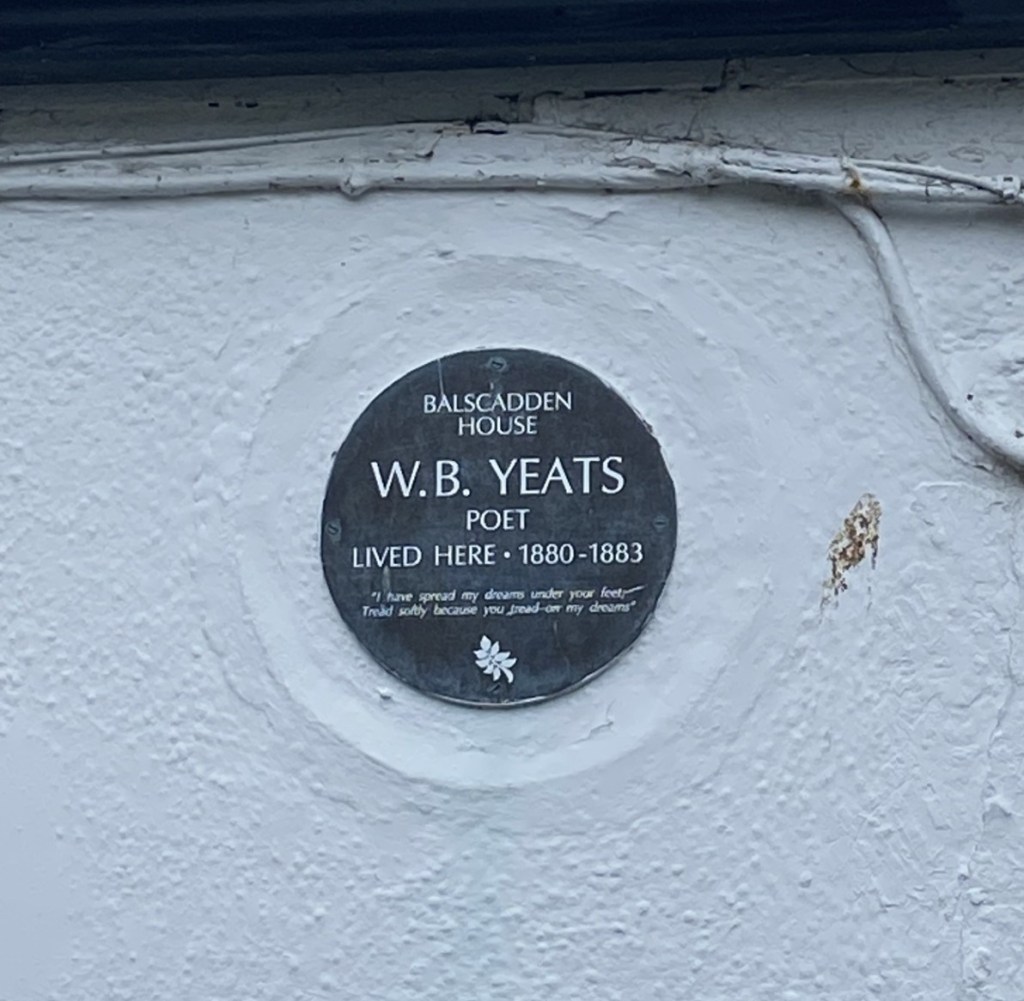
I was delighted to see that Yeats had lived here for a time.

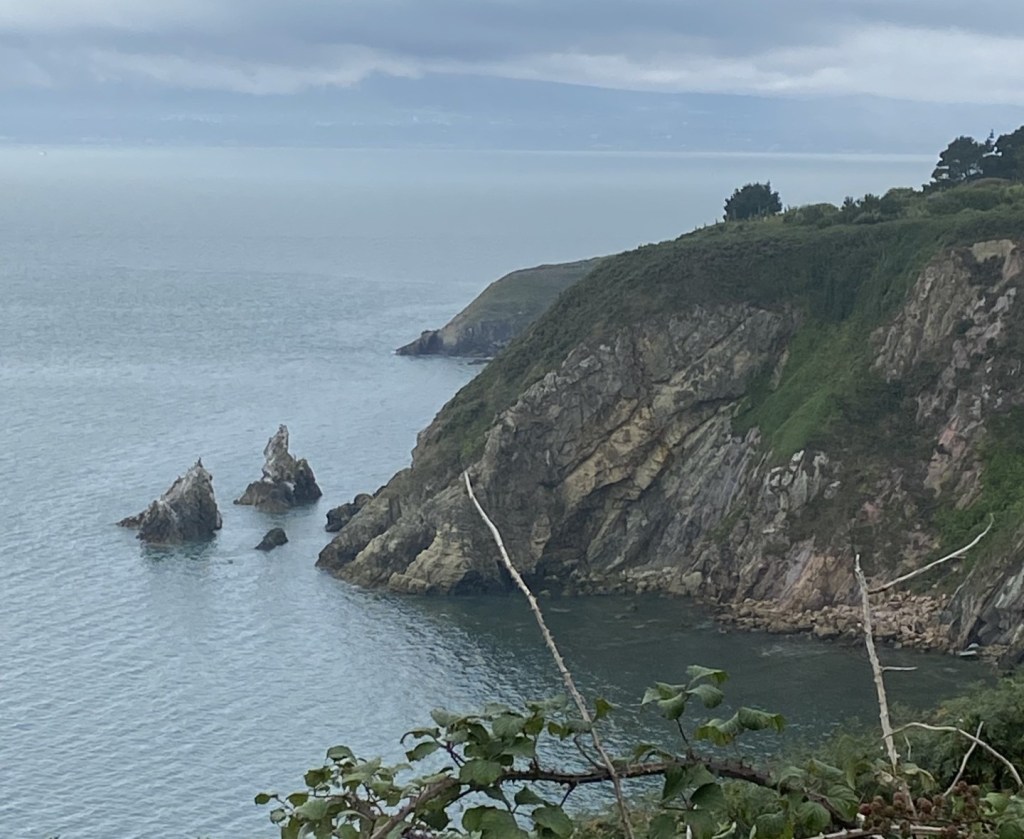
I couldn’t have imagined that there would be such a varied rural landscape so close to the city. I mainly took photos along the coastal portion – as we walked along the coastal path on top of the cliffs, with yachts from a sailing club flying past and practicing manoeuvres, a fishing boat dropping lobster pots, and herring gulls, kittiwakes and cormorants swooping high or flying low over the sea. At times, the grey sea blended into the grey sky, creating a mesmerizing horizonless seascape.

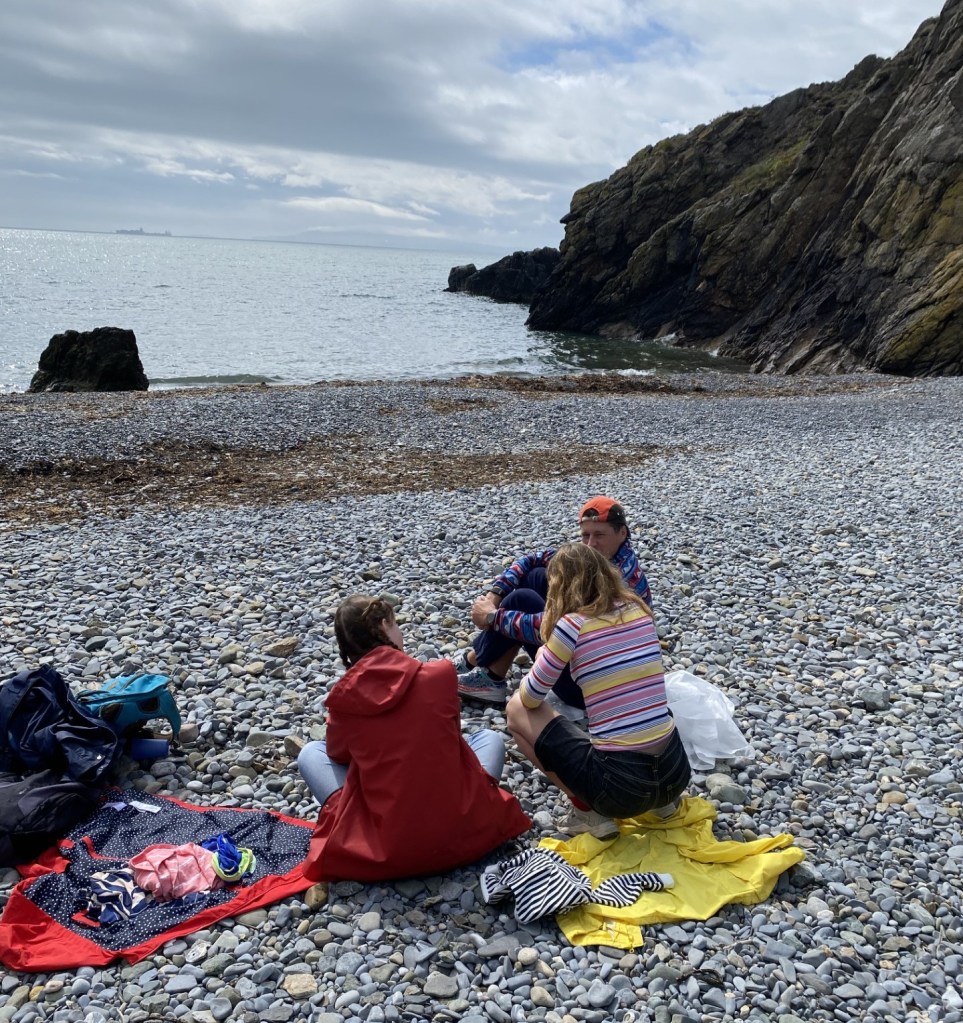
At lunchtime, we wound our way down to a small stony beach and, after a delicious picnic (if I do say so myself), we quickly changed into our swimsuits for a quick dip in the sea. The water was warm and we all could have stayed there all day. But we were only half way through the walk and our friends had a plane to catch to Lithuania in a few hours.

A dip in the sea here after lunch was glorious.

The path soon brought us away from the sea, up through birch woods and then up the side of a hill overlaid with blanket bog and heather. That took some effort and, for twenty minutes or so, we barely spoke – our chatty group focused now on getting up the hill and controlling our breathing. But that ended too and then, after a brief foray across a busy golf course, it was downhill all the way and back, once again, into the middle of Howth village.

It was a delightful day out. Just the perfect weather for a walk, a swim, a picnic. The other walkers we met were friendly and chatty. And, despite advice to the contrary on the cliff walk website, the trail was clearly and frequently marked.

I think it would be lovely to do it again.

69. Autumn has begun

Like someone flicked a switch, autumn came today. It wasn’t just one thing. It was the blackberries that Lily gathered all day from the hedges along the perimeter of Mammy’s garden. It was the southwesterly wind that blew orange and yellow leaves from the trees, leaves that swirled in through the open kitchen door and around our feet. It was the hasty retreat indoors, dinner in hand, when the wind blew the kale off our plates and sent the butter flittering across the patio table. It was the drizzle that set in, late afternoon, the sky grey, visibility reduced. It was the early sunset, no longer a summer sunset, in a sky that the clouds and soft rain transformed into a Turner painting. It was the slight chill in the air, the need for socks and a jumper. It was the photo a friend sent of her niece’s first day back at school. The time for flying south like barnacle geese is almost upon us. I will miss the dramatic transformation that autumn brings to Ireland.

63. What if it’s poisonous?

Our Lithuanian next door neighbours are visiting. Egle tells me they have spent the summer in Lithuania foraging for and eating wild mushrooms.

The very thought of eating wild mushrooms scares the living daylights out of me. Julian used to forage for mushrooms. I ate them once or twice, but never enjoyed them, too scared that I was going to die. I used to tell him, ‘If you’re still alive in 24 hours, I’ll try them then.’ The only wild mushrooms I’ve ever eaten with confidence are the giant puffball and the chicken of the wood, because no other species can be mistaken for them.

But while I’m scared, I’m also envious that my friends have the foraging skills to distinguish edible mushrooms from poisonous ones.

This evening, we went walking along the canal in Edenderry with Alisa, who’s been foraging for mushrooms with her parents in Lithuania. As soon as we set out on our walk, my daughters descended on the hedge, stuffing blackberries in their mouths as fast as they could pluck them from the brambles.

‘What are you doing?’ Alisa asked, concerned. ‘How do you know they’re not poisonous?’

I had to laugh. There I was, worrying about the safety of her family’s foraging in her country and here she is, worrying about my family’s foraging in our country. Maybe we all know what we’re doing after all, foraging foods we’ve known since childhood. Before long. Alisa was alongside my girls, searching for the juiciest blackberries she could find.