96. A novel sleeping partner

In November 2007, I headed south on a Ken Borrack Air Twin Otter. I’d been waiting all day, with the flight twice delayed owing to bad weather. Both times, I’d been sent home and, each time, got a call a couple of hours later telling me to get myself back to the airport. On the third try, the weather cleared long enough to allow the plane to take off.

Loading the Twin Otter at Arviat airport

The moment had come to fly the sixty miles south of Arviat to the hunting camp, and I boarded the stripped out plane that now only had three passenger seats. The only other human passengers were Nadine, the French-Canadian cook, and Reverend Jimmy Muckpah, minister at Arviat’s Anglican Church. The other passengers were two wooden boxes containing Jimmy’s sled dogs, packed securely for their own safety for the short low altitude flight. What little remaining space was packed to the rafters with a skidoo and some of the boxes of food and other items we’d need.

Lovely, kind Jimmy Muckpah, who knew more about polar bears than anyone I’ve known
Jimmy’s sled dogs, who seemed quite content with their travel arrangements

We flew south along the coast to our camp. The others had flown in on an earlier flight and we all helped to unload the plane before it took off again. It would return for us in two weeks. I was to live for those two weeks with five big game trophy hunters from the US, their five Inuit guides, all from Arviat (including Jimmy), and Nadine. The guides, Nadine and I all knew each other, but the trophy hunters were new to me and, indeed, to all of us. I was here for research. I was studying the relationship between humans and polar bears; specifically, seeking to understand the changing role of polar bears in Inuit culture and economy, as international laws about polar bear hunting was rapidly evolving.

Ryan, the camp outfitter, had generously invited me to the camp. What I learned in those two weeks hugely enriched my anthropological understanding of the role of polar bears in Inuit life and I published my findings in various academic journals and books in the subsequent years. My findings were even presented as evidence at US Congress hearings in 2008 that sought to amend US Fish and Wildlife laws concerning the importation of ‘trophy’ polar bears from other countries.

The camp comprised four cabins. The trophy hunters slept in two of the cabins, the guides all bunked together in another, and the fourth cabin – which was also the camp kitchen and eating quarters – was shared by Nadine and me. Each cabin had a ‘toilet,’ consisting of a ‘honey bucket’ – basically a bucket with a seat and a bin liner that we changed every few days. At those temperatures, anything you did into the honey bucket froze almost immediately. Nadine and I had a small room off the far end of the kitchen that contained a bunkbed. She slept on the top bunk and I on the bottom.

Our little huddle of humanity on the west coast of Hudson Bay

Ryan had built his outfitting camp here because it was situated along the polar bear migration route. Indeed, during the two weeks I was there, more than seventy individual polar bears passed through on their winter migration out onto the sea ice. Many of them came close, attracted by the smells of the camp, and snuffled around. We were under strict orders that no-one was to leave the cabins, or go between cabins, without a rifle and to never go alone. The trophy hunters rarely listened to that advice and took stupid risks by walking from the kitchen cabin to their own in the dark. The local guides, well aware of the realities of living in such close proximity with the world’s largest carnivores, were extremely annoyed by the idiocy of the trophy hunters.

I had various roles during those two weeks. I helped Nadine in the kitchen. I went out on hunting trips with the guides and the hunters in their charge. And I helped with skinning and preparing two of the three bears that were killed. (According to international and local law at the time, each hunter could take one trophy bear (they paid tens of thousands of dollars for the ‘privilege,’ some of which found its way back into the Inuit subsistence economy)). During those two weeks, three of the five hunters got their trophy. The other two went home empty handed.

I remember helping one of the guides, Donald, one day as he skinned a bear that had been shot by the trophy hunter in his care. The hunter was back in the warmth of the cabin, enjoying a hot coffee and some freshly baked cinnamon rolls. I held the bear’s huge heavy legs while Donald did what he had to do. It was cold and he wanted to get the work done quickly. So that he could keep his head down and concentrate on the work, he asked me to keep my eyes on the two polar bears that were circling close by and to let him know if either of them started to move closer. They didn’t, but I was shit scared and so was he.

Polar bears came close to and into the camp every day.

The plywood cabins were reinforced with corrugated metal. They had windows that were too small for a polar bear to get through, and the doors were covered with six inch nails, sharp side out, to discourage any bear that might try to break in. Even so, it was pretty scary at times. One particular day, when the hunters and guides had all left camp to go hunting, and Nadine and I were alone in the cabin, a bear came snuffling around. He stood on his hind legs, making him probably 8 feet tall. He looked in the window into our kitchen (imagine, a polar bear looking in at you!), and repeatedly hit against the side of the cabin with his front paws. He was trying to get in. Nadine and I were terrified. We had a rifle, but I’d only ever used it for target practice. Would I know what to do in a real life-or-death situation? Eventually, he gave up with trying to open the sardine tin that was our cabin and started to play around with the big cylinder of propane gas that was our only source of heat and cooking fuel. One slap with his paw, and he knocked the cylinder loose. Before we knew it, he was rolling it around on the ground, playing with it, and now was 20 or 30 metres away. While we were delighted that he seemed to have lost interest in us, we now had a new problem – it was about -15C and a polar bear was using our only heat source as a toy. Luckily, the hunters and guides came back about an hour later and all was well.

Every night when I went to bed, I could hear snuffling outside the cabin. Sometimes, I’d shine my flash light out the small window and see a pair of eyes reflected back. Lying in my bunk, I’d hear snuffling on the other side of the flimsy wall. Imagine my surprise the first morning I went out and saw a very clear indentation in the snow the size and shaped of a curled up polar bear. It was exactly on the other side of the wall from my bunkbed. The indentation was there every morning; sometimes, like in the photo below, accompanied by claw marks.

I didn’t sleep well for those two weeks, let me tell you, knowing that I was sleeping beside a polar bear, with only a strip of plywood and corrugated metal separating us. But when I looked back on it, I understood what a privilege those two weeks were.

It hard to see the indent of the bear’s body in this one, but the claw-mark is right in the centre.

91. Too far away

I remember the phone ringing down the hall. Mammy got up from the kitchen table to answer it. ‘It’s for you,’ she said, coming back to sit down. ‘Someone from Canada.’ I walked down the hall to the table by the hall window and put the receiver to my ear.

‘Hello?’ I said.

‘Huvi?’ came the reply. Frank. Dear Frank. My friend, my teacher, my hunting buddy. One of my primary research participants in Arviat, it was Frank who had taught me to skin and butcher caribou, and to get it right by doing it over and over; Frank who had taught me how to drive a boat amongst pods of beluga whales in the shallow waters close to shore, so he could harpoon them from the bow; Frank who put me on polar bear patrol while he collected the arctic char that had swum into his fishing net; Frank who I spent hours and days with, far inland on our quad bikes, out at sea at first light. He and Martha welcomed me into their home, made me tea, fed me biscuits and bannock, took me out on the land and to their cabin with their daughters. Frank made me laugh and made me think. How at ease I felt in his company.

And now, he was on the phone. He on the tundra, on the western shore of Hudson Bay; I in the Bog of Allen, in the middle of Ireland. And the distance between us seemed vast. Vaster than the Atlantic Ocean, and maritime Canada and the width of Hudson Bay that separated us. All that we talked about with such ease when we were together dissolved now across the expanse.

He asked about the weather and I told him. But what was Irish weather to him? What was the Irish autumn, with leaves changing colour and falling off the trees, the rain and the mud, when he lived in a place with no trees, where autumn meant the ground covered in snow and the sea gradually turning to ice, travel by boat giving way to skidoos. My autumn meant nothing to him and, from this distance, his autumn was starting to dim for me.

I asked what he’d been doing and he told me where he’d been seal hunting the previous day, who he’d gone with and the other hunters he’d met when he was out. I smiled as he spoke. In my mind’s eye, I could see where he’d been and who he’d been with. I had been there with him, and with his brother-in-law Arden, just a few weeks earlier.

He asked what I’d been up to. It was September and in Ireland there was only Gaelic football in the air. How could I tell him about the match I had been to on Sunday? About the crowds, the excitement, how important football was to my life here? Or that the turf was home and there were still a couple of loads to be thrown in the shed. My voice sounded strange in my ears as I tried to talk to him about my life here.

I’d lived in his world and loved it. He was interested in my world, but had no experience of it. The ease we felt in each other’s company was made jagged by the cultural distance that now lay between us.

We continued to speak on the phone occasionally and I got to spend another summer with him a few years later. It’s a few years now since he passed away. I wish I had been better able to bridge that distance when he called.

66. The A Book

At Christmas 1989, I was 16 years old and in my final year of secondary school. In February, I would have to complete my application for university – a centralized system in which I would have to list my choice of institutions and courses from one to ten. In June 1990, I would sit the state Leaving Certificate exam and, in August, I would be offered the highest ranked of the ten courses for which I had gained sufficient accumulated points in my Leaving Cert.

Geography and English were my favourite subjects and I imagined I would do a degree in those two subjects, become a teacher, and then come home to Edenderry and teach for the rest of my life. I didn’t know any better. My teachers were my role models for what could be done with a university degree. I loved Geography, ergo, I would become a geography teacher.

But, while at 16, I couldn’t imagine a life for myself outside of Edenderry, in my mind, I was a citizen of the world. From the age of 11, I’d had pen-pals in Singapore, Australia, Malawi, Egypt, Hong Kong, Spain, Greece (by the way, to this day I’m still friends with Aileen in Singapore and Haitham in Egypt), and spent vast amounts of time – and pocket money on stationary and stamps – telling them all about my life and learning all about their lives. And, shortly after I’d turned 16, I made the difficult decision to stop buying Smash Hits every fortnight and instead save up my pocket money and birthday and Christmas money to subscribe to National Geographic. I’d sit at the kitchen table or lie on my bed here in Ballygibbon, and read National Geographic from cover to cover, even the ads, as the words and photos took me on journeys to places and peoples in lands far from my little corner of Co. Kildare.

That Christmas of 1989, my aunt Marian and uncle Jim came up from west Cork to stay at Nana’s house in Gilroy. We saw them two or three times a year, but this time was a little different. Jim was a primary school headmaster and my parents had asked if he could help me with Maths. The Leaving Cert was only six months away and Maths was, by some measure, my worst subject. Poor Jim, he did his best but, he was fighting a losing battle from the start. Not only was I bad at Maths, I refused to even try to be good. My stubborn mental block took years to shift and it is residually still with me today.

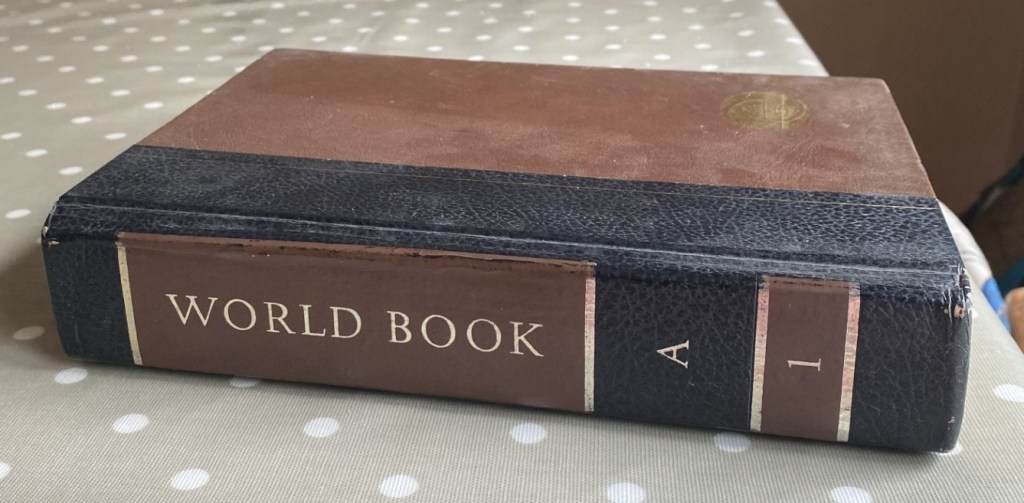
Jim, in his spare time, was also a door-to-door encyclopaedia salesman. On the day they arrived at Nana’s house that Christmas, Mammy and I popped in to visit. ‘Come out to the car,’ Jim said to me. ‘I’ve something for you.’ Out we went. He opened the boot of the car and fished out the A book of the World Book encyclopaedia. I was delighted with this and spent the remainder of the visit at Nana’s house browsing through the pages.

At home that evening, I sat on my bed, a mug of tea on the bedside table, and poured over the A book, page by page. It was filled with all sorts of interesting A things – from Kareem Abdul-Jabbar to Alexander I, from Antarctica to Austria, from Airplane to Audio-visual Materials. And then I came to page 509: Anthropology.

What on earth? There’s this field of study that I’ve never heard of before, that’s combines some of the bits I like best about geography, and that’s all about learning about people who live far away in other parts of the world. Could I do that? It seemed highly unlikely.

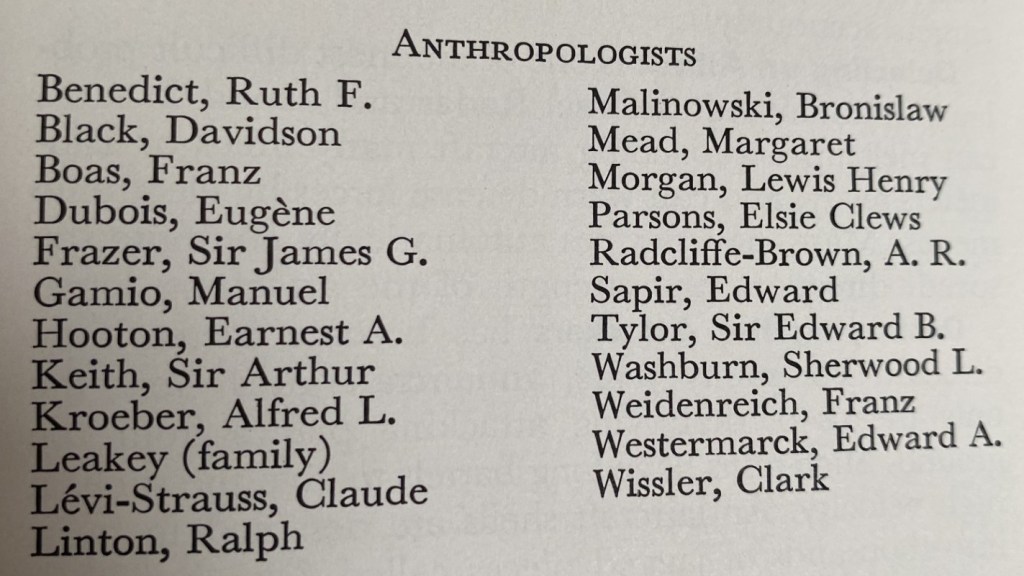
I read and re-read the four and half pages about Anthropology. Among the most renowned were a handful of women – notably Ruth Benedict, Margaret Mead, Elsie Parsons.

And I read that anthropologists did their research by immersing themselves in the lives and cultures of the peoples they studied, learning skills and languages, and then theorized and wrote about what they had learned from those experiences. Surely there were no anthropologists in Ireland! This was far too exotic and exciting!

I thought about anthropology all through the Christmas holidays and, as soon as I the January term started, I made a bee-line for the school career guidance counsellor, convinced that she would tell me she had never heard of this subject or that the nearest place I could do it was somewhere in England. Imagine my surprise when she told me that the only Anthropology department in the Republic of Ireland was in Maynooth – my nearest university! How could this be? How did I not know?

In February, I filled in my university application form, still erring on the side of Geography and English in UCD, but with Arts in Maynooth as my second choice. When I received my Leaving Cert results in August 1990, I knew I had enough points to do Anthropology and Geography at Maynooth.

And did I get my degree and return to Edenderry to become a Geography teacher? Well, I got my degree. And I followed that with a Masters degree in Anthropology. Then I went to live in Japan for three years. Then I moved to the Canadian Arctic. Then I did a PhD in Anthropology, immersing myself for long periods of time in an Inuit community on the west coast of Hudson Bay. Then I worked as an Anthropologist-Geographer in geography departments in Cambridge, Reading and Exeter universities. All thanks to my uncle Jim handing me the A book out of the boot of his car two months before I applied for university.

I was sitting at the kitchen table here in Ballygibbon earlier today. I glanced up towards the bookcase and saw the A book, still sitting there. Coincidentally, today is also the day when tens of thousands of students across Ireland receive their Leaving Cert results. I hope their lives are as unexpected and serendipitous as mine has proven to be up to now.