88. The Pope’s chairs

At the end of September 1979, Pope John Paul II visited Ireland. He was the first pontiff to visit Ireland (indeed, he was the first to visit most places in the world) and the country went wild. At the time, Ireland wasn’t only predominantly Catholic by religion; our culture was Catholic, the state was Catholic, the education, health care, and justice systems were Catholic. It felt as if the whole country was being blessed by God himself. The Pope said Mass at a number of venues around the country, attended in total by over 2.5 million people. The entire population of the country at the time was only 3.75 million! His first Mass, held in the Phoenix Park in Dublin on the day of his arrival, was attended by 1.25 million people – one third of the entire population of Ireland. I was one of them.

I have fleeting memories of that day. I was six years old. I went with Mammy, Daddy and Nana Quinlan, my maternal grandmother. I remember leaving home that morning, my one-year-old baby sister sitting on my aunt Lillie’s lap in our kitchen. I remember my sister crying as we left.

I remember Daddy parking the red Ford Escort in the field that was Weston air field. I knew Weston, because we always drove past it on our way to Dublin and I always looked for light aircraft flying low across the road towards the runway. I remember a sense of wonder that we were now parked in this very place where the planes should be.

I remember Daddy carrying me on his shoulders as we walked what felt like miles, in a sea of people filling up the road as far as I could see in front and behind us. From Weston, we were directed on to buses that took us directly to the Phoenix Park. I can’t fathom the logistics of getting one third of the population of our small poor country to a field on the edge of Dublin. But somehow it happened. I remember an awful lot of walking.

I remember the Pope’s chairs. Three chairs that my parents and Nana had bought in advance of the Mass. Simple metal frame folding beach chairs, with white plastic arm rests, and woven plastic seats and back. Our two were blue striped and Nana’s was brown striped. Forever after, they were known as the Pope’s chairs. They were put on the roof rack for every summer holiday and stuck out on the lawn for every summer heatwave. I think they’re still hanging in the shed at Mammy’s house.

So, Daddy carried me on his shoulders and he, Mammy and Nana carried the three chairs and food and drinks for the day. Ham sandwiches, I imagine, some biscuits, probably a flask of tea and a bottle of lemonade.

I don’t remember getting on or off buses, or arriving at the Phoenix Park. But I do remember being in our place on the grass. The three chairs set up. We were in the middle of the crowd, facing the huge white cross and altar that had been hastily erected for the Mass, which stands to this day in the middle of the Phoenix Park. We weren’t far from a roped off pathway, separating the area we were in from the next area over. I remember sitting around for a long time before Mass started.

I don’t remember the details of the Mass, but I can still hear the sound of his voice over the loudspeakers. It’s there in my head. And I remember the palpable excitement and awe – whether I picked it up from the crowd in general or from my family, I don’t know.

When the Mass ended, the Pope prepared to travel through the crowd, blessing them from the Popemobile. And here’s where my memory gets fuzzy. Mammy and Nana were going to move close to the rope barrier to get closer to him, but Daddy was going to stay looking after our stuff. At first I said I didn’t want to go with Mammy and Nana. I was a scared for some reason. But as soon as they left, I changed my mind and wanted to go with them. And I don’t know if I did or not. One version of my memory has Daddy calling after them, me running to Mammy, and Mammy holding me in her arms close to the rope barrier as the Pope went past. But in the other version of my memory, by the time I decide I want to go with them, it’s too late, they’re lost in the crowd, and I stay with Daddy, crying and regretting not getting to see the Pope up close and getting blessed with everyone else.

There are things I don’t remember. I don’t remember Daddy’s grief, or the grief of my auntie Lillie and my Nana Tyrrell as we set out from home that morning. Daddy and Lillie had, only recently, lost their beloved older sister, Cissie, to cancer at age 57. What comfort did being in the presence of the Pope offer to my grieving devoutly Catholic father? Or what hope for comfort and grace was there in the others left at home, who would watch the Mass on the television? I don’t remember and it’s not something that would even cross my mind for over four decades.

As a six year old, I was oblivious to all of that. But what stays with me most vividly, 46 years later, is being carried high on Daddy’s shoulders in an ocean of humanity along a road in west Co. Dublin. And the Pope’s chairs.

72. Dublin Airport

I’m at Dublin airport, waiting for my sister to come through arrivals. The airport is quiet tonight, a few families, a couple of guys with bunches of flowers, people hanging around on their phones or with paper cups of coffee.

A group of Spanish teenagers comes through the sliding doors, welcomed by an exuberant Dublin woman who bundles them together for a photo before ushering them towards the exit.

Groups of holiday makers arrive home from warmer climes, tanned and dressed inappropriately for the wet August night that awaits them outside the terminal.

Over the course of about twenty minutes, three middle aged women come through, Eastern European and Asian, greeted with hugs and kisses by their children and their tiny Irish grandchildren.

I could spend all evening here, watching these arrivals and reunions.

Dublin Airport is special to me. The scene of so many of my own departures and arrivals over the years. My first ever solo trip abroad (only my second trip ever in a plane), aged 16, when I went to central France for a few weeks to au pair and improve my French. How scared I was, and how scared my parents were, but I wanted to go and they didn’t hold me back.

Three years later, I was away again, this time to the Netherlands with my friend Louise; my aunt Catherine’s tent strapped to my huge rucksack. Mammy drove us to the airport that morning. We had no jobs, no clue what were doing, but we were youthfully optimistic that we’d find work for the summer. And we did.

I remember a big gang of family and friends coming to see me off when I departed for Japan, aged 22. My biggest trip yet. A year away, and so far away. I remember how we all tried to keep a brave face on things as we sat in one of the airport restaurants, waiting for the moment when I would have to say goodbye and take that lonely walk through to security. And I remember Daddy telling me that it would be ok if I didn’t like it and wanted to come home. We had no way of knowing how much I’d love it and that I’d end up staying for three years. And after that, there would be the multiple departures to the Canadian Arctic; all those journeys starting in Dublin Airport.

I remember the arrivals too. The time I came home from Japan with a shaved head and blue fingernails, and Mammy didn’t know what to think. The first time I travelled alone with Lily in her sling. And all those times I came home at short notice, for Jerry’s, Jimmy’s, Lillie’s, Nana’s funerals, cousins or uncles or my brother-in-law picking me up and often driving me directly to a wake late at night.

I remember the much more frequent arrivals during Daddy’s final seven or eight months, when I flew home from Aberdeen every few weeks. I no longer expected anyone to meet me at the airport. I’d take the bus home or I’d hop on a bus into the city and meet Daddy and Mammy at the hospital.

Tonight, I sit and look at the people waiting and arriving and departing and I wonder where they have come from, why they have flown into Dublin on this particular evening, and what awaits them when they pass through the doors and head for their destinations, each with their own fears and hopes, loves and losses, their own adventures and stories, pasts and futures.

70. This close to Dublin?

Last Saturday, I had six hours to kill between an airport pickup and an airport drop-off. I thought about what I could do with our friends from Lithuania, to give them a taste of Ireland. I didn’t want to take them into the city – that’s one version of Ireland, and we’d done that earlier in the week. I thought Howth might be nice. And then a friend suggested the Howth Cliff Walk. I’d never heard of it, but my friend had done it a couple of times and had only good things to say about it. So, I did a bit of research, saw that the car park where we could start the walk was less than 30 minutes from the airport, and decided on that for our ‘taste of Ireland’ day out.

I’d only been to Howth once before, years ago on the Dart with Julian, and then only for about an hour. There were a number of routes we could take on the cliff walk and, after consultation with the girls and our visitors, we decided to tackle the longest and most difficult walk – the 3 hour, 12km Bog of the Frogs walk. And what a walk it was.

We parked the car (for free) close to Howth Marina
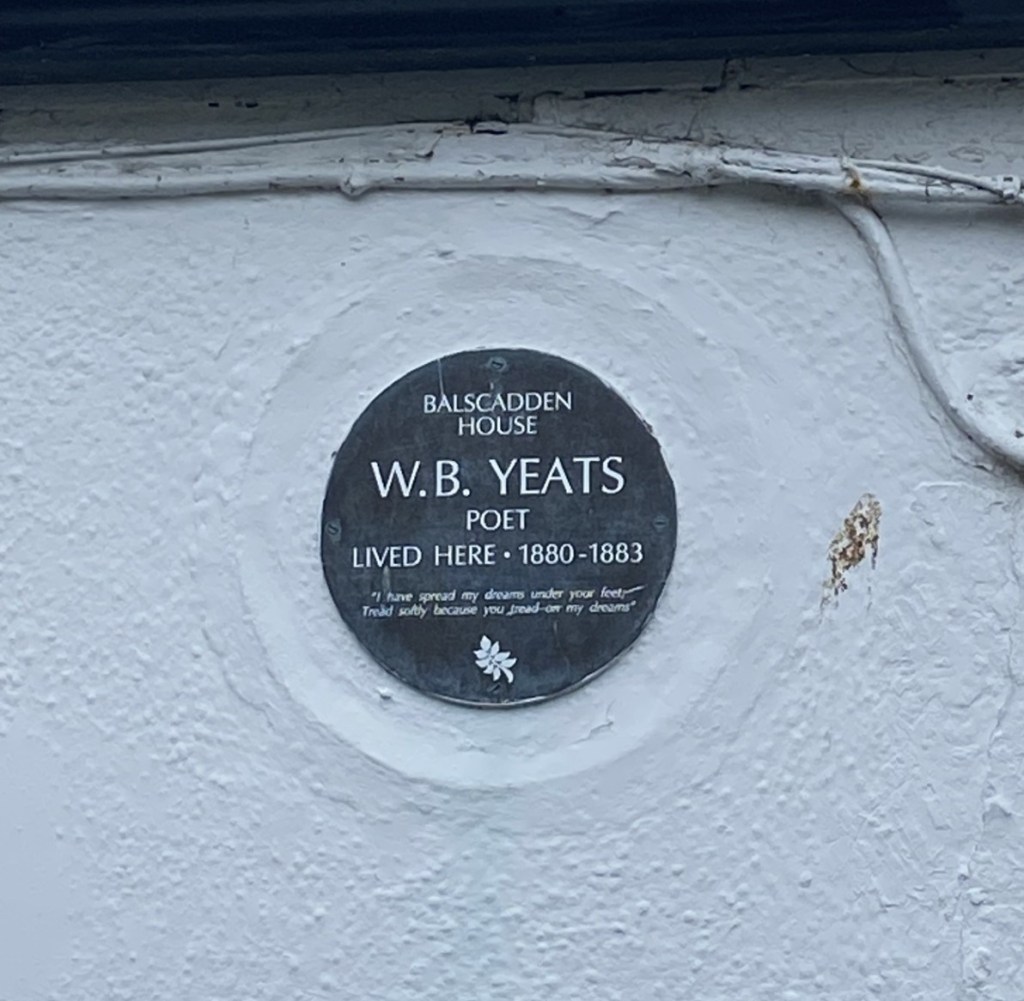
I was delighted to see that Yeats had lived here for a time.

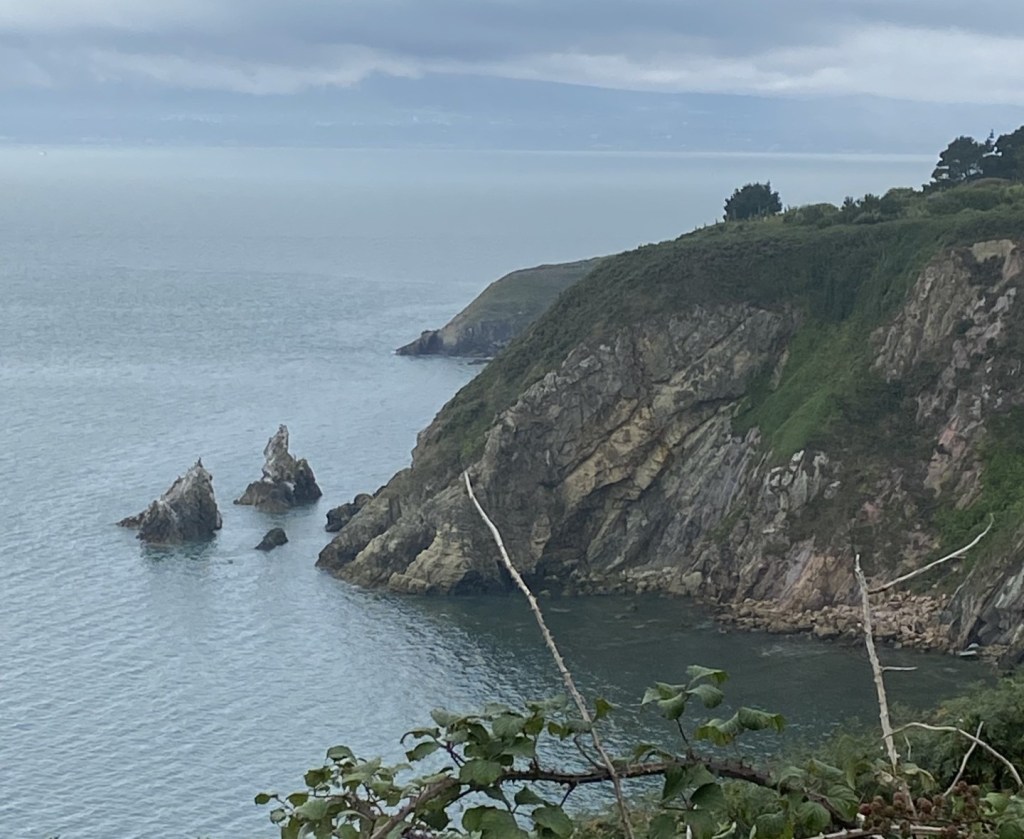
I couldn’t have imagined that there would be such a varied rural landscape so close to the city. I mainly took photos along the coastal portion – as we walked along the coastal path on top of the cliffs, with yachts from a sailing club flying past and practicing manoeuvres, a fishing boat dropping lobster pots, and herring gulls, kittiwakes and cormorants swooping high or flying low over the sea. At times, the grey sea blended into the grey sky, creating a mesmerizing horizonless seascape.

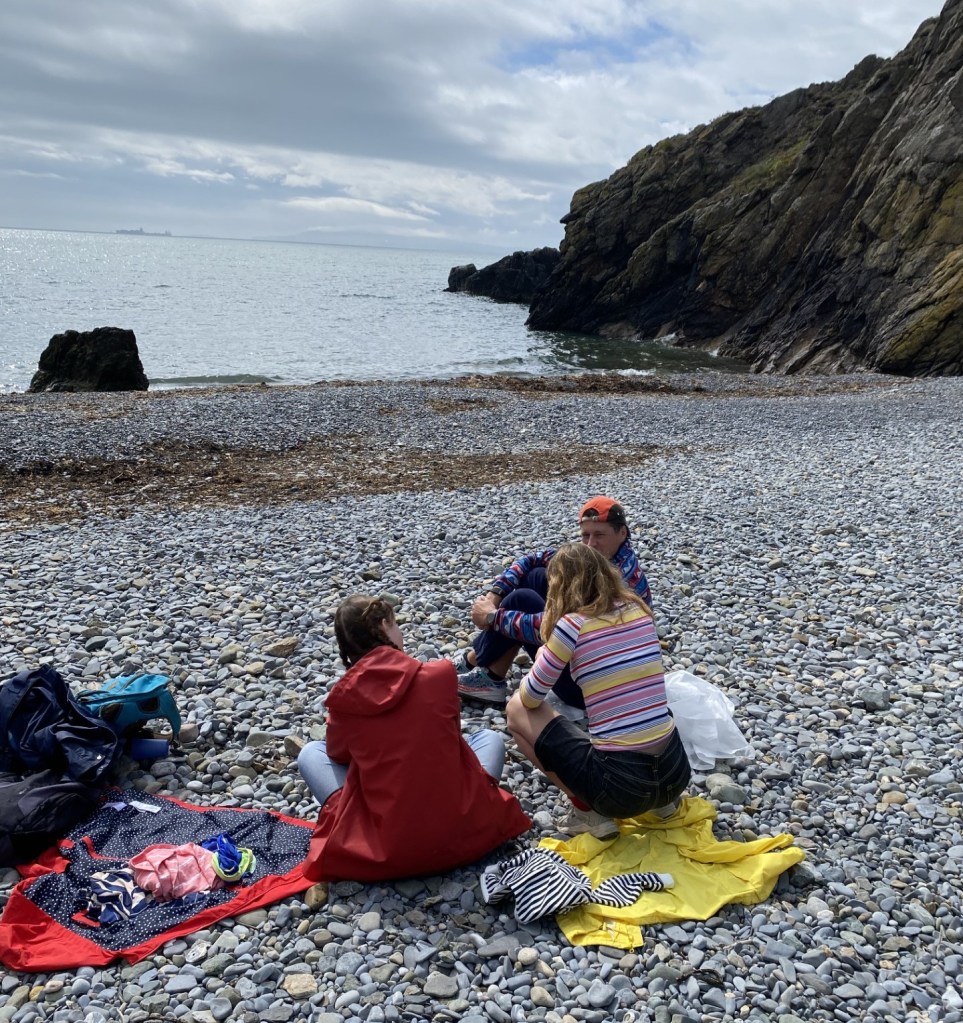
At lunchtime, we wound our way down to a small stony beach and, after a delicious picnic (if I do say so myself), we quickly changed into our swimsuits for a quick dip in the sea. The water was warm and we all could have stayed there all day. But we were only half way through the walk and our friends had a plane to catch to Lithuania in a few hours.

A dip in the sea here after lunch was glorious.

The path soon brought us away from the sea, up through birch woods and then up the side of a hill overlaid with blanket bog and heather. That took some effort and, for twenty minutes or so, we barely spoke – our chatty group focused now on getting up the hill and controlling our breathing. But that ended too and then, after a brief foray across a busy golf course, it was downhill all the way and back, once again, into the middle of Howth village.

It was a delightful day out. Just the perfect weather for a walk, a swim, a picnic. The other walkers we met were friendly and chatty. And, despite advice to the contrary on the cliff walk website, the trail was clearly and frequently marked.

I think it would be lovely to do it again.

62. Dublin can be heaven

There’s nothing quite like a sunny day in Dublin, when you’ve nothing to do but stroll around with friends. And you can see some strange things on an August night…

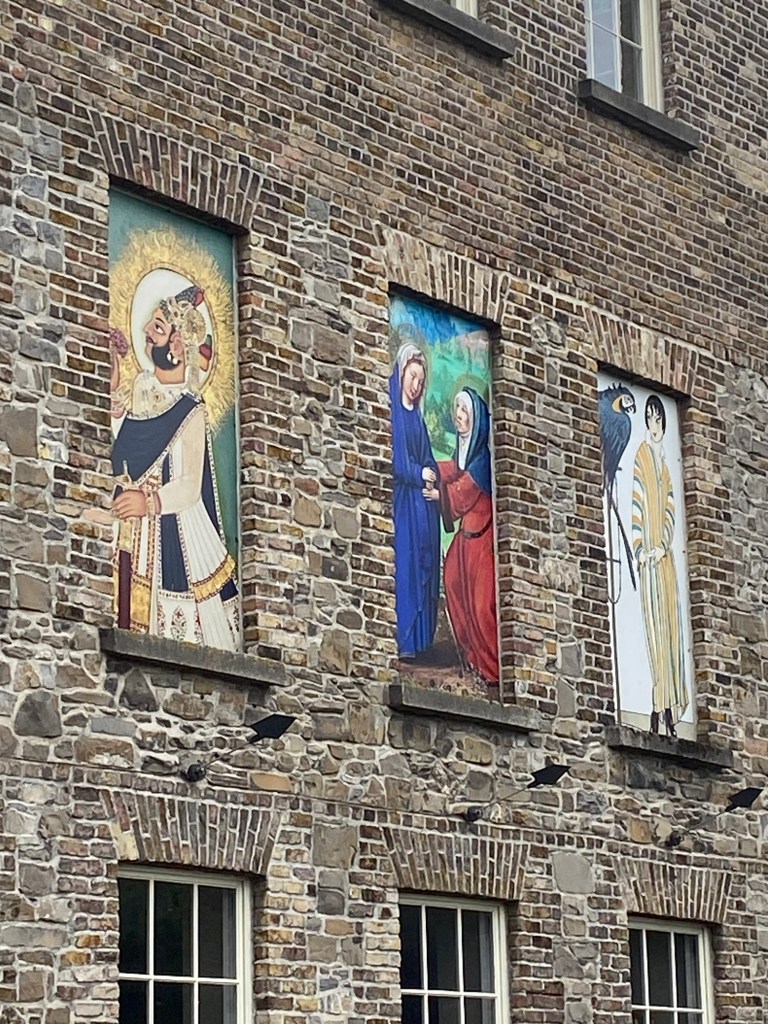
Chester Beatty Library
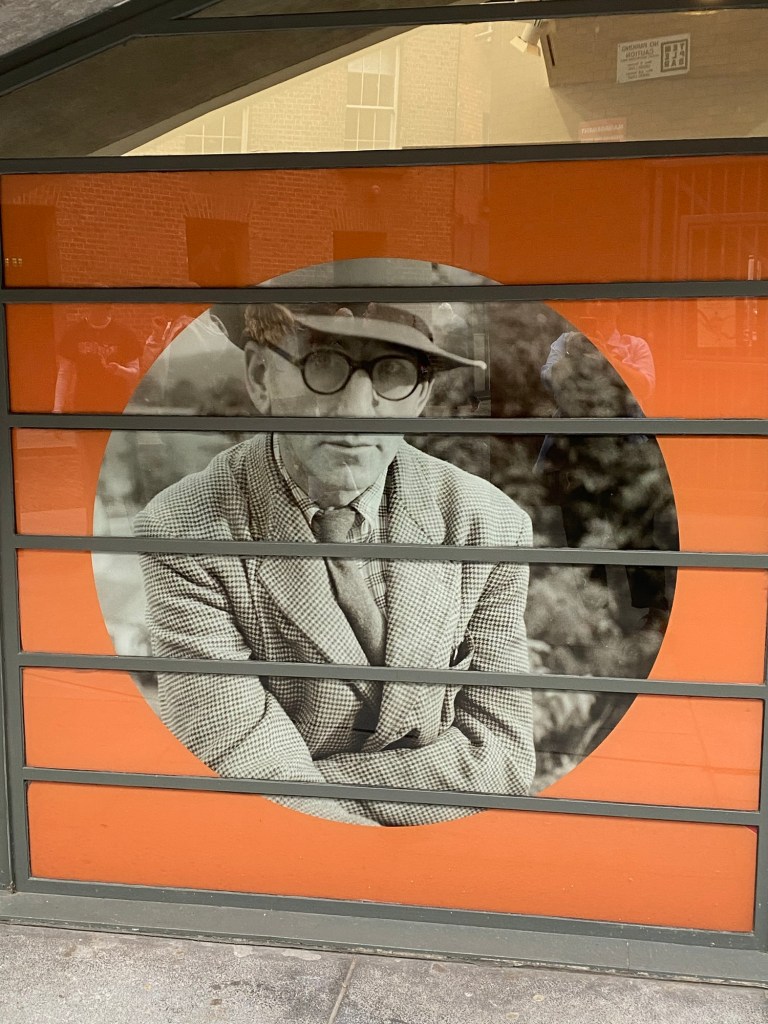
Patrick Kavanagh at the National Library
Our friends with Oscar Wilde
Zero zero but still oh so good
The Jeannie Johnson famine ship
The famine memorial
And the same to you!