97. Welcome to the jungle

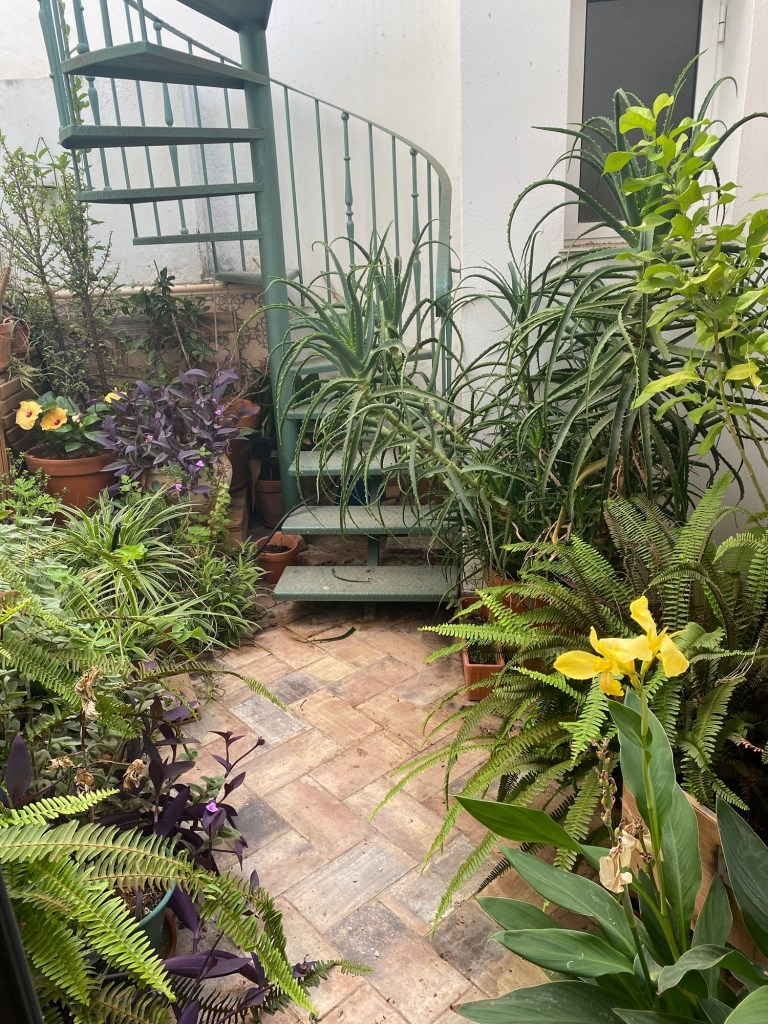
Before we went away for the summer, this was my little patio space, where I had a little table, a couple of chairs, and a love seat. It had a nice number of plants scattered around too. It was a shady space for breakfast or a mid-morning coffee.

But then we were going away for eleven weeks and I needed a keep the plants watered. On the Saturday and Sunday three weeks before we left, I folded away the table and chairs and gathered all the plants from my three outside spaces to here, the shadiest and coolest of my outdoor spaces. They certainly took up a lot of space. I then spent the mornings on the second to last and last weekends (in mid-June) setting up a watering system on a timer. The first of those four mornings was spent just sitting at my kitchen table, reading the instructions, watching YouTube videos and figuring out how to set up an irrigation system.

I got there in the end. It was like putting together some great puzzle, lining up the tubes, inserting the nozzles, plant to plant to plant, until all 50 plants (yep…50…even I was surprised that I had so many) were set up to have a one minute drip feed of water every 24 hours.

What I didn’t have time for was to properly test the system. I should have done it a week or so earlier. That way I’d know if some plants were getting too much or too little water. But I left it too late and just had to hope for the best.

My friends had a key to the house and reported after only a week that some of the plants were being overwatered and they’d turned the individual nozzles down to a mere trickle. Later in the summer they reported that my patio was now like a ‘jungle.’

I was quite dreading how jungle-like it would be on our return. However, I was pleasantly surprised. Sure, many of the plants had grown, but they looked far more lush and healthy than when I’d left them (I wouldn’t be the best at tending to my plants on a regular basis).

A few died. Three owing to a lack of water (the feeder tubes had slipped out of the pots and they didn’t get any water) and another three from overwatering, victims of the success of my irrigation system. When I’d set up the system, those three plants had been exposed to the sun. When I returned I found them in the undergrowth of other plants that had grown furiously, fully shaded and sitting in waterlogged soil.

We’ve been back two weeks already and it still looks like a jungle out there. I’ve gotten rid of the dead ones and I’ve started to move those that don’t belong on the patio back to their usual homes. Some need cutting back. But it’s slow work. One day, in the not too distant future, I hope I’ll have my table and chairs and love seat back again. I hope I won’t have to battle my way up the stairs to the clothesline. I hope I’ll be able to get to the gas bottles when they need to be changed.

But little by little, day by day, I’m getting there. And I’m getting to know my plants all over again in the process.

Lady enjoying the patio in more functional times

61. Playful weather

The last time I came home to Ireland for an extended summer visit – 2023 – it rained every day but two of the almost four weeks we were here. Not always heavily and not always prolonged. But every day but two it rained at least for some part of the day.

I wouldn’t really have minded. We live in a hot, dry country after all, and coming home to Ireland’s more temperate climate doesn’t really bother us. We’re here for family and friends, really. So what if there’s some rain? We just don our rain coats and sturdy shoes and get on with it.

Except that I came home for those four weeks in the summer of 2023 on a mission. I’d planned it in advance, discussed it with Mammy and with my sister. I was here to work. The wrought iron gates and garden furniture needed to be painted and the two sheds needed to be cleared out. On my first day or two home, I went to the hardware shop in Edenderry and bought the paint, brushes, rubber gloves and whatever else I needed. I was going to spend much of those four weeks out of doors, getting these much needed jobs done.

But it rained and rained. Day after day. What could I do? If the painting didn’t get done now, the gates and furniture would be facing into another winter of damage. So, I painted in the gaps in the rain, glancing worryingly at the sky and willing the rain to hold off for a few hours to let the paint dry. It rarely did. The painting got done, but the gates still carry the pock marks of raindrops on not quite dry paint.

The garden furniture was easier. We could haul it into the shed to paint it. But first the shed had to be cleared. I did that over two rainy days – clearing the contents of the shed, loading them into the boot and back of Mammy’s car to take them to the recycling centre, then back home to fill up another load. There were decades worth of old stuff to be thrown out – old paint cans, old rusty tools, old broken bits and bobs from the house and the garden. All hauled away in the rain. And then I tidied up what was left and now had space to paint the garden furniture.

Two days without rain that whole summer in Ireland. And it was cold too. We had to light the fire in July to keep warm.

I arrived in Ireland this year with no plans to do any outdoor work around the house. Well, you can guess what’s happened. Glorious weather most of the time, barely a cloud in the sky. The odd day or rain here and there. We’re dining al fresco for breakfast, lunch and dinner. I could be out painting the gates, or cutting back the hedges, or weeding the patio. Instead, I’m sitting inside at the kitchen table, a warm breeze wafting through the French doors, the light too bright for me to work outside on my laptop.

Maybe if I want a break in this glorious summer weather, I should plan to do a bit of painting.

24. The pear tree

I’ve fallen for this pear tree. In a park full of majestic giant oaks, giant chestnuts, giant sycamores, it is this more modest pear tree that I am drawn to day after day, to sit under to eat my lunch and take a break from staring at my computer screen.

I chose it at random the first day, a little bit off the path and providing just enough dappled shade from the sun. I ate my lunch and then, like Heaney’s threshers in The Wife’s Tale, who “still kept their ease, Spread out, unbuttoned, grateful, under the trees,” I lay down and gazed up through the branches. It was then that I noticed something I hadn’t noticed as I walked past it or under it.

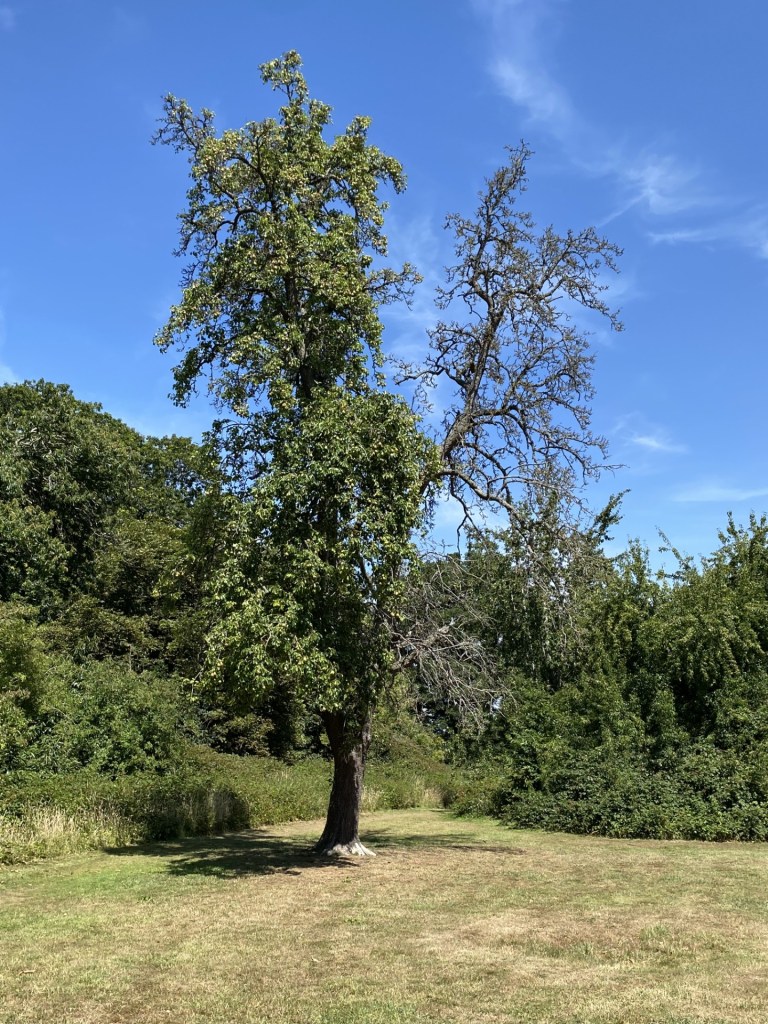
About six feet from the ground, it forks. The branches to one side of the fork are lifeless. No leaves grow, no buds. It is bare but for the lichen that has crept along it. The other side of the fork, in contrast, is heavy with life. The branches sag under the weight of innumerable pears that will be ripe by autumn, food for humans, food for animals, carrying the seeds of the offspring of this tree.

I’m drawn to the perseverance of this pear tree, to its wonky imperfection. Something happened to it – a lighning strike perhaps – that irreparably damaged one half of it, yet the other half carries on steadfast and lively. And I come to see that the damaged part might still have its role to play too, providing balance and stability, helping to anchor the still lively half.

A bumblebee lands on my brightly coloured trousers, resting in the shade of the tree for a moment before going on its way again. There are other insects too, not passing through but living here, making the tree their home. On both forks of the pear tree, I see intricate spider webs and, at the base, a hole made by some small animal. There are rabbit droppings on the ground around me. The tree, as a whole, is a place of liveliness, home to or way point for so many animals, me included.

As I sit up and prepare to return to work, I look around and see, not far away, smaller pear trees and saplings, surely the offspring of this one. The tree, despite its imperfections and its damaged parts, is living its best pear tree life.