My Christmas chronicles – Christmas pudding

Christmas is my favourite time of the year and I planned to start a series of Christmas blogs on the 1st of December but, like all the best laid plans, I didn’t get around to it. But here I am, finally. Better late than never. Hope you enjoy my Christmas memories and that they trigger some happy memories for you too.

For me, Christmas is all about food. Sourcing the ingredients. Cooking it. Baking it. Presenting it. Giving it away as gifts. And, of course, eating it. So, a lot of my Christmas memories revolve around food and those memories slip to the front of my mind each year as I once again get down to my Christmas food prep.

I’m a traditionalist when it comes to Christmas food, meaning that the foods that fill me with joy are the ones I grew up with and that I watched Mammy and Nana and my auntie’s Cissie and Lillie making from when I could barely see over the top of the kitchen table.

Christmas prep starts for me in the summer. I can’t easily get some of the ingredients I need for my Christmas cake and Christmas puddings in Spain, so I make sure there’s enough space in the suitcase when I’m home in the summer for the mixed peel, currants, and mixed spice that I’ll need. I like to make the cake and puddings in late October or early November, as the earlier you make those boozy fruit confections, the richer they taste come Christmas Day.

For all that I love this early baking, Mammy intensely dislikes it. I look forward to the Saturday in autumn that I devote to Christmas baking; she dreads it and postpones it as long as possible. Some years, she doesn’t even get around to it.

My aunt Cissie (Daddy’s sister) was the baker in our house, making multiple Christmas cakes and puddings for her brothers’ and sisters’ families and for Dr. Hill, for whom she was housekeeper. Cissie died of breast cancer, aged 56, in 1979. And, although I’ve never asked Mammy about it, I guess she just took over all that Christmas baking for her in-laws after that.

On a mid-week night in November, my sister, Mammy and I would go to my Nana’s house in Edenderry. Although we saw her almost every day, mid-week evening visits were rate, so this in itself felt like an out of the ordinary event. Mammy would arrive with her big cream-coloured ceramic mixing bowl, filled with all the ingredients needed to make the Christmas puddings – bags and bags of a variety of dried fruits, breadcrumbs, eggs, spices, a bottle of Guinness and so on. She and Nana would stand at the dining table, side by side, each making their own puddings, while my sister and I helped out by stirring in the ingredients, chopping glacé cherries, or searching through raisins or sultanas for the occasional errant stalk. Two of my aunts and two of my uncles still lived at home (Mammy is the oldest of 11 children), so the house was busy on those evenings.

Mixing the puddings was no mean feat, given the quantities Mammy and Nana were making. I don’t remember how many Nana made, but Mammy definitely made at least one large pudding and usually four or five medium-sized ones, mixing near-industrial quantities of ingredients at once. Once the laborious work of mixing was done, my sister and I (and maybe a teenage aunt or uncle) would get to make a wish while stirring the thick rich mixture. Even as I write this, I can feel the warmth in my Nana’s living room from the turf fire and the spicy smell of all those ingredients mixing together. Finally, they would transfer the mix into heat-resistant bowls, cover them with tinfoil and then tie twine around to secure each lid and to serve as a handle for removing them from the saucepans of boiling water in which they would be steamed over the coming days.

I remember this with nostalgia. Mammy remembers it as a chore, yet another item to tick off the Christmas to-do list. A lot of people were expecting her to make those puddings each year, so I suppose that took a lot of the fun out of it. That was all 30 or 40 years ago and Mammy no longer makes all those puddings, but I think she still feels the residual pressure of it.

This year, I went home to Ireland for a few days in early November. I hadn’t yet made my own puddings or cake. Mammy was bemoaning the fact that she would have to make her puddings soon (she no longer makes a cake) and, in her own words, was ‘dreading it.’ (At this stage, you’re probably asking why she doesn’t simply buy puddings, if making them causes her so much stress. The answer is simple: she knows that no shop-bought pudding tastes as good as the ones she makes). I suggested that we do it together, just like she and Nana used to in the old days.

Unlike Mammy and Nana, who lived only two miles or so from each other, Mammy and I live in different countries. But we have what she and her mother didn’t have – the technology to make our puddings together at a distance. We decided to do it the following weekend. I phoned her on Tuesday to suggest she go through her presses1 to see what ingredients she had in stock and what she needed to buy. I would do the same before doing my regular weekly grocery shop on Tuesday night. On Saturday morning, we would each put what ingredients we needed on our kitchen tables, each make ourselves a cup tea, and set our devices up so we could see each other, ready to start at 12:30.

And that’s what we did. In between weighing the breadcrumbs and butter, beating the eggs, measuring the alcohol (she used Guinness; I tried using brandy for a change), we chatted and got caught up on each other’s lives. We discussed our innovations – since moving to Spain, I now use a wider variety of whatever dried fruits I find in the shop; she has changed her cooking method (tradition, after all, is always evolving). What a delightful late morning we spent with each other. I even called Katie in to stir the mixture and make a wish. We each left our puddings overnight for the flavours to mingle and the next day we cooked them. Here, in southwest Spain and there, in the midlands of Ireland, our puddings are now cooked and sealed and ready for Christmas Day.

Our ingredients may have changed a little, and our mode of communication, but making the Christmas puddings with Mammy brought me right back to all those years in Nana’s house. I suggested we do it again next year and she said she was up for that!

1 Cupboards

100. And finally.…

A few things happened to get me to this point.

About eight months ago, I read Suleika Jaouad’s memoir, Between two kingdoms, a beautiful account of her life with leukemia when she was in her 20s. In one part of the book, she describes how she and her parents undertook a 100-day project – each of them committing to one act of creativity every day for 100 days. Her mother painted one ceramic tile a day, her father wrote one memory a day from his childhood in Tunisia, and Suleika, too weak to do much of anything, journaled. That’s a nice idea, I thought at the time, and didn’t think any more about it.

A few months later, I was thinking of ways to reduce my outgoings. Work had dried up and my bank balance was plummeting at an alarming rate (I’ve come out of that slump for now, thank goodness). I started to cancel subscriptions – Apple Music, Amazon Prime, that sort of thing. I hadn’t posted a blog on WordPress for over a year, yet I still had my subscription set to autopay. Two things bothered me about this. First, I knew it was a waste of money to have this subscription but not use it. Second, I wanted to write blogs, yet I never did. When I went to my WordPress account, I saw that my subscription was active until January 2026 – over seven months away. I could leave it sitting there and do nothing, or I could use that time to actually write something.

There and then, I set myself a challenge to write ten blog posts, starting that very day. I’d number them, for myself, as a reminder that I was doing it and how far along I was in the challenge. On the 18th of June I wrote the first one, about how busy life was in the last few days before the end of the girls’ school year. The next day, at the same time, I wrote another and then another. As I crept closer to number ten, I knew I wanted to keep going, so I committed to twenty. By the time I reached day fifteen I had committed, privately, to myself, that I would write 100. So I did. Every day, without fail, I wrote and published a blog. And today is day 100.

It wasn’t always easy. Ideas were never a problem. Every day I found something to write about, generally without even searching for it. Something always popped into my head. Indeed, there were quite a few days when I drafted something in the morning, but it was superseded by something else later in the day. Those drafts are still lying dormant in my drafts folder.

Instead, what got in the way or caused resistance was tiredness. I was travelling all summer, visiting family and friends in the UK and Ireland, and working at the same time. When I was in the UK, it was generally easy for me to get my blog written and out into the world by mid-morning. Things changed when I went to Ireland, where I spent so much time in conversation with family and friends that the day would slip away and the blog wouldn’t get written until I was already in bed, very late and feeling very sleepy. Occasionally, all I had the energy for at that time of night were a few photos of the day with a brief excuse for why I couldn’t write more.

But I was called back to write again, create again, share again every day. I saw that people were engaging with me – sending me messages, liking my posts – but I rarely had time to respond. I hope to respond to everyone in time. But seeing all that support was a marvelous motivator. I didn’t write to get likes or gain followers. My reasons for posting were more personal, for two reasons. First, I write all the time, but often lack the confidence, the courage, the self-belief to share what I’ve written or, indeed, to complete something I’ve started. Posting every day, without having the time for too much self-criticism or interrogation, was an act of forcing myself to put my writing out into the world without overthinking it. The positive responses I’ve received have been nothing but encouraging. Second, like many people, I so often start things that are for me and me alone, and then drop them because I prioritize the needs of others. How many times have I started a new routine – yoga, a commitment to exercise, a writing practice – only to let it slip because ‘I just don’t have time.’ This time, I made the time and I reached the finish line and, you know what, it feels great!

Writing something every day for these 100 days has reminded me to be more observant – to pay attention to the words people use, to see the colours and shapes in the world around me, to really see the material things around me.

So, where do I go from here? I will certainly continue to blog, but I’m giving myself a break from doing it every day. During these past 100 days, I’ve written a lot of rambling fluff. But I’ve also written some pieces that I think are rather good. I’d like to return to those now, maybe expand on some of them, share them on other platforms, such as Substack or Medium, and maybe even see if I can revise them and submit them for publication or writing contests. There are also pieces that I’ve written over the past 100 days that will definitely find their way into my memoir, which I have been writing for a little over a year now (I have to finish it!).

The past 100 days have taught me that I can do it, that my nearest and dearest will get used to it as part of our daily routine, and that no matter what your intention when you make a piece of writing public, readers will never cease to surprise you in the way they interpret it.

Thank you everyone who has been with me for the past 100 days. The silent ones and those who have sent me comments via social media or who have emailed me, and those who have stopped me in the supermarket or at a funeral to say they’re reading along. See you all soon!

91. Too far away

I remember the phone ringing down the hall. Mammy got up from the kitchen table to answer it. ‘It’s for you,’ she said, coming back to sit down. ‘Someone from Canada.’ I walked down the hall to the table by the hall window and put the receiver to my ear.

‘Hello?’ I said.

‘Huvi?’ came the reply. Frank. Dear Frank. My friend, my teacher, my hunting buddy. One of my primary research participants in Arviat, it was Frank who had taught me to skin and butcher caribou, and to get it right by doing it over and over; Frank who had taught me how to drive a boat amongst pods of beluga whales in the shallow waters close to shore, so he could harpoon them from the bow; Frank who put me on polar bear patrol while he collected the arctic char that had swum into his fishing net; Frank who I spent hours and days with, far inland on our quad bikes, out at sea at first light. He and Martha welcomed me into their home, made me tea, fed me biscuits and bannock, took me out on the land and to their cabin with their daughters. Frank made me laugh and made me think. How at ease I felt in his company.

And now, he was on the phone. He on the tundra, on the western shore of Hudson Bay; I in the Bog of Allen, in the middle of Ireland. And the distance between us seemed vast. Vaster than the Atlantic Ocean, and maritime Canada and the width of Hudson Bay that separated us. All that we talked about with such ease when we were together dissolved now across the expanse.

He asked about the weather and I told him. But what was Irish weather to him? What was the Irish autumn, with leaves changing colour and falling off the trees, the rain and the mud, when he lived in a place with no trees, where autumn meant the ground covered in snow and the sea gradually turning to ice, travel by boat giving way to skidoos. My autumn meant nothing to him and, from this distance, his autumn was starting to dim for me.

I asked what he’d been doing and he told me where he’d been seal hunting the previous day, who he’d gone with and the other hunters he’d met when he was out. I smiled as he spoke. In my mind’s eye, I could see where he’d been and who he’d been with. I had been there with him, and with his brother-in-law Arden, just a few weeks earlier.

He asked what I’d been up to. It was September and in Ireland there was only Gaelic football in the air. How could I tell him about the match I had been to on Sunday? About the crowds, the excitement, how important football was to my life here? Or that the turf was home and there were still a couple of loads to be thrown in the shed. My voice sounded strange in my ears as I tried to talk to him about my life here.

I’d lived in his world and loved it. He was interested in my world, but had no experience of it. The ease we felt in each other’s company was made jagged by the cultural distance that now lay between us.

We continued to speak on the phone occasionally and I got to spend another summer with him a few years later. It’s a few years now since he passed away. I wish I had been better able to bridge that distance when he called.

84. Surprising emotions

Arriving into Sanlúcar de Guadiana last night, I was surprised at just how happy I felt to be home. Just a simple feeling of contentment at being back in my own home.

Our seventy-five days in the UK and Ireland were delightful from start to end. I haven’t enjoyed myself so much or for so long on previous holidays. England was a joy and I experienced very strong positive emotions when I was in Ireland, whereas in the past my feelings have often been mixed. Not because Ireland isn’t great and not because my family and friends aren’t great. It was just me and where I was in my life on previous visits home that made me enjoy being in Ireland on holiday but also eager to return to where I had come from. I didn’t feel that way this time. I enjoyed my time there, and had very mixed feelings about leaving, feeling more torn between the two places I call home than I’ve ever felt before.

So, what a surprise to feel the way I did about turning the key in the lock and walking through my front door last night. Like an exhalation…I’m home. My house is looking a bit the worse for wear after lying empty for seventy-five days and it’ll take us a few days to sweep away the cobwebs, get unpacked and feel properly settled in, but that simple uncomplicated sense of being home was there from the moment I opened the door.

Our lovely friends had been in and left some food in the fridge and our neighbour had hung a fresh homemade loaf of bread on the front door. Still, I needed to buy a few odds and ends this morning, so, after breakfast I threw on something not very presentable that I pulled out of my suitcase and went to the two shops in the village. Ten minutes of shopping took me about three quarters of an hour, from all the people I met, the welcome back hugs and kisses I received, the conversations I had comparing Spanish and Irish weather. I felt welcomed home by my adopted village.

And then, the icing on the cake – collecting Lady from her summer villa (with a swimming pool, no less) and taking her home. Now that our scruffy, dusty, hair in her eyes Lady is back, my little home is complete.

Who cares that our two kayaks are still taking up most of the living room and the suitcases are on our bedroom floors? Time enough moving them tomorrow.

83. Dublin Airport…again

Organised mayhem

Here we are, back at Dublin airport again, but this time we are the ones departing. After eleven weeks away, we are going home to Sanlúcar. I am returning with mixed feelings – sad to leave this home, excited to return to that home.

This trip to the airport has been preceded by methodical packing over the course of 24 hours. We’re returning with a lot more than we left with – books mostly, and they’re heavy. Irish people, please don’t judge me for the Tetley tea. It’s a compromise and easier to buy in bulk than Irish brands.

Unlike the quiet evening at the airport 12 days ago to pick up my sister, the airport today is crowded, full of hustle and bustle. It seems as if every childless adult in Ireland has decided to go on holidays today, now that the school holidays are over and families are no longer travelling. The crowdedness has made it all a little overwhelming – sensory overload on top of the usual departure sensations regarding baggage weight, and security and so on.

But here we are, and in a few hours we will be home and returning to our own term-time routine.

81. All talk

So much talking. Our living room filled with family. Oh how we can talk. One conversation, multiple conversations simultaneously. Sometimes quiet intent listening. Sometimes uproarious laughter.

There’s football talk and golf talk. Talk of births and deaths and marriages. There’s politics and the economy and talk of the rising cost of everything from groceries to airport food.

We ask each other about half remembered family stories, piecing them together, sure to forget and likely to have to ask about them again the next time we meet, or the time after that.

The tea flows, and the wine. The plates of ham sandwiches, rhubarb tart, biscuits, cake disappear, and still the talk goes on.

All too soon it’s midnight. The cousins leave, not to be seen for another few weeks or months, having dropped in and lit up our evening.

And still the talk goes on. As we wash up. As we prepare for bed. As we decide to have one more drink. It feels like we won’t ever run out of talk.

80. Skyscape

The morning started out sunny and warm. We’d planned to spend the day on the beach but, as usual, we slept in too late and spent half the morning in our pyjamas, drinking tea and chatting around the kitchen table. By the time we were ready to go out, close to lunchtime, it had begun to cloud over.

For our tardiness we were rewarded with this incredible skyscape, the dark grey clouds reaching out across the sea, the rain falling in a sheet a mile or more out to sea. I thought it was coming towards us, that we’d get soaked even as we set the picnic out on a towel on the beach. The rain shower moved from west to east, appearing to approach, but instead moving away to the southeast over Galley Head.

By the time we’d finished our picnic, the sky had cleared and we were warmed by the sun. The sea was inviting but, in the few minutes it took to change into our swimsuits, another bank of clouds had rolled in, another shower of rain fell to the south and we were chilled by the wind as we braved seawater that was the coldest we’d experienced this year.

But as quickly as those clouds came, they went again, and again we were in the sun. And so it was for the afternoon, the mood of the sky changing by the minute, tempting and teasing us, and delighting us with its constantly evolving shapes and colours.

77. West Cork scenes

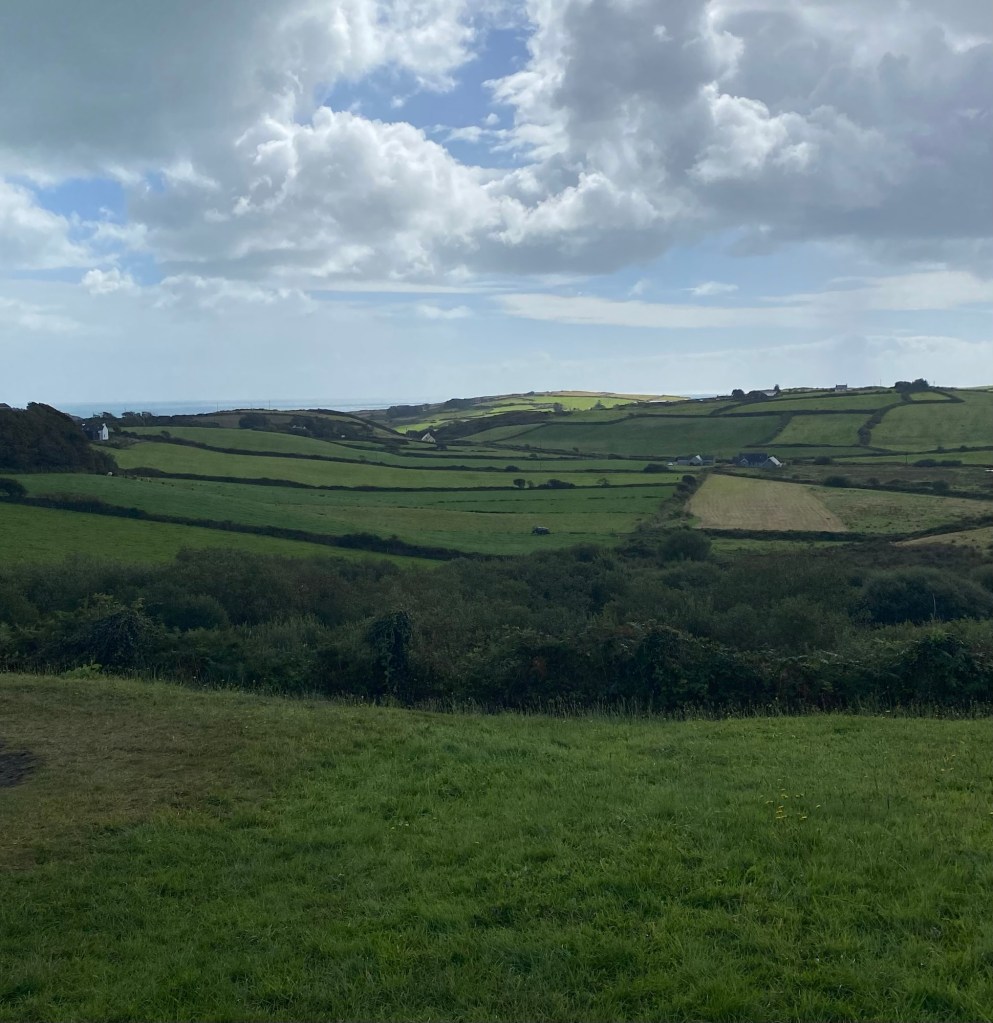
The last couple of days in west Cork have been a delight. Here are a few photos….

View from Glandore
Adam and Eve islands
The Warren, Roscarbery
The Warren from the cliff walk
Evening swimmers
Silliness on the beach

76. Drombeg

Drombeg stone circle

I visit Drombeg every time I come to west Cork. And each time, I feel a connection to the people who lived here 3000 years ago. Not some hokey connection, like these people were somehow more spiritual or more vital or more at one with nature than us. No. I feel a connection because they were people just like us, breathing in this same air, looking out over the view of the sea cradled in the V of the valley. These clouds hung over them, this rain fell on them, this wind chilled them, this sun shone on them.

While Newgrange or Stonehenge are huge and majestic monuments, stone circles such as Drombeg and the others that dot the landscape of southwest Cork feel much more intimate and ordinary. As astounding as the stone circle is, with its orientation based on deep astronomy, it is the more intimate and domestic elements of this site that move me. It is knowing that the body of a youth was found at the centre of the circle. It is the rectangle water pit, where water was boiled using stones first heated in a fire. Maybe the pit was used for cooking. Maybe it was used for dyeing or some other purpose. We simply don’t know. It doesn’t really matter. It’s that people – men, women, children – sat and walked and played and loved and argued and laughed here 3000 years ago. Ordinary people who couldn’t imagine that 3000 years into the future people would visit what remains of their home and wonder at what they did.

74. Like summer holidays past

The rain fell sideways as we packed the car this morning. Mammy had moved the car to as close to the door as she could get it. Still, we swopped bags of food and our mini suitcases for water and leaves trailed into the house underfoot.

It was a tight squeeze, five of us and all our stuff filling up the boot and obscuring the rear window. I remember rainy Saturday mornings just like this, in the early 1980s, Daddy hoisting the suitcase, the wind break, the deck chairs, onto the roof rack of the Ford Escort, covering the lot with the blue tarpaulin from an old tent, securing it with rope.

I had the playlist ready for today’s drive to Cork – 80s hits, of course, that we sang along to in between bursts of conversation.

The rain continued – sporadic heavy showers – and wind buffeted the car sideways. We pulled in to the Rock of Cashel for lunch – ham sandwiches made from yesterday’s boiled ham and Brennan’s bread washed down with sweet black tea from a flask. We stood around the picnic table in the rain, the hoods of our raincoats up, as a sudden heavy shower chased away the slash of blue sky that had briefly appeared. I couldn’t have been happier. Few things in the world taste as great as ham sandwiches and tea from a flask on a wet day, memory and nostalgia adding magical flavour to the food.

We reached our destination late afternoon and quickly unpacked the car. My sister started to make dinner and realized she was two ingredients short. Lily and I walked the couple of hundred metres up to the shop in the village square. On the walk back, we were blown down the hill by the strong wind, rain hitting us on the back. ‘This is perfect,’ I said to Lily. A seaside holiday in Ireland isn’t complete unless you get at least one wild night like this.’ The wind, the rain, the slight bite in the air, took me back 30, 40, 45 years, to family vacations here in west Cork, in Kerry, in Wexford, in Mayo.

Tomorrow we plan to go to the beach – in our raincoats, most likely.