60. Digital nomad

Only a few short years ago, this summer would have been impossible. But here I am, over fifty days since I left home, and barely a day of work missed. Laptop, wifi, Bluetooth; Word, Zoom, Google docs. These are the tools I need to work anywhere and at any time. In between all the fun summer activities – visiting friends, Wimbledon, Pride, museums, hikes, and on and on – I’ve been beavering away at work. Making space at the kitchen table at Mammy’s house, spending days in public libraries, in friends’ spare rooms and office spaces – I have been working away to pay the bills and fund this wonderful summer.

All summer I’ve been ghostwriting, editing and providing other writing support for clients in South Africa, the UK, Europe, the US, Canada and China, fitting in an hour of work here, a couple of days there, a weekend, an evening, whatever time I can find. It’s been challenging at times, as I’m not following my usual routine of working at my desk, on my lovely widescreen monitor, while the girls are at school. Instead, I’m working from an old laptop, in a variety of different places, at various times of the day, and with all sorts of distractions.

Technology that was almost unimaginable twenty years ago, clunky and clumsy ten years ago, intermittent and expensive even five years ago, is now ubiquitous, easy to access and easy to use. Even with a barely hanging in there laptop, I can work wherever and whenever I want.

I am privileged to have a job that allows me to choose when and where I work, and equally privileged to have access to the tools and hardware that allow me to work in this way. I’m one lucky summer digital nomad.

59. Discovering Ireland

If you love board games, may I recommend Discovering Ireland or its cousin, Discovering Europe. I’ve been playing this with my friend Niamh since we were both in university. It was as much fun more than 30 years ago as it is now, playing it with our kids.

The object of the game is for each player to get to five towns and then exit by a port, while each player tries to block everyone else from reaching their destination and getting rid of all of their cards.

We’ve played it three times this summer so far. It generally leads to great outbursts of laughter, occasional spilled drinks, impromptu song compositions. And the kids learn a little geography into the bargain!

I really need to add it to our board game collection at home in Sanlúcar.

58. The Irish Wake Museum

So culturally embedded are our death rituals that they are honoured and commemorated in a museum in Waterford city, The Irish Wake Museum. I didn’t know this museum existed until I walked past it a couple of days ago. How could I not take a trip inside?

Housed in an early 15th Century alms house in the heart of Waterford, the museum explores Ireland’s funeral rituals from pre-Christian times, through the Vikings and up to the present day.

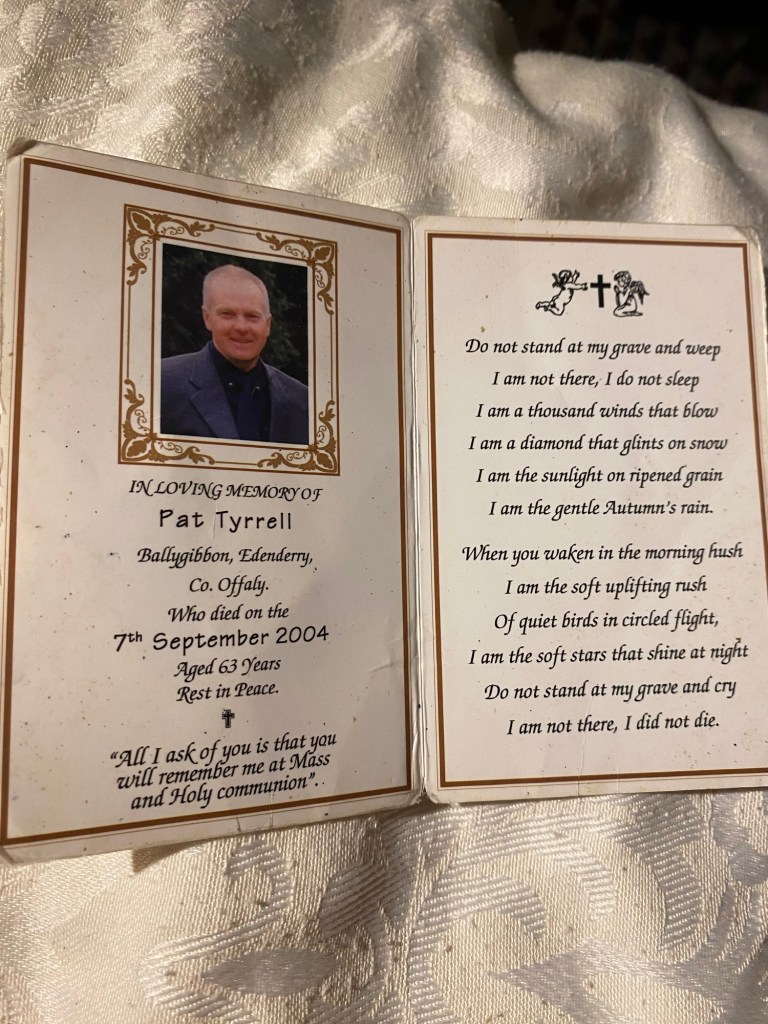
It was easy to see how memorial objects from the 1400s – commemorative pendants, coins and jewellery have been transformed into the memorial cards of the dead that are given out today.

I was familiar with the origins of the wake and many of the rituals surrounding it. The two or three days of sitting with the dead to ensure they really were dead. The liminality of the wake, when clocks are stopped (literally), mirrors are covered to prevent the spirit of the deceased from getting trapped, and when there is much socialising and, despite the circumstances, merriment. In certain parts of Ireland, keeners were brought in; women who performed highly ritualised keening (from the Irish ag caoineadh – to cry) over the body.

I learned that women were generally the ones who prepared the deceased for the wake because, on account of their ability to give birth, women were more able to defy death.

I learned that, in the old days, the drinking and socialising at wakes so concerned the Catholic church that notices were put up stating that unmarried young men and women who were unrelated were not allowed to be in attendance at a wake from sunset to sunrise!

It was heartwarming to see our death rituals so faithfully rendered and retold, sharing this part of our culture with visitors and instilling a sense of pride and belonging in those of us for whom this is a living and evolving tradition.

57. Now here’s an activity for me!

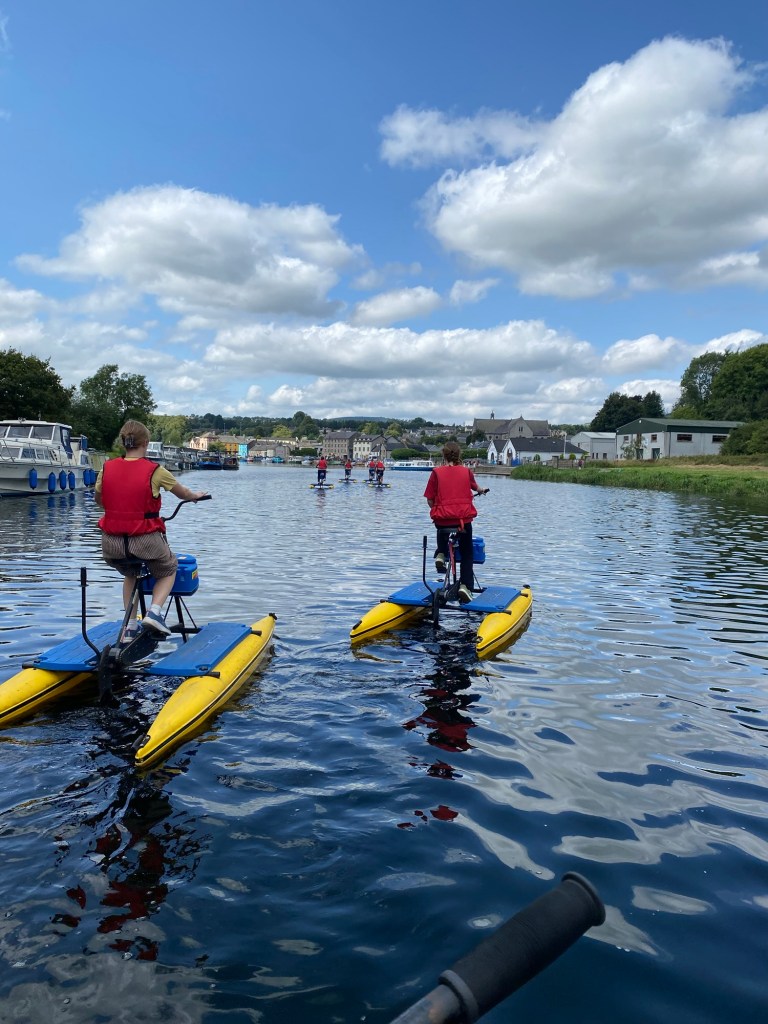
This morning, we went to the gorgeous Co. Kilkenny village of Graiguenamanagh, which sits on the banks of the River Barrow. Our purpose? Some high skilled, high powered, highly competitive* hydro-biking.

Sure, I was a bit overheated in the life jacket. But what an opportunity to demonstrate my superior biking skills AND superior navigation skills to the children. 🤣🤣

*None of the above!

56. The Guillamine

It’s a beautiful evening, warm and sunny, and the plan is to go for a swim at The Guillamine out in Tramore. Niamh and her family regularly drive the few miles from their house in Waterford city out to this cove where the swimming is good and, towards high water, you can jump from a high concrete platform into the sea.

There are a lot of people there when we arrive. Far more than I was expecting. Men and women of all ages, with a steady stream of people going down the narrow concrete steps from the car park and back up again.

When we get down to the swimming area, the sea is turquoise and there must be 50 or more people in the water. Niamh’s husband and son go straight to the diving platform.

That’s not for me. Without my glasses, I’m quite lost. I can’t really see where I am and, because I’ve never been here before and there are so many people here and it’s noisy with people splashing into the water, I suddenly feel overwhelmed and scared. I hold into a railing, with people asking if it’s ok to go past me. I let them pass. Niamh is in now, and Lily, and I momentarily think I should just turn back and wait for them up by our towels.

Lily swims back to me and tries to convince me to get in. But I don’t like this. Not one little bit. And why am I here? And this is not for me. Niamh swims over and suggests I enter the water via a hand rail. But I’ve already tried that and I couldn’t do it. She convinces me to try again.

It’s my eyesight. That’s the thing. Because I can’t see anything clearly beyond the end of my nose, I am figuratively, if not yet literally, out of my depth. I follow Niamh’s instructions, and now, in an instant, I am in and swimming away from the shore, away from the gentle waves breaking against the rocks, away from the hoards of people lining up to enter and exit the water.

And it’s glorious. The water is cold, but not too cold. Clumps of bladder wrack float past, dark green and slimy. The saltiness of the sea buoys me up with little effort. How could I ever have thought I didn’t want to be in here? I feel alive alive alive. I think I want to come back tomorrow.

54. My bedroom

I don’t know who was the first person to sleep in this bedroom and I don’t know who will be the last. But it was mine for a while and I’m back in it again for a few weeks. I don’t know if my great-grandparents slept in it or died in it; I don’t know if my father and his siblings were born in it. But I know it’s history from 1942 onwards.

Years ago, my uncle Willie told me that his father (my grandfather), Michael Tyrrell, had spent his final months in bed in this room. Willie, Jimmy and Cissie, the three oldest children, helped their mother look after their father through his cancer and he died in this room on 31 March 1942, Daddy’s first birthday.

When I was a child, there were two beds in this room. Hard to imagine now, given how small it is. Nana slept in the double bed by the window and L-shaped to her was Cissie’s smaller bed. As a child, I slept with Cissie a lot. I have memories of that time – of Mammy bringing me breakfast in bed of a fry-up of rashers, sausages, egg, tomatoes and Nana’s soda bread. I remember crying in pain with toothache in that bed too and Mammy bringing me up aspirin or some other pain relief.

Did I stay in that bed after Cissie got sick? I don’t remember. When I was four, a new bedroom was built onto the house. It was supposed to be for me, but I never slept in it. It was too far away from where everyone else was at night, so I stayed with Cissie.

Cissie died from breast cancer when I was six and, for a while, I slept in the bed with Nana. But I didn’t like sleeping with her – I remember she had scratchy toenails! After some time, a new plan was devised. Mammy and Daddy moved up to the room that had been built for me and my sister and I slept in two single beds in what had been my parent’s room. Now Nana had the small bedroom to herself. Cissie’s bed remained there for a few years, but was eventually removed.

In May 1985, Nana died in bed in this room. I remember our cousin Betty, who lived across the road, coming over to clean and prepare the body for the wake. Nana was laid out in the bed. I had turned twelve only a few days earlier and she was only the second dead person I had ever seen (Betty’s father, Garrett, had died the previous year and I’d seen him laid out in his bed across the road). For two days, people visited the house, filing into the bedroom to pay their respects, before coming down to the kitchen or sitting room for tea and beer and endless ham sandwiches and cake.

By the time I was 12, I was well and truly fed up with sharing a room with my seven year old sister and about two weeks after Nana died, I asked my parents if I could have her room. Going to sleep for the first time in a bed so recently vacated by my dead granny felt a bit weird, I have to admit, but I soon got used to it and transformed it into my own space.

The walls of this room throughout my teenage years were covered with posters. I had huge posters of one of the space shuttles, of an F16 fighter jet (thanks to Top Gun), and of an environmental quote from Chief Seattle. There were posters and newspaper clippings of Boris Becker (little did we know!!), Bruce Springsteen, James Dean and so many more – I can’t even remember now. The room was filled with library books, Jackie annuals, and back issues of Smash Hits and National Geographic. There were mementos of the few places I had been in my life, a desk that I rarely used because it was too small and wobbly (I did my homework and studying at the kitchen table). I had my own radio too. It was in this room that I first heard about the hole in the ozone layer (it scared the shit out of me), about Chernobyl (ditto), and where I listened to endless pop music.

I stayed in this room until I left for university and returned to it at weekends and holidays, and then on visits home from Japan, Nunavut, Scotland. I moved back into it again in the summer of 2004, when I came home from Aberdeen to be with Daddy in his final weeks or months (weeks, in the end, but I wasn’t to know that then).

These days, it’s Mammy’s room and has a feeling of warmth and relaxation about it, with the comfiest bed that’s ever been here. I’m sleeping in it while I’m here. I wake in the morning and here I am, once again, in this bedroom where I’ve probably spent more nights than in any other one place in my life; in this bedroom that has witnessed so much of my family’s life.

53. Blame Colette

I woke up nineteen hours ago, knowing exactly what I was going to write in today’s blog. It just came to me, fully formed. But then I got up, and worked for the day, and went for a walk along the canal with Mammy and Lily and Mammy’s dogs. And then it was time for rosary in the graveyard – the annual gathering of families at the grave’s of our loved ones. Six of my cousins, Mammy, Lily and me stood around our family grave. Our second and third cousins stood at the neighbouring graves, other neighbours at more distant graves. Fr. Maher led us through a decade of the rosary and blessed the graves with holy water. I got a bit giggly with my cousins. The rosary always brings out the giggles in me, taking me back to nights at home here, kneeling on the sitting room floor, my Nana leading the rosary and my sister and me shaking with stifled laughter over some silliness.

When the priest had finished, I went to say hello to the second and third cousins. Seamus is 92 now, Niamh has just had a baby, Michael is about to become a grandfather for the first time. And then it was back to my own gang and down to our house for tea, sandwiches, cake and biscuits.

I don’t really blame Colette for me not writing the blog I was planning to write today. But she is the ring leader of the chat and the stories and the gossip, and if you thought we’d done all the chatting that needed to be done two nights ago, then you’d be very wrong. We’re a noisy bunch when we get together – talking and laughing, sharing stories, reminiscing, enjoying each other’s company. And then it was close to midnight and time for the cousins to leave. Colette couldn’t find the key to her house, so we thought she was going to end up staying the night, likely sharing the bed with me. She found the key in the end – so we missed that opportunity to relive Christmas nights and holidays of old.

In four weeks’ time we’ll all be back here in the living room again, for more tea and sandwiches and cake and chat and laughter. I can’t wait. I’m going to write today’s blog early tomorrow.

51. Alma Mater

Around this time 35 years ago, I was accepted into St. Patrick’s College, Maynooth, now Maynooth University. I still remember the nervous and shy 17 year old I was on that early October day in 1990 when Daddy drove me the 25 miles up to Maynooth for registration and to drop me off in my student accommodation.

This morning I took Lily and Katie to Maynooth, Lily now only a year younger than I was then. So much has changed and, yet, so much remains the same. I took them into Rhetoric House, home of the Geography Department and scene of my encounter with kind John Sweeney. I showed them the swimming pool. They asked if was creepier than the pool in Edenderry. Definitely. The tiny post office remains unchanged, as does Pugin Hall, where we used to pretend we were theology students to avail of the free tea and coffee. The Beatle is still outside the library (a statue of Pope John Paul II blessing two children – George and Ringo). The library itself was full of students preparing for repeat exams, but we quietly strolled around – until I got us lost and we ended up in the fire escape. In my defence, it was the main stair in my day!

The new campus is unrecognisable, but the Arts Block remains the same – so tiny compared to how I remembered it. Even the lecture theatres, which seemed huge, now look tiny. From there to the canteen and sports centre and then the Student’s Union – scene of so much divilment over the years!!

Many of the friends I made in those years remain my great friends to this day. The courses I studied set the trajectory for my professional and personal life, leading me to where I am today. It was a glorious trip down memory lane, as I recounted various things my friends and I got up to. The girls thought I’d gone slightly mad and all we’d gotten up to 30 and more years ago was all rather quaint!

50. Geography

The deep history of Ireland is written in its landscape. In Donegal, the waves crash against the coast, turning cliff to cave, cave to arch, arch to stack, over aeons of time, crashing endlessly; cliff, cave, arch, stack, each a moment in its transformation into what it will become. Imagine speeding this erosive action up, so that these millions of years, tens of millions of years, hundreds of millions of years, can be seen to pass in a time frame that is comprehensible to creatures as short-lived as us.

Or maybe those aeons of time – the mere blip in the history of the universe that it took to transform cliff to cave to arch to stack – is too vast to comprehend. How about a shorter time frame? From Donegal, we drive inland, through the u-shaped valleys, the hanging valleys, the cirques, the scree, the ribbon lakes of the most recent ice age. Shorter time, easier to grasp. 20,000 years. 50,000 years. Time when our ancestors, not yet here, lived and loved and laughed and adapted to (or failed to adapt to) the changing climate. The landscape here is barren, in hues of grey and purple, still in its post-glacial youth.

Down through Monaghan, the road winds through what the glaciers left behind as they retreated in a warming world. Now, we are getting closer to our time. Only 10,000 or 9,000 years ago. The blink of an eye. The drumlins, those hills of glacial debris, all sloping together, like eggs in a basket, their blunt stross ends facing back northwest in the direction of the retreating ice, their more gently sloping lee ends looking southeast to a warmer world. The drumlins are bright green farmland now, criss-crossed with hedges, stone walls and fences. Cattle and sheep graze on the mineral rich grass. We have made them our home.

From the drumlins we drive across the eskers, the long collection of the Eiscir Riada, dried streams of glacial melt water that left behind the stone and sand and gravel that we drive along and extract and graze our animals on.

And now I am home. In the Bog of Allen. The raised bog, so similar and yet so different to the blanket bog I walked across in Donegal. This too is a remnant of the last ice age, the trapped melt water with no escape from the depression at the centre of the island. As the world warmed, trees grew and died and grew and died, over 10,000 years. Heaney wrote of the bog

Missing its last definition

By millions of years.

They’ll never dig coal here,

Only the waterlogged trunks

Of great firs, soft as pulp.

Our ancestors lived here, buried their dead here, punted their boats here. Archaeologists have found hoards of gold buried here and urns of butter still edible after 5000 years.

In the blink of an eye, we have ripped up the Bog of Allen. Heaney was wrong when he wrote ‘The wet centre is bottomless.’ In my lifetime, we have reached the bottom – digging, extracting, exhausting. And what did we find there? An earlier history told in seashells and calcified rock. From a time before. But to comprehend that, we must step back from this moment, to look across millions, tens of millions, hundreds of millions of years.

49. Breakfast

Breakfast is generally the most perfunctory of meals. Quick and practical at the start of the day. On Saturday or Sunday, I like to make pancakes or waffles, which we eat lazily with multiple mugs of tea. But still, it’s the meal that, most of the time, I make and eat at home. I always imagine going out for breakfasts, but I’ve never lived anywhere that’s had much in the way of breakfast options.

Visiting a city is always a great opportunity for sampling breakfasts of all sorts. The memory of New York and Toronto diner breakfasts make me drool even now, and I still get nostalgic about breakfasts in Paris, Sydney, Honolulu, Vienna, London, Sevilla. Eggs, bacon, pancakes, mueslis, yogurts; breakfasts of all shapes and sizes; enjoyed with friends or in my own.

This morning, on the way through Derry, I had one such memorable breakfast. Not at a diner or a cafe, but at a friend’s house, made all the more delicious for the care and devotion my friend’s brother and sister put into making it.

The dining table was dressed with food, like that Christmas scene in Greta Gerwig’s Little Women. Eight of us sat around a table laden with rashers, sausages, black pudding, grilled tomatoes, fried potatoes, baked beans; potato farls, brown bread, toast, brioche buns, pancakes; jams, honey, marmalade, maple syrup; tea, coffee, hot chocolate. Every breakfast I love, all there on the table. I could have sat there all day, gorging myself like the Prince Regent.

Alas, we had to get on the road. Home beckoned. So, with a tummy full of food made with care and passion, I set out, another memorable breakfast to fuel my future nostalgia.