48. Weathering

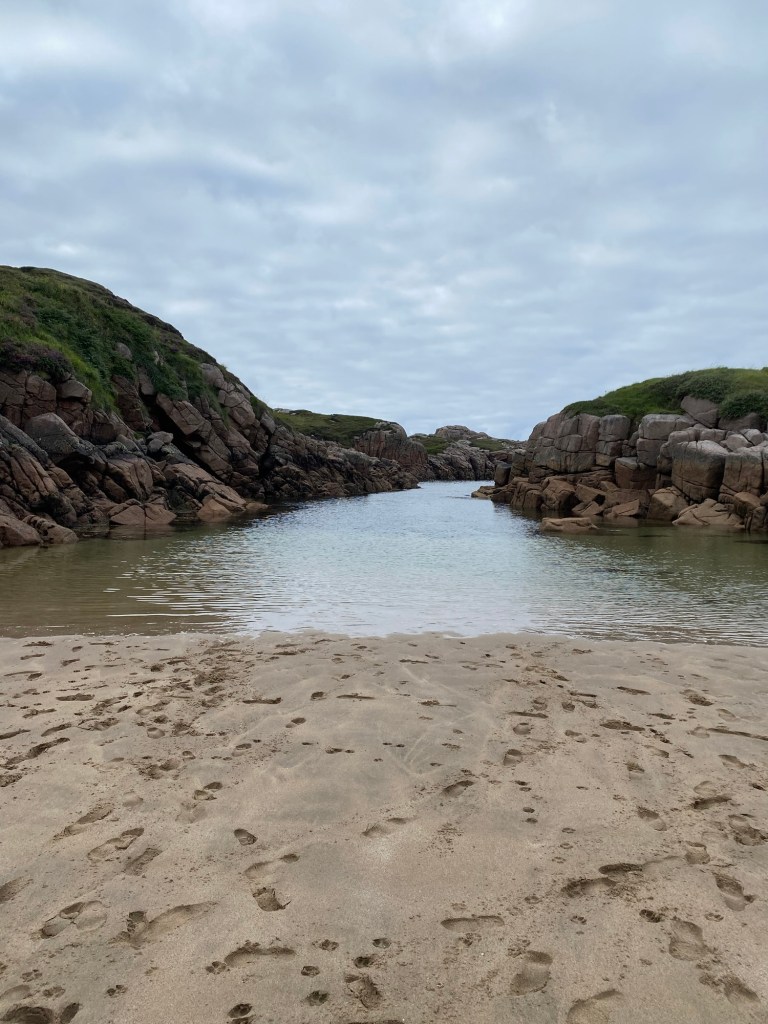
We had already decided to stay an extra night, to hole up here, in a house on a granite cliff, on the far northwest coast of Ireland. Better than running the risk of driving across Donegal and down through the country in the middle of a storm. We’d drive to the shop, get in supplies for the extra day.

Mid-morning, Katie called from the bathroom, ‘Is someone using the water out there?’ The shower wouldn’t heat up. A minute later she appeared wrapped in a towel. ‘The shower’s stopped working.’ Our trip to the shop in Dungloe delayed, we spent the next half hour trying to work out the source of the problem. The safety switch on the electricity junction box kept tripping. By a process of elimination, we realised that certain plug sockets also weren’t working. Michael stood on a kitchen chair, flicking switches on the junction box. ‘Shit. There’s smoke coming out of it,’ he said suddenly. I unlocked the door into the terrace in case we needed a speedy exit. My sister has survived two house fires – one in Ireland, one in Spain – both due to junction box fires, so I knew what could happen next

We ran around, unplugging and turning off lights. The smoke didn’t develop into anything more. Time for a sit down and a chat and decide what to do. It was Sunday morning, a bank holiday weekend. So calling out an electrician would be expensive and possibly not resolve the problem in the short term. Better to leave that til Tuesday and a normal working day. The house belongs to Michael’s aged aunt, so we didn’t want to bother or worry her when, at this moment, nothing could be done. And, the storm was still on its way.

We decided to ride it out here, without electricity. The girls raided the house for candles, torches, matches, while Michael and I figured out how to set up the ancient gas barbecue in a sheltered corner out the back of the house. Our shopping plan changed, as we considered what we could eat in the absence of electricity. We charged our phones as best we could during the drive.

When we got back from the shops, we went for a long walk across the island, still no hint that a storm was on its way. Michael lit the wood burning stove in the house and fired up the barbecue out the back. Up at this latitude at this time of year, it isn’t fully dark til 10:30. We sat chatting by candlelight til close to midnight. Michael was last to bed, leaving only a single (and safe) candle burning in the bathroom.

The wind woke me up around 5am, the back of the house, where I’m sleeping, creaking in its path. I was up at 7am, no longer able to sleep, keen to see what the sea looked like. I’m sitting here now by the big window that takes up half of this little house. Waves smash huge and white against the islands in the farther distance. Closer in, the sea is choppy, with gusts of wind dancing across its surface. A group of cormorants sit on the sea just down from the house, being tossed this way and that. The occasional seagull soars on a current of air, feet splayed as it attempts to land on firm ground

I’m glad we stayed. The lack of electricity gives a Wuthering Heights feel to this storm. We’ll leave later today or, more likely, tomorrow, whenever the storm has passed. All I’m missing is my morning cup of tea. For now, I’m going to sit back and enjoy the stormy sea.

46. Lá Lughnasa

We drive west from Derry and across Donegal. Katie comments that it’s the first time since leaving the midlands that the land has changed. She’s right. The spare glaciated landscape of Donegal is in stark contrast to the raised bogs and green fields that fill the middle of the country.

It’s the 1st of August, Lá Lughnasa, the old Irish harvest festival. Suitably, it’s also the start of the FrielDays Festival, a celebration of Ireland’s great playwright, Brian Friel. As I drive through the landscape that inspired so many of Friel’s plays, I have ply Michael with questions.

Years ago, I read some of Friel’s plays and went to an Abbey Theatre production of Dancing at Lughnasa. We talk mostly about Translations, the great play about place and the meaning of place and the colonial endeavour to translate our Irish place names into meaningless English names (for instance, how my town Eadán Doire – the brow of the oak tree – was transliterated into the meaningless Edenderry, or my parish Clough na Rinca – the dancing stones – was transliterated into Cloherinkoe). The same colonial endeavour that occurred all over the world.

Michael reminds me of the story and the characters in Translations, places the play within the context of the land we’re driving through and explains certain criticisms of Friel’s historical inaccuracies.

But more, Michael regales me with stories of Friel himself, of various family members, pointing out houses they lived in, houses that inspired characters in the plays, of his own encounters with Friel over the years.

Brian Friel’s plays are brought to life for me as I drive through this place. I want to read Translations now and think I must find a copy when I return to Edenderry.

We arrive at the house out on the island. ‘I keep Friel here, of course,’ Michael says, ‘and Heaney.’ An early collected works of Friel and one of Heaney too. He leaves the Friel on the table for me.

So, here I am now, reading Translations in a place that hums with Friel, where the shape of the people and the shape of the land run through each play. Where better to rediscover these plays?

45. Cruit

A couple of action packed days and late nights have come between me and writing. I wouldn’t swap these days for anything. I’m in Cruit tonight, back again after three years. This evening’s walk across this island off northwest Donegal was, as always, a delight…

Mt Errigal in the distance

44. Within these walls

I had only been home twelve hours when I attended a funeral, for a neighbour of ours, from a mile or more down the road. She was almost 97. To be honest, I hadn’t even realised that she was still alive. But she was our neighbour, a woman from my townland who I had known and liked all my life, so I accompanied Mammy to the funeral.

It was a big funeral for a Wednesday morning. I said hello to people I knew in the churchyard – second cousins, a neighbour from my childhood, people from our parish. We took our seats in the church. I watched the other funeral goers file in, recognizing people I’ve known all my life, many indeed, who I only knew within the walls of this church and the Masses I attended every Saturday night or Sunday morning of my life when I lived here.

The woman who died had been a regular Mass-goer all her life. I can still see where she sat relative to where I sat with Daddy and Nana when we took the same pew for Mass every single week.

The priest looked down at the large congregation. ‘These walls hold the history of our community,’ he said. ‘These walls embrace us and hold us together.’

I looked around the simple unadorned little country church. The statue of Jesus, the simple stained glass windows, the confession boxes, even the organist, unchanged for most of the years since my parents first took me here. I looked at the people around me – all a little older now, a few more wrinkles, a little more grey hair, And I felt a tremendous sense of gratitude for the grounding and sense of place that these four walls gifted me.

43. Busy day back

Between Mammy and the chats and the cousins and the chats and the neighbours and the chats and the tea and the chats and the rain and the chats and the dogs and the chats the coffee and the chats, I just haven’t had time to write anything today.

41. And tomorrow…home

After almost six weeks in the UK, tomorrow we will travel to Ireland. We haven’t started packing yet and the tiny bedroom we’ve been sharing at my father-in-law’s house looks like a bomb site, after all these weeks of us living out of our suitcases in there. But we’ll pack with care tomorrow, and say our goodbyes, and tomorrow night, all going well, I’ll be at home.

38. Chair-o-plane

This took me back. Today, the girls and I visited the Black Country Museum in Dudley, northwest of Birmingham. We learned all about coal mining in the 19th and early 20th centuries, went down a drift mine, and saw how people lived from about 1850 to 1950. It was all great.

But this is what did it for me. The chair-o-plane. I don’t know what you call it where you’re from, but at the fairground (or ‘carnival’ as we called it) in Courtown in Co. Wexford back in the early 1980s, this was a chair-o-plane (or, as Lily suggests ‘chaeroplane’).

Each year, Edenderry Shoe Company closed down for summer holidays for the first two weeks of August. Daddy was foreman of the warehouse and Mammy worked three afternoons a week in the shoe shop, selling ‘seconds’ (slightly damaged shoes that didn’t make it past quality control) to women who travelled from all over Ireland to buy these stylish and good quality shoes.

During August every year, when the factory was closed, we went on a weeklong family holiday. We tried out a few destinations (always in Ireland) but the one we returned to over and over again was Courtown, a seaside town on the southeast coast, in Co. Wexford. We often bumped into other shoe factory employees there too, also on their holidays.

My parents would rent a mobile home in the same caravan park each year. My Nana Tyrrell came most years and sometimes another family member – my aunt Louise came one year and my cousin Colette another.

We spent our days on the beach, having hauled the deck chairs, the wind break, and the day’s food down what, at the time, seemed like a very long lane to the beach but which now I imagine was no more than a couple of hundred metres. I loved those days on the beach. They felt endless.

And then evening came and, without fail, we drove to the carnival. There was a chair-o-plane, a merry-go-round, swinging boats, waltzers, bumping cars, a huge slide, a ghost train and a huge hall filled with slot machines. My sister and I spent our time out on the rides. She was five years younger than me (indeed, she still is!), so, in the early years, she was stuck on the little kiddie rides, while I went on the chair-o-plane on my own and got Daddy to come with me on the waltzers and swinging boats. That week was always the best week of the year.

Mammy liked to spend her evenings in at the slot machines. One year, it must have been the early 80s, she won £27 on one machine early on in the holiday. It was a small fortune. I remember the coins pouring out of the slot machine and Mammy running to get a plastic tub to put them in. She couldn’t believe her luck. We ate fish and chips and burger and chips every night of that holiday, paid for by Mammy’s winnings.

So today, when we got to the Black Country Museum and we discovered the funfair, I immediately had to go on the chair-o-plane. It brought it all back to me. I couldn’t have been happier. Later, we went on the ghost train and then converted £1.60 into old pennies and gambled at the slot machines. We won nothing, of course. After lunch, Katie suggested that we go on the chair-o-plane once more. She didn’t have to ask twice.

It was just as wonderful as I remembered from 40 and more years ago. I had a grin on my face from ear to ear. I was a kid again, back in Courtown in the 1980s.

23. Meeting Sean

I’m walking along the Grand Union Canal that runs behind the estate where my father-in-law lives. It’s a glorious evening and I’m on a video call with Katie who is away on the south coast this week with Lily and their uncle and aunt. I walk past four or five narrow boats. On the last boat in the row, a modest white and blue steel boat, a man is standing. I have the phone up, so he thinks I’m filming him or taking his photograph. He gives me a big smile and says something. But I’m talking to Katie, so there’s some confusion. He then realises that I’m not taking his picture and I realise that he’s talking to me. More than that, I hear his Irish accent and he hears mine.

“Where are you from?” he asks. “Kildare,” I reply. “Ah, a Lillywhite,” he says and I know immediately that I am firm ground. Despite his Dublin accent, he tells me he’s from Dungarvan in Co. Waterford. “The husband of one of my best friends is from Dungarvan,” I tell him. I tell Katie I’ll call her later because I have a feeling I might be chatting here for a while.

Sean and I chat for an hour, me standing on the grassy tow-path, he on the open deck of his narrow boat, the air cooled engine exposed to the evening air. We discover we have people and places in common. He pootled a narrow boat up to the harbour in Edenderry in the late 1960s and remembered going for a drink at The Harbour House. That was my uncle Tom’s favourite haunt, owned by Mary O’Connor, my Irish teacher, and her family. I was only in The Harbour House once, for a pint of Guinness with Tom back in the early 1990s. It was everything you would expect of a small Irish pub, all the old men lined up at the bar. It was renowned for its music and for Mary being as strict behind the bar as she was in the classroom.

Sean tells me about his job at Shannon airport and about people from Edenderry he knew there and at Ardnacrusha power station. I mention people I know who he might have known and we laugh when we get a bit tangled in Johns and Seans and who was who.

I tell him I had been a sailor and we talk about the joys of my Westerly Conway. He wonders how a girl from the Bog of Allen and a boy from the housing estate 20 metres from here could have ended up living on a boat and sailing to the places we did. He tells me of his adventures as a sea sailor and as a narrow boat owner and about his sustainable, no-cost approach to life.

At 80 years of age, he is only a few years younger that Daddy would have been. The Cuban Missile Crisis comes up in conversation (he makes me promise not to tell anyone why) and he shares his reminiscences of those few days in 1962 and I tell him what Daddy told me of his memories and fears of those days.

He explains how he has come to have that Dublin accent but says his heart remains firmly rooted in Dungarvan. He already owns a plot in Dungarvan graveyard where he wishes to be buried when his time comes.

“I had a half pint at the Cape of Good Hope a while ago,” he tells me, referring to the pub just a couple of hundred metres away. “When I went to the bar, I heard two men behind me. A Mayo man and a Galway man. Sure, I had to talk to them. The Mayo man was a bull man.”

“A bull man?” I ask, perplexed. “Ah, you’re too young,” he says. He explains what a ‘bull man’ is and realisation dawns. “Ah,” I say, “You mean the AI man. That’s what we call it where I come from.” He laughs and says how funny that we had that in Ireland where the Catholic church didn’t allow such things for humans. AI, for those of you not in the know, means, artificial insemination, and the Bull man or the AI man was, and remains, an integral part of our dairy and beef industries.

My daughters always tease me when I speak to other Irish people, accusing me of changing the way I talk and the way I hold myself. They’re not wrong. But I don’t do it on purpose. When I’m with other Irish people I become the version of myself that is the oldest part of me. I speak in the way I learned to speak as a baby, in the first accent I ever heard from the people and the place where I grew up. It is the accent, grammar, syntax and vocabulary that I am most comfortable with. There’s no modulation, no register change, no code switching. I am me at my most comfortable.

We all change our registers in different contexts. For instance, the way we speak to small children is not the same as the way we speak in the corporate office. The way we speak in church is not the same as on the terraces of the football stadium. But changing accents is something different. Over the years, I have modulated not only my accent, but the words I use when in conversation and the order in which I say them. Why? Well, for two reasons – one that I am comfortable with, the other less so.

For most of my life, I have chosen to live among people for whom English is not a first language. Therefore, to make myself understood among English speakers in Japan, Nunavut, Spain, and elsewhere, I slow down, speak carefully, use very standardized words and phrases to be understood and to make the person I am speaking to feel more comfortable. That is now second nature to me.

The other reason is that, over the years, I have been very aware of people making fun of my Irish accent – people laughing and repeating my pronunciation, my use of certain phrases or my Hiberno-English sentence structures. In order to reduce the feeling of discomfort (and anger) that this fun-making and ridicule causes in me, I modulate and change register. It’s just easier. I don’t like it, but it is how it is. That too is now second nature to me when I am around native English speakers who are not Irish.

But, when I speak to other Irish people, I can feel my body physically relax. I don’t have to think of an alternative phrase or word for ‘give out’, ‘press’, my use of bring/take, my pronunciation of H and th, or a thousand other usages of words and phrases. I’m not going to be laughed at for calling my parents Mammy and Daddy. I can throw in a reference to the GAA or to Eamon Casey or to the Angelus or to a million other things, and no further explanation is required. I can just be.

All migrants, no matter what their language or their circumstances, experience this distance from their first voice. Some people are happy to leave that first voice behind. I am privileged to have had so many opportunities to travel in my life. I have learned so many wonderful ways to speak and to see the world through the eyes of others. But speaking in the way that is oldest to my being is like relaxing into a large warm bath.

Sean is stuck along this stretch of the canal for the time being, as he waits for a lock gate farther along to be repaired. I tell him that if he’s still there the next time I walk that way, I’ll invite him down to the Cape of Good Hope for a beer. Who knows? Maybe the AI man will be there.

Stretch of the Grand Union Canal in Warwick

8. Leaving home and going home

Later today, I will close my front door behind me as the girls and I leave home for 10 weeks. We’ve never been away from Sanlucar for so long before. At first, we will spend a few weeks in the UK and then we will go home to Ireland. We have a wonderful summer ahead of us, packed with family and close friends and trips to all sorts of wonderful places and events.

But I have mixed emotions about leaving. I am saying goodbye to a close friend who, owing to illness, will likely no longer be with us when I return. At the same, I am excited to spend time with my family and dear friends, the people who have known me longer and who know me better than anyone.

I’m taking the girls away from a summer by the pool and at the beach, and being with their friends. I’m also taking them away from Lady. But then I remind myself of how hot it’s going to be and how we’ll be stuck inside the house most of each day in +40C heat. So, I’m looking forward to taking the girls to cooler beaches and to places familiar to them that they want to visit again and places new that they have never been to. And I’m excited about the time they will get to spend with friends in the UK, starting on Sunday, when we travel to London to visit their oldest friends.

While I have adapted to many aspects of Spanish culture, after ten years I have yet to adapt to staying out so late at night. I can do it once or twice in the entire summer. But, in general, when Sanlucar comes alive at night in the summertime, when many of our friends and neighbours are out strolling the streets, or at one of the bars, or sociably sitting outside their houses, the girls and I have already gone to bed. I have tried to adapt, but I can neither stay awake that late at night nor get by on so little sleep the next day when I need to be up at 6am to get my work done before it gets too hot. Lots of people have managed to adapt to it. Sadly, I’m not one of them. So, I’m looking forward to cooler weather in the UK and Ireland (despite a heatwave in the former at the moment) and sticking to my normal bedtime.

For all of that, for all the wonderful things I have planned, I know that when I am at home* in Ireland I will miss my home in Spain. I will be looking forward to coming home in September, batteries charged, feeling refreshed and renewed, and feeling love and longing for both the home I will be leaving behind and the home I will be returning to. I am grateful for both.

*I don’t actually own a home in Ireland. We’ll be couch and spare-bed surfing for the entire summer. It’s more that home owns me.

An aerial photo of my home in Ireland, taken sometime in the 1960s.

Gilroy

There were seventy-five of us, by my count. I might be out by a few. It was hard to keep count. Children, grandchildren, greatgrandchildren, spouses and partners. Seventy-six if you include Nana, in the middle of us all, in her coffin.

The undertaker, Patrick Larkin, had asked us to assemble in Gilroy at 12:45. And here we were, squashed together in the living room, where Nana lay in her coffin, and in the narrow kitchen off the living room, leading to the only bathroom in the house. Most of us had been here five and a half years earlier, for her 90th birthday party. But that had been a warm July day and we were spread out over her big back garden.

“How are your girls?” Angela asked me, as a gang of us stood shoulder to shoulder in the kitchen.

“Put that in the fridge,” Louise said, as she passed me a two-litre plastic container of milk.

I’d only closed the fridge door when Conor walked in. “Did anyone get milk?” he asked.

I took the milk back out of the fridge.

“I’m making tea for Dad,” Conor said. “Anyone else want anything?”

“I’ll have a coffee,” Antoinette said, taking an impossibly huge mug out of the press. I didn’t fancy her chances of getting through the funeral if she drank the fill of that.

“When did you get home?” one of the twins asked as she hugged me.

“One o’clock this morning,” I replied. “Declan Farrell picked me up from the airport.” I asked when she’d flown in, careful not to say her name until her sister arrived and I could work out which was which. This always happens when I haven’t seen my twin cousins for a while.

“Is this a queue for the loo?” David asked, as he walked into the kitchen, ushering his two young sons in ahead of him. He explained to his bewildered boys that all of us chattering women were his cousins and aunts. He hugged us each in turn as he directed the boys towards the toilet after their long car journey from Cork to Offaly.

“Oh my God,” Antoinette said. “Stuart looks like Ryan Reynolds.”

“Don’t tell him,” the twin laughed. “His head will explode.”

Antoinette told him anyway and he beamed and gave her an extra big hug.

I squeezed my way back into the living room. The other twin was there. She hugged me and told me what time she’d arrived home from England. She mentioned her sister’s name, so now I knew that this was Lisa and Joanne was in the kitchen. I hugged those cousins, aunts and uncles standing around me who I hadn’t already seen earlier in the morning when I’d been into Gilroy for a quieter moment with Nana. Martina’s three boys – all six foot something of them, and John’s girls, and James, looking surprisingly fresh-faced despite having just arrived in on a flight from Hong Kong. There were cousins and aunts on the chairs and the arms of chairs, and more standing squashed together like a Tokyo subway train at rush hour, except we were all family and everyone had hugs for everyone. Mugs of coffee and tea were precariously held and threatening to spill on our best clothes. We were loud and laughing, delighted to be here together, despite the circumstances.

I wondered would this be the last time we would all be in Gilroy?

Gilroy, the centre of our family universe. An unassuming terrace house on an unassuming street that was the beating heart of our family. And, at the centre of that universe was Nana, always in her armchair by the fire, always with a smile on her face, accepting us in at any time of the day or night, occasionally grudgingly, if we threatened to interrupt a programme or a football or hurling match on the telly or radio.

No matter what time of day or night you went in, there was sure to be someone else there. One or other of us always dropping in ‘just for a minute’ but nevertheless always having time for a mug of tea or coffee, a couple of biscuits, maybe a sweet or jelly from a bag or bowl on the coffee table in the middle of the living room floor.

It was the rare day that we went into town and didn’t drop up to Gilroy. When we went grocery shopping, Mass, a trip to the doctor or dentist. Always, up to Gilroy before or after. Pretty much every day of the 13 years I was in school, I walked over to Gilroy at lunchtime for a huge middle of the day dinner and a glass of milk, followed by a couple of biscuits or a slice of Nana’s homemade tart. In my 20s, she occasionally cooked dinner for me if I was working in Edenderry. I didn’t really like her food when I was a kid. In my 20s, I loved it. And always, there were aunts, uncles or cousins there. Always some of us dropping in.

I’d phone Mammy for a chat. “I’m in Gilroy,” she’d say.

“Jim and Marian are up,” someone would say. “Up” meaning up from Cork…and in Gilroy.

“Phil’s home,” meaning home from England…and in Gilroy.

“Liz is down,” meaning down from Dublin…and in Gilroy.

“Jim is over,” meaning over from Navan…and in Gilroy.

Up, down, over, home – all our shorthand simply meaning that we were in Gilroy. Half the time I’m not even sure we were visiting Nana. We were just being ‘in Gilroy’ because you wouldn’t be there more than a few minutes before someone else would drop in for a quick visit, a cup of coffee, a biscuit, a chat. I often wondered how much money Nana spent on tea, coffee and packets of biscuits each week.

And always Nana, sitting in the middle of it all, in her chair by the fire, smiling and laughing, telling us the latest gossip from the street, or the latest plotline of some soap opera she was engrossed in. And we carried on around her, feeling at home, sometimes the noise of our chatter so loud that we couldn’t hear each other. So, it was fitting that, on that day, most of us were there, and we were loud, and she was in the middle of it all one last time.

At 1.30, we started to move out. We formed two lines from the front of the house, out along the path, to the street. We stood, seventy-odd of us, joined now by neighbours and friends, as six of my uncles brought Nana out of her house on Gilroy for the last time.