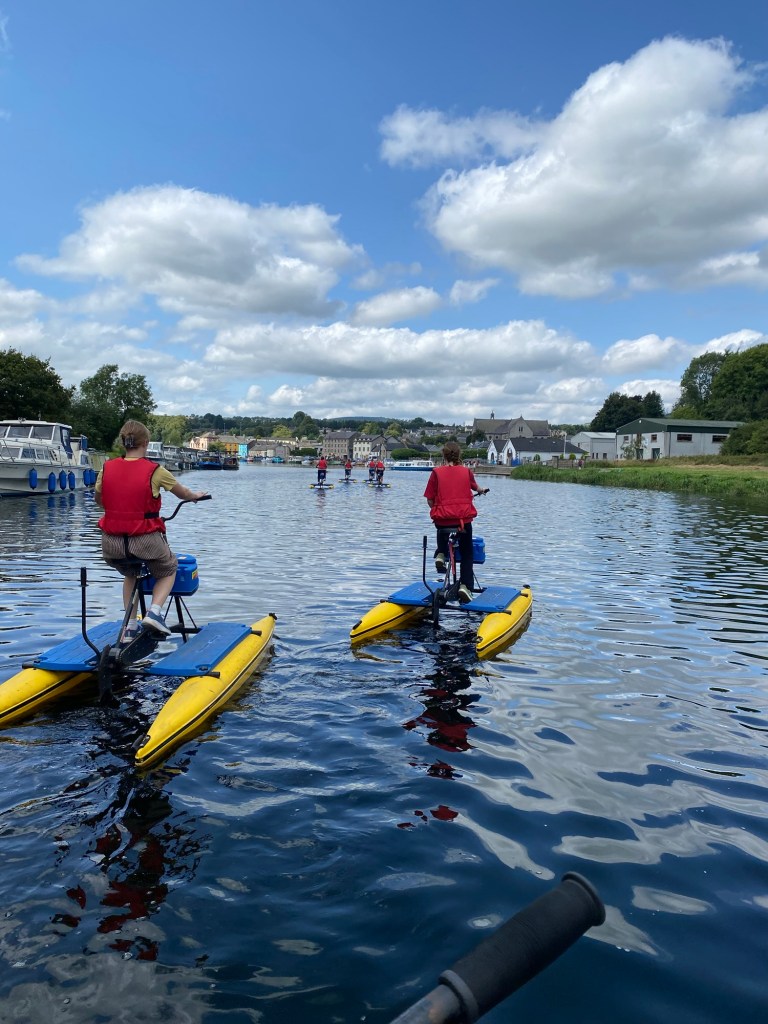
This morning, we went to the gorgeous Co. Kilkenny village of Graiguenamanagh, which sits on the banks of the River Barrow. Our purpose? Some high skilled, high powered, highly competitive* hydro-biking.
Sure, I was a bit overheated in the life jacket. But what an opportunity to demonstrate my superior biking skills AND superior navigation skills to the children. 🤣🤣
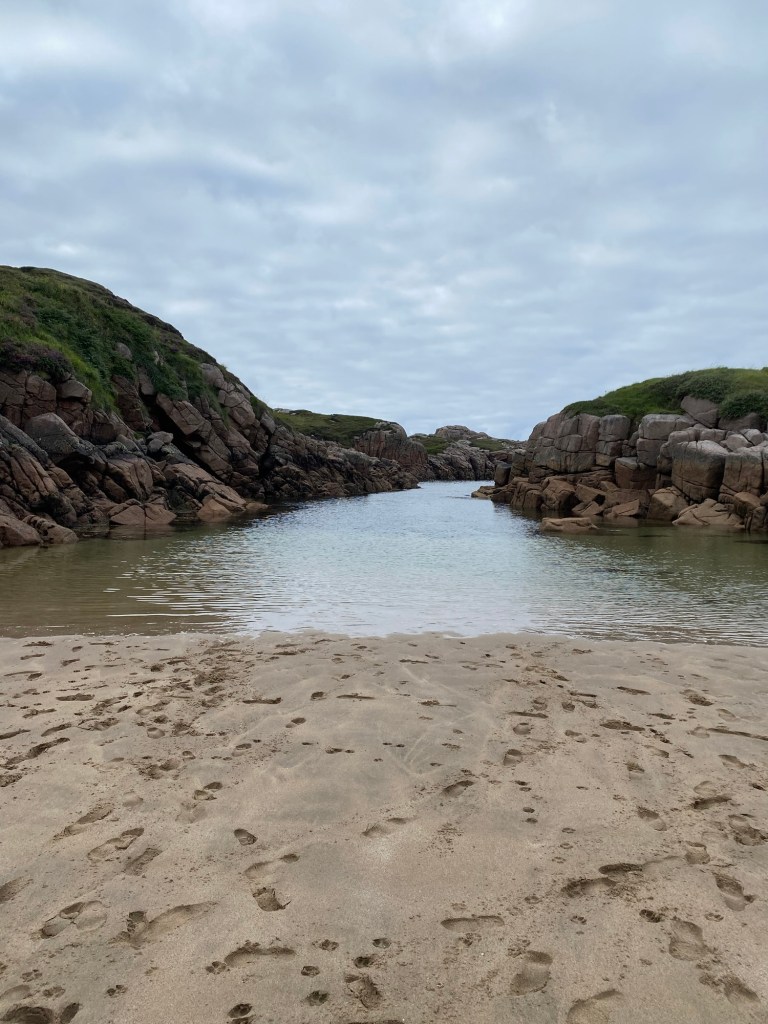
It’s a beautiful evening, warm and sunny, and the plan is to go for a swim at The Guillamine out in Tramore. Niamh and her family regularly drive the few miles from their house in Waterford city out to this cove where the swimming is good and, towards high water, you can jump from a high concrete platform into the sea.
There are a lot of people there when we arrive. Far more than I was expecting. Men and women of all ages, with a steady stream of people going down the narrow concrete steps from the car park and back up again.
When we get down to the swimming area, the sea is turquoise and there must be 50 or more people in the water. Niamh’s husband and son go straight to the diving platform.
That’s not for me. Without my glasses, I’m quite lost. I can’t really see where I am and, because I’ve never been here before and there are so many people here and it’s noisy with people splashing into the water, I suddenly feel overwhelmed and scared. I hold into a railing, with people asking if it’s ok to go past me. I let them pass. Niamh is in now, and Lily, and I momentarily think I should just turn back and wait for them up by our towels.
Lily swims back to me and tries to convince me to get in. But I don’t like this. Not one little bit. And why am I here? And this is not for me. Niamh swims over and suggests I enter the water via a hand rail. But I’ve already tried that and I couldn’t do it. She convinces me to try again.
It’s my eyesight. That’s the thing. Because I can’t see anything clearly beyond the end of my nose, I am figuratively, if not yet literally, out of my depth. I follow Niamh’s instructions, and now, in an instant, I am in and swimming away from the shore, away from the gentle waves breaking against the rocks, away from the hoards of people lining up to enter and exit the water.
And it’s glorious. The water is cold, but not too cold. Clumps of bladder wrack float past, dark green and slimy. The saltiness of the sea buoys me up with little effort. How could I ever have thought I didn’t want to be in here? I feel alive alive alive. I think I want to come back tomorrow.
The deep history of Ireland is written in its landscape. In Donegal, the waves crash against the coast, turning cliff to cave, cave to arch, arch to stack, over aeons of time, crashing endlessly; cliff, cave, arch, stack, each a moment in its transformation into what it will become. Imagine speeding this erosive action up, so that these millions of years, tens of millions of years, hundreds of millions of years, can be seen to pass in a time frame that is comprehensible to creatures as short-lived as us.
Or maybe those aeons of time – the mere blip in the history of the universe that it took to transform cliff to cave to arch to stack – is too vast to comprehend. How about a shorter time frame? From Donegal, we drive inland, through the u-shaped valleys, the hanging valleys, the cirques, the scree, the ribbon lakes of the most recent ice age. Shorter time, easier to grasp. 20,000 years. 50,000 years. Time when our ancestors, not yet here, lived and loved and laughed and adapted to (or failed to adapt to) the changing climate. The landscape here is barren, in hues of grey and purple, still in its post-glacial youth.
Down through Monaghan, the road winds through what the glaciers left behind as they retreated in a warming world. Now, we are getting closer to our time. Only 10,000 or 9,000 years ago. The blink of an eye. The drumlins, those hills of glacial debris, all sloping together, like eggs in a basket, their blunt stross ends facing back northwest in the direction of the retreating ice, their more gently sloping lee ends looking southeast to a warmer world. The drumlins are bright green farmland now, criss-crossed with hedges, stone walls and fences. Cattle and sheep graze on the mineral rich grass. We have made them our home.
From the drumlins we drive across the eskers, the long collection of the Eiscir Riada, dried streams of glacial melt water that left behind the stone and sand and gravel that we drive along and extract and graze our animals on.
And now I am home. In the Bog of Allen. The raised bog, so similar and yet so different to the blanket bog I walked across in Donegal. This too is a remnant of the last ice age, the trapped melt water with no escape from the depression at the centre of the island. As the world warmed, trees grew and died and grew and died, over 10,000 years. Heaney wrote of the bog
Missing its last definition
By millions of years.
They’ll never dig coal here,
Only the waterlogged trunks
Of great firs, soft as pulp.
Our ancestors lived here, buried their dead here, punted their boats here. Archaeologists have found hoards of gold buried here and urns of butter still edible after 5000 years.
In the blink of an eye, we have ripped up the Bog of Allen. Heaney was wrong when he wrote ‘The wet centre is bottomless.’ In my lifetime, we have reached the bottom – digging, extracting, exhausting. And what did we find there? An earlier history told in seashells and calcified rock. From a time before. But to comprehend that, we must step back from this moment, to look across millions, tens of millions, hundreds of millions of years.
We had already decided to stay an extra night, to hole up here, in a house on a granite cliff, on the far northwest coast of Ireland. Better than running the risk of driving across Donegal and down through the country in the middle of a storm. We’d drive to the shop, get in supplies for the extra day.
Mid-morning, Katie called from the bathroom, ‘Is someone using the water out there?’ The shower wouldn’t heat up. A minute later she appeared wrapped in a towel. ‘The shower’s stopped working.’ Our trip to the shop in Dungloe delayed, we spent the next half hour trying to work out the source of the problem. The safety switch on the electricity junction box kept tripping. By a process of elimination, we realised that certain plug sockets also weren’t working. Michael stood on a kitchen chair, flicking switches on the junction box. ‘Shit. There’s smoke coming out of it,’ he said suddenly. I unlocked the door into the terrace in case we needed a speedy exit. My sister has survived two house fires – one in Ireland, one in Spain – both due to junction box fires, so I knew what could happen next
We ran around, unplugging and turning off lights. The smoke didn’t develop into anything more. Time for a sit down and a chat and decide what to do. It was Sunday morning, a bank holiday weekend. So calling out an electrician would be expensive and possibly not resolve the problem in the short term. Better to leave that til Tuesday and a normal working day. The house belongs to Michael’s aged aunt, so we didn’t want to bother or worry her when, at this moment, nothing could be done. And, the storm was still on its way.
We decided to ride it out here, without electricity. The girls raided the house for candles, torches, matches, while Michael and I figured out how to set up the ancient gas barbecue in a sheltered corner out the back of the house. Our shopping plan changed, as we considered what we could eat in the absence of electricity. We charged our phones as best we could during the drive.
When we got back from the shops, we went for a long walk across the island, still no hint that a storm was on its way. Michael lit the wood burning stove in the house and fired up the barbecue out the back. Up at this latitude at this time of year, it isn’t fully dark til 10:30. We sat chatting by candlelight til close to midnight. Michael was last to bed, leaving only a single (and safe) candle burning in the bathroom.
The wind woke me up around 5am, the back of the house, where I’m sleeping, creaking in its path. I was up at 7am, no longer able to sleep, keen to see what the sea looked like. I’m sitting here now by the big window that takes up half of this little house. Waves smash huge and white against the islands in the farther distance. Closer in, the sea is choppy, with gusts of wind dancing across its surface. A group of cormorants sit on the sea just down from the house, being tossed this way and that. The occasional seagull soars on a current of air, feet splayed as it attempts to land on firm ground
I’m glad we stayed. The lack of electricity gives a Wuthering Heights feel to this storm. We’ll leave later today or, more likely, tomorrow, whenever the storm has passed. All I’m missing is my morning cup of tea. For now, I’m going to sit back and enjoy the stormy sea.
In late 2000, I’d already been working as a volunteer teacher at Levi Angmak Elementary School in Arviat, Nunavut, for some months. Kip Gibbons, one of the teachers who had befriended me, offered to show me how to sew my own mittens. She sent me to the Northern Store to buy ukaliq (arctic hare) fur. I duly went a couple of evenings later and bought two ukaliq skins. On Saturday, I went around to Kip’s house and we sat on her floor, where she helped me to cut the pattern and showed me how to stitch the parts together.
I’ve never been much of a crafts person, so I was delighted to be making my own mittens. It was probably -20C or -25C as I walked the snow-covered streets back to my house a few hours later, proudly wearing my new mittens. I would wear them for years, and still have them today, although there isn’t much call for them in southern Spain.
On the Monday after I sewed the mitts, I wore them to school. In the school foyer, I met Peter 2 Aulajoot, an older teacher, who was always friendly and jokey with me. He chuckled when he saw my mitts. I hadn’t cut them badly or sewed them poorly. But Peter 2 noticed something that I hadn’t. While the fur on my left mitt was mostly white with a little smattering of black, the fur on my right mitt was mostly black with a little smattering of white. They looked completely mismatched. How could I not have seen this?
From that day on, Peter 2 always called me Ukaliq – arctic hare. A few other people picked it up too, but it wasn’t a name I was commonly called. But I liked that name for myself. I’d always loved hares, always got a thrill when I’d see them in Ireland. Now that I was in Nunavut, I saw them more often – including one that lived out past the reservoir and seemed as tame as a pet bunny.
I’ve carried that name – Ukaliq – with me ever since, making the frisson of excitement I feel whenever I see a hare all the sharper. So, yesterday when Michael said, ‘There’s the hare,’ I immediately turned to the window. And there she was. At the base of a granite outcrop beside the house, ears up, alert. She paused, nibbled at a hind paw with her teeth, hopped along and then sat, ears back, looking out over the sea.
I was in a state of awe and nostalgia and joy all mingled together, remembering Peter 2 and Kip and that ukaliq by the reservoir and the person I was twenty-five years ago.
We drive west from Derry and across Donegal. Katie comments that it’s the first time since leaving the midlands that the land has changed. She’s right. The spare glaciated landscape of Donegal is in stark contrast to the raised bogs and green fields that fill the middle of the country.
It’s the 1st of August, Lá Lughnasa, the old Irish harvest festival. Suitably, it’s also the start of the FrielDays Festival, a celebration of Ireland’s great playwright, Brian Friel. As I drive through the landscape that inspired so many of Friel’s plays, I have ply Michael with questions.
Years ago, I read some of Friel’s plays and went to an Abbey Theatre production of Dancing at Lughnasa. We talk mostly about Translations, the great play about place and the meaning of place and the colonial endeavour to translate our Irish place names into meaningless English names (for instance, how my town Eadán Doire – the brow of the oak tree – was transliterated into the meaningless Edenderry, or my parish Clough na Rinca – the dancing stones – was transliterated into Cloherinkoe). The same colonial endeavour that occurred all over the world.
Michael reminds me of the story and the characters in Translations, places the play within the context of the land we’re driving through and explains certain criticisms of Friel’s historical inaccuracies.
But more, Michael regales me with stories of Friel himself, of various family members, pointing out houses they lived in, houses that inspired characters in the plays, of his own encounters with Friel over the years.
Brian Friel’s plays are brought to life for me as I drive through this place. I want to read Translations now and think I must find a copy when I return to Edenderry.
We arrive at the house out on the island. ‘I keep Friel here, of course,’ Michael says, ‘and Heaney.’ An early collected works of Friel and one of Heaney too. He leaves the Friel on the table for me.
So, here I am now, reading Translations in a place that hums with Friel, where the shape of the people and the shape of the land run through each play. Where better to rediscover these plays?
A couple of action packed days and late nights have come between me and writing. I wouldn’t swap these days for anything. I’m in Cruit tonight, back again after three years. This evening’s walk across this island off northwest Donegal was, as always, a delight…
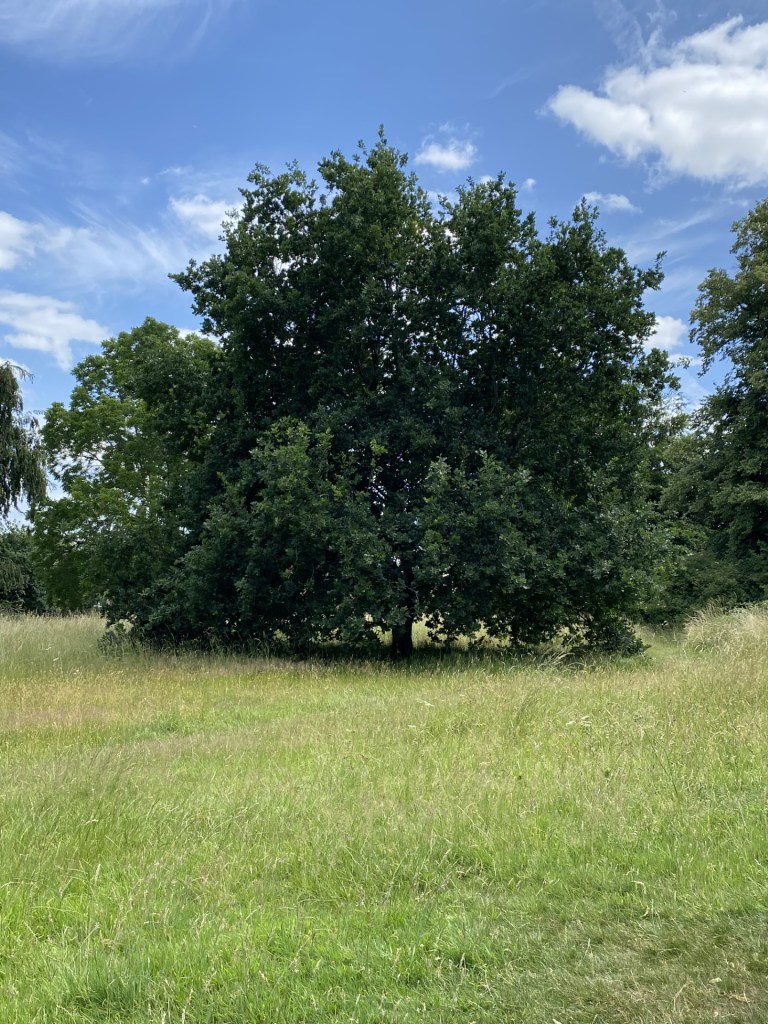
The trees are so big and so green and so varied and so alive. Oaks, horse chestnuts, sycamores, beech. Their trunks are immense and they reach high up into the blue sky. So unlike the scrubby arid trees of the dehesa (savannah) of southwest Spain. Tiredness is causing me to have an out of body experience as I walk through Priory Park. Is this what it’s like to experience the world when high on drugs, I wonder? The giant beautiful trees seem to pulsate around me, my brain and eyes playing tricks on me. Maybe the trees are playing tricks on me too. The tiredness is adding to my disbelief that I’m here, when only a few hours ago, I was there.
We woke up at 3.10am. I slept little anyway, checking my phone through the night to make sure I hadn’t slept through the alarm. Katie had set her alarm too, so it wouldn’t have mattered, but tell that to my subconscious/unconscious brain. It didn’t help that the narrow single bed in the cheap airport hotel was springy and uncomfortable and the room was too hot at first, then too cold with the fan, then too hot when I turned the fan off. Through those few brief hours, I heard other hotel guests arriving and departing, the thunk-thunk of heavy suitcases being hauled up or down the old stone stairs of this hotel without a lift, the wheels squeaking down the corridor outside our bedroom door, a movement-sensing light flooding our room with light through the glass panel over the door.
I am grateful that the airport was straightforward, the flight uneventful, our train to Leamington Spa on time. By the time we get to my father-in-law’s house mid-morning, the effects of the tiny €30 airport breakfast has long worn off and we are starving. While he asks the girls about the flight, I make a bee-line for the kitchen, knowing exactly what I’ll make (the girls and I have been discussing it, fantasizing about it). We anticipate what Granddad will have in stock, and we’re not disappointed. Rashers and eggs and fried tomatoes, with buttered fresh white bread and strong tea.
Afterwards, I rest for an hour, unpack a little and then I’m off again. The girls are sleepy, though they claim they aren’t. But they’re pale and have bags under their eyes, so they can’t fool me. I leave them sitting in the livingroom with Granddad, looking out over his garden at a fat pigeon pecking at the seeds he’s scattered about. I leave the house to the sounds of him telling the girls about a radio he built when he was a teenager, from his dad’s old cigar box. I hear him ask them what components they’d need to make a radio. My Gen Z teenagers have never used a radio in their lives, but I’m out the door before I hear their answer.
While my work life will be decidedly less frenetic in the coming weeks than it has been of late, I have a deadline to meet this coming weekend and I need to crack on. I spend a few hours at the library, meet my self-imposted work target for the day, and head back to my father-in-law’s house again. By now, I am well and truly zombified with tiredness, and the trees pulsate as I walk through them. Perhaps they are really Ents. Perhaps I need a good night’s sleep.
It was unusually and pleasantly cool when I went for my walk just before 8 o’clock this morning. Overcast and with a slight mist on my face. A respite from most mornings when the sun is already beating down hot and glaring from the sky at that hour. It won’t last long. In a few hours, the clouds will have burned away and the temperature will be in the mid to high 30s.
Sheep on my walk this morning
This week every year feels like the lead up to Christmas for its levels of busyness. The last week of school each year somehow always coincides with me having more than normal amounts of editing and writing work. It’s not that I perceive that there’s more work because I’m so busy doing other things. My records show that, year after year, one of my busiest work weeks of the year is also the last week of school. Maybe the writers I work with are also racing to complete their writing projects before the end of their or their kids’ academic years.
When the girls were little, the last week of school involved a day-long parent-student-teacher excursion to a water park, preparation for the end of year school performance, the one-day medieval festival that we, the parents’ association, organized, and finally a parents’ association convivencia, to which we all brought and shared food, had a barbecue and got sozzled – in the baking sun.
Now that the girls are older, my duties are more of a chauffeuring nature. No longer in the village school only a one-minute walk from our house, their secondary school is 25km away. As the school year draws to a close, trips to that town have increased – for evening graduation prep (for Lily), get togethers with friends, end of year parent-teacher meetings, and so on. Then there’s Katie to her tennis lessons 40km in the opposite direction. Plus the dog’s annual rabies vaccination lands this week each year. Luckily, the roads are good and we have some good music and podcasts to listen to.
To make matters slightly more crazy this year, we’re leaving next week for 10 weeks. We’ve never left Sanlucar for such a long time before so I’m in the process of getting the house ready to close it up. At least I haven’t had to do much grocery shopping this week, as I’m running down the food cupboards and the fridge. I’m setting up an irrigation system to water the 50 potted plants on my patio (I didn’t realize I had 50 until I set about the rather fiddly business of setting up the system). I still need to lift the dinghy and kayaks out of the water and store them until we come back. And there’s the packing, of course – not only of clothes and whatnot, but everything I will need to be able to carry on working while I’m away. Somewhere, in the midst of it all, as with every other year, I find the time to sit at my desk and meet my work deadlines.
The craziness of this time of the year is suffused with optimism and looking forward. All three of us are looking forward to the end of the school year for a shake-up of a routine that has started to feel like a drudge. All three of us, for different reasons, have had a tougher than expected year, so we’re looking forward to the end of school perhaps more than other years. A miscalculation on my part, however, means that, rather than having a few days to relax at home, and swim in the pool and the river, we’re leaving Sanlucar the very first day of the school holidays. Silly me.
Four more days of school…and summer, here we come!!
In late December, I set myself a challenge to walk 200km in January.
2023 had been an exceptional year for me. I was joyful and exuberant in turning 50 and everything about my life seemed to glow. That was until the end of the year, when it felt as if someone let the air out of my balloon. From early December, I felt lost, drained, living in a cloud of cotton wool, from which I neither could nor desired to work, be with other people, or drag myself out of the house.
Happiness and contentment are my default modes. If chemical imbalances play a role in the onset of depression, then I often think that I have chemical imbalances in the other direction. I’m chronically happy. I’m annoyingly upbeat. My glass is always way more than half full.
Except at the end of 2023, when it wasn’t. I had no reason to feel down, and yet I did. A weekend in Sevilla uplifted me momentarily but, even there, I was unusually sharp with my daughters and, at times, felt the strain of being in a city more acutely than usual. Then I came down with COVID and a week in Tenerife over Christmas that was supposed to relight my lamp instead left me feeling even more down in the dumps. I returned home to Sanlúcar COVID-free but feeling flat.
Then one day, in the last week of December, I set out to walk the dog. Not an ‘oh god, I’ve got to walk the dog’ sort of walk, the kind that had become my default over the past year, when I’ve increasingly cited lack of time, but a ‘let’s see how far we can go’ sort of walk, with a backpack on my back, containing my water bottle, a notebook and pen, and my phone to take photos. I walked north, along the path that leads up the river, stopping to allow myself to be enveloped in the silence, to watch a raft of canes drift down the river, to marvel at the orogeny on a wall of rock. The dog, of course, loved it too, walking farther than she had in months. At the farthest point from home, I decided to set myself the challenge of walking 200km in January.
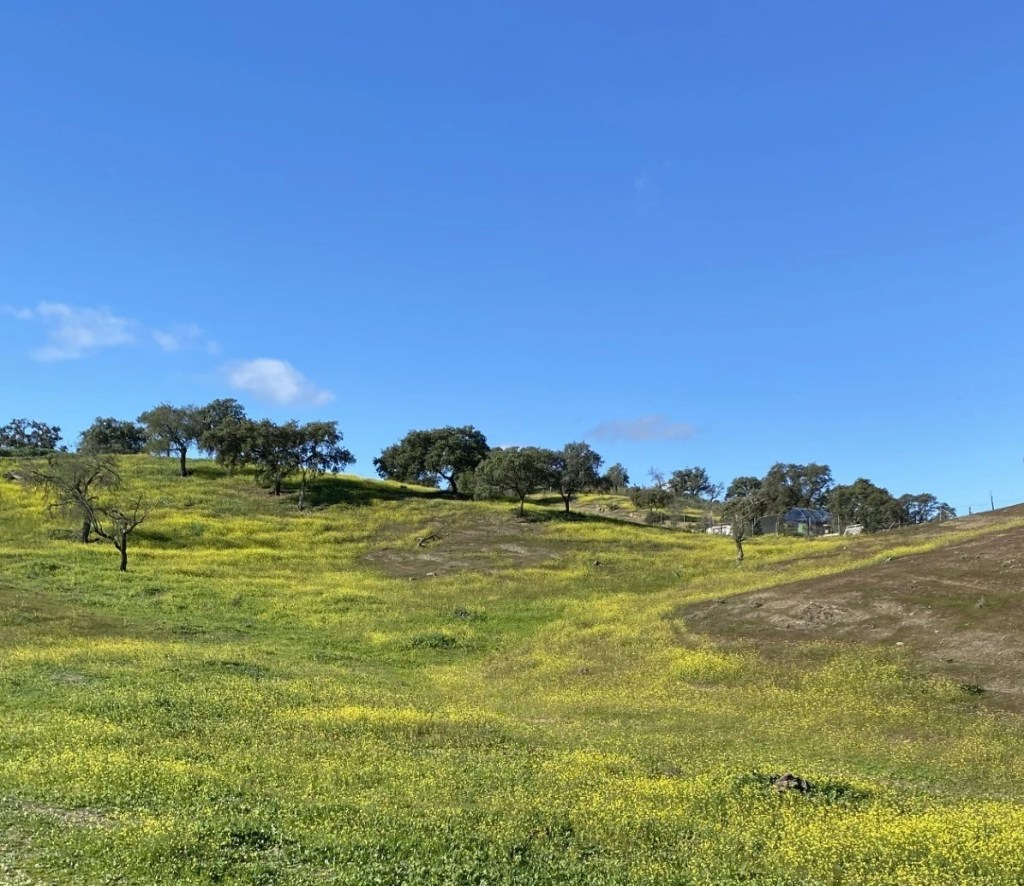
I walked for the first few days of January, recording the distance so that I had a sense of how far I might walk in a certain amount of time and considering how I could make space in my work day for this challenge. On each walk, I was uplifted. The land was brightly green, decorated with patches of wildflowers, yellow and white. It was a balm to the eyes and to the soul. Each day, though my spirits descended again when I returned from my walks, the troughs were not so deep. By the second week of January, I felt like myself again.
Some days I walked 10km or more, one day I only managed 1km. I walked at all times of the day – in cold early morning mist in jacket and woolly hat, bright afternoon sunshine in t-shirt and sunglasses, at sunset, carefully picking my way along rocky paths in the dark; Lady always my faithful companion, the land I walked through nourishing and uplifting me.
By the end of the month, I had walked 201km, along paths leading out in a radius from my house. I became reacquainted with places I hadn’t walked in years, just as I became reacquainted with why I love living here in the first place – the immensity of the land, the stories it tells of the people who lived here before, if only you take the time to read those stories in the landscape, the other creatures nourished by the land, and the river that brought me here snaking through it all; the vastness of the sky, at times a blue so deep as to seem unreal, at times ominous shades of grey, at night the riot of stars a glorious reminder of my insignificance, the Milky Way mirroring the route of our little river.
Over the course of the month, I observed changes taking place – sudden changes brought about by a heavy rain shower, slower changes as grasses grew, the number of lambs in a herd of sheep increased dramatically, the oranges continued to ripen and fall from the trees. I have found one, two, or even three hours in each day to walk. Those hours were there for the taking all along, I just failed to see them. Walking became the fulcrum of my day throughout January, uplifting me, soothing my soul, reassuring me that in the face of such ordinary magnificence, it is only to be expected that happiness is my default mode.
As for February? I’m back on the tracks and trails again, mostly in the lengthening evenings, challenging myself to another 200km. It hardly feels like a challenge. It’s starting to feel more like a drug.








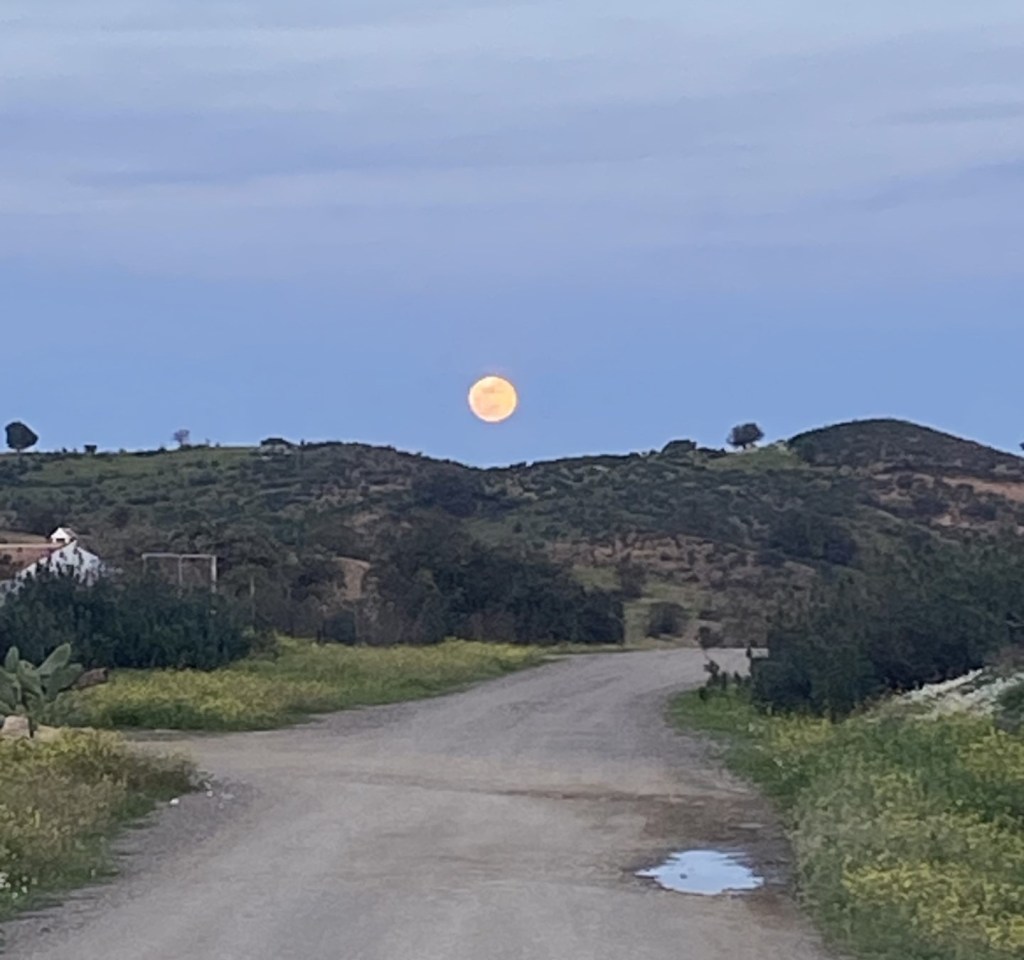
 Me in place