66. The A Book

At Christmas 1989, I was 16 years old and in my final year of secondary school. In February, I would have to complete my application for university – a centralized system in which I would have to list my choice of institutions and courses from one to ten. In June 1990, I would sit the state Leaving Certificate exam and, in August, I would be offered the highest ranked of the ten courses for which I had gained sufficient accumulated points in my Leaving Cert.

Geography and English were my favourite subjects and I imagined I would do a degree in those two subjects, become a teacher, and then come home to Edenderry and teach for the rest of my life. I didn’t know any better. My teachers were my role models for what could be done with a university degree. I loved Geography, ergo, I would become a geography teacher.

But, while at 16, I couldn’t imagine a life for myself outside of Edenderry, in my mind, I was a citizen of the world. From the age of 11, I’d had pen-pals in Singapore, Australia, Malawi, Egypt, Hong Kong, Spain, Greece (by the way, to this day I’m still friends with Aileen in Singapore and Haitham in Egypt), and spent vast amounts of time – and pocket money on stationary and stamps – telling them all about my life and learning all about their lives. And, shortly after I’d turned 16, I made the difficult decision to stop buying Smash Hits every fortnight and instead save up my pocket money and birthday and Christmas money to subscribe to National Geographic. I’d sit at the kitchen table or lie on my bed here in Ballygibbon, and read National Geographic from cover to cover, even the ads, as the words and photos took me on journeys to places and peoples in lands far from my little corner of Co. Kildare.

That Christmas of 1989, my aunt Marian and uncle Jim came up from west Cork to stay at Nana’s house in Gilroy. We saw them two or three times a year, but this time was a little different. Jim was a primary school headmaster and my parents had asked if he could help me with Maths. The Leaving Cert was only six months away and Maths was, by some measure, my worst subject. Poor Jim, he did his best but, he was fighting a losing battle from the start. Not only was I bad at Maths, I refused to even try to be good. My stubborn mental block took years to shift and it is residually still with me today.

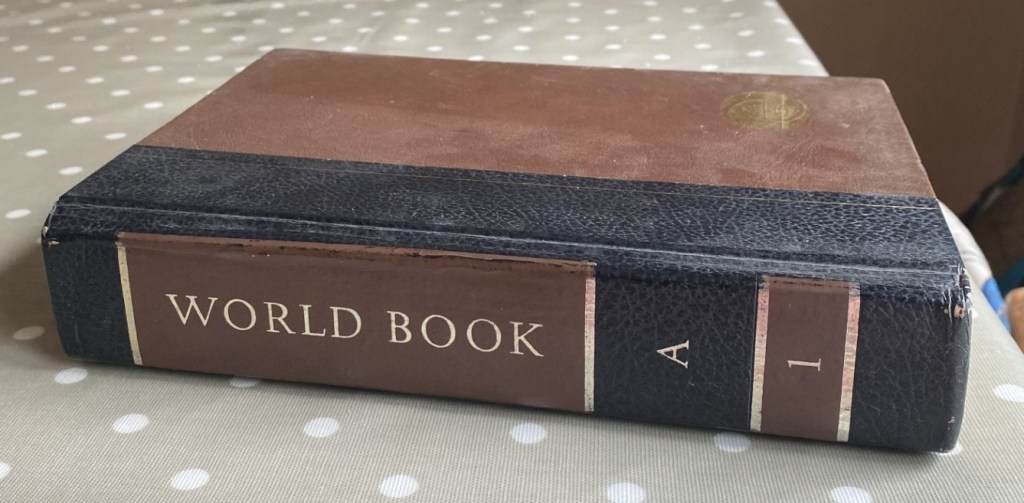
Jim, in his spare time, was also a door-to-door encyclopaedia salesman. On the day they arrived at Nana’s house that Christmas, Mammy and I popped in to visit. ‘Come out to the car,’ Jim said to me. ‘I’ve something for you.’ Out we went. He opened the boot of the car and fished out the A book of the World Book encyclopaedia. I was delighted with this and spent the remainder of the visit at Nana’s house browsing through the pages.

At home that evening, I sat on my bed, a mug of tea on the bedside table, and poured over the A book, page by page. It was filled with all sorts of interesting A things – from Kareem Abdul-Jabbar to Alexander I, from Antarctica to Austria, from Airplane to Audio-visual Materials. And then I came to page 509: Anthropology.

What on earth? There’s this field of study that I’ve never heard of before, that’s combines some of the bits I like best about geography, and that’s all about learning about people who live far away in other parts of the world. Could I do that? It seemed highly unlikely.

I read and re-read the four and half pages about Anthropology. Among the most renowned were a handful of women – notably Ruth Benedict, Margaret Mead, Elsie Parsons.

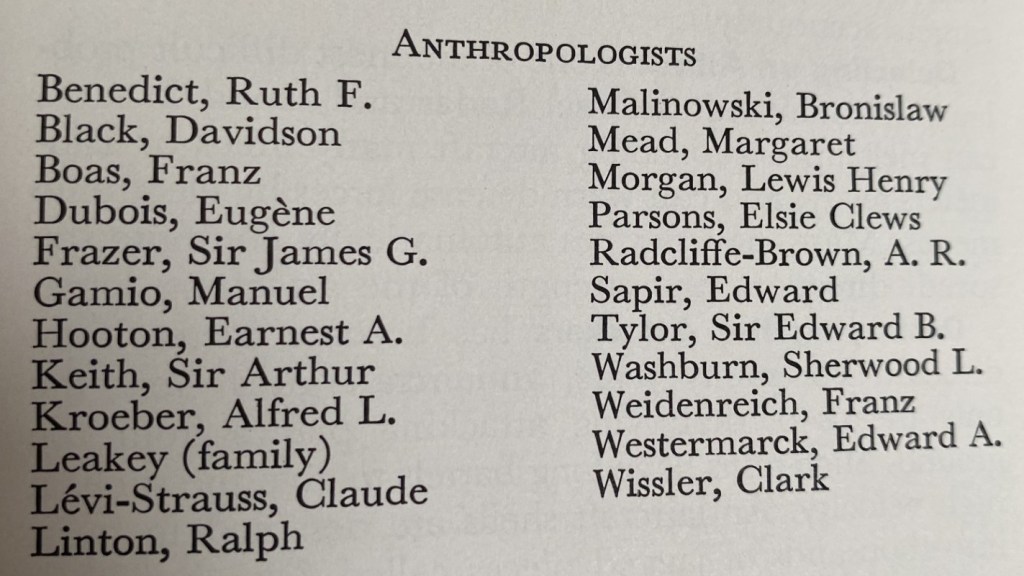
And I read that anthropologists did their research by immersing themselves in the lives and cultures of the peoples they studied, learning skills and languages, and then theorized and wrote about what they had learned from those experiences. Surely there were no anthropologists in Ireland! This was far too exotic and exciting!

I thought about anthropology all through the Christmas holidays and, as soon as I the January term started, I made a bee-line for the school career guidance counsellor, convinced that she would tell me she had never heard of this subject or that the nearest place I could do it was somewhere in England. Imagine my surprise when she told me that the only Anthropology department in the Republic of Ireland was in Maynooth – my nearest university! How could this be? How did I not know?

In February, I filled in my university application form, still erring on the side of Geography and English in UCD, but with Arts in Maynooth as my second choice. When I received my Leaving Cert results in August 1990, I knew I had enough points to do Anthropology and Geography at Maynooth.

And did I get my degree and return to Edenderry to become a Geography teacher? Well, I got my degree. And I followed that with a Masters degree in Anthropology. Then I went to live in Japan for three years. Then I moved to the Canadian Arctic. Then I did a PhD in Anthropology, immersing myself for long periods of time in an Inuit community on the west coast of Hudson Bay. Then I worked as an Anthropologist-Geographer in geography departments in Cambridge, Reading and Exeter universities. All thanks to my uncle Jim handing me the A book out of the boot of his car two months before I applied for university.

I was sitting at the kitchen table here in Ballygibbon earlier today. I glanced up towards the bookcase and saw the A book, still sitting there. Coincidentally, today is also the day when tens of thousands of students across Ireland receive their Leaving Cert results. I hope their lives are as unexpected and serendipitous as mine has proven to be up to now.
62. Dublin can be heaven

There’s nothing quite like a sunny day in Dublin, when you’ve nothing to do but stroll around with friends. And you can see some strange things on an August night…

Chester Beatty Library
Patrick Kavanagh at the National Library
Our friends with Oscar Wilde
Zero zero but still oh so good
The Jeannie Johnson famine ship
The famine memorial
And the same to you!

60. Digital nomad

Only a few short years ago, this summer would have been impossible. But here I am, over fifty days since I left home, and barely a day of work missed. Laptop, wifi, Bluetooth; Word, Zoom, Google docs. These are the tools I need to work anywhere and at any time. In between all the fun summer activities – visiting friends, Wimbledon, Pride, museums, hikes, and on and on – I’ve been beavering away at work. Making space at the kitchen table at Mammy’s house, spending days in public libraries, in friends’ spare rooms and office spaces – I have been working away to pay the bills and fund this wonderful summer.

All summer I’ve been ghostwriting, editing and providing other writing support for clients in South Africa, the UK, Europe, the US, Canada and China, fitting in an hour of work here, a couple of days there, a weekend, an evening, whatever time I can find. It’s been challenging at times, as I’m not following my usual routine of working at my desk, on my lovely widescreen monitor, while the girls are at school. Instead, I’m working from an old laptop, in a variety of different places, at various times of the day, and with all sorts of distractions.

Technology that was almost unimaginable twenty years ago, clunky and clumsy ten years ago, intermittent and expensive even five years ago, is now ubiquitous, easy to access and easy to use. Even with a barely hanging in there laptop, I can work wherever and whenever I want.

I am privileged to have a job that allows me to choose when and where I work, and equally privileged to have access to the tools and hardware that allow me to work in this way. I’m one lucky summer digital nomad.

57. Now here’s an activity for me!

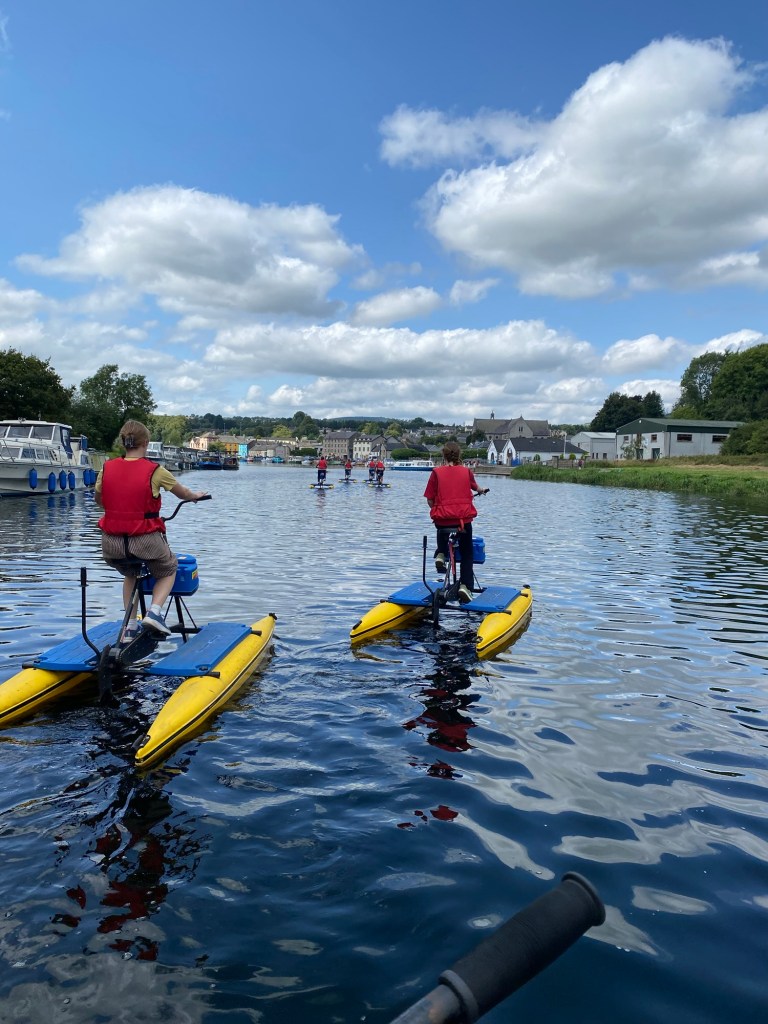
This morning, we went to the gorgeous Co. Kilkenny village of Graiguenamanagh, which sits on the banks of the River Barrow. Our purpose? Some high skilled, high powered, highly competitive* hydro-biking.

Sure, I was a bit overheated in the life jacket. But what an opportunity to demonstrate my superior biking skills AND superior navigation skills to the children. 🤣🤣

*None of the above!

54. My bedroom

I don’t know who was the first person to sleep in this bedroom and I don’t know who will be the last. But it was mine for a while and I’m back in it again for a few weeks. I don’t know if my great-grandparents slept in it or died in it; I don’t know if my father and his siblings were born in it. But I know it’s history from 1942 onwards.

Years ago, my uncle Willie told me that his father (my grandfather), Michael Tyrrell, had spent his final months in bed in this room. Willie, Jimmy and Cissie, the three oldest children, helped their mother look after their father through his cancer and he died in this room on 31 March 1942, Daddy’s first birthday.

When I was a child, there were two beds in this room. Hard to imagine now, given how small it is. Nana slept in the double bed by the window and L-shaped to her was Cissie’s smaller bed. As a child, I slept with Cissie a lot. I have memories of that time – of Mammy bringing me breakfast in bed of a fry-up of rashers, sausages, egg, tomatoes and Nana’s soda bread. I remember crying in pain with toothache in that bed too and Mammy bringing me up aspirin or some other pain relief.

Did I stay in that bed after Cissie got sick? I don’t remember. When I was four, a new bedroom was built onto the house. It was supposed to be for me, but I never slept in it. It was too far away from where everyone else was at night, so I stayed with Cissie.

Cissie died from breast cancer when I was six and, for a while, I slept in the bed with Nana. But I didn’t like sleeping with her – I remember she had scratchy toenails! After some time, a new plan was devised. Mammy and Daddy moved up to the room that had been built for me and my sister and I slept in two single beds in what had been my parent’s room. Now Nana had the small bedroom to herself. Cissie’s bed remained there for a few years, but was eventually removed.

In May 1985, Nana died in bed in this room. I remember our cousin Betty, who lived across the road, coming over to clean and prepare the body for the wake. Nana was laid out in the bed. I had turned twelve only a few days earlier and she was only the second dead person I had ever seen (Betty’s father, Garrett, had died the previous year and I’d seen him laid out in his bed across the road). For two days, people visited the house, filing into the bedroom to pay their respects, before coming down to the kitchen or sitting room for tea and beer and endless ham sandwiches and cake.

By the time I was 12, I was well and truly fed up with sharing a room with my seven year old sister and about two weeks after Nana died, I asked my parents if I could have her room. Going to sleep for the first time in a bed so recently vacated by my dead granny felt a bit weird, I have to admit, but I soon got used to it and transformed it into my own space.

The walls of this room throughout my teenage years were covered with posters. I had huge posters of one of the space shuttles, of an F16 fighter jet (thanks to Top Gun), and of an environmental quote from Chief Seattle. There were posters and newspaper clippings of Boris Becker (little did we know!!), Bruce Springsteen, James Dean and so many more – I can’t even remember now. The room was filled with library books, Jackie annuals, and back issues of Smash Hits and National Geographic. There were mementos of the few places I had been in my life, a desk that I rarely used because it was too small and wobbly (I did my homework and studying at the kitchen table). I had my own radio too. It was in this room that I first heard about the hole in the ozone layer (it scared the shit out of me), about Chernobyl (ditto), and where I listened to endless pop music.

I stayed in this room until I left for university and returned to it at weekends and holidays, and then on visits home from Japan, Nunavut, Scotland. I moved back into it again in the summer of 2004, when I came home from Aberdeen to be with Daddy in his final weeks or months (weeks, in the end, but I wasn’t to know that then).

These days, it’s Mammy’s room and has a feeling of warmth and relaxation about it, with the comfiest bed that’s ever been here. I’m sleeping in it while I’m here. I wake in the morning and here I am, once again, in this bedroom where I’ve probably spent more nights than in any other one place in my life; in this bedroom that has witnessed so much of my family’s life.

53. Blame Colette

I woke up nineteen hours ago, knowing exactly what I was going to write in today’s blog. It just came to me, fully formed. But then I got up, and worked for the day, and went for a walk along the canal with Mammy and Lily and Mammy’s dogs. And then it was time for rosary in the graveyard – the annual gathering of families at the grave’s of our loved ones. Six of my cousins, Mammy, Lily and me stood around our family grave. Our second and third cousins stood at the neighbouring graves, other neighbours at more distant graves. Fr. Maher led us through a decade of the rosary and blessed the graves with holy water. I got a bit giggly with my cousins. The rosary always brings out the giggles in me, taking me back to nights at home here, kneeling on the sitting room floor, my Nana leading the rosary and my sister and me shaking with stifled laughter over some silliness.

When the priest had finished, I went to say hello to the second and third cousins. Seamus is 92 now, Niamh has just had a baby, Michael is about to become a grandfather for the first time. And then it was back to my own gang and down to our house for tea, sandwiches, cake and biscuits.

I don’t really blame Colette for me not writing the blog I was planning to write today. But she is the ring leader of the chat and the stories and the gossip, and if you thought we’d done all the chatting that needed to be done two nights ago, then you’d be very wrong. We’re a noisy bunch when we get together – talking and laughing, sharing stories, reminiscing, enjoying each other’s company. And then it was close to midnight and time for the cousins to leave. Colette couldn’t find the key to her house, so we thought she was going to end up staying the night, likely sharing the bed with me. She found the key in the end – so we missed that opportunity to relive Christmas nights and holidays of old.

In four weeks’ time we’ll all be back here in the living room again, for more tea and sandwiches and cake and chat and laughter. I can’t wait. I’m going to write today’s blog early tomorrow.

52. Talking COVID

Two of my cousins dropped in for a cup of tea last night. I’d seen Colette last week, but it was a my first time to see Michael since we arrived in Ireland. Our conversation followed the usual pattern – catching up on local news, who is dead or dying, who is having babies, buying houses, getting married, separating. We shared news of family members and talked about the state of upkeep of various family graves.

Soon, however, the conversation turned to Covid and it followed a pattern that I have increasingly noticed when I am in the company of people I haven’t seen for a long time. I’ve had a version of this conversation with friends in Spain, Portugal, the UK, and Ireland. And I had it again last night.

A year or two ago, I remember the conversation revolving around how we couldn’t really remember much of what had happened. ‘Were the kids really not allowed to leave the house for seven weeks?’ ‘Did the elderly really have to cocoon?’ That can’t be right. There seemed to be a collective amnesia, as we returned to normality (or a new normal, as Colette pointed out last night) and the key social elements of the pandemic were forgotten to us. It was as if we were asking each other, ‘Did it really happen?’

But, I have noticed an evolution in the way we talk about it now. Five years out from that first wave, and we are now telling the stories of what happened to us during that time. We recall the days, weeks and months of isolation, of the measures we took to keep ourselves and our families and friends safe. We have started to tell Covid to each other, affirming that these things happened to us. Last night, Mammy and Colette recalled the shopping that Colette and other family members did for Mammy, driving out to deliver it to her front gate. We all talked of the fear we felt, of our minor indiscretions (Mammy drove into town late one night to get money from the cash machine; I drove to our neighbouring village in Spain to pick up an order of ice cream), and of the more major indiscretions of others (the family caught by the police for turning their garage into an inpromptu bar; the couple who drove across the country to buy a boat).

Telling these stories over and over is a form of catharsis. Together once again, we can now laugh about the fear and the loneliness and the isolation. We can talk about the good memories of those times as well as the bad. Through our shared story-telling – telling the stories of Covid to others but, more importantly, aloud to ourselves – we are laying down the folklore of what happened in 2020. All over the world, wherever people meet, we are telling the story of Covid. Not the story of the disease and the illness and the vaccination, but the stories of how we, isolated but together, found mundane but remarkable ways to keep ourselves and our loved ones going.

I wonder in what directions our telling of Covid will evolve? What will I tell my grandchildren twenty or more years from now? Or what will Lily and Katie tell their grandchildren in turn?

Photo by Fusion Medical Animation on Unsplash

51. Alma Mater

Around this time 35 years ago, I was accepted into St. Patrick’s College, Maynooth, now Maynooth University. I still remember the nervous and shy 17 year old I was on that early October day in 1990 when Daddy drove me the 25 miles up to Maynooth for registration and to drop me off in my student accommodation.

This morning I took Lily and Katie to Maynooth, Lily now only a year younger than I was then. So much has changed and, yet, so much remains the same. I took them into Rhetoric House, home of the Geography Department and scene of my encounter with kind John Sweeney. I showed them the swimming pool. They asked if was creepier than the pool in Edenderry. Definitely. The tiny post office remains unchanged, as does Pugin Hall, where we used to pretend we were theology students to avail of the free tea and coffee. The Beatle is still outside the library (a statue of Pope John Paul II blessing two children – George and Ringo). The library itself was full of students preparing for repeat exams, but we quietly strolled around – until I got us lost and we ended up in the fire escape. In my defence, it was the main stair in my day!

The new campus is unrecognisable, but the Arts Block remains the same – so tiny compared to how I remembered it. Even the lecture theatres, which seemed huge, now look tiny. From there to the canteen and sports centre and then the Student’s Union – scene of so much divilment over the years!!

Many of the friends I made in those years remain my great friends to this day. The courses I studied set the trajectory for my professional and personal life, leading me to where I am today. It was a glorious trip down memory lane, as I recounted various things my friends and I got up to. The girls thought I’d gone slightly mad and all we’d gotten up to 30 and more years ago was all rather quaint!

42. Strangers

I meet Sean again when I go out for an evening walk. This time he’s sitting on a camping chair on the canal bank, beside his boat. He’s with a younger man, who’s sitting on the grass. I shout ‘hello’ over to them and they beckon me over. By the time I walk back to the nearest bridge and cross over to the other side of the canal, Sean has pulled another camping chair out from his boat. His buddy is Carl, a Mancunian. The two met only yesterday, when Carl was taking his daily walk along the canal. I sit with them for a couple of hours, shooting the breeze, sharing stories about where we’ve come from and where we’re going to, the importance of listening, and the power of poetry. I bid them farewell and carry on my way.

••••••

‘I started working with papier-mâché during lockdown,’ Jean tells me. ‘I wanted to make art with what was lying around the house.’ I’ve wandered into her studio and find her sitting at a table, surrounded by papier-mâché spheres and abstractly-shaped boxes, everything looking precarious and on the edge. ‘Everywhere I turned, they were talking about tipping points. Scientists, activists. Tipping points are my great anxiety. So I’m working through that anxiety in my art.’ I ask where she’s from. ‘From Indiana originally, she say, but I’ve lived in England for forty years.’ She shows me how her tactile, playful art moves and explains how she makes it. I wish her luck with her project.

••••••

‘Do you mind if I sit here?’ I ask the man sitting alone at a table who looks like he’s working. I’m here to work too, so this could be a good place to sit. ‘The working end of the cafe,’ I say to him. ‘Yes,’ he smiles. I spot a university logo on the paper in his hand. From this angle, it looks like exam grading criteria. ‘Marking exams?’ I ask him. ‘Job application,’ he says. He’s Mark, an academic at a midlands university, grown tired of his job and applying for a position at a university in eastern Germany. We talk about the state of academia in the UK, the Spanish education system and, before long, an hour has passed and neither of us have done any work. I have a Zoom meeting to prep for and he has a train to catch, so we say goodbye and I get on with my work.

••••••

‘I’m at a stage in my life where friendships with women are most important to me,’ Amanda says. She tells me that she’s only moved to Leamington two days ago. She’s a few years younger than me, has a corporate job, but her real passion is healing. I tell her about a book I’m currently editing, and we discuss the power of stories and how we’re only able to tell our stories once we have worked through our trauma. We’re the only two visitors in a small art gallery and we’ve both arrived at the same time. We start out shadowing each other, a little self conscious in the small rooms. But soon we’re talking about healing and friendship, and what a great place Leamington Spa is, and the fact that we’ve both recently been to Thames Ditton. We leave the gallery together, saying goodbye as we walk away in different directions.

••••••

I find it hard to stay strangers with anyone for long.

41. And tomorrow…home

After almost six weeks in the UK, tomorrow we will travel to Ireland. We haven’t started packing yet and the tiny bedroom we’ve been sharing at my father-in-law’s house looks like a bomb site, after all these weeks of us living out of our suitcases in there. But we’ll pack with care tomorrow, and say our goodbyes, and tomorrow night, all going well, I’ll be at home.