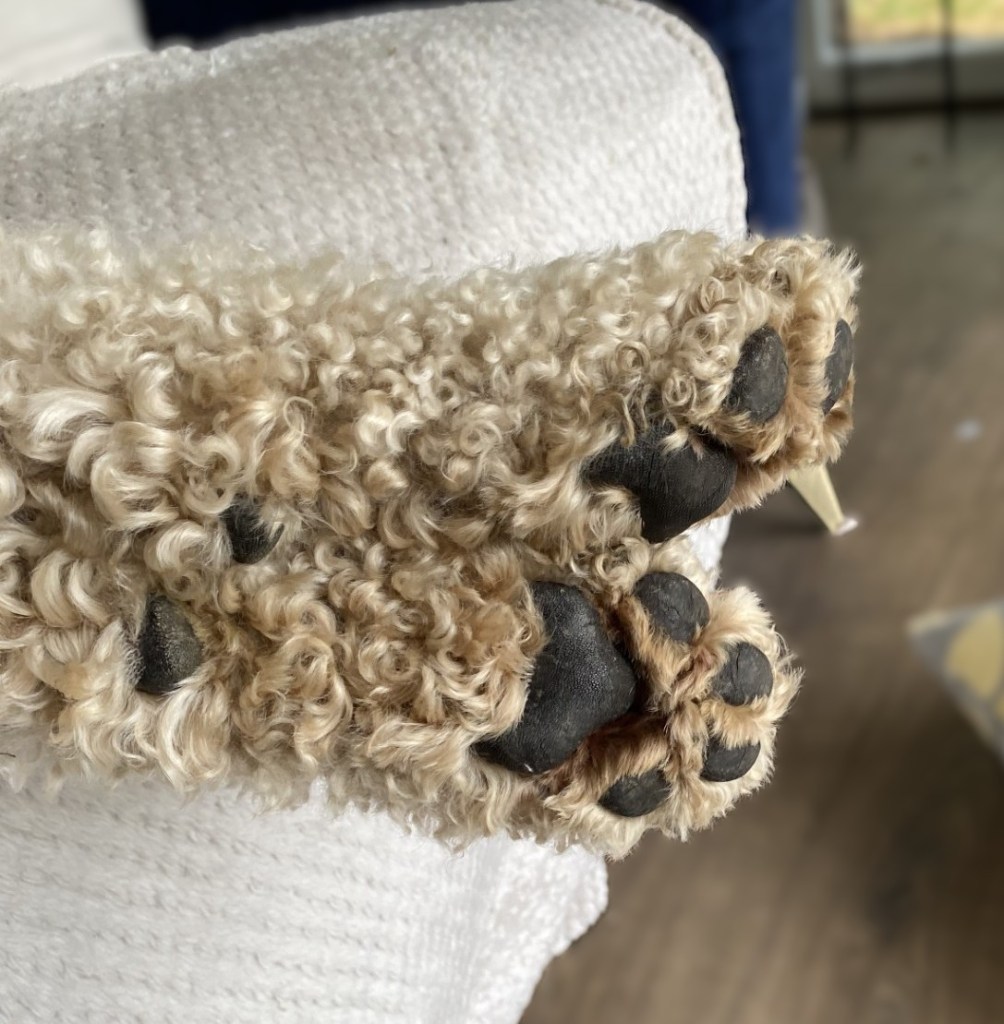
We’ve been looking after Hudson for the past week and we’ll be very sorry to say goodbye to him later today. Is there a better doggy in all of England? I sincerely doubt it. He’s been a joy to look after and a great first experience for us in the world of Trusted House Sitters.
Some friends in Sanlucar are signed up to the Trusted House Sitters app and others to a house swapping app. Both use those apps to travel to interesting places and get their accommodation for free. I’m not yet ready for house swapping – not until I finally get around to installing the new oven that’s been sitting on my kitchen floor for the past six months. Trusted House Sitting seemed like a better fit for us at the moment.
So, a couple of months back, I signed up, paid a small annual fee, got three people to write references for me, created my profile and away I went. This week has been our first dog-sit and I will definitely do it again. We made contact through the app with a couple in a village in the English midlands who needed someone to look after their dog and water a few plants while they were away on vacation. We met briefly by video call and then, last Monday, we arrived.
It has been a perfect experience from start to finish. Hudson is the perfect dog. Giant and gentle, easy going and with (almost) no bad habits (we all have some bad habits after all). He’s a dream dog. The house is like something out of a magazine. A modernized old cottage with an extensive garden that is so easy to live in that, really, I don’t want to leave. All over the house and garden is scattered comfortable furniture where all three of us can find our own space to curl up and read our books. The family photos and grandchildren’s arts and crafts suggest this is a house filled with love. And, there is an amazing office halfway down the garden, where I have been working all week.
The house is situated in a very typical middle class English village, with a decent (if expensive) pub and an amazing village shop. All around are paths and byways through the fields, so there’s no shortage of exercise for Hudson or for us.
Our hosts left easy-to-follow instructions for everything from where to find the doggy treats to how to use the air fryer. A gardener came in one day and a cleaner another. It is no understatement to say that I have been living a lifestyle this week that is so far removed from my normal life.
On this house sit, we didn’t venture far. The house itself and the surrounding are enough of a holiday for us, giving us a chance to experience a different lifestyle. But, already, I’m scrolling the app to look for future house sits in cities or towns that I want to visit and, for some reason, I keep putting in searches in the Alps – I really want to take the girls to the Alps some time.
So now, we will say goodbye to Hudson and to his fabulous home and look forward to more house and doggy-sits to come.
I’ve been working hard lately. After a rather worrying nine-month work drought, during which my editing and ghostwriting work dropped to half of what I would normally expect, the last three months have been among the best I’ve had since I started freelancing ten years ago. But, over the nine months of the drought, I watched my bank balance dip to a worrying low. I tightened my belt, carefully budgeted for groceries, dropped a number of subscriptions, cut out weekends away and meals out. But those were only mini bites into my outgoings. The big stuff – the mortgage, my monthly self-employed social security payments, and other such things – well there was no budgeting for them.
I wasn’t alone. Creative industries (and, as an editor and writer, I am in that category) have been hit hard by AI. When we thought things couldn’t get worse, Ebron Skunk’s DOGE slashed funding to US government research that accounts for about 40% of my editing work. Was I worried? Hell yes. Very.
At first, I put the slow-down down to it being summer. August is generally a slow month. But when things didn’t pick up in September, October and onwards, I was well and truly sweating. Work was still trickling in, I was still just about keeping my head above water, but at the start of each month I worried that maybe this month would be the month that I wouldn’t be able to pay my mortgage.
I worked just as hard as ever, saying yes to every editing job that came my way, when before I would have been more picky. I had to dismiss my long-held promise to myself and to the kids that I wouldn’t work on weekends or on school holidays (summer excepted…it’s just too damn long). But I had a whole lot of time on my hands when I wasn’t editing or writing for other people, so I used that time to make contact with potential new clients, to make myself more visible on LinkedIn, to update my website and my online profiles. I had numerous Zoom meetings and phone calls with prospective clients that came to dead ends.
But, in spring, a glimmer of light started to appear down that dark tunnel of money worries. I landed a couple of lovely medium and longer term clients and the one-off editing jobs that are my bread and butter have started to creep up again. I diversified my US work and now have a large ongoing project in addition to almost back to normal flow of one-off jobs. Part of this upturn is down to the work I’ve put in to find work. But I also wonder if clients are starting to realise that what we do as professional editors and writers is far more than what AI is capable of, i.e., human understanding, nuance, humour, and so on.
Since April, every month has been a good month. Fingers crossed, it will continue this way. However, that doesn’t mean I’m out of the woods. I’ve got that bank balance to claw back so that next time a slump comes I’m prepared for it. I’m still not in a position to be picky, so I’m still working most weekends and on holidays. I’m hoping I’ll get to a point soon when I can ease off on that again. I’m 52. I don’t have the energy for this.
Which brings me to Gaia. I’ve been working long hours this past week. I had three deadlines for yesterday. Two of those were really complicated and took far longer to complete than anticipated. When I finally turned my computer off at 9:30 last night I was well and truly ready for a break. But I’m someone who can’t sit still for long. I knew that, if the weather was nice, I’d feel the need to go for a long walk today, to fill up my day with action.
When I woke up this morning it was lashing rain. And it has continued to rain for most of today. No going out. No being active. Gaia insisting that I have the break I well and truly need. I started the morning with 40 minutes of gentle yoga, took the dog for a short walk in the rain, got back into my pajamas when I returned home, and here I remain. I have spent the day curled up in an armchair, drinking mugs of tea and reading the book I’ve been dying to read since the day we got here.
Back to work on Monday but, for now, I am relaxed and at ease and, as I look out the window, I see that it has started to rain again. Thank you Mother Earth.
From the moment my parents took me to see Bambi when I was about four years old, I’ve been a cinephile. There have been so many phases to my cinema going – with Daddy and/or my cousin Sean, every Tuesday evening with my cousin Colette and her friends when I was still a pre-teen, and then, once I got to university, spending every penny of spare change I had on going to the movies. I’d go with friends and I’d go on my own. Lots of my friends spent their spare money on Silk Cut cigarettes; I spent mine on Kevin Costner.
In my third year of my undergraduate degree, I had a two hour cartography class at 10am every Friday. There were two problems with that. First, found the class boring and, second, midway between my house and the Maynooth Geography department was the bus stop for the number 66 bus into Dublin.
I attended the first few classes of the first term but, as the weeks wore on, I found myself more and more often stepping into the bus if it happened to be there as I walked past. On those days when I got on the bus rather than going to my cartography class, I would arrive in Dublin in time to fit in three films throughout the day. I can’t remember the names of the cinemas or if they’re there any more, but there was one on either side of O’Connell Street and another over on the end of D’Olier Street. Sometimes I’d spend all day in one cinema, other days I’d flit from one to the other and back again, grabbing a cheap sandwich in between. I went to see everything, apart from horror; some films I saw multiple times, even going out at the end of one showing to buy a ticket and go straight back in to the next.
Soon I was hopping on the number 66 bus every Friday morning, not thinking twice about the class I was missing or the assignments I was supposed to be completing and submitting every week.
One week, the bus wasn’t there, so I carried on to the Geography department and into my class. I sat amongst my friends and the class began. About 20 minutes in, there was a knock on the door and Professor John Sweeney asked if he could see me. I got up and went out with him. (My friend Niamh told me later that she thought I was being called out because I was going to get some award for my excellence in geography!! One thing I’ve always loved about Niamh is her blind faith in me!!)
I followed Professor Sweeney up to his office and he sat me down. He seemed very concerned about me. ‘How are you?’ he asked. When I told him I was great, he asked how was my family, how was my health, how were things at home. To all his questions, I told him everything was great. I had no idea where he was going with this.
‘We have students who start out poorly in this cartography course and then drop out. And we have those who start out well, but then their assignment grades drop and then they drop out. But you,’ he said. ‘You started out with good grades and then suddenly stopped submitting your assignments. So I’m worried that something is wrong.’
A smile broke out on my face. Relief. And told him the truth. About my love of cinema. About the timing of the number 66. About how I spent my Fridays. About finding the cartography class a bit boring. My honesty disarmed him or caught him off guard. He was probably relieved that he didn’t have a student in crisis situation on his hands. Whatever it was, he gave me another shot.
Monday was a bank holiday, so he gave me until Tuesday at 10am to submit the seven assignments I’d missed. I returned to class. I spent the next three days catching up (admittedly with a major dollop of help from Niamh’s, Paula’s, Sinead’s and Fionnuala’s assignments) and handed them in on Tuesday morning. I didn’t miss a Friday morning cartography class for the rest of the year.
I thought about all of this at 10:30 this morning when Katie suggested we race into Leamington to catch the 11:10am showing of Jurassic World Rebirth. I sat in the dark at the cinema, my eyes wide, excitement mounting as the trailers rolled. I looked over at Katie, and thought ‘That’s my girl.’
I’m walking along the Grand Union Canal that runs behind the estate where my father-in-law lives. It’s a glorious evening and I’m on a video call with Katie who is away on the south coast this week with Lily and their uncle and aunt. I walk past four or five narrow boats. On the last boat in the row, a modest white and blue steel boat, a man is standing. I have the phone up, so he thinks I’m filming him or taking his photograph. He gives me a big smile and says something. But I’m talking to Katie, so there’s some confusion. He then realises that I’m not taking his picture and I realise that he’s talking to me. More than that, I hear his Irish accent and he hears mine.
“Where are you from?” he asks. “Kildare,” I reply. “Ah, a Lillywhite,” he says and I know immediately that I am firm ground. Despite his Dublin accent, he tells me he’s from Dungarvan in Co. Waterford. “The husband of one of my best friends is from Dungarvan,” I tell him. I tell Katie I’ll call her later because I have a feeling I might be chatting here for a while.
Sean and I chat for an hour, me standing on the grassy tow-path, he on the open deck of his narrow boat, the air cooled engine exposed to the evening air. We discover we have people and places in common. He pootled a narrow boat up to the harbour in Edenderry in the late 1960s and remembered going for a drink at The Harbour House. That was my uncle Tom’s favourite haunt, owned by Mary O’Connor, my Irish teacher, and her family. I was only in The Harbour House once, for a pint of Guinness with Tom back in the early 1990s. It was everything you would expect of a small Irish pub, all the old men lined up at the bar. It was renowned for its music and for Mary being as strict behind the bar as she was in the classroom.
Sean tells me about his job at Shannon airport and about people from Edenderry he knew there and at Ardnacrusha power station. I mention people I know who he might have known and we laugh when we get a bit tangled in Johns and Seans and who was who.
I tell him I had been a sailor and we talk about the joys of my Westerly Conway. He wonders how a girl from the Bog of Allen and a boy from the housing estate 20 metres from here could have ended up living on a boat and sailing to the places we did. He tells me of his adventures as a sea sailor and as a narrow boat owner and about his sustainable, no-cost approach to life.
At 80 years of age, he is only a few years younger that Daddy would have been. The Cuban Missile Crisis comes up in conversation (he makes me promise not to tell anyone why) and he shares his reminiscences of those few days in 1962 and I tell him what Daddy told me of his memories and fears of those days.
He explains how he has come to have that Dublin accent but says his heart remains firmly rooted in Dungarvan. He already owns a plot in Dungarvan graveyard where he wishes to be buried when his time comes.
“I had a half pint at the Cape of Good Hope a while ago,” he tells me, referring to the pub just a couple of hundred metres away. “When I went to the bar, I heard two men behind me. A Mayo man and a Galway man. Sure, I had to talk to them. The Mayo man was a bull man.”
“A bull man?” I ask, perplexed. “Ah, you’re too young,” he says. He explains what a ‘bull man’ is and realisation dawns. “Ah,” I say, “You mean the AI man. That’s what we call it where I come from.” He laughs and says how funny that we had that in Ireland where the Catholic church didn’t allow such things for humans. AI, for those of you not in the know, means, artificial insemination, and the Bull man or the AI man was, and remains, an integral part of our dairy and beef industries.
My daughters always tease me when I speak to other Irish people, accusing me of changing the way I talk and the way I hold myself. They’re not wrong. But I don’t do it on purpose. When I’m with other Irish people I become the version of myself that is the oldest part of me. I speak in the way I learned to speak as a baby, in the first accent I ever heard from the people and the place where I grew up. It is the accent, grammar, syntax and vocabulary that I am most comfortable with. There’s no modulation, no register change, no code switching. I am me at my most comfortable.
We all change our registers in different contexts. For instance, the way we speak to small children is not the same as the way we speak in the corporate office. The way we speak in church is not the same as on the terraces of the football stadium. But changing accents is something different. Over the years, I have modulated not only my accent, but the words I use when in conversation and the order in which I say them. Why? Well, for two reasons – one that I am comfortable with, the other less so.
For most of my life, I have chosen to live among people for whom English is not a first language. Therefore, to make myself understood among English speakers in Japan, Nunavut, Spain, and elsewhere, I slow down, speak carefully, use very standardized words and phrases to be understood and to make the person I am speaking to feel more comfortable. That is now second nature to me.
The other reason is that, over the years, I have been very aware of people making fun of my Irish accent – people laughing and repeating my pronunciation, my use of certain phrases or my Hiberno-English sentence structures. In order to reduce the feeling of discomfort (and anger) that this fun-making and ridicule causes in me, I modulate and change register. It’s just easier. I don’t like it, but it is how it is. That too is now second nature to me when I am around native English speakers who are not Irish.
But, when I speak to other Irish people, I can feel my body physically relax. I don’t have to think of an alternative phrase or word for ‘give out’, ‘press’, my use of bring/take, my pronunciation of H and th, or a thousand other usages of words and phrases. I’m not going to be laughed at for calling my parents Mammy and Daddy. I can throw in a reference to the GAA or to Eamon Casey or to the Angelus or to a million other things, and no further explanation is required. I can just be.
All migrants, no matter what their language or their circumstances, experience this distance from their first voice. Some people are happy to leave that first voice behind. I am privileged to have had so many opportunities to travel in my life. I have learned so many wonderful ways to speak and to see the world through the eyes of others. But speaking in the way that is oldest to my being is like relaxing into a large warm bath.
Sean is stuck along this stretch of the canal for the time being, as he waits for a lock gate farther along to be repaired. I tell him that if he’s still there the next time I walk that way, I’ll invite him down to the Cape of Good Hope for a beer. Who knows? Maybe the AI man will be there.
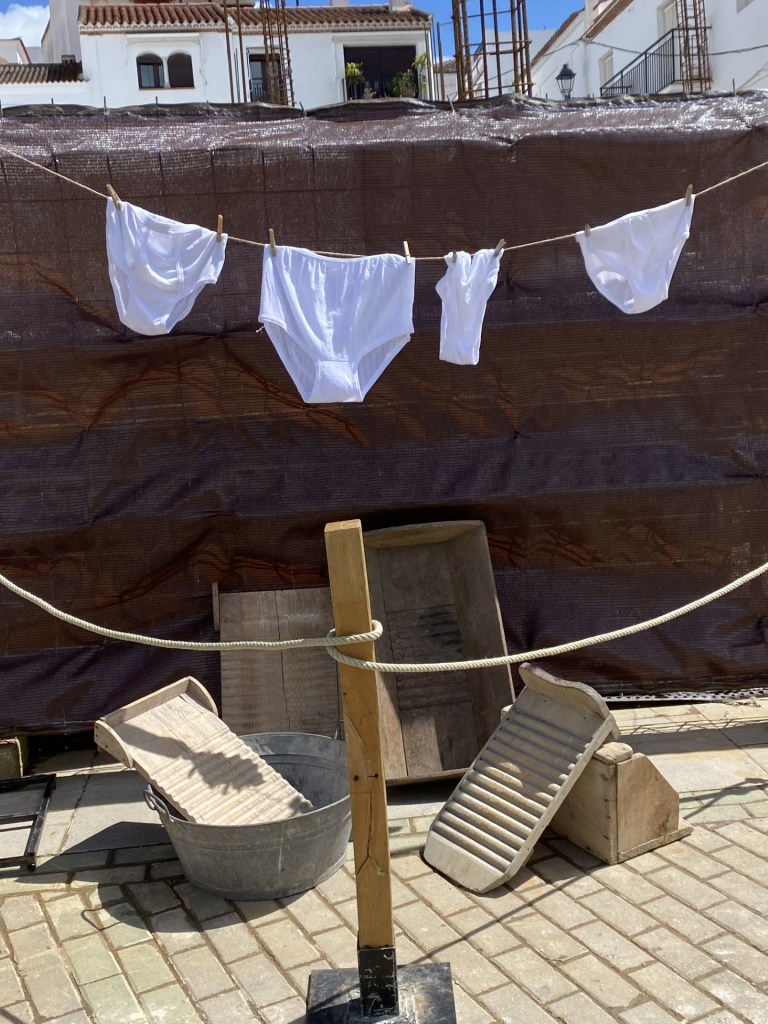
We arrived back to Leamington Spa late on Saturday evening, leaving the girls with a 19 hour turn-around time before leaving for a week in Lymington with their uncle, and leaving me with even less time than that to get the laundry done. It’s all too easy to forget how quickly clothes dry at this time of year in southwest Spain. Hang ’em out and take ’em in again two hours later, hard as boards. Not so in England. But the weather has been unseasonably warm here. We sweltered in 35 degree heat at Wimbledon last week and, if that weather had continued for just one more day, well…I’m just saying, it would have made doing the laundry a little easier. Gaia, why are you toying with me like this?
It was breezy when I woke up yesterday morning, my first task to fill the washing machine and do a quick 30-minute wash. Not that that did me any good. By the time they came out of the machine, the heavens had opened and rain fell at a slant onto my father-in-law’s newly laid patio slabs, and in through the open kitchen window, leaving the window sill and the floor slippery and dangerous. Did I care? Of course not. There’s a tumble drier out in the garage. I don’t like using a tumble drier, but needs must, so out I flitted, my father-in-law stating the glaringly obvious, ‘You’ll get wet.’
Forty minutes at high heat. Out into the rain again. The clothes were still wet in the drier. Another thirty minutes. Then another. No joy. My father-in-law insisted I was doing something wrong. I insisted I wasn’t. We eventually found the culprit – a very dirty filter thing that would need to be taken apart and cleaned out. But neither of us had any idea how and the instruction manual was long gone. Did I have time to go search how to do it online? I did not.
By now, the sun had come out, so I put all the clothes on the clothes horse and moved them to the far end of the north-facing garden to catch the sun shining in over the house. I was taking a shower when the next rain shower came and Lily dashed out to bring the clothes horse in. Then back out when the rain passed. Then in again. Then out again. And always that guessing game of ‘is this item of clothing really dry or am I just wishing it dry?’
Finally, the moment came for the girls to leave. Most of Lily’s stuff was still on the clothes horse and still damp or downright wet. There was nothing for it but to stuff it all into a bag with instructions for her to dry it when she reached her destination. “Don’t forget,” I warned ominously. “It’ll turn sour.”
About this time six years ago, I started to drop in to visit my friend Angela regularly. She was 82 years old at the time. What started as a one-off visit for a gin and tonic one Sunday evening, turned into a weekly affair. I’d pop around at 6 o’clock each Sunday evening (or later during the summer), the gin and tonic on the worktop ready for me to pour. I’d make us a glass each and then we’d sit and chat for the next couple of hours, with Miranda the cat sleeping by the gas fire, Mora the dachshund trying to sneak onto my lap, and Archie the African grey parrot adding his own opinions to the conversation. Our conversations were far-ranging. We talked a lot about the books we were reading, the movies we had watched, with each of us often taking up the others’ recommendations. She frequently quoted poetry to me – long-remembered lines that popped into her conversation, appropriate to whatever we were discussing. We talked politics – from our little village all the way up to the international level. She talked about her childhood during the war, her years in London as a trainee nurse, and then her married life raising her three children in Wales. Being a retired nurse, no topic of conversation was too delicate or too squeamish for our Sunday evenings. With deteriorating eyesight and hearing, she preferred these one-on-one get togethers with friends in the quiet of her own home.
When COVID came the following spring, our Sunday night visits continued via WhatsApp video. We’d each pour a glass of red wine or a gin and tonic in our respective homes, only a few hundred metres away from each other and carry on our conversations are normal. How happy we were when we finally got to meet in person again.
As her eyesight deteriorated, she found ingenious ways to continue reading and watching movies. She turned to Audible and listened to books now and she devised an iPad and magnifying glass set-up to allow her to continue watching movies. For a woman of her years, she was remarkably tech savvy and had a weakness for buying clothes and gadgets and all sorts of wonderful things online.
One Sunday evening in the early summer of 2021, she announced, “I think I’ve gone and something totally mad.” I expected it to be some new online purchase. “What have you done?” I asked. She told me that, at the age of 84, she was tired of living in a house that didn’t have a garden. In whatever remaining years she had, she wanted to grow vegetables again and keep hens. This wasn’t too shocking. After all, at the age of 77, she had decided to sell her home in Wales and moved to Sanlucar de Guadiana. “What are you going to do with this house?” I asked. “I don’t know,” she said. “I haven’t thought about it.” “Would you sell it to me?” I asked. The girls and I were living in a big old rented house at the time and I was despairing of ever having a house of my own. “Yes,” she said, without pausing to think about it. I’d no idea how I was going to afford this house, but was determined to find a way.
And so began the next phase of my relationship with Angela. She was happy to sell me the house, but under certain conditions, the main one being that the girls and I live in it for a year to see if we really liked it. During that year, I would pay her a tiny amount of rent, which would allow me to save up for a deposit for a mortgage. If, at the end of that year, I decided the house wasn’t for us, we could walk away, and she’d put it on the market. A couple of months later, she moved out into her new house – just 50 metres along the same street – and I moved into her old house and she became my landlady. Our weekly get togethers continued, now at her new house and we continued to put the world to rights for those two hours every Sunday evening.
When I quit drinking and she mostly quit drinking, our Sunday evening chats came to an end and I started to drop in to her on Monday or Tuesday mornings instead. I never tired of our conversation and felt something was missing on those occasional weeks when, for one reason or another, I couldn’t make it over to spend time with her.
Almost two years ago she fell in the house, slipping on a piece of plastic on her living room floor. She broke her hip and spent some time in hospital. But soon she was out, valiantly doing her physio exercises and getting her fitness back on a stationary bike that she bought and installed in the spare room. Although she was frustrated with her slow recovery, the rest of us were amazed by her speedy recovery and soon she was out walking the dog again, first using a walker, then crutches, then a walking stick. About six months later, she fell again, this time breaking her wrist, when she got tangled up in the dog’s lead while out walking up a steep hill one morning.
Her eyesight continued to deteriorate and her next ingenious online purchase was a gaming chair and TV. The sight of a tiny 87-year-old woman sitting in a teenager’s gaming chair was something else! I’d drop in and she’d tell me about some 1940s black and white movie she’d watched, recalling Hollywood stars in movies that were old even when I was a kid. She introduced me to The Rest is History podcast and we got great mileage discussing the various episodes we’d listened to.
She remained positive and engaged and witty, despite her body increasingly letting her down. I can’t list all the things she carried on doing – gardening and baking and taking trips back to the UK and just being engaged with the world – that people half her age have already given up on. I thought often of Seamus Heaney’s Field of Vision when I was with her. He might have written the following lines about her:
She was steadfast as the big window itself.
Her brow as clear as the chrome bits of the chair.
She never lamented once and she never
Carried a spare ounce of emotional weight.
She was a loyal friend too, not just to me, but to so many of us in Sanlucar. Every single day, without fail, she had a phone conversation with Val (Honeybunch) her friend back in the UK from her nursing days in London in the late 1950s. That’s friendship for you.
For all her amazing attributes, she was my hero. I don’t aspire to be like her in my 80s; I aspire to be like her now. Her attitude to life was like that of no-one I’ve ever met.
Only four weeks ago, she was diagnosed with incurable cancer. I had the privilege to spend a lot of time with her in the first three of those weeks and, despite her increasingly frail body, we continued to laugh and take an interest in life. On the last day I was with her, when her body seemed to not be able to go on any more, she continued to tell me fascinating stories about her life. When I left to come to England last week, I knew how much I would miss her as we said goodbye for the last time and I knew that she would be sorely missed by all of us who have had the privilege of having her in our lives.
Angela died yesterday afternoon.
Angela handing me the keys three years ago, the day she sold her house to me.
Being in the UK and, in particular, in this town, brings memories of Julian flooding back. I pass through places by car that I only ever drove through with him. I go to places that I visited for the first time, or only ever visited with him. Indeed, I would never have known this town in the middle of England, had I never met him.
There have been times in the past few years, when being here has been overwhelming. Not only being in this place, but being with Julian’s family and the memories and emotions that being in their company brings to the surface. In the past, being here has caused me to have panic attacks. In fact, last year, after only four days, I ended up in A&E (ER) with a panic attack that I thought was a heart attack. That was a scary day.
This time, however, I am so much more at ease. Time has played a part in healing me, so too have eight sessions with a therapist that I gave as a birthday present to myself last year, so too the memoir I’ve been writing this past year. I’m busy with work (intentionally, perhaps?) and I’m absorbing the sensations of being in parks and along canals and surrounded by nature in this exceptionally nature-filled town. (Yesterday, a falcon had an aerial fight with two crows only metres from me in Priory Park!)
Each morning since we got here, I work for a few hours at Warwick Library. Yesterday, I went in as usual. But it wasn’t usual. It was Saturday, so the market was on in the square in front of the library. Even better, at the far end of the square I saw a van bearing the words ‘Jumbo Hot Dogs’. Memories came flooding back. I phoned Katie and suggested that she and Lily get Granddad to drive them to the library in a few hours, so we could wander the market and have jumbo hot dogs for lunch.
The girls duly arrived and I packed up my laptop and we wandered around the market, chatting to the vendors and browsing the arts, crafts and foodstuffs they had on offer. At the food stalls, there were savoury pies and all sorts of lovely things that tempted me. But I was going for the jumbo hot dogs, for nostalgia’s sake more than anything else.
You see, Julian loved jumbo hot dogs. No matter what his state of hunger, if he spotted a jumbo hot dog stand, he had to have one. He was also someone who stuffed receipts into his pockets. When we both worked, we shared the task of doing the laundry. Every time it was my turn to put a load in the machine, I’d first have to empty Julian’s trouser pockets of receipts. When we lived in Cambridge, I’d often find five or six receipts for the jumbo hot dog stand! How long had he been wearing those trousers? Or how many hot dogs was he consuming a day? He’d laugh sheepishly and tell me he’d occasionally get a craving in the middle of work, leave his desk, hop on his bike and cycle the two miles into the middle of Cambridge for a jumbo hot dog and then return to work. Crazy man.
So, there was nothing for it yesterday but to introduce jumbo hot dogs to our daughters, who’d only ever before had those cheap rubbery vacuum packed frankfurters you get at kid’s birthday parties, and not these juicy British sausages, with real fried onions, ketchup, in a soft, freshly baked hotdog roll. Katie wasn’t sure if she wanted one, so I bought two. One bite of mine and I had to go back to get a third from the friendly chatty couple running the van.
Good God, they tasted good, that combination of good food mixed with good memories. As we ate, I told the girls about their father’s jumbo hot dog obsession, another piece of him revealed to them, another good memory of him restored to me.
When she was in her early 50s, my mother decided to take up painting. She joined an art class, bought art supplies and painted some lovely landscapes and rustic urban scenes that still grace the walls of her house.
The Christmas after she took up painting, I arrived home from somewhere, I can’t now remember where. The presents were all under the tree – all except Mammy’s present to me. One of my and my sister’s favourite pastimes in the days leading up to Christmas Eve was to sit by the tree, examining all the carefully wrapped presents with our names on and guess the contents, comparing the size and weight of our respective presents. Mammy explained that she hadn’t put my present under the tree yet, because I would immediately know what it was and the surprise would be ruined. She planned to only put it under the tree in the moments before we unwrapped our presents after tea on Christmas Eve. I had no idea what it might be.
The next day, I went in to Gilroy to see Nana. She made me a mug of coffee and put a plate of biscuits on the coffee table beside the bowl of Quality Street chocolates that was already there. We chatted about this and that. After a while, and seemingly apropos to nothing, she said, “What do you think of it?” “Hmmm?” I said, too busy deciding whether to have another Quality Street or another biscuit. “I don’t think it looks anything like you, do you?” she asked. “Erm, no,” I replied, with genuinely not a clue what she was talking about, but also still too distracted by the chocolate to find out more. And the conversation moved on to other things.
Christmas Eve evening arrived. We ate our tea and then went to light the Christmas candle on the hall table. Daddy lit the candle and the four of us bowed our heads and said a prayer. The moment to open our presents had come. In the middle of tea, Mammy had slipped out to put her present to me under the tree. As soon as I walked into the sitting room and saw it under the tree, I knew that it was a painting of some sort.
We opened our presents one by one, each of us waiting to see what everyone else had received and watching their reactions. The moment came to unwrap my painting from Mammy. I carefully removed the wrapping to reveal…a portrait of ME! Well, sort of a portrait of me. I tried hard not to burst out laughing and one look at Daddy’s and my sister’s faces let me know that they were struggling not to laugh too. But, she’d put so much effort into it and none of us wanted to hurt her feelings. But, God, it was hard.
“I couldn’t get the lips right,” she said. I thought to myself ‘And that’s not all!’. I could see that the lips and been drawn, erased and redrawn many times in pencil, as she tried and failed to get the shape right. My nose was very long and narrow, my eyes strangely slanted and wide-set and my hair sat on top of my head like a helmet. My shoulders were heavy and, although the portrait stopped above my chest, it gave the impression that I had the huge heavy breasts of a seventy year old. “It’s lovely,” I said.
I don’t remember what happened next, but by the next day, Mammy’s portrait of me had turned into a highlight of our Christmas. The first to see it was my uncle Tom, when he arrived out for Christmas Day dinner, and then my uncles and cousins who came out for tea later that evening. Mammy was very quickly in on the joke, realising that this was perhaps not her best work and that the portrait had value of a different kind – it made us all silly with laughter. We discovered the best thing about the portrait was showing it to people with straight faces, pretending that we thought it was brilliant and watching as the cogs moved in their heads as they tried to find something polite to say about it.
The portrait came with me to the UK and, when I met Julian, it came with us to the many houses we lived in over the years. I’d sometimes arrive home late at night to find Julian in bed with the portrait on my pillow, delighted with his little joke. He carried on the tradition started by my own family of showing it to his family and our friends with a straight face and waiting for their reactions.
When we moved onto the boat, there was no room for the portrait, so we put it up in my father-in-law’s loft in Coventry. I imagined it doing a Dorian Grey on me but, I’ve grown older and it continues to not look at all like me! A little over a year ago, my father-in-law downsized to a smaller house and I travelled to the UK to deal with what was left of our stuff up in his loft. There I found the portrait, which I hadn’t seen in years. There was only one place for it – on the wall of the spare room (Lily and Katie’s room) at my father-in-law’s new house.
Lily and I are sleeping in that room at the moment, with Katie relegated to the sofa in the living room. Every time we look up at that portrait we giggle. Who could have guessed that that heartfelt and earnestly created piece of art would have such an unexpected life out in the world.
I’ve been spending a lot more time with Angela in these last few weeks, since she was given her terminal prognosis. My weekly visits for morning coffee have evolved now into twice or three times a day visits. I know our time is short. I will leave to go to the UK soon and she will simply go. I call in at 11 each morning and again at 1:30 and maybe again at 3pm. Sometimes she’s asleep and I simply check on her and leave again. More often than not, however, she wakes when I come in, I help her to sit up, go to the kitchen to pour her a cold drink and make myself a coffee, and sit with her and chat.
Despite being noticeably more frail with each passing day, her memories are as sharp as ever. She quotes Tennyson and Shakespeare. She recalls a book on Pembrokeshire written by someone called Loxley that she borrowed from the library 61 years ago. She tells me about her first ever time on an aeroplane when she accompanied a patient from London to Trinidad and got drunk on gin and coconut water when she got there. She tells me about being a trainee nurse in London in the late 1950s and writing letters home to her parents in Leicester every day. Despite our weekly get-togethers over the past number of years, I learn more about her every day.
But I’m also in a rush. I’m leaving home soon and I won’t be back for ten weeks, so there are preparations to be made, the fridge to clear out, everything organized for the dog to go spend the summer with friends. I will be working all summer while I’m away, so I need to remember to transfer all my work from my computer onto my laptop. On top of that, I have an unusually large amount of work on my plate with various deadlines looming, so I’m trying to keep four different editing and writing plates spinning at once. Five days before I leave, a neighbour dies and the next day another. That’s two funerals now that I want to attend. On the day the first neighbour dies, another friend is rushed to hospital. Her husband is at a loss and asks me for some help. I wake up the next morning to discover that one of my kayaks has been stolen. I discover the next day that it’s been abandoned over the river, so now I have to go retrieve it. To say things are frantic and chaotic in these final few days is an understatement.
Yet, in the midst of it all, I continue to call to Angela two or three times a day. On Monday, she’s feeling weaker than ever and her every movement is slow and laboured and requiring lots of breaks. When she’s finally sitting up, with a glass of drinking yoghurt in her hand, she smiles at me and says, ‘It’s alright. We have all the time in the world.’ And you know, she’s right.
For all the mad rushing around, the lack of sleep, the ‘not-another-thing-piled-on-top-of-everything-else’ sort of week, here in her bedroom, time is meaningless. It’s just her and me, sharing our stories as always, making each other laugh, making each other think.
On my last day, as I finish up my work, finish packing, finish prepping the house to close it up, and count down the hours till my 7 o’clock departure, I decide to embrace Angela‘s insight that we have all the time in the world. When I visit her mid morning, she’s asleep. I don’t wake her but neither do I go home. Instead, I make a coffee and sit with her for half an hour, feeling time slowing down and my shoulders beginning to relax. When I return a couple of hours later, she’s awake. I help her up so that she’s sitting on the edge of the bed and we talk and talk and talk. For that hour, in that room, we have all the time in the world.
Later today, I will close my front door behind me as the girls and I leave home for 10 weeks. We’ve never been away from Sanlucar for so long before. At first, we will spend a few weeks in the UK and then we will go home to Ireland. We have a wonderful summer ahead of us, packed with family and close friends and trips to all sorts of wonderful places and events.
But I have mixed emotions about leaving. I am saying goodbye to a close friend who, owing to illness, will likely no longer be with us when I return. At the same, I am excited to spend time with my family and dear friends, the people who have known me longer and who know me better than anyone.
I’m taking the girls away from a summer by the pool and at the beach, and being with their friends. I’m also taking them away from Lady. But then I remind myself of how hot it’s going to be and how we’ll be stuck inside the house most of each day in +40C heat. So, I’m looking forward to taking the girls to cooler beaches and to places familiar to them that they want to visit again and places new that they have never been to. And I’m excited about the time they will get to spend with friends in the UK, starting on Sunday, when we travel to London to visit their oldest friends.
While I have adapted to many aspects of Spanish culture, after ten years I have yet to adapt to staying out so late at night. I can do it once or twice in the entire summer. But, in general, when Sanlucar comes alive at night in the summertime, when many of our friends and neighbours are out strolling the streets, or at one of the bars, or sociably sitting outside their houses, the girls and I have already gone to bed. I have tried to adapt, but I can neither stay awake that late at night nor get by on so little sleep the next day when I need to be up at 6am to get my work done before it gets too hot. Lots of people have managed to adapt to it. Sadly, I’m not one of them. So, I’m looking forward to cooler weather in the UK and Ireland (despite a heatwave in the former at the moment) and sticking to my normal bedtime.
For all of that, for all the wonderful things I have planned, I know that when I am at home* in Ireland I will miss my home in Spain. I will be looking forward to coming home in September, batteries charged, feeling refreshed and renewed, and feeling love and longing for both the home I will be leaving behind and the home I will be returning to. I am grateful for both.
*I don’t actually own a home in Ireland. We’ll be couch and spare-bed surfing for the entire summer. It’s more that home owns me.
An aerial photo of my home in Ireland, taken sometime in the 1960s.







 Me in place