My Christmas chronicles – Christmas pudding

Christmas is my favourite time of the year and I planned to start a series of Christmas blogs on the 1st of December but, like all the best laid plans, I didn’t get around to it. But here I am, finally. Better late than never. Hope you enjoy my Christmas memories and that they trigger some happy memories for you too.

For me, Christmas is all about food. Sourcing the ingredients. Cooking it. Baking it. Presenting it. Giving it away as gifts. And, of course, eating it. So, a lot of my Christmas memories revolve around food and those memories slip to the front of my mind each year as I once again get down to my Christmas food prep.

I’m a traditionalist when it comes to Christmas food, meaning that the foods that fill me with joy are the ones I grew up with and that I watched Mammy and Nana and my auntie’s Cissie and Lillie making from when I could barely see over the top of the kitchen table.

Christmas prep starts for me in the summer. I can’t easily get some of the ingredients I need for my Christmas cake and Christmas puddings in Spain, so I make sure there’s enough space in the suitcase when I’m home in the summer for the mixed peel, currants, and mixed spice that I’ll need. I like to make the cake and puddings in late October or early November, as the earlier you make those boozy fruit confections, the richer they taste come Christmas Day.

For all that I love this early baking, Mammy intensely dislikes it. I look forward to the Saturday in autumn that I devote to Christmas baking; she dreads it and postpones it as long as possible. Some years, she doesn’t even get around to it.

My aunt Cissie (Daddy’s sister) was the baker in our house, making multiple Christmas cakes and puddings for her brothers’ and sisters’ families and for Dr. Hill, for whom she was housekeeper. Cissie died of breast cancer, aged 56, in 1979. And, although I’ve never asked Mammy about it, I guess she just took over all that Christmas baking for her in-laws after that.

On a mid-week night in November, my sister, Mammy and I would go to my Nana’s house in Edenderry. Although we saw her almost every day, mid-week evening visits were rate, so this in itself felt like an out of the ordinary event. Mammy would arrive with her big cream-coloured ceramic mixing bowl, filled with all the ingredients needed to make the Christmas puddings – bags and bags of a variety of dried fruits, breadcrumbs, eggs, spices, a bottle of Guinness and so on. She and Nana would stand at the dining table, side by side, each making their own puddings, while my sister and I helped out by stirring in the ingredients, chopping glacé cherries, or searching through raisins or sultanas for the occasional errant stalk. Two of my aunts and two of my uncles still lived at home (Mammy is the oldest of 11 children), so the house was busy on those evenings.

Mixing the puddings was no mean feat, given the quantities Mammy and Nana were making. I don’t remember how many Nana made, but Mammy definitely made at least one large pudding and usually four or five medium-sized ones, mixing near-industrial quantities of ingredients at once. Once the laborious work of mixing was done, my sister and I (and maybe a teenage aunt or uncle) would get to make a wish while stirring the thick rich mixture. Even as I write this, I can feel the warmth in my Nana’s living room from the turf fire and the spicy smell of all those ingredients mixing together. Finally, they would transfer the mix into heat-resistant bowls, cover them with tinfoil and then tie twine around to secure each lid and to serve as a handle for removing them from the saucepans of boiling water in which they would be steamed over the coming days.

I remember this with nostalgia. Mammy remembers it as a chore, yet another item to tick off the Christmas to-do list. A lot of people were expecting her to make those puddings each year, so I suppose that took a lot of the fun out of it. That was all 30 or 40 years ago and Mammy no longer makes all those puddings, but I think she still feels the residual pressure of it.

This year, I went home to Ireland for a few days in early November. I hadn’t yet made my own puddings or cake. Mammy was bemoaning the fact that she would have to make her puddings soon (she no longer makes a cake) and, in her own words, was ‘dreading it.’ (At this stage, you’re probably asking why she doesn’t simply buy puddings, if making them causes her so much stress. The answer is simple: she knows that no shop-bought pudding tastes as good as the ones she makes). I suggested that we do it together, just like she and Nana used to in the old days.

Unlike Mammy and Nana, who lived only two miles or so from each other, Mammy and I live in different countries. But we have what she and her mother didn’t have – the technology to make our puddings together at a distance. We decided to do it the following weekend. I phoned her on Tuesday to suggest she go through her presses1 to see what ingredients she had in stock and what she needed to buy. I would do the same before doing my regular weekly grocery shop on Tuesday night. On Saturday morning, we would each put what ingredients we needed on our kitchen tables, each make ourselves a cup tea, and set our devices up so we could see each other, ready to start at 12:30.

And that’s what we did. In between weighing the breadcrumbs and butter, beating the eggs, measuring the alcohol (she used Guinness; I tried using brandy for a change), we chatted and got caught up on each other’s lives. We discussed our innovations – since moving to Spain, I now use a wider variety of whatever dried fruits I find in the shop; she has changed her cooking method (tradition, after all, is always evolving). What a delightful late morning we spent with each other. I even called Katie in to stir the mixture and make a wish. We each left our puddings overnight for the flavours to mingle and the next day we cooked them. Here, in southwest Spain and there, in the midlands of Ireland, our puddings are now cooked and sealed and ready for Christmas Day.

Our ingredients may have changed a little, and our mode of communication, but making the Christmas puddings with Mammy brought me right back to all those years in Nana’s house. I suggested we do it again next year and she said she was up for that!

1 Cupboards

100. And finally.…

A few things happened to get me to this point.

About eight months ago, I read Suleika Jaouad’s memoir, Between two kingdoms, a beautiful account of her life with leukemia when she was in her 20s. In one part of the book, she describes how she and her parents undertook a 100-day project – each of them committing to one act of creativity every day for 100 days. Her mother painted one ceramic tile a day, her father wrote one memory a day from his childhood in Tunisia, and Suleika, too weak to do much of anything, journaled. That’s a nice idea, I thought at the time, and didn’t think any more about it.

A few months later, I was thinking of ways to reduce my outgoings. Work had dried up and my bank balance was plummeting at an alarming rate (I’ve come out of that slump for now, thank goodness). I started to cancel subscriptions – Apple Music, Amazon Prime, that sort of thing. I hadn’t posted a blog on WordPress for over a year, yet I still had my subscription set to autopay. Two things bothered me about this. First, I knew it was a waste of money to have this subscription but not use it. Second, I wanted to write blogs, yet I never did. When I went to my WordPress account, I saw that my subscription was active until January 2026 – over seven months away. I could leave it sitting there and do nothing, or I could use that time to actually write something.

There and then, I set myself a challenge to write ten blog posts, starting that very day. I’d number them, for myself, as a reminder that I was doing it and how far along I was in the challenge. On the 18th of June I wrote the first one, about how busy life was in the last few days before the end of the girls’ school year. The next day, at the same time, I wrote another and then another. As I crept closer to number ten, I knew I wanted to keep going, so I committed to twenty. By the time I reached day fifteen I had committed, privately, to myself, that I would write 100. So I did. Every day, without fail, I wrote and published a blog. And today is day 100.

It wasn’t always easy. Ideas were never a problem. Every day I found something to write about, generally without even searching for it. Something always popped into my head. Indeed, there were quite a few days when I drafted something in the morning, but it was superseded by something else later in the day. Those drafts are still lying dormant in my drafts folder.

Instead, what got in the way or caused resistance was tiredness. I was travelling all summer, visiting family and friends in the UK and Ireland, and working at the same time. When I was in the UK, it was generally easy for me to get my blog written and out into the world by mid-morning. Things changed when I went to Ireland, where I spent so much time in conversation with family and friends that the day would slip away and the blog wouldn’t get written until I was already in bed, very late and feeling very sleepy. Occasionally, all I had the energy for at that time of night were a few photos of the day with a brief excuse for why I couldn’t write more.

But I was called back to write again, create again, share again every day. I saw that people were engaging with me – sending me messages, liking my posts – but I rarely had time to respond. I hope to respond to everyone in time. But seeing all that support was a marvelous motivator. I didn’t write to get likes or gain followers. My reasons for posting were more personal, for two reasons. First, I write all the time, but often lack the confidence, the courage, the self-belief to share what I’ve written or, indeed, to complete something I’ve started. Posting every day, without having the time for too much self-criticism or interrogation, was an act of forcing myself to put my writing out into the world without overthinking it. The positive responses I’ve received have been nothing but encouraging. Second, like many people, I so often start things that are for me and me alone, and then drop them because I prioritize the needs of others. How many times have I started a new routine – yoga, a commitment to exercise, a writing practice – only to let it slip because ‘I just don’t have time.’ This time, I made the time and I reached the finish line and, you know what, it feels great!

Writing something every day for these 100 days has reminded me to be more observant – to pay attention to the words people use, to see the colours and shapes in the world around me, to really see the material things around me.

So, where do I go from here? I will certainly continue to blog, but I’m giving myself a break from doing it every day. During these past 100 days, I’ve written a lot of rambling fluff. But I’ve also written some pieces that I think are rather good. I’d like to return to those now, maybe expand on some of them, share them on other platforms, such as Substack or Medium, and maybe even see if I can revise them and submit them for publication or writing contests. There are also pieces that I’ve written over the past 100 days that will definitely find their way into my memoir, which I have been writing for a little over a year now (I have to finish it!).

The past 100 days have taught me that I can do it, that my nearest and dearest will get used to it as part of our daily routine, and that no matter what your intention when you make a piece of writing public, readers will never cease to surprise you in the way they interpret it.

Thank you everyone who has been with me for the past 100 days. The silent ones and those who have sent me comments via social media or who have emailed me, and those who have stopped me in the supermarket or at a funeral to say they’re reading along. See you all soon!

92. Sense memory

What sound, smell, taste awakens in you memories of a far off time or place? Maybe it’s a memory that’s so visceral you can almost touch it. Or maybe it’s more ethereal, shrouded in a hazy fog. Sometimes, the senses elicit nostalgia that you can’t quite put your finger on – a sense of joy or sadness, longing or release, but to what it’s connected, you don’t quite know. Why don’t you think about that as you drift off to sleep tonight, or as you go about your quotidian day. And if you encounter that sense memory, stop, lean into it, see where it takes you.

I’ll tell you about mine tomorrow.

88. The Pope’s chairs

At the end of September 1979, Pope John Paul II visited Ireland. He was the first pontiff to visit Ireland (indeed, he was the first to visit most places in the world) and the country went wild. At the time, Ireland wasn’t only predominantly Catholic by religion; our culture was Catholic, the state was Catholic, the education, health care, and justice systems were Catholic. It felt as if the whole country was being blessed by God himself. The Pope said Mass at a number of venues around the country, attended in total by over 2.5 million people. The entire population of the country at the time was only 3.75 million! His first Mass, held in the Phoenix Park in Dublin on the day of his arrival, was attended by 1.25 million people – one third of the entire population of Ireland. I was one of them.

I have fleeting memories of that day. I was six years old. I went with Mammy, Daddy and Nana Quinlan, my maternal grandmother. I remember leaving home that morning, my one-year-old baby sister sitting on my aunt Lillie’s lap in our kitchen. I remember my sister crying as we left.

I remember Daddy parking the red Ford Escort in the field that was Weston air field. I knew Weston, because we always drove past it on our way to Dublin and I always looked for light aircraft flying low across the road towards the runway. I remember a sense of wonder that we were now parked in this very place where the planes should be.

I remember Daddy carrying me on his shoulders as we walked what felt like miles, in a sea of people filling up the road as far as I could see in front and behind us. From Weston, we were directed on to buses that took us directly to the Phoenix Park. I can’t fathom the logistics of getting one third of the population of our small poor country to a field on the edge of Dublin. But somehow it happened. I remember an awful lot of walking.

I remember the Pope’s chairs. Three chairs that my parents and Nana had bought in advance of the Mass. Simple metal frame folding beach chairs, with white plastic arm rests, and woven plastic seats and back. Our two were blue striped and Nana’s was brown striped. Forever after, they were known as the Pope’s chairs. They were put on the roof rack for every summer holiday and stuck out on the lawn for every summer heatwave. I think they’re still hanging in the shed at Mammy’s house.

So, Daddy carried me on his shoulders and he, Mammy and Nana carried the three chairs and food and drinks for the day. Ham sandwiches, I imagine, some biscuits, probably a flask of tea and a bottle of lemonade.

I don’t remember getting on or off buses, or arriving at the Phoenix Park. But I do remember being in our place on the grass. The three chairs set up. We were in the middle of the crowd, facing the huge white cross and altar that had been hastily erected for the Mass, which stands to this day in the middle of the Phoenix Park. We weren’t far from a roped off pathway, separating the area we were in from the next area over. I remember sitting around for a long time before Mass started.

I don’t remember the details of the Mass, but I can still hear the sound of his voice over the loudspeakers. It’s there in my head. And I remember the palpable excitement and awe – whether I picked it up from the crowd in general or from my family, I don’t know.

When the Mass ended, the Pope prepared to travel through the crowd, blessing them from the Popemobile. And here’s where my memory gets fuzzy. Mammy and Nana were going to move close to the rope barrier to get closer to him, but Daddy was going to stay looking after our stuff. At first I said I didn’t want to go with Mammy and Nana. I was a scared for some reason. But as soon as they left, I changed my mind and wanted to go with them. And I don’t know if I did or not. One version of my memory has Daddy calling after them, me running to Mammy, and Mammy holding me in her arms close to the rope barrier as the Pope went past. But in the other version of my memory, by the time I decide I want to go with them, it’s too late, they’re lost in the crowd, and I stay with Daddy, crying and regretting not getting to see the Pope up close and getting blessed with everyone else.

There are things I don’t remember. I don’t remember Daddy’s grief, or the grief of my auntie Lillie and my Nana Tyrrell as we set out from home that morning. Daddy and Lillie had, only recently, lost their beloved older sister, Cissie, to cancer at age 57. What comfort did being in the presence of the Pope offer to my grieving devoutly Catholic father? Or what hope for comfort and grace was there in the others left at home, who would watch the Mass on the television? I don’t remember and it’s not something that would even cross my mind for over four decades.

As a six year old, I was oblivious to all of that. But what stays with me most vividly, 46 years later, is being carried high on Daddy’s shoulders in an ocean of humanity along a road in west Co. Dublin. And the Pope’s chairs.

76. Drombeg

Drombeg stone circle

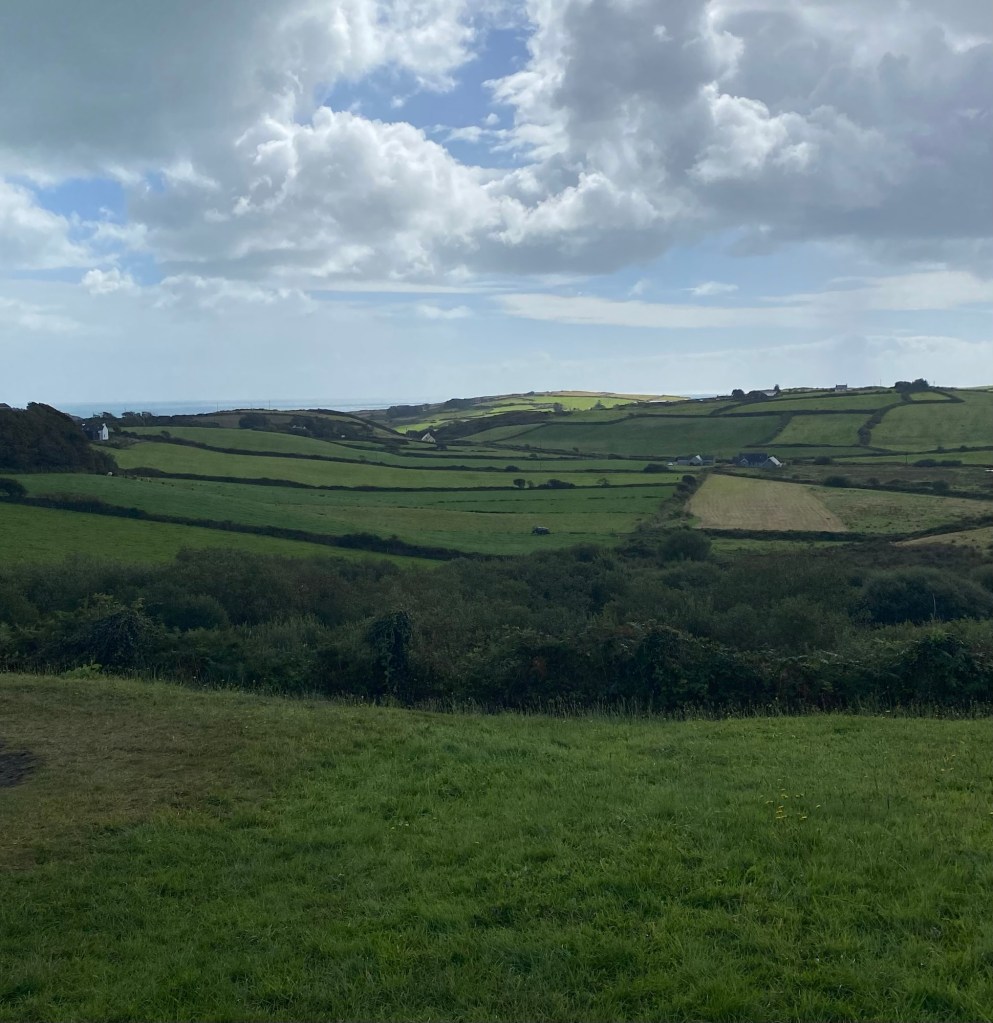
I visit Drombeg every time I come to west Cork. And each time, I feel a connection to the people who lived here 3000 years ago. Not some hokey connection, like these people were somehow more spiritual or more vital or more at one with nature than us. No. I feel a connection because they were people just like us, breathing in this same air, looking out over the view of the sea cradled in the V of the valley. These clouds hung over them, this rain fell on them, this wind chilled them, this sun shone on them.

While Newgrange or Stonehenge are huge and majestic monuments, stone circles such as Drombeg and the others that dot the landscape of southwest Cork feel much more intimate and ordinary. As astounding as the stone circle is, with its orientation based on deep astronomy, it is the more intimate and domestic elements of this site that move me. It is knowing that the body of a youth was found at the centre of the circle. It is the rectangle water pit, where water was boiled using stones first heated in a fire. Maybe the pit was used for cooking. Maybe it was used for dyeing or some other purpose. We simply don’t know. It doesn’t really matter. It’s that people – men, women, children – sat and walked and played and loved and argued and laughed here 3000 years ago. Ordinary people who couldn’t imagine that 3000 years into the future people would visit what remains of their home and wonder at what they did.

75. A summer dress

I remember I was eight or nine years old. Daddy had dropped Mammy, my little sister and me to the train station, to get the train down to Cork. We were coming here. I was wearing a new summer dress. It was so pretty – a pastel flower pattern. It was my first time to wear it. I’d been saving it for a special occasion and this was it. As we waited for the train, I squatted down and sat on my hunkers on the platform. Not realising that the hem was caught under the heels of my sandals, I stood up again as the train approached. I heard the fabric tear. I was horrified. My gorgeous dress ripped across the back, along the hem. I felt so sad. Something had been done that couldn’t be undone. I wished I could turn the clock back just a few seconds. The next week, my dress was mended, but the line where it had ripped and been restitched remained, visible if you knew what to look for. To an onlooker, it might have seemed like a trifling thing. But I never forgot that dress and that instant when I ripped it.

74. Like summer holidays past

The rain fell sideways as we packed the car this morning. Mammy had moved the car to as close to the door as she could get it. Still, we swopped bags of food and our mini suitcases for water and leaves trailed into the house underfoot.

It was a tight squeeze, five of us and all our stuff filling up the boot and obscuring the rear window. I remember rainy Saturday mornings just like this, in the early 1980s, Daddy hoisting the suitcase, the wind break, the deck chairs, onto the roof rack of the Ford Escort, covering the lot with the blue tarpaulin from an old tent, securing it with rope.

I had the playlist ready for today’s drive to Cork – 80s hits, of course, that we sang along to in between bursts of conversation.

The rain continued – sporadic heavy showers – and wind buffeted the car sideways. We pulled in to the Rock of Cashel for lunch – ham sandwiches made from yesterday’s boiled ham and Brennan’s bread washed down with sweet black tea from a flask. We stood around the picnic table in the rain, the hoods of our raincoats up, as a sudden heavy shower chased away the slash of blue sky that had briefly appeared. I couldn’t have been happier. Few things in the world taste as great as ham sandwiches and tea from a flask on a wet day, memory and nostalgia adding magical flavour to the food.

We reached our destination late afternoon and quickly unpacked the car. My sister started to make dinner and realized she was two ingredients short. Lily and I walked the couple of hundred metres up to the shop in the village square. On the walk back, we were blown down the hill by the strong wind, rain hitting us on the back. ‘This is perfect,’ I said to Lily. A seaside holiday in Ireland isn’t complete unless you get at least one wild night like this.’ The wind, the rain, the slight bite in the air, took me back 30, 40, 45 years, to family vacations here in west Cork, in Kerry, in Wexford, in Mayo.

Tomorrow we plan to go to the beach – in our raincoats, most likely.

72. Dublin Airport

I’m at Dublin airport, waiting for my sister to come through arrivals. The airport is quiet tonight, a few families, a couple of guys with bunches of flowers, people hanging around on their phones or with paper cups of coffee.

A group of Spanish teenagers comes through the sliding doors, welcomed by an exuberant Dublin woman who bundles them together for a photo before ushering them towards the exit.

Groups of holiday makers arrive home from warmer climes, tanned and dressed inappropriately for the wet August night that awaits them outside the terminal.

Over the course of about twenty minutes, three middle aged women come through, Eastern European and Asian, greeted with hugs and kisses by their children and their tiny Irish grandchildren.

I could spend all evening here, watching these arrivals and reunions.

Dublin Airport is special to me. The scene of so many of my own departures and arrivals over the years. My first ever solo trip abroad (only my second trip ever in a plane), aged 16, when I went to central France for a few weeks to au pair and improve my French. How scared I was, and how scared my parents were, but I wanted to go and they didn’t hold me back.

Three years later, I was away again, this time to the Netherlands with my friend Louise; my aunt Catherine’s tent strapped to my huge rucksack. Mammy drove us to the airport that morning. We had no jobs, no clue what were doing, but we were youthfully optimistic that we’d find work for the summer. And we did.

I remember a big gang of family and friends coming to see me off when I departed for Japan, aged 22. My biggest trip yet. A year away, and so far away. I remember how we all tried to keep a brave face on things as we sat in one of the airport restaurants, waiting for the moment when I would have to say goodbye and take that lonely walk through to security. And I remember Daddy telling me that it would be ok if I didn’t like it and wanted to come home. We had no way of knowing how much I’d love it and that I’d end up staying for three years. And after that, there would be the multiple departures to the Canadian Arctic; all those journeys starting in Dublin Airport.

I remember the arrivals too. The time I came home from Japan with a shaved head and blue fingernails, and Mammy didn’t know what to think. The first time I travelled alone with Lily in her sling. And all those times I came home at short notice, for Jerry’s, Jimmy’s, Lillie’s, Nana’s funerals, cousins or uncles or my brother-in-law picking me up and often driving me directly to a wake late at night.

I remember the much more frequent arrivals during Daddy’s final seven or eight months, when I flew home from Aberdeen every few weeks. I no longer expected anyone to meet me at the airport. I’d take the bus home or I’d hop on a bus into the city and meet Daddy and Mammy at the hospital.

Tonight, I sit and look at the people waiting and arriving and departing and I wonder where they have come from, why they have flown into Dublin on this particular evening, and what awaits them when they pass through the doors and head for their destinations, each with their own fears and hopes, loves and losses, their own adventures and stories, pasts and futures.

58. The Irish Wake Museum

So culturally embedded are our death rituals that they are honoured and commemorated in a museum in Waterford city, The Irish Wake Museum. I didn’t know this museum existed until I walked past it a couple of days ago. How could I not take a trip inside?

Housed in an early 15th Century alms house in the heart of Waterford, the museum explores Ireland’s funeral rituals from pre-Christian times, through the Vikings and up to the present day.

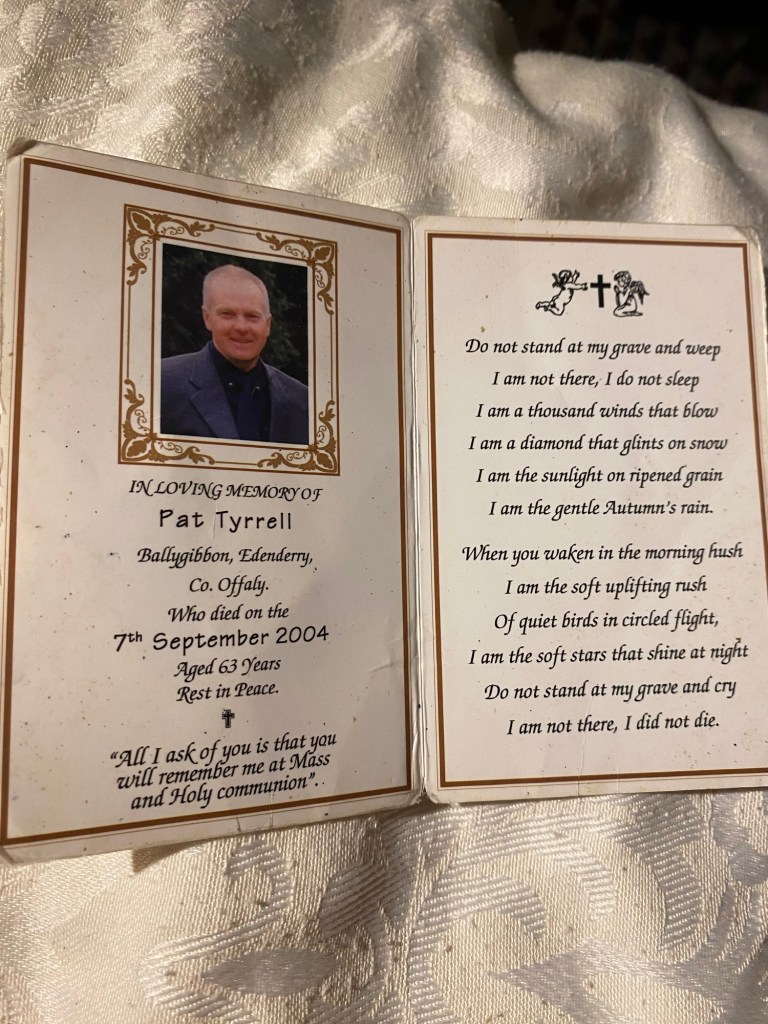
It was easy to see how memorial objects from the 1400s – commemorative pendants, coins and jewellery have been transformed into the memorial cards of the dead that are given out today.

I was familiar with the origins of the wake and many of the rituals surrounding it. The two or three days of sitting with the dead to ensure they really were dead. The liminality of the wake, when clocks are stopped (literally), mirrors are covered to prevent the spirit of the deceased from getting trapped, and when there is much socialising and, despite the circumstances, merriment. In certain parts of Ireland, keeners were brought in; women who performed highly ritualised keening (from the Irish ag caoineadh – to cry) over the body.

I learned that women were generally the ones who prepared the deceased for the wake because, on account of their ability to give birth, women were more able to defy death.

I learned that, in the old days, the drinking and socialising at wakes so concerned the Catholic church that notices were put up stating that unmarried young men and women who were unrelated were not allowed to be in attendance at a wake from sunset to sunrise!

It was heartwarming to see our death rituals so faithfully rendered and retold, sharing this part of our culture with visitors and instilling a sense of pride and belonging in those of us for whom this is a living and evolving tradition.

54. My bedroom

I don’t know who was the first person to sleep in this bedroom and I don’t know who will be the last. But it was mine for a while and I’m back in it again for a few weeks. I don’t know if my great-grandparents slept in it or died in it; I don’t know if my father and his siblings were born in it. But I know it’s history from 1942 onwards.

Years ago, my uncle Willie told me that his father (my grandfather), Michael Tyrrell, had spent his final months in bed in this room. Willie, Jimmy and Cissie, the three oldest children, helped their mother look after their father through his cancer and he died in this room on 31 March 1942, Daddy’s first birthday.

When I was a child, there were two beds in this room. Hard to imagine now, given how small it is. Nana slept in the double bed by the window and L-shaped to her was Cissie’s smaller bed. As a child, I slept with Cissie a lot. I have memories of that time – of Mammy bringing me breakfast in bed of a fry-up of rashers, sausages, egg, tomatoes and Nana’s soda bread. I remember crying in pain with toothache in that bed too and Mammy bringing me up aspirin or some other pain relief.

Did I stay in that bed after Cissie got sick? I don’t remember. When I was four, a new bedroom was built onto the house. It was supposed to be for me, but I never slept in it. It was too far away from where everyone else was at night, so I stayed with Cissie.

Cissie died from breast cancer when I was six and, for a while, I slept in the bed with Nana. But I didn’t like sleeping with her – I remember she had scratchy toenails! After some time, a new plan was devised. Mammy and Daddy moved up to the room that had been built for me and my sister and I slept in two single beds in what had been my parent’s room. Now Nana had the small bedroom to herself. Cissie’s bed remained there for a few years, but was eventually removed.

In May 1985, Nana died in bed in this room. I remember our cousin Betty, who lived across the road, coming over to clean and prepare the body for the wake. Nana was laid out in the bed. I had turned twelve only a few days earlier and she was only the second dead person I had ever seen (Betty’s father, Garrett, had died the previous year and I’d seen him laid out in his bed across the road). For two days, people visited the house, filing into the bedroom to pay their respects, before coming down to the kitchen or sitting room for tea and beer and endless ham sandwiches and cake.

By the time I was 12, I was well and truly fed up with sharing a room with my seven year old sister and about two weeks after Nana died, I asked my parents if I could have her room. Going to sleep for the first time in a bed so recently vacated by my dead granny felt a bit weird, I have to admit, but I soon got used to it and transformed it into my own space.

The walls of this room throughout my teenage years were covered with posters. I had huge posters of one of the space shuttles, of an F16 fighter jet (thanks to Top Gun), and of an environmental quote from Chief Seattle. There were posters and newspaper clippings of Boris Becker (little did we know!!), Bruce Springsteen, James Dean and so many more – I can’t even remember now. The room was filled with library books, Jackie annuals, and back issues of Smash Hits and National Geographic. There were mementos of the few places I had been in my life, a desk that I rarely used because it was too small and wobbly (I did my homework and studying at the kitchen table). I had my own radio too. It was in this room that I first heard about the hole in the ozone layer (it scared the shit out of me), about Chernobyl (ditto), and where I listened to endless pop music.

I stayed in this room until I left for university and returned to it at weekends and holidays, and then on visits home from Japan, Nunavut, Scotland. I moved back into it again in the summer of 2004, when I came home from Aberdeen to be with Daddy in his final weeks or months (weeks, in the end, but I wasn’t to know that then).

These days, it’s Mammy’s room and has a feeling of warmth and relaxation about it, with the comfiest bed that’s ever been here. I’m sleeping in it while I’m here. I wake in the morning and here I am, once again, in this bedroom where I’ve probably spent more nights than in any other one place in my life; in this bedroom that has witnessed so much of my family’s life.