51. Alma Mater

Around this time 35 years ago, I was accepted into St. Patrick’s College, Maynooth, now Maynooth University. I still remember the nervous and shy 17 year old I was on that early October day in 1990 when Daddy drove me the 25 miles up to Maynooth for registration and to drop me off in my student accommodation.

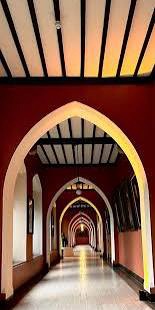
This morning I took Lily and Katie to Maynooth, Lily now only a year younger than I was then. So much has changed and, yet, so much remains the same. I took them into Rhetoric House, home of the Geography Department and scene of my encounter with kind John Sweeney. I showed them the swimming pool. They asked if was creepier than the pool in Edenderry. Definitely. The tiny post office remains unchanged, as does Pugin Hall, where we used to pretend we were theology students to avail of the free tea and coffee. The Beatle is still outside the library (a statue of Pope John Paul II blessing two children – George and Ringo). The library itself was full of students preparing for repeat exams, but we quietly strolled around – until I got us lost and we ended up in the fire escape. In my defence, it was the main stair in my day!

The new campus is unrecognisable, but the Arts Block remains the same – so tiny compared to how I remembered it. Even the lecture theatres, which seemed huge, now look tiny. From there to the canteen and sports centre and then the Student’s Union – scene of so much divilment over the years!!

Many of the friends I made in those years remain my great friends to this day. The courses I studied set the trajectory for my professional and personal life, leading me to where I am today. It was a glorious trip down memory lane, as I recounted various things my friends and I got up to. The girls thought I’d gone slightly mad and all we’d gotten up to 30 and more years ago was all rather quaint!

49. Breakfast

Breakfast is generally the most perfunctory of meals. Quick and practical at the start of the day. On Saturday or Sunday, I like to make pancakes or waffles, which we eat lazily with multiple mugs of tea. But still, it’s the meal that, most of the time, I make and eat at home. I always imagine going out for breakfasts, but I’ve never lived anywhere that’s had much in the way of breakfast options.

Visiting a city is always a great opportunity for sampling breakfasts of all sorts. The memory of New York and Toronto diner breakfasts make me drool even now, and I still get nostalgic about breakfasts in Paris, Sydney, Honolulu, Vienna, London, Sevilla. Eggs, bacon, pancakes, mueslis, yogurts; breakfasts of all shapes and sizes; enjoyed with friends or in my own.

This morning, on the way through Derry, I had one such memorable breakfast. Not at a diner or a cafe, but at a friend’s house, made all the more delicious for the care and devotion my friend’s brother and sister put into making it.

The dining table was dressed with food, like that Christmas scene in Greta Gerwig’s Little Women. Eight of us sat around a table laden with rashers, sausages, black pudding, grilled tomatoes, fried potatoes, baked beans; potato farls, brown bread, toast, brioche buns, pancakes; jams, honey, marmalade, maple syrup; tea, coffee, hot chocolate. Every breakfast I love, all there on the table. I could have sat there all day, gorging myself like the Prince Regent.

Alas, we had to get on the road. Home beckoned. So, with a tummy full of food made with care and passion, I set out, another memorable breakfast to fuel my future nostalgia.

47. Ukaliq

In late 2000, I’d already been working as a volunteer teacher at Levi Angmak Elementary School in Arviat, Nunavut, for some months. Kip Gibbons, one of the teachers who had befriended me, offered to show me how to sew my own mittens. She sent me to the Northern Store to buy ukaliq (arctic hare) fur. I duly went a couple of evenings later and bought two ukaliq skins. On Saturday, I went around to Kip’s house and we sat on her floor, where she helped me to cut the pattern and showed me how to stitch the parts together.

I’ve never been much of a crafts person, so I was delighted to be making my own mittens. It was probably -20C or -25C as I walked the snow-covered streets back to my house a few hours later, proudly wearing my new mittens. I would wear them for years, and still have them today, although there isn’t much call for them in southern Spain.

On the Monday after I sewed the mitts, I wore them to school. In the school foyer, I met Peter 2 Aulajoot, an older teacher, who was always friendly and jokey with me. He chuckled when he saw my mitts. I hadn’t cut them badly or sewed them poorly. But Peter 2 noticed something that I hadn’t. While the fur on my left mitt was mostly white with a little smattering of black, the fur on my right mitt was mostly black with a little smattering of white. They looked completely mismatched. How could I not have seen this?

From that day on, Peter 2 always called me Ukaliq – arctic hare. A few other people picked it up too, but it wasn’t a name I was commonly called. But I liked that name for myself. I’d always loved hares, always got a thrill when I’d see them in Ireland. Now that I was in Nunavut, I saw them more often – including one that lived out past the reservoir and seemed as tame as a pet bunny.

I’ve carried that name – Ukaliq – with me ever since, making the frisson of excitement I feel whenever I see a hare all the sharper. So, yesterday when Michael said, ‘There’s the hare,’ I immediately turned to the window. And there she was. At the base of a granite outcrop beside the house, ears up, alert. She paused, nibbled at a hind paw with her teeth, hopped along and then sat, ears back, looking out over the sea.

I was in a state of awe and nostalgia and joy all mingled together, remembering Peter 2 and Kip and that ukaliq by the reservoir and the person I was twenty-five years ago.

45. Cruit

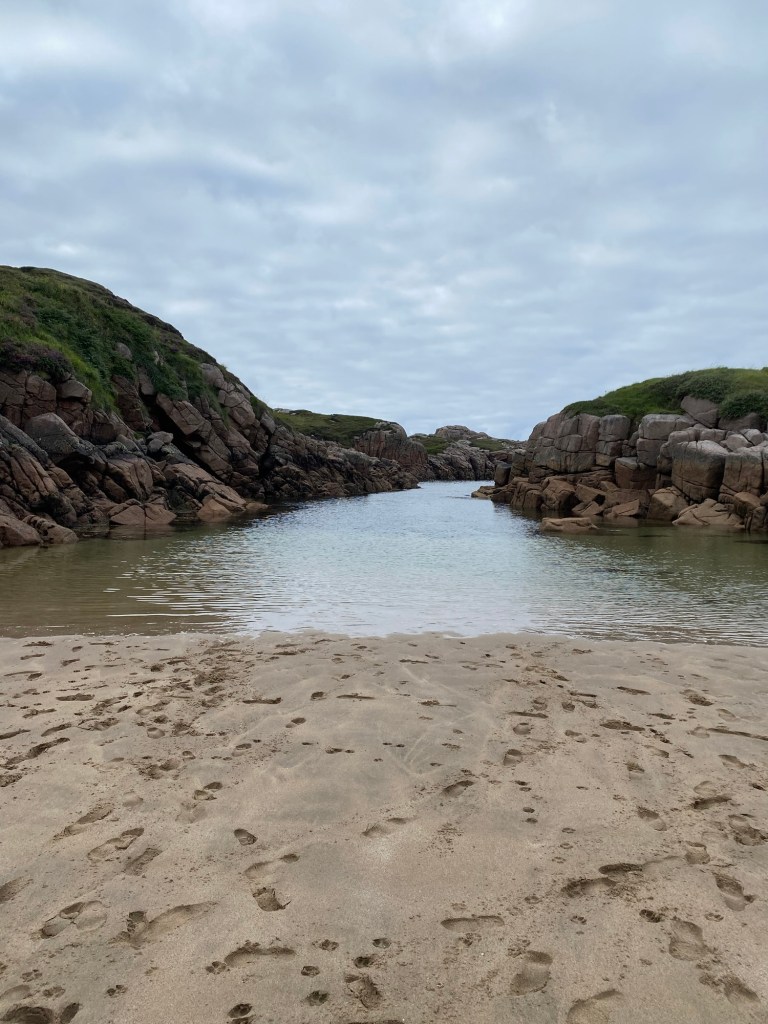
A couple of action packed days and late nights have come between me and writing. I wouldn’t swap these days for anything. I’m in Cruit tonight, back again after three years. This evening’s walk across this island off northwest Donegal was, as always, a delight…

Mt Errigal in the distance

41. And tomorrow…home

After almost six weeks in the UK, tomorrow we will travel to Ireland. We haven’t started packing yet and the tiny bedroom we’ve been sharing at my father-in-law’s house looks like a bomb site, after all these weeks of us living out of our suitcases in there. But we’ll pack with care tomorrow, and say our goodbyes, and tomorrow night, all going well, I’ll be at home.

Materiality and nostalgia

Last week, I spent a few days in Coventry city centre. It’s not a particularly pleasant or pretty city, but I had reason to be there and some time on my hands. Seeking refuge from the excessive noise and busyness of the city, I took myself to Coventry Cathedral and, later, to The Herbert Museum.

Having wandered around the shell of the old cathedral, St. Michael’s, which was bombed almost to oblivion by the Luftwaffe on 14 November 1940, I proceeded to the new cathedral, also St. Michael’s, which opened in 1962. From the first time I visited this cathedral, twelve or more years ago, I have loved its modernist architecture, sharp edges and industrial style, so unlike the medieval cathedrals one is more likely to encounter in British and other European cities.

I was already in a reflective and somewhat melancholic mood when I entered the cathedral, and the sparse grandeur of it moved me even more. The Peace Chapel, to the left of the entrance, caught my attention. I saw, through the open doors, long strings of colourful origami tsuru (orizuru), paper cranes, hanging almost to the floor. I was drawn to them, nostalgia for Japan rising in me as I walked across the nave of the cathedral towards them.

The small side chapel had chairs arranged in a circle, with the altar and the hanging strings of tsuru completing the circle. I reached out and ever so gently ran my fingers through them, and I was swept back a quarter century to Japan, to first learning to make tsuru with my students, to visiting shrines and temples with my friends and colleagues, with my kind taiko teacher and his wife (whose names, I am ashamed to say, now escape me – Lisa McClintock, if you’re reading this, please remind me), and to visiting the memorials at Nagasaki and Hiroshima. Waves of nostalgia washed over me and suddenly tears were streaming down my cheeks and my throat was constricted around sobs desperate to get out. I sat on one of the chairs in the circle, overwhelmed by a sense of loss for a part of my life that is no more. I have no great yearning to return to Japan, although I would love to take my daughters there some day. This was not a nostalgia (or natsukashii, as they say in Japan) brought about by a longing to be in that place again in the future, but rather to be back in the past, in a place and at a time to which I can never return.

I composed myself, spent some more time sitting in reflection in the nave of the cathedral, and then walked the 50 metres to The Herbert Museum. I knew the museum well, having often taken Lily and Katie there when we visited their grandad in Coventry when they were younger. The museum was a little shabbier than I remembered it, some of the exhibits a little worse for wear. I made my way upstairs and into the permanent Elements exhibition, only remembering it as I walked through it. It contains some beautiful natural objects – shells, crystals, fossils and, against the back wall, mounted vertically and side-by-side, two narwhal tusks. Like the tsuru in the cathedral, I was drawn to the tusks. I stood in front of them, running my hand over the swirling lines, reveling in the cold hardness of them.

I’ve never seen a narwhal, alive or dead, but they are so indelibly connected with the Arctic, that they swept me away to the winter sea ice of Hudson Bay, to Arvia’juaq and Huluraq, to beluga whale hunting in summer with Arden and Frank, to arctic char fishing with my ataata Pemik. Once again, I was a blubbering wreck, clinging to the larger of the two tusks like a drowning woman. Again, nostalgia for a time and place overcame me and I was momentarily grief-stricken. Unlike Japan, Nunavut (and, specifically, Arviat) is a continuing presence in my life, through my research, my on-going relationships with people there (one of the great positives of social media), through my daughter’s name, and through the way my lived experiences and academic research of Inuit life have changed forever the way I interact with humans and other animals and with the world around me. But the Arviat I knew has changed. Some of the people most important to me are no longer there – passed on or moved on – and I too am changed.

I composed myself for the second time in so many hours, continued my exploration of the museum and then sat in the museum café with a pot of tea and toasted crumpet. As I sat, I reflected on how the materiality of those objects had drawn out this nostalgia in me. Two objects, one removed from its cultural setting and the other from its natural setting, and set in a different context thousands of miles away. The cultural distance the tsuru had travelled was, perhaps, less great, as these delicate paper cranes have come to symbolize peace, the anti-war movement and nuclear disarmament throughout the world. But, just as the tusk of an Arctic marine mammal was far from the place and context of its origin, so too, the tsuru, placed in an Anglican cathedral in the middle of England, had been decontextualized from Japan’s long history of origami and other delicate crafts. It was the sudden and unexpected encounter with these objects out of place that caused them to grab me by the wrist and pull me back to the places of their origin, places that, for half of my life, have had meaning for me.

But my encounters with those objects also caught me at a moment when I was feeling particularly melancholic. Another day, in a different mood, nostalgia brought about by the tsuru and the narwhal tusks might have caused me to laugh aloud with joyful reminiscences of the same times, places and people. I was reminded of this a few days later when, back home again in Sanlúcar de Guadiana, I caught the smell and texture of spring in the air, and it brought me back to the springs of my childhood in Ireland. This time, in a buoyant mood, I grinned from ear to ear.

Productive procrastination and the tug of memory

The editing assignment I’m working on at the moment is one of the most interesting, and biggest, I’ve had in the three years I’ve worked as an academic editor. Each new editing assignment, written by academics in China, Japan, Indonesia and elsewhere, is a new and fascinating learning experience for me. But the one I’m currently working on is particularly enjoyable because it is closest to my own research interests and the suggestions I have made to the authors come from my own specific background as an environmental anthropologist, rather than from my usually broader background as a social scientist at the interstices of culture and nature. This week’s assignment is about intangible cultural heritage, about the conservation and transmission of knowledge, skill and memory.

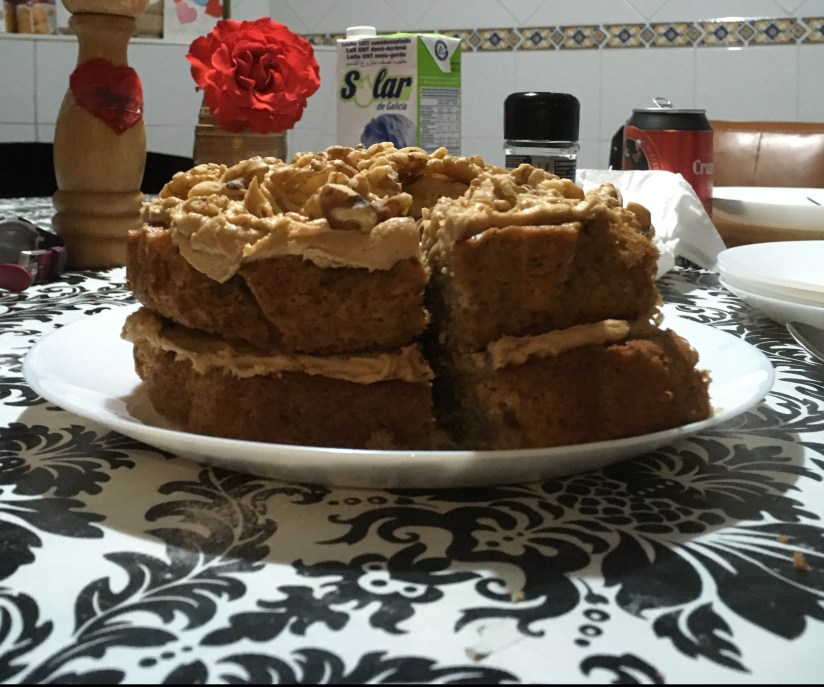
However, despite my enjoyment of this current assignment, I find myself procrastinating. Having done the washing up after lunch today I knew I should return to my office and sit down for an afternoon of editing. Instead, I decided on the spur of the moment to make a coffee cake. I’ve never made a coffee cake before, but I have a hand-written recipe in the little recipe book I’ve been adding to and baking from for years.
img_13721.jpg

My ‘not as good as Cissie’s’ coffee cake

I’ve been craving coffee cake for weeks, probably since the end of March and what would have been my father’s 78th birthday. You see, for me, coffee cake is intimately and indelibly tied up with memories of my father and my aunt Cissie, Daddy’s oldest sister. Coffee cake does not exist in my memory and my imagination independent of those two very important people in my life.

Until I was five years old, I was the only child in a small house in rural Ireland that was home to my mother and father, my paternal grandmother, and my paternal aunt, Cissie. My uncle Tom was there most days too and each weekend, my cousins Sean, Declan and Colette and my aunt Lillie were there too. I grew up in a house filled with love and jokes and an obsession with Gaelic football. I never once questioned my place in that wonderful setting. I was grounded and protected and loved. When I was five years old, my baby sister was added to the mix, and when I was six, my beloved aunt Cissie died of breast cancer.

tyrrell 112

Cissie and me on the lawn in Ballygibbon, summer 1974.

Cissie was 18 or 19 years older than my father, who was the baby in a family of eight children that spanned a 22-year range. They all grew up in that house, as had my grandfather before them, who had died on my father’s first birthday. Cissie was the third oldest in the family, and the oldest girl. In what would be the final years of her life (although none of us could ever have imagined that someone so full of life could die so young), and her most important years from my young perspective, she worked as a housekeeper for a country doctor. Dr. Hill was herself an amazing woman, family doctor to all of us and a woman who had gone to medical school in Ireland in what must have been the 1930s. She and her husband, Ger, who was confined to a wheelchair, lived in a big bright orange farmhouse up a long avenue, a couple of miles from my house. Cissie worked in the kitchen, cooked the meals, baked, helped with Ger and slept in the house a couple of nights a week. I have very strong memories of sleeping in Cissie’s bed in her room at Dr. Hill’s house once and feeling simultaneously thrilled and terrified by the vastness of the house.

Back home in our little two-bedroom, five-person house, I shared a bed with Cissie and we, in turn, shared a room with my grandmother. When I go home to Ballygibbon now I can’t imagine how or where we fit two large old beds, a wardrobe and a chest of drawers in that room. But, somehow, we did (maybe the confined space prepared me for life on a boat).

Cissie’s baking was legendary. She baked all the time and everything was delicious. Cakes, tarts, desserts, she made them all. My father, despite hating coffee, loved his big sister’s coffee cake. And, despite being in his mid-30s in the mid-1970s, when I was a little girl, he was still Cissie’s adored baby brother, Cinn-bán Paddy, blond-headed Paddy, and she indulged and cultivated his sweet tooth at every opportunity.

It would be incorrect to say Daddy loved coffee cake. He loved Cissie’s coffee cake. After she died, in 1979, at a time when I was too young to appreciate the grief of those around me, he rarely ate coffee cake again. On those rare occasions when he conceded to try a slice of coffee cake, his response was always the same, ‘It’s not as good as Cissie’s’. Coffee cake never being as good as Cissie’s became, and still is, a running family joke.

tyrrell 113

With my parents and sister at Dublin Zoo on the day of my First Communion, May 1980, less than a year after Cissie’s death.

My father died fourteen and a half years ago. Although my grief is triggered in often odd and unexpected ways, twice a year, on the anniversaries of his birth (March) and his death (September) I am usually guaranteed to feel his absence particularly acutely. This year I was less sad than usual, but was overcome by an almost madness-inducing craving not only to eat coffee cake, but to bake coffee cake. For weeks the stars have failed to align – not enough eggs in the house one day, not enough of the right type of flour the next, the gas bottle too close to empty to chance baking in the oven. But the craving to make and eat coffee cake never went away.

This morning, I took a mid-morning break from editing, as I had promised Katie I would play padel with her. Padel is a game that’s very similar to tennis, but played on a court that’s some way similar to both a squash and a real tennis court. Katie seems to be a natural at most sports and as we hit the ball back and forth across the padel net, I told her (not for the first time) how much Grandad Pat would have adored her and about all the sports they could have played together. Talking like that set me off and I had to take a little break from padel while my eight-year old daughter comforted me.

IMG_1375[1]

Katie approved!

So, with my head full of ideas of intangible cultural heritage, of memory and skill and the transmission of knowledge, and with my heart full of my long-lost loved ones, my procrastination was inevitable, as I took my recipe book from its shelf. So, I’ve made a coffee cake for the first time for my blond-haired girls, and the cycle of intangible culture, love and belonging goes on.

Would Daddy like the coffee cake I’ve made? Although he would never say so, for fear of hurting my feelings, I’m sure inside he’d be thinking, ‘It’s not as good as Cissie’s’. And I would have to agree!


P.S. Apologies to my mother, sister and any other family members who I have made cry by bringing back these happy memories. We’re a sappy bunch.