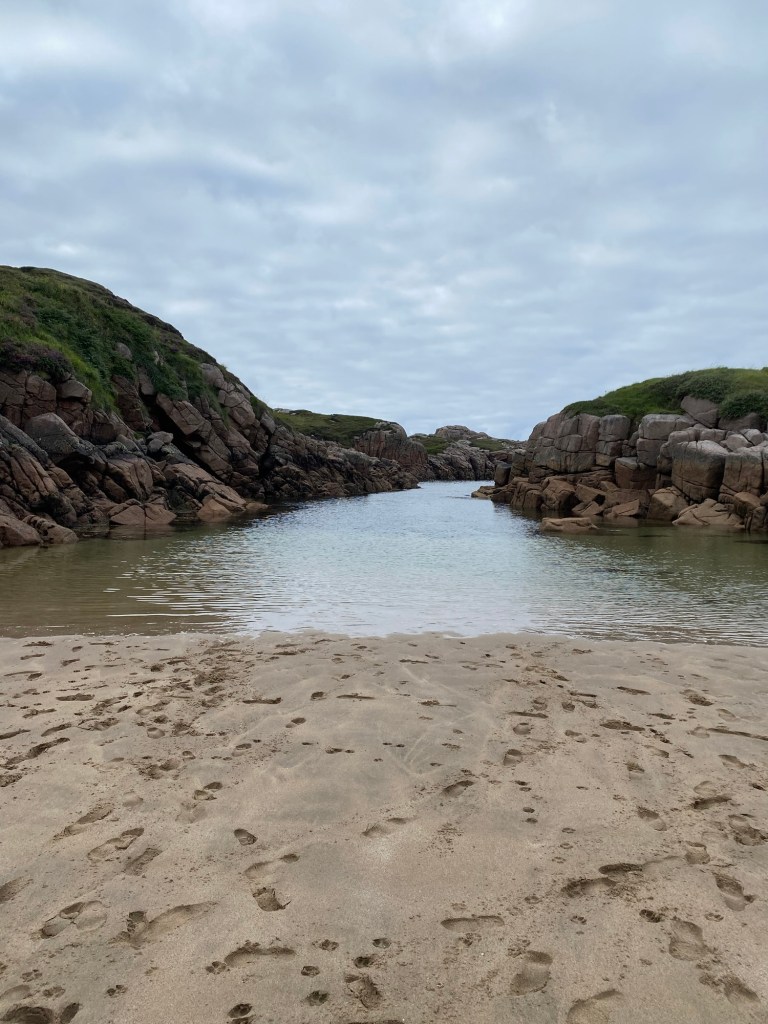
A couple of action packed days and late nights have come between me and writing. I wouldn’t swap these days for anything. I’m in Cruit tonight, back again after three years. This evening’s walk across this island off northwest Donegal was, as always, a delight…
The heatwave has passed for now. It’s windy and the early morning sky threatens rain. I’m wearing my new raincoat that I bought last week in the height of the heatwave. The sales assistant looked at me funny and I said, “Well, this has to end sometime.” It’s certainly ended now.
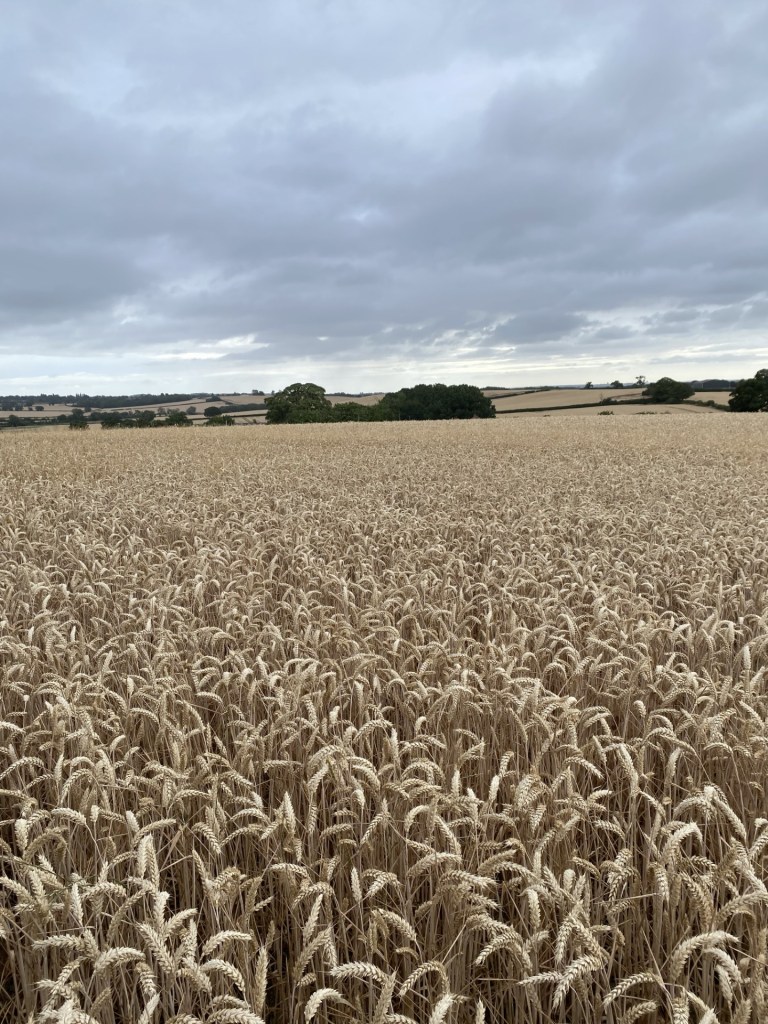
This week, we’re looking after the adorable Hudson (see yesterday’s post) at his home in a little village in the middle of England, while his human parents are away on vacation. It’s 8am and Hudson and I are out for our morning walk. There’s nobody else around, as we walk for a few kilometres along the edges of arable land and across fields of sheep and lambs, from one kissing gate to the next.
One young lamb is curious and tries to come to us, its worried mother keeping pace with it, probably wishing it wasn’t so curious about this big woolly dog and red-raincoated human (what colours can sheep see?). A field of rape seed is half-harvested, a big yellow combine sitting in the middle of the field, ready to resume its work when the rain lets up. I see something move at the wide fallow edge of the field, heads bobbing up and down. I think it is a couple of rabbits at first, but as we get closer, I see that it is a family of grouse. They are disinclined to leave the relative safety of the long grass for the exposed stubble of the field. I think I should turn back and leave them be. But at the exact instant I have this thought, one flies up from right at my feet, completely invisible to me and to Hudson up to now, scaring me and sending all the others into flight too. They fly the 20 or so metres from the grassy verge into the yet unharvested half of the field. I feel bad for them. Hudson is good, though. My own dog, Lady, would be going crazy for them, but Hudson seems oblivious.
A little farther on, I step over a badger sett. It looks neat and tidy and, therefore, in use, and I get a little thrill thinking that, underneath my feet, a family of badgers is likely settling down for the day to sleep. Towards the end of the walk, we pass a small patch of open grassland backing onto a copse of trees. Two hawks circle each other ten or so metres off the ground over the grassland, crying out to each other. One lands in a tree and the other continues to circle, eventually settling on the branch of a nearby tree. Their cries continue to ring out.
I am reminded of other early morning country walks along English pathways – in the Fens and Cambridgeshire, up north in Cumbria and down south in Devon – and of the hares, the muntjac and the red deer, the red squirrels, the badgers and foxes, the eagles and hawks and falcons and owls, of the times I have been privileged enough to see those animals in person and the times when I have found signs and signals that they have been there and may still be there, watching me, the clumsy human, walking through their home.
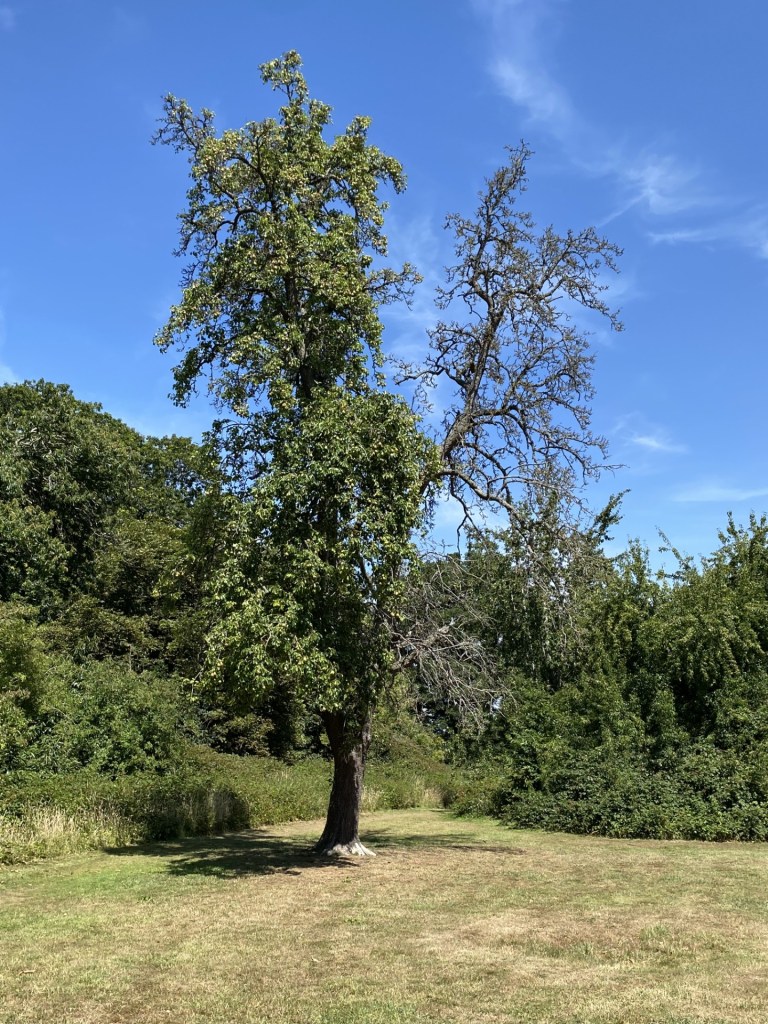
I’ve fallen for this pear tree. In a park full of majestic giant oaks, giant chestnuts, giant sycamores, it is this more modest pear tree that I am drawn to day after day, to sit under to eat my lunch and take a break from staring at my computer screen.
I chose it at random the first day, a little bit off the path and providing just enough dappled shade from the sun. I ate my lunch and then, like Heaney’s threshers in The Wife’s Tale, who “still kept their ease, Spread out, unbuttoned, grateful, under the trees,” I lay down and gazed up through the branches. It was then that I noticed something I hadn’t noticed as I walked past it or under it.
About six feet from the ground, it forks. The branches to one side of the fork are lifeless. No leaves grow, no buds. It is bare but for the lichen that has crept along it. The other side of the fork, in contrast, is heavy with life. The branches sag under the weight of innumerable pears that will be ripe by autumn, food for humans, food for animals, carrying the seeds of the offspring of this tree.
I’m drawn to the perseverance of this pear tree, to its wonky imperfection. Something happened to it – a lighning strike perhaps – that irreparably damaged one half of it, yet the other half carries on steadfast and lively. And I come to see that the damaged part might still have its role to play too, providing balance and stability, helping to anchor the still lively half.
A bumblebee lands on my brightly coloured trousers, resting in the shade of the tree for a moment before going on its way again. There are other insects too, not passing through but living here, making the tree their home. On both forks of the pear tree, I see intricate spider webs and, at the base, a hole made by some small animal. There are rabbit droppings on the ground around me. The tree, as a whole, is a place of liveliness, home to or way point for so many animals, me included.
As I sit up and prepare to return to work, I look around and see, not far away, smaller pear trees and saplings, surely the offspring of this one. The tree, despite its imperfections and its damaged parts, is living its best pear tree life.