
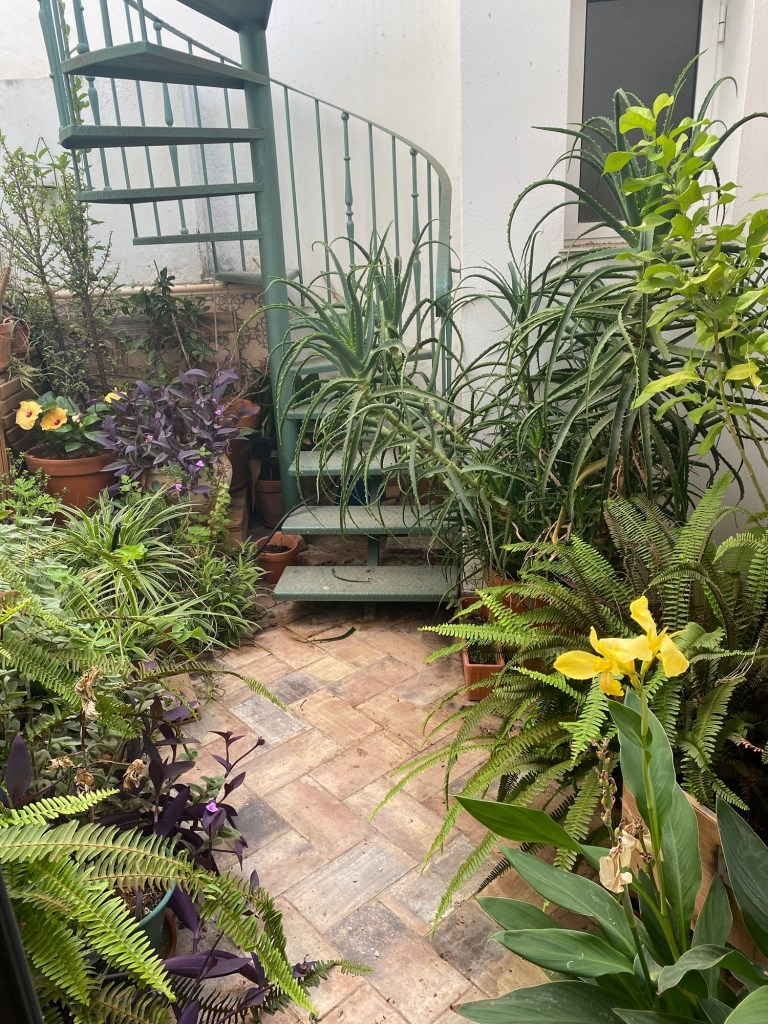
Before we went away for the summer, this was my little patio space, where I had a little table, a couple of chairs, and a love seat. It had a nice number of plants scattered around too. It was a shady space for breakfast or a mid-morning coffee.
But then we were going away for eleven weeks and I needed a keep the plants watered. On the Saturday and Sunday three weeks before we left, I folded away the table and chairs and gathered all the plants from my three outside spaces to here, the shadiest and coolest of my outdoor spaces. They certainly took up a lot of space. I then spent the mornings on the second to last and last weekends (in mid-June) setting up a watering system on a timer. The first of those four mornings was spent just sitting at my kitchen table, reading the instructions, watching YouTube videos and figuring out how to set up an irrigation system.
I got there in the end. It was like putting together some great puzzle, lining up the tubes, inserting the nozzles, plant to plant to plant, until all 50 plants (yep…50…even I was surprised that I had so many) were set up to have a one minute drip feed of water every 24 hours.
What I didn’t have time for was to properly test the system. I should have done it a week or so earlier. That way I’d know if some plants were getting too much or too little water. But I left it too late and just had to hope for the best.
My friends had a key to the house and reported after only a week that some of the plants were being overwatered and they’d turned the individual nozzles down to a mere trickle. Later in the summer they reported that my patio was now like a ‘jungle.’
I was quite dreading how jungle-like it would be on our return. However, I was pleasantly surprised. Sure, many of the plants had grown, but they looked far more lush and healthy than when I’d left them (I wouldn’t be the best at tending to my plants on a regular basis).
A few died. Three owing to a lack of water (the feeder tubes had slipped out of the pots and they didn’t get any water) and another three from overwatering, victims of the success of my irrigation system. When I’d set up the system, those three plants had been exposed to the sun. When I returned I found them in the undergrowth of other plants that had grown furiously, fully shaded and sitting in waterlogged soil.
We’ve been back two weeks already and it still looks like a jungle out there. I’ve gotten rid of the dead ones and I’ve started to move those that don’t belong on the patio back to their usual homes. Some need cutting back. But it’s slow work. One day, in the not too distant future, I hope I’ll have my table and chairs and love seat back again. I hope I won’t have to battle my way up the stairs to the clothesline. I hope I’ll be able to get to the gas bottles when they need to be changed.
But little by little, day by day, I’m getting there. And I’m getting to know my plants all over again in the process.

 Me in place