I had only been home twelve hours when I attended a funeral, for a neighbour of ours, from a mile or more down the road. She was almost 97. To be honest, I hadn’t even realised that she was still alive. But she was our neighbour, a woman from my townland who I had known and liked all my life, so I accompanied Mammy to the funeral.
It was a big funeral for a Wednesday morning. I said hello to people I knew in the churchyard – second cousins, a neighbour from my childhood, people from our parish. We took our seats in the church. I watched the other funeral goers file in, recognizing people I’ve known all my life, many indeed, who I only knew within the walls of this church and the Masses I attended every Saturday night or Sunday morning of my life when I lived here.
The woman who died had been a regular Mass-goer all her life. I can still see where she sat relative to where I sat with Daddy and Nana when we took the same pew for Mass every single week.
The priest looked down at the large congregation. ‘These walls hold the history of our community,’ he said. ‘These walls embrace us and hold us together.’
I looked around the simple unadorned little country church. The statue of Jesus, the simple stained glass windows, the confession boxes, even the organist, unchanged for most of the years since my parents first took me here. I looked at the people around me – all a little older now, a few more wrinkles, a little more grey hair, And I felt a tremendous sense of gratitude for the grounding and sense of place that these four walls gifted me.
Between Mammy and the chats and the cousins and the chats and the neighbours and the chats and the tea and the chats and the rain and the chats and the dogs and the chats the coffee and the chats, I just haven’t had time to write anything today.
I meet Sean again when I go out for an evening walk. This time he’s sitting on a camping chair on the canal bank, beside his boat. He’s with a younger man, who’s sitting on the grass. I shout ‘hello’ over to them and they beckon me over. By the time I walk back to the nearest bridge and cross over to the other side of the canal, Sean has pulled another camping chair out from his boat. His buddy is Carl, a Mancunian. The two met only yesterday, when Carl was taking his daily walk along the canal. I sit with them for a couple of hours, shooting the breeze, sharing stories about where we’ve come from and where we’re going to, the importance of listening, and the power of poetry. I bid them farewell and carry on my way.
••••••
‘I started working with papier-mâché during lockdown,’ Jean tells me. ‘I wanted to make art with what was lying around the house.’ I’ve wandered into her studio and find her sitting at a table, surrounded by papier-mâché spheres and abstractly-shaped boxes, everything looking precarious and on the edge. ‘Everywhere I turned, they were talking about tipping points. Scientists, activists. Tipping points are my great anxiety. So I’m working through that anxiety in my art.’ I ask where she’s from. ‘From Indiana originally, she say, but I’ve lived in England for forty years.’ She shows me how her tactile, playful art moves and explains how she makes it. I wish her luck with her project.
••••••
‘Do you mind if I sit here?’ I ask the man sitting alone at a table who looks like he’s working. I’m here to work too, so this could be a good place to sit. ‘The working end of the cafe,’ I say to him. ‘Yes,’ he smiles. I spot a university logo on the paper in his hand. From this angle, it looks like exam grading criteria. ‘Marking exams?’ I ask him. ‘Job application,’ he says. He’s Mark, an academic at a midlands university, grown tired of his job and applying for a position at a university in eastern Germany. We talk about the state of academia in the UK, the Spanish education system and, before long, an hour has passed and neither of us have done any work. I have a Zoom meeting to prep for and he has a train to catch, so we say goodbye and I get on with my work.
••••••
‘I’m at a stage in my life where friendships with women are most important to me,’ Amanda says. She tells me that she’s only moved to Leamington two days ago. She’s a few years younger than me, has a corporate job, but her real passion is healing. I tell her about a book I’m currently editing, and we discuss the power of stories and how we’re only able to tell our stories once we have worked through our trauma. We’re the only two visitors in a small art gallery and we’ve both arrived at the same time. We start out shadowing each other, a little self conscious in the small rooms. But soon we’re talking about healing and friendship, and what a great place Leamington Spa is, and the fact that we’ve both recently been to Thames Ditton. We leave the gallery together, saying goodbye as we walk away in different directions.
••••••
I find it hard to stay strangers with anyone for long.
After almost six weeks in the UK, tomorrow we will travel to Ireland. We haven’t started packing yet and the tiny bedroom we’ve been sharing at my father-in-law’s house looks like a bomb site, after all these weeks of us living out of our suitcases in there. But we’ll pack with care tomorrow, and say our goodbyes, and tomorrow night, all going well, I’ll be at home.
This took me back. Today, the girls and I visited the Black Country Museum in Dudley, northwest of Birmingham. We learned all about coal mining in the 19th and early 20th centuries, went down a drift mine, and saw how people lived from about 1850 to 1950. It was all great.
But this is what did it for me. The chair-o-plane. I don’t know what you call it where you’re from, but at the fairground (or ‘carnival’ as we called it) in Courtown in Co. Wexford back in the early 1980s, this was a chair-o-plane (or, as Lily suggests ‘chaeroplane’).
Each year, Edenderry Shoe Company closed down for summer holidays for the first two weeks of August. Daddy was foreman of the warehouse and Mammy worked three afternoons a week in the shoe shop, selling ‘seconds’ (slightly damaged shoes that didn’t make it past quality control) to women who travelled from all over Ireland to buy these stylish and good quality shoes.
During August every year, when the factory was closed, we went on a weeklong family holiday. We tried out a few destinations (always in Ireland) but the one we returned to over and over again was Courtown, a seaside town on the southeast coast, in Co. Wexford. We often bumped into other shoe factory employees there too, also on their holidays.
My parents would rent a mobile home in the same caravan park each year. My Nana Tyrrell came most years and sometimes another family member – my aunt Louise came one year and my cousin Colette another.
We spent our days on the beach, having hauled the deck chairs, the wind break, and the day’s food down what, at the time, seemed like a very long lane to the beach but which now I imagine was no more than a couple of hundred metres. I loved those days on the beach. They felt endless.
And then evening came and, without fail, we drove to the carnival. There was a chair-o-plane, a merry-go-round, swinging boats, waltzers, bumping cars, a huge slide, a ghost train and a huge hall filled with slot machines. My sister and I spent our time out on the rides. She was five years younger than me (indeed, she still is!), so, in the early years, she was stuck on the little kiddie rides, while I went on the chair-o-plane on my own and got Daddy to come with me on the waltzers and swinging boats. That week was always the best week of the year.
Mammy liked to spend her evenings in at the slot machines. One year, it must have been the early 80s, she won £27 on one machine early on in the holiday. It was a small fortune. I remember the coins pouring out of the slot machine and Mammy running to get a plastic tub to put them in. She couldn’t believe her luck. We ate fish and chips and burger and chips every night of that holiday, paid for by Mammy’s winnings.
So today, when we got to the Black Country Museum and we discovered the funfair, I immediately had to go on the chair-o-plane. It brought it all back to me. I couldn’t have been happier. Later, we went on the ghost train and then converted £1.60 into old pennies and gambled at the slot machines. We won nothing, of course. After lunch, Katie suggested that we go on the chair-o-plane once more. She didn’t have to ask twice.
It was just as wonderful as I remembered from 40 and more years ago. I had a grin on my face from ear to ear. I was a kid again, back in Courtown in the 1980s.
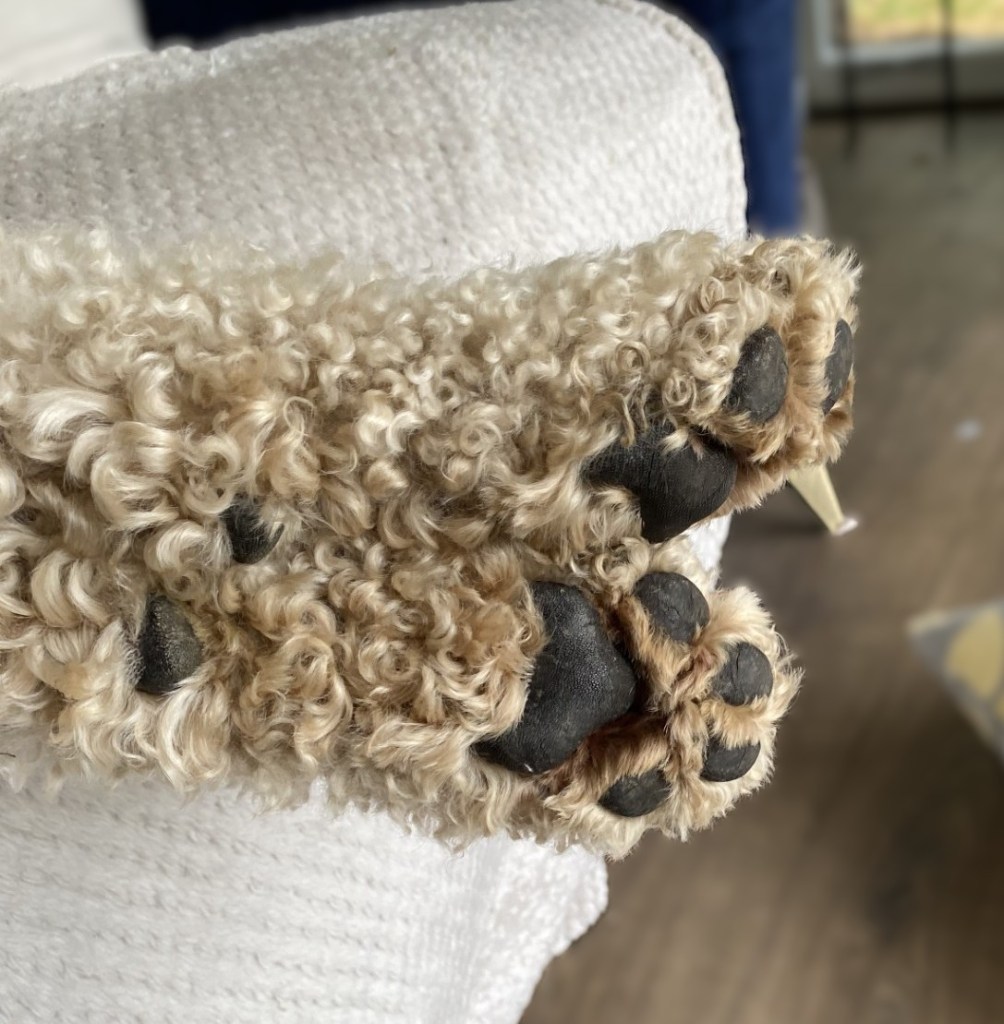
We’ve been looking after Hudson for the past week and we’ll be very sorry to say goodbye to him later today. Is there a better doggy in all of England? I sincerely doubt it. He’s been a joy to look after and a great first experience for us in the world of Trusted House Sitters.
Some friends in Sanlucar are signed up to the Trusted House Sitters app and others to a house swapping app. Both use those apps to travel to interesting places and get their accommodation for free. I’m not yet ready for house swapping – not until I finally get around to installing the new oven that’s been sitting on my kitchen floor for the past six months. Trusted House Sitting seemed like a better fit for us at the moment.
So, a couple of months back, I signed up, paid a small annual fee, got three people to write references for me, created my profile and away I went. This week has been our first dog-sit and I will definitely do it again. We made contact through the app with a couple in a village in the English midlands who needed someone to look after their dog and water a few plants while they were away on vacation. We met briefly by video call and then, last Monday, we arrived.
It has been a perfect experience from start to finish. Hudson is the perfect dog. Giant and gentle, easy going and with (almost) no bad habits (we all have some bad habits after all). He’s a dream dog. The house is like something out of a magazine. A modernized old cottage with an extensive garden that is so easy to live in that, really, I don’t want to leave. All over the house and garden is scattered comfortable furniture where all three of us can find our own space to curl up and read our books. The family photos and grandchildren’s arts and crafts suggest this is a house filled with love. And, there is an amazing office halfway down the garden, where I have been working all week.
The house is situated in a very typical middle class English village, with a decent (if expensive) pub and an amazing village shop. All around are paths and byways through the fields, so there’s no shortage of exercise for Hudson or for us.
Our hosts left easy-to-follow instructions for everything from where to find the doggy treats to how to use the air fryer. A gardener came in one day and a cleaner another. It is no understatement to say that I have been living a lifestyle this week that is so far removed from my normal life.
On this house sit, we didn’t venture far. The house itself and the surrounding are enough of a holiday for us, giving us a chance to experience a different lifestyle. But, already, I’m scrolling the app to look for future house sits in cities or towns that I want to visit and, for some reason, I keep putting in searches in the Alps – I really want to take the girls to the Alps some time.
So now, we will say goodbye to Hudson and to his fabulous home and look forward to more house and doggy-sits to come.
It’s been too wet the past couple of mornings to go walking through the fields, so Hudson and I have been taking a route through the village that takes us up to the village church and through the graveyard.
I love old graveyards. There’s something peaceful and soothing and familiar about them. The silence they offer, with their old mature coniferous trees standing stately amongst the graves. I love headstones that are so old and weathered that they are barely legible and that thrill when I squint or run my hands over the inscription or rub it with grass to better see it and discover that it is the grave of someone who died two or three hundred years ago. There is something timeless and beautiful – an unbroken thread of connection – in seeing someone who was buried only yesterday alongside someone buried 300 years ago.
When I was a child, we visited our family grave at least once a week, usually more. My father’s side of the family is buried in the beautiful country graveyard on top of Carrick Hill, in the shadow of the ruins of Carrick Castle. Back then, there was little traffic on the roads, so we regularly walked the mile from home up to the graveyard – on a summer’s evening, after dinner on Sundays in winter – and we always dropped in to the graveyard on the way home from Mass on Sunday mornings or, indeed, any other time we were driving by. As I grew older and more independent, I would often walk or ride my bike up on my own or with friends, and have a picnic amongst the graves. There were usually other people there too, someone tending a family grave or, like us, dropping in on the way past. So, the graveyard was as sociable place, where we caught up with neighbours and people we might not otherwise see much.
I loved wandering amongst the headstones and discovering the history of the place where I lived through the stories that the inscriptions told. The people buried up on Carrick Hill were the parents, grandparents, great grandparents and all the other relatives of people I knew. I guess it was the nascent anthropologist in me that was interested in family lines and family histories, in relationships and kinship, and in what I could discern about the living from the inscriptions of the dead.
Like many rural graveyards, Carrick tells the history of my family and my community; where people are laid down in death is a reflection of where they resided in life. The Tyrrell family grave contains the bodies of my great-grandparents Eliza and William, my grandparents Roseann and Michael, my great-uncle Pat (his arm buried a few months before he was, after it was amputated due to cancer), my aunt Cissie and Daddy, along with the ashes of my uncle Willie, aunt Vera, and Julian. (I never thought Julian would end up there, but Katie and Lily suggested it and I thought, why not).
Immediately next to my family are the graves of our cousins – who are also our immediate neighbours – the Hickeys, the McGlynns, the Mulraneys, the other Tyrrells. All around the graveyard are similar clusters of neighbours and extended families buried in proximity to each other. The graveyard tells the history of my community and of my family in simple metrics – birth dates and death dates, beloved daughter of, father of, grandson of, sometimes a wife’s maiden name. This simple information weaves together a story of community. The graveyard also tells a social history of status and class, from the small simple headstones of the majority of people of lesser means to the few large headstones and even those who, long ago, were placed in tombs. Although those grave markers are the outward representation of social status in life, beneath the ground everyone meets the same fate.
I’ve never thought of graveyards as maudlin or dark places. At times of death, they are a place where community comes together to pay witness to a life lived and to console the bereaved. At different times in my life, I have found it comforting to sit by the grave of a loved one, and feel an ongoing connection. But, most of the time, they are places that instill in me a sense of peace and that intrigue me in the stories they tell and the histories they reveal.
The heatwave has passed for now. It’s windy and the early morning sky threatens rain. I’m wearing my new raincoat that I bought last week in the height of the heatwave. The sales assistant looked at me funny and I said, “Well, this has to end sometime.” It’s certainly ended now.
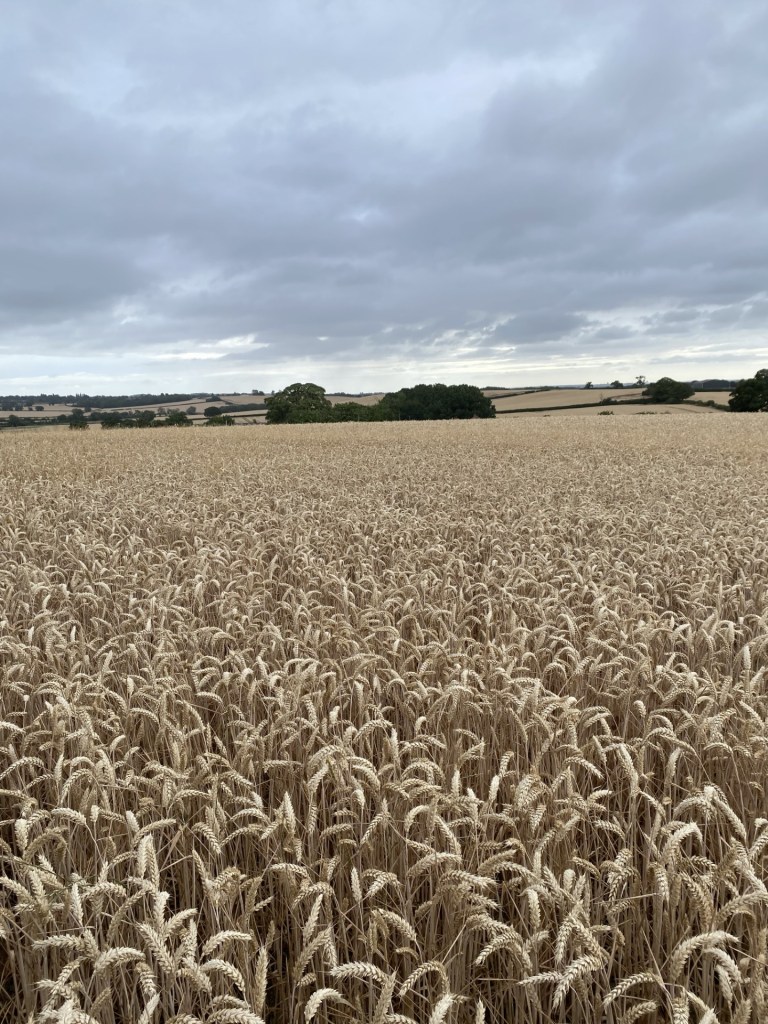
This week, we’re looking after the adorable Hudson (see yesterday’s post) at his home in a little village in the middle of England, while his human parents are away on vacation. It’s 8am and Hudson and I are out for our morning walk. There’s nobody else around, as we walk for a few kilometres along the edges of arable land and across fields of sheep and lambs, from one kissing gate to the next.
One young lamb is curious and tries to come to us, its worried mother keeping pace with it, probably wishing it wasn’t so curious about this big woolly dog and red-raincoated human (what colours can sheep see?). A field of rape seed is half-harvested, a big yellow combine sitting in the middle of the field, ready to resume its work when the rain lets up. I see something move at the wide fallow edge of the field, heads bobbing up and down. I think it is a couple of rabbits at first, but as we get closer, I see that it is a family of grouse. They are disinclined to leave the relative safety of the long grass for the exposed stubble of the field. I think I should turn back and leave them be. But at the exact instant I have this thought, one flies up from right at my feet, completely invisible to me and to Hudson up to now, scaring me and sending all the others into flight too. They fly the 20 or so metres from the grassy verge into the yet unharvested half of the field. I feel bad for them. Hudson is good, though. My own dog, Lady, would be going crazy for them, but Hudson seems oblivious.
A little farther on, I step over a badger sett. It looks neat and tidy and, therefore, in use, and I get a little thrill thinking that, underneath my feet, a family of badgers is likely settling down for the day to sleep. Towards the end of the walk, we pass a small patch of open grassland backing onto a copse of trees. Two hawks circle each other ten or so metres off the ground over the grassland, crying out to each other. One lands in a tree and the other continues to circle, eventually settling on the branch of a nearby tree. Their cries continue to ring out.
I am reminded of other early morning country walks along English pathways – in the Fens and Cambridgeshire, up north in Cumbria and down south in Devon – and of the hares, the muntjac and the red deer, the red squirrels, the badgers and foxes, the eagles and hawks and falcons and owls, of the times I have been privileged enough to see those animals in person and the times when I have found signs and signals that they have been there and may still be there, watching me, the clumsy human, walking through their home.
From the moment my parents took me to see Bambi when I was about four years old, I’ve been a cinephile. There have been so many phases to my cinema going – with Daddy and/or my cousin Sean, every Tuesday evening with my cousin Colette and her friends when I was still a pre-teen, and then, once I got to university, spending every penny of spare change I had on going to the movies. I’d go with friends and I’d go on my own. Lots of my friends spent their spare money on Silk Cut cigarettes; I spent mine on Kevin Costner.
In my third year of my undergraduate degree, I had a two hour cartography class at 10am every Friday. There were two problems with that. First, found the class boring and, second, midway between my house and the Maynooth Geography department was the bus stop for the number 66 bus into Dublin.
I attended the first few classes of the first term but, as the weeks wore on, I found myself more and more often stepping into the bus if it happened to be there as I walked past. On those days when I got on the bus rather than going to my cartography class, I would arrive in Dublin in time to fit in three films throughout the day. I can’t remember the names of the cinemas or if they’re there any more, but there was one on either side of O’Connell Street and another over on the end of D’Olier Street. Sometimes I’d spend all day in one cinema, other days I’d flit from one to the other and back again, grabbing a cheap sandwich in between. I went to see everything, apart from horror; some films I saw multiple times, even going out at the end of one showing to buy a ticket and go straight back in to the next.
Soon I was hopping on the number 66 bus every Friday morning, not thinking twice about the class I was missing or the assignments I was supposed to be completing and submitting every week.
One week, the bus wasn’t there, so I carried on to the Geography department and into my class. I sat amongst my friends and the class began. About 20 minutes in, there was a knock on the door and Professor John Sweeney asked if he could see me. I got up and went out with him. (My friend Niamh told me later that she thought I was being called out because I was going to get some award for my excellence in geography!! One thing I’ve always loved about Niamh is her blind faith in me!!)
I followed Professor Sweeney up to his office and he sat me down. He seemed very concerned about me. ‘How are you?’ he asked. When I told him I was great, he asked how was my family, how was my health, how were things at home. To all his questions, I told him everything was great. I had no idea where he was going with this.
‘We have students who start out poorly in this cartography course and then drop out. And we have those who start out well, but then their assignment grades drop and then they drop out. But you,’ he said. ‘You started out with good grades and then suddenly stopped submitting your assignments. So I’m worried that something is wrong.’
A smile broke out on my face. Relief. And told him the truth. About my love of cinema. About the timing of the number 66. About how I spent my Fridays. About finding the cartography class a bit boring. My honesty disarmed him or caught him off guard. He was probably relieved that he didn’t have a student in crisis situation on his hands. Whatever it was, he gave me another shot.
Monday was a bank holiday, so he gave me until Tuesday at 10am to submit the seven assignments I’d missed. I returned to class. I spent the next three days catching up (admittedly with a major dollop of help from Niamh’s, Paula’s, Sinead’s and Fionnuala’s assignments) and handed them in on Tuesday morning. I didn’t miss a Friday morning cartography class for the rest of the year.
I thought about all of this at 10:30 this morning when Katie suggested we race into Leamington to catch the 11:10am showing of Jurassic World Rebirth. I sat in the dark at the cinema, my eyes wide, excitement mounting as the trailers rolled. I looked over at Katie, and thought ‘That’s my girl.’
I’m walking along the Grand Union Canal that runs behind the estate where my father-in-law lives. It’s a glorious evening and I’m on a video call with Katie who is away on the south coast this week with Lily and their uncle and aunt. I walk past four or five narrow boats. On the last boat in the row, a modest white and blue steel boat, a man is standing. I have the phone up, so he thinks I’m filming him or taking his photograph. He gives me a big smile and says something. But I’m talking to Katie, so there’s some confusion. He then realises that I’m not taking his picture and I realise that he’s talking to me. More than that, I hear his Irish accent and he hears mine.
“Where are you from?” he asks. “Kildare,” I reply. “Ah, a Lillywhite,” he says and I know immediately that I am firm ground. Despite his Dublin accent, he tells me he’s from Dungarvan in Co. Waterford. “The husband of one of my best friends is from Dungarvan,” I tell him. I tell Katie I’ll call her later because I have a feeling I might be chatting here for a while.
Sean and I chat for an hour, me standing on the grassy tow-path, he on the open deck of his narrow boat, the air cooled engine exposed to the evening air. We discover we have people and places in common. He pootled a narrow boat up to the harbour in Edenderry in the late 1960s and remembered going for a drink at The Harbour House. That was my uncle Tom’s favourite haunt, owned by Mary O’Connor, my Irish teacher, and her family. I was only in The Harbour House once, for a pint of Guinness with Tom back in the early 1990s. It was everything you would expect of a small Irish pub, all the old men lined up at the bar. It was renowned for its music and for Mary being as strict behind the bar as she was in the classroom.
Sean tells me about his job at Shannon airport and about people from Edenderry he knew there and at Ardnacrusha power station. I mention people I know who he might have known and we laugh when we get a bit tangled in Johns and Seans and who was who.
I tell him I had been a sailor and we talk about the joys of my Westerly Conway. He wonders how a girl from the Bog of Allen and a boy from the housing estate 20 metres from here could have ended up living on a boat and sailing to the places we did. He tells me of his adventures as a sea sailor and as a narrow boat owner and about his sustainable, no-cost approach to life.
At 80 years of age, he is only a few years younger that Daddy would have been. The Cuban Missile Crisis comes up in conversation (he makes me promise not to tell anyone why) and he shares his reminiscences of those few days in 1962 and I tell him what Daddy told me of his memories and fears of those days.
He explains how he has come to have that Dublin accent but says his heart remains firmly rooted in Dungarvan. He already owns a plot in Dungarvan graveyard where he wishes to be buried when his time comes.
“I had a half pint at the Cape of Good Hope a while ago,” he tells me, referring to the pub just a couple of hundred metres away. “When I went to the bar, I heard two men behind me. A Mayo man and a Galway man. Sure, I had to talk to them. The Mayo man was a bull man.”
“A bull man?” I ask, perplexed. “Ah, you’re too young,” he says. He explains what a ‘bull man’ is and realisation dawns. “Ah,” I say, “You mean the AI man. That’s what we call it where I come from.” He laughs and says how funny that we had that in Ireland where the Catholic church didn’t allow such things for humans. AI, for those of you not in the know, means, artificial insemination, and the Bull man or the AI man was, and remains, an integral part of our dairy and beef industries.
My daughters always tease me when I speak to other Irish people, accusing me of changing the way I talk and the way I hold myself. They’re not wrong. But I don’t do it on purpose. When I’m with other Irish people I become the version of myself that is the oldest part of me. I speak in the way I learned to speak as a baby, in the first accent I ever heard from the people and the place where I grew up. It is the accent, grammar, syntax and vocabulary that I am most comfortable with. There’s no modulation, no register change, no code switching. I am me at my most comfortable.
We all change our registers in different contexts. For instance, the way we speak to small children is not the same as the way we speak in the corporate office. The way we speak in church is not the same as on the terraces of the football stadium. But changing accents is something different. Over the years, I have modulated not only my accent, but the words I use when in conversation and the order in which I say them. Why? Well, for two reasons – one that I am comfortable with, the other less so.
For most of my life, I have chosen to live among people for whom English is not a first language. Therefore, to make myself understood among English speakers in Japan, Nunavut, Spain, and elsewhere, I slow down, speak carefully, use very standardized words and phrases to be understood and to make the person I am speaking to feel more comfortable. That is now second nature to me.
The other reason is that, over the years, I have been very aware of people making fun of my Irish accent – people laughing and repeating my pronunciation, my use of certain phrases or my Hiberno-English sentence structures. In order to reduce the feeling of discomfort (and anger) that this fun-making and ridicule causes in me, I modulate and change register. It’s just easier. I don’t like it, but it is how it is. That too is now second nature to me when I am around native English speakers who are not Irish.
But, when I speak to other Irish people, I can feel my body physically relax. I don’t have to think of an alternative phrase or word for ‘give out’, ‘press’, my use of bring/take, my pronunciation of H and th, or a thousand other usages of words and phrases. I’m not going to be laughed at for calling my parents Mammy and Daddy. I can throw in a reference to the GAA or to Eamon Casey or to the Angelus or to a million other things, and no further explanation is required. I can just be.
All migrants, no matter what their language or their circumstances, experience this distance from their first voice. Some people are happy to leave that first voice behind. I am privileged to have had so many opportunities to travel in my life. I have learned so many wonderful ways to speak and to see the world through the eyes of others. But speaking in the way that is oldest to my being is like relaxing into a large warm bath.
Sean is stuck along this stretch of the canal for the time being, as he waits for a lock gate farther along to be repaired. I tell him that if he’s still there the next time I walk that way, I’ll invite him down to the Cape of Good Hope for a beer. Who knows? Maybe the AI man will be there.




 Me in place