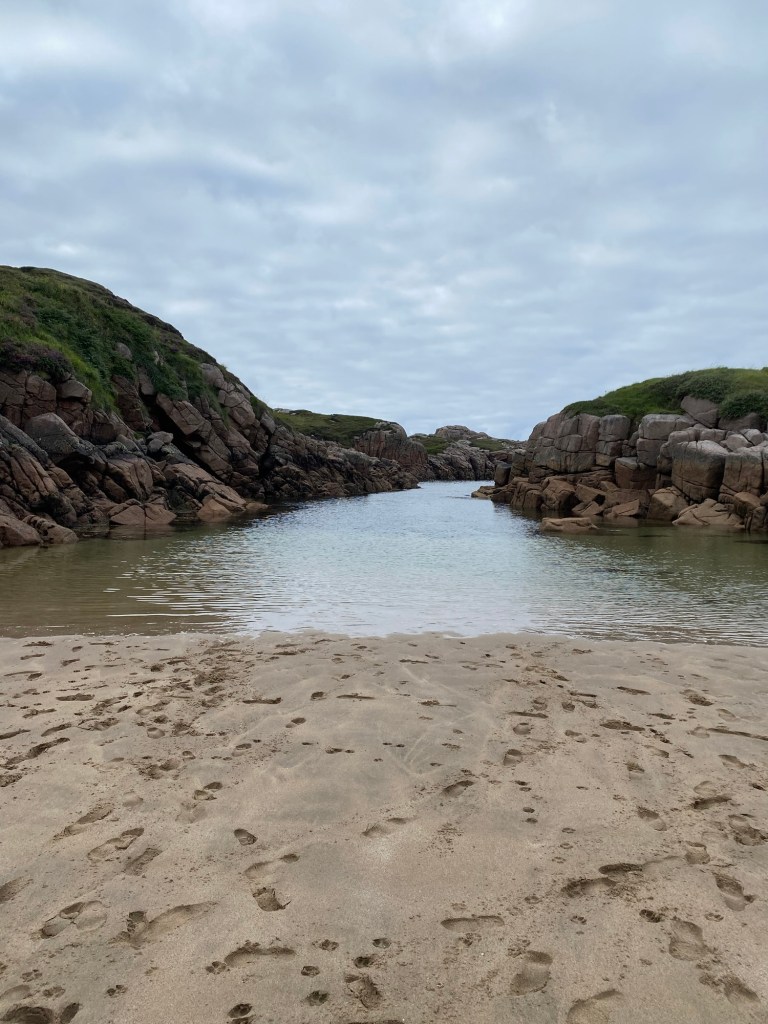
A couple of action packed days and late nights have come between me and writing. I wouldn’t swap these days for anything. I’m in Cruit tonight, back again after three years. This evening’s walk across this island off northwest Donegal was, as always, a delight…
The heatwave has passed for now. It’s windy and the early morning sky threatens rain. I’m wearing my new raincoat that I bought last week in the height of the heatwave. The sales assistant looked at me funny and I said, “Well, this has to end sometime.” It’s certainly ended now.
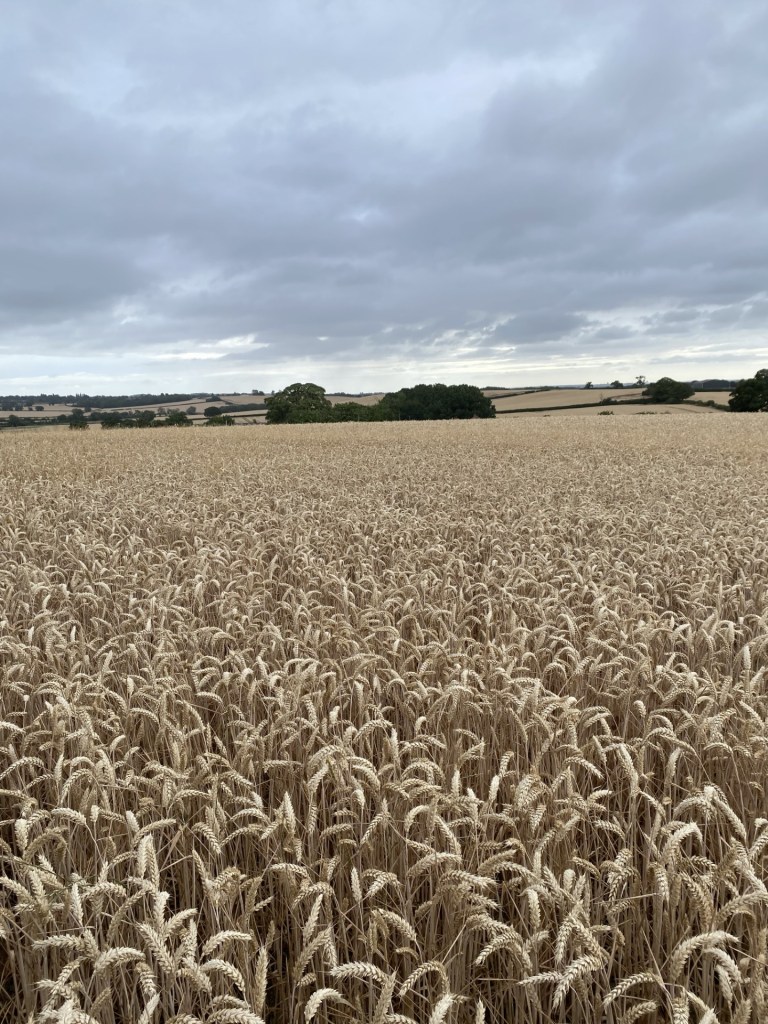
This week, we’re looking after the adorable Hudson (see yesterday’s post) at his home in a little village in the middle of England, while his human parents are away on vacation. It’s 8am and Hudson and I are out for our morning walk. There’s nobody else around, as we walk for a few kilometres along the edges of arable land and across fields of sheep and lambs, from one kissing gate to the next.
One young lamb is curious and tries to come to us, its worried mother keeping pace with it, probably wishing it wasn’t so curious about this big woolly dog and red-raincoated human (what colours can sheep see?). A field of rape seed is half-harvested, a big yellow combine sitting in the middle of the field, ready to resume its work when the rain lets up. I see something move at the wide fallow edge of the field, heads bobbing up and down. I think it is a couple of rabbits at first, but as we get closer, I see that it is a family of grouse. They are disinclined to leave the relative safety of the long grass for the exposed stubble of the field. I think I should turn back and leave them be. But at the exact instant I have this thought, one flies up from right at my feet, completely invisible to me and to Hudson up to now, scaring me and sending all the others into flight too. They fly the 20 or so metres from the grassy verge into the yet unharvested half of the field. I feel bad for them. Hudson is good, though. My own dog, Lady, would be going crazy for them, but Hudson seems oblivious.
A little farther on, I step over a badger sett. It looks neat and tidy and, therefore, in use, and I get a little thrill thinking that, underneath my feet, a family of badgers is likely settling down for the day to sleep. Towards the end of the walk, we pass a small patch of open grassland backing onto a copse of trees. Two hawks circle each other ten or so metres off the ground over the grassland, crying out to each other. One lands in a tree and the other continues to circle, eventually settling on the branch of a nearby tree. Their cries continue to ring out.
I am reminded of other early morning country walks along English pathways – in the Fens and Cambridgeshire, up north in Cumbria and down south in Devon – and of the hares, the muntjac and the red deer, the red squirrels, the badgers and foxes, the eagles and hawks and falcons and owls, of the times I have been privileged enough to see those animals in person and the times when I have found signs and signals that they have been there and may still be there, watching me, the clumsy human, walking through their home.
In late December, I set myself a challenge to walk 200km in January.
2023 had been an exceptional year for me. I was joyful and exuberant in turning 50 and everything about my life seemed to glow. That was until the end of the year, when it felt as if someone let the air out of my balloon. From early December, I felt lost, drained, living in a cloud of cotton wool, from which I neither could nor desired to work, be with other people, or drag myself out of the house.
Happiness and contentment are my default modes. If chemical imbalances play a role in the onset of depression, then I often think that I have chemical imbalances in the other direction. I’m chronically happy. I’m annoyingly upbeat. My glass is always way more than half full.
Except at the end of 2023, when it wasn’t. I had no reason to feel down, and yet I did. A weekend in Sevilla uplifted me momentarily but, even there, I was unusually sharp with my daughters and, at times, felt the strain of being in a city more acutely than usual. Then I came down with COVID and a week in Tenerife over Christmas that was supposed to relight my lamp instead left me feeling even more down in the dumps. I returned home to Sanlúcar COVID-free but feeling flat.
Then one day, in the last week of December, I set out to walk the dog. Not an ‘oh god, I’ve got to walk the dog’ sort of walk, the kind that had become my default over the past year, when I’ve increasingly cited lack of time, but a ‘let’s see how far we can go’ sort of walk, with a backpack on my back, containing my water bottle, a notebook and pen, and my phone to take photos. I walked north, along the path that leads up the river, stopping to allow myself to be enveloped in the silence, to watch a raft of canes drift down the river, to marvel at the orogeny on a wall of rock. The dog, of course, loved it too, walking farther than she had in months. At the farthest point from home, I decided to set myself the challenge of walking 200km in January.
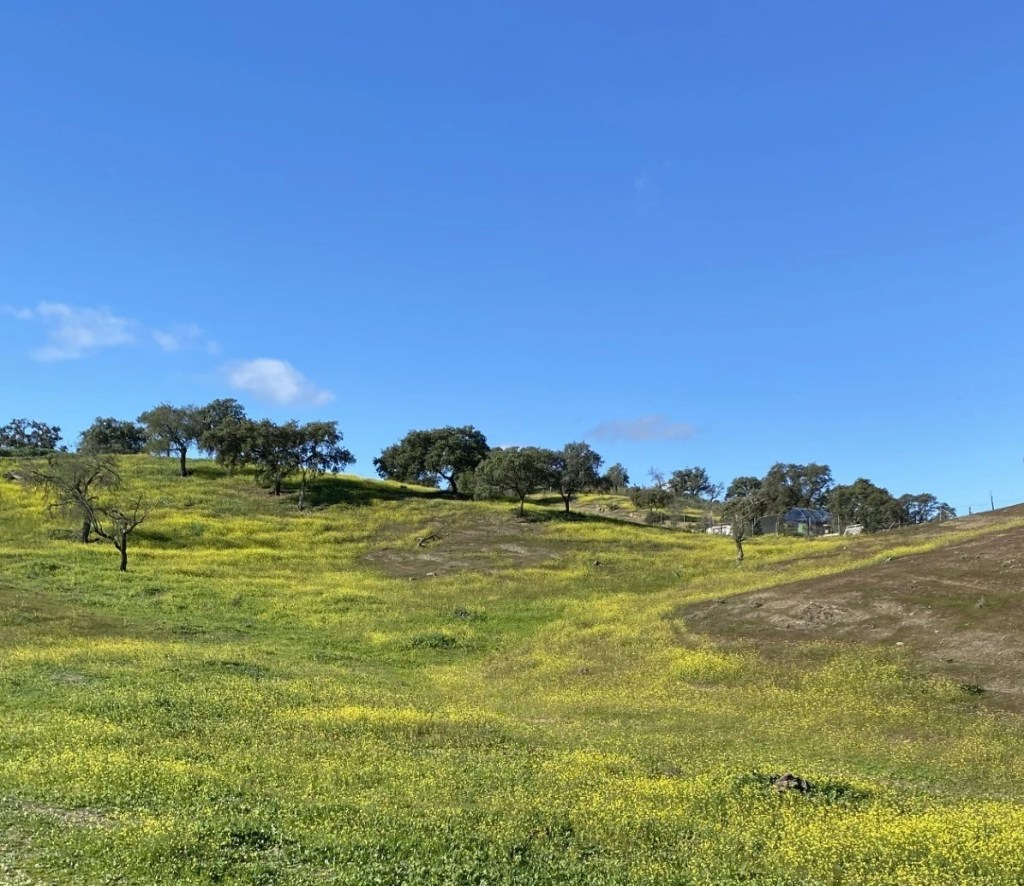
I walked for the first few days of January, recording the distance so that I had a sense of how far I might walk in a certain amount of time and considering how I could make space in my work day for this challenge. On each walk, I was uplifted. The land was brightly green, decorated with patches of wildflowers, yellow and white. It was a balm to the eyes and to the soul. Each day, though my spirits descended again when I returned from my walks, the troughs were not so deep. By the second week of January, I felt like myself again.
Some days I walked 10km or more, one day I only managed 1km. I walked at all times of the day – in cold early morning mist in jacket and woolly hat, bright afternoon sunshine in t-shirt and sunglasses, at sunset, carefully picking my way along rocky paths in the dark; Lady always my faithful companion, the land I walked through nourishing and uplifting me.
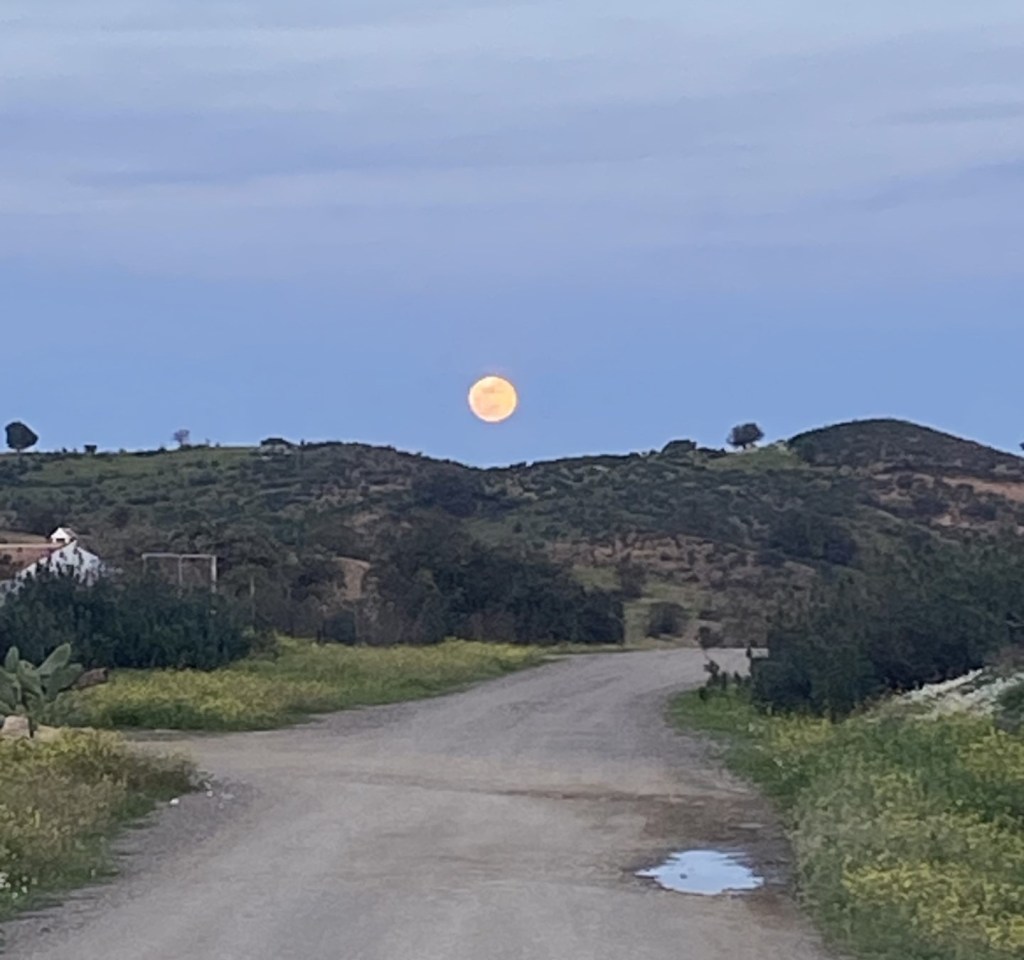
By the end of the month, I had walked 201km, along paths leading out in a radius from my house. I became reacquainted with places I hadn’t walked in years, just as I became reacquainted with why I love living here in the first place – the immensity of the land, the stories it tells of the people who lived here before, if only you take the time to read those stories in the landscape, the other creatures nourished by the land, and the river that brought me here snaking through it all; the vastness of the sky, at times a blue so deep as to seem unreal, at times ominous shades of grey, at night the riot of stars a glorious reminder of my insignificance, the Milky Way mirroring the route of our little river.
Over the course of the month, I observed changes taking place – sudden changes brought about by a heavy rain shower, slower changes as grasses grew, the number of lambs in a herd of sheep increased dramatically, the oranges continued to ripen and fall from the trees. I have found one, two, or even three hours in each day to walk. Those hours were there for the taking all along, I just failed to see them. Walking became the fulcrum of my day throughout January, uplifting me, soothing my soul, reassuring me that in the face of such ordinary magnificence, it is only to be expected that happiness is my default mode.
As for February? I’m back on the tracks and trails again, mostly in the lengthening evenings, challenging myself to another 200km. It hardly feels like a challenge. It’s starting to feel more like a drug.
The Ribera Grande dries up every summer, leaving only pools of varying depths on either side of the channel. I like to walk the dog there. Sometimes, I pack a picnic, bring my book, and go with the children to one of the larger, deeper pools to swim. On a hot summer morning, it’s a great walk. When it’s already 30˚C by 9am, I can do a lazy slow 1.5km walk, while Lady covers three times as much ground at least, running ahead, running back to me, swimming in most of the pools we encounter. She gets a ton of exercise but stays cool and I don’t get heat stroke from doing one of my more usual 7 or 10km walks.
I rarely meet anyone. In the three years I’ve been walking that river bed, I can only remember three occasions when I met another person. The place is devoid of human sounds and full of life. Steep rock walls rise up on one side of the river – with the deepest pools at the base of those cliffs – and, on the other side, the hills are somewhat less steep. We usually disturb partridges and larks and, occasionally, I see vultures flying overhead.
A few weeks ago, the dog, the kids and I went there for a walk. A disturbance in the river to my left caught my attention. I turned to see a flash of iridescent blue and orange. Two flashes, in fact. I whispered to the girls to stop and look. Two kingfishers were in a mid-air battle over a fish. The fish’s head was in the mouth of one bird and its tail in the mouth of the other. The two birds flapped their wings furiously, each pulling in the opposite direction as they tried to stay in flight – a mid-air fishy tug-of-war. At one point, they lost momentum and both fell to the surface of the river, neither losing its grip on the fish, splashing through but then rising again from the river, with the fish still extended between them. I was in awe; mesmerized. They can’t have been unaware of our presence; we were very close to them. But their aerial battle for breakfast was more important to them than the presence of three curious humans and a dog.
I can’t be sure of what happened next, because it happened so quickly. Did one of them win the battle, turn tail and fly up river? Or did they both lose, as the fish fell from their mouths and into the water? I don’t know. But one of them did turn heel and dart up the river, zipping along about a metre above the water, with the other in hot pursuit.
Recently, as I recounted this story to some friends, I recalled another mesmerizing encounter along the same stretch of river at almost exactly the same time last year. That time it was just Lady and me. Something halfway up the hillside caught Lady’s attention and I turned to look. There, on the hill, were three cats, the most unusual looking cats I had ever seen. From that distance, all three looked identical and each was about the size of Lady – in other words, a medium sized dog. They were spotty and had distinctive long and full ringed tails, like lemur tails. They eyed Lady and me and we eyed them. I was in awe, and had no idea what they were, but assumed they must be Iberian lynx. The three suddenly turned tail and ran farther up the hill, keeping low to the ground, and eventually were over the hill and out of sight.
When I came home, I Googled lynx. They certainly weren’t lynx. And someone who knows the ecology of the area better than I do later told me that there aren’t any lynx around here. For a year, I have wondered what those strange cat-like creatures were.
And so, when I recounted the kingfisher story to my friends, and followed it up with my story of those strange cats, one of my friends immediately said, ‘They’re genets.’ We Googled them and, sure enough, the Google images were of precisely the creatures I had seen last summer. Genets are an African animal in the mammalian suborder feliforma. They are distantly related to cats, sharing a common ancestor many millions of years ago. They are native to Africa, but one subspecies, the common genet, was introduced to Iberia in historical times and is now also found in France and Italy.
The mystery was solved, I was now aware of the existence of another medium-sized mammal species, and I was delighted. Every time Lady and I go on that walk, I am filled with a sense of anticipation. I hear a rustle in the undergrowth, disturb a locust resting on a rock, delight in butterflies flitting from shrub to shrub. My heart lifts at the plop plop of frogs leaping into the pools, at the families of partridges running across our path, taking impossibly long to take to flight. I feel eyes on me as I walk. Even if I see only birds and insects, I know there are other animals watching us, keeping us in their sights, interlopers in their home.
It is a giving place. At a time of year when other much-loved walks are too hot or too cumbersome to undertake, the river dries up just enough to allow me to walk on the dry bed, but leaving pools deep enough for the dog, the children and I to cool down in. It is a place to be cherished.






 Me in place