Each year, on the first (or sometimes the second) Saturday in December, my family would go to Dublin to do our Christmas shopping. It was a huge day out and we would be up and on the road early, like half of the rest of the population of rural Ireland. The traffic was usually heavy, the weather generally bad, and there was always the anxiety that there might not be any parking spaces left for our red Ford Escort in the Penney’s car park (there was always space). We stuck to Henry St. and Mary St., and the futuristic Ilac Centre, when it opened, traipsing from one crowded shop to the next, seeking out new outfits that we would wear on Christmas Day, and new winter coats for my sister and me, if we hadn’t already got them in one of the drapery shops in Edenderry. We each had lists of Christmas presents we wanted to buy – presents for each other, for our friends and other family members. We’d take a break for tea (Daddy), coffee (Mammy) and cake, and Knickerbocker glories (Antoinette and me) at the Soda Fountain in the Ilac Centre (was there ever a place more fabulous?) and a middle of the day dinner in the cafeteria of one of the department stores.
When I say ‘we’ shopped for this and ‘we’ looked for that, what I really mean, of course, is that Mammy, Antoinette and I did. Daddy’s role in all of this was to facilitate our shopping, first as driver and, once the car was parked, as bag carrier. At first, he’d come into the shops with us, look around, offer his advice on an outfit if we asked. But, as the day wore on, and the number of bags he was lugging in each hand grew, it became more cumbersome for him to come into the shops. With all those bags around his thighs and knees, he simply was too bulky to get around the narrow aisles in between rails of clothes. So, he’d stand outside the front door of the shop, a little to the side, so he wasn’t in anyone’s way, in the December cold, weighed down by all those bags, patiently waiting while the three of us tried on clothes and bought presents and browsed through books or records in overheated shops. At some point, he’d make a trip back to the car to dump all the bags and then return to us to start the process again.
He wasn’t alone. Outside every shop on Henry St. were two or three men like Daddy, all in the same boat, all patiently waiting, bag carriers, while their womenfolk were inside enjoying themselves.
That’s one of my abiding memories of the build-up to Christmas. I don’t remember what we tried on, or what we bought, or what we filled those bags with. That was all just stuff. But I do remember Daddy, patiently and good-naturedly standing in the cold, making sure that we were having a good time. Like always, putting ‘the wimmin’, as he called us, first.
About eight months ago, I read Suleika Jaouad’s memoir, Between two kingdoms, a beautiful account of her life with leukemia when she was in her 20s. In one part of the book, she describes how she and her parents undertook a 100-day project – each of them committing to one act of creativity every day for 100 days. Her mother painted one ceramic tile a day, her father wrote one memory a day from his childhood in Tunisia, and Suleika, too weak to do much of anything, journaled. That’s a nice idea, I thought at the time, and didn’t think any more about it.
A few months later, I was thinking of ways to reduce my outgoings. Work had dried up and my bank balance was plummeting at an alarming rate (I’ve come out of that slump for now, thank goodness). I started to cancel subscriptions – Apple Music, Amazon Prime, that sort of thing. I hadn’t posted a blog on WordPress for over a year, yet I still had my subscription set to autopay. Two things bothered me about this. First, I knew it was a waste of money to have this subscription but not use it. Second, I wanted to write blogs, yet I never did. When I went to my WordPress account, I saw that my subscription was active until January 2026 – over seven months away. I could leave it sitting there and do nothing, or I could use that time to actually write something.
There and then, I set myself a challenge to write ten blog posts, starting that very day. I’d number them, for myself, as a reminder that I was doing it and how far along I was in the challenge. On the 18th of June I wrote the first one, about how busy life was in the last few days before the end of the girls’ school year. The next day, at the same time, I wrote another and then another. As I crept closer to number ten, I knew I wanted to keep going, so I committed to twenty. By the time I reached day fifteen I had committed, privately, to myself, that I would write 100. So I did. Every day, without fail, I wrote and published a blog. And today is day 100.
It wasn’t always easy. Ideas were never a problem. Every day I found something to write about, generally without even searching for it. Something always popped into my head. Indeed, there were quite a few days when I drafted something in the morning, but it was superseded by something else later in the day. Those drafts are still lying dormant in my drafts folder.
Instead, what got in the way or caused resistance was tiredness. I was travelling all summer, visiting family and friends in the UK and Ireland, and working at the same time. When I was in the UK, it was generally easy for me to get my blog written and out into the world by mid-morning. Things changed when I went to Ireland, where I spent so much time in conversation with family and friends that the day would slip away and the blog wouldn’t get written until I was already in bed, very late and feeling very sleepy. Occasionally, all I had the energy for at that time of night were a few photos of the day with a brief excuse for why I couldn’t write more.
But I was called back to write again, create again, share again every day. I saw that people were engaging with me – sending me messages, liking my posts – but I rarely had time to respond. I hope to respond to everyone in time. But seeing all that support was a marvelous motivator. I didn’t write to get likes or gain followers. My reasons for posting were more personal, for two reasons. First, I write all the time, but often lack the confidence, the courage, the self-belief to share what I’ve written or, indeed, to complete something I’ve started. Posting every day, without having the time for too much self-criticism or interrogation, was an act of forcing myself to put my writing out into the world without overthinking it. The positive responses I’ve received have been nothing but encouraging. Second, like many people, I so often start things that are for me and me alone, and then drop them because I prioritize the needs of others. How many times have I started a new routine – yoga, a commitment to exercise, a writing practice – only to let it slip because ‘I just don’t have time.’ This time, I made the time and I reached the finish line and, you know what, it feels great!
Writing something every day for these 100 days has reminded me to be more observant – to pay attention to the words people use, to see the colours and shapes in the world around me, to really see the material things around me.
So, where do I go from here? I will certainly continue to blog, but I’m giving myself a break from doing it every day. During these past 100 days, I’ve written a lot of rambling fluff. But I’ve also written some pieces that I think are rather good. I’d like to return to those now, maybe expand on some of them, share them on other platforms, such as Substack or Medium, and maybe even see if I can revise them and submit them for publication or writing contests. There are also pieces that I’ve written over the past 100 days that will definitely find their way into my memoir, which I have been writing for a little over a year now (I have to finish it!).
The past 100 days have taught me that I can do it, that my nearest and dearest will get used to it as part of our daily routine, and that no matter what your intention when you make a piece of writing public, readers will never cease to surprise you in the way they interpret it.
Thank you everyone who has been with me for the past 100 days. The silent ones and those who have sent me comments via social media or who have emailed me, and those who have stopped me in the supermarket or at a funeral to say they’re reading along. See you all soon!
What’s your favourite smell? Freshly mown grass? Fresh coffee? That smell when you nuzzle your face into a baby? Why is it your favourite smell? Do you know?
I was sitting at my desk yesterday morning, the window open to cool the house down before the heat of the day kicked in. That’s when the smell came tumbling in and nostalgia stroked my face like a feather. One of the council workers was strimming the strip of grass that runs the length of my street. And there it was: The smell of exhaust from a 2-stroke engine. There’s comfort in that smell for me and it’s deeply entwined with so many good memories.
We’re living on Carina of Devon. Me and Julian and the girls. The smell of a 2-stroke engine is us leaving Carina to head off on an adventure in the rubber dinghy. Maybe it’s all of us, going ashore to explore a new place or to wander up a river that’s too shallow for Carina‘s draught. Or I’m on my own, the freedom of having the outboard tiller in my hand, setting out to go for a solitary walk or to go shopping or do the laundry. Or it’s Julian, taking the girls across the Rio Guadiana to school. Or it’s all the other yachties we met over the years, the smell and sound of a 2-stroke outboard motor signalling their arrivals and departures from their anchored yachts. It’s adventure and freedom.
Strip that layer away, and I’m living in Arviat. It’s summer, with open sea and lake-pocked land. I have my own quad bike and I zip around town in the near 20-hour daylight, picking my friend Crystal up at 3am, so we can go check the fishing net we’re sharing for the summer, or meeting Frank at 5am to go beluga hunting. His quad has Arden’s boat trailer attached on the back, so I hop on and reverse the quad into the sea under Frank’s guidance; he offloads the boat, as I park the quad and trailer. Or I’m out along the road to the dump, or the road past the reservoir, at twilight or after dark, speeding along way too fast, sometimes alone, sometimes not. In my mind, I’m a badass. In reality, probably not.
Strip that layer away, and I’m living in Arviat. It’s spring, and I’m at the floe edge with Arden. We’ve come by skidoo; him driving, me sitting in the qamutik (sled), facing back towards Arviat, back towards the direction we’ve come from, to shield myself from the powdery snow blown up by the skidoo runners. I’m surrounded by the immense beautiful whiteness of the west coast of Hudson Bay. We’ll stop when we get to the floe edge. Arden will talk to me and teach me, I’ll try to remember everything; we’ll drink tea and eat the bannock Theresa has made for us.
Strip away that layer and I’m at home in Ballygibbon. I could be 10 or 20 or 25. The 2-stroke exhaust is Daddy mowing the lawn. It’s the ease and efficiency of the first petrol-powered lawn mower after years of a small, manual one. It’s me spending summer evenings following Daddy round the garden – at 10 or 20 or 25 – just for his company and the important things we have to talk about – Gaelic football and films and music, a bit of politics and other sports.
When I catch a whiff of 2-stroke exhaust, it doesn’t conjure any one of these times in my life in particular. Rather, it mashes them all up, and loosens something in me, a knot unravels, and a feeling of belonging rushes through my veins. Now, I am here, with a view out my window that’s as green as I could ever have hoped for. And a new layer is added to my love of that smell.
I remember the phone ringing down the hall. Mammy got up from the kitchen table to answer it. ‘It’s for you,’ she said, coming back to sit down. ‘Someone from Canada.’ I walked down the hall to the table by the hall window and put the receiver to my ear.
‘Hello?’ I said.
‘Huvi?’ came the reply. Frank. Dear Frank. My friend, my teacher, my hunting buddy. One of my primary research participants in Arviat, it was Frank who had taught me to skin and butcher caribou, and to get it right by doing it over and over; Frank who had taught me how to drive a boat amongst pods of beluga whales in the shallow waters close to shore, so he could harpoon them from the bow; Frank who put me on polar bear patrol while he collected the arctic char that had swum into his fishing net; Frank who I spent hours and days with, far inland on our quad bikes, out at sea at first light. He and Martha welcomed me into their home, made me tea, fed me biscuits and bannock, took me out on the land and to their cabin with their daughters. Frank made me laugh and made me think. How at ease I felt in his company.
And now, he was on the phone. He on the tundra, on the western shore of Hudson Bay; I in the Bog of Allen, in the middle of Ireland. And the distance between us seemed vast. Vaster than the Atlantic Ocean, and maritime Canada and the width of Hudson Bay that separated us. All that we talked about with such ease when we were together dissolved now across the expanse.
He asked about the weather and I told him. But what was Irish weather to him? What was the Irish autumn, with leaves changing colour and falling off the trees, the rain and the mud, when he lived in a place with no trees, where autumn meant the ground covered in snow and the sea gradually turning to ice, travel by boat giving way to skidoos. My autumn meant nothing to him and, from this distance, his autumn was starting to dim for me.
I asked what he’d been doing and he told me where he’d been seal hunting the previous day, who he’d gone with and the other hunters he’d met when he was out. I smiled as he spoke. In my mind’s eye, I could see where he’d been and who he’d been with. I had been there with him, and with his brother-in-law Arden, just a few weeks earlier.
He asked what I’d been up to. It was September and in Ireland there was only Gaelic football in the air. How could I tell him about the match I had been to on Sunday? About the crowds, the excitement, how important football was to my life here? Or that the turf was home and there were still a couple of loads to be thrown in the shed. My voice sounded strange in my ears as I tried to talk to him about my life here.
I’d lived in his world and loved it. He was interested in my world, but had no experience of it. The ease we felt in each other’s company was made jagged by the cultural distance that now lay between us.
We continued to speak on the phone occasionally and I got to spend another summer with him a few years later. It’s a few years now since he passed away. I wish I had been better able to bridge that distance when he called.
Arriving into Sanlúcar de Guadiana last night, I was surprised at just how happy I felt to be home. Just a simple feeling of contentment at being back in my own home.
Our seventy-five days in the UK and Ireland were delightful from start to end. I haven’t enjoyed myself so much or for so long on previous holidays. England was a joy and I experienced very strong positive emotions when I was in Ireland, whereas in the past my feelings have often been mixed. Not because Ireland isn’t great and not because my family and friends aren’t great. It was just me and where I was in my life on previous visits home that made me enjoy being in Ireland on holiday but also eager to return to where I had come from. I didn’t feel that way this time. I enjoyed my time there, and had very mixed feelings about leaving, feeling more torn between the two places I call home than I’ve ever felt before.
So, what a surprise to feel the way I did about turning the key in the lock and walking through my front door last night. Like an exhalation…I’m home. My house is looking a bit the worse for wear after lying empty for seventy-five days and it’ll take us a few days to sweep away the cobwebs, get unpacked and feel properly settled in, but that simple uncomplicated sense of being home was there from the moment I opened the door.
Our lovely friends had been in and left some food in the fridge and our neighbour had hung a fresh homemade loaf of bread on the front door. Still, I needed to buy a few odds and ends this morning, so, after breakfast I threw on something not very presentable that I pulled out of my suitcase and went to the two shops in the village. Ten minutes of shopping took me about three quarters of an hour, from all the people I met, the welcome back hugs and kisses I received, the conversations I had comparing Spanish and Irish weather. I felt welcomed home by my adopted village.
And then, the icing on the cake – collecting Lady from her summer villa (with a swimming pool, no less) and taking her home. Now that our scruffy, dusty, hair in her eyes Lady is back, my little home is complete.
Who cares that our two kayaks are still taking up most of the living room and the suitcases are on our bedroom floors? Time enough moving them tomorrow.
The rain fell sideways as we packed the car this morning. Mammy had moved the car to as close to the door as she could get it. Still, we swopped bags of food and our mini suitcases for water and leaves trailed into the house underfoot.
It was a tight squeeze, five of us and all our stuff filling up the boot and obscuring the rear window. I remember rainy Saturday mornings just like this, in the early 1980s, Daddy hoisting the suitcase, the wind break, the deck chairs, onto the roof rack of the Ford Escort, covering the lot with the blue tarpaulin from an old tent, securing it with rope.
I had the playlist ready for today’s drive to Cork – 80s hits, of course, that we sang along to in between bursts of conversation.
The rain continued – sporadic heavy showers – and wind buffeted the car sideways. We pulled in to the Rock of Cashel for lunch – ham sandwiches made from yesterday’s boiled ham and Brennan’s bread washed down with sweet black tea from a flask. We stood around the picnic table in the rain, the hoods of our raincoats up, as a sudden heavy shower chased away the slash of blue sky that had briefly appeared. I couldn’t have been happier. Few things in the world taste as great as ham sandwiches and tea from a flask on a wet day, memory and nostalgia adding magical flavour to the food.
We reached our destination late afternoon and quickly unpacked the car. My sister started to make dinner and realized she was two ingredients short. Lily and I walked the couple of hundred metres up to the shop in the village square. On the walk back, we were blown down the hill by the strong wind, rain hitting us on the back. ‘This is perfect,’ I said to Lily. A seaside holiday in Ireland isn’t complete unless you get at least one wild night like this.’ The wind, the rain, the slight bite in the air, took me back 30, 40, 45 years, to family vacations here in west Cork, in Kerry, in Wexford, in Mayo.
Tomorrow we plan to go to the beach – in our raincoats, most likely.
I’m at Dublin airport, waiting for my sister to come through arrivals. The airport is quiet tonight, a few families, a couple of guys with bunches of flowers, people hanging around on their phones or with paper cups of coffee.
A group of Spanish teenagers comes through the sliding doors, welcomed by an exuberant Dublin woman who bundles them together for a photo before ushering them towards the exit.
Groups of holiday makers arrive home from warmer climes, tanned and dressed inappropriately for the wet August night that awaits them outside the terminal.
Over the course of about twenty minutes, three middle aged women come through, Eastern European and Asian, greeted with hugs and kisses by their children and their tiny Irish grandchildren.
I could spend all evening here, watching these arrivals and reunions.
Dublin Airport is special to me. The scene of so many of my own departures and arrivals over the years. My first ever solo trip abroad (only my second trip ever in a plane), aged 16, when I went to central France for a few weeks to au pair and improve my French. How scared I was, and how scared my parents were, but I wanted to go and they didn’t hold me back.
Three years later, I was away again, this time to the Netherlands with my friend Louise; my aunt Catherine’s tent strapped to my huge rucksack. Mammy drove us to the airport that morning. We had no jobs, no clue what were doing, but we were youthfully optimistic that we’d find work for the summer. And we did.
I remember a big gang of family and friends coming to see me off when I departed for Japan, aged 22. My biggest trip yet. A year away, and so far away. I remember how we all tried to keep a brave face on things as we sat in one of the airport restaurants, waiting for the moment when I would have to say goodbye and take that lonely walk through to security. And I remember Daddy telling me that it would be ok if I didn’t like it and wanted to come home. We had no way of knowing how much I’d love it and that I’d end up staying for three years. And after that, there would be the multiple departures to the Canadian Arctic; all those journeys starting in Dublin Airport.
I remember the arrivals too. The time I came home from Japan with a shaved head and blue fingernails, and Mammy didn’t know what to think. The first time I travelled alone with Lily in her sling. And all those times I came home at short notice, for Jerry’s, Jimmy’s, Lillie’s, Nana’s funerals, cousins or uncles or my brother-in-law picking me up and often driving me directly to a wake late at night.
I remember the much more frequent arrivals during Daddy’s final seven or eight months, when I flew home from Aberdeen every few weeks. I no longer expected anyone to meet me at the airport. I’d take the bus home or I’d hop on a bus into the city and meet Daddy and Mammy at the hospital.
Tonight, I sit and look at the people waiting and arriving and departing and I wonder where they have come from, why they have flown into Dublin on this particular evening, and what awaits them when they pass through the doors and head for their destinations, each with their own fears and hopes, loves and losses, their own adventures and stories, pasts and futures.
At Christmas 1989, I was 16 years old and in my final year of secondary school. In February, I would have to complete my application for university – a centralized system in which I would have to list my choice of institutions and courses from one to ten. In June 1990, I would sit the state Leaving Certificate exam and, in August, I would be offered the highest ranked of the ten courses for which I had gained sufficient accumulated points in my Leaving Cert.
Geography and English were my favourite subjects and I imagined I would do a degree in those two subjects, become a teacher, and then come home to Edenderry and teach for the rest of my life. I didn’t know any better. My teachers were my role models for what could be done with a university degree. I loved Geography, ergo, I would become a geography teacher.
But, while at 16, I couldn’t imagine a life for myself outside of Edenderry, in my mind, I was a citizen of the world. From the age of 11, I’d had pen-pals in Singapore, Australia, Malawi, Egypt, Hong Kong, Spain, Greece (by the way, to this day I’m still friends with Aileen in Singapore and Haitham in Egypt), and spent vast amounts of time – and pocket money on stationary and stamps – telling them all about my life and learning all about their lives. And, shortly after I’d turned 16, I made the difficult decision to stop buying Smash Hits every fortnight and instead save up my pocket money and birthday and Christmas money to subscribe to National Geographic. I’d sit at the kitchen table or lie on my bed here in Ballygibbon, and read National Geographic from cover to cover, even the ads, as the words and photos took me on journeys to places and peoples in lands far from my little corner of Co. Kildare.
That Christmas of 1989, my aunt Marian and uncle Jim came up from west Cork to stay at Nana’s house in Gilroy. We saw them two or three times a year, but this time was a little different. Jim was a primary school headmaster and my parents had asked if he could help me with Maths. The Leaving Cert was only six months away and Maths was, by some measure, my worst subject. Poor Jim, he did his best but, he was fighting a losing battle from the start. Not only was I bad at Maths, I refused to even try to be good. My stubborn mental block took years to shift and it is residually still with me today.
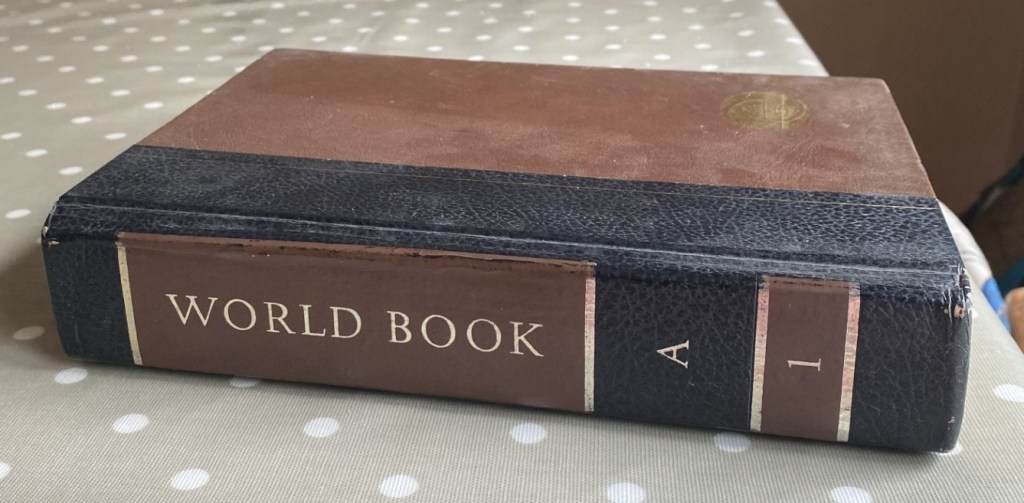
Jim, in his spare time, was also a door-to-door encyclopaedia salesman. On the day they arrived at Nana’s house that Christmas, Mammy and I popped in to visit. ‘Come out to the car,’ Jim said to me. ‘I’ve something for you.’ Out we went. He opened the boot of the car and fished out the A book of the World Book encyclopaedia. I was delighted with this and spent the remainder of the visit at Nana’s house browsing through the pages.
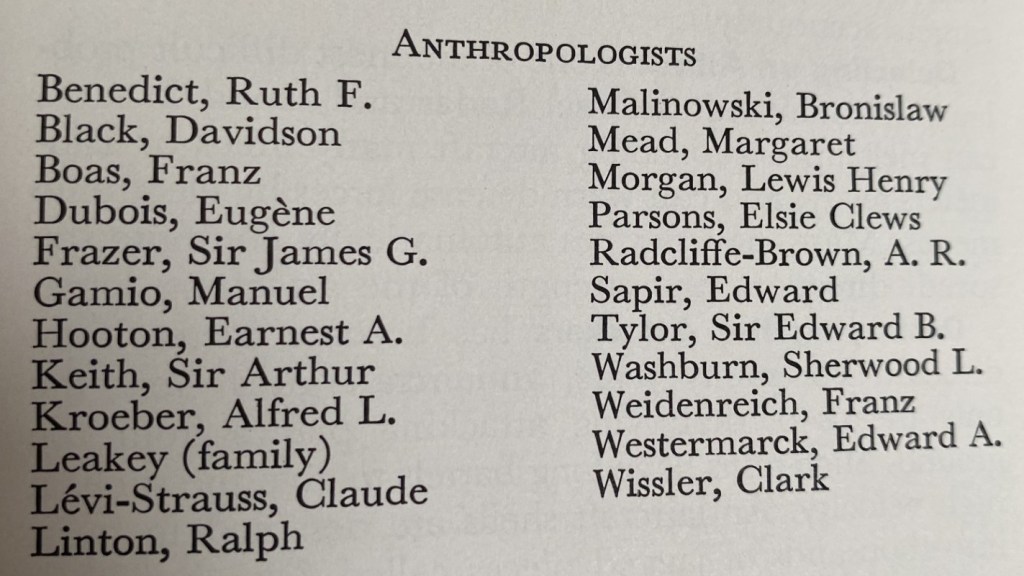
At home that evening, I sat on my bed, a mug of tea on the bedside table, and poured over the A book, page by page. It was filled with all sorts of interesting A things – from Kareem Abdul-Jabbar to Alexander I, from Antarctica to Austria, from Airplane to Audio-visual Materials. And then I came to page 509: Anthropology.
What on earth? There’s this field of study that I’ve never heard of before, that’s combines some of the bits I like best about geography, and that’s all about learning about people who live far away in other parts of the world. Could I do that? It seemed highly unlikely.
I read and re-read the four and half pages about Anthropology. Among the most renowned were a handful of women – notably Ruth Benedict, Margaret Mead, Elsie Parsons.
And I read that anthropologists did their research by immersing themselves in the lives and cultures of the peoples they studied, learning skills and languages, and then theorized and wrote about what they had learned from those experiences. Surely there were no anthropologists in Ireland! This was far too exotic and exciting!
I thought about anthropology all through the Christmas holidays and, as soon as I the January term started, I made a bee-line for the school career guidance counsellor, convinced that she would tell me she had never heard of this subject or that the nearest place I could do it was somewhere in England. Imagine my surprise when she told me that the only Anthropology department in the Republic of Ireland was in Maynooth – my nearest university! How could this be? How did I not know?
In February, I filled in my university application form, still erring on the side of Geography and English in UCD, but with Arts in Maynooth as my second choice. When I received my Leaving Cert results in August 1990, I knew I had enough points to do Anthropology and Geography at Maynooth.
And did I get my degree and return to Edenderry to become a Geography teacher? Well, I got my degree. And I followed that with a Masters degree in Anthropology. Then I went to live in Japan for three years. Then I moved to the Canadian Arctic. Then I did a PhD in Anthropology, immersing myself for long periods of time in an Inuit community on the west coast of Hudson Bay. Then I worked as an Anthropologist-Geographer in geography departments in Cambridge, Reading and Exeter universities. All thanks to my uncle Jim handing me the A book out of the boot of his car two months before I applied for university.
I was sitting at the kitchen table here in Ballygibbon earlier today. I glanced up towards the bookcase and saw the A book, still sitting there. Coincidentally, today is also the day when tens of thousands of students across Ireland receive their Leaving Cert results. I hope their lives are as unexpected and serendipitous as mine has proven to be up to now.
Only a few short years ago, this summer would have been impossible. But here I am, over fifty days since I left home, and barely a day of work missed. Laptop, wifi, Bluetooth; Word, Zoom, Google docs. These are the tools I need to work anywhere and at any time. In between all the fun summer activities – visiting friends, Wimbledon, Pride, museums, hikes, and on and on – I’ve been beavering away at work. Making space at the kitchen table at Mammy’s house, spending days in public libraries, in friends’ spare rooms and office spaces – I have been working away to pay the bills and fund this wonderful summer.
All summer I’ve been ghostwriting, editing and providing other writing support for clients in South Africa, the UK, Europe, the US, Canada and China, fitting in an hour of work here, a couple of days there, a weekend, an evening, whatever time I can find. It’s been challenging at times, as I’m not following my usual routine of working at my desk, on my lovely widescreen monitor, while the girls are at school. Instead, I’m working from an old laptop, in a variety of different places, at various times of the day, and with all sorts of distractions.
Technology that was almost unimaginable twenty years ago, clunky and clumsy ten years ago, intermittent and expensive even five years ago, is now ubiquitous, easy to access and easy to use. Even with a barely hanging in there laptop, I can work wherever and whenever I want.
I am privileged to have a job that allows me to choose when and where I work, and equally privileged to have access to the tools and hardware that allow me to work in this way. I’m one lucky summer digital nomad.
I don’t know who was the first person to sleep in this bedroom and I don’t know who will be the last. But it was mine for a while and I’m back in it again for a few weeks. I don’t know if my great-grandparents slept in it or died in it; I don’t know if my father and his siblings were born in it. But I know it’s history from 1942 onwards.
Years ago, my uncle Willie told me that his father (my grandfather), Michael Tyrrell, had spent his final months in bed in this room. Willie, Jimmy and Cissie, the three oldest children, helped their mother look after their father through his cancer and he died in this room on 31 March 1942, Daddy’s first birthday.
When I was a child, there were two beds in this room. Hard to imagine now, given how small it is. Nana slept in the double bed by the window and L-shaped to her was Cissie’s smaller bed. As a child, I slept with Cissie a lot. I have memories of that time – of Mammy bringing me breakfast in bed of a fry-up of rashers, sausages, egg, tomatoes and Nana’s soda bread. I remember crying in pain with toothache in that bed too and Mammy bringing me up aspirin or some other pain relief.
Did I stay in that bed after Cissie got sick? I don’t remember. When I was four, a new bedroom was built onto the house. It was supposed to be for me, but I never slept in it. It was too far away from where everyone else was at night, so I stayed with Cissie.
Cissie died from breast cancer when I was six and, for a while, I slept in the bed with Nana. But I didn’t like sleeping with her – I remember she had scratchy toenails! After some time, a new plan was devised. Mammy and Daddy moved up to the room that had been built for me and my sister and I slept in two single beds in what had been my parent’s room. Now Nana had the small bedroom to herself. Cissie’s bed remained there for a few years, but was eventually removed.
In May 1985, Nana died in bed in this room. I remember our cousin Betty, who lived across the road, coming over to clean and prepare the body for the wake. Nana was laid out in the bed. I had turned twelve only a few days earlier and she was only the second dead person I had ever seen (Betty’s father, Garrett, had died the previous year and I’d seen him laid out in his bed across the road). For two days, people visited the house, filing into the bedroom to pay their respects, before coming down to the kitchen or sitting room for tea and beer and endless ham sandwiches and cake.
By the time I was 12, I was well and truly fed up with sharing a room with my seven year old sister and about two weeks after Nana died, I asked my parents if I could have her room. Going to sleep for the first time in a bed so recently vacated by my dead granny felt a bit weird, I have to admit, but I soon got used to it and transformed it into my own space.
The walls of this room throughout my teenage years were covered with posters. I had huge posters of one of the space shuttles, of an F16 fighter jet (thanks to Top Gun), and of an environmental quote from Chief Seattle. There were posters and newspaper clippings of Boris Becker (little did we know!!), Bruce Springsteen, James Dean and so many more – I can’t even remember now. The room was filled with library books, Jackie annuals, and back issues of Smash Hits and National Geographic. There were mementos of the few places I had been in my life, a desk that I rarely used because it was too small and wobbly (I did my homework and studying at the kitchen table). I had my own radio too. It was in this room that I first heard about the hole in the ozone layer (it scared the shit out of me), about Chernobyl (ditto), and where I listened to endless pop music.
I stayed in this room until I left for university and returned to it at weekends and holidays, and then on visits home from Japan, Nunavut, Scotland. I moved back into it again in the summer of 2004, when I came home from Aberdeen to be with Daddy in his final weeks or months (weeks, in the end, but I wasn’t to know that then).
These days, it’s Mammy’s room and has a feeling of warmth and relaxation about it, with the comfiest bed that’s ever been here. I’m sleeping in it while I’m here. I wake in the morning and here I am, once again, in this bedroom where I’ve probably spent more nights than in any other one place in my life; in this bedroom that has witnessed so much of my family’s life.




 Me in place