5. Sedna

Sedna/Nuliajuq by Brian Arualak, Arviat, 20003

A few days ago, when it was too hot for Lady’s little paws to be on the road, I took her down to the river for a swim. When I got there, I spotted a yacht on the pontoon called Sedna. I got very excited. Sedna (or Nuliajuq in the Kivalliq region of Nunavut) is the supreme goddess of Inuit mythology. Goddess of the sea, she hides and protects the marine animals in her long flowing seaweedy hair, only revealing them to hunters who prove themselves deserving. How does she decide who’s deserving? It’s those hunters and, more importantly, their wives, who generously share the meat and fur and other parts taken in the hunt. In the old days (and in some quarters still today), Inuit believed that animals, once released from Sedna’s hair, gave themselves to generous hunters.

So, I got very excited when I saw this boat. The way I got excited in the past to see a boat called Aarluk (orca) or one called Nanuq (polar bear). One doesn’t expect to see Inuktitut words in southern Europe! I couldn’t resist popping down to the pontoon to say hi and inquire as to why the owner had named his boat after the Inuit goddess of the sea. I mean, a goddess of the sea I get; but the Inuit one specifically?

I saw that the boat was flying a Spanish flag and had a Spanish registration mark printed on the hull. There was a man in his seventies in the cockpit. ‘Buenas tardes,’ I said, assuming that he, like his boat, was Spanish. When he replied in English with a British accent, I said hi, and told him, perhaps a little over-enthusiastically, that I’d noticed his boat was called Sedna.

‘Oh yeah,’ he said, distinctly less enthusiastic than I was. ‘Why did you call it that?’ I asked. ‘Thatโ€™s what the previous owner called it and I didn’t bother to change it.’ He seemed not curious, not interested, not bemused, not annoyed that I’d bothered him. Indeed, he seemed not really anything at all that this overly-exuberant Irish dog-walker on the Spanish border was trying to make conversation about the name of his boat.

‘Do you know what it means?’ I asked.

‘Nope,’ he replied.

‘She’s the Inuit goddess of the sea,’ I started, but he cut me short and asked, ‘Do you live here?’ He was completely disinterested and my little bubble of excitement at having found someone who might share my interest in Inuit mythology and Inuit culture was immediately burst.

I laughed at my silliness after. At how I had imagined our conversation would go and at how the conversation actually went. I chatted with him for a few minutes more, answering his questions about life in the village, and whether I still owned a boat, and whether the schools around here are any good. Then I said goodbye, wished him luck on his sailing trip and Lady and I carried on on our merry way.

4. Blinded by the tears

Itโ€™s hard to put into words what Bruce Springsteen means to me. His music and his persona are so entangled with my teenage years and my 20s, with my relationships with my father, my sister, my cousin Sean. Bruce Springsteen is me listening to the Born in the USA album on the stereo in our living room when I was 13 or 14 years’ old, wishing I could go see him in Slane. Itโ€™s finally going to see him when I was 17 in the RDS with Daddy and my sister. Itโ€™s going to see him again when I was 20, this time on my own, the night before my final anthropology exam at the end of my degree. None of my friends would come with me, because of…well…final exams, but I’d been to Bon Jovi the night before and now Bruce (I did great in those exams, by the way). I remember standing on my own at the very front of the crowd, crushed up against the stage and Bruce doing an acoustic version of Thunder Road. Itโ€™s me on my 50th birthday, standing in a muddy stadium in Barcelona with my sister and my best friend, tears streaming down my face as Bruce sang Thunder Road again. I’m not a Bruce completist. I don’t have (or even know) all of his music, but I’m an all in, unapologetic fan.

My favorite album, not just by Bruce, but my favourite album by anyone ever, is Nebraska. I’ve listened to it a thousand times. I could sing the whole album to you without skipping a beat (not that anyone would want me to). I love that album. From that opening harmonica of the title track, it just grabs me, with its pathos and anger and the death of the American Dream, and Bruce’s gravelly voice weaving stories of the struggles of ordinary people. It simply moves me in ways that no other album ever has.

Two mornings ago I did what I do first thing every morning. I put on the kettle and, while I waited for it to boil, I got my phone and looked at the news. I scrolled down my preferred news site, reading about all the terrible things happening in the world at the moment. Down at the culture section, I see that a trailer for some new Bruce Springsteen film has just been released. Not only is it a film about Bruce, itโ€™s a film about the making of the Nebraska album. Jeremy Allen White is playing Bruce. I really loved The Bear, not really because of Jeremy Allen White but because of the entire ensemble cast. I find him an odd-looking sullen little man and I wondered what he would be like in the role of Bruce. I was thinking about it on my one-hour walk so, when I got home, I found the trailer on YouTube for Deliver me from Nowhere, as I discovered the film is called. I watched the two and a half minute trailer and without warning, found tears streamed down my face. I don’t think a trailer has ever made me cry before. It had such a deep impact on me. I don’t really even know why I was crying, but I think a mixture of nostalgia, joy, excitement about seeing the film, and remembering listening to that album throughout my teens and 20s and 30s and how it has meant something different to me at different stages of my life. Later on, instead of listening to a podcast, as I usually do when I’m making lunch, I did the only thing I could possibly do and played the Nebraska album from first song to last.

3. W.W.A.D.

My next-door neighbor Alfredas has quite an impressive social media following given that, until recently, his content was exclusively presented in Lithuanian. He posts daily videos about sobriety, quitting smoking, sleep health, mental health, and so on, tracking his own journey and sharing what he has learned with others. His videos are well informed and based on peer reviewed science. I know this because I get the omnibus edition when my family has lunch with his family every Sunday. He’s less the man who wants to live forever and more the man who wants to live his remaining years on the planet in the best way possible.

Last year, he returned home to Lithuania for a few months to organize Sober Summer. He recruited thousands of people, mostly young and middle-aged, to quit alcohol for the summer. To party, have fun, be active, be engaged, and do it all without alcohol. His Sober Summer events were featured widely on Lithuanian social and traditional media.

This summer, he’s returned to Lithuania with a new plan: 90 X 90. Heโ€™s encouraging everyone to be active for one hour every day for the ninety days of summer. 90 X 90 officially started on 1 June and, well, I couldnโ€™t pass up the opportunity to join in.

Doing one hour of activity is not a problem for me. I regularly walk the dog for an hour or more, do housework for an hour or play pรกdel with Katie for an hour. However, I lack the consistency of engaging in a continuous hour of activity every single day. So thatโ€™s my challenge.

I started on day one and, twenty days in, I haven’t missed a day yet. Iโ€™ve been walking the dog and playing sports as usual. I’ve even started jogging a little, which is something I haven’t done since I was pregnant with Lily. It’s extremely hot these days (40C yesterday), so I leave the house with the girls in the morning when they go to catch the school bus and get my active hour in then. It feels great to do this consistently.

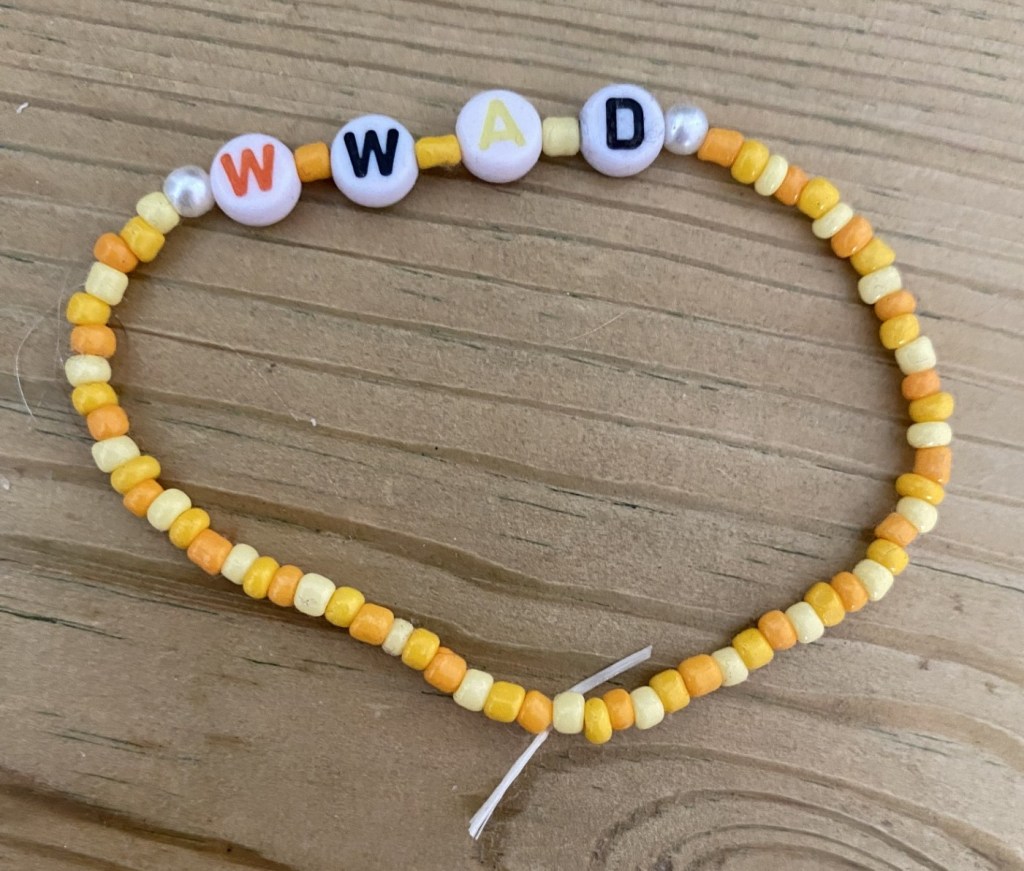
Alfredas is a man of action and, for some time, my family and his family have had a running joke: ‘Ask yourself, what would Alfredas do?’ So, Lily, crafty kid that she is, made W.W.A.D. bracelets for all of us! And that’s my motto on days when I think ‘maybe I don’t have an hour to spare today’. What would Alfredas do? He’d put on his running shoes and go.

2. You did WHAT?!

The girls are only just realizing, perhaps only now taking an interest in the fact that I had a life before they came along. Some weeks ago, I was talking about Australia with someone. Afterwards, Katie said to me, almost as an accusation, “You never told us that youโ€™d been to Australia,” like Iโ€™ve been keeping it from them on purpose. Iโ€™m sure Iโ€™ve told them before about the three weeks I spent on the east coast of Australia when I was 23. Maybe not. Either way, they were intrigued and wanted to know more. Lily then teasingly said, “What else are you not telling us?”

A couple of weeks later, Katie had to do a school project about her mother. Maybe it was about a parent. I donโ€™t know. Anyway, she did it about me. I remember Lily doing the same project at the same time last year. I asked Katie if she wanted to interview me, but she told me no, she’d find out all she needed on the Internet. Dear God! What would she unearth?

Home from school a couple of days later, she says, “It says you lectured in Cambridge?” She canโ€™t believe it. I explain that I was a post-doctoral fellow at Cambridge and that I gave some lectures in the Geography department. “But at Cambridge?” she asks. She really canโ€™t believe it and it doesnโ€™t seem to matter that I wasnโ€™t a don, but rather an occasional contributor to a course or two as part of my fellowship. “Cambridge,” she says again.

Then she discovers some of the stuff Iโ€™ve had published – newspaper and online stories about my research, and such like. “You can write,” she says, impressed; this new information absolutely at odds with the mummy figure who forces her to eat her greens and nags her about leaving her trainers on the middle of the living room floor. I tell her that something I wrote my was once used as evidence in hearings at the US Congress.

“So, what on earth are you doing here?” she asks, referring to this tiny corner of Spain where we now live. I explain that, for me, coming here was the end of one great adventure – the boat, the cruising – and the start of another – a new culture, new language, a new community of people, an adventure that I’m still on ten years later. For her, this place is home. She’s lived here since she was four years old. It’s boring old Sanlucar, from where she wants to get out into the world, not a place you’d leave Cambridge for!

This morning, as the girls were getting ready for school, Lily asked, “Mum, have you ever been to a disco?” I almost choked on my herbal tea. When I told them about the Huntsman in Edenderry, the Wednesday night bar-exes in the students’ union in Maynooth, the Saturday night’s at the Crazy Cock in Fukuoka, the night I met their father, my first date with their father, they looked at each other and rolled their eyes. Lily asked me to show them my dance moves. “You know my dance moves,” I laughed. Iโ€™m relieved thereโ€™s no evidence of my disco days on the Internet.

I was young once…but never cool!!!

1. Four more days of school

It was unusually and pleasantly cool when I went for my walk just before 8 o’clock this morning. Overcast and with a slight mist on my face. A respite from most mornings when the sun is already beating down hot and glaring from the sky at that hour. It won’t last long. In a few hours, the clouds will have burned away and the temperature will be in the mid to high 30s.

Sheep on my walk this morning

This week every year feels like the lead up to Christmas for its levels of busyness. The last week of school each year somehow always coincides with me having more than normal amounts of editing and writing work. It’s not that I perceive that there’s more work because I’m so busy doing other things. My records show that, year after year, one of my busiest work weeks of the year is also the last week of school. Maybe the writers I work with are also racing to complete their writing projects before the end of their or their kids’ academic years.

When the girls were little, the last week of school involved a day-long parent-student-teacher excursion to a water park, preparation for the end of year school performance, the one-day medieval festival that we, the parents’ association, organized, and finally a parents’ association convivencia, to which we all brought and shared food, had a barbecue and got sozzled – in the baking sun.

Now that the girls are older, my duties are more of a chauffeuring nature. No longer in the village school only a one-minute walk from our house, their secondary school is 25km away. As the school year draws to a close, trips to that town have increased – for evening graduation prep (for Lily), get togethers with friends, end of year parent-teacher meetings, and so on. Then there’s Katie to her tennis lessons 40km in the opposite direction. Plus the dog’s annual rabies vaccination lands this week each year. Luckily, the roads are good and we have some good music and podcasts to listen to.

To make matters slightly more crazy this year, we’re leaving next week for 10 weeks. Weโ€™ve never left Sanlucar for such a long time before so Iโ€™m in the process of getting the house ready to close it up. At least I haven’t had to do much grocery shopping this week, as I’m running down the food cupboards and the fridge. I’m setting up an irrigation system to water the 50 potted plants on my patio (I didn’t realize I had 50 until I set about the rather fiddly business of setting up the system). I still need to lift the dinghy and kayaks out of the water and store them until we come back. And there’s the packing, of course – not only of clothes and whatnot, but everything I will need to be able to carry on working while I’m away. Somewhere, in the midst of it all, as with every other year, I find the time to sit at my desk and meet my work deadlines.

The craziness of this time of the year is suffused with optimism and looking forward. All three of us are looking forward to the end of the school year for a shake-up of a routine that has started to feel like a drudge. All three of us, for different reasons, have had a tougher than expected year, so we’re looking forward to the end of school perhaps more than other years. A miscalculation on my part, however, means that, rather than having a few days to relax at home, and swim in the pool and the river, we’re leaving Sanlucar the very first day of the school holidays. Silly me.

Four more days of school…and summer, here we come!!

Home made retreat

In a time of grief and anxiety, I created my own retreat at home.

My next-door neighbour, Alfredas Chmieliauskas, posts on Instagram on issues related to health and well-being, sobriety and detoxing. I occasionally send him links to podcasts, articles, or other media that I think might interest him. Recently, I sent him links to episodes from two podcasts.

One was from Maya Shankarโ€™s A Slight Change of Plans on the theme of awe and the other was from Laurie Santosโ€™s The Happiness Lab on aligning oneโ€™s personal actions against climate change with activities that make us happy. My podcast tastes are catholic, to say the least, and I have a tendency to fall down a rabbit hole of one and listen to nothing else for weeks on end. When new episodes of both A Slight Change of Plans and The Happiness Lab popped up on my podcast app a few weeks ago, I started to dip into them again.

Both podcasts were key elements of my pathway through grief and overcoming the panic attacks and anxiety that I experienced after Julian died in September 2021. My grief was messy and complicated, owing to our recent separation and his subsequent sudden death from a heart attack. In the weeks that followed, as I mourned his loss, thought deeply about his life, supported our daughters through the loss of their dad, and worried about the effect his death would have on them, I started to have panic attacks. At the time, I didnโ€™t know what was happening to me, only that my heart was fluttering uncomfortably, sometimes pounding like it would jump out of my chest, I was short of breath, the world was closing in around me, black and hazy in my peripheral vision. Each night, Iโ€™d go to bed terrified that I wouldnโ€™t wake up in the morning, panicking even more that the girls would find me dead and that theyโ€™d have lost both parents in a short space of time. I would fall asleep quickly, but wake up an hour or two later, in full panic attack mode, and then spend hours scrolling through my phone to take my mind off the flutters in my chest, eventually falling back to sleep, and then waking up in the morning exhausted.

I realized that there was a psychological element to this, because when I was with other people โ€“ with friends, doing the shopping, or when I was out walking the dog over the hills, I didnโ€™t have these sensations. Ever. Only when I was alone, or just with the children, did I get these awful and terrifying sensations.

I made an appointment to see the GP one Wednesday morning in late November 2021 and, perhaps as luck would have it, all of these sensations came on at once while I was sitting on my own in the waiting room. I thought I would faint and that the GP would find me in a heap on the floor. I didnโ€™t. But he only had to hear a couple of my symptoms and learn my very recent history to diagnose panic attack. โ€œThis is a panic attack?โ€ I asked him. He was sure of it. But my heart was fluttering, so, he sent me down the hall to the nurse for an ECG, told me to come back in a couple of days for blood tests, and made an appointment for me to see a cardiologist. He was, however, pretty confident that these were panic attacks and nothing more sinister. Oh, and he prescribed Xanax, and told me only to take one when I felt these symptoms coming on.

I went home relieved that I had a diagnosis and made up my mind to do something about it. I decided to create therapy conditions in my own home, to find ways to walk through my grief and release my anxiety. The first thing I did was improve my sleep hygiene. At night, I banned my mobile phone to the kitchen with the sound turned off. I bought an alarm clock, so I no longer needed the phone alarm to wake me up. Before going to bed, I kept the lights in my bedroom low and practiced yoga for 10 minutes (with the wonderful Kassandra on YouTube) followed by 10 minutes of silent meditation. Once in bed, I would read my book for a few minutes before turning the lights out. When a panic attack came on in the middle of the night, I took a Xanax[1] and read my book. I fell back asleep much more quickly from reading my book than from scrolling my phone. Each morning, I would again practice yoga for 10 minutes and meditate for 10 minutes before going downstairs to start my day.

I found time each day to write and poured my complicated messy grief out onto the page. Stuff came out that I didnโ€™t even know was in there. I never want to share what I wrote with anyone; indeed, I’ve yet to read it again myself. But I needed to get it out in order to work through it. I went for long solitary walks with the dog, giving free rein to my emotions. For weeks, maybe even months, every single time I went for a walk on my own, I cried. I can only imagine what the other walkers I occasionally met on the trails must have thought of me, tears and snot streaming down my face.

And, I discovered these two amazing podcasts. In The Happiness Lab, Dr Laurie Santos, a Yale University professor of psychology, explores the science of happiness and provides practical advice on how to improve your wellbeing. A Slight Change of Plans is hosted by Dr Maya Shankar, a cognitive scientist who was a senior mental health advisor in the Obama White House. In each episode, a different guest shares their personal story of a sudden and unexpected event that dramatically altered their lives. Guests have stories about accidents and illnesses, being kidnapped or held at gunpoint, or receiving a piece of news that changed the direction of their lives. With great empathy, Dr Shankar interrogates how these โ€˜slight change of plansโ€™ have altered peoplesโ€™ perceptions of themselves and others, of their place in the world, and of their value to the world.

Both of these podcasts had a profound impact on me as I travelled through my grief and anxiety and figured out how best to support my girls as they travelled through their own. I found fellowship among strangers who had experienced and could now reflect on their life-changing experiences and I learned about practices I could enact in my own life to support my wellbeing. I guess you could say I created a retreat in my own home โ€“ one where I could turn to these two experts and their guests at a momentโ€™s notice, where I could roll out my mat as often as I wanted to practice yoga and meditation, where I wrote my grief onto the pages of my notebook, and where I created and stuck to healthy sleep routines.

By the time I had my cardiology appointment a couple of months later, the panic attacks were behind me and my home retreat practices had become routine. I havenโ€™t looked back. The following summer, ten months after Julian died, the panic attacks returned. This time I knew what they were, I knew what had triggered them and, though they scared me still, I knew how to take care of myself through them. Grief evolves rather than disappears and I know that my home-made retreat is not the same as speaking to a professional therapist. Maybe I will go down that road some day too.

This is the first time Iโ€™ve publicly written about Julianโ€™s death โ€“ even though this has been about my reaction to it, rather than about Julian himself. Itโ€™s taken me a long time to get to the point where I wanted to share anything, even with those closest to me. I’ve chosen not to write about my daughters here โ€“ their stories and their grief are theirs alone to tell.ย 


[1] The GP prescribed me 30 Xanax in November 2021. When I threw the box away last month, three Xanax remained. I used them sparingly.

Walking through January

In late December, I set myself a challenge to walk 200km in January.

2023 had been an exceptional year for me. I was joyful and exuberant in turning 50 and everything about my life seemed to glow. That was until the end of the year, when it felt as if someone let the air out of my balloon. From early December, I felt lost, drained, living in a cloud of cotton wool, from which I neither could nor desired to work, be with other people, or drag myself out of the house.

Happiness and contentment are my default modes. If chemical imbalances play a role in the onset of depression, then I often think that I have chemical imbalances in the other direction. Iโ€™m chronically happy. Iโ€™m annoyingly upbeat. My glass is always way more than half full.

Except at the end of 2023, when it wasnโ€™t. I had no reason to feel down, and yet I did. A weekend in Sevilla uplifted me momentarily but, even there, I was unusually sharp with my daughters and, at times, felt the strain of being in a city more acutely than usual. Then I came down with COVID and a week in Tenerife over Christmas that was supposed to relight my lamp instead left me feeling even more down in the dumps. I returned home to Sanlรบcar COVID-free but feeling flat.

Then one day, in the last week of December, I set out to walk the dog. Not an โ€˜oh god, Iโ€™ve got to walk the dogโ€™ sort of walk, the kind that had become my default over the past year, when Iโ€™ve increasingly cited lack of time, but a โ€˜letโ€™s see how far we can goโ€™ sort of walk, with a backpack on my back, containing my water bottle, a notebook and pen, and my phone to take photos. I walked north, along the path that leads up the river, stopping to allow myself to be enveloped in the silence, to watch a raft of canes drift down the river, to marvel at the orogeny on a wall of rock. The dog, of course, loved it too, walking farther than she had in months. At the farthest point from home, I decided to set myself the challenge of walking 200km in January.

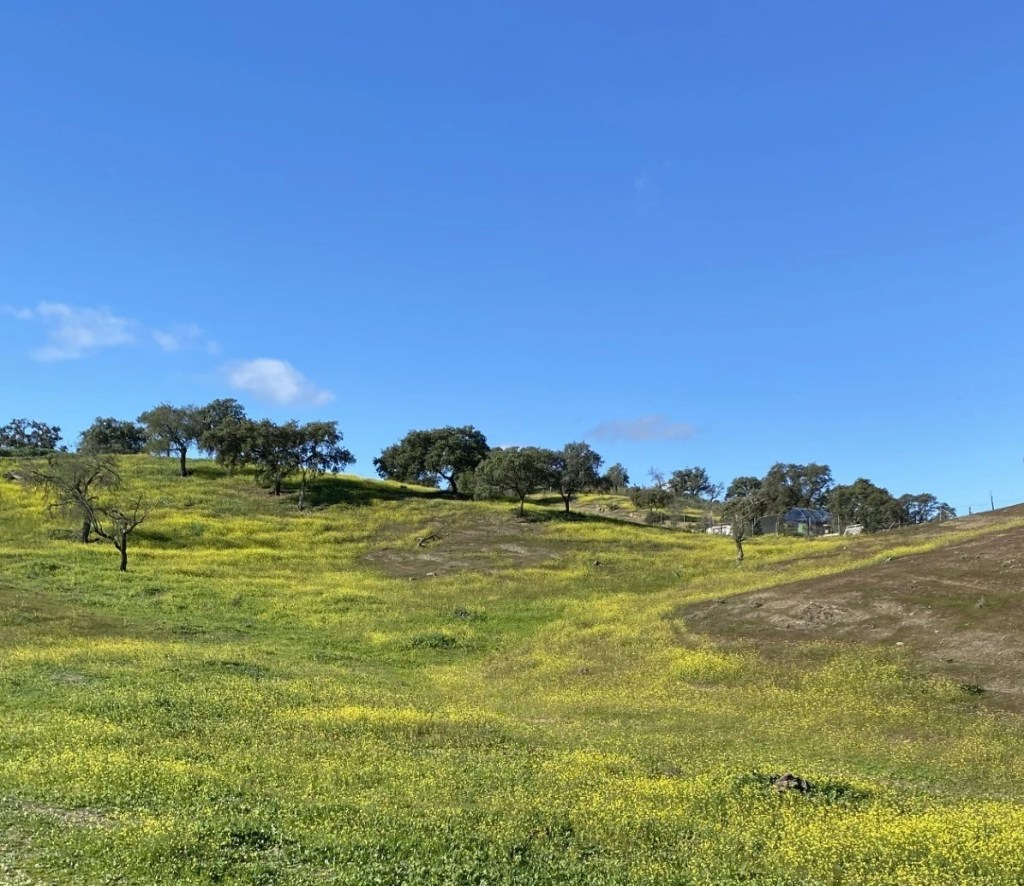
I walked for the first few days of January, recording the distance so that I had a sense of how far I might walk in a certain amount of time and considering how I could make space in my work day for this challenge. On each walk, I was uplifted. The land was brightly green, decorated with patches of wildflowers, yellow and white. It was a balm to the eyes and to the soul. Each day, though my spirits descended again when I returned from my walks, the troughs were not so deep. By the second week of January, I felt like myself again.

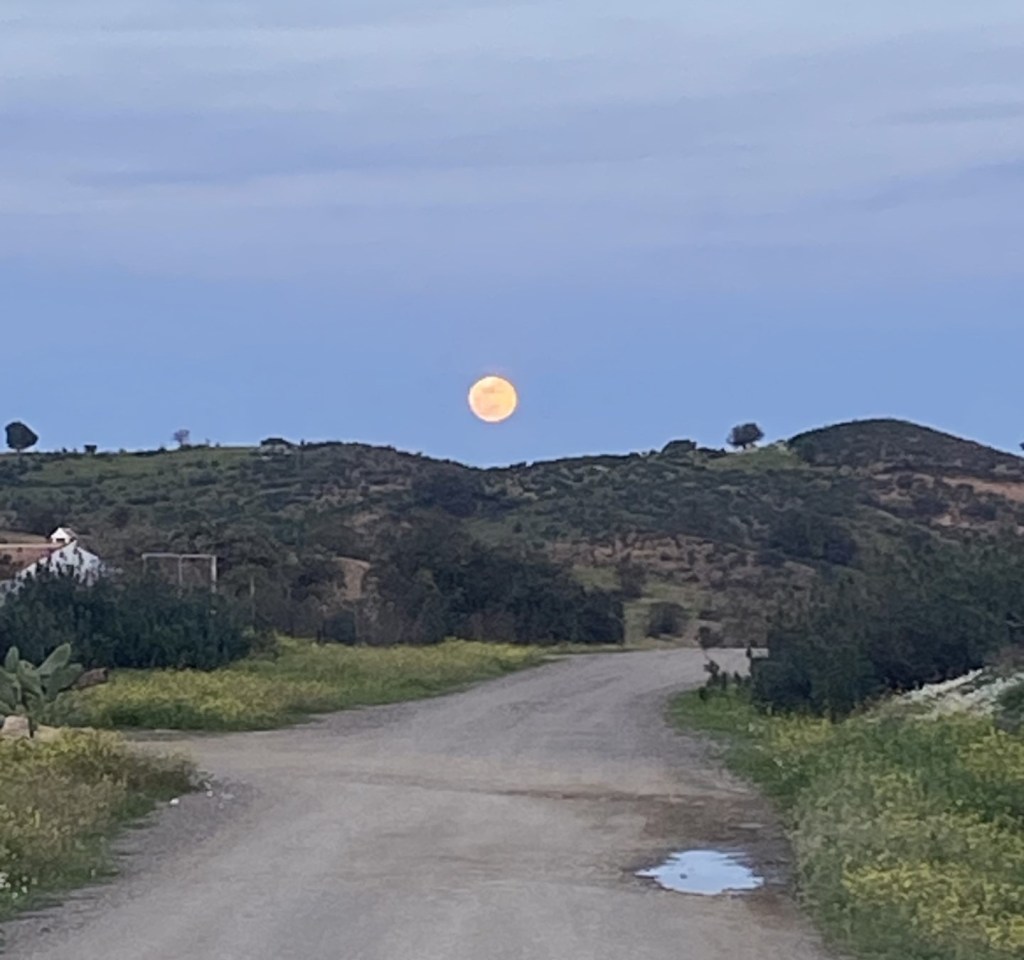
Some days I walked 10km or more, one day I only managed 1km. I walked at all times of the day โ€“ in cold early morning mist in jacket and woolly hat, bright afternoon sunshine in t-shirt and sunglasses, at sunset, carefully picking my way along rocky paths in the dark; Lady always my faithful companion, the land I walked through nourishing and uplifting me.

By the end of the month, I had walked 201km, along paths leading out in a radius from my house. I became reacquainted with places I hadnโ€™t walked in years, just as I became reacquainted with why I love living here in the first place โ€“ the immensity of the land, the stories it tells of the people who lived here before, if only you take the time to read those stories in the landscape, the other creatures nourished by the land, and the river that brought me here snaking through it all; the vastness of the sky, at times a blue so deep as to seem unreal, at times ominous shades of grey, at night the riot of stars a glorious reminder of my insignificance, the Milky Way mirroring the route of our little river.

Over the course of the month, I observed changes taking place โ€“ sudden changes brought about by a heavy rain shower, slower changes as grasses grew, the number of lambs in a herd of sheep increased dramatically, the oranges continued to ripen and fall from the trees. I have found one, two, or even three hours in each day to walk. Those hours were there for the taking all along, I just failed to see them. Walking became the fulcrum of my day throughout January, uplifting me, soothing my soul, reassuring me that in the face of such ordinary magnificence, it is only to be expected that happiness is my default mode.

As for February? Iโ€™m back on the tracks and trails again, mostly in the lengthening evenings, challenging myself to another 200km. It hardly feels like a challenge. Itโ€™s starting to feel more like a drug.

Remembering Lahaina

I spent less than a month of my life in Lahaina, but the town had a profound and lasting impact on me. It wouldnโ€™t be an exaggeration to say that the two visits I made to Lahaina shaped the direction of my life.

I first went to Lahaina just a couple of weeks before my 23rd birthday. It was spring vacation in Japan, and my Portuguese-Australian friend, Liliane, and I booked a two-week holiday in the Maui tourist town. At the time, going on vacation to Hawaii from Japan was equivalent to northern Europeans vacationing in the Canary Islands. We booked the holiday through a travel agent (remember them?) who travelled from school to school, booking holidays for busy teachers, and in March we flew east from Japan, across the Pacific Ocean, to Hawaii. It was my first grown-up holiday, and the first time I ever flew somewhere to take a break from work.

Lahaina was beautiful, full of low wooden buildings, palm trees, and artists. The mountains behind the town were deep green and, from the perspective of a boat at sea, dotted with rainbows. The streets were lined with artistsโ€™ galleries selling art inspired by the sea โ€“ humpback whales, turtles, fish as paintings, sculptures, silk prints, photographs. The sunsets each evening were mesmerizing and, as many nights as I could, I found a wall to sit on, where I could look west over the ocean, and bathe in those sunsets.

It was in Lahaina that I first ate mango, first ate Mexican food, first ate macadamia nuts and macadamia nut ice cream. Ah, the ice cream. I wasnโ€™t much of a fan of ice cream, having mostly only ever eaten tasteless blocks of HB vanilla that we had in the freezer back in Ireland. The ice cream in Lahaina was like nothing Iโ€™d ever tasted and I soon discovered the best ice cream shop, on a corner just by the banyan tree. That banyan tree, claimed to be the largest in the western hemisphere, covering over an acre of land. It was the first thing I thought about when I first heard about the fire โ€“ that vast tree and all of the activities that took place under its shade โ€“ family gatherings, markets, people raising awareness for their important causes, buskers making music.

Lahaina was also my first time in the US and I was unprepared for how friendly all the service staff were. Shop assistants, waiters, bar staff were all so NICE. It took a little getting used to walking into a shop and the shop assistant telling me how much she loved my dress or my sunglasses or my accent. Iโ€™d never before encountered such fresh and unabashed complements and I quickly grew to love that attitude.

My lasting impression of the local people I encountered was that they were fiercely unique and independent. On that trip, and when I returned a couple of years later, I met aging hippies and flower children now in their sixties, and Vietnam vets from the US mainland; I met native Hawaiians and people of Japanese descent and I spent a memorable night sitting in a diner with a 76-year-old jazz musician, getting endless top-ups of coffee, as he told me of the amazing life heโ€™d led. Iโ€™d never met people so keen to tell their life stories. As a recently graduated anthropology student, I was hypnotized.

But the biggest impact that Lahaina had on me was in the ocean that surrounded it. As part of that vacation, I had decided that I wanted to learn to scuba dive. In the first couple of days, I found a dive shop and signed up to do the PADI open water course. The three-day course involved classroom work, four open water dives to practice and test skills, and a classroom exam. The instructor was a huge red-headed Midwesterner called Gary Bluhm, who had only recently moved to Lahaina after 25 years as a dive instructor on Lake Michigan. I felt in safe hands.

Scuba diving was a transformative experience for me and something I continued to do regularly for many years afterwards. I put a tank on my back again a few months ago after a break of almost a decade, when I took 12-year-old Katie for her first dive in the Mediterranean. I was delighted that she loved the experience as much as me.

Lilian and I took a boat trip one day to a humpback whale research station along the coast. On the way, we saw humpback whales breaching, diving, breathing. That first experience of seeing whales in their natural habitat had a profound impact on me. The waters off Lahaina are a humpback whale nursery, where pregnant females, who have spent the summer in Alaska, migrate to Lahaina to give birth and raise their calves, preparing them for the arduous migration north in spring.

From that first moment, I decided I wanted to learn more about humpback whales and whales in general. I returned home to Japan and dug into the natural history of humpback whales, into the history of whaling, into the science of studying whales. Two years later, in 1995, I returned to Lahaina as a volunteer humpback whale researcher, joining Dr Adam Pack and Professor Louis Herman and their team of post-grads and PhD students, for two weeks of research. I was almost as much in awe of the dedicated scientists and the work they did as I was of the humpback whales that I had the privilege of seeing while assisting in their work.

For those two weeks, I lived in a rented house in the suburbs of Lahaina with the scientists and two other volunteers. Each morning, weโ€™d quickly make our lunch for the day (peanut butter and jelly for meโ€ฆanother first and another revelation), hop in the van and head off for a long dayโ€™s work. Some days, I was up on a hill overlooking the ocean, from where we had a panoramic view of where the whales were and the direction they were travelling. We recorded their movements โ€“ coordinates of where we saw them and what behaviours they were exhibiting (spouting, breaching, slapping, deep diving), whether they were mother-calf pairs, or were in larger groups. We radioed their location to the boat team, who we could also see from our lookout point.

Other days I was on the boat, and those were the best days of all. Based on our own observations and on those radioed down from the hill, the skipper (one of the post-docs) would manoeuvre the 15-foot Boston Whaler into the vicinity of some whales. And then heโ€™d cut the motor and weโ€™d wait. I remember whales breaching so close that we got wet from the splash, and the fishy smell when they came up to breathe right beside us. I remember a calf with its mother, lying sideways in the water, as it looked up at us with one huge eye, full of youthful curiosity. One day, a young male whale swam under the boat. I could see his pectoral fins, like wings, either side of the boat. He remained perfectly still underneath us and sang. I felt his song more than heard it, as it reverberated up through the hull, up through my feet and legs, and up to my heart and head. I can still feel that vibrating sound in my body to this day, 25 years on.

My job, as a volunteer, was to keep my eyes peeled for whales, to help the scientists as they prepared to do their work, and then to take precise written notes of what was going on. Meanwhile, the real scientists did their work. Some took photographs of flukes (fluke matching is the primary way to identify individual humpbacks, as each fluke is unique). Others dived in with underwater cameras to film whale behavior. Microphones were dropped overboard to record songs and calls.

The days were long and, without a loo onboard, a moment would come each day when weโ€™d have a mass evacuation into the sea. Anyone who needed to relieve themselves would jump into the 5,000 metre deep Pacific Ocean, knowing there were humpback whales and tiger sharks and who knew what else, in there too. Iโ€™d jump in but, the thought of the depth of the water beneath me and what might brush against my legโ€ฆor worse…left me with stage fright and no matter how much I needed a wee before jumping in, it always took longer than I hoped. Iโ€™d haul myself back onto the boat as quickly as possible and weโ€™d be on our way again.

Each evening after supper (everyone took their turn to do the cooking), weโ€™d pour over piles of photo albums, filled with page after page of black and white photographs of humpback whale flukes, trying to match up a fluke from one year with one from a different year. Did a fluke from 1982, with no other identifying notes, match one from 1994, this time with a calf and, therefore, clearly identified as female?

From those couple of weeks learning about humpback whales and about marine biology, my love of whales and of the sea deepened. It wouldnโ€™t be a stretch to say that I pursued a PhD into the anthropology of the sea and how humans relate to the sea and acquire their sea-related knowledge and skill because of those two weeks, or that my postdoctoral research was about the relationship between humans and beluga whales, or that I became a sailor and took to the sea. That I got a tattoo of a humpback whale doesnโ€™t require too deep a psychological investigation. For years, I had a recurring dream about humpback whales. At times of stress in my life, they came to my rescue and brought me safely to shore.

And so, when I woke one morning last week to the news that Lahaina was on fire, I was deeply saddened. My first thought was of the banyan tree but, as the days wore on and news of the fire grew grimmer and more desperate, with more deaths and more destruction, I thought of all the incredible people I met these in 1993 and 1995 โ€“ the marine biologists, the hippies, the Vietnam vets, the artists, the scuba divers, the sales assistants and waiters, the dancers and performers. They are in my thoughts, wherever they are now.

A life lesson learned

The Spanish health care system has a pretty good reputation and most of my experiences with it confirm that. First of all, itโ€™s free, which, coming from a country where a ten-minute consultation with your GP costs โ‚ฌ70 for all but a minority, thatโ€™s a major bonus. Staff are generally caring and kind and referrals are reasonably prompt. In addition, prescription medications are heavily subsidized. Overall, Iโ€™m pretty happy with the health care system in my adopted country.

Butโ€ฆitโ€™s different. The culture of care is unlike the one I grew up with and over the years Iโ€™ve had quite a few experiences that have jolted me because the processes and procedures are justโ€ฆwellโ€ฆdifferent.

Towards the end of last year I experienced a funny sensation in my left leg for a few weeks โ€“ pain in my calf, heaviness in my entire leg, occasional pins and needles throughout my leg. Itโ€™s something Iโ€™ve had on and off over the years and, being a bit of a hypochondriac, I always convince myself that I have deep vein thrombosis. But the pain always goes away before I do anything about it. This time, however, it lingered and, as the weekend approached, it worsened.

By midday on Saturday Iโ€™d convinced myself that Iโ€™d be dead by nightfall and I decided to go to the doctor. Being a Saturday, the health centre in the village was closed and I had to drive the 22km to the nearest 24-hour centre.

I was surprised to find the door to the health centre locked when I got there. A note stuck to the door had the centreโ€™s phone number, so I called it. Before I had two words out, the grey metal door to my right opened and I was ushered in to the treatment room immediately behind the door. I tried to avert my gaze from the old man, shirt open, lying on the consulting table, being treated by a male member of staff. The woman who had opened the door to me turned out to be the doctor.

โ€œSit there,โ€ she said, pointing to a chair only two metres from where the other patient was being treated. Shouldnโ€™t he have some privacy, I thought. Shouldnโ€™t I? I sat with my back to the man, trying not to listen as he was prepared for the ambulance that was to take him to the hospital, forty minutes away.

The doctor sat behind her desk and began her consultation with me. But before we got two sentences into it, there was another knock on the main door. The doctor opened the window beside her desk and shouted out, โ€œCome in through the grey metal door.โ€ There was no response, so she got up, walked around her desk, and let a middle-aged couple in. The treatment room was beginning to feel decidedly overcrowded.

The doctor directed the couple to the waiting room, but left the door between it and the treatment room open.

โ€œIโ€™ll have to see your leg,โ€ she instructed me, after I had explained my symptoms and sheโ€™d asked me some preliminary questions.

With the door to the waiting room still open, the old man still on the treatment table and the male staff member beside him, and the grey door to the street now open to allow the ambulance crew in, I stood up, unbuckled my belt and dropped my jeans to the floor, my pink-knickered arse towards the old man. The doctor had a feel around my leg and asked me some more questions. She was sufficiently concerned to immediately send me to A&E at the big provincial hospital.

I didnโ€™t want to go on my own, so I phoned a friend to ask if heโ€™d drive me. Then I drove home, packed a few things in a bag, and was soon on the road to the hospital. The waiting room was large and airy and pretty comfortable as waiting rooms go, which was just as well, because I had a three hour wait.

Finally, my number appeared on the screen. I was to go to consultation room six. I walked into consultation room six to find a woman lying half-naked on the treatment table. โ€œGo next door,โ€ one of the staff told me. I went to consultation room seven and the woman sitting at the desk asked my name.

โ€œYouโ€™re not Rosario?โ€ she said, looking confused.

At that moment an extremely tall, very bald, bespectacled young doctor appeared at the door behind me.

โ€œMartina?โ€ he asked. โ€œAh, here you are. Follow me.โ€

I followed him to the other side of the corridor and into a large room that contained a number of beds. On one bed lay yet another old man, with his shirt open and his large belly on display. I tried to look anywhere but at the old man while the doctor consulted a computer and tried to find which room I was supposed to be in.

โ€œStay here,โ€ he said and set off down the corridor, leaving me stranded. I looked at the television monitor and saw that I was assigned to both consultation rooms six and nine. Just then, the doctor popped his head out of room nine and indicated that I go there.

The brightly lit consultation room was cold enough that I commented on it to the young, dark-haired (and, admittedly, handsome) member of staff sitting behind the desk. The tall, bald doctor, whose white coat was askew and whose trousers didnโ€™t reach to the top of his colourful socks, asked me where Iโ€™m from.

โ€œIreland,โ€ I said.

โ€œAh, Holland,โ€ he replied, a common mistake which must have something to do with the weird way I pronounce โ€˜irโ€™ in Spanish. I corrected him.

โ€œLetโ€™s do this in English, then,โ€ he said, and switched to flawless English far superior to my Spanish.

I told him my symptoms and he asked me some further questions.

โ€œIโ€™m going to have to see it,โ€ he said.

By now, the tall, bald doctor and the dark-haired, handsome doctor were both standing in front of me, as I sat on the consultation table. There didnโ€™t seem to be anywhere for me to go to remove my trousers in a dignified manner, or a curtain to pull around to spare my blushes. I guessed Iโ€™d just have to get on with it.

With both men standing mere inches away from me and facing me, I removed my shoes and then my socks. A number of thoughts flashed through my head as I started to drop my trousers. 1. I havenโ€™t shaved my legs in about two weeks. 2. I havenโ€™t moisturized my legs in probably the same length of time. 3. Why am I wearing my motherโ€™s hand-me-down knickers today? (Calm down…she hadn’t worn then…or so she swore to me)

With my trousers removed, I sat back on the table and the tall bald doctor proceeded to examine my hairy scaly left leg, pointing to a bruise on my thigh (I walked into the kitchen table) and another on my shin (an ungraceful scramble out of the dinghy). He talked his colleague through the examination and then used a very impressive hand-held ultrasound device that he plugged into his phone to look below the surface.

He assured me that all was fine. I didnโ€™t have DVT, but I did have some damage to a surface vein. โ€œDoes that put me at greater risk of DVT?โ€ I asked.

โ€œImagine your deep veins are the motorway,โ€ he said, โ€œgoing up to your heart and lungs. You have damaged a small country road. So, thereโ€™s not much to worry about. But, as you know, sometimes we get off the motorway and take a country road instead. So, yes, thereโ€™s a little risk.โ€

What a cool doctor. I felt sorry for him that heโ€™d had to touch my troll-like leg. Heโ€™d asked me about my work and, as I got dressed โ€“ again, undignified and in front of the two of them, almost losing my balance as I put my right leg into my jeans โ€“ he gave me some sage advice. โ€œDisco dance while you work. Itโ€™ll keep your legs moving.โ€

And that was it โ€“ undignified, lacking in privacy, lacking in an concerns about a woman patient stripping in a consultation room in front of two men and no female staff member present. I could have done anything to those two lovely doctors!

I returned home feeling reassured, and having learned some valuable lessons โ€“ disco dance while working and never, ever, leave my legs unshaved and unmoisturized again.

Gilroy

There were seventy-five of us, by my count. I might be out by a few. It was hard to keep count. Children, grandchildren, greatgrandchildren, spouses and partners. Seventy-six if you include Nana, in the middle of us all, in her coffin.

The undertaker, Patrick Larkin, had asked us to assemble in Gilroy at 12:45. And here we were, squashed together in the living room, where Nana lay in her coffin, and in the narrow kitchen off the living room, leading to the only bathroom in the house. Most of us had been here five and a half years earlier, for her 90th birthday party. But that had been a warm July day and we were spread out over her big back garden.

โ€œHow are your girls?โ€ Angela asked me, as a gang of us stood shoulder to shoulder in the kitchen.

โ€œPut that in the fridge,โ€ Louise said, as she passed me a two-litre plastic container of milk.

Iโ€™d only closed the fridge door when Conor walked in. โ€œDid anyone get milk?โ€ he asked.

I took the milk back out of the fridge.

โ€œIโ€™m making tea for Dad,โ€ Conor said. โ€œAnyone else want anything?โ€

โ€œIโ€™ll have a coffee,โ€ Antoinette said, taking an impossibly huge mug out of the press. I didnโ€™t fancy her chances of getting through the funeral if she drank the fill of that.

โ€œWhen did you get home?โ€ one of the twins asked as she hugged me.

โ€œOne oโ€™clock this morning,โ€ I replied. โ€œDeclan Farrell picked me up from the airport.โ€ I asked when sheโ€™d flown in, careful not to say her name until her sister arrived and I could work out which was which. This always happens when I havenโ€™t seen my twin cousins for a while.

โ€œIs this a queue for the loo?โ€ David asked, as he walked into the kitchen, ushering his two young sons in ahead of him. He explained to his bewildered boys that all of us chattering women were his cousins and aunts. He hugged us each in turn as he directed the boys towards the toilet after their long car journey from Cork to Offaly.

โ€œOh my God,โ€ Antoinette said. โ€œStuart looks like Ryan Reynolds.โ€

โ€œDonโ€™t tell him,โ€ the twin laughed. โ€œHis head will explode.โ€

Antoinette told him anyway and he beamed and gave her an extra big hug.

I squeezed my way back into the living room. The other twin was there. She hugged me and told me what time sheโ€™d arrived home from England. She mentioned her sisterโ€™s name, so now I knew that this was Lisa and Joanne was in the kitchen. I hugged those cousins, aunts and uncles standing around me who I hadnโ€™t already seen earlier in the morning when Iโ€™d been into Gilroy for a quieter moment with Nana. Martinaโ€™s three boys โ€“ all six foot something of them, and Johnโ€™s girls, and James, looking surprisingly fresh-faced despite having just arrived in on a flight from Hong Kong. There were cousins and aunts on the chairs and the arms of chairs, and more standing squashed together like a Tokyo subway train at rush hour, except we were all family and everyone had hugs for everyone. Mugs of coffee and tea were precariously held and threatening to spill on our best clothes. We were loud and laughing, delighted to be here together, despite the circumstances.

I wondered would this be the last time we would all be in Gilroy?

Gilroy, the centre of our family universe. An unassuming terrace house on an unassuming street that was the beating heart of our family. And, at the centre of that universe was Nana, always in her armchair by the fire, always with a smile on her face, accepting us in at any time of the day or night, occasionally grudgingly, if we threatened to interrupt a programme or a football or hurling match on the telly or radio.

No matter what time of day or night you went in, there was sure to be someone else there. One or other of us always dropping in โ€˜just for a minuteโ€™ but nevertheless always having time for a mug of tea or coffee, a couple of biscuits, maybe a sweet or jelly from a bag or bowl on the coffee table in the middle of the living room floor.

It was the rare day that we went into town and didnโ€™t drop up to Gilroy. When we went grocery shopping, Mass, a trip to the doctor or dentist. Always, up to Gilroy before or after. Pretty much every day of the 13 years I was in school, I walked over to Gilroy at lunchtime for a huge middle of the day dinner and a glass of milk, followed by a couple of biscuits or a slice of Nanaโ€™s homemade tart. In my 20s, she occasionally cooked dinner for me if I was working in Edenderry. I didnโ€™t really like her food when I was a kid. In my 20s, I loved it. And always, there were aunts, uncles or cousins there. Always some of us dropping in.

Iโ€™d phone Mammy for a chat. โ€œIโ€™m in Gilroy,โ€ sheโ€™d say.

โ€œJim and Marian are up,โ€ someone would say. โ€œUpโ€ meaning up from Corkโ€ฆand in Gilroy.

โ€œPhilโ€™s home,โ€ meaning home from Englandโ€ฆand in Gilroy.

โ€œLiz is down,โ€ meaning down from Dublinโ€ฆand in Gilroy.

โ€œJim is over,โ€ meaning over from Navanโ€ฆand in Gilroy.

Up, down, over, home โ€“ all our shorthand simply meaning that we were in Gilroy. Half the time Iโ€™m not even sure we were visiting Nana. We were just being โ€˜in Gilroyโ€™ because you wouldnโ€™t be there more than a few minutes before someone else would drop in for a quick visit, a cup of coffee, a biscuit, a chat. I often wondered how much money Nana spent on tea, coffee and packets of biscuits each week.

And always Nana, sitting in the middle of it all, in her chair by the fire, smiling and laughing, telling us the latest gossip from the street, or the latest plotline of some soap opera she was engrossed in. And we carried on around her, feeling at home, sometimes the noise of our chatter so loud that we couldnโ€™t hear each other. So, it was fitting that, on that day, most of us were there, and we were loud, and she was in the middle of it all one last time.

At 1.30, we started to move out. We formed two lines from the front of the house, out along the path, to the street. We stood, seventy-odd of us, joined now by neighbours and friends, as six of my uncles brought Nana out of her house on Gilroy for the last time.