My Christmas Chronicles – Bag man

Each year, on the first (or sometimes the second) Saturday in December, my family would go to Dublin to do our Christmas shopping. It was a huge day out and we would be up and on the road early, like half of the rest of the population of rural Ireland. The traffic was usually heavy, the weather generally bad, and there was always the anxiety that there might not be any parking spaces left for our red Ford Escort in the Penney’s car park (there was always space). We stuck to Henry St. and Mary St., and the futuristic Ilac Centre, when it opened, traipsing from one crowded shop to the next, seeking out new outfits that we would wear on Christmas Day, and new winter coats for my sister and me, if we hadn’t already got them in one of the drapery shops in Edenderry. We each had lists of Christmas presents we wanted to buy – presents for each other, for our friends and other family members. We’d take a break for tea (Daddy), coffee (Mammy) and cake, and Knickerbocker glories (Antoinette and me) at the Soda Fountain in the Ilac Centre (was there ever a place more fabulous?) and a middle of the day dinner in the cafeteria of one of the department stores.

When I say ‘we’ shopped for this and ‘we’ looked for that, what I really mean, of course, is that Mammy, Antoinette and I did. Daddy’s role in all of this was to facilitate our shopping, first as driver and, once the car was parked, as bag carrier. At first, he’d come into the shops with us, look around, offer his advice on an outfit if we asked. But, as the day wore on, and the number of bags he was lugging in each hand grew, it became more cumbersome for him to come into the shops. With all those bags around his thighs and knees, he simply was too bulky to get around the narrow aisles in between rails of clothes. So, he’d stand outside the front door of the shop, a little to the side, so he wasn’t in anyone’s way, in the December cold, weighed down by all those bags, patiently waiting while the three of us tried on clothes and bought presents and browsed through books or records in overheated shops. At some point, he’d make a trip back to the car to dump all the bags and then return to us to start the process again.

He wasn’t alone. Outside every shop on Henry St. were two or three men like Daddy, all in the same boat, all patiently waiting, bag carriers, while their womenfolk were inside enjoying themselves.

That’s one of my abiding memories of the build-up to Christmas. I don’t remember what we tried on, or what we bought, or what we filled those bags with. That was all just stuff. But I do remember Daddy, patiently and good-naturedly standing in the cold, making sure that we were having a good time. Like always, putting ‘the wimmin’, as he called us, first.

32. Gaia says ‘Take the day off’

Photo by Noah Silliman on Unsplash

I’ve been working hard lately. After a rather worrying nine-month work drought, during which my editing and ghostwriting work dropped to half of what I would normally expect, the last three months have been among the best I’ve had since I started freelancing ten years ago. But, over the nine months of the drought, I watched my bank balance dip to a worrying low. I tightened my belt, carefully budgeted for groceries, dropped a number of subscriptions, cut out weekends away and meals out. But those were only mini bites into my outgoings. The big stuff – the mortgage, my monthly self-employed social security payments, and other such things – well there was no budgeting for them.

I wasn’t alone. Creative industries (and, as an editor and writer, I am in that category) have been hit hard by AI. When we thought things couldn’t get worse, Ebron Skunk’s DOGE slashed funding to US government research that accounts for about 40% of my editing work. Was I worried? Hell yes. Very.

At first, I put the slow-down down to it being summer. August is generally a slow month. But when things didn’t pick up in September, October and onwards, I was well and truly sweating. Work was still trickling in, I was still just about keeping my head above water, but at the start of each month I worried that maybe this month would be the month that I wouldn’t be able to pay my mortgage.

I worked just as hard as ever, saying yes to every editing job that came my way, when before I would have been more picky. I had to dismiss my long-held promise to myself and to the kids that I wouldn’t work on weekends or on school holidays (summer excepted…it’s just too damn long). But I had a whole lot of time on my hands when I wasn’t editing or writing for other people, so I used that time to make contact with potential new clients, to make myself more visible on LinkedIn, to update my website and my online profiles. I had numerous Zoom meetings and phone calls with prospective clients that came to dead ends.

But, in spring, a glimmer of light started to appear down that dark tunnel of money worries. I landed a couple of lovely medium and longer term clients and the one-off editing jobs that are my bread and butter have started to creep up again. I diversified my US work and now have a large ongoing project in addition to almost back to normal flow of one-off jobs. Part of this upturn is down to the work I’ve put in to find work. But I also wonder if clients are starting to realise that what we do as professional editors and writers is far more than what AI is capable of, i.e., human understanding, nuance, humour, and so on.

Since April, every month has been a good month. Fingers crossed, it will continue this way. However, that doesn’t mean I’m out of the woods. I’ve got that bank balance to claw back so that next time a slump comes I’m prepared for it. I’m still not in a position to be picky, so I’m still working most weekends and on holidays. I’m hoping I’ll get to a point soon when I can ease off on that again. I’m 52. I don’t have the energy for this.

Which brings me to Gaia. I’ve been working long hours this past week. I had three deadlines for yesterday. Two of those were really complicated and took far longer to complete than anticipated. When I finally turned my computer off at 9:30 last night I was well and truly ready for a break. But I’m someone who can’t sit still for long. I knew that, if the weather was nice, I’d feel the need to go for a long walk today, to fill up my day with action.

When I woke up this morning it was lashing rain. And it has continued to rain for most of today. No going out. No being active. Gaia insisting that I have the break I well and truly need. I started the morning with 40 minutes of gentle yoga, took the dog for a short walk in the rain, got back into my pajamas when I returned home, and here I remain. I have spent the day curled up in an armchair, drinking mugs of tea and reading the book I’ve been dying to read since the day we got here.

Back to work on Monday but, for now, I am relaxed and at ease and, as I look out the window, I see that it has started to rain again. Thank you Mother Earth.

Freelancing, foraging and feminist anthropology

A version of this article was, indeed, published by Green Parent magazine in October 2018.

Foraging: An immersive way to learn about nature

On the morning of the day my younger daughter, Katie, was born, I was out amongst the hedgerows with her big sister, Lily, gathering blackberries. We ate at least half of what we gathered, Lily’s seventeen-month-old face and hands stained purple with blackberry juice, and returned home with the rest in tubs. Two days later we were once again out amongst the hedgerows, blackberry juice staining the sling in which newborn Katie slept. At two days old, this was her introduction to foraging and she’s been at it ever since. By the time she was two-and-a-half, Katie could identify and gather wild carrot, fennel and mint, and recognised a handful of inedible plants.

Besides fantastic opportunities to put healthy, organic, wild and free food on the table, foraging is an active and productive immersion in the natural world. Through foraging, children come to understand ecology and local environments, to learn from and about nature, and to develop a sense of their place in, and obligations to, our planet.
MTyrrell2

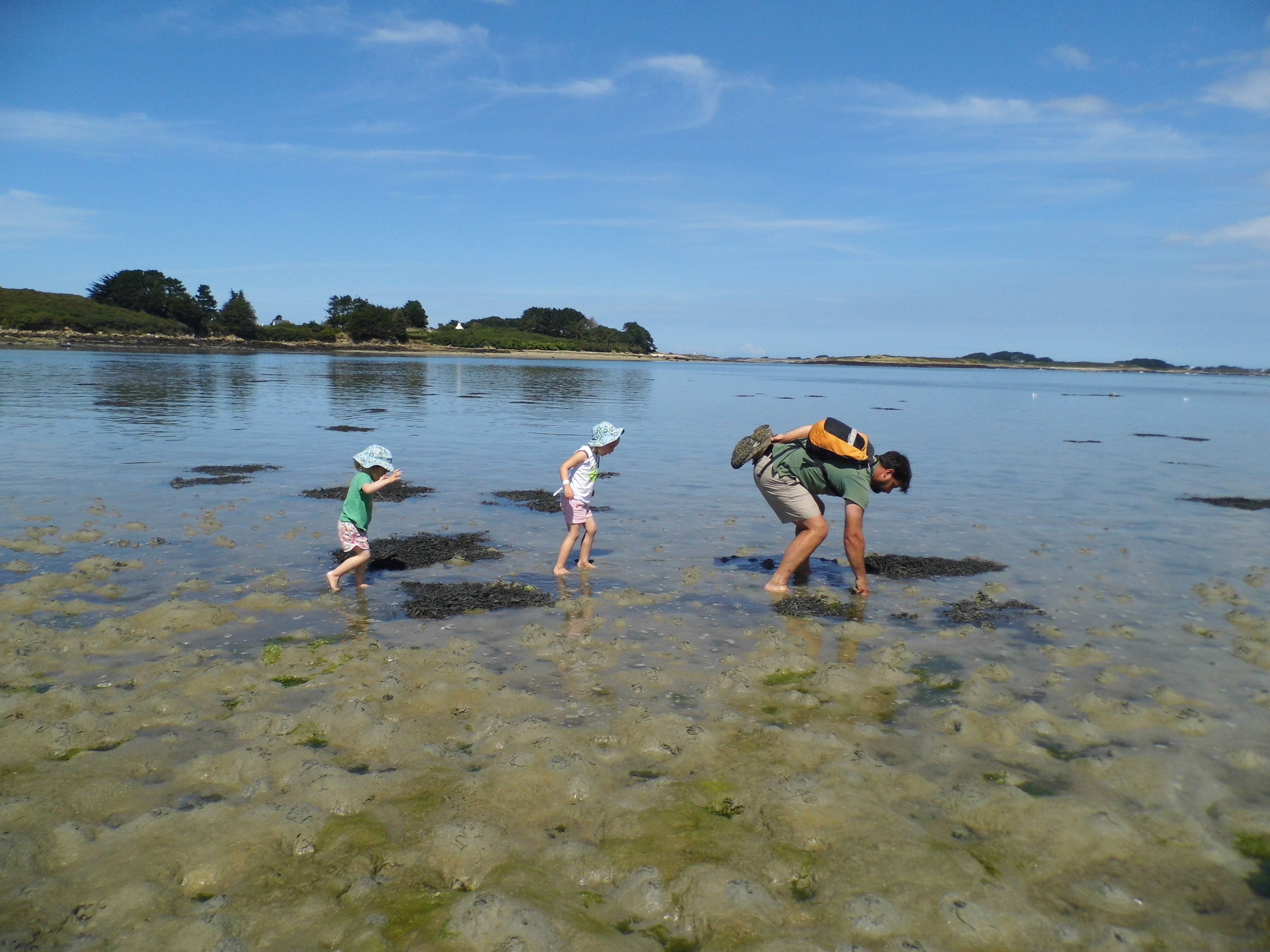
Foraging for clams in Brittany

As a nomadic family, we foraged for food in the middle of England, along the coasts of Devon, Cornwall, Ireland, Brittany and Galicia, and in southern Spain and Portugal. From trees growing in green city spaces to rural woodlands and open countryside, we have gathered almonds, apples, apricots, carobs, figs, hazelnuts, lemons, loquats, olives, oranges, plums and pomegranates. From seashores we have gathered clams, cockles and mussels, sea beet, rock samphire and wild carrot. We have gathered alexanders, asparagus, chard, fennel, lavender, mint, nettles and rosemary from woodlands, scrubland and walking trails, blackberries from hedgerows and camomile from fields. Lily and Katie have accompanied me as I’ve picked prickly pears and their dad as he’s gathered edible mushrooms.

***

As humans, we are increasingly disengaged from the natural world. And the more disengaged we become, the less we appreciate the incredible world around us, or understand our place in it and our obligations to it. Providing our children with opportunities to be immersed in the world helps them to develop that sense of appreciation, understanding and obligation. Immersion helps us to become part of the world again as we learn about the seasons, ecological niches, how plants depend on each other, and the lives and behaviours of animals. When we engage with the world, when we come to know it intimately, we are in a greater position to care for it, and to recognise our obligations to it.

Among the most ancient of ways to engage with the natural world is through foraging for food. Our ancestors have been doing it since before we were human. Until the late 1960s paleo-anthropologists believed that language, tool use and group organisation – those cultural characteristics that make us human – were developed and honed through hunting. The earliest tools, it was believed, were those used to hunt, kill and process wild animals; the earliest forms of communication were in the organisation of hunting parties. But in the late 1960s, female anthropologists began to study the previously ignored lives of women in contemporary hunter-gatherer societies. And what they discovered radically altered our understanding of the development of human culture.

Rather than hunted meat being the mainstay of most hunter-gatherer diets, it is foraged foods – vegetables, tubers, fruit, nuts, eggs, honey, shellfish, grubs and insects – that are the staple and daily elements of the diet. From these observations of contemporary hunter-gatherers, a new theory of the development of human culture emerged. Rather than hunting tools being the first forms of material culture, it was foraging tools – bags for carrying foraged food, and slings and straps for carrying infants. (However, unlike stone tools, these leave almost no trace in the fossil or archaeological record.) Indeed, the organisation required to communally care for infants and young children while women foraged was most likely what necessitated the development of language and complex culture. Forget man the hunter. Human culture blossomed around woman the gatherer.

Our ancient ancestors were intimately acquainted with the world around them. They had to be. Subsisting on foraged food required a deep knowledge of edible and inedible plants, of where, when and how wild foods grew, of how their growth was influenced by the plants and animals sharing that ecosystem, of weather and seasons, and of how foraging practices protected or destroyed plants for future use.

***

While we no longer rely on foraged food to survive, the practice of foraging draws us into the world around us. My family has discovered that the more time we spend in search of wild foods, the more intimately acquainted and attuned we become with the natural world. Not only do my children remember the location of the best patches of asparagus from previous years, for example, but they have learned, through experience, the environmental conditions best suited to this plant and, thus, where and when to look for it in new places. They have grown to know the seasonal changes that plants undergo and the other plants that share and are vital to the health of that habitat.

When we forage, our senses are caressed, challenged and enriched by the landscape. We walk up and down hills, through bright sunshine and dank shade, through woods and across fields, our hearts and breaths racing with exertion, feet slipping on damp rocks as we leap across streams or sinking into muddy tidal flats. Stopping to enjoy the sound of buzzing bees, our children learn from which plants bees forage at different times of year. They learn that other animals like the same foods as we do – wasps and birds on plums and pomegranates, the snuffling marks of a wild boar that got to the delicious asparagus tips before we did, the hollowed circles of grass made by a badger amongst the blackberry brambles, or our horse friend who makes short work of carob seed pods. And they can observe how wasps, ants, bees, birds and other small animals are linked to the life of each plant.

Such observations connect children to the natural world, allowing them to indirectly observe that the wild foods they collect are part of complex ecosystems. Further, they come to understand that they themselves are part of that ecosystem, just like the badger, the ant and the honey bee. They also learn that, to a far greater extent than any of these other animals, humans have the power to nurture or to destroy the environment. We teach our children, by example, to not take more than we need and to take only a little from each individual plant or area. Our children observe for themselves the destruction caused by wanton use and thoughtless disposal of plastics, metals and other industrial products, or by the needless felling of trees.

***

MTyrrell1

Lily in long sleeves and long trousers for the thorny work of asparagus hunting

Foraging is a deeply rewarding activity. We spend quality time with our children, engaged in activity together towards a common goal. The wild foods we bring home are transformed into delicious meals for immediate consumption or preserved or dried for use at some later date. When we return home after a few hours of walking, talking and foraging, we are often tired and grass or mud-stained, but our spirits soar from all we have seen and done, our bodies and minds enriched and enlivened from our immersion in the landscape. And with that immersion comes a stronger sense of care, compassion and empathy for the natural world and its many and varied inhabitants.

Born again minimalist

I used to be a minimalist. I was even recruited by an environmental website to write a series of blog posts about living a minimalist life*. Julian and I chose minimalism when we chose to live on a boat. From that fateful day in April 2011 when we decided to radically change our lives by quitting our jobs, selling our house and buying a boat, minimalism became our goal. Our first symbolic act, that same evening, was to unplug the television, put it in the boot of the car, and take it to the dump the next day. After that, minimalism became a necessity as well as a desire. If our family of four was going to live on a small boat we had to get rid of most of our stuff.

During the summer of 2011, we radically de-cluttered. If we numbered each item we owned, I would make an educated guess that we got rid of over 80% of our belongings. We sold or gave away most of my close to one thousand books, we sold our excess kitchenware, clothing, toys and gardening tools. The things that were meaningful to us, but that we wouldn’t have room for on the boat, went into storage in my parents-in-laws’ houses. When we bought Carina and first moved aboard, we quickly realised we still had too much stuff and at the end of our first sailing season we downsized again.

Each year we have returned to my father-in-law’s loft, and have further pared back what we’ve kept in storage. Some things we simply don’t need any more, such as the cots, children’s beds and toys that Lily and Katie have outgrown. But we have also pared back items that we had stored out of sentimentality, but which now no longer seem so important to us. The pile of truly important material items has decreased over time. We also still have a few large items in my father-in-law’s garage, such as a sofa, a dining table and chairs, a washing machine and our bicycles. I think the time has come to consider selling or donating some or all of those items, if they have not already been damaged by damp or pests.

However, in our life on the boat and now our life back ashore again, the quantity of stuff in our lives has started to creep up again. One of the reasons we moved off the boat was because there wasn’t enough room any more. The lack of room was partly due to two growing girls and two parents who are larger than when we moved aboard, but it is also partly due to creeping quantities of stuff. We moved off the boat and brought all that stuff with us, and for four months we added to it. Our house was cluttered and it made me uneasy. It felt messy and unnecessary.

Early in the new year I watched both the documentary Minimalism and the Marie Kondo series Tidy Up on Netflix. Both reminded me that I once, not so long ago, shared these minimalist ideals and aspirations. And I realised two things. First, that I wanted to return to that simpler way of living and, second, minimalism is an ongoing project and a lifestyle choice. It is not something we do once and forever. In a world bombarded with consumption, we have to work mindfully to keep unwanted stuff out of our lives and to reduce the unwanted stuff in our lives, whether it sneaks in when we are not being mindful or it is once-useful but now obsolete stuff.

In the past couple of months, I have been keeping ‘minimalism’ at the forefront of my mind. The children and I have de-cluttered together and I am being more mindful of my consumer choices. 2019 has become my year to return to my minimalism. Unlike the first time around, I know it is more a process than a project, a lifestyle choice rather than a lifestyle change. I’ll let you know how I get on over the coming months.

*Sadly, this site is no longer available. However, I still have copies of all my posts on that site.