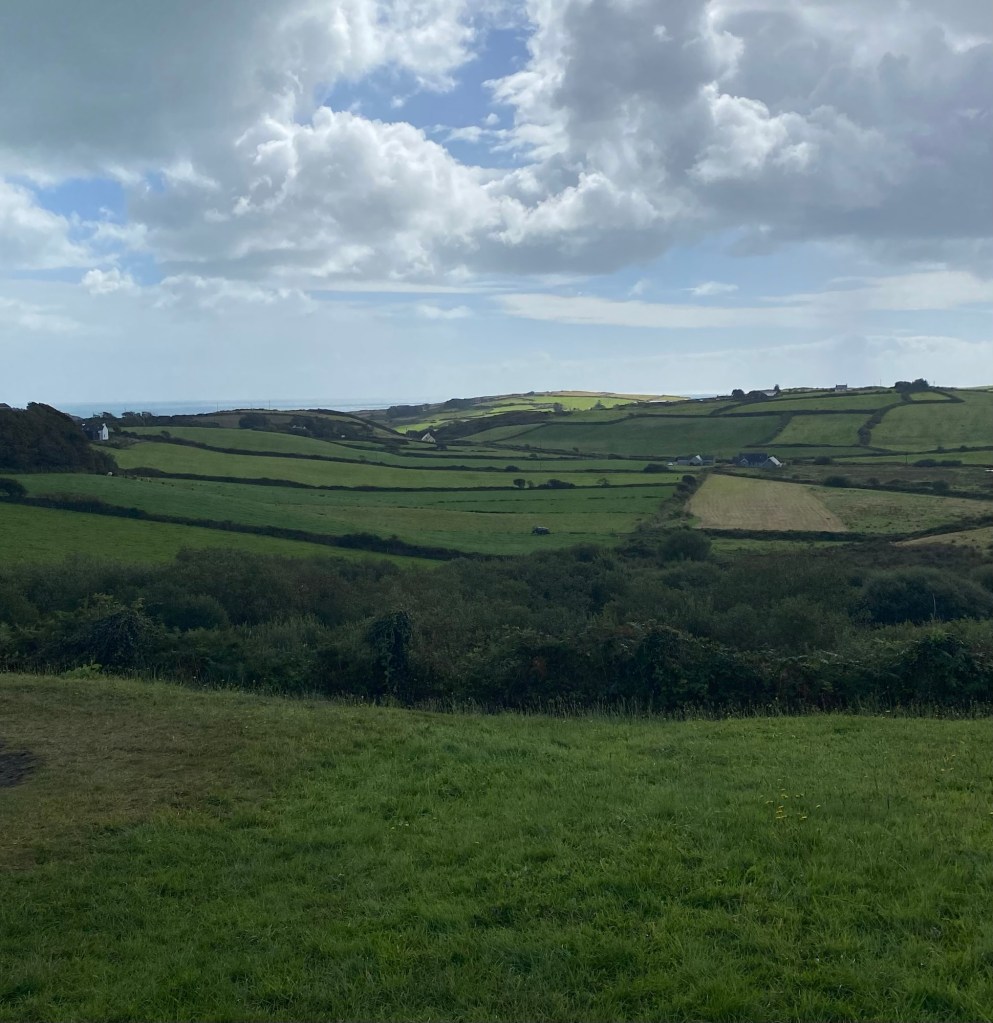
99. Membrillo

I thought we’d missed the season. I was disappointed. I’ve been parsing out the last bit of membrillo (quince jelly) to Lily and Katie to eat with cheese. ‘Is there any more?’ they ask, when faced with the thin sliver of fragrant amber jelly on their plates. ‘That’s it,’ I say. ‘It’s nearly all gone.’

Since moving to Sanlúcar a decade ago, I have made quince jelly pretty much every year in late summer. First, I pick a large bagful from a couple of trees by the river on the land tended by lovely old Juan de Correos (who sadly passed away this summer), or I get some from the land of my friends, Paul and Diana.

Turning the hard pale green fruits into dark orange deliciousness is a Saturday morning’s work – washing the growth of fuzz off each fruit, peeling and coring them (they have nasty black sticky cores), chopping them into the saucepan and adding sugar and the tiniest bit of water. And then the magic happens. The quince gradually transform from something more akin to a potato than a pear in look and texture into the most fragrant, most floral, deepest orange mush. A quick blitz with the hand blender once the mush has reached setting temperature, and then I pour it into two trays to set. As it cools, it solidifies to a jelly and turns translucent. It’s magical. And the taste is heavenly. When it cools and sets, I cut it into blocks and store it for use throughout the year.
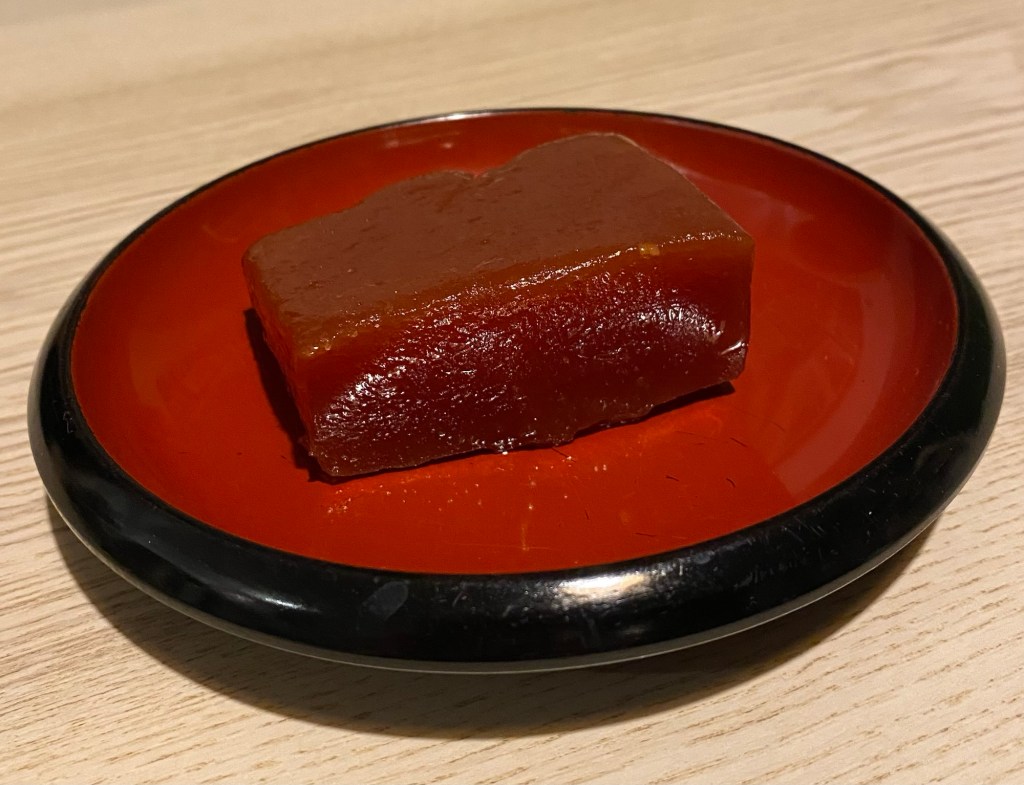
The last of last year’s membrillo

In my house, we eat it with cheese or sometimes on toast. I put it as a middle layer in homemade oat bars, and I even add it to apple pies.

So, imagine how I felt when I thought I’d missed the season. We’d been away for so long and I’m still kind of settling back in to life here, so making membrillo had slipped my mind. Until I realised we were down to our last block. A whole year without membrillo? Unimaginable!

This evening, Lady and I went out for our evening walk and I came to a membrillo tree, branches sagging under the weight of a healthy fruit crop. And then I remembered. This was the very tree that I had picked the quince from last year. This tree comes into fruit later than the other trees that I usually pick from and the fruit last year was much better – no rotten bits, no waspy bits, just perfect quinces.

The tree is on the edge of a field, with half its branches hanging out over the fence and over the edge of the road. It was ftom these branches that I picked last year. This evening, I made a mental note to come back tomorrow with my backpack and take what I need.

As I walked past the tree on the return leg of my walk, the man who owns the field was there. I asked if I could take some quinces tomorrow and told him I’d taken some last year. We got into a conversation about membrillo and it’s many delicious uses and he told me to take what I need.

So, tomorrow I’ll be back by the tree to forage some fruit and, although I’d planned to do something else, Saturday will be my annual membrillo-making day.

93. 2-stroke

What’s your favourite smell? Freshly mown grass? Fresh coffee? That smell when you nuzzle your face into a baby? Why is it your favourite smell? Do you know?

I was sitting at my desk yesterday morning, the window open to cool the house down before the heat of the day kicked in. That’s when the smell came tumbling in and nostalgia stroked my face like a feather. One of the council workers was strimming the strip of grass that runs the length of my street. And there it was: The smell of exhaust from a 2-stroke engine. There’s comfort in that smell for me and it’s deeply entwined with so many good memories.

We’re living on Carina of Devon. Me and Julian and the girls. The smell of a 2-stroke engine is us leaving Carina to head off on an adventure in the rubber dinghy. Maybe it’s all of us, going ashore to explore a new place or to wander up a river that’s too shallow for Carina‘s draught. Or I’m on my own, the freedom of having the outboard tiller in my hand, setting out to go for a solitary walk or to go shopping or do the laundry. Or it’s Julian, taking the girls across the Rio Guadiana to school. Or it’s all the other yachties we met over the years, the smell and sound of a 2-stroke outboard motor signalling their arrivals and departures from their anchored yachts. It’s adventure and freedom.

Strip that layer away, and I’m living in Arviat. It’s summer, with open sea and lake-pocked land. I have my own quad bike and I zip around town in the near 20-hour daylight, picking my friend Crystal up at 3am, so we can go check the fishing net we’re sharing for the summer, or meeting Frank at 5am to go beluga hunting. His quad has Arden’s boat trailer attached on the back, so I hop on and reverse the quad into the sea under Frank’s guidance; he offloads the boat, as I park the quad and trailer. Or I’m out along the road to the dump, or the road past the reservoir, at twilight or after dark, speeding along way too fast, sometimes alone, sometimes not. In my mind, I’m a badass. In reality, probably not.

Strip that layer away, and I’m living in Arviat. It’s spring, and I’m at the floe edge with Arden. We’ve come by skidoo; him driving, me sitting in the qamutik (sled), facing back towards Arviat, back towards the direction we’ve come from, to shield myself from the powdery snow blown up by the skidoo runners. I’m surrounded by the immense beautiful whiteness of the west coast of Hudson Bay. We’ll stop when we get to the floe edge. Arden will talk to me and teach me, I’ll try to remember everything; we’ll drink tea and eat the bannock Theresa has made for us.

Strip away that layer and I’m at home in Ballygibbon. I could be 10 or 20 or 25. The 2-stroke exhaust is Daddy mowing the lawn. It’s the ease and efficiency of the first petrol-powered lawn mower after years of a small, manual one. It’s me spending summer evenings following Daddy round the garden – at 10 or 20 or 25 – just for his company and the important things we have to talk about – Gaelic football and films and music, a bit of politics and other sports.

When I catch a whiff of 2-stroke exhaust, it doesn’t conjure any one of these times in my life in particular. Rather, it mashes them all up, and loosens something in me, a knot unravels, and a feeling of belonging rushes through my veins. Now, I am here, with a view out my window that’s as green as I could ever have hoped for. And a new layer is added to my love of that smell.

91. Too far away

I remember the phone ringing down the hall. Mammy got up from the kitchen table to answer it. ‘It’s for you,’ she said, coming back to sit down. ‘Someone from Canada.’ I walked down the hall to the table by the hall window and put the receiver to my ear.

‘Hello?’ I said.

‘Huvi?’ came the reply. Frank. Dear Frank. My friend, my teacher, my hunting buddy. One of my primary research participants in Arviat, it was Frank who had taught me to skin and butcher caribou, and to get it right by doing it over and over; Frank who had taught me how to drive a boat amongst pods of beluga whales in the shallow waters close to shore, so he could harpoon them from the bow; Frank who put me on polar bear patrol while he collected the arctic char that had swum into his fishing net; Frank who I spent hours and days with, far inland on our quad bikes, out at sea at first light. He and Martha welcomed me into their home, made me tea, fed me biscuits and bannock, took me out on the land and to their cabin with their daughters. Frank made me laugh and made me think. How at ease I felt in his company.

And now, he was on the phone. He on the tundra, on the western shore of Hudson Bay; I in the Bog of Allen, in the middle of Ireland. And the distance between us seemed vast. Vaster than the Atlantic Ocean, and maritime Canada and the width of Hudson Bay that separated us. All that we talked about with such ease when we were together dissolved now across the expanse.

He asked about the weather and I told him. But what was Irish weather to him? What was the Irish autumn, with leaves changing colour and falling off the trees, the rain and the mud, when he lived in a place with no trees, where autumn meant the ground covered in snow and the sea gradually turning to ice, travel by boat giving way to skidoos. My autumn meant nothing to him and, from this distance, his autumn was starting to dim for me.

I asked what he’d been doing and he told me where he’d been seal hunting the previous day, who he’d gone with and the other hunters he’d met when he was out. I smiled as he spoke. In my mind’s eye, I could see where he’d been and who he’d been with. I had been there with him, and with his brother-in-law Arden, just a few weeks earlier.

He asked what I’d been up to. It was September and in Ireland there was only Gaelic football in the air. How could I tell him about the match I had been to on Sunday? About the crowds, the excitement, how important football was to my life here? Or that the turf was home and there were still a couple of loads to be thrown in the shed. My voice sounded strange in my ears as I tried to talk to him about my life here.

I’d lived in his world and loved it. He was interested in my world, but had no experience of it. The ease we felt in each other’s company was made jagged by the cultural distance that now lay between us.

We continued to speak on the phone occasionally and I got to spend another summer with him a few years later. It’s a few years now since he passed away. I wish I had been better able to bridge that distance when he called.

86. The most exclusive club

During the hazy lazy days of summer, Sanlúcar’s municipal swimming pool feels like some exclusive country club you’d see in a Hollywood movie, minus the shrimp cocktail and the dramatic intrigue. And it’s not just Sanlúcar. Village swimming pools all over Spain are like this, but I suspect there are few in as beautiful a location as this one, overlooking the Rio Guadiana and the hills of the northeast Algarve in Portugal on its western bank.

Why does it remind me of a country club? Well, our village is tiny, so the numbers of people attending the pool are pretty small. And everyone knows everyone. This really is Sanlúcar’s pool and, apart from the occasional visitor, the sun worshippers and bathers at this pool are the young and old of the village. Neighbours, friends, family members chat in the cool of the pool, look out for the toddlers tottering at the pool’s edge, gather in groups to share afternoon snacks. Children wander from one group of adults to another, because they know everyone, and you’d certainly never worry about leaving your belongings unattended. The life guards and other attendants are all local kids too.

But, unlike a country club, there’s no real exclusivity here. €2 for a day entry, €68 for a family for the entire season. Everyone is welcome here. But those who use the pool as visitors to the village might find the familiarity of all the other pool users with each other a bit strange. For Sanluceños, it’s just a wonderful break from the summer heat right on our doorsteps.

82. Bog road

‘Turn on Radio 1,’ Niamh said, as we got into our cars to drive in convoy across Kildare. ‘Sunday Miscellany is all about the bog this morning.’

I led the way along the bog road, through Allenwood and Prosperous, past the road down to Coill Dubh, through a landscape I have known all my life, a landscape so densely entwined with memory and meaning.

It’s impossible to come from the midlands of Ireland and not have the boglands seeping through your veins. This great flat landscape, the fuel source around which our year and our society revolved. The footing and the haping, and tea from a milk bottle and sandwiches wrapped in waxed paper. Cold March Saturdays of the men cleaning the turf bank all the way through to warm August Saturdays of bringing the turf home.

And it’s the poetry and the music – Heaney and Christy Moore and Luka Bloom. It’s the dissertation I wrote as an undergrad and the bog PhD I started in my 20s.

As I drove across the bog, I listened to the radio programme, as Niamh suggested. It was filled with the stories, songs, reminiscences of people from the midlands. Some people, like me, who have chosen to live abroad and have never found a way to adequately describe and explain all that the bog is to people who don’t know it. And some people who had lived in the bog their whole lives, who evocatively expressed what the bog meant to them.

To listen to this as I drove across the bog this morning was moving enough. But today also happens to be the 21st anniversary of the day that Daddy died. And for me, above all else, my memories of the bog, and what the bog means to me, are inseparable from my memories of Daddy.

It was, therefore, a bittersweet drive, with the stories and the road and this particular day, all evoking memory and emotion, and tears running down my cheeks, not of sadness, but of gratitude for this place and all that it means to me.

80. Skyscape

The morning started out sunny and warm. We’d planned to spend the day on the beach but, as usual, we slept in too late and spent half the morning in our pyjamas, drinking tea and chatting around the kitchen table. By the time we were ready to go out, close to lunchtime, it had begun to cloud over.

For our tardiness we were rewarded with this incredible skyscape, the dark grey clouds reaching out across the sea, the rain falling in a sheet a mile or more out to sea. I thought it was coming towards us, that we’d get soaked even as we set the picnic out on a towel on the beach. The rain shower moved from west to east, appearing to approach, but instead moving away to the southeast over Galley Head.

By the time we’d finished our picnic, the sky had cleared and we were warmed by the sun. The sea was inviting but, in the few minutes it took to change into our swimsuits, another bank of clouds had rolled in, another shower of rain fell to the south and we were chilled by the wind as we braved seawater that was the coldest we’d experienced this year.

But as quickly as those clouds came, they went again, and again we were in the sun. And so it was for the afternoon, the mood of the sky changing by the minute, tempting and teasing us, and delighting us with its constantly evolving shapes and colours.

78. Genius neighbours

I leave the house by the back door to walk up to the village shop to buy a couple of items to complete our picnic. The patio slabs are strewn with rotting food. Slices of greying white bread turned to mush, slimy pepper, faded to a pale green. Lettuce, tomatoes, onions, all slime and mush. These are the offerings of the previous occupants of the house, thrown directly into the small brown food waste bin and not yet put out for refuse collection. The compostable bag of food waste we have placed in the bin is on the ground too, ripped open, its contents still inside. The ground is a mess.

‘Come look at this,’ I call back into the house to Mammy. We suspect a fox, maybe a badger. A rat perhaps?

‘Buy me rubber gloves,’ Mammy says as I leave for the shop. I walk out the back gate. My eyes are drawn upwards by the noise overhead. Two jackdaws are sitting on the electricity line running behind the row of houses, in loud conversation. ‘Was it you?’ I ask, looking up at them. One of them flies off, ignoring my question.

Twenty minutes later, rubber gloved, Mammy clears up the mess, returns it all to the food bin, and places a large flat stone on top of the closed lid. Secure.

Later, on the path that runs along the back of the beach, a jackdaw flies past at my eye level. It has something in its mouth. I watch it go, see it drop whatever was in its mouth. The bird circles back, lands, picks up what it’s dropped, flies again, drops it again. Repeats. And repeats. This is no accident. It knows exactly what it’s doing, dropping the object on the thin strip of stony path in between the sandy beach on one side and the grass-covered sand dune on the other. With each drop, the object cracks a little more. It’s a mussel. The jackdaw is on top of it now, holding the cracked shell firm with one foot while it pulls out the tasty flesh with its beak. As we walk along the path, I see it is strewn with cracked and crushed mussel shells. Previous meals. Smart jackdaw.

Still, it’s hard to believe that the two jackdaws near the house were the culprits of the knocked over bin. Dropping a mussel shell is one thing. Knocking over a bin is quite another. Maybe I’m accusing them in the wrong. Maybe they were simply taking advantage of another animal’s handiwork.

The next morning, Mammy is first out the door. She can’t believe it. It’s a mess again. The bin lying on its side, the stale bread, slimy vegetables and our compost bag pouring out. The large flat stone she has placed on top has, somehow, been knocked off. And in the middle of it all? The two jackdaws. They fly away when they see her, hurling abuse at her in their language, not at all happy that she has disturbed their hard work. Clever birds.

She’s put two rocks on top of the bin now. Let’s see if they can figure that out.

77. West Cork scenes

The last couple of days in west Cork have been a delight. Here are a few photos….

View from Glandore
Adam and Eve islands
The Warren, Roscarbery
The Warren from the cliff walk
Evening swimmers
Silliness on the beach

76. Drombeg

Drombeg stone circle

I visit Drombeg every time I come to west Cork. And each time, I feel a connection to the people who lived here 3000 years ago. Not some hokey connection, like these people were somehow more spiritual or more vital or more at one with nature than us. No. I feel a connection because they were people just like us, breathing in this same air, looking out over the view of the sea cradled in the V of the valley. These clouds hung over them, this rain fell on them, this wind chilled them, this sun shone on them.

While Newgrange or Stonehenge are huge and majestic monuments, stone circles such as Drombeg and the others that dot the landscape of southwest Cork feel much more intimate and ordinary. As astounding as the stone circle is, with its orientation based on deep astronomy, it is the more intimate and domestic elements of this site that move me. It is knowing that the body of a youth was found at the centre of the circle. It is the rectangle water pit, where water was boiled using stones first heated in a fire. Maybe the pit was used for cooking. Maybe it was used for dyeing or some other purpose. We simply don’t know. It doesn’t really matter. It’s that people – men, women, children – sat and walked and played and loved and argued and laughed here 3000 years ago. Ordinary people who couldn’t imagine that 3000 years into the future people would visit what remains of their home and wonder at what they did.

73. Squeezing the last drops out of summer

Autumn is definitely here. It’s raining more and it’s colder. We lit the fire in the kitchen yesterday. And still, the girls and I remain in Ireland, squeezing every last drop out of this long long summer. In the eleven years we’ve lived in Spain, we’ve never been away this long. Usually, we’d be back by now, going to the pool after our mid-afternoon siesta, or taking the dog down to the dog friendly beach in Isla Cristina.

Yet, here we are, still in Ireland, and one final adventure awaits before we return to Spain. Tomorrow morning, we are driving down to west Cork for a week in Roscarbery. It’s one of my favourite places in Ireland – a picturesque village by the sea, with an amazing beach, great walks – a simply lovely place. Because my aunt, uncle and cousins live there, we’ve been visiting Roscarbery since I was a small child, so it is infused with memories from so many different stages of my life.

Our bags are packed, the makings of the picnic are in the fridge, and we’ll be ready to hit the road after breakfast tomorrow. Forecast? Autumn showers and autumn temperatures. It’ll be lovely.