28. Some fields in England

The heatwave has passed for now. It’s windy and the early morning sky threatens rain. I’m wearing my new raincoat that I bought last week in the height of the heatwave. The sales assistant looked at me funny and I said, “Well, this has to end sometime.” It’s certainly ended now.

This week, we’re looking after the adorable Hudson (see yesterday’s post) at his home in a little village in the middle of England, while his human parents are away on vacation. It’s 8am and Hudson and I are out for our morning walk. There’s nobody else around, as we walk for a few kilometres along the edges of arable land and across fields of sheep and lambs, from one kissing gate to the next.

One young lamb is curious and tries to come to us, its worried mother keeping pace with it, probably wishing it wasn’t so curious about this big woolly dog and red-raincoated human (what colours can sheep see?). A field of rape seed is half-harvested, a big yellow combine sitting in the middle of the field, ready to resume its work when the rain lets up. I see something move at the wide fallow edge of the field, heads bobbing up and down. I think it is a couple of rabbits at first, but as we get closer, I see that it is a family of grouse. They are disinclined to leave the relative safety of the long grass for the exposed stubble of the field. I think I should turn back and leave them be. But at the exact instant I have this thought, one flies up from right at my feet, completely invisible to me and to Hudson up to now, scaring me and sending all the others into flight too. They fly the 20 or so metres from the grassy verge into the yet unharvested half of the field. I feel bad for them. Hudson is good, though. My own dog, Lady, would be going crazy for them, but Hudson seems oblivious.

A little farther on, I step over a badger sett. It looks neat and tidy and, therefore, in use, and I get a little thrill thinking that, underneath my feet, a family of badgers is likely settling down for the day to sleep. Towards the end of the walk, we pass a small patch of open grassland backing onto a copse of trees. Two hawks circle each other ten or so metres off the ground over the grassland, crying out to each other. One lands in a tree and the other continues to circle, eventually settling on the branch of a nearby tree. Their cries continue to ring out.

I am reminded of other early morning country walks along English pathways – in the Fens and Cambridgeshire, up north in Cumbria and down south in Devon – and of the hares, the muntjac and the red deer, the red squirrels, the badgers and foxes, the eagles and hawks and falcons and owls, of the times I have been privileged enough to see those animals in person and the times when I have found signs and signals that they have been there and may still be there, watching me, the clumsy human, walking through their home.

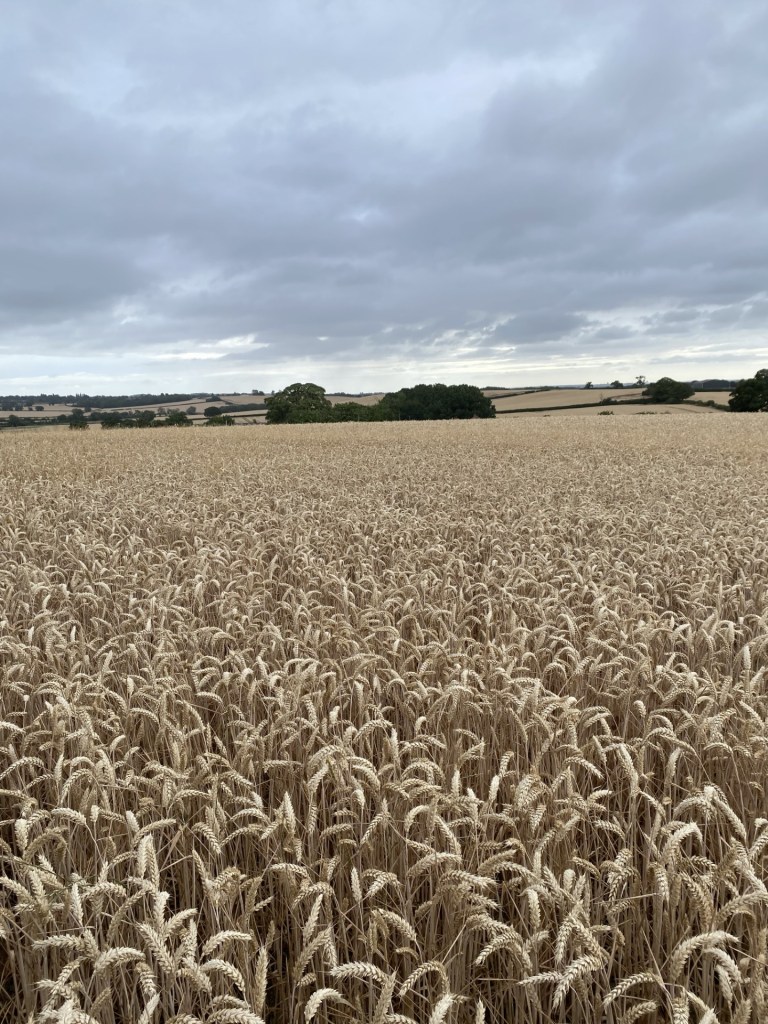
A grey morning in a wheat field

24. The pear tree

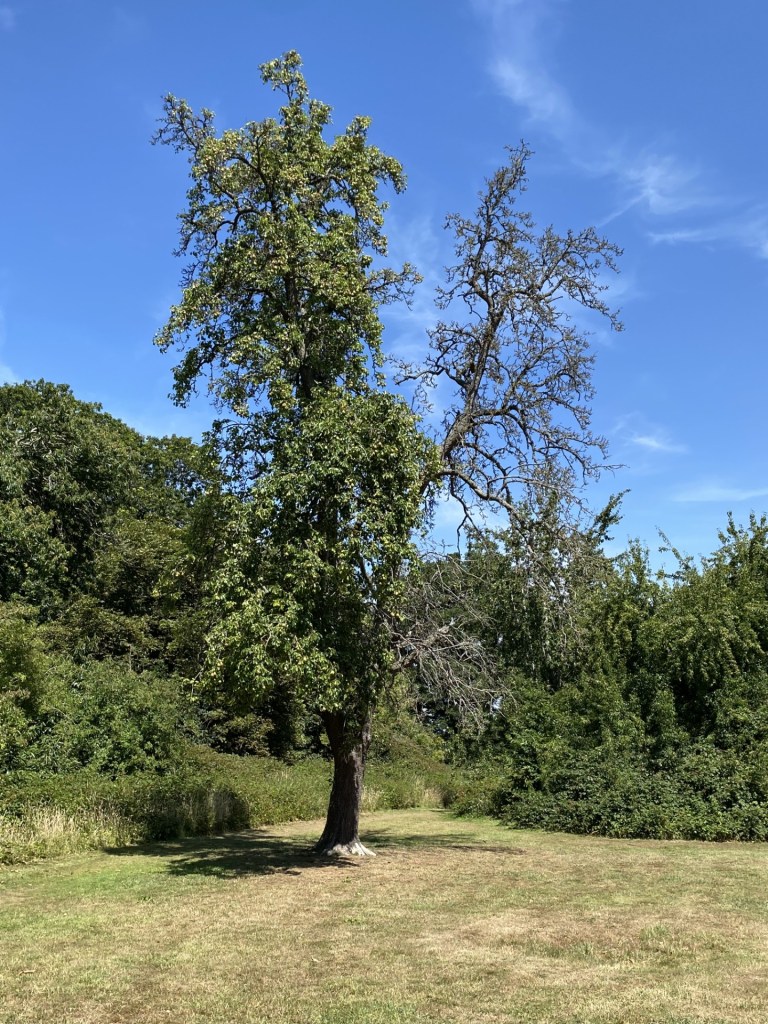
I’ve fallen for this pear tree. In a park full of majestic giant oaks, giant chestnuts, giant sycamores, it is this more modest pear tree that I am drawn to day after day, to sit under to eat my lunch and take a break from staring at my computer screen.

I chose it at random the first day, a little bit off the path and providing just enough dappled shade from the sun. I ate my lunch and then, like Heaney’s threshers in The Wife’s Tale, who “still kept their ease, Spread out, unbuttoned, grateful, under the trees,” I lay down and gazed up through the branches. It was then that I noticed something I hadn’t noticed as I walked past it or under it.

About six feet from the ground, it forks. The branches to one side of the fork are lifeless. No leaves grow, no buds. It is bare but for the lichen that has crept along it. The other side of the fork, in contrast, is heavy with life. The branches sag under the weight of innumerable pears that will be ripe by autumn, food for humans, food for animals, carrying the seeds of the offspring of this tree.

I’m drawn to the perseverance of this pear tree, to its wonky imperfection. Something happened to it – a lighning strike perhaps – that irreparably damaged one half of it, yet the other half carries on steadfast and lively. And I come to see that the damaged part might still have its role to play too, providing balance and stability, helping to anchor the still lively half.

A bumblebee lands on my brightly coloured trousers, resting in the shade of the tree for a moment before going on its way again. There are other insects too, not passing through but living here, making the tree their home. On both forks of the pear tree, I see intricate spider webs and, at the base, a hole made by some small animal. There are rabbit droppings on the ground around me. The tree, as a whole, is a place of liveliness, home to or way point for so many animals, me included.

As I sit up and prepare to return to work, I look around and see, not far away, smaller pear trees and saplings, surely the offspring of this one. The tree, despite its imperfections and its damaged parts, is living its best pear tree life.

23. Meeting Sean

I’m walking along the Grand Union Canal that runs behind the estate where my father-in-law lives. It’s a glorious evening and I’m on a video call with Katie who is away on the south coast this week with Lily and their uncle and aunt. I walk past four or five narrow boats. On the last boat in the row, a modest white and blue steel boat, a man is standing. I have the phone up, so he thinks I’m filming him or taking his photograph. He gives me a big smile and says something. But I’m talking to Katie, so there’s some confusion. He then realises that I’m not taking his picture and I realise that he’s talking to me. More than that, I hear his Irish accent and he hears mine.

“Where are you from?” he asks. “Kildare,” I reply. “Ah, a Lillywhite,” he says and I know immediately that I am firm ground. Despite his Dublin accent, he tells me he’s from Dungarvan in Co. Waterford. “The husband of one of my best friends is from Dungarvan,” I tell him. I tell Katie I’ll call her later because I have a feeling I might be chatting here for a while.

Sean and I chat for an hour, me standing on the grassy tow-path, he on the open deck of his narrow boat, the air cooled engine exposed to the evening air. We discover we have people and places in common. He pootled a narrow boat up to the harbour in Edenderry in the late 1960s and remembered going for a drink at The Harbour House. That was my uncle Tom’s favourite haunt, owned by Mary O’Connor, my Irish teacher, and her family. I was only in The Harbour House once, for a pint of Guinness with Tom back in the early 1990s. It was everything you would expect of a small Irish pub, all the old men lined up at the bar. It was renowned for its music and for Mary being as strict behind the bar as she was in the classroom.

Sean tells me about his job at Shannon airport and about people from Edenderry he knew there and at Ardnacrusha power station. I mention people I know who he might have known and we laugh when we get a bit tangled in Johns and Seans and who was who.

I tell him I had been a sailor and we talk about the joys of my Westerly Conway. He wonders how a girl from the Bog of Allen and a boy from the housing estate 20 metres from here could have ended up living on a boat and sailing to the places we did. He tells me of his adventures as a sea sailor and as a narrow boat owner and about his sustainable, no-cost approach to life.

At 80 years of age, he is only a few years younger that Daddy would have been. The Cuban Missile Crisis comes up in conversation (he makes me promise not to tell anyone why) and he shares his reminiscences of those few days in 1962 and I tell him what Daddy told me of his memories and fears of those days.

He explains how he has come to have that Dublin accent but says his heart remains firmly rooted in Dungarvan. He already owns a plot in Dungarvan graveyard where he wishes to be buried when his time comes.

“I had a half pint at the Cape of Good Hope a while ago,” he tells me, referring to the pub just a couple of hundred metres away. “When I went to the bar, I heard two men behind me. A Mayo man and a Galway man. Sure, I had to talk to them. The Mayo man was a bull man.”

“A bull man?” I ask, perplexed. “Ah, you’re too young,” he says. He explains what a ‘bull man’ is and realisation dawns. “Ah,” I say, “You mean the AI man. That’s what we call it where I come from.” He laughs and says how funny that we had that in Ireland where the Catholic church didn’t allow such things for humans. AI, for those of you not in the know, means, artificial insemination, and the Bull man or the AI man was, and remains, an integral part of our dairy and beef industries.

My daughters always tease me when I speak to other Irish people, accusing me of changing the way I talk and the way I hold myself. They’re not wrong. But I don’t do it on purpose. When I’m with other Irish people I become the version of myself that is the oldest part of me. I speak in the way I learned to speak as a baby, in the first accent I ever heard from the people and the place where I grew up. It is the accent, grammar, syntax and vocabulary that I am most comfortable with. There’s no modulation, no register change, no code switching. I am me at my most comfortable.

We all change our registers in different contexts. For instance, the way we speak to small children is not the same as the way we speak in the corporate office. The way we speak in church is not the same as on the terraces of the football stadium. But changing accents is something different. Over the years, I have modulated not only my accent, but the words I use when in conversation and the order in which I say them. Why? Well, for two reasons – one that I am comfortable with, the other less so.

For most of my life, I have chosen to live among people for whom English is not a first language. Therefore, to make myself understood among English speakers in Japan, Nunavut, Spain, and elsewhere, I slow down, speak carefully, use very standardized words and phrases to be understood and to make the person I am speaking to feel more comfortable. That is now second nature to me.

The other reason is that, over the years, I have been very aware of people making fun of my Irish accent – people laughing and repeating my pronunciation, my use of certain phrases or my Hiberno-English sentence structures. In order to reduce the feeling of discomfort (and anger) that this fun-making and ridicule causes in me, I modulate and change register. It’s just easier. I don’t like it, but it is how it is. That too is now second nature to me when I am around native English speakers who are not Irish.

But, when I speak to other Irish people, I can feel my body physically relax. I don’t have to think of an alternative phrase or word for ‘give out’, ‘press’, my use of bring/take, my pronunciation of H and th, or a thousand other usages of words and phrases. I’m not going to be laughed at for calling my parents Mammy and Daddy. I can throw in a reference to the GAA or to Eamon Casey or to the Angelus or to a million other things, and no further explanation is required. I can just be.

All migrants, no matter what their language or their circumstances, experience this distance from their first voice. Some people are happy to leave that first voice behind. I am privileged to have had so many opportunities to travel in my life. I have learned so many wonderful ways to speak and to see the world through the eyes of others. But speaking in the way that is oldest to my being is like relaxing into a large warm bath.

Sean is stuck along this stretch of the canal for the time being, as he waits for a lock gate farther along to be repaired. I tell him that if he’s still there the next time I walk that way, I’ll invite him down to the Cape of Good Hope for a beer. Who knows? Maybe the AI man will be there.

Stretch of the Grand Union Canal in Warwick

20. Normal England has resumed

We arrived back to Leamington Spa late on Saturday evening, leaving the girls with a 19 hour turn-around time before leaving for a week in Lymington with their uncle, and leaving me with even less time than that to get the laundry done. It’s all too easy to forget how quickly clothes dry at this time of year in southwest Spain. Hang ’em out and take ’em in again two hours later, hard as boards. Not so in England. But the weather has been unseasonably warm here. We sweltered in 35 degree heat at Wimbledon last week and, if that weather had continued for just one more day, well…I’m just saying, it would have made doing the laundry a little easier. Gaia, why are you toying with me like this?

It was breezy when I woke up yesterday morning, my first task to fill the washing machine and do a quick 30-minute wash. Not that that did me any good. By the time they came out of the machine, the heavens had opened and rain fell at a slant onto my father-in-law’s newly laid patio slabs, and in through the open kitchen window, leaving the window sill and the floor slippery and dangerous. Did I care? Of course not. There’s a tumble drier out in the garage. I don’t like using a tumble drier, but needs must, so out I flitted, my father-in-law stating the glaringly obvious, ‘You’ll get wet.’

Forty minutes at high heat. Out into the rain again. The clothes were still wet in the drier. Another thirty minutes. Then another. No joy. My father-in-law insisted I was doing something wrong. I insisted I wasn’t. We eventually found the culprit – a very dirty filter thing that would need to be taken apart and cleaned out. But neither of us had any idea how and the instruction manual was long gone. Did I have time to go search how to do it online? I did not.

By now, the sun had come out, so I put all the clothes on the clothes horse and moved them to the far end of the north-facing garden to catch the sun shining in over the house. I was taking a shower when the next rain shower came and Lily dashed out to bring the clothes horse in. Then back out when the rain passed. Then in again. Then out again. And always that guessing game of ‘is this item of clothing really dry or am I just wishing it dry?’

Finally, the moment came for the girls to leave. Most of Lily’s stuff was still on the clothes horse and still damp or downright wet. There was nothing for it but to stuff it all into a bag with instructions for her to dry it when she reached her destination. “Don’t forget,” I warned ominously. “It’ll turn sour.”

Now I really feel like I’m back in England.

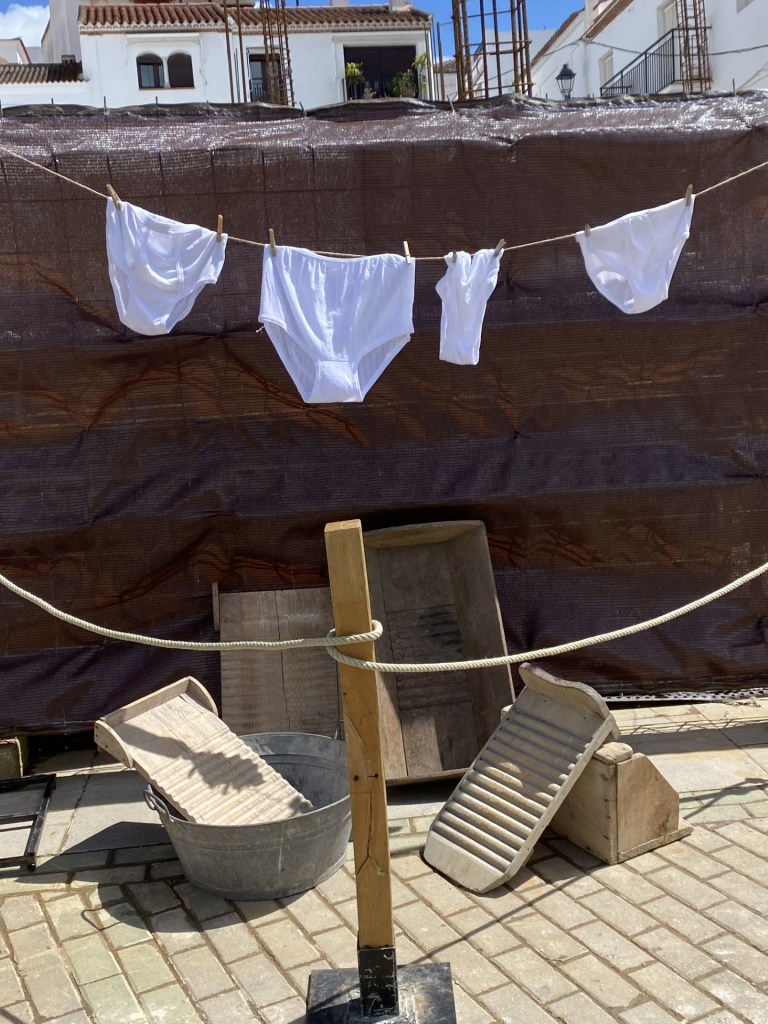
These are not our giant white knickers…I swear!!!

10. From there to here

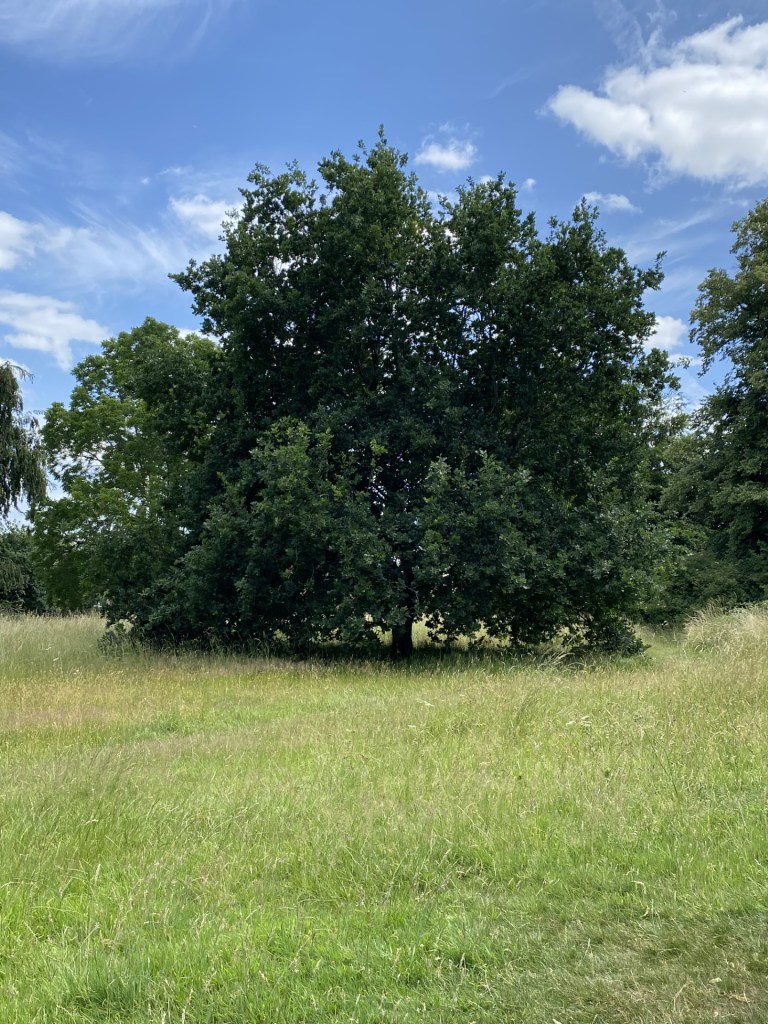
The trees are so big and so green and so varied and so alive. Oaks, horse chestnuts, sycamores, beech. Their trunks are immense and they reach high up into the blue sky. So unlike the scrubby arid trees of the dehesa (savannah) of southwest Spain. Tiredness is causing me to have an out of body experience as I walk through Priory Park. Is this what it’s like to experience the world when high on drugs, I wonder? The giant beautiful trees seem to pulsate around me, my brain and eyes playing tricks on me. Maybe the trees are playing tricks on me too. The tiredness is adding to my disbelief that I’m here, when only a few hours ago, I was there.

We woke up at 3.10am. I slept little anyway, checking my phone through the night to make sure I hadn’t slept through the alarm. Katie had set her alarm too, so it wouldn’t have mattered, but tell that to my subconscious/unconscious brain. It didn’t help that the narrow single bed in the cheap airport hotel was springy and uncomfortable and the room was too hot at first, then too cold with the fan, then too hot when I turned the fan off. Through those few brief hours, I heard other hotel guests arriving and departing, the thunk-thunk of heavy suitcases being hauled up or down the old stone stairs of this hotel without a lift, the wheels squeaking down the corridor outside our bedroom door, a movement-sensing light flooding our room with light through the glass panel over the door.

I am grateful that the airport was straightforward, the flight uneventful, our train to Leamington Spa on time. By the time we get to my father-in-law’s house mid-morning, the effects of the tiny €30 airport breakfast has long worn off and we are starving. While he asks the girls about the flight, I make a bee-line for the kitchen, knowing exactly what I’ll make (the girls and I have been discussing it, fantasizing about it). We anticipate what Granddad will have in stock, and we’re not disappointed. Rashers and eggs and fried tomatoes, with buttered fresh white bread and strong tea.

Afterwards, I rest for an hour, unpack a little and then I’m off again. The girls are sleepy, though they claim they aren’t. But they’re pale and have bags under their eyes, so they can’t fool me. I leave them sitting in the livingroom with Granddad, looking out over his garden at a fat pigeon pecking at the seeds he’s scattered about. I leave the house to the sounds of him telling the girls about a radio he built when he was a teenager, from his dad’s old cigar box. I hear him ask them what components they’d need to make a radio. My Gen Z teenagers have never used a radio in their lives, but I’m out the door before I hear their answer.

While my work life will be decidedly less frenetic in the coming weeks than it has been of late, I have a deadline to meet this coming weekend and I need to crack on. I spend a few hours at the library, meet my self-imposted work target for the day, and head back to my father-in-law’s house again. By now, I am well and truly zombified with tiredness, and the trees pulsate as I walk through them. Perhaps they are really Ents. Perhaps I need a good night’s sleep.

6. Ants

A few nights ago, in the middle of a cozy family viewing of Wicked, Lily got up to get something from the press. ‘Mum,’ she called from the kitchen. ‘There’re ants everywhere.’ We’ve had very few ants so far this summer – just one minor marching infestation that I’d quickly dispatched. I leave the comfort of the sofa to go investigate. To say I lost it would be an understatement. I swore at the ants. I shouted at them. I wished them nothing but back fortune. Our food cupboard had gone from zero ants to nothing but ants in the space of a few hours. I traced where they’d come from and found a line of the little blighters coming in via the top corner of the patio door. The patio door that had so valiantly kept them out last year, but now they’d found a way in. Mid-movie, I now found myself hot and bothered, feverishly swiping ants from around the honey jar, the bag of sugar, the jar of peanut butter. Every time I picked up a can or a jar, I found ants scurrying underneath, suddenly disturbed and running in circles, disturbed by this giant human who has lifted the roof off. The reason I’m so mad is that I know that once they’re in, they’re in, and the only thing that will get rid of them is autumn and the temperature dropping. Autumn’s a long time away.

I deal with the invasion as best I can and return to Wicked, all hot and bothered and the girls bemused by my over-the-top reaction to the ants. The next morning, I get up to find them all over my worktop. The morning after that on a crumb of bread I’d missed when sweeping the floor. Everything is an ant attractant – dishes not washed up immediately after use, the dog not eating her dinner quick enough (she’s a slow eater and sometimes can take a few hours to eat her food, so in summer I have to whip the bowl off the floor if she leaves it for more than 10 minutes). Every day I find them in some new place. And, I know the worst hasn’t happened yet, but it will, because it happens every year. There are two tiny gaps between tiles on my living room floor, just at the bottom of the stairs. Sometime, late July or early August of every year, they come pouring in there. One hot day, I’ll come into the living room to find a procession of ants pouring out of those two tiny gaps. I’ve tried filling the gaps, covering the gaps, pouring ant powder down the gaps. It doesn’t matter. Eventually, one way or another, they find their way into the house.

What bugs me about them (no pun intended) is that their presence forces me into action when I don’t want to do, don’t have time for, or that disturbs something else that I’m in the middle of. I’m not a natural ‘put everything away and wash everything up to sterile hospital conditions’ sort of person. But I live in a country that is, I’m pretty sure this is a scientific fact, 99% made up of ants. At least it seems that way at this time of year.

But now I’m taking a different approach. I’m channeling my old geography colleague Steve Hinchliffe’s work on conviviality, of living with and alongside nature. The ants are here for now. Like they’re here every year. Until it gets cooler. They have a job to do. When they’re not in my house, when I encounter them outside, I’m fascinated by them – their strength, the way they communicate with each other (what they say, I don’t know, but they clearly communicate, one going in opposite direction to the others in their procession), their tenacity, their ability to very quickly break down and get rid of the remains of dead animals and food. I’m grateful for the role they play in the ecosystem as decomposers and nutrient recyclers.

So, why should I feel differently about them when they come into my house? They’re not really doing any harm. They’re just doing their thing. And they’re simply forcing me to tidy up a bit more swiftly and not leave things out on the worktop. I’ve also come to the self-awareness that I’m less concerned about the ants being in my house than I am about what people might think if they came into my house and saw the ants. But everyone has ants at this time of year. I see them on other people’s worktops and floors and I don’t judge them. They’re part of our lives in summer in Spain. So, rather than getting mad at them I’ve decided to be more convivial towards them. Live with them by being a bit more swift and thorough in my cleaning. But I’m still likely to get mad at the kids when they leave an empty yogurt pot lying on its side on the kitchen table!

5. Sedna

Sedna/Nuliajuq by Brian Arualak, Arviat, 20003

A few days ago, when it was too hot for Lady’s little paws to be on the road, I took her down to the river for a swim. When I got there, I spotted a yacht on the pontoon called Sedna. I got very excited. Sedna (or Nuliajuq in the Kivalliq region of Nunavut) is the supreme goddess of Inuit mythology. Goddess of the sea, she hides and protects the marine animals in her long flowing seaweedy hair, only revealing them to hunters who prove themselves deserving. How does she decide who’s deserving? It’s those hunters and, more importantly, their wives, who generously share the meat and fur and other parts taken in the hunt. In the old days (and in some quarters still today), Inuit believed that animals, once released from Sedna’s hair, gave themselves to generous hunters.

So, I got very excited when I saw this boat. The way I got excited in the past to see a boat called Aarluk (orca) or one called Nanuq (polar bear). One doesn’t expect to see Inuktitut words in southern Europe! I couldn’t resist popping down to the pontoon to say hi and inquire as to why the owner had named his boat after the Inuit goddess of the sea. I mean, a goddess of the sea I get; but the Inuit one specifically?

I saw that the boat was flying a Spanish flag and had a Spanish registration mark printed on the hull. There was a man in his seventies in the cockpit. ‘Buenas tardes,’ I said, assuming that he, like his boat, was Spanish. When he replied in English with a British accent, I said hi, and told him, perhaps a little over-enthusiastically, that I’d noticed his boat was called Sedna.

‘Oh yeah,’ he said, distinctly less enthusiastic than I was. ‘Why did you call it that?’ I asked. ‘That’s what the previous owner called it and I didn’t bother to change it.’ He seemed not curious, not interested, not bemused, not annoyed that I’d bothered him. Indeed, he seemed not really anything at all that this overly-exuberant Irish dog-walker on the Spanish border was trying to make conversation about the name of his boat.

‘Do you know what it means?’ I asked.

‘Nope,’ he replied.

‘She’s the Inuit goddess of the sea,’ I started, but he cut me short and asked, ‘Do you live here?’ He was completely disinterested and my little bubble of excitement at having found someone who might share my interest in Inuit mythology and Inuit culture was immediately burst.

I laughed at my silliness after. At how I had imagined our conversation would go and at how the conversation actually went. I chatted with him for a few minutes more, answering his questions about life in the village, and whether I still owned a boat, and whether the schools around here are any good. Then I said goodbye, wished him luck on his sailing trip and Lady and I carried on on our merry way.

Home made retreat

In a time of grief and anxiety, I created my own retreat at home.

My next-door neighbour, Alfredas Chmieliauskas, posts on Instagram on issues related to health and well-being, sobriety and detoxing. I occasionally send him links to podcasts, articles, or other media that I think might interest him. Recently, I sent him links to episodes from two podcasts.

One was from Maya Shankar’s A Slight Change of Plans on the theme of awe and the other was from Laurie Santos’s The Happiness Lab on aligning one’s personal actions against climate change with activities that make us happy. My podcast tastes are catholic, to say the least, and I have a tendency to fall down a rabbit hole of one and listen to nothing else for weeks on end. When new episodes of both A Slight Change of Plans and The Happiness Lab popped up on my podcast app a few weeks ago, I started to dip into them again.

Both podcasts were key elements of my pathway through grief and overcoming the panic attacks and anxiety that I experienced after Julian died in September 2021. My grief was messy and complicated, owing to our recent separation and his subsequent sudden death from a heart attack. In the weeks that followed, as I mourned his loss, thought deeply about his life, supported our daughters through the loss of their dad, and worried about the effect his death would have on them, I started to have panic attacks. At the time, I didn’t know what was happening to me, only that my heart was fluttering uncomfortably, sometimes pounding like it would jump out of my chest, I was short of breath, the world was closing in around me, black and hazy in my peripheral vision. Each night, I’d go to bed terrified that I wouldn’t wake up in the morning, panicking even more that the girls would find me dead and that they’d have lost both parents in a short space of time. I would fall asleep quickly, but wake up an hour or two later, in full panic attack mode, and then spend hours scrolling through my phone to take my mind off the flutters in my chest, eventually falling back to sleep, and then waking up in the morning exhausted.

I realized that there was a psychological element to this, because when I was with other people – with friends, doing the shopping, or when I was out walking the dog over the hills, I didn’t have these sensations. Ever. Only when I was alone, or just with the children, did I get these awful and terrifying sensations.

I made an appointment to see the GP one Wednesday morning in late November 2021 and, perhaps as luck would have it, all of these sensations came on at once while I was sitting on my own in the waiting room. I thought I would faint and that the GP would find me in a heap on the floor. I didn’t. But he only had to hear a couple of my symptoms and learn my very recent history to diagnose panic attack. “This is a panic attack?” I asked him. He was sure of it. But my heart was fluttering, so, he sent me down the hall to the nurse for an ECG, told me to come back in a couple of days for blood tests, and made an appointment for me to see a cardiologist. He was, however, pretty confident that these were panic attacks and nothing more sinister. Oh, and he prescribed Xanax, and told me only to take one when I felt these symptoms coming on.

I went home relieved that I had a diagnosis and made up my mind to do something about it. I decided to create therapy conditions in my own home, to find ways to walk through my grief and release my anxiety. The first thing I did was improve my sleep hygiene. At night, I banned my mobile phone to the kitchen with the sound turned off. I bought an alarm clock, so I no longer needed the phone alarm to wake me up. Before going to bed, I kept the lights in my bedroom low and practiced yoga for 10 minutes (with the wonderful Kassandra on YouTube) followed by 10 minutes of silent meditation. Once in bed, I would read my book for a few minutes before turning the lights out. When a panic attack came on in the middle of the night, I took a Xanax[1] and read my book. I fell back asleep much more quickly from reading my book than from scrolling my phone. Each morning, I would again practice yoga for 10 minutes and meditate for 10 minutes before going downstairs to start my day.

I found time each day to write and poured my complicated messy grief out onto the page. Stuff came out that I didn’t even know was in there. I never want to share what I wrote with anyone; indeed, I’ve yet to read it again myself. But I needed to get it out in order to work through it. I went for long solitary walks with the dog, giving free rein to my emotions. For weeks, maybe even months, every single time I went for a walk on my own, I cried. I can only imagine what the other walkers I occasionally met on the trails must have thought of me, tears and snot streaming down my face.

And, I discovered these two amazing podcasts. In The Happiness Lab, Dr Laurie Santos, a Yale University professor of psychology, explores the science of happiness and provides practical advice on how to improve your wellbeing. A Slight Change of Plans is hosted by Dr Maya Shankar, a cognitive scientist who was a senior mental health advisor in the Obama White House. In each episode, a different guest shares their personal story of a sudden and unexpected event that dramatically altered their lives. Guests have stories about accidents and illnesses, being kidnapped or held at gunpoint, or receiving a piece of news that changed the direction of their lives. With great empathy, Dr Shankar interrogates how these ‘slight change of plans’ have altered peoples’ perceptions of themselves and others, of their place in the world, and of their value to the world.

Both of these podcasts had a profound impact on me as I travelled through my grief and anxiety and figured out how best to support my girls as they travelled through their own. I found fellowship among strangers who had experienced and could now reflect on their life-changing experiences and I learned about practices I could enact in my own life to support my wellbeing. I guess you could say I created a retreat in my own home – one where I could turn to these two experts and their guests at a moment’s notice, where I could roll out my mat as often as I wanted to practice yoga and meditation, where I wrote my grief onto the pages of my notebook, and where I created and stuck to healthy sleep routines.

By the time I had my cardiology appointment a couple of months later, the panic attacks were behind me and my home retreat practices had become routine. I haven’t looked back. The following summer, ten months after Julian died, the panic attacks returned. This time I knew what they were, I knew what had triggered them and, though they scared me still, I knew how to take care of myself through them. Grief evolves rather than disappears and I know that my home-made retreat is not the same as speaking to a professional therapist. Maybe I will go down that road some day too.

This is the first time I’ve publicly written about Julian’s death – even though this has been about my reaction to it, rather than about Julian himself. It’s taken me a long time to get to the point where I wanted to share anything, even with those closest to me. I’ve chosen not to write about my daughters here – their stories and their grief are theirs alone to tell. 


[1] The GP prescribed me 30 Xanax in November 2021. When I threw the box away last month, three Xanax remained. I used them sparingly.

Walking through January

In late December, I set myself a challenge to walk 200km in January.

2023 had been an exceptional year for me. I was joyful and exuberant in turning 50 and everything about my life seemed to glow. That was until the end of the year, when it felt as if someone let the air out of my balloon. From early December, I felt lost, drained, living in a cloud of cotton wool, from which I neither could nor desired to work, be with other people, or drag myself out of the house.

Happiness and contentment are my default modes. If chemical imbalances play a role in the onset of depression, then I often think that I have chemical imbalances in the other direction. I’m chronically happy. I’m annoyingly upbeat. My glass is always way more than half full.

Except at the end of 2023, when it wasn’t. I had no reason to feel down, and yet I did. A weekend in Sevilla uplifted me momentarily but, even there, I was unusually sharp with my daughters and, at times, felt the strain of being in a city more acutely than usual. Then I came down with COVID and a week in Tenerife over Christmas that was supposed to relight my lamp instead left me feeling even more down in the dumps. I returned home to Sanlúcar COVID-free but feeling flat.

Then one day, in the last week of December, I set out to walk the dog. Not an ‘oh god, I’ve got to walk the dog’ sort of walk, the kind that had become my default over the past year, when I’ve increasingly cited lack of time, but a ‘let’s see how far we can go’ sort of walk, with a backpack on my back, containing my water bottle, a notebook and pen, and my phone to take photos. I walked north, along the path that leads up the river, stopping to allow myself to be enveloped in the silence, to watch a raft of canes drift down the river, to marvel at the orogeny on a wall of rock. The dog, of course, loved it too, walking farther than she had in months. At the farthest point from home, I decided to set myself the challenge of walking 200km in January.

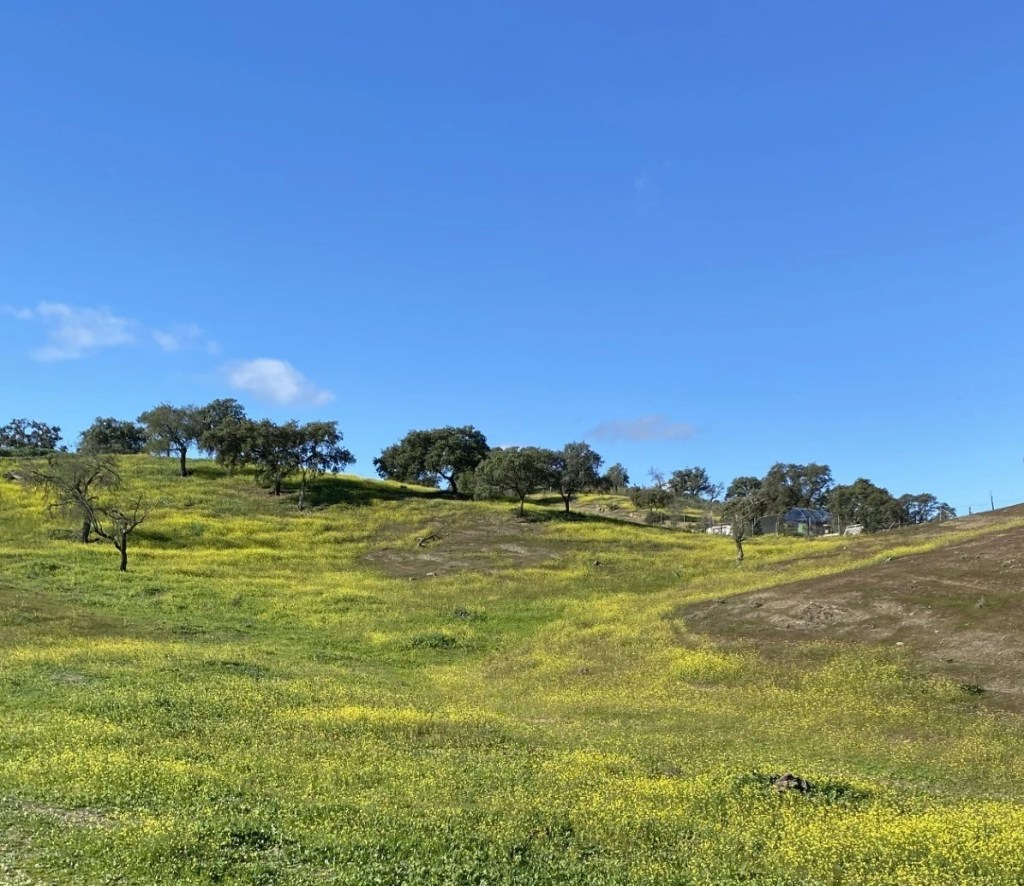
I walked for the first few days of January, recording the distance so that I had a sense of how far I might walk in a certain amount of time and considering how I could make space in my work day for this challenge. On each walk, I was uplifted. The land was brightly green, decorated with patches of wildflowers, yellow and white. It was a balm to the eyes and to the soul. Each day, though my spirits descended again when I returned from my walks, the troughs were not so deep. By the second week of January, I felt like myself again.

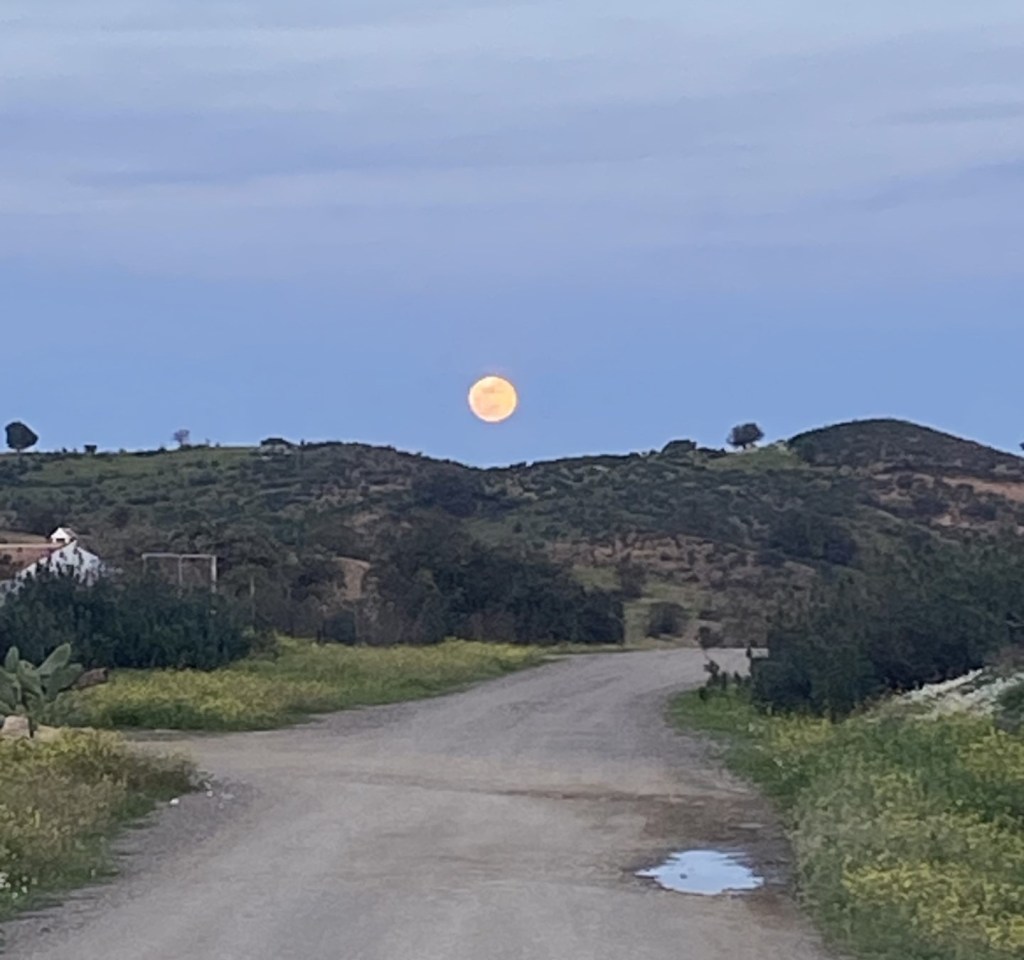
Some days I walked 10km or more, one day I only managed 1km. I walked at all times of the day – in cold early morning mist in jacket and woolly hat, bright afternoon sunshine in t-shirt and sunglasses, at sunset, carefully picking my way along rocky paths in the dark; Lady always my faithful companion, the land I walked through nourishing and uplifting me.

By the end of the month, I had walked 201km, along paths leading out in a radius from my house. I became reacquainted with places I hadn’t walked in years, just as I became reacquainted with why I love living here in the first place – the immensity of the land, the stories it tells of the people who lived here before, if only you take the time to read those stories in the landscape, the other creatures nourished by the land, and the river that brought me here snaking through it all; the vastness of the sky, at times a blue so deep as to seem unreal, at times ominous shades of grey, at night the riot of stars a glorious reminder of my insignificance, the Milky Way mirroring the route of our little river.

Over the course of the month, I observed changes taking place – sudden changes brought about by a heavy rain shower, slower changes as grasses grew, the number of lambs in a herd of sheep increased dramatically, the oranges continued to ripen and fall from the trees. I have found one, two, or even three hours in each day to walk. Those hours were there for the taking all along, I just failed to see them. Walking became the fulcrum of my day throughout January, uplifting me, soothing my soul, reassuring me that in the face of such ordinary magnificence, it is only to be expected that happiness is my default mode.

As for February? I’m back on the tracks and trails again, mostly in the lengthening evenings, challenging myself to another 200km. It hardly feels like a challenge. It’s starting to feel more like a drug.

Remembering Lahaina

I spent less than a month of my life in Lahaina, but the town had a profound and lasting impact on me. It wouldn’t be an exaggeration to say that the two visits I made to Lahaina shaped the direction of my life.

I first went to Lahaina just a couple of weeks before my 23rd birthday. It was spring vacation in Japan, and my Portuguese-Australian friend, Liliane, and I booked a two-week holiday in the Maui tourist town. At the time, going on vacation to Hawaii from Japan was equivalent to northern Europeans vacationing in the Canary Islands. We booked the holiday through a travel agent (remember them?) who travelled from school to school, booking holidays for busy teachers, and in March we flew east from Japan, across the Pacific Ocean, to Hawaii. It was my first grown-up holiday, and the first time I ever flew somewhere to take a break from work.

Lahaina was beautiful, full of low wooden buildings, palm trees, and artists. The mountains behind the town were deep green and, from the perspective of a boat at sea, dotted with rainbows. The streets were lined with artists’ galleries selling art inspired by the sea – humpback whales, turtles, fish as paintings, sculptures, silk prints, photographs. The sunsets each evening were mesmerizing and, as many nights as I could, I found a wall to sit on, where I could look west over the ocean, and bathe in those sunsets.

It was in Lahaina that I first ate mango, first ate Mexican food, first ate macadamia nuts and macadamia nut ice cream. Ah, the ice cream. I wasn’t much of a fan of ice cream, having mostly only ever eaten tasteless blocks of HB vanilla that we had in the freezer back in Ireland. The ice cream in Lahaina was like nothing I’d ever tasted and I soon discovered the best ice cream shop, on a corner just by the banyan tree. That banyan tree, claimed to be the largest in the western hemisphere, covering over an acre of land. It was the first thing I thought about when I first heard about the fire – that vast tree and all of the activities that took place under its shade – family gatherings, markets, people raising awareness for their important causes, buskers making music.

Lahaina was also my first time in the US and I was unprepared for how friendly all the service staff were. Shop assistants, waiters, bar staff were all so NICE. It took a little getting used to walking into a shop and the shop assistant telling me how much she loved my dress or my sunglasses or my accent. I’d never before encountered such fresh and unabashed complements and I quickly grew to love that attitude.

My lasting impression of the local people I encountered was that they were fiercely unique and independent. On that trip, and when I returned a couple of years later, I met aging hippies and flower children now in their sixties, and Vietnam vets from the US mainland; I met native Hawaiians and people of Japanese descent and I spent a memorable night sitting in a diner with a 76-year-old jazz musician, getting endless top-ups of coffee, as he told me of the amazing life he’d led. I’d never met people so keen to tell their life stories. As a recently graduated anthropology student, I was hypnotized.

But the biggest impact that Lahaina had on me was in the ocean that surrounded it. As part of that vacation, I had decided that I wanted to learn to scuba dive. In the first couple of days, I found a dive shop and signed up to do the PADI open water course. The three-day course involved classroom work, four open water dives to practice and test skills, and a classroom exam. The instructor was a huge red-headed Midwesterner called Gary Bluhm, who had only recently moved to Lahaina after 25 years as a dive instructor on Lake Michigan. I felt in safe hands.

Scuba diving was a transformative experience for me and something I continued to do regularly for many years afterwards. I put a tank on my back again a few months ago after a break of almost a decade, when I took 12-year-old Katie for her first dive in the Mediterranean. I was delighted that she loved the experience as much as me.

Lilian and I took a boat trip one day to a humpback whale research station along the coast. On the way, we saw humpback whales breaching, diving, breathing. That first experience of seeing whales in their natural habitat had a profound impact on me. The waters off Lahaina are a humpback whale nursery, where pregnant females, who have spent the summer in Alaska, migrate to Lahaina to give birth and raise their calves, preparing them for the arduous migration north in spring.

From that first moment, I decided I wanted to learn more about humpback whales and whales in general. I returned home to Japan and dug into the natural history of humpback whales, into the history of whaling, into the science of studying whales. Two years later, in 1995, I returned to Lahaina as a volunteer humpback whale researcher, joining Dr Adam Pack and Professor Louis Herman and their team of post-grads and PhD students, for two weeks of research. I was almost as much in awe of the dedicated scientists and the work they did as I was of the humpback whales that I had the privilege of seeing while assisting in their work.

For those two weeks, I lived in a rented house in the suburbs of Lahaina with the scientists and two other volunteers. Each morning, we’d quickly make our lunch for the day (peanut butter and jelly for me…another first and another revelation), hop in the van and head off for a long day’s work. Some days, I was up on a hill overlooking the ocean, from where we had a panoramic view of where the whales were and the direction they were travelling. We recorded their movements – coordinates of where we saw them and what behaviours they were exhibiting (spouting, breaching, slapping, deep diving), whether they were mother-calf pairs, or were in larger groups. We radioed their location to the boat team, who we could also see from our lookout point.

Other days I was on the boat, and those were the best days of all. Based on our own observations and on those radioed down from the hill, the skipper (one of the post-docs) would manoeuvre the 15-foot Boston Whaler into the vicinity of some whales. And then he’d cut the motor and we’d wait. I remember whales breaching so close that we got wet from the splash, and the fishy smell when they came up to breathe right beside us. I remember a calf with its mother, lying sideways in the water, as it looked up at us with one huge eye, full of youthful curiosity. One day, a young male whale swam under the boat. I could see his pectoral fins, like wings, either side of the boat. He remained perfectly still underneath us and sang. I felt his song more than heard it, as it reverberated up through the hull, up through my feet and legs, and up to my heart and head. I can still feel that vibrating sound in my body to this day, 25 years on.

My job, as a volunteer, was to keep my eyes peeled for whales, to help the scientists as they prepared to do their work, and then to take precise written notes of what was going on. Meanwhile, the real scientists did their work. Some took photographs of flukes (fluke matching is the primary way to identify individual humpbacks, as each fluke is unique). Others dived in with underwater cameras to film whale behavior. Microphones were dropped overboard to record songs and calls.

The days were long and, without a loo onboard, a moment would come each day when we’d have a mass evacuation into the sea. Anyone who needed to relieve themselves would jump into the 5,000 metre deep Pacific Ocean, knowing there were humpback whales and tiger sharks and who knew what else, in there too. I’d jump in but, the thought of the depth of the water beneath me and what might brush against my leg…or worse…left me with stage fright and no matter how much I needed a wee before jumping in, it always took longer than I hoped. I’d haul myself back onto the boat as quickly as possible and we’d be on our way again.

Each evening after supper (everyone took their turn to do the cooking), we’d pour over piles of photo albums, filled with page after page of black and white photographs of humpback whale flukes, trying to match up a fluke from one year with one from a different year. Did a fluke from 1982, with no other identifying notes, match one from 1994, this time with a calf and, therefore, clearly identified as female?

From those couple of weeks learning about humpback whales and about marine biology, my love of whales and of the sea deepened. It wouldn’t be a stretch to say that I pursued a PhD into the anthropology of the sea and how humans relate to the sea and acquire their sea-related knowledge and skill because of those two weeks, or that my postdoctoral research was about the relationship between humans and beluga whales, or that I became a sailor and took to the sea. That I got a tattoo of a humpback whale doesn’t require too deep a psychological investigation. For years, I had a recurring dream about humpback whales. At times of stress in my life, they came to my rescue and brought me safely to shore.

And so, when I woke one morning last week to the news that Lahaina was on fire, I was deeply saddened. My first thought was of the banyan tree but, as the days wore on and news of the fire grew grimmer and more desperate, with more deaths and more destruction, I thought of all the incredible people I met these in 1993 and 1995 – the marine biologists, the hippies, the Vietnam vets, the artists, the scuba divers, the sales assistants and waiters, the dancers and performers. They are in my thoughts, wherever they are now.