It wasn’t the Christmas holiday I had planned. The Christmas holiday I had planned included mornings out drinking coffee and being sociable, building up my running endurance to complete a 7km circuit, going to Sevilla for a couple of days, writing a daily Christmas-themed blog, board games, jigsaw puzzles, long walks with the dog.
Instead, I worked far too hard in the lead up to Christmas, putting in 14-hour or longer days in a bid to get all my work done before the holidays began. Then, once the holidays arrived, I continued to push myself – Christmas shopping, tidying and cleaning the house, which was neglected owing to the long work hours, and prepping food for Christmas. The food prep, though tiring, brought me great joy – what a delight to be in the kitchen, surrounded by nostalgia-inducing smells and textures, Christmas songs playing in the background. I failed to notice that I wasn’t giving myself enough rest, not taking care of myself.
And then, of course, the inevitable happened. As soon as I served dinner on Christmas Day, my body realised its work was done and I started to feel bad. Nose tingling, head muzzy, throat sore. By the time our guests left on Christmas night, I was hot and shivery. I’d caught what half the village, indeed half the world, seems to have – the flu.
That was a week ago and I’m still not fully recovered. Yesterday, I walked the dog and ate a meal for the first time since Christmas Day. My week has been spent in enforced rest – reading, watching movies, sleeping. Feeling rubbish. I’m definitely on the mend now, and that’s great.
I used to be a great one for New Year’s Resolutions. But not any more. Who needs that pressure during the darkest days of the year? I prefer my reflections and resolutions in September. But today I am making one resolution – to no longer put in those 14+ hour days; rather, to approach my work more mindfully, and not put my immune system in jeopardy.
I have long considered the psychological roots of why I work the way I do. But that’s something to dig into another day. For now, it’s enough to say that I want to do something about it.
Wishing you all a happy, healthy and creative 2026.
Each year, on the first (or sometimes the second) Saturday in December, my family would go to Dublin to do our Christmas shopping. It was a huge day out and we would be up and on the road early, like half of the rest of the population of rural Ireland. The traffic was usually heavy, the weather generally bad, and there was always the anxiety that there might not be any parking spaces left for our red Ford Escort in the Penney’s car park (there was always space). We stuck to Henry St. and Mary St., and the futuristic Ilac Centre, when it opened, traipsing from one crowded shop to the next, seeking out new outfits that we would wear on Christmas Day, and new winter coats for my sister and me, if we hadn’t already got them in one of the drapery shops in Edenderry. We each had lists of Christmas presents we wanted to buy – presents for each other, for our friends and other family members. We’d take a break for tea (Daddy), coffee (Mammy) and cake, and Knickerbocker glories (Antoinette and me) at the Soda Fountain in the Ilac Centre (was there ever a place more fabulous?) and a middle of the day dinner in the cafeteria of one of the department stores.
When I say ‘we’ shopped for this and ‘we’ looked for that, what I really mean, of course, is that Mammy, Antoinette and I did. Daddy’s role in all of this was to facilitate our shopping, first as driver and, once the car was parked, as bag carrier. At first, he’d come into the shops with us, look around, offer his advice on an outfit if we asked. But, as the day wore on, and the number of bags he was lugging in each hand grew, it became more cumbersome for him to come into the shops. With all those bags around his thighs and knees, he simply was too bulky to get around the narrow aisles in between rails of clothes. So, he’d stand outside the front door of the shop, a little to the side, so he wasn’t in anyone’s way, in the December cold, weighed down by all those bags, patiently waiting while the three of us tried on clothes and bought presents and browsed through books or records in overheated shops. At some point, he’d make a trip back to the car to dump all the bags and then return to us to start the process again.
He wasn’t alone. Outside every shop on Henry St. were two or three men like Daddy, all in the same boat, all patiently waiting, bag carriers, while their womenfolk were inside enjoying themselves.
That’s one of my abiding memories of the build-up to Christmas. I don’t remember what we tried on, or what we bought, or what we filled those bags with. That was all just stuff. But I do remember Daddy, patiently and good-naturedly standing in the cold, making sure that we were having a good time. Like always, putting ‘the wimmin’, as he called us, first.
Christmas is my favourite time of the year and I planned to start a series of Christmas blogs on the 1st of December but, like all the best laid plans, I didn’t get around to it. But here I am, finally. Better late than never. Hope you enjoy my Christmas memories and that they trigger some happy memories for you too.
For me, Christmas is all about food. Sourcing the ingredients. Cooking it. Baking it. Presenting it. Giving it away as gifts. And, of course, eating it. So, a lot of my Christmas memories revolve around food and those memories slip to the front of my mind each year as I once again get down to my Christmas food prep.
I’m a traditionalist when it comes to Christmas food, meaning that the foods that fill me with joy are the ones I grew up with and that I watched Mammy and Nana and my auntie’s Cissie and Lillie making from when I could barely see over the top of the kitchen table.
Christmas prep starts for me in the summer. I can’t easily get some of the ingredients I need for my Christmas cake and Christmas puddings in Spain, so I make sure there’s enough space in the suitcase when I’m home in the summer for the mixed peel, currants, and mixed spice that I’ll need. I like to make the cake and puddings in late October or early November, as the earlier you make those boozy fruit confections, the richer they taste come Christmas Day.
For all that I love this early baking, Mammy intensely dislikes it. I look forward to the Saturday in autumn that I devote to Christmas baking; she dreads it and postpones it as long as possible. Some years, she doesn’t even get around to it.
My aunt Cissie (Daddy’s sister) was the baker in our house, making multiple Christmas cakes and puddings for her brothers’ and sisters’ families and for Dr. Hill, for whom she was housekeeper. Cissie died of breast cancer, aged 56, in 1979. And, although I’ve never asked Mammy about it, I guess she just took over all that Christmas baking for her in-laws after that.
On a mid-week night in November, my sister, Mammy and I would go to my Nana’s house in Edenderry. Although we saw her almost every day, mid-week evening visits were rate, so this in itself felt like an out of the ordinary event. Mammy would arrive with her big cream-coloured ceramic mixing bowl, filled with all the ingredients needed to make the Christmas puddings – bags and bags of a variety of dried fruits, breadcrumbs, eggs, spices, a bottle of Guinness and so on. She and Nana would stand at the dining table, side by side, each making their own puddings, while my sister and I helped out by stirring in the ingredients, chopping glacé cherries, or searching through raisins or sultanas for the occasional errant stalk. Two of my aunts and two of my uncles still lived at home (Mammy is the oldest of 11 children), so the house was busy on those evenings.
Mixing the puddings was no mean feat, given the quantities Mammy and Nana were making. I don’t remember how many Nana made, but Mammy definitely made at least one large pudding and usually four or five medium-sized ones, mixing near-industrial quantities of ingredients at once. Once the laborious work of mixing was done, my sister and I (and maybe a teenage aunt or uncle) would get to make a wish while stirring the thick rich mixture. Even as I write this, I can feel the warmth in my Nana’s living room from the turf fire and the spicy smell of all those ingredients mixing together. Finally, they would transfer the mix into heat-resistant bowls, cover them with tinfoil and then tie twine around to secure each lid and to serve as a handle for removing them from the saucepans of boiling water in which they would be steamed over the coming days.
I remember this with nostalgia. Mammy remembers it as a chore, yet another item to tick off the Christmas to-do list. A lot of people were expecting her to make those puddings each year, so I suppose that took a lot of the fun out of it. That was all 30 or 40 years ago and Mammy no longer makes all those puddings, but I think she still feels the residual pressure of it.
This year, I went home to Ireland for a few days in early November. I hadn’t yet made my own puddings or cake. Mammy was bemoaning the fact that she would have to make her puddings soon (she no longer makes a cake) and, in her own words, was ‘dreading it.’ (At this stage, you’re probably asking why she doesn’t simply buy puddings, if making them causes her so much stress. The answer is simple: she knows that no shop-bought pudding tastes as good as the ones she makes). I suggested that we do it together, just like she and Nana used to in the old days.
Unlike Mammy and Nana, who lived only two miles or so from each other, Mammy and I live in different countries. But we have what she and her mother didn’t have – the technology to make our puddings together at a distance. We decided to do it the following weekend. I phoned her on Tuesday to suggest she go through her presses1 to see what ingredients she had in stock and what she needed to buy. I would do the same before doing my regular weekly grocery shop on Tuesday night. On Saturday morning, we would each put what ingredients we needed on our kitchen tables, each make ourselves a cup tea, and set our devices up so we could see each other, ready to start at 12:30.
And that’s what we did. In between weighing the breadcrumbs and butter, beating the eggs, measuring the alcohol (she used Guinness; I tried using brandy for a change), we chatted and got caught up on each other’s lives. We discussed our innovations – since moving to Spain, I now use a wider variety of whatever dried fruits I find in the shop; she has changed her cooking method (tradition, after all, is always evolving). What a delightful late morning we spent with each other. I even called Katie in to stir the mixture and make a wish. We each left our puddings overnight for the flavours to mingle and the next day we cooked them. Here, in southwest Spain and there, in the midlands of Ireland, our puddings are now cooked and sealed and ready for Christmas Day.
Our ingredients may have changed a little, and our mode of communication, but making the Christmas puddings with Mammy brought me right back to all those years in Nana’s house. I suggested we do it again next year and she said she was up for that!
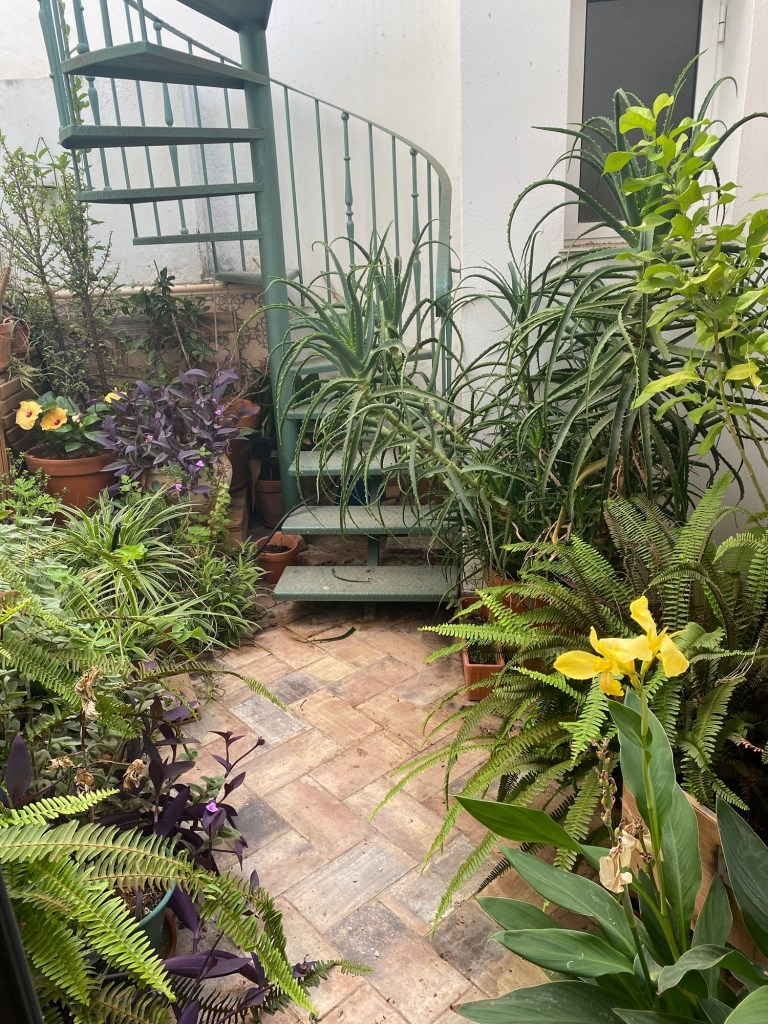
Before we went away for the summer, this was my little patio space, where I had a little table, a couple of chairs, and a love seat. It had a nice number of plants scattered around too. It was a shady space for breakfast or a mid-morning coffee.
But then we were going away for eleven weeks and I needed a keep the plants watered. On the Saturday and Sunday three weeks before we left, I folded away the table and chairs and gathered all the plants from my three outside spaces to here, the shadiest and coolest of my outdoor spaces. They certainly took up a lot of space. I then spent the mornings on the second to last and last weekends (in mid-June) setting up a watering system on a timer. The first of those four mornings was spent just sitting at my kitchen table, reading the instructions, watching YouTube videos and figuring out how to set up an irrigation system.
I got there in the end. It was like putting together some great puzzle, lining up the tubes, inserting the nozzles, plant to plant to plant, until all 50 plants (yep…50…even I was surprised that I had so many) were set up to have a one minute drip feed of water every 24 hours.
What I didn’t have time for was to properly test the system. I should have done it a week or so earlier. That way I’d know if some plants were getting too much or too little water. But I left it too late and just had to hope for the best.
My friends had a key to the house and reported after only a week that some of the plants were being overwatered and they’d turned the individual nozzles down to a mere trickle. Later in the summer they reported that my patio was now like a ‘jungle.’
I was quite dreading how jungle-like it would be on our return. However, I was pleasantly surprised. Sure, many of the plants had grown, but they looked far more lush and healthy than when I’d left them (I wouldn’t be the best at tending to my plants on a regular basis).
A few died. Three owing to a lack of water (the feeder tubes had slipped out of the pots and they didn’t get any water) and another three from overwatering, victims of the success of my irrigation system. When I’d set up the system, those three plants had been exposed to the sun. When I returned I found them in the undergrowth of other plants that had grown furiously, fully shaded and sitting in waterlogged soil.
We’ve been back two weeks already and it still looks like a jungle out there. I’ve gotten rid of the dead ones and I’ve started to move those that don’t belong on the patio back to their usual homes. Some need cutting back. But it’s slow work. One day, in the not too distant future, I hope I’ll have my table and chairs and love seat back again. I hope I won’t have to battle my way up the stairs to the clothesline. I hope I’ll be able to get to the gas bottles when they need to be changed.
But little by little, day by day, I’m getting there. And I’m getting to know my plants all over again in the process.
What’s your favourite smell? Freshly mown grass? Fresh coffee? That smell when you nuzzle your face into a baby? Why is it your favourite smell? Do you know?
I was sitting at my desk yesterday morning, the window open to cool the house down before the heat of the day kicked in. That’s when the smell came tumbling in and nostalgia stroked my face like a feather. One of the council workers was strimming the strip of grass that runs the length of my street. And there it was: The smell of exhaust from a 2-stroke engine. There’s comfort in that smell for me and it’s deeply entwined with so many good memories.
We’re living on Carina of Devon. Me and Julian and the girls. The smell of a 2-stroke engine is us leaving Carina to head off on an adventure in the rubber dinghy. Maybe it’s all of us, going ashore to explore a new place or to wander up a river that’s too shallow for Carina‘s draught. Or I’m on my own, the freedom of having the outboard tiller in my hand, setting out to go for a solitary walk or to go shopping or do the laundry. Or it’s Julian, taking the girls across the Rio Guadiana to school. Or it’s all the other yachties we met over the years, the smell and sound of a 2-stroke outboard motor signalling their arrivals and departures from their anchored yachts. It’s adventure and freedom.
Strip that layer away, and I’m living in Arviat. It’s summer, with open sea and lake-pocked land. I have my own quad bike and I zip around town in the near 20-hour daylight, picking my friend Crystal up at 3am, so we can go check the fishing net we’re sharing for the summer, or meeting Frank at 5am to go beluga hunting. His quad has Arden’s boat trailer attached on the back, so I hop on and reverse the quad into the sea under Frank’s guidance; he offloads the boat, as I park the quad and trailer. Or I’m out along the road to the dump, or the road past the reservoir, at twilight or after dark, speeding along way too fast, sometimes alone, sometimes not. In my mind, I’m a badass. In reality, probably not.
Strip that layer away, and I’m living in Arviat. It’s spring, and I’m at the floe edge with Arden. We’ve come by skidoo; him driving, me sitting in the qamutik (sled), facing back towards Arviat, back towards the direction we’ve come from, to shield myself from the powdery snow blown up by the skidoo runners. I’m surrounded by the immense beautiful whiteness of the west coast of Hudson Bay. We’ll stop when we get to the floe edge. Arden will talk to me and teach me, I’ll try to remember everything; we’ll drink tea and eat the bannock Theresa has made for us.
Strip away that layer and I’m at home in Ballygibbon. I could be 10 or 20 or 25. The 2-stroke exhaust is Daddy mowing the lawn. It’s the ease and efficiency of the first petrol-powered lawn mower after years of a small, manual one. It’s me spending summer evenings following Daddy round the garden – at 10 or 20 or 25 – just for his company and the important things we have to talk about – Gaelic football and films and music, a bit of politics and other sports.
When I catch a whiff of 2-stroke exhaust, it doesn’t conjure any one of these times in my life in particular. Rather, it mashes them all up, and loosens something in me, a knot unravels, and a feeling of belonging rushes through my veins. Now, I am here, with a view out my window that’s as green as I could ever have hoped for. And a new layer is added to my love of that smell.
I remember the phone ringing down the hall. Mammy got up from the kitchen table to answer it. ‘It’s for you,’ she said, coming back to sit down. ‘Someone from Canada.’ I walked down the hall to the table by the hall window and put the receiver to my ear.
‘Hello?’ I said.
‘Huvi?’ came the reply. Frank. Dear Frank. My friend, my teacher, my hunting buddy. One of my primary research participants in Arviat, it was Frank who had taught me to skin and butcher caribou, and to get it right by doing it over and over; Frank who had taught me how to drive a boat amongst pods of beluga whales in the shallow waters close to shore, so he could harpoon them from the bow; Frank who put me on polar bear patrol while he collected the arctic char that had swum into his fishing net; Frank who I spent hours and days with, far inland on our quad bikes, out at sea at first light. He and Martha welcomed me into their home, made me tea, fed me biscuits and bannock, took me out on the land and to their cabin with their daughters. Frank made me laugh and made me think. How at ease I felt in his company.
And now, he was on the phone. He on the tundra, on the western shore of Hudson Bay; I in the Bog of Allen, in the middle of Ireland. And the distance between us seemed vast. Vaster than the Atlantic Ocean, and maritime Canada and the width of Hudson Bay that separated us. All that we talked about with such ease when we were together dissolved now across the expanse.
He asked about the weather and I told him. But what was Irish weather to him? What was the Irish autumn, with leaves changing colour and falling off the trees, the rain and the mud, when he lived in a place with no trees, where autumn meant the ground covered in snow and the sea gradually turning to ice, travel by boat giving way to skidoos. My autumn meant nothing to him and, from this distance, his autumn was starting to dim for me.
I asked what he’d been doing and he told me where he’d been seal hunting the previous day, who he’d gone with and the other hunters he’d met when he was out. I smiled as he spoke. In my mind’s eye, I could see where he’d been and who he’d been with. I had been there with him, and with his brother-in-law Arden, just a few weeks earlier.
He asked what I’d been up to. It was September and in Ireland there was only Gaelic football in the air. How could I tell him about the match I had been to on Sunday? About the crowds, the excitement, how important football was to my life here? Or that the turf was home and there were still a couple of loads to be thrown in the shed. My voice sounded strange in my ears as I tried to talk to him about my life here.
I’d lived in his world and loved it. He was interested in my world, but had no experience of it. The ease we felt in each other’s company was made jagged by the cultural distance that now lay between us.
We continued to speak on the phone occasionally and I got to spend another summer with him a few years later. It’s a few years now since he passed away. I wish I had been better able to bridge that distance when he called.
At the end of September 1979, Pope John Paul II visited Ireland. He was the first pontiff to visit Ireland (indeed, he was the first to visit most places in the world) and the country went wild. At the time, Ireland wasn’t only predominantly Catholic by religion; our culture was Catholic, the state was Catholic, the education, health care, and justice systems were Catholic. It felt as if the whole country was being blessed by God himself. The Pope said Mass at a number of venues around the country, attended in total by over 2.5 million people. The entire population of the country at the time was only 3.75 million! His first Mass, held in the Phoenix Park in Dublin on the day of his arrival, was attended by 1.25 million people – one third of the entire population of Ireland. I was one of them.
I have fleeting memories of that day. I was six years old. I went with Mammy, Daddy and Nana Quinlan, my maternal grandmother. I remember leaving home that morning, my one-year-old baby sister sitting on my aunt Lillie’s lap in our kitchen. I remember my sister crying as we left.
I remember Daddy parking the red Ford Escort in the field that was Weston air field. I knew Weston, because we always drove past it on our way to Dublin and I always looked for light aircraft flying low across the road towards the runway. I remember a sense of wonder that we were now parked in this very place where the planes should be.
I remember Daddy carrying me on his shoulders as we walked what felt like miles, in a sea of people filling up the road as far as I could see in front and behind us. From Weston, we were directed on to buses that took us directly to the Phoenix Park. I can’t fathom the logistics of getting one third of the population of our small poor country to a field on the edge of Dublin. But somehow it happened. I remember an awful lot of walking.
I remember the Pope’s chairs. Three chairs that my parents and Nana had bought in advance of the Mass. Simple metal frame folding beach chairs, with white plastic arm rests, and woven plastic seats and back. Our two were blue striped and Nana’s was brown striped. Forever after, they were known as the Pope’s chairs. They were put on the roof rack for every summer holiday and stuck out on the lawn for every summer heatwave. I think they’re still hanging in the shed at Mammy’s house.
So, Daddy carried me on his shoulders and he, Mammy and Nana carried the three chairs and food and drinks for the day. Ham sandwiches, I imagine, some biscuits, probably a flask of tea and a bottle of lemonade.
I don’t remember getting on or off buses, or arriving at the Phoenix Park. But I do remember being in our place on the grass. The three chairs set up. We were in the middle of the crowd, facing the huge white cross and altar that had been hastily erected for the Mass, which stands to this day in the middle of the Phoenix Park. We weren’t far from a roped off pathway, separating the area we were in from the next area over. I remember sitting around for a long time before Mass started.
I don’t remember the details of the Mass, but I can still hear the sound of his voice over the loudspeakers. It’s there in my head. And I remember the palpable excitement and awe – whether I picked it up from the crowd in general or from my family, I don’t know.
When the Mass ended, the Pope prepared to travel through the crowd, blessing them from the Popemobile. And here’s where my memory gets fuzzy. Mammy and Nana were going to move close to the rope barrier to get closer to him, but Daddy was going to stay looking after our stuff. At first I said I didn’t want to go with Mammy and Nana. I was a scared for some reason. But as soon as they left, I changed my mind and wanted to go with them. And I don’t know if I did or not. One version of my memory has Daddy calling after them, me running to Mammy, and Mammy holding me in her arms close to the rope barrier as the Pope went past. But in the other version of my memory, by the time I decide I want to go with them, it’s too late, they’re lost in the crowd, and I stay with Daddy, crying and regretting not getting to see the Pope up close and getting blessed with everyone else.
There are things I don’t remember. I don’t remember Daddy’s grief, or the grief of my auntie Lillie and my Nana Tyrrell as we set out from home that morning. Daddy and Lillie had, only recently, lost their beloved older sister, Cissie, to cancer at age 57. What comfort did being in the presence of the Pope offer to my grieving devoutly Catholic father? Or what hope for comfort and grace was there in the others left at home, who would watch the Mass on the television? I don’t remember and it’s not something that would even cross my mind for over four decades.
As a six year old, I was oblivious to all of that. But what stays with me most vividly, 46 years later, is being carried high on Daddy’s shoulders in an ocean of humanity along a road in west Co. Dublin. And the Pope’s chairs.
It’s 10:55pm. This night, fifteen years ago, I was huge and uncomfortable and eight days overdue, thinking to myself ‘Is this baby ever going to arrive?’ It was certainly taking its time. My friend Sinead, whose baby was due the same day as mine, had already given birth seventeen days ago, and here I was, plodding around, looking like a planet with limbs.
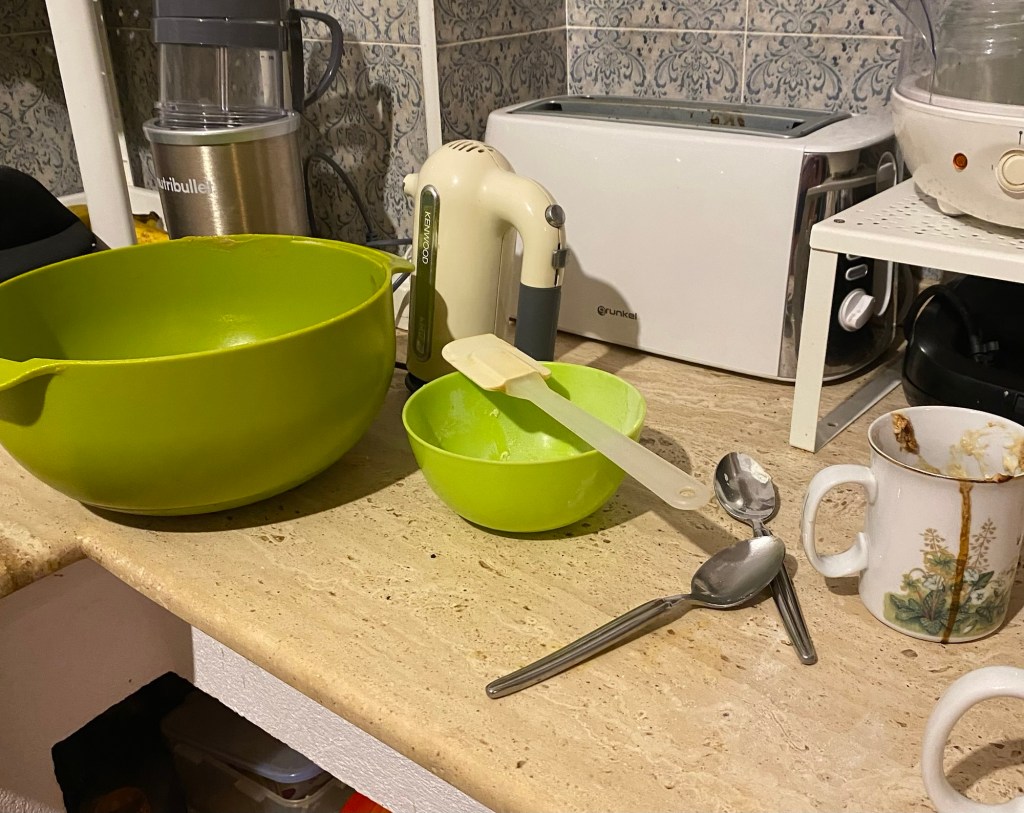
Fifteen years later, and here I am, waiting…this time for the coffee cake that she’s requested for her fifteenth birthday tomorrow to come out of the oven. The same cake she’s wanted for her birthday for years.
Little did I know, this time fifteen years ago, that I’d fall so madly in love with the it that turned out to be a she that making her birthday cake long after my bedtime would feel like a blessing rather than a chore.
Arriving into Sanlúcar de Guadiana last night, I was surprised at just how happy I felt to be home. Just a simple feeling of contentment at being back in my own home.
Our seventy-five days in the UK and Ireland were delightful from start to end. I haven’t enjoyed myself so much or for so long on previous holidays. England was a joy and I experienced very strong positive emotions when I was in Ireland, whereas in the past my feelings have often been mixed. Not because Ireland isn’t great and not because my family and friends aren’t great. It was just me and where I was in my life on previous visits home that made me enjoy being in Ireland on holiday but also eager to return to where I had come from. I didn’t feel that way this time. I enjoyed my time there, and had very mixed feelings about leaving, feeling more torn between the two places I call home than I’ve ever felt before.
So, what a surprise to feel the way I did about turning the key in the lock and walking through my front door last night. Like an exhalation…I’m home. My house is looking a bit the worse for wear after lying empty for seventy-five days and it’ll take us a few days to sweep away the cobwebs, get unpacked and feel properly settled in, but that simple uncomplicated sense of being home was there from the moment I opened the door.
Our lovely friends had been in and left some food in the fridge and our neighbour had hung a fresh homemade loaf of bread on the front door. Still, I needed to buy a few odds and ends this morning, so, after breakfast I threw on something not very presentable that I pulled out of my suitcase and went to the two shops in the village. Ten minutes of shopping took me about three quarters of an hour, from all the people I met, the welcome back hugs and kisses I received, the conversations I had comparing Spanish and Irish weather. I felt welcomed home by my adopted village.
And then, the icing on the cake – collecting Lady from her summer villa (with a swimming pool, no less) and taking her home. Now that our scruffy, dusty, hair in her eyes Lady is back, my little home is complete.
Who cares that our two kayaks are still taking up most of the living room and the suitcases are on our bedroom floors? Time enough moving them tomorrow.
‘Turn on Radio 1,’ Niamh said, as we got into our cars to drive in convoy across Kildare. ‘Sunday Miscellany is all about the bog this morning.’
I led the way along the bog road, through Allenwood and Prosperous, past the road down to Coill Dubh, through a landscape I have known all my life, a landscape so densely entwined with memory and meaning.
It’s impossible to come from the midlands of Ireland and not have the boglands seeping through your veins. This great flat landscape, the fuel source around which our year and our society revolved. The footing and the haping, and tea from a milk bottle and sandwiches wrapped in waxed paper. Cold March Saturdays of the men cleaning the turf bank all the way through to warm August Saturdays of bringing the turf home.
And it’s the poetry and the music – Heaney and Christy Moore and Luka Bloom. It’s the dissertation I wrote as an undergrad and the bog PhD I started in my 20s.
As I drove across the bog, I listened to the radio programme, as Niamh suggested. It was filled with the stories, songs, reminiscences of people from the midlands. Some people, like me, who have chosen to live abroad and have never found a way to adequately describe and explain all that the bog is to people who don’t know it. And some people who had lived in the bog their whole lives, who evocatively expressed what the bog meant to them.
To listen to this as I drove across the bog this morning was moving enough. But today also happens to be the 21st anniversary of the day that Daddy died. And for me, above all else, my memories of the bog, and what the bog means to me, are inseparable from my memories of Daddy.
It was, therefore, a bittersweet drive, with the stories and the road and this particular day, all evoking memory and emotion, and tears running down my cheeks, not of sadness, but of gratitude for this place and all that it means to me.



 Me in place