12. Jumbo hot dogs

Warwick market, Saturday morning

Being in the UK and, in particular, in this town, brings memories of Julian flooding back. I pass through places by car that I only ever drove through with him. I go to places that I visited for the first time, or only ever visited with him. Indeed, I would never have known this town in the middle of England, had I never met him.

There have been times in the past few years, when being here has been overwhelming. Not only being in this place, but being with Julian’s family and the memories and emotions that being in their company brings to the surface. In the past, being here has caused me to have panic attacks. In fact, last year, after only four days, I ended up in A&E (ER) with a panic attack that I thought was a heart attack. That was a scary day.

This time, however, I am so much more at ease. Time has played a part in healing me, so too have eight sessions with a therapist that I gave as a birthday present to myself last year, so too the memoir I’ve been writing this past year. I’m busy with work (intentionally, perhaps?) and I’m absorbing the sensations of being in parks and along canals and surrounded by nature in this exceptionally nature-filled town. (Yesterday, a falcon had an aerial fight with two crows only metres from me in Priory Park!)

Each morning since we got here, I work for a few hours at Warwick Library. Yesterday, I went in as usual. But it wasn’t usual. It was Saturday, so the market was on in the square in front of the library. Even better, at the far end of the square I saw a van bearing the words ‘Jumbo Hot Dogs’. Memories came flooding back. I phoned Katie and suggested that she and Lily get Granddad to drive them to the library in a few hours, so we could wander the market and have jumbo hot dogs for lunch.

The girls duly arrived and I packed up my laptop and we wandered around the market, chatting to the vendors and browsing the arts, crafts and foodstuffs they had on offer. At the food stalls, there were savoury pies and all sorts of lovely things that tempted me. But I was going for the jumbo hot dogs, for nostalgia’s sake more than anything else.

You see, Julian loved jumbo hot dogs. No matter what his state of hunger, if he spotted a jumbo hot dog stand, he had to have one. He was also someone who stuffed receipts into his pockets. When we both worked, we shared the task of doing the laundry. Every time it was my turn to put a load in the machine, I’d first have to empty Julian’s trouser pockets of receipts. When we lived in Cambridge, I’d often find five or six receipts for the jumbo hot dog stand! How long had he been wearing those trousers? Or how many hot dogs was he consuming a day? He’d laugh sheepishly and tell me he’d occasionally get a craving in the middle of work, leave his desk, hop on his bike and cycle the two miles into the middle of Cambridge for a jumbo hot dog and then return to work. Crazy man.

So, there was nothing for it yesterday but to introduce jumbo hot dogs to our daughters, who’d only ever before had those cheap rubbery vacuum packed frankfurters you get at kid’s birthday parties, and not these juicy British sausages, with real fried onions, ketchup, in a soft, freshly baked hotdog roll. Katie wasn’t sure if she wanted one, so I bought two. One bite of mine and I had to go back to get a third from the friendly chatty couple running the van.

Good God, they tasted good, that combination of good food mixed with good memories. As we ate, I told the girls about their father’s jumbo hot dog obsession, another piece of him revealed to them, another good memory of him restored to me.

11. The artist formerly known as…

When she was in her early 50s, my mother decided to take up painting. She joined an art class, bought art supplies and painted some lovely landscapes and rustic urban scenes that still grace the walls of her house.

The Christmas after she took up painting, I arrived home from somewhere, I can’t now remember where. The presents were all under the tree – all except Mammy’s present to me. One of my and my sister’s favourite pastimes in the days leading up to Christmas Eve was to sit by the tree, examining all the carefully wrapped presents with our names on and guess the contents, comparing the size and weight of our respective presents. Mammy explained that she hadn’t put my present under the tree yet, because I would immediately know what it was and the surprise would be ruined. She planned to only put it under the tree in the moments before we unwrapped our presents after tea on Christmas Eve. I had no idea what it might be.

The next day, I went in to Gilroy to see Nana. She made me a mug of coffee and put a plate of biscuits on the coffee table beside the bowl of Quality Street chocolates that was already there. We chatted about this and that. After a while, and seemingly apropos to nothing, she said, “What do you think of it?” “Hmmm?” I said, too busy deciding whether to have another Quality Street or another biscuit. “I don’t think it looks anything like you, do you?” she asked. “Erm, no,” I replied, with genuinely not a clue what she was talking about, but also still too distracted by the chocolate to find out more. And the conversation moved on to other things.

Christmas Eve evening arrived. We ate our tea and then went to light the Christmas candle on the hall table. Daddy lit the candle and the four of us bowed our heads and said a prayer. The moment to open our presents had come. In the middle of tea, Mammy had slipped out to put her present to me under the tree. As soon as I walked into the sitting room and saw it under the tree, I knew that it was a painting of some sort.

We opened our presents one by one, each of us waiting to see what everyone else had received and watching their reactions. The moment came to unwrap my painting from Mammy. I carefully removed the wrapping to reveal…a portrait of ME! Well, sort of a portrait of me. I tried hard not to burst out laughing and one look at Daddy’s and my sister’s faces let me know that they were struggling not to laugh too. But, she’d put so much effort into it and none of us wanted to hurt her feelings. But, God, it was hard.

“I couldn’t get the lips right,” she said. I thought to myself ‘And that’s not all!’. I could see that the lips and been drawn, erased and redrawn many times in pencil, as she tried and failed to get the shape right. My nose was very long and narrow, my eyes strangely slanted and wide-set and my hair sat on top of my head like a helmet. My shoulders were heavy and, although the portrait stopped above my chest, it gave the impression that I had the huge heavy breasts of a seventy year old. “It’s lovely,” I said.

I don’t remember what happened next, but by the next day, Mammy’s portrait of me had turned into a highlight of our Christmas. The first to see it was my uncle Tom, when he arrived out for Christmas Day dinner, and then my uncles and cousins who came out for tea later that evening. Mammy was very quickly in on the joke, realising that this was perhaps not her best work and that the portrait had value of a different kind – it made us all silly with laughter. We discovered the best thing about the portrait was showing it to people with straight faces, pretending that we thought it was brilliant and watching as the cogs moved in their heads as they tried to find something polite to say about it.

The portrait came with me to the UK and, when I met Julian, it came with us to the many houses we lived in over the years. I’d sometimes arrive home late at night to find Julian in bed with the portrait on my pillow, delighted with his little joke. He carried on the tradition started by my own family of showing it to his family and our friends with a straight face and waiting for their reactions.

When we moved onto the boat, there was no room for the portrait, so we put it up in my father-in-law’s loft in Coventry. I imagined it doing a Dorian Grey on me but, I’ve grown older and it continues to not look at all like me! A little over a year ago, my father-in-law downsized to a smaller house and I travelled to the UK to deal with what was left of our stuff up in his loft. There I found the portrait, which I hadn’t seen in years. There was only one place for it – on the wall of the spare room (Lily and Katie’s room) at my father-in-law’s new house.

Lily and I are sleeping in that room at the moment, with Katie relegated to the sofa in the living room. Every time we look up at that portrait we giggle. Who could have guessed that that heartfelt and earnestly created piece of art would have such an unexpected life out in the world.

10. From there to here

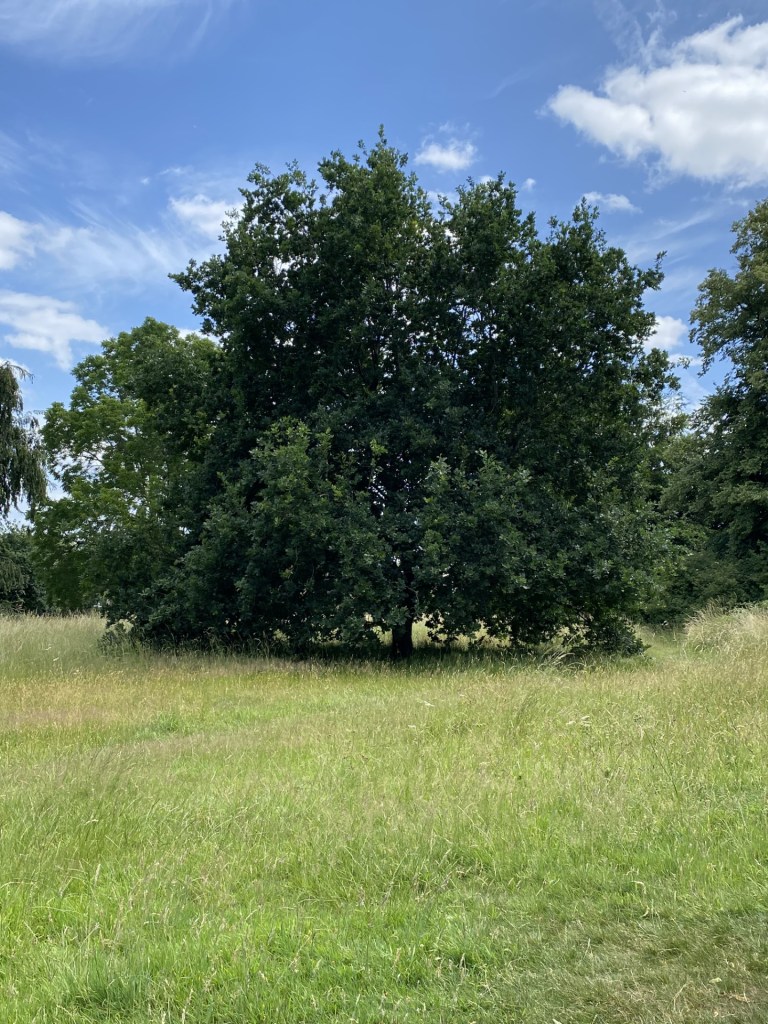
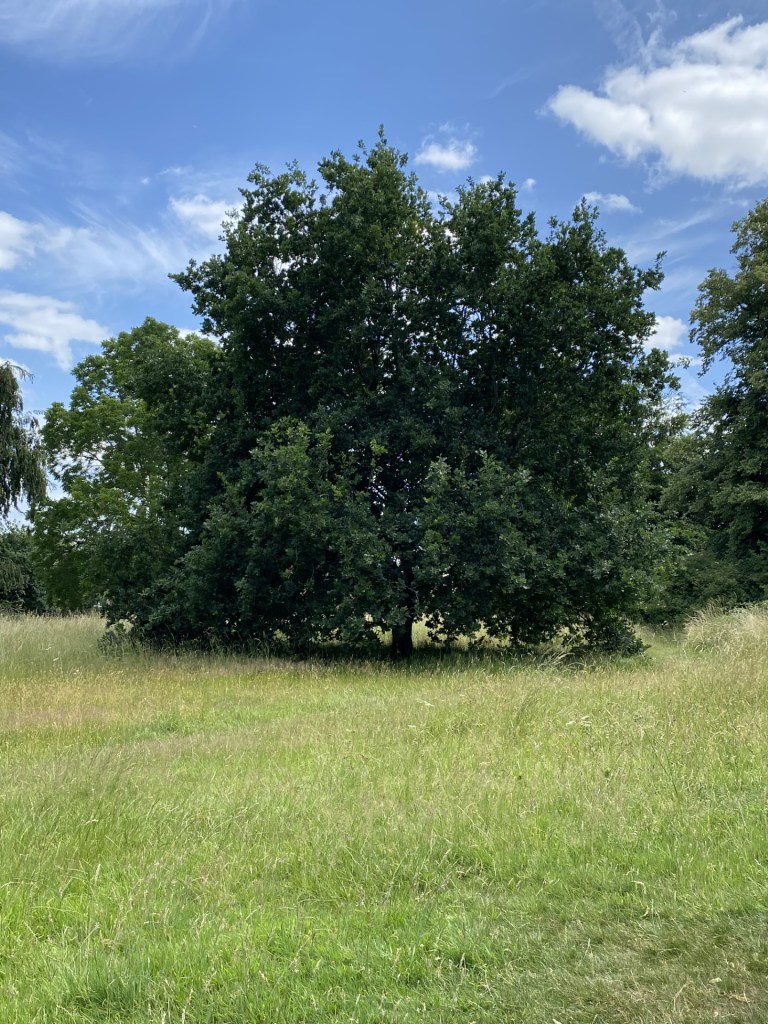
The trees are so big and so green and so varied and so alive. Oaks, horse chestnuts, sycamores, beech. Their trunks are immense and they reach high up into the blue sky. So unlike the scrubby arid trees of the dehesa (savannah) of southwest Spain. Tiredness is causing me to have an out of body experience as I walk through Priory Park. Is this what it’s like to experience the world when high on drugs, I wonder? The giant beautiful trees seem to pulsate around me, my brain and eyes playing tricks on me. Maybe the trees are playing tricks on me too. The tiredness is adding to my disbelief that I’m here, when only a few hours ago, I was there.

We woke up at 3.10am. I slept little anyway, checking my phone through the night to make sure I hadn’t slept through the alarm. Katie had set her alarm too, so it wouldn’t have mattered, but tell that to my subconscious/unconscious brain. It didn’t help that the narrow single bed in the cheap airport hotel was springy and uncomfortable and the room was too hot at first, then too cold with the fan, then too hot when I turned the fan off. Through those few brief hours, I heard other hotel guests arriving and departing, the thunk-thunk of heavy suitcases being hauled up or down the old stone stairs of this hotel without a lift, the wheels squeaking down the corridor outside our bedroom door, a movement-sensing light flooding our room with light through the glass panel over the door.

I am grateful that the airport was straightforward, the flight uneventful, our train to Leamington Spa on time. By the time we get to my father-in-law’s house mid-morning, the effects of the tiny €30 airport breakfast has long worn off and we are starving. While he asks the girls about the flight, I make a bee-line for the kitchen, knowing exactly what I’ll make (the girls and I have been discussing it, fantasizing about it). We anticipate what Granddad will have in stock, and we’re not disappointed. Rashers and eggs and fried tomatoes, with buttered fresh white bread and strong tea.

Afterwards, I rest for an hour, unpack a little and then I’m off again. The girls are sleepy, though they claim they aren’t. But they’re pale and have bags under their eyes, so they can’t fool me. I leave them sitting in the livingroom with Granddad, looking out over his garden at a fat pigeon pecking at the seeds he’s scattered about. I leave the house to the sounds of him telling the girls about a radio he built when he was a teenager, from his dad’s old cigar box. I hear him ask them what components they’d need to make a radio. My Gen Z teenagers have never used a radio in their lives, but I’m out the door before I hear their answer.

While my work life will be decidedly less frenetic in the coming weeks than it has been of late, I have a deadline to meet this coming weekend and I need to crack on. I spend a few hours at the library, meet my self-imposted work target for the day, and head back to my father-in-law’s house again. By now, I am well and truly zombified with tiredness, and the trees pulsate as I walk through them. Perhaps they are really Ents. Perhaps I need a good night’s sleep.

9. All the time in the world

I’ve been spending a lot more time with Angela in these last few weeks, since she was given her terminal prognosis. My weekly visits for morning coffee have evolved now into twice or three times a day visits. I know our time is short. I will leave to go to the UK soon and she will simply go. I call in at 11 each morning and again at 1:30 and maybe again at 3pm. Sometimes she’s asleep and I simply check on her and leave again. More often than not, however, she wakes when I come in, I help her to sit up, go to the kitchen to pour her a cold drink and make myself a coffee, and sit with her and chat.

Despite being noticeably more frail with each passing day, her memories are as sharp as ever. She quotes Tennyson and Shakespeare. She recalls a book on Pembrokeshire written by someone called Loxley that she borrowed from the library 61 years ago. She tells me about her first ever time on an aeroplane when she accompanied a patient from London to Trinidad and got drunk on gin and coconut water when she got there. She tells me about being a trainee nurse in London in the late 1950s and writing letters home to her parents in Leicester every day. Despite our weekly get-togethers over the past number of years, I learn more about her every day.

But I’m also in a rush. I’m leaving home soon and I won’t be back for ten weeks, so there are preparations to be made, the fridge to clear out, everything organized for the dog to go spend the summer with friends. I will be working all summer while I’m away, so I need to remember to transfer all my work from my computer onto my laptop. On top of that, I have an unusually large amount of work on my plate with various deadlines looming, so I’m trying to keep four different editing and writing plates spinning at once. Five days before I leave, a neighbour dies and the next day another. That’s two funerals now that I want to attend. On the day the first neighbour dies, another friend is rushed to hospital. Her husband is at a loss and asks me for some help. I wake up the next morning to discover that one of my kayaks has been stolen. I discover the next day that it’s been abandoned over the river, so now I have to go retrieve it. To say things are frantic and chaotic in these final few days is an understatement.

Yet, in the midst of it all, I continue to call to Angela two or three times a day. On Monday, she’s feeling weaker than ever and her every movement is slow and laboured and requiring lots of breaks. When she’s finally sitting up, with a glass of drinking yoghurt in her hand, she smiles at me and says, ‘It’s alright. We have all the time in the world.’ And you know, she’s right.

For all the mad rushing around, the lack of sleep, the ‘not-another-thing-piled-on-top-of-everything-else’ sort of week, here in her bedroom, time is meaningless. It’s just her and me, sharing our stories as always, making each other laugh, making each other think.

On my last day, as I finish up my work, finish packing, finish prepping the house to close it up, and count down the hours till my 7 o’clock departure, I decide to embrace Angela‘s insight that we have all the time in the world. When I visit her mid morning, she’s asleep. I don’t wake her but neither do I go home. Instead, I make a coffee and sit with her for half an hour, feeling time slowing down and my shoulders beginning to relax. When I return a couple of hours later, she’s awake. I help her up so that she’s sitting on the edge of the bed and we talk and talk and talk. For that hour, in that room, we have all the time in the world.

8. Leaving home and going home

Later today, I will close my front door behind me as the girls and I leave home for 10 weeks. We’ve never been away from Sanlucar for so long before. At first, we will spend a few weeks in the UK and then we will go home to Ireland. We have a wonderful summer ahead of us, packed with family and close friends and trips to all sorts of wonderful places and events.

But I have mixed emotions about leaving. I am saying goodbye to a close friend who, owing to illness, will likely no longer be with us when I return. At the same, I am excited to spend time with my family and dear friends, the people who have known me longer and who know me better than anyone.

I’m taking the girls away from a summer by the pool and at the beach, and being with their friends. I’m also taking them away from Lady. But then I remind myself of how hot it’s going to be and how we’ll be stuck inside the house most of each day in +40C heat. So, I’m looking forward to taking the girls to cooler beaches and to places familiar to them that they want to visit again and places new that they have never been to. And I’m excited about the time they will get to spend with friends in the UK, starting on Sunday, when we travel to London to visit their oldest friends.

While I have adapted to many aspects of Spanish culture, after ten years I have yet to adapt to staying out so late at night. I can do it once or twice in the entire summer. But, in general, when Sanlucar comes alive at night in the summertime, when many of our friends and neighbours are out strolling the streets, or at one of the bars, or sociably sitting outside their houses, the girls and I have already gone to bed. I have tried to adapt, but I can neither stay awake that late at night nor get by on so little sleep the next day when I need to be up at 6am to get my work done before it gets too hot. Lots of people have managed to adapt to it. Sadly, I’m not one of them. So, I’m looking forward to cooler weather in the UK and Ireland (despite a heatwave in the former at the moment) and sticking to my normal bedtime.

For all of that, for all the wonderful things I have planned, I know that when I am at home* in Ireland I will miss my home in Spain. I will be looking forward to coming home in September, batteries charged, feeling refreshed and renewed, and feeling love and longing for both the home I will be leaving behind and the home I will be returning to. I am grateful for both.

*I don’t actually own a home in Ireland. We’ll be couch and spare-bed surfing for the entire summer. It’s more that home owns me.

An aerial photo of my home in Ireland, taken sometime in the 1960s.

Walking through January

In late December, I set myself a challenge to walk 200km in January.

2023 had been an exceptional year for me. I was joyful and exuberant in turning 50 and everything about my life seemed to glow. That was until the end of the year, when it felt as if someone let the air out of my balloon. From early December, I felt lost, drained, living in a cloud of cotton wool, from which I neither could nor desired to work, be with other people, or drag myself out of the house.

Happiness and contentment are my default modes. If chemical imbalances play a role in the onset of depression, then I often think that I have chemical imbalances in the other direction. I’m chronically happy. I’m annoyingly upbeat. My glass is always way more than half full.

Except at the end of 2023, when it wasn’t. I had no reason to feel down, and yet I did. A weekend in Sevilla uplifted me momentarily but, even there, I was unusually sharp with my daughters and, at times, felt the strain of being in a city more acutely than usual. Then I came down with COVID and a week in Tenerife over Christmas that was supposed to relight my lamp instead left me feeling even more down in the dumps. I returned home to Sanlúcar COVID-free but feeling flat.

Then one day, in the last week of December, I set out to walk the dog. Not an ‘oh god, I’ve got to walk the dog’ sort of walk, the kind that had become my default over the past year, when I’ve increasingly cited lack of time, but a ‘let’s see how far we can go’ sort of walk, with a backpack on my back, containing my water bottle, a notebook and pen, and my phone to take photos. I walked north, along the path that leads up the river, stopping to allow myself to be enveloped in the silence, to watch a raft of canes drift down the river, to marvel at the orogeny on a wall of rock. The dog, of course, loved it too, walking farther than she had in months. At the farthest point from home, I decided to set myself the challenge of walking 200km in January.

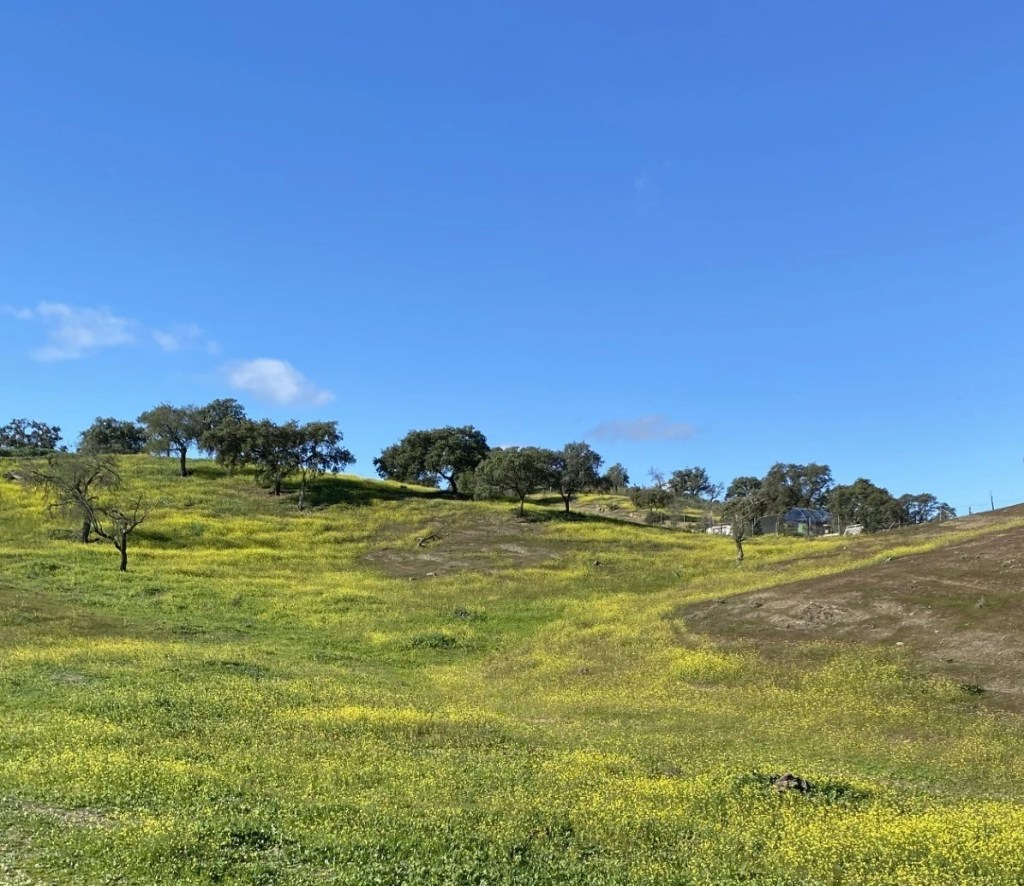
I walked for the first few days of January, recording the distance so that I had a sense of how far I might walk in a certain amount of time and considering how I could make space in my work day for this challenge. On each walk, I was uplifted. The land was brightly green, decorated with patches of wildflowers, yellow and white. It was a balm to the eyes and to the soul. Each day, though my spirits descended again when I returned from my walks, the troughs were not so deep. By the second week of January, I felt like myself again.

Some days I walked 10km or more, one day I only managed 1km. I walked at all times of the day – in cold early morning mist in jacket and woolly hat, bright afternoon sunshine in t-shirt and sunglasses, at sunset, carefully picking my way along rocky paths in the dark; Lady always my faithful companion, the land I walked through nourishing and uplifting me.

By the end of the month, I had walked 201km, along paths leading out in a radius from my house. I became reacquainted with places I hadn’t walked in years, just as I became reacquainted with why I love living here in the first place – the immensity of the land, the stories it tells of the people who lived here before, if only you take the time to read those stories in the landscape, the other creatures nourished by the land, and the river that brought me here snaking through it all; the vastness of the sky, at times a blue so deep as to seem unreal, at times ominous shades of grey, at night the riot of stars a glorious reminder of my insignificance, the Milky Way mirroring the route of our little river.

Over the course of the month, I observed changes taking place – sudden changes brought about by a heavy rain shower, slower changes as grasses grew, the number of lambs in a herd of sheep increased dramatically, the oranges continued to ripen and fall from the trees. I have found one, two, or even three hours in each day to walk. Those hours were there for the taking all along, I just failed to see them. Walking became the fulcrum of my day throughout January, uplifting me, soothing my soul, reassuring me that in the face of such ordinary magnificence, it is only to be expected that happiness is my default mode.

As for February? I’m back on the tracks and trails again, mostly in the lengthening evenings, challenging myself to another 200km. It hardly feels like a challenge. It’s starting to feel more like a drug.

Gilroy

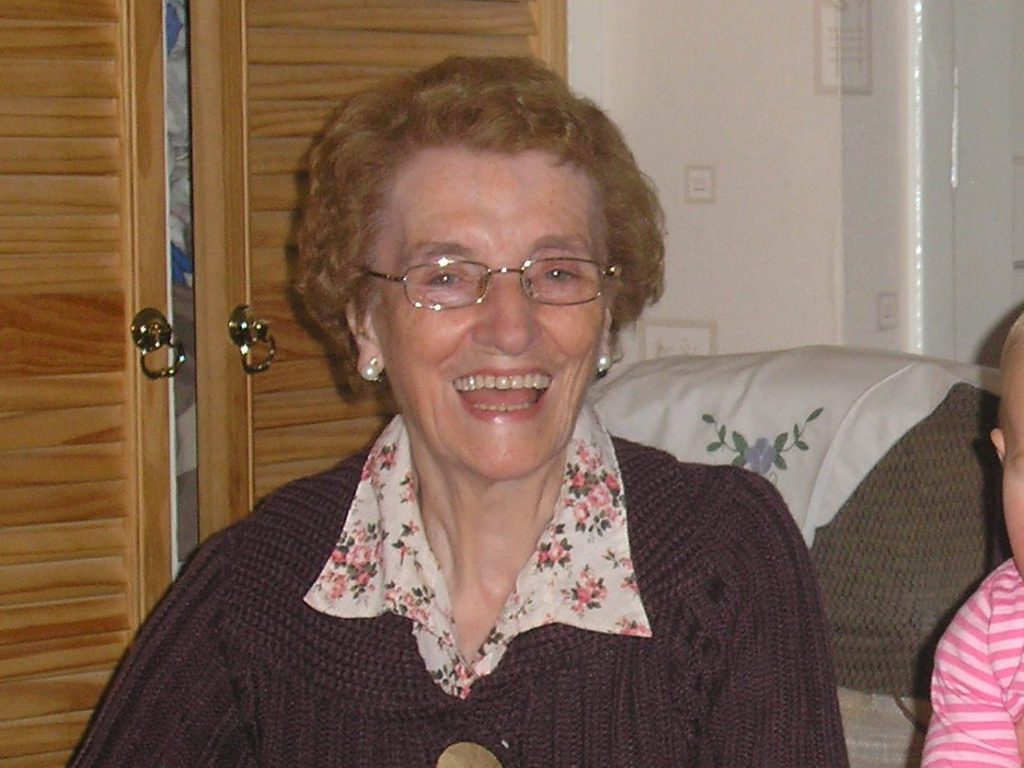
There were seventy-five of us, by my count. I might be out by a few. It was hard to keep count. Children, grandchildren, greatgrandchildren, spouses and partners. Seventy-six if you include Nana, in the middle of us all, in her coffin.

The undertaker, Patrick Larkin, had asked us to assemble in Gilroy at 12:45. And here we were, squashed together in the living room, where Nana lay in her coffin, and in the narrow kitchen off the living room, leading to the only bathroom in the house. Most of us had been here five and a half years earlier, for her 90th birthday party. But that had been a warm July day and we were spread out over her big back garden.

“How are your girls?” Angela asked me, as a gang of us stood shoulder to shoulder in the kitchen.

“Put that in the fridge,” Louise said, as she passed me a two-litre plastic container of milk.

I’d only closed the fridge door when Conor walked in. “Did anyone get milk?” he asked.

I took the milk back out of the fridge.

“I’m making tea for Dad,” Conor said. “Anyone else want anything?”

“I’ll have a coffee,” Antoinette said, taking an impossibly huge mug out of the press. I didn’t fancy her chances of getting through the funeral if she drank the fill of that.

“When did you get home?” one of the twins asked as she hugged me.

“One o’clock this morning,” I replied. “Declan Farrell picked me up from the airport.” I asked when she’d flown in, careful not to say her name until her sister arrived and I could work out which was which. This always happens when I haven’t seen my twin cousins for a while.

“Is this a queue for the loo?” David asked, as he walked into the kitchen, ushering his two young sons in ahead of him. He explained to his bewildered boys that all of us chattering women were his cousins and aunts. He hugged us each in turn as he directed the boys towards the toilet after their long car journey from Cork to Offaly.

“Oh my God,” Antoinette said. “Stuart looks like Ryan Reynolds.”

“Don’t tell him,” the twin laughed. “His head will explode.”

Antoinette told him anyway and he beamed and gave her an extra big hug.

I squeezed my way back into the living room. The other twin was there. She hugged me and told me what time she’d arrived home from England. She mentioned her sister’s name, so now I knew that this was Lisa and Joanne was in the kitchen. I hugged those cousins, aunts and uncles standing around me who I hadn’t already seen earlier in the morning when I’d been into Gilroy for a quieter moment with Nana. Martina’s three boys – all six foot something of them, and John’s girls, and James, looking surprisingly fresh-faced despite having just arrived in on a flight from Hong Kong. There were cousins and aunts on the chairs and the arms of chairs, and more standing squashed together like a Tokyo subway train at rush hour, except we were all family and everyone had hugs for everyone. Mugs of coffee and tea were precariously held and threatening to spill on our best clothes. We were loud and laughing, delighted to be here together, despite the circumstances.

I wondered would this be the last time we would all be in Gilroy?

Gilroy, the centre of our family universe. An unassuming terrace house on an unassuming street that was the beating heart of our family. And, at the centre of that universe was Nana, always in her armchair by the fire, always with a smile on her face, accepting us in at any time of the day or night, occasionally grudgingly, if we threatened to interrupt a programme or a football or hurling match on the telly or radio.

No matter what time of day or night you went in, there was sure to be someone else there. One or other of us always dropping in ‘just for a minute’ but nevertheless always having time for a mug of tea or coffee, a couple of biscuits, maybe a sweet or jelly from a bag or bowl on the coffee table in the middle of the living room floor.

It was the rare day that we went into town and didn’t drop up to Gilroy. When we went grocery shopping, Mass, a trip to the doctor or dentist. Always, up to Gilroy before or after. Pretty much every day of the 13 years I was in school, I walked over to Gilroy at lunchtime for a huge middle of the day dinner and a glass of milk, followed by a couple of biscuits or a slice of Nana’s homemade tart. In my 20s, she occasionally cooked dinner for me if I was working in Edenderry. I didn’t really like her food when I was a kid. In my 20s, I loved it. And always, there were aunts, uncles or cousins there. Always some of us dropping in.

I’d phone Mammy for a chat. “I’m in Gilroy,” she’d say.

“Jim and Marian are up,” someone would say. “Up” meaning up from Cork…and in Gilroy.

“Phil’s home,” meaning home from England…and in Gilroy.

“Liz is down,” meaning down from Dublin…and in Gilroy.

“Jim is over,” meaning over from Navan…and in Gilroy.

Up, down, over, home – all our shorthand simply meaning that we were in Gilroy. Half the time I’m not even sure we were visiting Nana. We were just being ‘in Gilroy’ because you wouldn’t be there more than a few minutes before someone else would drop in for a quick visit, a cup of coffee, a biscuit, a chat. I often wondered how much money Nana spent on tea, coffee and packets of biscuits each week.

And always Nana, sitting in the middle of it all, in her chair by the fire, smiling and laughing, telling us the latest gossip from the street, or the latest plotline of some soap opera she was engrossed in. And we carried on around her, feeling at home, sometimes the noise of our chatter so loud that we couldn’t hear each other. So, it was fitting that, on that day, most of us were there, and we were loud, and she was in the middle of it all one last time.

At 1.30, we started to move out. We formed two lines from the front of the house, out along the path, to the street. We stood, seventy-odd of us, joined now by neighbours and friends, as six of my uncles brought Nana out of her house on Gilroy for the last time.