49. Breakfast

Breakfast is generally the most perfunctory of meals. Quick and practical at the start of the day. On Saturday or Sunday, I like to make pancakes or waffles, which we eat lazily with multiple mugs of tea. But still, it’s the meal that, most of the time, I make and eat at home. I always imagine going out for breakfasts, but I’ve never lived anywhere that’s had much in the way of breakfast options.

Visiting a city is always a great opportunity for sampling breakfasts of all sorts. The memory of New York and Toronto diner breakfasts make me drool even now, and I still get nostalgic about breakfasts in Paris, Sydney, Honolulu, Vienna, London, Sevilla. Eggs, bacon, pancakes, mueslis, yogurts; breakfasts of all shapes and sizes; enjoyed with friends or in my own.

This morning, on the way through Derry, I had one such memorable breakfast. Not at a diner or a cafe, but at a friend’s house, made all the more delicious for the care and devotion my friend’s brother and sister put into making it.

The dining table was dressed with food, like that Christmas scene in Greta Gerwig’s Little Women. Eight of us sat around a table laden with rashers, sausages, black pudding, grilled tomatoes, fried potatoes, baked beans; potato farls, brown bread, toast, brioche buns, pancakes; jams, honey, marmalade, maple syrup; tea, coffee, hot chocolate. Every breakfast I love, all there on the table. I could have sat there all day, gorging myself like the Prince Regent.

Alas, we had to get on the road. Home beckoned. So, with a tummy full of food made with care and passion, I set out, another memorable breakfast to fuel my future nostalgia.

48. Weathering

We had already decided to stay an extra night, to hole up here, in a house on a granite cliff, on the far northwest coast of Ireland. Better than running the risk of driving across Donegal and down through the country in the middle of a storm. We’d drive to the shop, get in supplies for the extra day.

Mid-morning, Katie called from the bathroom, ‘Is someone using the water out there?’ The shower wouldn’t heat up. A minute later she appeared wrapped in a towel. ‘The shower’s stopped working.’ Our trip to the shop in Dungloe delayed, we spent the next half hour trying to work out the source of the problem. The safety switch on the electricity junction box kept tripping. By a process of elimination, we realised that certain plug sockets also weren’t working. Michael stood on a kitchen chair, flicking switches on the junction box. ‘Shit. There’s smoke coming out of it,’ he said suddenly. I unlocked the door into the terrace in case we needed a speedy exit. My sister has survived two house fires – one in Ireland, one in Spain – both due to junction box fires, so I knew what could happen next

We ran around, unplugging and turning off lights. The smoke didn’t develop into anything more. Time for a sit down and a chat and decide what to do. It was Sunday morning, a bank holiday weekend. So calling out an electrician would be expensive and possibly not resolve the problem in the short term. Better to leave that til Tuesday and a normal working day. The house belongs to Michael’s aged aunt, so we didn’t want to bother or worry her when, at this moment, nothing could be done. And, the storm was still on its way.

We decided to ride it out here, without electricity. The girls raided the house for candles, torches, matches, while Michael and I figured out how to set up the ancient gas barbecue in a sheltered corner out the back of the house. Our shopping plan changed, as we considered what we could eat in the absence of electricity. We charged our phones as best we could during the drive.

When we got back from the shops, we went for a long walk across the island, still no hint that a storm was on its way. Michael lit the wood burning stove in the house and fired up the barbecue out the back. Up at this latitude at this time of year, it isn’t fully dark til 10:30. We sat chatting by candlelight til close to midnight. Michael was last to bed, leaving only a single (and safe) candle burning in the bathroom.

The wind woke me up around 5am, the back of the house, where I’m sleeping, creaking in its path. I was up at 7am, no longer able to sleep, keen to see what the sea looked like. I’m sitting here now by the big window that takes up half of this little house. Waves smash huge and white against the islands in the farther distance. Closer in, the sea is choppy, with gusts of wind dancing across its surface. A group of cormorants sit on the sea just down from the house, being tossed this way and that. The occasional seagull soars on a current of air, feet splayed as it attempts to land on firm ground

I’m glad we stayed. The lack of electricity gives a Wuthering Heights feel to this storm. We’ll leave later today or, more likely, tomorrow, whenever the storm has passed. All I’m missing is my morning cup of tea. For now, I’m going to sit back and enjoy the stormy sea.

47. Ukaliq

In late 2000, I’d already been working as a volunteer teacher at Levi Angmak Elementary School in Arviat, Nunavut, for some months. Kip Gibbons, one of the teachers who had befriended me, offered to show me how to sew my own mittens. She sent me to the Northern Store to buy ukaliq (arctic hare) fur. I duly went a couple of evenings later and bought two ukaliq skins. On Saturday, I went around to Kip’s house and we sat on her floor, where she helped me to cut the pattern and showed me how to stitch the parts together.

I’ve never been much of a crafts person, so I was delighted to be making my own mittens. It was probably -20C or -25C as I walked the snow-covered streets back to my house a few hours later, proudly wearing my new mittens. I would wear them for years, and still have them today, although there isn’t much call for them in southern Spain.

On the Monday after I sewed the mitts, I wore them to school. In the school foyer, I met Peter 2 Aulajoot, an older teacher, who was always friendly and jokey with me. He chuckled when he saw my mitts. I hadn’t cut them badly or sewed them poorly. But Peter 2 noticed something that I hadn’t. While the fur on my left mitt was mostly white with a little smattering of black, the fur on my right mitt was mostly black with a little smattering of white. They looked completely mismatched. How could I not have seen this?

From that day on, Peter 2 always called me Ukaliq – arctic hare. A few other people picked it up too, but it wasn’t a name I was commonly called. But I liked that name for myself. I’d always loved hares, always got a thrill when I’d see them in Ireland. Now that I was in Nunavut, I saw them more often – including one that lived out past the reservoir and seemed as tame as a pet bunny.

I’ve carried that name – Ukaliq – with me ever since, making the frisson of excitement I feel whenever I see a hare all the sharper. So, yesterday when Michael said, ‘There’s the hare,’ I immediately turned to the window. And there she was. At the base of a granite outcrop beside the house, ears up, alert. She paused, nibbled at a hind paw with her teeth, hopped along and then sat, ears back, looking out over the sea.

I was in a state of awe and nostalgia and joy all mingled together, remembering Peter 2 and Kip and that ukaliq by the reservoir and the person I was twenty-five years ago.

43. Busy day back

Between Mammy and the chats and the cousins and the chats and the neighbours and the chats and the tea and the chats and the rain and the chats and the dogs and the chats the coffee and the chats, I just haven’t had time to write anything today.

42. Strangers

I meet Sean again when I go out for an evening walk. This time he’s sitting on a camping chair on the canal bank, beside his boat. He’s with a younger man, who’s sitting on the grass. I shout ‘hello’ over to them and they beckon me over. By the time I walk back to the nearest bridge and cross over to the other side of the canal, Sean has pulled another camping chair out from his boat. His buddy is Carl, a Mancunian. The two met only yesterday, when Carl was taking his daily walk along the canal. I sit with them for a couple of hours, shooting the breeze, sharing stories about where we’ve come from and where we’re going to, the importance of listening, and the power of poetry. I bid them farewell and carry on my way.

••••••

‘I started working with papier-mâché during lockdown,’ Jean tells me. ‘I wanted to make art with what was lying around the house.’ I’ve wandered into her studio and find her sitting at a table, surrounded by papier-mâché spheres and abstractly-shaped boxes, everything looking precarious and on the edge. ‘Everywhere I turned, they were talking about tipping points. Scientists, activists. Tipping points are my great anxiety. So I’m working through that anxiety in my art.’ I ask where she’s from. ‘From Indiana originally, she say, but I’ve lived in England for forty years.’ She shows me how her tactile, playful art moves and explains how she makes it. I wish her luck with her project.

••••••

‘Do you mind if I sit here?’ I ask the man sitting alone at a table who looks like he’s working. I’m here to work too, so this could be a good place to sit. ‘The working end of the cafe,’ I say to him. ‘Yes,’ he smiles. I spot a university logo on the paper in his hand. From this angle, it looks like exam grading criteria. ‘Marking exams?’ I ask him. ‘Job application,’ he says. He’s Mark, an academic at a midlands university, grown tired of his job and applying for a position at a university in eastern Germany. We talk about the state of academia in the UK, the Spanish education system and, before long, an hour has passed and neither of us have done any work. I have a Zoom meeting to prep for and he has a train to catch, so we say goodbye and I get on with my work.

••••••

‘I’m at a stage in my life where friendships with women are most important to me,’ Amanda says. She tells me that she’s only moved to Leamington two days ago. She’s a few years younger than me, has a corporate job, but her real passion is healing. I tell her about a book I’m currently editing, and we discuss the power of stories and how we’re only able to tell our stories once we have worked through our trauma. We’re the only two visitors in a small art gallery and we’ve both arrived at the same time. We start out shadowing each other, a little self conscious in the small rooms. But soon we’re talking about healing and friendship, and what a great place Leamington Spa is, and the fact that we’ve both recently been to Thames Ditton. We leave the gallery together, saying goodbye as we walk away in different directions.

••••••

I find it hard to stay strangers with anyone for long.

41. And tomorrow…home

After almost six weeks in the UK, tomorrow we will travel to Ireland. We haven’t started packing yet and the tiny bedroom we’ve been sharing at my father-in-law’s house looks like a bomb site, after all these weeks of us living out of our suitcases in there. But we’ll pack with care tomorrow, and say our goodbyes, and tomorrow night, all going well, I’ll be at home.

40. Instant coffee

‘Is it ok if we sit here?’ the young woman asks me. I’m sitting at a long table outside a cafe, drinking a coffee and reading. ‘Of course,’ I reply. She sits down with her two young children. She gets a banana out of a bag for the toddler and, before long, her partner arrives carrying a tray with lunch for them all.

A little while passes and a young man joins them. They’ve obviously been expecting him. The three young adults all look the same age – late 20s, maybe early 30s. By the tone and topic of their conversation, I would guess that they met at university. The things the young couple tell their friend about their kids and about parenthood suggests that he is childless.

It’s a happy jokey conversation, although the woman has the lion’s share of looking after the children – the toddler especially, who wants to run here and there and is keen to smash the banana into his face and clothes.

The conversation turns to the cafe. It’s a great cafe in a great location, somewhere I always come to when I’m in Leamington. The three friends like it too, and share what they like about the sandwiches and the cakes.

Then, the young woman says, ‘The coffee’s great too.’ The friend replies, ‘Oh but it’s…[he names whatever the coffee brand is]. It’s awful coffee.’ He’s not drinking coffee. She is. ‘Oh, is it not?’ she asks, and I can hear her doubting herself. It’s not that the taste of this coffee – her subjective taste experience of this specific cup of coffee – is no good. It’s that she now thinks her Taste in coffee is no good. I can hear it in her voice.

Her partner, of course, sides with his friend, because, God forbid he’d be accused of not having good Taste in coffee. He agrees with the friend that the coffee here is ‘no good.’ (I’m sitting beside them, enjoying a perfectly lovely cup of coffee…but more about me later.)

I want to turn to her and say, woman-to-woman, ‘If this coffee tastes good to you, then don’t let anyone tell you it’s no good. Trust your own taste. And, as my friend Bernard Greene would say, F**k the begrudgers.’

For years, I used to apologise to people visiting my house for ‘only’ having instant coffee to offer them. Like I was somehow lesser than for not having fresh coffee and a cafetière or a coffee maker or whatever. And, if someone else made me coffee, I would apologetically ask that they make it weak. Because, let’s face it, the world is full of coffee snobs.

I used to be like that young woman, doubting my own taste in coffee because someone else (a man 99.9% of the time, because women have bigger things to worry about than posh coffee) told me it was no good. I tried liking it. I tried making it. I’d buy a bag of coffee and make a pot or two. But it was just too much effort for a less than satisfying outcome.

I dropped that attitude long ago. I have instant coffee in my house because that’s what I like to drink. That’s my taste and my taste alone. I like it weak. And milky. Is my taste in coffee bad? No. It’s neither good nor bad. It’s just mine.

So, if posh coffee (or wine or whiskey or anything else, food or otherwise) is your thing, then I wish you the very best of luck with it. I hope you savour every moment of it and that it brings you great pleasure. But don’t, for goodness sake, make someone else feel lesser than because their taste isn’t the same as yours.

Now, I quite fancy a chocolate digestive dipped in a mug of milky Nescafé.

38. Chair-o-plane

This took me back. Today, the girls and I visited the Black Country Museum in Dudley, northwest of Birmingham. We learned all about coal mining in the 19th and early 20th centuries, went down a drift mine, and saw how people lived from about 1850 to 1950. It was all great.

But this is what did it for me. The chair-o-plane. I don’t know what you call it where you’re from, but at the fairground (or ‘carnival’ as we called it) in Courtown in Co. Wexford back in the early 1980s, this was a chair-o-plane (or, as Lily suggests ‘chaeroplane’).

Each year, Edenderry Shoe Company closed down for summer holidays for the first two weeks of August. Daddy was foreman of the warehouse and Mammy worked three afternoons a week in the shoe shop, selling ‘seconds’ (slightly damaged shoes that didn’t make it past quality control) to women who travelled from all over Ireland to buy these stylish and good quality shoes.

During August every year, when the factory was closed, we went on a weeklong family holiday. We tried out a few destinations (always in Ireland) but the one we returned to over and over again was Courtown, a seaside town on the southeast coast, in Co. Wexford. We often bumped into other shoe factory employees there too, also on their holidays.

My parents would rent a mobile home in the same caravan park each year. My Nana Tyrrell came most years and sometimes another family member – my aunt Louise came one year and my cousin Colette another.

We spent our days on the beach, having hauled the deck chairs, the wind break, and the day’s food down what, at the time, seemed like a very long lane to the beach but which now I imagine was no more than a couple of hundred metres. I loved those days on the beach. They felt endless.

And then evening came and, without fail, we drove to the carnival. There was a chair-o-plane, a merry-go-round, swinging boats, waltzers, bumping cars, a huge slide, a ghost train and a huge hall filled with slot machines. My sister and I spent our time out on the rides. She was five years younger than me (indeed, she still is!), so, in the early years, she was stuck on the little kiddie rides, while I went on the chair-o-plane on my own and got Daddy to come with me on the waltzers and swinging boats. That week was always the best week of the year.

Mammy liked to spend her evenings in at the slot machines. One year, it must have been the early 80s, she won £27 on one machine early on in the holiday. It was a small fortune. I remember the coins pouring out of the slot machine and Mammy running to get a plastic tub to put them in. She couldn’t believe her luck. We ate fish and chips and burger and chips every night of that holiday, paid for by Mammy’s winnings.

So today, when we got to the Black Country Museum and we discovered the funfair, I immediately had to go on the chair-o-plane. It brought it all back to me. I couldn’t have been happier. Later, we went on the ghost train and then converted £1.60 into old pennies and gambled at the slot machines. We won nothing, of course. After lunch, Katie suggested that we go on the chair-o-plane once more. She didn’t have to ask twice.

It was just as wonderful as I remembered from 40 and more years ago. I had a grin on my face from ear to ear. I was a kid again, back in Courtown in the 1980s.

37. Summer reading challenge

The library has become noticeably busier this week, now that schools in England have finally closed for the summer. The girls and I have been feeling very sorry for all these English kids who are still at school six weeks after Spanish summer holidays started. (Irish holidays aren’t much shorter than Spanish holidays. How I relished those long holidays as a child).

With so much going on in the library, I’ve had to move to a different table, this time near the front. I sit at one of two round tables; the other is reserved for signing children up for the Summer Reading Challenge.

All morning, mothers arrive with their kids, mostly in the 5 to 7 age range. There are laid back chilled out mums, frazzled harried mums, mums who’ve been bringing their kids to the library since they were born, mums who’ve only stepped into this library for the first time today.

The young member of staff assigned to the task of signing kids up is great. She focuses on the kids, asks their name and how to spell it, asks if they know their birthday. She finds a point of interest in almost every kid – catches something they say or some object they have – and lets them know she’s their ally. For one kid, it’s Pokémon – asks the kid which is their favourite and then says she likes that one too. For another kid, it’s their favourite colour (green), for another, a book they like. Did I already mention how great libraries and librarians are?

All of this takes me back more than a decade, when we still lived in England and the girls signed up for the Summer Reading Challenge, two years running, if I’m not mistaken. They had to set a goal for how many books they’d read (one six year old this morning said he was going to read six hundred billion million). I can’t remember what the goal was now – five maybe? Or maybe that’s too low. I can’t remember.

Anyway, the point is, Lily was the reader. She’d picked up reading early, read her first Harry Potter book at five. (Looking back now, even I can’t believe that’s true, but it is). So the ‘challenge’ part of the Summer Reading Challenge didn’t really exist for her. But for Katie, it really was a challenge – for her and for me. I despaired of her ever reading. She refused. She wailed. She simply would not read. By the time she was nine, I was resigned to the fact that she was never going to read. I don’t mean she was illiterate, but she was so halting and uncomfortable with reading that I had decided that maybe it just wasn’t for her.

She turned 10, then 11, then 12. Two summers ago, just before she turned 13, she discovered the joy of reading. It started with a graphic novel and then reading a novel by the same author. Once she got going, there was as no stopping her. She now puts Lily and me in the ha’penny place. This year so far, she’s read more than 20 novels. The first place she wanted to go to when we arrived in the UK was a bookshop. Here are her books just for the few weeks we’re here:

The summer reading challenge now? Figuring out how we’ll stay under our luggage limit, thanks to all of Katie’s books!

33. What a good boy!

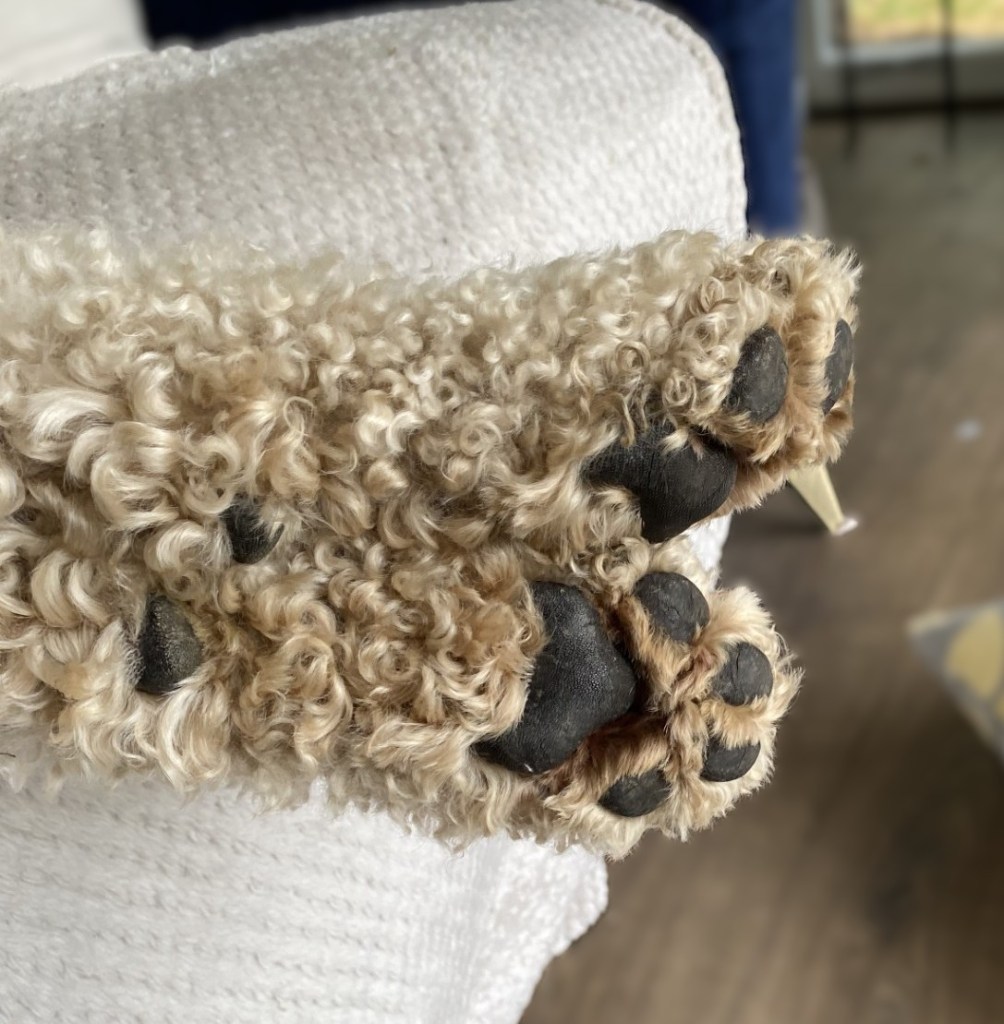
We’ve been looking after Hudson for the past week and we’ll be very sorry to say goodbye to him later today. Is there a better doggy in all of England? I sincerely doubt it. He’s been a joy to look after and a great first experience for us in the world of Trusted House Sitters.

Some friends in Sanlucar are signed up to the Trusted House Sitters app and others to a house swapping app. Both use those apps to travel to interesting places and get their accommodation for free. I’m not yet ready for house swapping – not until I finally get around to installing the new oven that’s been sitting on my kitchen floor for the past six months. Trusted House Sitting seemed like a better fit for us at the moment.

So, a couple of months back, I signed up, paid a small annual fee, got three people to write references for me, created my profile and away I went. This week has been our first dog-sit and I will definitely do it again. We made contact through the app with a couple in a village in the English midlands who needed someone to look after their dog and water a few plants while they were away on vacation. We met briefly by video call and then, last Monday, we arrived.

It has been a perfect experience from start to finish. Hudson is the perfect dog. Giant and gentle, easy going and with (almost) no bad habits (we all have some bad habits after all). He’s a dream dog. The house is like something out of a magazine. A modernized old cottage with an extensive garden that is so easy to live in that, really, I don’t want to leave. All over the house and garden is scattered comfortable furniture where all three of us can find our own space to curl up and read our books. The family photos and grandchildren’s arts and crafts suggest this is a house filled with love. And, there is an amazing office halfway down the garden, where I have been working all week.

The house is situated in a very typical middle class English village, with a decent (if expensive) pub and an amazing village shop. All around are paths and byways through the fields, so there’s no shortage of exercise for Hudson or for us.

Our hosts left easy-to-follow instructions for everything from where to find the doggy treats to how to use the air fryer. A gardener came in one day and a cleaner another. It is no understatement to say that I have been living a lifestyle this week that is so far removed from my normal life.

On this house sit, we didn’t venture far. The house itself and the surrounding are enough of a holiday for us, giving us a chance to experience a different lifestyle. But, already, I’m scrolling the app to look for future house sits in cities or towns that I want to visit and, for some reason, I keep putting in searches in the Alps – I really want to take the girls to the Alps some time.

So now, we will say goodbye to Hudson and to his fabulous home and look forward to more house and doggy-sits to come.