32. Gaia says ‘Take the day off’

Photo by Noah Silliman on Unsplash

I’ve been working hard lately. After a rather worrying nine-month work drought, during which my editing and ghostwriting work dropped to half of what I would normally expect, the last three months have been among the best I’ve had since I started freelancing ten years ago. But, over the nine months of the drought, I watched my bank balance dip to a worrying low. I tightened my belt, carefully budgeted for groceries, dropped a number of subscriptions, cut out weekends away and meals out. But those were only mini bites into my outgoings. The big stuff – the mortgage, my monthly self-employed social security payments, and other such things – well there was no budgeting for them.

I wasn’t alone. Creative industries (and, as an editor and writer, I am in that category) have been hit hard by AI. When we thought things couldn’t get worse, Ebron Skunk’s DOGE slashed funding to US government research that accounts for about 40% of my editing work. Was I worried? Hell yes. Very.

At first, I put the slow-down down to it being summer. August is generally a slow month. But when things didn’t pick up in September, October and onwards, I was well and truly sweating. Work was still trickling in, I was still just about keeping my head above water, but at the start of each month I worried that maybe this month would be the month that I wouldn’t be able to pay my mortgage.

I worked just as hard as ever, saying yes to every editing job that came my way, when before I would have been more picky. I had to dismiss my long-held promise to myself and to the kids that I wouldn’t work on weekends or on school holidays (summer excepted…it’s just too damn long). But I had a whole lot of time on my hands when I wasn’t editing or writing for other people, so I used that time to make contact with potential new clients, to make myself more visible on LinkedIn, to update my website and my online profiles. I had numerous Zoom meetings and phone calls with prospective clients that came to dead ends.

But, in spring, a glimmer of light started to appear down that dark tunnel of money worries. I landed a couple of lovely medium and longer term clients and the one-off editing jobs that are my bread and butter have started to creep up again. I diversified my US work and now have a large ongoing project in addition to almost back to normal flow of one-off jobs. Part of this upturn is down to the work I’ve put in to find work. But I also wonder if clients are starting to realise that what we do as professional editors and writers is far more than what AI is capable of, i.e., human understanding, nuance, humour, and so on.

Since April, every month has been a good month. Fingers crossed, it will continue this way. However, that doesn’t mean I’m out of the woods. I’ve got that bank balance to claw back so that next time a slump comes I’m prepared for it. I’m still not in a position to be picky, so I’m still working most weekends and on holidays. I’m hoping I’ll get to a point soon when I can ease off on that again. I’m 52. I don’t have the energy for this.

Which brings me to Gaia. I’ve been working long hours this past week. I had three deadlines for yesterday. Two of those were really complicated and took far longer to complete than anticipated. When I finally turned my computer off at 9:30 last night I was well and truly ready for a break. But I’m someone who can’t sit still for long. I knew that, if the weather was nice, I’d feel the need to go for a long walk today, to fill up my day with action.

When I woke up this morning it was lashing rain. And it has continued to rain for most of today. No going out. No being active. Gaia insisting that I have the break I well and truly need. I started the morning with 40 minutes of gentle yoga, took the dog for a short walk in the rain, got back into my pajamas when I returned home, and here I remain. I have spent the day curled up in an armchair, drinking mugs of tea and reading the book I’ve been dying to read since the day we got here.

Back to work on Monday but, for now, I am relaxed and at ease and, as I look out the window, I see that it has started to rain again. Thank you Mother Earth.

31. Headstones

It’s been too wet the past couple of mornings to go walking through the fields, so Hudson and I have been taking a route through the village that takes us up to the village church and through the graveyard.

I love old graveyards. There’s something peaceful and soothing and familiar about them. The silence they offer, with their old mature coniferous trees standing stately amongst the graves. I love headstones that are so old and weathered that they are barely legible and that thrill when I squint or run my hands over the inscription or rub it with grass to better see it and discover that it is the grave of someone who died two or three hundred years ago. There is something timeless and beautiful – an unbroken thread of connection – in seeing someone who was buried only yesterday alongside someone buried 300 years ago.

When I was a child, we visited our family grave at least once a week, usually more. My father’s side of the family is buried in the beautiful country graveyard on top of Carrick Hill, in the shadow of the ruins of Carrick Castle. Back then, there was little traffic on the roads, so we regularly walked the mile from home up to the graveyard – on a summer’s evening, after dinner on Sundays in winter – and we always dropped in to the graveyard on the way home from Mass on Sunday mornings or, indeed, any other time we were driving by. As I grew older and more independent, I would often walk or ride my bike up on my own or with friends, and have a picnic amongst the graves. There were usually other people there too, someone tending a family grave or, like us, dropping in on the way past. So, the graveyard was as sociable place, where we caught up with neighbours and people we might not otherwise see much.

I loved wandering amongst the headstones and discovering the history of the place where I lived through the stories that the inscriptions told. The people buried up on Carrick Hill were the parents, grandparents, great grandparents and all the other relatives of people I knew. I guess it was the nascent anthropologist in me that was interested in family lines and family histories, in relationships and kinship, and in what I could discern about the living from the inscriptions of the dead.

Like many rural graveyards, Carrick tells the history of my family and my community; where people are laid down in death is a reflection of where they resided in life. The Tyrrell family grave contains the bodies of my great-grandparents Eliza and William, my grandparents Roseann and Michael, my great-uncle Pat (his arm buried a few months before he was, after it was amputated due to cancer), my aunt Cissie and Daddy, along with the ashes of my uncle Willie, aunt Vera, and Julian. (I never thought Julian would end up there, but Katie and Lily suggested it and I thought, why not).

Immediately next to my family are the graves of our cousins – who are also our immediate neighbours – the Hickeys, the McGlynns, the Mulraneys, the other Tyrrells. All around the graveyard are similar clusters of neighbours and extended families buried in proximity to each other. The graveyard tells the history of my community and of my family in simple metrics – birth dates and death dates, beloved daughter of, father of, grandson of, sometimes a wife’s maiden name. This simple information weaves together a story of community. The graveyard also tells a social history of status and class, from the small simple headstones of the majority of people of lesser means to the few large headstones and even those who, long ago, were placed in tombs. Although those grave markers are the outward representation of social status in life, beneath the ground everyone meets the same fate.

I’ve never thought of graveyards as maudlin or dark places. At times of death, they are a place where community comes together to pay witness to a life lived and to console the bereaved. At different times in my life, I have found it comforting to sit by the grave of a loved one, and feel an ongoing connection. But, most of the time, they are places that instill in me a sense of peace and that intrigue me in the stories they tell and the histories they reveal.

Graveyard on my morning walk

28. Some fields in England

The heatwave has passed for now. It’s windy and the early morning sky threatens rain. I’m wearing my new raincoat that I bought last week in the height of the heatwave. The sales assistant looked at me funny and I said, “Well, this has to end sometime.” It’s certainly ended now.

This week, we’re looking after the adorable Hudson (see yesterday’s post) at his home in a little village in the middle of England, while his human parents are away on vacation. It’s 8am and Hudson and I are out for our morning walk. There’s nobody else around, as we walk for a few kilometres along the edges of arable land and across fields of sheep and lambs, from one kissing gate to the next.

One young lamb is curious and tries to come to us, its worried mother keeping pace with it, probably wishing it wasn’t so curious about this big woolly dog and red-raincoated human (what colours can sheep see?). A field of rape seed is half-harvested, a big yellow combine sitting in the middle of the field, ready to resume its work when the rain lets up. I see something move at the wide fallow edge of the field, heads bobbing up and down. I think it is a couple of rabbits at first, but as we get closer, I see that it is a family of grouse. They are disinclined to leave the relative safety of the long grass for the exposed stubble of the field. I think I should turn back and leave them be. But at the exact instant I have this thought, one flies up from right at my feet, completely invisible to me and to Hudson up to now, scaring me and sending all the others into flight too. They fly the 20 or so metres from the grassy verge into the yet unharvested half of the field. I feel bad for them. Hudson is good, though. My own dog, Lady, would be going crazy for them, but Hudson seems oblivious.

A little farther on, I step over a badger sett. It looks neat and tidy and, therefore, in use, and I get a little thrill thinking that, underneath my feet, a family of badgers is likely settling down for the day to sleep. Towards the end of the walk, we pass a small patch of open grassland backing onto a copse of trees. Two hawks circle each other ten or so metres off the ground over the grassland, crying out to each other. One lands in a tree and the other continues to circle, eventually settling on the branch of a nearby tree. Their cries continue to ring out.

I am reminded of other early morning country walks along English pathways – in the Fens and Cambridgeshire, up north in Cumbria and down south in Devon – and of the hares, the muntjac and the red deer, the red squirrels, the badgers and foxes, the eagles and hawks and falcons and owls, of the times I have been privileged enough to see those animals in person and the times when I have found signs and signals that they have been there and may still be there, watching me, the clumsy human, walking through their home.

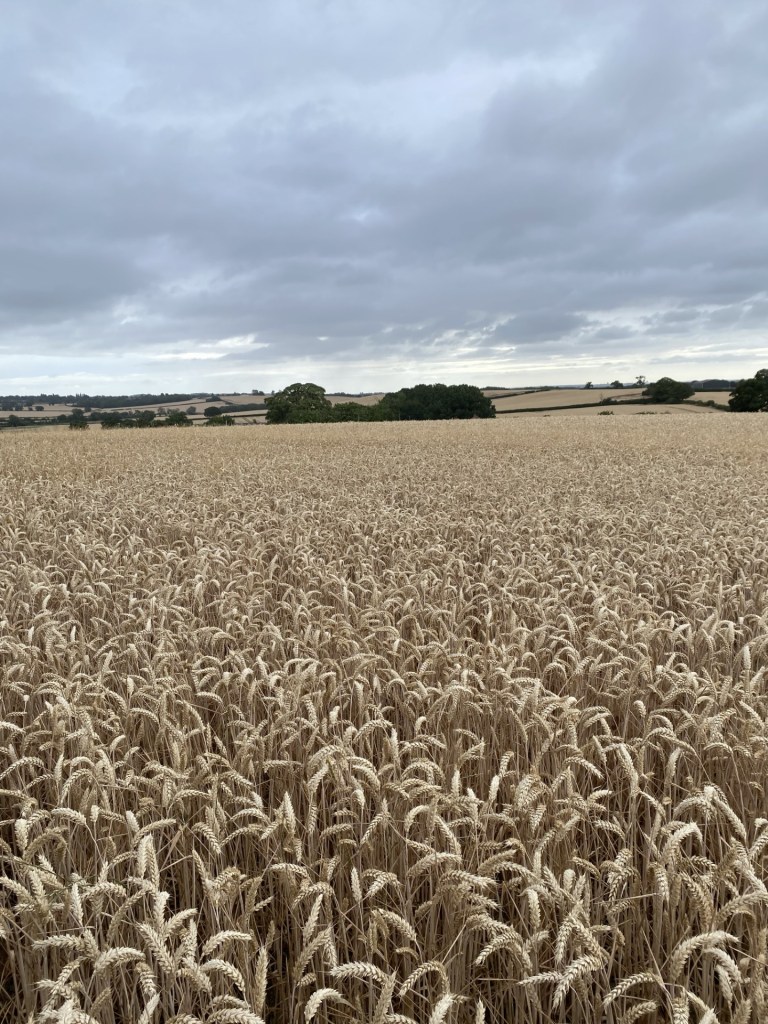
A grey morning in a wheat field

25. My dream holiday

There’s an ongoing battle taking place on in a living room in Warwick. My father-in-law insists he will make space for me to use the kitchen. I insist that I have no intention of using the kitchen. In fact, I want to stay as far away from the kitchen for as long as possible. We go through the routine multiple times a day. “I’ll be out of your way soon,” he says. “Take your time,” I say. “You’re not in my way.” He seems desperate to get me into the kitchen to cook elaborate and time consuming meals for myself. But, while he busies himself making batches of hearty barley and vegetable soup and rich meaty liver and sausage stews (in the middle of a heatwave!), that he will freeze for use over the coming weeks, I want to use the kitchen for no more than making a cup of tea or grabbing something quick and easy out of the fridge.

You see, I’m a solo parent. That means that, like so many parents in my position, I am 100% responsible for everything. My kids are great, they help out (when asked or urged) but, ultimately, the buck stops with me and me only. Apart from Sunday lunch at our next door neighbours’ house and the very occasional meal out, I am responsible for planning and making three meals a day, every day of the week, week in and week out. Sure, I take shortcuts such as batch cooking and eating leftovers, but that still requires planning. In addition, we live in a remote place without take-away options or the option of a quick trip to the supermarket to buy something last minute. I’m responsible for making sure the washing up gets done (by me or the girls), that the shopping gets done, that the gas bottle gets replaced for the cooker, and so on. I love cooking and baking, I really do. But the day in day out of it can become monotonous drudgery that takes up far too much time and head space.

So, for me, a holiday is not having to do any of that or, at least, reduce it to an absolute minimum. The girls have been away all week and I’ve only had my own food needs to think about. For me, that was as good as spending a week in one of those 6-star hotels in the Maldives or Dubai. Seriously, it was bliss. I gave absolutely no thought to what I would eat for any of my meals. When I was hungry, I grabbed a piece of fruit from the fruit bowl or popped up to the M&S Simply Food just 200 metres away and bought a yogurt or a meal deal. One night I ate microwavable mac and cheese in front of the TV and it tasted like haute cuisine, simply because I didn’t have to cook it and I didn’t have to clean up after. For lunches, I popped into a bakery near the library and got a spinach and feta roll or a sausage roll.

The break from cooking is part of a larger sense of what ‘holiday’ means to me. As a solo parent, I am constantly in decision-making mode for every single aspect of my life and the lives of my two children (with advice and support coming from wonderful family and friends). Financial decisions, educational decisions, health decisions, house and car decisions, and on and on. So, a holiday for me is also a break from decision-making. When friends and family ask what I want to do when we’re in the UK and Ireland my answer is “I don’t care.” And I really mean it. So long as I don’t have to make a decision about what to do, I’m up for anything. By the end of the past twelve months we’ve just had, I can’t tell you what it’s like to set aside my decision fatigue and rest my tired brain.

The girls are back now from their week away and, boy, did I miss them. But it’s pizza for dinner tonight and maybe a take-away tomorrow. I’m still in holiday mode and, try as he might, my father-in-law is going to fail in his bid to get me into that kitchen.

A bliss-inducing cappuccino that comes with Smarties on the side.

24. The pear tree

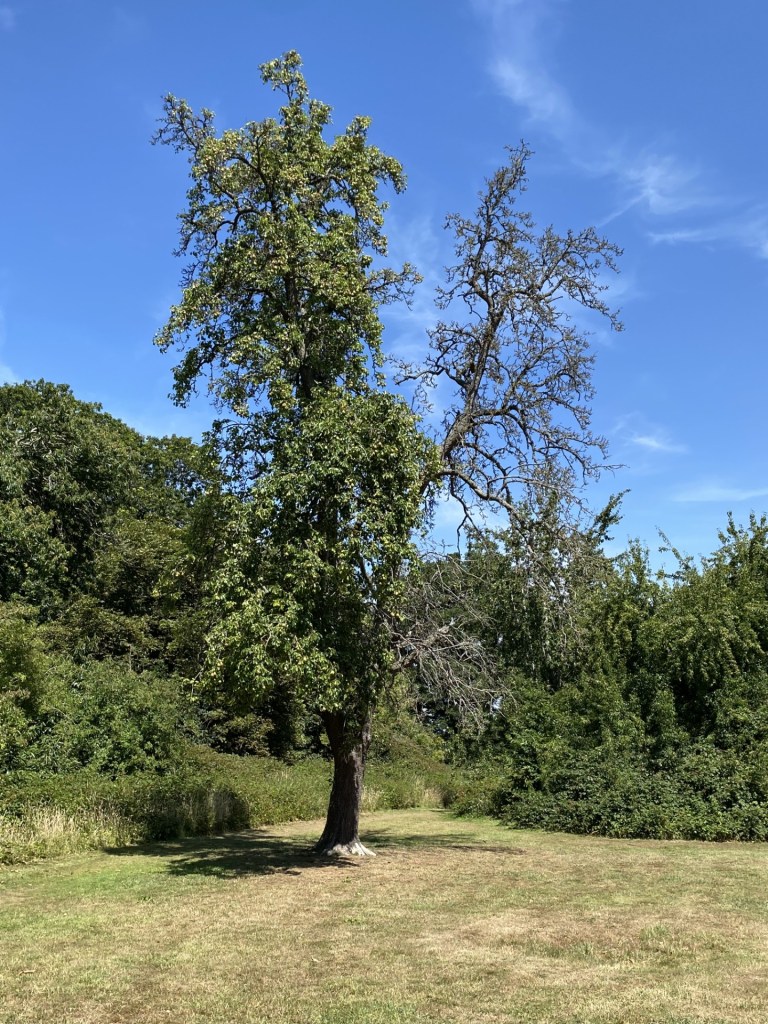
I’ve fallen for this pear tree. In a park full of majestic giant oaks, giant chestnuts, giant sycamores, it is this more modest pear tree that I am drawn to day after day, to sit under to eat my lunch and take a break from staring at my computer screen.

I chose it at random the first day, a little bit off the path and providing just enough dappled shade from the sun. I ate my lunch and then, like Heaney’s threshers in The Wife’s Tale, who “still kept their ease, Spread out, unbuttoned, grateful, under the trees,” I lay down and gazed up through the branches. It was then that I noticed something I hadn’t noticed as I walked past it or under it.

About six feet from the ground, it forks. The branches to one side of the fork are lifeless. No leaves grow, no buds. It is bare but for the lichen that has crept along it. The other side of the fork, in contrast, is heavy with life. The branches sag under the weight of innumerable pears that will be ripe by autumn, food for humans, food for animals, carrying the seeds of the offspring of this tree.

I’m drawn to the perseverance of this pear tree, to its wonky imperfection. Something happened to it – a lighning strike perhaps – that irreparably damaged one half of it, yet the other half carries on steadfast and lively. And I come to see that the damaged part might still have its role to play too, providing balance and stability, helping to anchor the still lively half.

A bumblebee lands on my brightly coloured trousers, resting in the shade of the tree for a moment before going on its way again. There are other insects too, not passing through but living here, making the tree their home. On both forks of the pear tree, I see intricate spider webs and, at the base, a hole made by some small animal. There are rabbit droppings on the ground around me. The tree, as a whole, is a place of liveliness, home to or way point for so many animals, me included.

As I sit up and prepare to return to work, I look around and see, not far away, smaller pear trees and saplings, surely the offspring of this one. The tree, despite its imperfections and its damaged parts, is living its best pear tree life.

23. Meeting Sean

I’m walking along the Grand Union Canal that runs behind the estate where my father-in-law lives. It’s a glorious evening and I’m on a video call with Katie who is away on the south coast this week with Lily and their uncle and aunt. I walk past four or five narrow boats. On the last boat in the row, a modest white and blue steel boat, a man is standing. I have the phone up, so he thinks I’m filming him or taking his photograph. He gives me a big smile and says something. But I’m talking to Katie, so there’s some confusion. He then realises that I’m not taking his picture and I realise that he’s talking to me. More than that, I hear his Irish accent and he hears mine.

“Where are you from?” he asks. “Kildare,” I reply. “Ah, a Lillywhite,” he says and I know immediately that I am firm ground. Despite his Dublin accent, he tells me he’s from Dungarvan in Co. Waterford. “The husband of one of my best friends is from Dungarvan,” I tell him. I tell Katie I’ll call her later because I have a feeling I might be chatting here for a while.

Sean and I chat for an hour, me standing on the grassy tow-path, he on the open deck of his narrow boat, the air cooled engine exposed to the evening air. We discover we have people and places in common. He pootled a narrow boat up to the harbour in Edenderry in the late 1960s and remembered going for a drink at The Harbour House. That was my uncle Tom’s favourite haunt, owned by Mary O’Connor, my Irish teacher, and her family. I was only in The Harbour House once, for a pint of Guinness with Tom back in the early 1990s. It was everything you would expect of a small Irish pub, all the old men lined up at the bar. It was renowned for its music and for Mary being as strict behind the bar as she was in the classroom.

Sean tells me about his job at Shannon airport and about people from Edenderry he knew there and at Ardnacrusha power station. I mention people I know who he might have known and we laugh when we get a bit tangled in Johns and Seans and who was who.

I tell him I had been a sailor and we talk about the joys of my Westerly Conway. He wonders how a girl from the Bog of Allen and a boy from the housing estate 20 metres from here could have ended up living on a boat and sailing to the places we did. He tells me of his adventures as a sea sailor and as a narrow boat owner and about his sustainable, no-cost approach to life.

At 80 years of age, he is only a few years younger that Daddy would have been. The Cuban Missile Crisis comes up in conversation (he makes me promise not to tell anyone why) and he shares his reminiscences of those few days in 1962 and I tell him what Daddy told me of his memories and fears of those days.

He explains how he has come to have that Dublin accent but says his heart remains firmly rooted in Dungarvan. He already owns a plot in Dungarvan graveyard where he wishes to be buried when his time comes.

“I had a half pint at the Cape of Good Hope a while ago,” he tells me, referring to the pub just a couple of hundred metres away. “When I went to the bar, I heard two men behind me. A Mayo man and a Galway man. Sure, I had to talk to them. The Mayo man was a bull man.”

“A bull man?” I ask, perplexed. “Ah, you’re too young,” he says. He explains what a ‘bull man’ is and realisation dawns. “Ah,” I say, “You mean the AI man. That’s what we call it where I come from.” He laughs and says how funny that we had that in Ireland where the Catholic church didn’t allow such things for humans. AI, for those of you not in the know, means, artificial insemination, and the Bull man or the AI man was, and remains, an integral part of our dairy and beef industries.

My daughters always tease me when I speak to other Irish people, accusing me of changing the way I talk and the way I hold myself. They’re not wrong. But I don’t do it on purpose. When I’m with other Irish people I become the version of myself that is the oldest part of me. I speak in the way I learned to speak as a baby, in the first accent I ever heard from the people and the place where I grew up. It is the accent, grammar, syntax and vocabulary that I am most comfortable with. There’s no modulation, no register change, no code switching. I am me at my most comfortable.

We all change our registers in different contexts. For instance, the way we speak to small children is not the same as the way we speak in the corporate office. The way we speak in church is not the same as on the terraces of the football stadium. But changing accents is something different. Over the years, I have modulated not only my accent, but the words I use when in conversation and the order in which I say them. Why? Well, for two reasons – one that I am comfortable with, the other less so.

For most of my life, I have chosen to live among people for whom English is not a first language. Therefore, to make myself understood among English speakers in Japan, Nunavut, Spain, and elsewhere, I slow down, speak carefully, use very standardized words and phrases to be understood and to make the person I am speaking to feel more comfortable. That is now second nature to me.

The other reason is that, over the years, I have been very aware of people making fun of my Irish accent – people laughing and repeating my pronunciation, my use of certain phrases or my Hiberno-English sentence structures. In order to reduce the feeling of discomfort (and anger) that this fun-making and ridicule causes in me, I modulate and change register. It’s just easier. I don’t like it, but it is how it is. That too is now second nature to me when I am around native English speakers who are not Irish.

But, when I speak to other Irish people, I can feel my body physically relax. I don’t have to think of an alternative phrase or word for ‘give out’, ‘press’, my use of bring/take, my pronunciation of H and th, or a thousand other usages of words and phrases. I’m not going to be laughed at for calling my parents Mammy and Daddy. I can throw in a reference to the GAA or to Eamon Casey or to the Angelus or to a million other things, and no further explanation is required. I can just be.

All migrants, no matter what their language or their circumstances, experience this distance from their first voice. Some people are happy to leave that first voice behind. I am privileged to have had so many opportunities to travel in my life. I have learned so many wonderful ways to speak and to see the world through the eyes of others. But speaking in the way that is oldest to my being is like relaxing into a large warm bath.

Sean is stuck along this stretch of the canal for the time being, as he waits for a lock gate farther along to be repaired. I tell him that if he’s still there the next time I walk that way, I’ll invite him down to the Cape of Good Hope for a beer. Who knows? Maybe the AI man will be there.

Stretch of the Grand Union Canal in Warwick

22. Lovely libraries

“I’m off to the library,” I say to my father-in-law on our first day here in the UK. “The library?” he asks, looking at me like I have two heads. “There are no libraries any more,” he says. “Yes, there are,” I say. “I’m going to Warwick County library, in Shire Hall.” He used to work at Shire Hall and it’s one of his favourite topics of conversation. But he’s convinced there is no library there, that all the libraries in the country have closed down due to lack of interest, lack of funding and, his pet hate, technology. I try to convince him that the library is still there. I know because of…erm…technology. I’ve already done my research online and I know its daily opening hours (extensive) and I even know where I plan to sit when I go there every day to work. He remains perplexed and unbelieving. “Who uses libraries these days?” he asks.

I go to the library that afternoon and have been coming here for a few hours every morning since on those days when we are in Leamington Spa. Who uses the library, indeed? There are old people and young people, babies in strollers and grannies on mobility scooters. There are young frazzled parents and teenagers straight from school still in their uniforms. There are able-bodied people and disabled people. There are school groups and people in residential care. There are people here for parent and child story time and rhyme time and teenagers here for book club. There are people browsing the shelves and people consulting the librarians for help finding specific books. There are people in to renew their library card or to get one for the first time. There are people seeking assistance on matters that have nothing to do with books. And there are people like me, who have come in to use the space to work. A young women is at the table behind me a couple of days a week, writing away on her laptop. One day, a man about my age arrives in, in a business suit and dragging a suitcase behind him. He sits for a couple of hours and works on his laptop as he waits for his train or plane or whatever mode of transport he needs to get to where he’s going.

The library is small. But it’s bright and colourful. There are bright and inviting displays about gardening and, for the children, there’s a summer treasure hunt of herbs, that they have to guess from their scent. There are special displays – of gardening books, LGBTQ+ books, Black history books, summer reading recommendations. The librarians are, to a person, kind and smiling and give the appearance of people who love their jobs. This is not some stern library where people are forced to be silent. Those days, I hope, are long gone for public libraries. I hear the librarians quietly chatting amongst themselves and being friendly to everyone who comes in the door.

I choose to sit at the work/study space towards the back, next to the children’s library, with its snug spaces for kids to get lost in books. Nearer to the front, and I would be distracted by the conversations taking place at the front desk. But here, I am generally not distracted by the sounds of children, or of their mothers reading books to them (except when a mum reads a book that I read to my girls; then, I get a little nostalgic). I was distracted yesterday, however, when the soft-voiced man leading story time read a book to a group of toddlers and their parents about a trip to the zoo. One toddler, clearly not enjoying herself, spent the entire story saying “It’s so boring, it’s so boring.” That made me chuckle.

So, despite lack of funding and the digital world we live in, this small library is bursting at the seams with liveliness and activity. So, here’s to libraries everywhere, and to the librarians who take care of them and to the people who use them and to the taxpayers who fund them and to the civil servants and politicians who budget to keep them open. I wish I could convince my father-in-law to come here and see for himself, but alas, he’s a non-believer.

20. Normal England has resumed

We arrived back to Leamington Spa late on Saturday evening, leaving the girls with a 19 hour turn-around time before leaving for a week in Lymington with their uncle, and leaving me with even less time than that to get the laundry done. It’s all too easy to forget how quickly clothes dry at this time of year in southwest Spain. Hang ’em out and take ’em in again two hours later, hard as boards. Not so in England. But the weather has been unseasonably warm here. We sweltered in 35 degree heat at Wimbledon last week and, if that weather had continued for just one more day, well…I’m just saying, it would have made doing the laundry a little easier. Gaia, why are you toying with me like this?

It was breezy when I woke up yesterday morning, my first task to fill the washing machine and do a quick 30-minute wash. Not that that did me any good. By the time they came out of the machine, the heavens had opened and rain fell at a slant onto my father-in-law’s newly laid patio slabs, and in through the open kitchen window, leaving the window sill and the floor slippery and dangerous. Did I care? Of course not. There’s a tumble drier out in the garage. I don’t like using a tumble drier, but needs must, so out I flitted, my father-in-law stating the glaringly obvious, ‘You’ll get wet.’

Forty minutes at high heat. Out into the rain again. The clothes were still wet in the drier. Another thirty minutes. Then another. No joy. My father-in-law insisted I was doing something wrong. I insisted I wasn’t. We eventually found the culprit – a very dirty filter thing that would need to be taken apart and cleaned out. But neither of us had any idea how and the instruction manual was long gone. Did I have time to go search how to do it online? I did not.

By now, the sun had come out, so I put all the clothes on the clothes horse and moved them to the far end of the north-facing garden to catch the sun shining in over the house. I was taking a shower when the next rain shower came and Lily dashed out to bring the clothes horse in. Then back out when the rain passed. Then in again. Then out again. And always that guessing game of ‘is this item of clothing really dry or am I just wishing it dry?’

Finally, the moment came for the girls to leave. Most of Lily’s stuff was still on the clothes horse and still damp or downright wet. There was nothing for it but to stuff it all into a bag with instructions for her to dry it when she reached her destination. “Don’t forget,” I warned ominously. “It’ll turn sour.”

Now I really feel like I’m back in England.

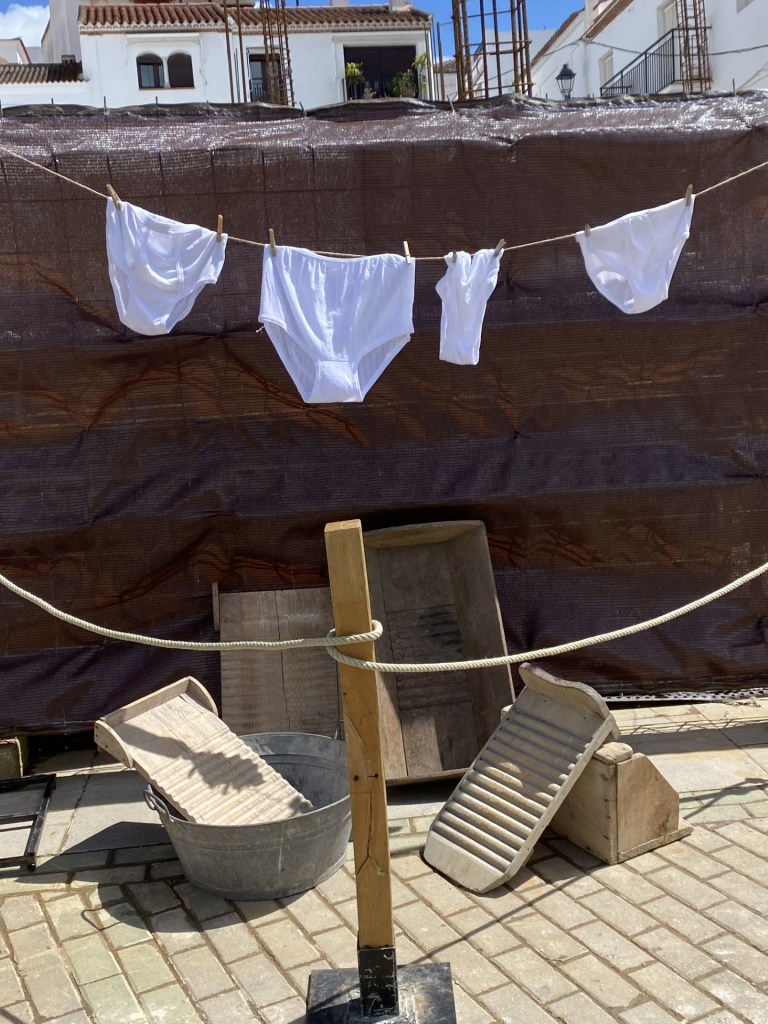
These are not our giant white knickers…I swear!!!

18. The hatch

A conversation I had while out walking the other evening with Sarah threw up a memory of the summer of 1988, when I 15 years old.

We were having major renovations done to our house. A central heating system was being installed throughout, and the sitting room was being made a little bigger by the removal of a storage room (the cubby hole) in one corner. The contractor, Henry, had delayed starting the job so that his eventual start coincided with the start of the summer Olympics in Seoul. Daddy and I, sports fanatics, were not impressed. Neither was Mammy, when Daddy decided the large television on its wheeled stand would have to be moved to the kitchen for the duration of the renovation work. The kitchen was small enough as it was; negotiating a large clunky television in the middle of it would be most inconvenient.

The house, built in the late 19th century, had originally been a three room cottage – two bedrooms and a kitchen. The first two generations of Tyrrells lived there without electricity or plumbing. In the late 1950s, the house got electricity and Daddy was the first person on the road to have both a radio and, later, a television. In 1971/72, just before my parents got married and Mammy moved into the house, Daddy built an extension that included a new kitchen and, for the first time, indoor plumbing and a bathroom. The old kitchen now became the sitting room and it was this room that Henry was ripping up and reshaping during the Seoul Olympics.

In 1971/72, the new kitchen had been built onto the back of the house and what had been a small window now became a hatch between the kitchen and sitting room. The walls of the old house were thick, so this hatch was almost two feet deep, with a door that could be opened from either side. We used it to pass things between kitchen and sitting room and the newspapers that Daddy bought every day were stored there until they were burned or repurposed.

It was the late 80s, and the hatch just didn’t seem trendy, so it was decided to fill it in. In hindsight, it could have been made into shelf space, but then where was hindsight when we needed it?

And so to the Seoul Olympics. Being on the other side of the world, all the action was taking place in the middle of the night, our time. There was mounting excitement in the build up to the men’s 100m final. There was the great Carl Lewis of course, but also this new guy, the Canadian Ben Johnson, muscular and stocky and not built at all like the other sprinters. But he’d come through the heats impressively and we knew he was one to watch.

Because of the renovations, my sister and I were sleeping in our parents’ bedroom and they were in our rooms, which were the other side of the rubble. Before the 100m final, Daddy planned to wake me up so we could watch it together. I remember groggily stumbling into the kitchen at about 2 in the morning and Daddy and I watching, open mouthed, as Ben Johnson smashed the world record and left Carl Lewis and everyone else in his wake. We couldn’t believe what we had just witnessed.

I went back to bed then. When I got up the next morning, Daddy was eating breakfast at the kitchen table. He told me the news. Shortly after his unbelievable win, Johnson had failed a drug test. He was pumped full of steroids. This was shocking. These were the days before Lance Armstrong, before the East Germans, before accusations against Michelle Smith, before doped up horses. Performance enhancing drug use was unheard of – at least in our innocent little kitchen in Ballygibbon. It was all we could talk about for days. Indeed, it was all the media could talk about for days and Ben Johnson’s photo was splashed across every newspaper in the world.

When it came time for Henry to inset a plaster board wall in the hatch space a few days later, I suggested we put a newspaper into the space for posterity. So, we carefully placed a newspaper from a couple of days earlier, one with Ben Johnson on the front page, and columns of space devoted to what had occurred, in there. That newspaper is still there.

In 10 or 50 or 100 years time, when the house is knocked down or refurbished again or meets whatever fate awaits it, I wonder what they will think when they find that meaningless newspaper and all the kerfuffle about Ben Johnson. For us, it meant everything for those few weeks; for the discoverers of the newspaper, it will mean nothing.