12. Jumbo hot dogs

Warwick market, Saturday morning

Being in the UK and, in particular, in this town, brings memories of Julian flooding back. I pass through places by car that I only ever drove through with him. I go to places that I visited for the first time, or only ever visited with him. Indeed, I would never have known this town in the middle of England, had I never met him.

There have been times in the past few years, when being here has been overwhelming. Not only being in this place, but being with Julian’s family and the memories and emotions that being in their company brings to the surface. In the past, being here has caused me to have panic attacks. In fact, last year, after only four days, I ended up in A&E (ER) with a panic attack that I thought was a heart attack. That was a scary day.

This time, however, I am so much more at ease. Time has played a part in healing me, so too have eight sessions with a therapist that I gave as a birthday present to myself last year, so too the memoir I’ve been writing this past year. I’m busy with work (intentionally, perhaps?) and I’m absorbing the sensations of being in parks and along canals and surrounded by nature in this exceptionally nature-filled town. (Yesterday, a falcon had an aerial fight with two crows only metres from me in Priory Park!)

Each morning since we got here, I work for a few hours at Warwick Library. Yesterday, I went in as usual. But it wasn’t usual. It was Saturday, so the market was on in the square in front of the library. Even better, at the far end of the square I saw a van bearing the words ‘Jumbo Hot Dogs’. Memories came flooding back. I phoned Katie and suggested that she and Lily get Granddad to drive them to the library in a few hours, so we could wander the market and have jumbo hot dogs for lunch.

The girls duly arrived and I packed up my laptop and we wandered around the market, chatting to the vendors and browsing the arts, crafts and foodstuffs they had on offer. At the food stalls, there were savoury pies and all sorts of lovely things that tempted me. But I was going for the jumbo hot dogs, for nostalgia’s sake more than anything else.

You see, Julian loved jumbo hot dogs. No matter what his state of hunger, if he spotted a jumbo hot dog stand, he had to have one. He was also someone who stuffed receipts into his pockets. When we both worked, we shared the task of doing the laundry. Every time it was my turn to put a load in the machine, I’d first have to empty Julian’s trouser pockets of receipts. When we lived in Cambridge, I’d often find five or six receipts for the jumbo hot dog stand! How long had he been wearing those trousers? Or how many hot dogs was he consuming a day? He’d laugh sheepishly and tell me he’d occasionally get a craving in the middle of work, leave his desk, hop on his bike and cycle the two miles into the middle of Cambridge for a jumbo hot dog and then return to work. Crazy man.

So, there was nothing for it yesterday but to introduce jumbo hot dogs to our daughters, who’d only ever before had those cheap rubbery vacuum packed frankfurters you get at kid’s birthday parties, and not these juicy British sausages, with real fried onions, ketchup, in a soft, freshly baked hotdog roll. Katie wasn’t sure if she wanted one, so I bought two. One bite of mine and I had to go back to get a third from the friendly chatty couple running the van.

Good God, they tasted good, that combination of good food mixed with good memories. As we ate, I told the girls about their father’s jumbo hot dog obsession, another piece of him revealed to them, another good memory of him restored to me.

11. The artist formerly known as…

When she was in her early 50s, my mother decided to take up painting. She joined an art class, bought art supplies and painted some lovely landscapes and rustic urban scenes that still grace the walls of her house.

The Christmas after she took up painting, I arrived home from somewhere, I can’t now remember where. The presents were all under the tree – all except Mammy’s present to me. One of my and my sister’s favourite pastimes in the days leading up to Christmas Eve was to sit by the tree, examining all the carefully wrapped presents with our names on and guess the contents, comparing the size and weight of our respective presents. Mammy explained that she hadn’t put my present under the tree yet, because I would immediately know what it was and the surprise would be ruined. She planned to only put it under the tree in the moments before we unwrapped our presents after tea on Christmas Eve. I had no idea what it might be.

The next day, I went in to Gilroy to see Nana. She made me a mug of coffee and put a plate of biscuits on the coffee table beside the bowl of Quality Street chocolates that was already there. We chatted about this and that. After a while, and seemingly apropos to nothing, she said, “What do you think of it?” “Hmmm?” I said, too busy deciding whether to have another Quality Street or another biscuit. “I don’t think it looks anything like you, do you?” she asked. “Erm, no,” I replied, with genuinely not a clue what she was talking about, but also still too distracted by the chocolate to find out more. And the conversation moved on to other things.

Christmas Eve evening arrived. We ate our tea and then went to light the Christmas candle on the hall table. Daddy lit the candle and the four of us bowed our heads and said a prayer. The moment to open our presents had come. In the middle of tea, Mammy had slipped out to put her present to me under the tree. As soon as I walked into the sitting room and saw it under the tree, I knew that it was a painting of some sort.

We opened our presents one by one, each of us waiting to see what everyone else had received and watching their reactions. The moment came to unwrap my painting from Mammy. I carefully removed the wrapping to reveal…a portrait of ME! Well, sort of a portrait of me. I tried hard not to burst out laughing and one look at Daddy’s and my sister’s faces let me know that they were struggling not to laugh too. But, she’d put so much effort into it and none of us wanted to hurt her feelings. But, God, it was hard.

“I couldn’t get the lips right,” she said. I thought to myself ‘And that’s not all!’. I could see that the lips and been drawn, erased and redrawn many times in pencil, as she tried and failed to get the shape right. My nose was very long and narrow, my eyes strangely slanted and wide-set and my hair sat on top of my head like a helmet. My shoulders were heavy and, although the portrait stopped above my chest, it gave the impression that I had the huge heavy breasts of a seventy year old. “It’s lovely,” I said.

I don’t remember what happened next, but by the next day, Mammy’s portrait of me had turned into a highlight of our Christmas. The first to see it was my uncle Tom, when he arrived out for Christmas Day dinner, and then my uncles and cousins who came out for tea later that evening. Mammy was very quickly in on the joke, realising that this was perhaps not her best work and that the portrait had value of a different kind – it made us all silly with laughter. We discovered the best thing about the portrait was showing it to people with straight faces, pretending that we thought it was brilliant and watching as the cogs moved in their heads as they tried to find something polite to say about it.

The portrait came with me to the UK and, when I met Julian, it came with us to the many houses we lived in over the years. I’d sometimes arrive home late at night to find Julian in bed with the portrait on my pillow, delighted with his little joke. He carried on the tradition started by my own family of showing it to his family and our friends with a straight face and waiting for their reactions.

When we moved onto the boat, there was no room for the portrait, so we put it up in my father-in-law’s loft in Coventry. I imagined it doing a Dorian Grey on me but, I’ve grown older and it continues to not look at all like me! A little over a year ago, my father-in-law downsized to a smaller house and I travelled to the UK to deal with what was left of our stuff up in his loft. There I found the portrait, which I hadn’t seen in years. There was only one place for it – on the wall of the spare room (Lily and Katie’s room) at my father-in-law’s new house.

Lily and I are sleeping in that room at the moment, with Katie relegated to the sofa in the living room. Every time we look up at that portrait we giggle. Who could have guessed that that heartfelt and earnestly created piece of art would have such an unexpected life out in the world.

10. From there to here

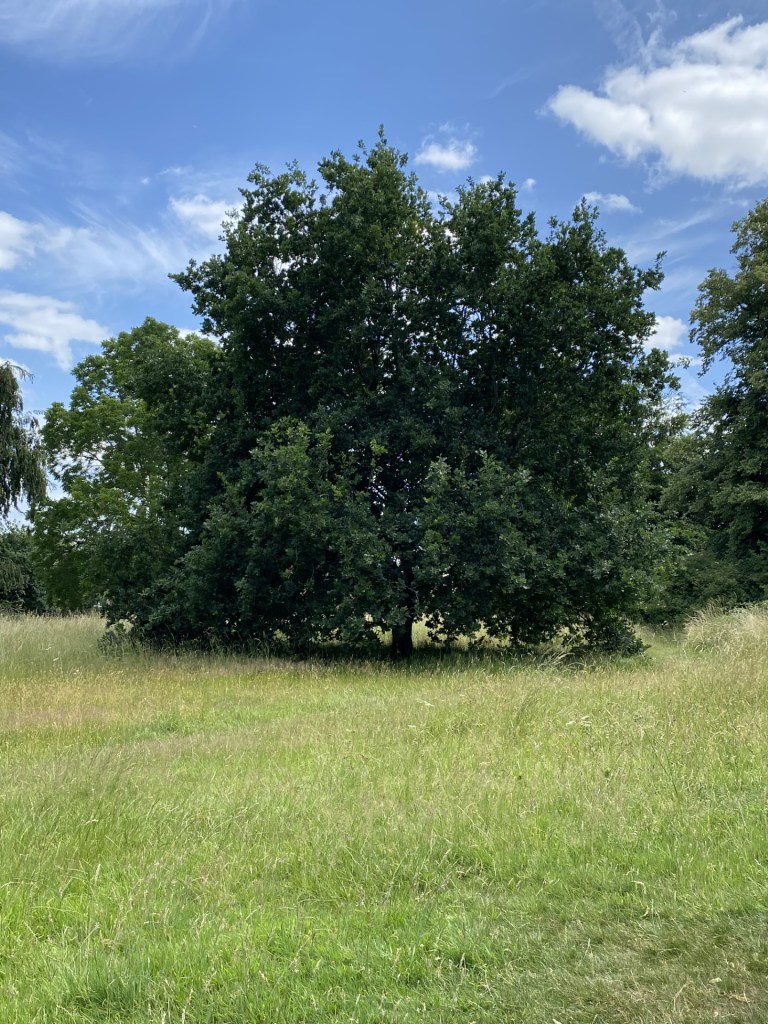
The trees are so big and so green and so varied and so alive. Oaks, horse chestnuts, sycamores, beech. Their trunks are immense and they reach high up into the blue sky. So unlike the scrubby arid trees of the dehesa (savannah) of southwest Spain. Tiredness is causing me to have an out of body experience as I walk through Priory Park. Is this what it’s like to experience the world when high on drugs, I wonder? The giant beautiful trees seem to pulsate around me, my brain and eyes playing tricks on me. Maybe the trees are playing tricks on me too. The tiredness is adding to my disbelief that I’m here, when only a few hours ago, I was there.

We woke up at 3.10am. I slept little anyway, checking my phone through the night to make sure I hadn’t slept through the alarm. Katie had set her alarm too, so it wouldn’t have mattered, but tell that to my subconscious/unconscious brain. It didn’t help that the narrow single bed in the cheap airport hotel was springy and uncomfortable and the room was too hot at first, then too cold with the fan, then too hot when I turned the fan off. Through those few brief hours, I heard other hotel guests arriving and departing, the thunk-thunk of heavy suitcases being hauled up or down the old stone stairs of this hotel without a lift, the wheels squeaking down the corridor outside our bedroom door, a movement-sensing light flooding our room with light through the glass panel over the door.

I am grateful that the airport was straightforward, the flight uneventful, our train to Leamington Spa on time. By the time we get to my father-in-law’s house mid-morning, the effects of the tiny €30 airport breakfast has long worn off and we are starving. While he asks the girls about the flight, I make a bee-line for the kitchen, knowing exactly what I’ll make (the girls and I have been discussing it, fantasizing about it). We anticipate what Granddad will have in stock, and we’re not disappointed. Rashers and eggs and fried tomatoes, with buttered fresh white bread and strong tea.

Afterwards, I rest for an hour, unpack a little and then I’m off again. The girls are sleepy, though they claim they aren’t. But they’re pale and have bags under their eyes, so they can’t fool me. I leave them sitting in the livingroom with Granddad, looking out over his garden at a fat pigeon pecking at the seeds he’s scattered about. I leave the house to the sounds of him telling the girls about a radio he built when he was a teenager, from his dad’s old cigar box. I hear him ask them what components they’d need to make a radio. My Gen Z teenagers have never used a radio in their lives, but I’m out the door before I hear their answer.

While my work life will be decidedly less frenetic in the coming weeks than it has been of late, I have a deadline to meet this coming weekend and I need to crack on. I spend a few hours at the library, meet my self-imposted work target for the day, and head back to my father-in-law’s house again. By now, I am well and truly zombified with tiredness, and the trees pulsate as I walk through them. Perhaps they are really Ents. Perhaps I need a good night’s sleep.

8. Leaving home and going home

Later today, I will close my front door behind me as the girls and I leave home for 10 weeks. We’ve never been away from Sanlucar for so long before. At first, we will spend a few weeks in the UK and then we will go home to Ireland. We have a wonderful summer ahead of us, packed with family and close friends and trips to all sorts of wonderful places and events.

But I have mixed emotions about leaving. I am saying goodbye to a close friend who, owing to illness, will likely no longer be with us when I return. At the same, I am excited to spend time with my family and dear friends, the people who have known me longer and who know me better than anyone.

I’m taking the girls away from a summer by the pool and at the beach, and being with their friends. I’m also taking them away from Lady. But then I remind myself of how hot it’s going to be and how we’ll be stuck inside the house most of each day in +40C heat. So, I’m looking forward to taking the girls to cooler beaches and to places familiar to them that they want to visit again and places new that they have never been to. And I’m excited about the time they will get to spend with friends in the UK, starting on Sunday, when we travel to London to visit their oldest friends.

While I have adapted to many aspects of Spanish culture, after ten years I have yet to adapt to staying out so late at night. I can do it once or twice in the entire summer. But, in general, when Sanlucar comes alive at night in the summertime, when many of our friends and neighbours are out strolling the streets, or at one of the bars, or sociably sitting outside their houses, the girls and I have already gone to bed. I have tried to adapt, but I can neither stay awake that late at night nor get by on so little sleep the next day when I need to be up at 6am to get my work done before it gets too hot. Lots of people have managed to adapt to it. Sadly, I’m not one of them. So, I’m looking forward to cooler weather in the UK and Ireland (despite a heatwave in the former at the moment) and sticking to my normal bedtime.

For all of that, for all the wonderful things I have planned, I know that when I am at home* in Ireland I will miss my home in Spain. I will be looking forward to coming home in September, batteries charged, feeling refreshed and renewed, and feeling love and longing for both the home I will be leaving behind and the home I will be returning to. I am grateful for both.

*I don’t actually own a home in Ireland. We’ll be couch and spare-bed surfing for the entire summer. It’s more that home owns me.

An aerial photo of my home in Ireland, taken sometime in the 1960s.

5. Sedna

Sedna/Nuliajuq by Brian Arualak, Arviat, 20003

A few days ago, when it was too hot for Lady’s little paws to be on the road, I took her down to the river for a swim. When I got there, I spotted a yacht on the pontoon called Sedna. I got very excited. Sedna (or Nuliajuq in the Kivalliq region of Nunavut) is the supreme goddess of Inuit mythology. Goddess of the sea, she hides and protects the marine animals in her long flowing seaweedy hair, only revealing them to hunters who prove themselves deserving. How does she decide who’s deserving? It’s those hunters and, more importantly, their wives, who generously share the meat and fur and other parts taken in the hunt. In the old days (and in some quarters still today), Inuit believed that animals, once released from Sedna’s hair, gave themselves to generous hunters.

So, I got very excited when I saw this boat. The way I got excited in the past to see a boat called Aarluk (orca) or one called Nanuq (polar bear). One doesn’t expect to see Inuktitut words in southern Europe! I couldn’t resist popping down to the pontoon to say hi and inquire as to why the owner had named his boat after the Inuit goddess of the sea. I mean, a goddess of the sea I get; but the Inuit one specifically?

I saw that the boat was flying a Spanish flag and had a Spanish registration mark printed on the hull. There was a man in his seventies in the cockpit. ‘Buenas tardes,’ I said, assuming that he, like his boat, was Spanish. When he replied in English with a British accent, I said hi, and told him, perhaps a little over-enthusiastically, that I’d noticed his boat was called Sedna.

‘Oh yeah,’ he said, distinctly less enthusiastic than I was. ‘Why did you call it that?’ I asked. ‘That’s what the previous owner called it and I didn’t bother to change it.’ He seemed not curious, not interested, not bemused, not annoyed that I’d bothered him. Indeed, he seemed not really anything at all that this overly-exuberant Irish dog-walker on the Spanish border was trying to make conversation about the name of his boat.

‘Do you know what it means?’ I asked.

‘Nope,’ he replied.

‘She’s the Inuit goddess of the sea,’ I started, but he cut me short and asked, ‘Do you live here?’ He was completely disinterested and my little bubble of excitement at having found someone who might share my interest in Inuit mythology and Inuit culture was immediately burst.

I laughed at my silliness after. At how I had imagined our conversation would go and at how the conversation actually went. I chatted with him for a few minutes more, answering his questions about life in the village, and whether I still owned a boat, and whether the schools around here are any good. Then I said goodbye, wished him luck on his sailing trip and Lady and I carried on on our merry way.

4. Blinded by the tears

It’s hard to put into words what Bruce Springsteen means to me. His music and his persona are so entangled with my teenage years and my 20s, with my relationships with my father, my sister, my cousin Sean. Bruce Springsteen is me listening to the Born in the USA album on the stereo in our living room when I was 13 or 14 years’ old, wishing I could go see him in Slane. It’s finally going to see him when I was 17 in the RDS with Daddy and my sister. It’s going to see him again when I was 20, this time on my own, the night before my final anthropology exam at the end of my degree. None of my friends would come with me, because of…well…final exams, but I’d been to Bon Jovi the night before and now Bruce (I did great in those exams, by the way). I remember standing on my own at the very front of the crowd, crushed up against the stage and Bruce doing an acoustic version of Thunder Road. It’s me on my 50th birthday, standing in a muddy stadium in Barcelona with my sister and my best friend, tears streaming down my face as Bruce sang Thunder Road again. I’m not a Bruce completist. I don’t have (or even know) all of his music, but I’m an all in, unapologetic fan.

My favorite album, not just by Bruce, but my favourite album by anyone ever, is Nebraska. I’ve listened to it a thousand times. I could sing the whole album to you without skipping a beat (not that anyone would want me to). I love that album. From that opening harmonica of the title track, it just grabs me, with its pathos and anger and the death of the American Dream, and Bruce’s gravelly voice weaving stories of the struggles of ordinary people. It simply moves me in ways that no other album ever has.

Two mornings ago I did what I do first thing every morning. I put on the kettle and, while I waited for it to boil, I got my phone and looked at the news. I scrolled down my preferred news site, reading about all the terrible things happening in the world at the moment. Down at the culture section, I see that a trailer for some new Bruce Springsteen film has just been released. Not only is it a film about Bruce, it’s a film about the making of the Nebraska album. Jeremy Allen White is playing Bruce. I really loved The Bear, not really because of Jeremy Allen White but because of the entire ensemble cast. I find him an odd-looking sullen little man and I wondered what he would be like in the role of Bruce. I was thinking about it on my one-hour walk so, when I got home, I found the trailer on YouTube for Deliver me from Nowhere, as I discovered the film is called. I watched the two and a half minute trailer and without warning, found tears streamed down my face. I don’t think a trailer has ever made me cry before. It had such a deep impact on me. I don’t really even know why I was crying, but I think a mixture of nostalgia, joy, excitement about seeing the film, and remembering listening to that album throughout my teens and 20s and 30s and how it has meant something different to me at different stages of my life. Later on, instead of listening to a podcast, as I usually do when I’m making lunch, I did the only thing I could possibly do and played the Nebraska album from first song to last.

3. W.W.A.D.

My next-door neighbor Alfredas has quite an impressive social media following given that, until recently, his content was exclusively presented in Lithuanian. He posts daily videos about sobriety, quitting smoking, sleep health, mental health, and so on, tracking his own journey and sharing what he has learned with others. His videos are well informed and based on peer reviewed science. I know this because I get the omnibus edition when my family has lunch with his family every Sunday. He’s less the man who wants to live forever and more the man who wants to live his remaining years on the planet in the best way possible.

Last year, he returned home to Lithuania for a few months to organize Sober Summer. He recruited thousands of people, mostly young and middle-aged, to quit alcohol for the summer. To party, have fun, be active, be engaged, and do it all without alcohol. His Sober Summer events were featured widely on Lithuanian social and traditional media.

This summer, he’s returned to Lithuania with a new plan: 90 X 90. He’s encouraging everyone to be active for one hour every day for the ninety days of summer. 90 X 90 officially started on 1 June and, well, I couldn’t pass up the opportunity to join in.

Doing one hour of activity is not a problem for me. I regularly walk the dog for an hour or more, do housework for an hour or play pádel with Katie for an hour. However, I lack the consistency of engaging in a continuous hour of activity every single day. So that’s my challenge.

I started on day one and, twenty days in, I haven’t missed a day yet. I’ve been walking the dog and playing sports as usual. I’ve even started jogging a little, which is something I haven’t done since I was pregnant with Lily. It’s extremely hot these days (40C yesterday), so I leave the house with the girls in the morning when they go to catch the school bus and get my active hour in then. It feels great to do this consistently.

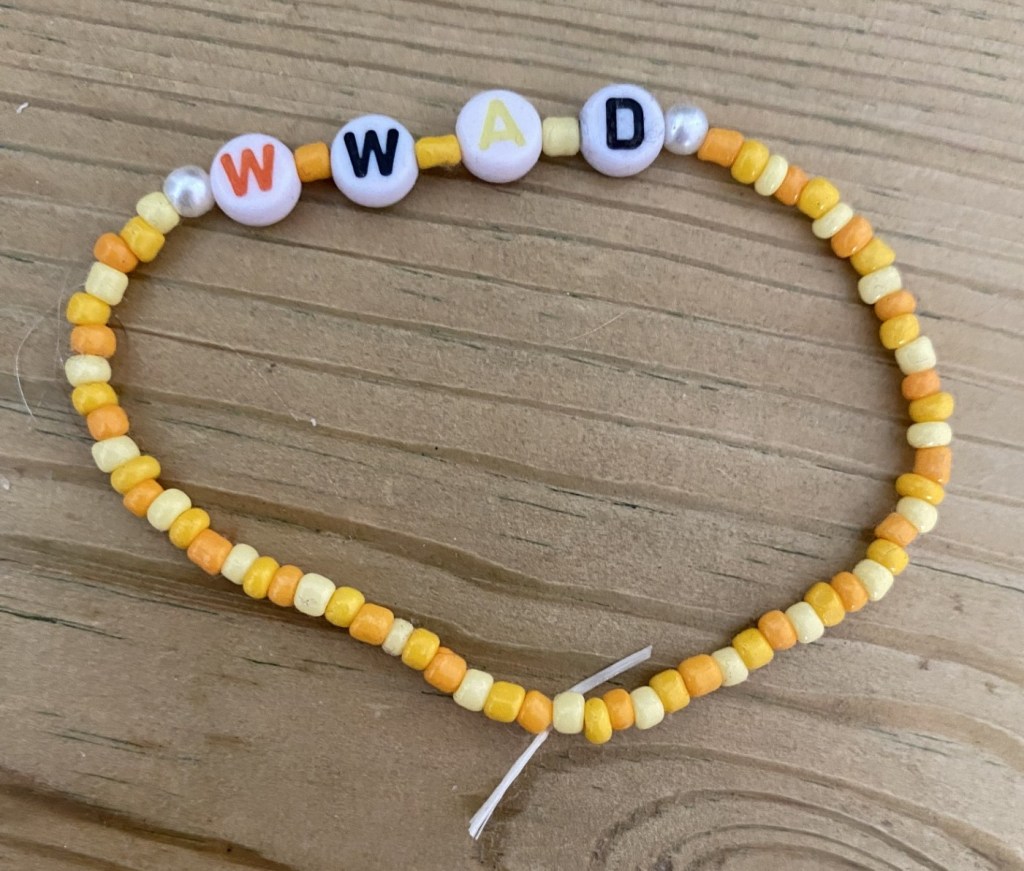
Alfredas is a man of action and, for some time, my family and his family have had a running joke: ‘Ask yourself, what would Alfredas do?’ So, Lily, crafty kid that she is, made W.W.A.D. bracelets for all of us! And that’s my motto on days when I think ‘maybe I don’t have an hour to spare today’. What would Alfredas do? He’d put on his running shoes and go.

2. You did WHAT?!

The girls are only just realizing, perhaps only now taking an interest in the fact that I had a life before they came along. Some weeks ago, I was talking about Australia with someone. Afterwards, Katie said to me, almost as an accusation, “You never told us that you’d been to Australia,” like I’ve been keeping it from them on purpose. I’m sure I’ve told them before about the three weeks I spent on the east coast of Australia when I was 23. Maybe not. Either way, they were intrigued and wanted to know more. Lily then teasingly said, “What else are you not telling us?”

A couple of weeks later, Katie had to do a school project about her mother. Maybe it was about a parent. I don’t know. Anyway, she did it about me. I remember Lily doing the same project at the same time last year. I asked Katie if she wanted to interview me, but she told me no, she’d find out all she needed on the Internet. Dear God! What would she unearth?

Home from school a couple of days later, she says, “It says you lectured in Cambridge?” She can’t believe it. I explain that I was a post-doctoral fellow at Cambridge and that I gave some lectures in the Geography department. “But at Cambridge?” she asks. She really can’t believe it and it doesn’t seem to matter that I wasn’t a don, but rather an occasional contributor to a course or two as part of my fellowship. “Cambridge,” she says again.

Then she discovers some of the stuff I’ve had published – newspaper and online stories about my research, and such like. “You can write,” she says, impressed; this new information absolutely at odds with the mummy figure who forces her to eat her greens and nags her about leaving her trainers on the middle of the living room floor. I tell her that something I wrote my was once used as evidence in hearings at the US Congress.

“So, what on earth are you doing here?” she asks, referring to this tiny corner of Spain where we now live. I explain that, for me, coming here was the end of one great adventure – the boat, the cruising – and the start of another – a new culture, new language, a new community of people, an adventure that I’m still on ten years later. For her, this place is home. She’s lived here since she was four years old. It’s boring old Sanlucar, from where she wants to get out into the world, not a place you’d leave Cambridge for!

This morning, as the girls were getting ready for school, Lily asked, “Mum, have you ever been to a disco?” I almost choked on my herbal tea. When I told them about the Huntsman in Edenderry, the Wednesday night bar-exes in the students’ union in Maynooth, the Saturday night’s at the Crazy Cock in Fukuoka, the night I met their father, my first date with their father, they looked at each other and rolled their eyes. Lily asked me to show them my dance moves. “You know my dance moves,” I laughed. I’m relieved there’s no evidence of my disco days on the Internet.

I was young once…but never cool!!!

A life lesson learned

The Spanish health care system has a pretty good reputation and most of my experiences with it confirm that. First of all, it’s free, which, coming from a country where a ten-minute consultation with your GP costs €70 for all but a minority, that’s a major bonus. Staff are generally caring and kind and referrals are reasonably prompt. In addition, prescription medications are heavily subsidized. Overall, I’m pretty happy with the health care system in my adopted country.

But…it’s different. The culture of care is unlike the one I grew up with and over the years I’ve had quite a few experiences that have jolted me because the processes and procedures are just…well…different.

Towards the end of last year I experienced a funny sensation in my left leg for a few weeks – pain in my calf, heaviness in my entire leg, occasional pins and needles throughout my leg. It’s something I’ve had on and off over the years and, being a bit of a hypochondriac, I always convince myself that I have deep vein thrombosis. But the pain always goes away before I do anything about it. This time, however, it lingered and, as the weekend approached, it worsened.

By midday on Saturday I’d convinced myself that I’d be dead by nightfall and I decided to go to the doctor. Being a Saturday, the health centre in the village was closed and I had to drive the 22km to the nearest 24-hour centre.

I was surprised to find the door to the health centre locked when I got there. A note stuck to the door had the centre’s phone number, so I called it. Before I had two words out, the grey metal door to my right opened and I was ushered in to the treatment room immediately behind the door. I tried to avert my gaze from the old man, shirt open, lying on the consulting table, being treated by a male member of staff. The woman who had opened the door to me turned out to be the doctor.

“Sit there,” she said, pointing to a chair only two metres from where the other patient was being treated. Shouldn’t he have some privacy, I thought. Shouldn’t I? I sat with my back to the man, trying not to listen as he was prepared for the ambulance that was to take him to the hospital, forty minutes away.

The doctor sat behind her desk and began her consultation with me. But before we got two sentences into it, there was another knock on the main door. The doctor opened the window beside her desk and shouted out, “Come in through the grey metal door.” There was no response, so she got up, walked around her desk, and let a middle-aged couple in. The treatment room was beginning to feel decidedly overcrowded.

The doctor directed the couple to the waiting room, but left the door between it and the treatment room open.

“I’ll have to see your leg,” she instructed me, after I had explained my symptoms and she’d asked me some preliminary questions.

With the door to the waiting room still open, the old man still on the treatment table and the male staff member beside him, and the grey door to the street now open to allow the ambulance crew in, I stood up, unbuckled my belt and dropped my jeans to the floor, my pink-knickered arse towards the old man. The doctor had a feel around my leg and asked me some more questions. She was sufficiently concerned to immediately send me to A&E at the big provincial hospital.

I didn’t want to go on my own, so I phoned a friend to ask if he’d drive me. Then I drove home, packed a few things in a bag, and was soon on the road to the hospital. The waiting room was large and airy and pretty comfortable as waiting rooms go, which was just as well, because I had a three hour wait.

Finally, my number appeared on the screen. I was to go to consultation room six. I walked into consultation room six to find a woman lying half-naked on the treatment table. “Go next door,” one of the staff told me. I went to consultation room seven and the woman sitting at the desk asked my name.

“You’re not Rosario?” she said, looking confused.

At that moment an extremely tall, very bald, bespectacled young doctor appeared at the door behind me.

“Martina?” he asked. “Ah, here you are. Follow me.”

I followed him to the other side of the corridor and into a large room that contained a number of beds. On one bed lay yet another old man, with his shirt open and his large belly on display. I tried to look anywhere but at the old man while the doctor consulted a computer and tried to find which room I was supposed to be in.

“Stay here,” he said and set off down the corridor, leaving me stranded. I looked at the television monitor and saw that I was assigned to both consultation rooms six and nine. Just then, the doctor popped his head out of room nine and indicated that I go there.

The brightly lit consultation room was cold enough that I commented on it to the young, dark-haired (and, admittedly, handsome) member of staff sitting behind the desk. The tall, bald doctor, whose white coat was askew and whose trousers didn’t reach to the top of his colourful socks, asked me where I’m from.

“Ireland,” I said.

“Ah, Holland,” he replied, a common mistake which must have something to do with the weird way I pronounce ‘ir’ in Spanish. I corrected him.

“Let’s do this in English, then,” he said, and switched to flawless English far superior to my Spanish.

I told him my symptoms and he asked me some further questions.

“I’m going to have to see it,” he said.

By now, the tall, bald doctor and the dark-haired, handsome doctor were both standing in front of me, as I sat on the consultation table. There didn’t seem to be anywhere for me to go to remove my trousers in a dignified manner, or a curtain to pull around to spare my blushes. I guessed I’d just have to get on with it.

With both men standing mere inches away from me and facing me, I removed my shoes and then my socks. A number of thoughts flashed through my head as I started to drop my trousers. 1. I haven’t shaved my legs in about two weeks. 2. I haven’t moisturized my legs in probably the same length of time. 3. Why am I wearing my mother’s hand-me-down knickers today? (Calm down…she hadn’t worn then…or so she swore to me)

With my trousers removed, I sat back on the table and the tall bald doctor proceeded to examine my hairy scaly left leg, pointing to a bruise on my thigh (I walked into the kitchen table) and another on my shin (an ungraceful scramble out of the dinghy). He talked his colleague through the examination and then used a very impressive hand-held ultrasound device that he plugged into his phone to look below the surface.

He assured me that all was fine. I didn’t have DVT, but I did have some damage to a surface vein. “Does that put me at greater risk of DVT?” I asked.

“Imagine your deep veins are the motorway,” he said, “going up to your heart and lungs. You have damaged a small country road. So, there’s not much to worry about. But, as you know, sometimes we get off the motorway and take a country road instead. So, yes, there’s a little risk.”

What a cool doctor. I felt sorry for him that he’d had to touch my troll-like leg. He’d asked me about my work and, as I got dressed – again, undignified and in front of the two of them, almost losing my balance as I put my right leg into my jeans – he gave me some sage advice. “Disco dance while you work. It’ll keep your legs moving.”

And that was it – undignified, lacking in privacy, lacking in an concerns about a woman patient stripping in a consultation room in front of two men and no female staff member present. I could have done anything to those two lovely doctors!

I returned home feeling reassured, and having learned some valuable lessons – disco dance while working and never, ever, leave my legs unshaved and unmoisturized again.