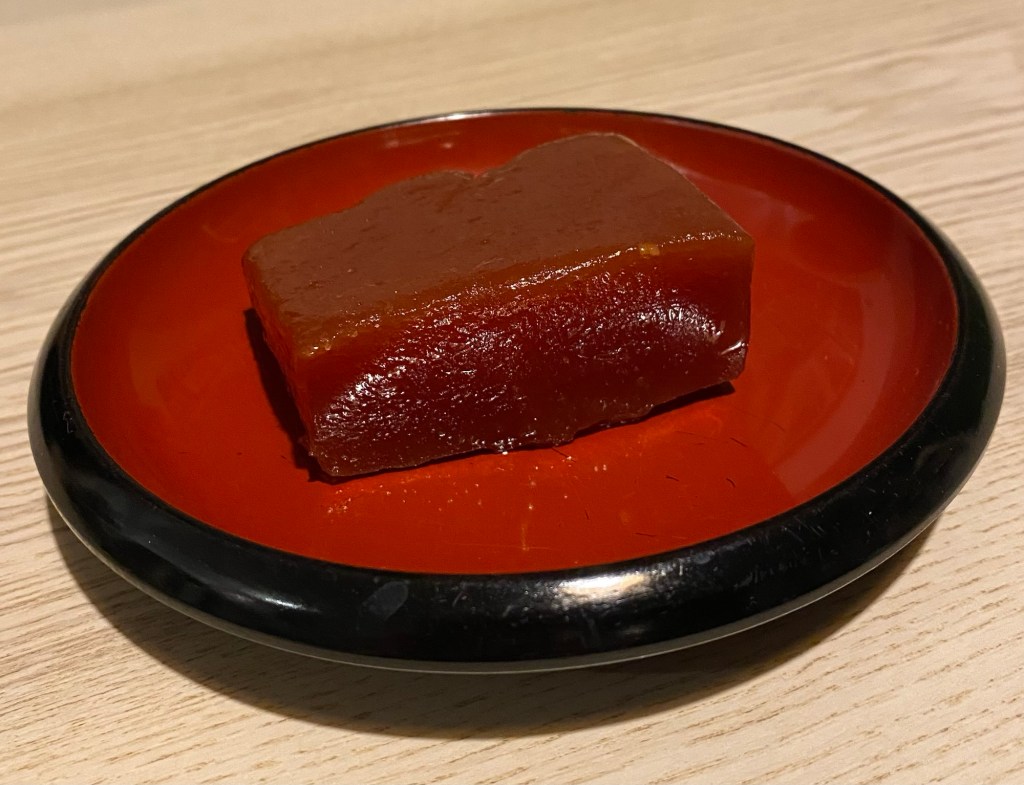
I thought we’d missed the season. I was disappointed. I’ve been parsing out the last bit of membrillo (quince jelly) to Lily and Katie to eat with cheese. ‘Is there any more?’ they ask, when faced with the thin sliver of fragrant amber jelly on their plates. ‘That’s it,’ I say. ‘It’s nearly all gone.’
Since moving to Sanlúcar a decade ago, I have made quince jelly pretty much every year in late summer. First, I pick a large bagful from a couple of trees by the river on the land tended by lovely old Juan de Correos (who sadly passed away this summer), or I get some from the land of my friends, Paul and Diana.
Turning the hard pale green fruits into dark orange deliciousness is a Saturday morning’s work – washing the growth of fuzz off each fruit, peeling and coring them (they have nasty black sticky cores), chopping them into the saucepan and adding sugar and the tiniest bit of water. And then the magic happens. The quince gradually transform from something more akin to a potato than a pear in look and texture into the most fragrant, most floral, deepest orange mush. A quick blitz with the hand blender once the mush has reached setting temperature, and then I pour it into two trays to set. As it cools, it solidifies to a jelly and turns translucent. It’s magical. And the taste is heavenly. When it cools and sets, I cut it into blocks and store it for use throughout the year.
The last of last year’s membrillo
In my house, we eat it with cheese or sometimes on toast. I put it as a middle layer in homemade oat bars, and I even add it to apple pies.
So, imagine how I felt when I thought I’d missed the season. We’d been away for so long and I’m still kind of settling back in to life here, so making membrillo had slipped my mind. Until I realised we were down to our last block. A whole year without membrillo? Unimaginable!
This evening, Lady and I went out for our evening walk and I came to a membrillo tree, branches sagging under the weight of a healthy fruit crop. And then I remembered. This was the very tree that I had picked the quince from last year. This tree comes into fruit later than the other trees that I usually pick from and the fruit last year was much better – no rotten bits, no waspy bits, just perfect quinces.
The tree is on the edge of a field, with half its branches hanging out over the fence and over the edge of the road. It was ftom these branches that I picked last year. This evening, I made a mental note to come back tomorrow with my backpack and take what I need.
As I walked past the tree on the return leg of my walk, the man who owns the field was there. I asked if I could take some quinces tomorrow and told him I’d taken some last year. We got into a conversation about membrillo and it’s many delicious uses and he told me to take what I need.
So, tomorrow I’ll be back by the tree to forage some fruit and, although I’d planned to do something else, Saturday will be my annual membrillo-making day.
In November 2007, I headed south on a Ken Borrack Air Twin Otter. I’d been waiting all day, with the flight twice delayed owing to bad weather. Both times, I’d been sent home and, each time, got a call a couple of hours later telling me to get myself back to the airport. On the third try, the weather cleared long enough to allow the plane to take off.
Loading the Twin Otter at Arviat airport
The moment had come to fly the sixty miles south of Arviat to the hunting camp, and I boarded the stripped out plane that now only had three passenger seats. The only other human passengers were Nadine, the French-Canadian cook, and Reverend Jimmy Muckpah, minister at Arviat’s Anglican Church. The other passengers were two wooden boxes containing Jimmy’s sled dogs, packed securely for their own safety for the short low altitude flight. What little remaining space was packed to the rafters with a skidoo and some of the boxes of food and other items we’d need.
Lovely, kind Jimmy Muckpah, who knew more about polar bears than anyone I’ve knownJimmy’s sled dogs, who seemed quite content with their travel arrangements
We flew south along the coast to our camp. The others had flown in on an earlier flight and we all helped to unload the plane before it took off again. It would return for us in two weeks. I was to live for those two weeks with five big game trophy hunters from the US, their five Inuit guides, all from Arviat (including Jimmy), and Nadine. The guides, Nadine and I all knew each other, but the trophy hunters were new to me and, indeed, to all of us. I was here for research. I was studying the relationship between humans and polar bears; specifically, seeking to understand the changing role of polar bears in Inuit culture and economy, as international laws about polar bear hunting was rapidly evolving.
Ryan, the camp outfitter, had generously invited me to the camp. What I learned in those two weeks hugely enriched my anthropological understanding of the role of polar bears in Inuit life and I published my findings in various academic journals and books in the subsequent years. My findings were even presented as evidence at US Congress hearings in 2008 that sought to amend US Fish and Wildlife laws concerning the importation of ‘trophy’ polar bears from other countries.
The camp comprised four cabins. The trophy hunters slept in two of the cabins, the guides all bunked together in another, and the fourth cabin – which was also the camp kitchen and eating quarters – was shared by Nadine and me. Each cabin had a ‘toilet,’ consisting of a ‘honey bucket’ – basically a bucket with a seat and a bin liner that we changed every few days. At those temperatures, anything you did into the honey bucket froze almost immediately. Nadine and I had a small room off the far end of the kitchen that contained a bunkbed. She slept on the top bunk and I on the bottom.
Our little huddle of humanity on the west coast of Hudson Bay
Ryan had built his outfitting camp here because it was situated along the polar bear migration route. Indeed, during the two weeks I was there, more than seventy individual polar bears passed through on their winter migration out onto the sea ice. Many of them came close, attracted by the smells of the camp, and snuffled around. We were under strict orders that no-one was to leave the cabins, or go between cabins, without a rifle and to never go alone. The trophy hunters rarely listened to that advice and took stupid risks by walking from the kitchen cabin to their own in the dark. The local guides, well aware of the realities of living in such close proximity with the world’s largest carnivores, were extremely annoyed by the idiocy of the trophy hunters.
I had various roles during those two weeks. I helped Nadine in the kitchen. I went out on hunting trips with the guides and the hunters in their charge. And I helped with skinning and preparing two of the three bears that were killed. (According to international and local law at the time, each hunter could take one trophy bear (they paid tens of thousands of dollars for the ‘privilege,’ some of which found its way back into the Inuit subsistence economy)). During those two weeks, three of the five hunters got their trophy. The other two went home empty handed.
I remember helping one of the guides, Donald, one day as he skinned a bear that had been shot by the trophy hunter in his care. The hunter was back in the warmth of the cabin, enjoying a hot coffee and some freshly baked cinnamon rolls. I held the bear’s huge heavy legs while Donald did what he had to do. It was cold and he wanted to get the work done quickly. So that he could keep his head down and concentrate on the work, he asked me to keep my eyes on the two polar bears that were circling close by and to let him know if either of them started to move closer. They didn’t, but I was shit scared and so was he.
Polar bears came close to and into the camp every day.
The plywood cabins were reinforced with corrugated metal. They had windows that were too small for a polar bear to get through, and the doors were covered with six inch nails, sharp side out, to discourage any bear that might try to break in. Even so, it was pretty scary at times. One particular day, when the hunters and guides had all left camp to go hunting, and Nadine and I were alone in the cabin, a bear came snuffling around. He stood on his hind legs, making him probably 8 feet tall. He looked in the window into our kitchen (imagine, a polar bear looking in at you!), and repeatedly hit against the side of the cabin with his front paws. He was trying to get in. Nadine and I were terrified. We had a rifle, but I’d only ever used it for target practice. Would I know what to do in a real life-or-death situation? Eventually, he gave up with trying to open the sardine tin that was our cabin and started to play around with the big cylinder of propane gas that was our only source of heat and cooking fuel. One slap with his paw, and he knocked the cylinder loose. Before we knew it, he was rolling it around on the ground, playing with it, and now was 20 or 30 metres away. While we were delighted that he seemed to have lost interest in us, we now had a new problem – it was about -15C and a polar bear was using our only heat source as a toy. Luckily, the hunters and guides came back about an hour later and all was well.
Every night when I went to bed, I could hear snuffling outside the cabin. Sometimes, I’d shine my flash light out the small window and see a pair of eyes reflected back. Lying in my bunk, I’d hear snuffling on the other side of the flimsy wall. Imagine my surprise the first morning I went out and saw a very clear indentation in the snow the size and shaped of a curled up polar bear. It was exactly on the other side of the wall from my bunkbed. The indentation was there every morning; sometimes, like in the photo below, accompanied by claw marks.
I didn’t sleep well for those two weeks, let me tell you, knowing that I was sleeping beside a polar bear, with only a strip of plywood and corrugated metal separating us. But when I looked back on it, I understood what a privilege those two weeks were.
It hard to see the indent of the bear’s body in this one, but the claw-mark is right in the centre.
I thought the early starts last week would be much tougher. In fact, they weren’t too bad at all. After almost three months, during which I only occasionally set an alarm and most days didn’t get up until at least 8am, I wasn’t looking forward to not only returning to the Monday to Friday school routine, but also having to get up an hour earlier because of Lily starting a new school.
Like I said before, getting up in the dark is not one of my favourite things. But, as I’ve discovered this week, getting up at 6am has its merits. This week, while Lily got ready for school, I wrote my morning pages, did ten minutes of yoga, and prepped breakfasts and school snacks.
Lily leaving the house at 7:05 to walk to the bus is the perfect opportunity for me to take Lady for her first walk of the day – just a short one, which works out better for me and for her and for the timing of our later, big walk of the morning.
And what did Lily and I (and maybe Lady) discover? Stars! So many stars in the sky at that hour. And the moon. And planets. And the occasional shooting star. What a way to start the day, with a few moments of star gazing.
By the time Lady and I get home after our brief walk, Katie is up and getting ready to catch her bus, forty minutes later.
It’s a new approach to the morning. I doubt I’ll be feeling this positive when the mornings are no longer a pleasant temperature and I have to drag myself out from under my winter duvet.
P.S. One slight fly in the ointment occurred on the second day of school, when the bus simply didn’t turn up. Lily waited and waited and eventually came home again. She’s the only student from Sanlúcar going to that school and she’s the first one to go to that school in at least three years. The bus driver came the first day. A different bus driver, the second day, forgot to drive to Sanlúcar out of habit. So she got the day off school (I wasn’t about to undertake an 80 minute round trip to drive her there.) I phoned the principal, who phoned the bus company, and the bus has arrived promptly every day since.
One of the weirdest, wackiest and most delightful books I read in the past year or so is Yann Martel’s The High Mountains of Portugal. It consists of three deliciously intertwined short stories that, together, form a novel. The story begins with a man who walks backways. Martel describes the man walking backways the length of Lisbon, avoiding walking into horses and donkeys and the general life and bustle of the pre-car city.
A few months ago, my friend Paul, who I walk with occasionally and who loves nothing more reading up on different approaches to physical and mental well-being, said to me, ‘I’ve started walking backwards.’ I immediately thought of the character from the novel. Paul told me that he’d read that walking backways is good for back health and for posture. He told me that he’d recently started doing it, walking backways for five or ten minutes on his daily walks. I thought he was crazy.
But the next time I went for a walk on a reasonably flat road, I thought I’d give it a try. I set a timer on my phone for five minutes and started to walk backways.
At first it was quite difficult. I didn’t trust myself, scared that I was going to trip over something or veer off the path into the ditch. However, after about two minutes, I started to feel comfortable in the walk. I could feel that I was using my muscles differently, across my back, down my legs, into my feet. When the five minutes came to an end, the strangest thing happened. I turned around and had the feeling that a strong force was pushing me from behind, as I walked faster and smoother than I had before I’d commenced the backways walking.
After that, I increased the time, walking backways for ten minutes of my daily walks on those days when I walked on roads (paved or not), rather than winding trails.
But here’s the strange thing. Walking backways not only requires me to use my muscles in a different way; it requires me to engage with the world through my senses in a different way too. With my eyes, I can see where I’ve come from, rather than where I’m going to, including the shape and contours of the path. I can only extrapolate from that what the path is like along my direction of travel. Instead, I rely much more on my sense of touch; in this case, my feet testing the ground with each footfall. Walking backways doesn’t slow me down too much, but with each step, I’m trusting the landing foot to give me the information that I need to not trip or fall over.
It’s a playful way to walk for ten minutes every day. I almost tripped over Lady once when she came up and stood behind me. She came out the worst and we both scared each other. Other than that, I’ve had no accidents or near accidents.
For those ten minutes, the simple act of walking backways alters my perception of the world around me, and engages my mind and body in unusual and, at times, counterintuitive ways.
So, if you see me out and about around Sanlucar walking backways, you might think I’m mad. And you might be right. But I’m enjoying the hell out of those few minutes, as I experience the world anew.
What’s your favourite smell? Freshly mown grass? Fresh coffee? That smell when you nuzzle your face into a baby? Why is it your favourite smell? Do you know?
I was sitting at my desk yesterday morning, the window open to cool the house down before the heat of the day kicked in. That’s when the smell came tumbling in and nostalgia stroked my face like a feather. One of the council workers was strimming the strip of grass that runs the length of my street. And there it was: The smell of exhaust from a 2-stroke engine. There’s comfort in that smell for me and it’s deeply entwined with so many good memories.
We’re living on Carina of Devon. Me and Julian and the girls. The smell of a 2-stroke engine is us leaving Carina to head off on an adventure in the rubber dinghy. Maybe it’s all of us, going ashore to explore a new place or to wander up a river that’s too shallow for Carina‘s draught. Or I’m on my own, the freedom of having the outboard tiller in my hand, setting out to go for a solitary walk or to go shopping or do the laundry. Or it’s Julian, taking the girls across the Rio Guadiana to school. Or it’s all the other yachties we met over the years, the smell and sound of a 2-stroke outboard motor signalling their arrivals and departures from their anchored yachts. It’s adventure and freedom.
Strip that layer away, and I’m living in Arviat. It’s summer, with open sea and lake-pocked land. I have my own quad bike and I zip around town in the near 20-hour daylight, picking my friend Crystal up at 3am, so we can go check the fishing net we’re sharing for the summer, or meeting Frank at 5am to go beluga hunting. His quad has Arden’s boat trailer attached on the back, so I hop on and reverse the quad into the sea under Frank’s guidance; he offloads the boat, as I park the quad and trailer. Or I’m out along the road to the dump, or the road past the reservoir, at twilight or after dark, speeding along way too fast, sometimes alone, sometimes not. In my mind, I’m a badass. In reality, probably not.
Strip that layer away, and I’m living in Arviat. It’s spring, and I’m at the floe edge with Arden. We’ve come by skidoo; him driving, me sitting in the qamutik (sled), facing back towards Arviat, back towards the direction we’ve come from, to shield myself from the powdery snow blown up by the skidoo runners. I’m surrounded by the immense beautiful whiteness of the west coast of Hudson Bay. We’ll stop when we get to the floe edge. Arden will talk to me and teach me, I’ll try to remember everything; we’ll drink tea and eat the bannock Theresa has made for us.
Strip away that layer and I’m at home in Ballygibbon. I could be 10 or 20 or 25. The 2-stroke exhaust is Daddy mowing the lawn. It’s the ease and efficiency of the first petrol-powered lawn mower after years of a small, manual one. It’s me spending summer evenings following Daddy round the garden – at 10 or 20 or 25 – just for his company and the important things we have to talk about – Gaelic football and films and music, a bit of politics and other sports.
When I catch a whiff of 2-stroke exhaust, it doesn’t conjure any one of these times in my life in particular. Rather, it mashes them all up, and loosens something in me, a knot unravels, and a feeling of belonging rushes through my veins. Now, I am here, with a view out my window that’s as green as I could ever have hoped for. And a new layer is added to my love of that smell.
What sound, smell, taste awakens in you memories of a far off time or place? Maybe it’s a memory that’s so visceral you can almost touch it. Or maybe it’s more ethereal, shrouded in a hazy fog. Sometimes, the senses elicit nostalgia that you can’t quite put your finger on – a sense of joy or sadness, longing or release, but to what it’s connected, you don’t quite know. Why don’t you think about that as you drift off to sleep tonight, or as you go about your quotidian day. And if you encounter that sense memory, stop, lean into it, see where it takes you.
The biggest shock about coming back to Spain after a whole summer away at higher latitudes is the very late sunrise.
After giving myself a lie-in on our first morning back, I set my alarm for 7:00 the next day. I wasn’t going to push it. 7:00 would be perfectly manageable.
The alarm duly went off at 7:00 the next morning. But wait, there must have been some mistake. It was still the middle of the night.
I dozed a bit longer. 7:20, 7:30, 7:40. Still felt like the middle of the night. When I finally got up at 7:50, there was a little light outside, but not enough to light the rooms. Back in Ireland, I’d been throwing open the blinds in Mammy’s kitchen at that hour, the sun pouring in on me as I made my first cup of tea.
Not so here. I love getting up early in the morning. But I don’t like getting up in what feels like the middle of the night. (There’s also the different time zones to consider, even though Ireland and Spain are longitudinally close).
We’re only a week away from the autumn equinox and the time of sunrise in Ireland and Spain are rapidly inching closer. Soon, those higher latitudes will have later sunrise and shorter days than down here in Spain.
The big challenge for us begins tomorrow, when school begins in earnest. (Today was only a trial run with a late start). Lily will have to be up a little after 6am and out the door a little after 7, and Katie following on her heels 50 minutes later. Hard as it is for me to get up in the dark, dragging those two teenagers up will be no fun at all.
At the end of September 1979, Pope John Paul II visited Ireland. He was the first pontiff to visit Ireland (indeed, he was the first to visit most places in the world) and the country went wild. At the time, Ireland wasn’t only predominantly Catholic by religion; our culture was Catholic, the state was Catholic, the education, health care, and justice systems were Catholic. It felt as if the whole country was being blessed by God himself. The Pope said Mass at a number of venues around the country, attended in total by over 2.5 million people. The entire population of the country at the time was only 3.75 million! His first Mass, held in the Phoenix Park in Dublin on the day of his arrival, was attended by 1.25 million people – one third of the entire population of Ireland. I was one of them.
I have fleeting memories of that day. I was six years old. I went with Mammy, Daddy and Nana Quinlan, my maternal grandmother. I remember leaving home that morning, my one-year-old baby sister sitting on my aunt Lillie’s lap in our kitchen. I remember my sister crying as we left.
I remember Daddy parking the red Ford Escort in the field that was Weston air field. I knew Weston, because we always drove past it on our way to Dublin and I always looked for light aircraft flying low across the road towards the runway. I remember a sense of wonder that we were now parked in this very place where the planes should be.
I remember Daddy carrying me on his shoulders as we walked what felt like miles, in a sea of people filling up the road as far as I could see in front and behind us. From Weston, we were directed on to buses that took us directly to the Phoenix Park. I can’t fathom the logistics of getting one third of the population of our small poor country to a field on the edge of Dublin. But somehow it happened. I remember an awful lot of walking.
I remember the Pope’s chairs. Three chairs that my parents and Nana had bought in advance of the Mass. Simple metal frame folding beach chairs, with white plastic arm rests, and woven plastic seats and back. Our two were blue striped and Nana’s was brown striped. Forever after, they were known as the Pope’s chairs. They were put on the roof rack for every summer holiday and stuck out on the lawn for every summer heatwave. I think they’re still hanging in the shed at Mammy’s house.
So, Daddy carried me on his shoulders and he, Mammy and Nana carried the three chairs and food and drinks for the day. Ham sandwiches, I imagine, some biscuits, probably a flask of tea and a bottle of lemonade.
I don’t remember getting on or off buses, or arriving at the Phoenix Park. But I do remember being in our place on the grass. The three chairs set up. We were in the middle of the crowd, facing the huge white cross and altar that had been hastily erected for the Mass, which stands to this day in the middle of the Phoenix Park. We weren’t far from a roped off pathway, separating the area we were in from the next area over. I remember sitting around for a long time before Mass started.
I don’t remember the details of the Mass, but I can still hear the sound of his voice over the loudspeakers. It’s there in my head. And I remember the palpable excitement and awe – whether I picked it up from the crowd in general or from my family, I don’t know.
When the Mass ended, the Pope prepared to travel through the crowd, blessing them from the Popemobile. And here’s where my memory gets fuzzy. Mammy and Nana were going to move close to the rope barrier to get closer to him, but Daddy was going to stay looking after our stuff. At first I said I didn’t want to go with Mammy and Nana. I was a scared for some reason. But as soon as they left, I changed my mind and wanted to go with them. And I don’t know if I did or not. One version of my memory has Daddy calling after them, me running to Mammy, and Mammy holding me in her arms close to the rope barrier as the Pope went past. But in the other version of my memory, by the time I decide I want to go with them, it’s too late, they’re lost in the crowd, and I stay with Daddy, crying and regretting not getting to see the Pope up close and getting blessed with everyone else.
There are things I don’t remember. I don’t remember Daddy’s grief, or the grief of my auntie Lillie and my Nana Tyrrell as we set out from home that morning. Daddy and Lillie had, only recently, lost their beloved older sister, Cissie, to cancer at age 57. What comfort did being in the presence of the Pope offer to my grieving devoutly Catholic father? Or what hope for comfort and grace was there in the others left at home, who would watch the Mass on the television? I don’t remember and it’s not something that would even cross my mind for over four decades.
As a six year old, I was oblivious to all of that. But what stays with me most vividly, 46 years later, is being carried high on Daddy’s shoulders in an ocean of humanity along a road in west Co. Dublin. And the Pope’s chairs.
During the hazy lazy days of summer, Sanlúcar’s municipal swimming pool feels like some exclusive country club you’d see in a Hollywood movie, minus the shrimp cocktail and the dramatic intrigue. And it’s not just Sanlúcar. Village swimming pools all over Spain are like this, but I suspect there are few in as beautiful a location as this one, overlooking the Rio Guadiana and the hills of the northeast Algarve in Portugal on its western bank.
Why does it remind me of a country club? Well, our village is tiny, so the numbers of people attending the pool are pretty small. And everyone knows everyone. This really is Sanlúcar’s pool and, apart from the occasional visitor, the sun worshippers and bathers at this pool are the young and old of the village. Neighbours, friends, family members chat in the cool of the pool, look out for the toddlers tottering at the pool’s edge, gather in groups to share afternoon snacks. Children wander from one group of adults to another, because they know everyone, and you’d certainly never worry about leaving your belongings unattended. The life guards and other attendants are all local kids too.
But, unlike a country club, there’s no real exclusivity here. €2 for a day entry, €68 for a family for the entire season. Everyone is welcome here. But those who use the pool as visitors to the village might find the familiarity of all the other pool users with each other a bit strange. For Sanluceños, it’s just a wonderful break from the summer heat right on our doorsteps.
Arriving into Sanlúcar de Guadiana last night, I was surprised at just how happy I felt to be home. Just a simple feeling of contentment at being back in my own home.
Our seventy-five days in the UK and Ireland were delightful from start to end. I haven’t enjoyed myself so much or for so long on previous holidays. England was a joy and I experienced very strong positive emotions when I was in Ireland, whereas in the past my feelings have often been mixed. Not because Ireland isn’t great and not because my family and friends aren’t great. It was just me and where I was in my life on previous visits home that made me enjoy being in Ireland on holiday but also eager to return to where I had come from. I didn’t feel that way this time. I enjoyed my time there, and had very mixed feelings about leaving, feeling more torn between the two places I call home than I’ve ever felt before.
So, what a surprise to feel the way I did about turning the key in the lock and walking through my front door last night. Like an exhalation…I’m home. My house is looking a bit the worse for wear after lying empty for seventy-five days and it’ll take us a few days to sweep away the cobwebs, get unpacked and feel properly settled in, but that simple uncomplicated sense of being home was there from the moment I opened the door.
Our lovely friends had been in and left some food in the fridge and our neighbour had hung a fresh homemade loaf of bread on the front door. Still, I needed to buy a few odds and ends this morning, so, after breakfast I threw on something not very presentable that I pulled out of my suitcase and went to the two shops in the village. Ten minutes of shopping took me about three quarters of an hour, from all the people I met, the welcome back hugs and kisses I received, the conversations I had comparing Spanish and Irish weather. I felt welcomed home by my adopted village.
And then, the icing on the cake – collecting Lady from her summer villa (with a swimming pool, no less) and taking her home. Now that our scruffy, dusty, hair in her eyes Lady is back, my little home is complete.
Who cares that our two kayaks are still taking up most of the living room and the suitcases are on our bedroom floors? Time enough moving them tomorrow.



 Me in place