48. Weathering

We had already decided to stay an extra night, to hole up here, in a house on a granite cliff, on the far northwest coast of Ireland. Better than running the risk of driving across Donegal and down through the country in the middle of a storm. We’d drive to the shop, get in supplies for the extra day.

Mid-morning, Katie called from the bathroom, ‘Is someone using the water out there?’ The shower wouldn’t heat up. A minute later she appeared wrapped in a towel. ‘The shower’s stopped working.’ Our trip to the shop in Dungloe delayed, we spent the next half hour trying to work out the source of the problem. The safety switch on the electricity junction box kept tripping. By a process of elimination, we realised that certain plug sockets also weren’t working. Michael stood on a kitchen chair, flicking switches on the junction box. ‘Shit. There’s smoke coming out of it,’ he said suddenly. I unlocked the door into the terrace in case we needed a speedy exit. My sister has survived two house fires – one in Ireland, one in Spain – both due to junction box fires, so I knew what could happen next

We ran around, unplugging and turning off lights. The smoke didn’t develop into anything more. Time for a sit down and a chat and decide what to do. It was Sunday morning, a bank holiday weekend. So calling out an electrician would be expensive and possibly not resolve the problem in the short term. Better to leave that til Tuesday and a normal working day. The house belongs to Michael’s aged aunt, so we didn’t want to bother or worry her when, at this moment, nothing could be done. And, the storm was still on its way.

We decided to ride it out here, without electricity. The girls raided the house for candles, torches, matches, while Michael and I figured out how to set up the ancient gas barbecue in a sheltered corner out the back of the house. Our shopping plan changed, as we considered what we could eat in the absence of electricity. We charged our phones as best we could during the drive.

When we got back from the shops, we went for a long walk across the island, still no hint that a storm was on its way. Michael lit the wood burning stove in the house and fired up the barbecue out the back. Up at this latitude at this time of year, it isn’t fully dark til 10:30. We sat chatting by candlelight til close to midnight. Michael was last to bed, leaving only a single (and safe) candle burning in the bathroom.

The wind woke me up around 5am, the back of the house, where I’m sleeping, creaking in its path. I was up at 7am, no longer able to sleep, keen to see what the sea looked like. I’m sitting here now by the big window that takes up half of this little house. Waves smash huge and white against the islands in the farther distance. Closer in, the sea is choppy, with gusts of wind dancing across its surface. A group of cormorants sit on the sea just down from the house, being tossed this way and that. The occasional seagull soars on a current of air, feet splayed as it attempts to land on firm ground

I’m glad we stayed. The lack of electricity gives a Wuthering Heights feel to this storm. We’ll leave later today or, more likely, tomorrow, whenever the storm has passed. All I’m missing is my morning cup of tea. For now, I’m going to sit back and enjoy the stormy sea.

47. Ukaliq

In late 2000, I’d already been working as a volunteer teacher at Levi Angmak Elementary School in Arviat, Nunavut, for some months. Kip Gibbons, one of the teachers who had befriended me, offered to show me how to sew my own mittens. She sent me to the Northern Store to buy ukaliq (arctic hare) fur. I duly went a couple of evenings later and bought two ukaliq skins. On Saturday, I went around to Kip’s house and we sat on her floor, where she helped me to cut the pattern and showed me how to stitch the parts together.

I’ve never been much of a crafts person, so I was delighted to be making my own mittens. It was probably -20C or -25C as I walked the snow-covered streets back to my house a few hours later, proudly wearing my new mittens. I would wear them for years, and still have them today, although there isn’t much call for them in southern Spain.

On the Monday after I sewed the mitts, I wore them to school. In the school foyer, I met Peter 2 Aulajoot, an older teacher, who was always friendly and jokey with me. He chuckled when he saw my mitts. I hadn’t cut them badly or sewed them poorly. But Peter 2 noticed something that I hadn’t. While the fur on my left mitt was mostly white with a little smattering of black, the fur on my right mitt was mostly black with a little smattering of white. They looked completely mismatched. How could I not have seen this?

From that day on, Peter 2 always called me Ukaliq – arctic hare. A few other people picked it up too, but it wasn’t a name I was commonly called. But I liked that name for myself. I’d always loved hares, always got a thrill when I’d see them in Ireland. Now that I was in Nunavut, I saw them more often – including one that lived out past the reservoir and seemed as tame as a pet bunny.

I’ve carried that name – Ukaliq – with me ever since, making the frisson of excitement I feel whenever I see a hare all the sharper. So, yesterday when Michael said, ‘There’s the hare,’ I immediately turned to the window. And there she was. At the base of a granite outcrop beside the house, ears up, alert. She paused, nibbled at a hind paw with her teeth, hopped along and then sat, ears back, looking out over the sea.

I was in a state of awe and nostalgia and joy all mingled together, remembering Peter 2 and Kip and that ukaliq by the reservoir and the person I was twenty-five years ago.

46. Lá Lughnasa

We drive west from Derry and across Donegal. Katie comments that it’s the first time since leaving the midlands that the land has changed. She’s right. The spare glaciated landscape of Donegal is in stark contrast to the raised bogs and green fields that fill the middle of the country.

It’s the 1st of August, Lá Lughnasa, the old Irish harvest festival. Suitably, it’s also the start of the FrielDays Festival, a celebration of Ireland’s great playwright, Brian Friel. As I drive through the landscape that inspired so many of Friel’s plays, I have ply Michael with questions.

Years ago, I read some of Friel’s plays and went to an Abbey Theatre production of Dancing at Lughnasa. We talk mostly about Translations, the great play about place and the meaning of place and the colonial endeavour to translate our Irish place names into meaningless English names (for instance, how my town Eadán Doire – the brow of the oak tree – was transliterated into the meaningless Edenderry, or my parish Clough na Rinca – the dancing stones – was transliterated into Cloherinkoe). The same colonial endeavour that occurred all over the world.

Michael reminds me of the story and the characters in Translations, places the play within the context of the land we’re driving through and explains certain criticisms of Friel’s historical inaccuracies.

But more, Michael regales me with stories of Friel himself, of various family members, pointing out houses they lived in, houses that inspired characters in the plays, of his own encounters with Friel over the years.

Brian Friel’s plays are brought to life for me as I drive through this place. I want to read Translations now and think I must find a copy when I return to Edenderry.

We arrive at the house out on the island. ‘I keep Friel here, of course,’ Michael says, ‘and Heaney.’ An early collected works of Friel and one of Heaney too. He leaves the Friel on the table for me.

So, here I am now, reading Translations in a place that hums with Friel, where the shape of the people and the shape of the land run through each play. Where better to rediscover these plays?

44. Within these walls

I had only been home twelve hours when I attended a funeral, for a neighbour of ours, from a mile or more down the road. She was almost 97. To be honest, I hadn’t even realised that she was still alive. But she was our neighbour, a woman from my townland who I had known and liked all my life, so I accompanied Mammy to the funeral.

It was a big funeral for a Wednesday morning. I said hello to people I knew in the churchyard – second cousins, a neighbour from my childhood, people from our parish. We took our seats in the church. I watched the other funeral goers file in, recognizing people I’ve known all my life, many indeed, who I only knew within the walls of this church and the Masses I attended every Saturday night or Sunday morning of my life when I lived here.

The woman who died had been a regular Mass-goer all her life. I can still see where she sat relative to where I sat with Daddy and Nana when we took the same pew for Mass every single week.

The priest looked down at the large congregation. ‘These walls hold the history of our community,’ he said. ‘These walls embrace us and hold us together.’

I looked around the simple unadorned little country church. The statue of Jesus, the simple stained glass windows, the confession boxes, even the organist, unchanged for most of the years since my parents first took me here. I looked at the people around me – all a little older now, a few more wrinkles, a little more grey hair, And I felt a tremendous sense of gratitude for the grounding and sense of place that these four walls gifted me.

41. And tomorrow…home

After almost six weeks in the UK, tomorrow we will travel to Ireland. We haven’t started packing yet and the tiny bedroom we’ve been sharing at my father-in-law’s house looks like a bomb site, after all these weeks of us living out of our suitcases in there. But we’ll pack with care tomorrow, and say our goodbyes, and tomorrow night, all going well, I’ll be at home.

31. Headstones

It’s been too wet the past couple of mornings to go walking through the fields, so Hudson and I have been taking a route through the village that takes us up to the village church and through the graveyard.

I love old graveyards. There’s something peaceful and soothing and familiar about them. The silence they offer, with their old mature coniferous trees standing stately amongst the graves. I love headstones that are so old and weathered that they are barely legible and that thrill when I squint or run my hands over the inscription or rub it with grass to better see it and discover that it is the grave of someone who died two or three hundred years ago. There is something timeless and beautiful – an unbroken thread of connection – in seeing someone who was buried only yesterday alongside someone buried 300 years ago.

When I was a child, we visited our family grave at least once a week, usually more. My father’s side of the family is buried in the beautiful country graveyard on top of Carrick Hill, in the shadow of the ruins of Carrick Castle. Back then, there was little traffic on the roads, so we regularly walked the mile from home up to the graveyard – on a summer’s evening, after dinner on Sundays in winter – and we always dropped in to the graveyard on the way home from Mass on Sunday mornings or, indeed, any other time we were driving by. As I grew older and more independent, I would often walk or ride my bike up on my own or with friends, and have a picnic amongst the graves. There were usually other people there too, someone tending a family grave or, like us, dropping in on the way past. So, the graveyard was as sociable place, where we caught up with neighbours and people we might not otherwise see much.

I loved wandering amongst the headstones and discovering the history of the place where I lived through the stories that the inscriptions told. The people buried up on Carrick Hill were the parents, grandparents, great grandparents and all the other relatives of people I knew. I guess it was the nascent anthropologist in me that was interested in family lines and family histories, in relationships and kinship, and in what I could discern about the living from the inscriptions of the dead.

Like many rural graveyards, Carrick tells the history of my family and my community; where people are laid down in death is a reflection of where they resided in life. The Tyrrell family grave contains the bodies of my great-grandparents Eliza and William, my grandparents Roseann and Michael, my great-uncle Pat (his arm buried a few months before he was, after it was amputated due to cancer), my aunt Cissie and Daddy, along with the ashes of my uncle Willie, aunt Vera, and Julian. (I never thought Julian would end up there, but Katie and Lily suggested it and I thought, why not).

Immediately next to my family are the graves of our cousins – who are also our immediate neighbours – the Hickeys, the McGlynns, the Mulraneys, the other Tyrrells. All around the graveyard are similar clusters of neighbours and extended families buried in proximity to each other. The graveyard tells the history of my community and of my family in simple metrics – birth dates and death dates, beloved daughter of, father of, grandson of, sometimes a wife’s maiden name. This simple information weaves together a story of community. The graveyard also tells a social history of status and class, from the small simple headstones of the majority of people of lesser means to the few large headstones and even those who, long ago, were placed in tombs. Although those grave markers are the outward representation of social status in life, beneath the ground everyone meets the same fate.

I’ve never thought of graveyards as maudlin or dark places. At times of death, they are a place where community comes together to pay witness to a life lived and to console the bereaved. At different times in my life, I have found it comforting to sit by the grave of a loved one, and feel an ongoing connection. But, most of the time, they are places that instill in me a sense of peace and that intrigue me in the stories they tell and the histories they reveal.

Graveyard on my morning walk

28. Some fields in England

The heatwave has passed for now. It’s windy and the early morning sky threatens rain. I’m wearing my new raincoat that I bought last week in the height of the heatwave. The sales assistant looked at me funny and I said, “Well, this has to end sometime.” It’s certainly ended now.

This week, we’re looking after the adorable Hudson (see yesterday’s post) at his home in a little village in the middle of England, while his human parents are away on vacation. It’s 8am and Hudson and I are out for our morning walk. There’s nobody else around, as we walk for a few kilometres along the edges of arable land and across fields of sheep and lambs, from one kissing gate to the next.

One young lamb is curious and tries to come to us, its worried mother keeping pace with it, probably wishing it wasn’t so curious about this big woolly dog and red-raincoated human (what colours can sheep see?). A field of rape seed is half-harvested, a big yellow combine sitting in the middle of the field, ready to resume its work when the rain lets up. I see something move at the wide fallow edge of the field, heads bobbing up and down. I think it is a couple of rabbits at first, but as we get closer, I see that it is a family of grouse. They are disinclined to leave the relative safety of the long grass for the exposed stubble of the field. I think I should turn back and leave them be. But at the exact instant I have this thought, one flies up from right at my feet, completely invisible to me and to Hudson up to now, scaring me and sending all the others into flight too. They fly the 20 or so metres from the grassy verge into the yet unharvested half of the field. I feel bad for them. Hudson is good, though. My own dog, Lady, would be going crazy for them, but Hudson seems oblivious.

A little farther on, I step over a badger sett. It looks neat and tidy and, therefore, in use, and I get a little thrill thinking that, underneath my feet, a family of badgers is likely settling down for the day to sleep. Towards the end of the walk, we pass a small patch of open grassland backing onto a copse of trees. Two hawks circle each other ten or so metres off the ground over the grassland, crying out to each other. One lands in a tree and the other continues to circle, eventually settling on the branch of a nearby tree. Their cries continue to ring out.

I am reminded of other early morning country walks along English pathways – in the Fens and Cambridgeshire, up north in Cumbria and down south in Devon – and of the hares, the muntjac and the red deer, the red squirrels, the badgers and foxes, the eagles and hawks and falcons and owls, of the times I have been privileged enough to see those animals in person and the times when I have found signs and signals that they have been there and may still be there, watching me, the clumsy human, walking through their home.

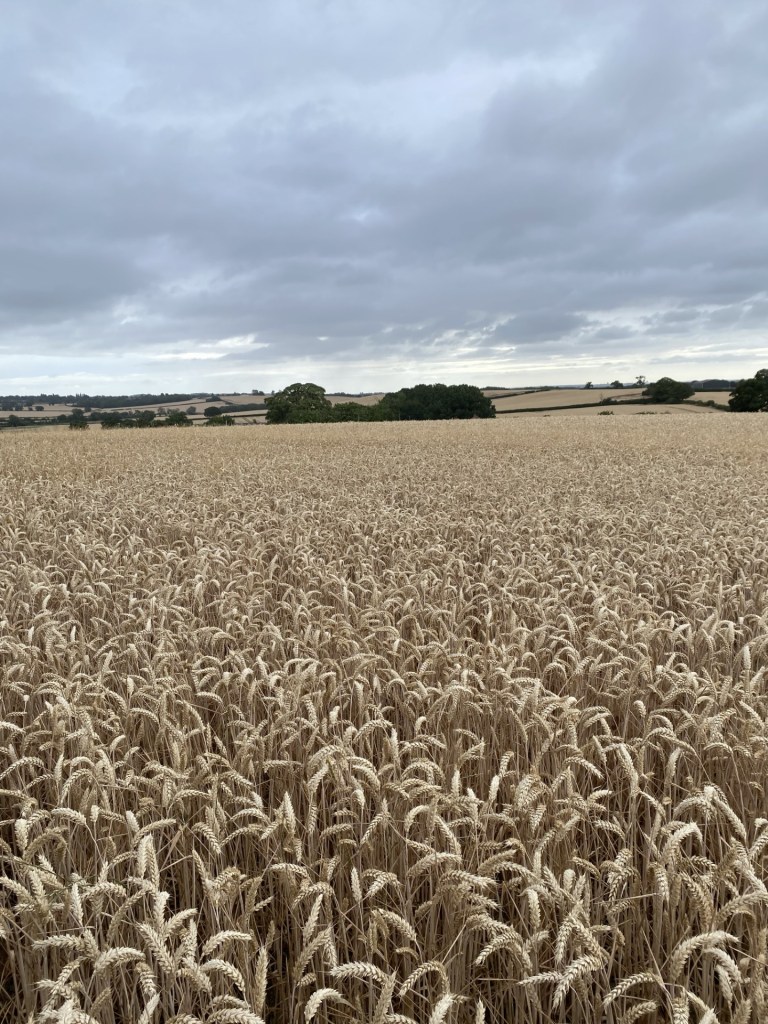
A grey morning in a wheat field

24. The pear tree

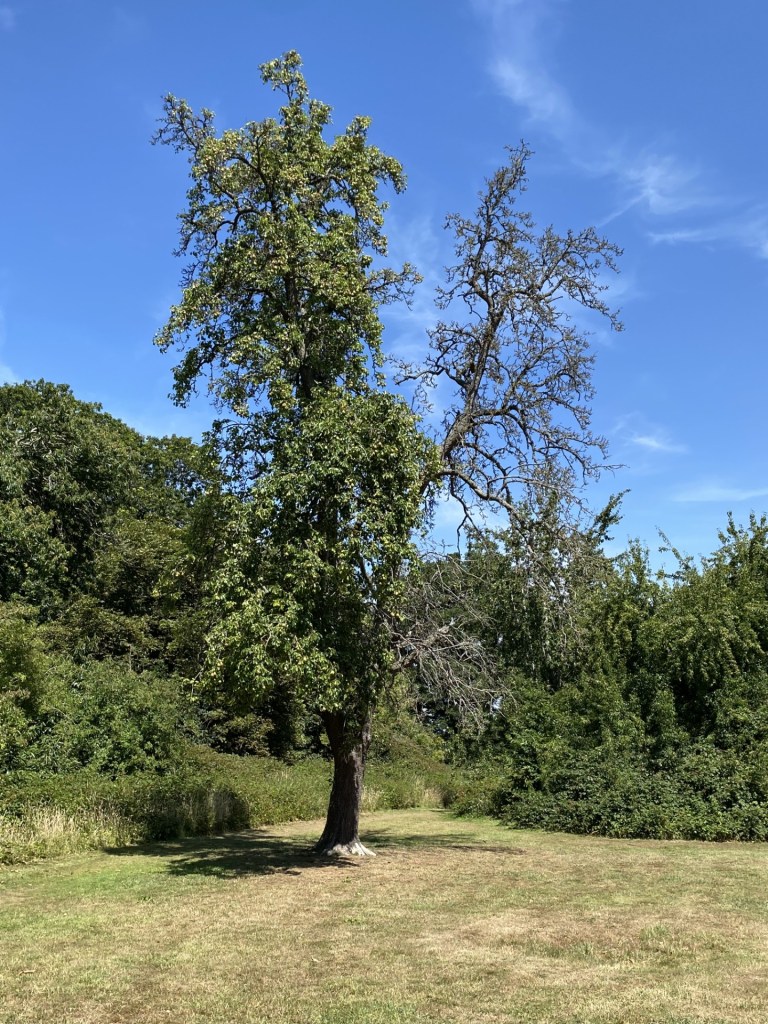
I’ve fallen for this pear tree. In a park full of majestic giant oaks, giant chestnuts, giant sycamores, it is this more modest pear tree that I am drawn to day after day, to sit under to eat my lunch and take a break from staring at my computer screen.

I chose it at random the first day, a little bit off the path and providing just enough dappled shade from the sun. I ate my lunch and then, like Heaney’s threshers in The Wife’s Tale, who “still kept their ease, Spread out, unbuttoned, grateful, under the trees,” I lay down and gazed up through the branches. It was then that I noticed something I hadn’t noticed as I walked past it or under it.

About six feet from the ground, it forks. The branches to one side of the fork are lifeless. No leaves grow, no buds. It is bare but for the lichen that has crept along it. The other side of the fork, in contrast, is heavy with life. The branches sag under the weight of innumerable pears that will be ripe by autumn, food for humans, food for animals, carrying the seeds of the offspring of this tree.

I’m drawn to the perseverance of this pear tree, to its wonky imperfection. Something happened to it – a lighning strike perhaps – that irreparably damaged one half of it, yet the other half carries on steadfast and lively. And I come to see that the damaged part might still have its role to play too, providing balance and stability, helping to anchor the still lively half.

A bumblebee lands on my brightly coloured trousers, resting in the shade of the tree for a moment before going on its way again. There are other insects too, not passing through but living here, making the tree their home. On both forks of the pear tree, I see intricate spider webs and, at the base, a hole made by some small animal. There are rabbit droppings on the ground around me. The tree, as a whole, is a place of liveliness, home to or way point for so many animals, me included.

As I sit up and prepare to return to work, I look around and see, not far away, smaller pear trees and saplings, surely the offspring of this one. The tree, despite its imperfections and its damaged parts, is living its best pear tree life.

21. Thoughts on The Salt Path

I’ve been writing memoir in one form or another for years. Essays published in newspapers, magazines and online, regular blog posts when we lived on the boat, and these more recent offerings. I’ve been working on longer form memoir for some time too – two unfinished memoirs that have now been smashed together into something very different and that I have been working on now for about a year. And then there is my experiment with a fictional screenplay for a six-part dark comedy, every element of which is stuff that happened to me or to people I know, just not in that order, or in that context, or to those people. Unlike my novelist sister, I lack the imagination to make things up, so everything I write is my direct experience. I’ve taken memoir writing courses and I am a member of a memoir-writing group that meets online a couple of times a month.

Despite writing memoir myself, I have never been much interested in reading it, much preferring fiction and certain forms of non-fiction (science writing and nature writing, in particular). In my mind, a good memoir should read like good fiction. I have read the work of some great memoirists, however – Maya Angelou, Joan Didion, Helen MacDonald, Frank McCourt, Cheryl Strayed, Suleika Jaouad, Barak Obama. One of the best I’ve read in the past few years was Raynor Winn’s The Salt Path. It was phenomenally written – lyrical and immersive, rocking along with the pace and timing of a great novel. I loved it so much that the day after I finished it, I popped it into an envelope and posted it to my old walking buddy Martha Main (Hello, Martha!), in Arviat, Nunavut. I was then delighted to find out a few weeks ago that it had been made into a film, staring Gillian Anderson and Jason Isaacs (Hello to Jason Isaacs) and, as luck would have it, it’s on in the cinema in Leamington Spa this Thursday morning and I plan to go.

So, imagine my surprise when, yesterday evening when I was watching the BBC news with my father-in-law, it was reported that a story in The Observer claimed that the author had lied about key facts in the book, and some of those lies were related to alleged criminality. I read The Observer article and then Mammy, my sister and I had a long chat about it this morning. My sister has also read the book and we had both recommended it to various people (she to her book club). We both had the same feeling of discomfort and feeling like the rug had been pulled from under our feet. It was hard to describe the feeling.

These allegations don’t in any way take from the amazing writing achievement of The Salt Path. It remains lyrical and immersive, tender and heartbreaking. But certain key elements of the story now may not be true. And that leaves a sour taste in the mouth. I’m now not sure that want to see the film.

This raises a bigger question about the role and the duty of the memoir writer. One of my favourite essayists is David Sedaris who, admittedly, I have listened to reading his essays far more than I have read his work. His writing is hilarious and heartbreaking, so that I find myself roaring laughing in one moment and roaring crying the next. But he faced a backlash about two decades ago concerning, not the writing itself, but rather its marketing as non-fiction, and the argument that it was insufficiently factual to be marketed as such. Sedaris clearly manipulates and exaggerates the things that have happened in his life for comic effect. But isn’t that what makes him a great writer – taking the ordinary, the mundane, and seeing in it something fantastical and outrageous? And boy, is it effective!

So, I don’t have a problem with how Sedaris writes because I know he’s exaggerating the truth. But that feels very different to what Raynor Winn is accused of doing. She is accused of criminal activity and of misrepresenting her husband’s illness. She presents her version of events as fact. Maybe they are. Maybe they’re not. But The Observer article is convincing enough that it has left a sour taste in my mouth. And it makes me think very carefully about the way I write my memories and the difference between a memory being true to me and a memory being true.

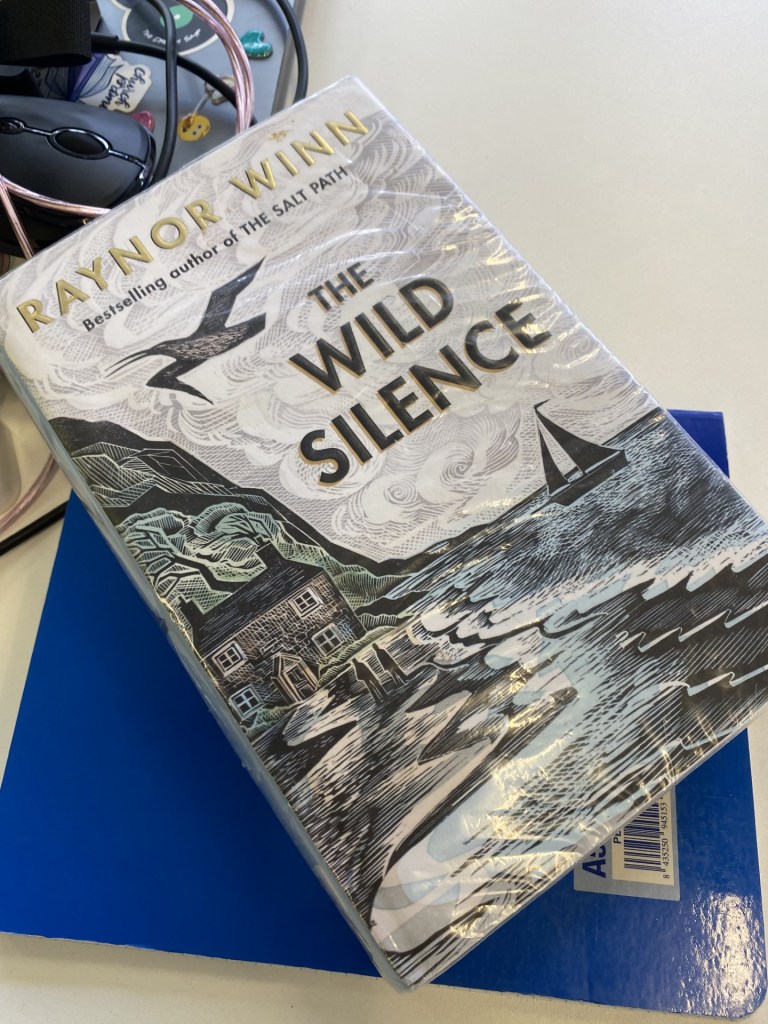
Not The Salt Path. When I inquired after the book at the library, I was told it had been borrowed this morning. Here’s a sequel.

10. From there to here

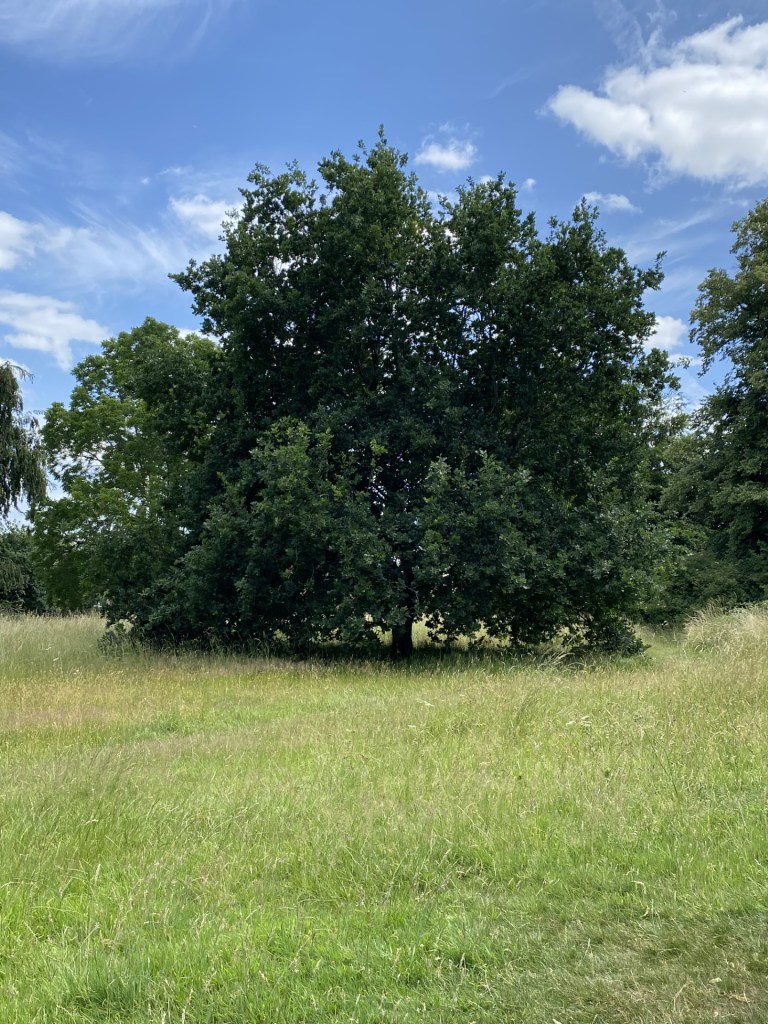
The trees are so big and so green and so varied and so alive. Oaks, horse chestnuts, sycamores, beech. Their trunks are immense and they reach high up into the blue sky. So unlike the scrubby arid trees of the dehesa (savannah) of southwest Spain. Tiredness is causing me to have an out of body experience as I walk through Priory Park. Is this what it’s like to experience the world when high on drugs, I wonder? The giant beautiful trees seem to pulsate around me, my brain and eyes playing tricks on me. Maybe the trees are playing tricks on me too. The tiredness is adding to my disbelief that I’m here, when only a few hours ago, I was there.

We woke up at 3.10am. I slept little anyway, checking my phone through the night to make sure I hadn’t slept through the alarm. Katie had set her alarm too, so it wouldn’t have mattered, but tell that to my subconscious/unconscious brain. It didn’t help that the narrow single bed in the cheap airport hotel was springy and uncomfortable and the room was too hot at first, then too cold with the fan, then too hot when I turned the fan off. Through those few brief hours, I heard other hotel guests arriving and departing, the thunk-thunk of heavy suitcases being hauled up or down the old stone stairs of this hotel without a lift, the wheels squeaking down the corridor outside our bedroom door, a movement-sensing light flooding our room with light through the glass panel over the door.

I am grateful that the airport was straightforward, the flight uneventful, our train to Leamington Spa on time. By the time we get to my father-in-law’s house mid-morning, the effects of the tiny €30 airport breakfast has long worn off and we are starving. While he asks the girls about the flight, I make a bee-line for the kitchen, knowing exactly what I’ll make (the girls and I have been discussing it, fantasizing about it). We anticipate what Granddad will have in stock, and we’re not disappointed. Rashers and eggs and fried tomatoes, with buttered fresh white bread and strong tea.

Afterwards, I rest for an hour, unpack a little and then I’m off again. The girls are sleepy, though they claim they aren’t. But they’re pale and have bags under their eyes, so they can’t fool me. I leave them sitting in the livingroom with Granddad, looking out over his garden at a fat pigeon pecking at the seeds he’s scattered about. I leave the house to the sounds of him telling the girls about a radio he built when he was a teenager, from his dad’s old cigar box. I hear him ask them what components they’d need to make a radio. My Gen Z teenagers have never used a radio in their lives, but I’m out the door before I hear their answer.

While my work life will be decidedly less frenetic in the coming weeks than it has been of late, I have a deadline to meet this coming weekend and I need to crack on. I spend a few hours at the library, meet my self-imposted work target for the day, and head back to my father-in-law’s house again. By now, I am well and truly zombified with tiredness, and the trees pulsate as I walk through them. Perhaps they are really Ents. Perhaps I need a good night’s sleep.