86. The most exclusive club

During the hazy lazy days of summer, Sanlúcar’s municipal swimming pool feels like some exclusive country club you’d see in a Hollywood movie, minus the shrimp cocktail and the dramatic intrigue. And it’s not just Sanlúcar. Village swimming pools all over Spain are like this, but I suspect there are few in as beautiful a location as this one, overlooking the Rio Guadiana and the hills of the northeast Algarve in Portugal on its western bank.

Why does it remind me of a country club? Well, our village is tiny, so the numbers of people attending the pool are pretty small. And everyone knows everyone. This really is Sanlúcar’s pool and, apart from the occasional visitor, the sun worshippers and bathers at this pool are the young and old of the village. Neighbours, friends, family members chat in the cool of the pool, look out for the toddlers tottering at the pool’s edge, gather in groups to share afternoon snacks. Children wander from one group of adults to another, because they know everyone, and you’d certainly never worry about leaving your belongings unattended. The life guards and other attendants are all local kids too.

But, unlike a country club, there’s no real exclusivity here. €2 for a day entry, €68 for a family for the entire season. Everyone is welcome here. But those who use the pool as visitors to the village might find the familiarity of all the other pool users with each other a bit strange. For Sanluceños, it’s just a wonderful break from the summer heat right on our doorsteps.

84. Surprising emotions

Arriving into Sanlúcar de Guadiana last night, I was surprised at just how happy I felt to be home. Just a simple feeling of contentment at being back in my own home.

Our seventy-five days in the UK and Ireland were delightful from start to end. I haven’t enjoyed myself so much or for so long on previous holidays. England was a joy and I experienced very strong positive emotions when I was in Ireland, whereas in the past my feelings have often been mixed. Not because Ireland isn’t great and not because my family and friends aren’t great. It was just me and where I was in my life on previous visits home that made me enjoy being in Ireland on holiday but also eager to return to where I had come from. I didn’t feel that way this time. I enjoyed my time there, and had very mixed feelings about leaving, feeling more torn between the two places I call home than I’ve ever felt before.

So, what a surprise to feel the way I did about turning the key in the lock and walking through my front door last night. Like an exhalation…I’m home. My house is looking a bit the worse for wear after lying empty for seventy-five days and it’ll take us a few days to sweep away the cobwebs, get unpacked and feel properly settled in, but that simple uncomplicated sense of being home was there from the moment I opened the door.

Our lovely friends had been in and left some food in the fridge and our neighbour had hung a fresh homemade loaf of bread on the front door. Still, I needed to buy a few odds and ends this morning, so, after breakfast I threw on something not very presentable that I pulled out of my suitcase and went to the two shops in the village. Ten minutes of shopping took me about three quarters of an hour, from all the people I met, the welcome back hugs and kisses I received, the conversations I had comparing Spanish and Irish weather. I felt welcomed home by my adopted village.

And then, the icing on the cake – collecting Lady from her summer villa (with a swimming pool, no less) and taking her home. Now that our scruffy, dusty, hair in her eyes Lady is back, my little home is complete.

Who cares that our two kayaks are still taking up most of the living room and the suitcases are on our bedroom floors? Time enough moving them tomorrow.

Walking through January

In late December, I set myself a challenge to walk 200km in January.

2023 had been an exceptional year for me. I was joyful and exuberant in turning 50 and everything about my life seemed to glow. That was until the end of the year, when it felt as if someone let the air out of my balloon. From early December, I felt lost, drained, living in a cloud of cotton wool, from which I neither could nor desired to work, be with other people, or drag myself out of the house.

Happiness and contentment are my default modes. If chemical imbalances play a role in the onset of depression, then I often think that I have chemical imbalances in the other direction. I’m chronically happy. I’m annoyingly upbeat. My glass is always way more than half full.

Except at the end of 2023, when it wasn’t. I had no reason to feel down, and yet I did. A weekend in Sevilla uplifted me momentarily but, even there, I was unusually sharp with my daughters and, at times, felt the strain of being in a city more acutely than usual. Then I came down with COVID and a week in Tenerife over Christmas that was supposed to relight my lamp instead left me feeling even more down in the dumps. I returned home to Sanlúcar COVID-free but feeling flat.

Then one day, in the last week of December, I set out to walk the dog. Not an ‘oh god, I’ve got to walk the dog’ sort of walk, the kind that had become my default over the past year, when I’ve increasingly cited lack of time, but a ‘let’s see how far we can go’ sort of walk, with a backpack on my back, containing my water bottle, a notebook and pen, and my phone to take photos. I walked north, along the path that leads up the river, stopping to allow myself to be enveloped in the silence, to watch a raft of canes drift down the river, to marvel at the orogeny on a wall of rock. The dog, of course, loved it too, walking farther than she had in months. At the farthest point from home, I decided to set myself the challenge of walking 200km in January.

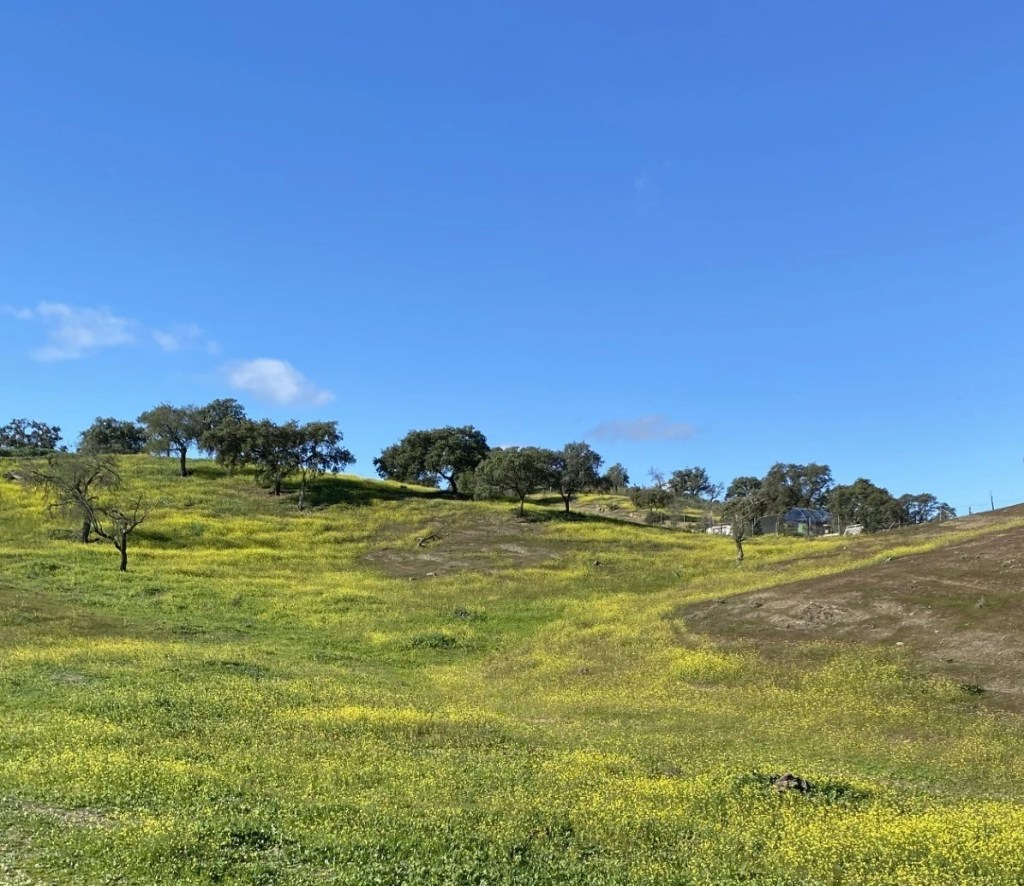
I walked for the first few days of January, recording the distance so that I had a sense of how far I might walk in a certain amount of time and considering how I could make space in my work day for this challenge. On each walk, I was uplifted. The land was brightly green, decorated with patches of wildflowers, yellow and white. It was a balm to the eyes and to the soul. Each day, though my spirits descended again when I returned from my walks, the troughs were not so deep. By the second week of January, I felt like myself again.

Some days I walked 10km or more, one day I only managed 1km. I walked at all times of the day – in cold early morning mist in jacket and woolly hat, bright afternoon sunshine in t-shirt and sunglasses, at sunset, carefully picking my way along rocky paths in the dark; Lady always my faithful companion, the land I walked through nourishing and uplifting me.

By the end of the month, I had walked 201km, along paths leading out in a radius from my house. I became reacquainted with places I hadn’t walked in years, just as I became reacquainted with why I love living here in the first place – the immensity of the land, the stories it tells of the people who lived here before, if only you take the time to read those stories in the landscape, the other creatures nourished by the land, and the river that brought me here snaking through it all; the vastness of the sky, at times a blue so deep as to seem unreal, at times ominous shades of grey, at night the riot of stars a glorious reminder of my insignificance, the Milky Way mirroring the route of our little river.

Over the course of the month, I observed changes taking place – sudden changes brought about by a heavy rain shower, slower changes as grasses grew, the number of lambs in a herd of sheep increased dramatically, the oranges continued to ripen and fall from the trees. I have found one, two, or even three hours in each day to walk. Those hours were there for the taking all along, I just failed to see them. Walking became the fulcrum of my day throughout January, uplifting me, soothing my soul, reassuring me that in the face of such ordinary magnificence, it is only to be expected that happiness is my default mode.

As for February? I’m back on the tracks and trails again, mostly in the lengthening evenings, challenging myself to another 200km. It hardly feels like a challenge. It’s starting to feel more like a drug.

A life lesson learned

The Spanish health care system has a pretty good reputation and most of my experiences with it confirm that. First of all, it’s free, which, coming from a country where a ten-minute consultation with your GP costs €70 for all but a minority, that’s a major bonus. Staff are generally caring and kind and referrals are reasonably prompt. In addition, prescription medications are heavily subsidized. Overall, I’m pretty happy with the health care system in my adopted country.

But…it’s different. The culture of care is unlike the one I grew up with and over the years I’ve had quite a few experiences that have jolted me because the processes and procedures are just…well…different.

Towards the end of last year I experienced a funny sensation in my left leg for a few weeks – pain in my calf, heaviness in my entire leg, occasional pins and needles throughout my leg. It’s something I’ve had on and off over the years and, being a bit of a hypochondriac, I always convince myself that I have deep vein thrombosis. But the pain always goes away before I do anything about it. This time, however, it lingered and, as the weekend approached, it worsened.

By midday on Saturday I’d convinced myself that I’d be dead by nightfall and I decided to go to the doctor. Being a Saturday, the health centre in the village was closed and I had to drive the 22km to the nearest 24-hour centre.

I was surprised to find the door to the health centre locked when I got there. A note stuck to the door had the centre’s phone number, so I called it. Before I had two words out, the grey metal door to my right opened and I was ushered in to the treatment room immediately behind the door. I tried to avert my gaze from the old man, shirt open, lying on the consulting table, being treated by a male member of staff. The woman who had opened the door to me turned out to be the doctor.

“Sit there,” she said, pointing to a chair only two metres from where the other patient was being treated. Shouldn’t he have some privacy, I thought. Shouldn’t I? I sat with my back to the man, trying not to listen as he was prepared for the ambulance that was to take him to the hospital, forty minutes away.

The doctor sat behind her desk and began her consultation with me. But before we got two sentences into it, there was another knock on the main door. The doctor opened the window beside her desk and shouted out, “Come in through the grey metal door.” There was no response, so she got up, walked around her desk, and let a middle-aged couple in. The treatment room was beginning to feel decidedly overcrowded.

The doctor directed the couple to the waiting room, but left the door between it and the treatment room open.

“I’ll have to see your leg,” she instructed me, after I had explained my symptoms and she’d asked me some preliminary questions.

With the door to the waiting room still open, the old man still on the treatment table and the male staff member beside him, and the grey door to the street now open to allow the ambulance crew in, I stood up, unbuckled my belt and dropped my jeans to the floor, my pink-knickered arse towards the old man. The doctor had a feel around my leg and asked me some more questions. She was sufficiently concerned to immediately send me to A&E at the big provincial hospital.

I didn’t want to go on my own, so I phoned a friend to ask if he’d drive me. Then I drove home, packed a few things in a bag, and was soon on the road to the hospital. The waiting room was large and airy and pretty comfortable as waiting rooms go, which was just as well, because I had a three hour wait.

Finally, my number appeared on the screen. I was to go to consultation room six. I walked into consultation room six to find a woman lying half-naked on the treatment table. “Go next door,” one of the staff told me. I went to consultation room seven and the woman sitting at the desk asked my name.

“You’re not Rosario?” she said, looking confused.

At that moment an extremely tall, very bald, bespectacled young doctor appeared at the door behind me.

“Martina?” he asked. “Ah, here you are. Follow me.”

I followed him to the other side of the corridor and into a large room that contained a number of beds. On one bed lay yet another old man, with his shirt open and his large belly on display. I tried to look anywhere but at the old man while the doctor consulted a computer and tried to find which room I was supposed to be in.

“Stay here,” he said and set off down the corridor, leaving me stranded. I looked at the television monitor and saw that I was assigned to both consultation rooms six and nine. Just then, the doctor popped his head out of room nine and indicated that I go there.

The brightly lit consultation room was cold enough that I commented on it to the young, dark-haired (and, admittedly, handsome) member of staff sitting behind the desk. The tall, bald doctor, whose white coat was askew and whose trousers didn’t reach to the top of his colourful socks, asked me where I’m from.

“Ireland,” I said.

“Ah, Holland,” he replied, a common mistake which must have something to do with the weird way I pronounce ‘ir’ in Spanish. I corrected him.

“Let’s do this in English, then,” he said, and switched to flawless English far superior to my Spanish.

I told him my symptoms and he asked me some further questions.

“I’m going to have to see it,” he said.

By now, the tall, bald doctor and the dark-haired, handsome doctor were both standing in front of me, as I sat on the consultation table. There didn’t seem to be anywhere for me to go to remove my trousers in a dignified manner, or a curtain to pull around to spare my blushes. I guessed I’d just have to get on with it.

With both men standing mere inches away from me and facing me, I removed my shoes and then my socks. A number of thoughts flashed through my head as I started to drop my trousers. 1. I haven’t shaved my legs in about two weeks. 2. I haven’t moisturized my legs in probably the same length of time. 3. Why am I wearing my mother’s hand-me-down knickers today? (Calm down…she hadn’t worn then…or so she swore to me)

With my trousers removed, I sat back on the table and the tall bald doctor proceeded to examine my hairy scaly left leg, pointing to a bruise on my thigh (I walked into the kitchen table) and another on my shin (an ungraceful scramble out of the dinghy). He talked his colleague through the examination and then used a very impressive hand-held ultrasound device that he plugged into his phone to look below the surface.

He assured me that all was fine. I didn’t have DVT, but I did have some damage to a surface vein. “Does that put me at greater risk of DVT?” I asked.

“Imagine your deep veins are the motorway,” he said, “going up to your heart and lungs. You have damaged a small country road. So, there’s not much to worry about. But, as you know, sometimes we get off the motorway and take a country road instead. So, yes, there’s a little risk.”

What a cool doctor. I felt sorry for him that he’d had to touch my troll-like leg. He’d asked me about my work and, as I got dressed – again, undignified and in front of the two of them, almost losing my balance as I put my right leg into my jeans – he gave me some sage advice. “Disco dance while you work. It’ll keep your legs moving.”

And that was it – undignified, lacking in privacy, lacking in an concerns about a woman patient stripping in a consultation room in front of two men and no female staff member present. I could have done anything to those two lovely doctors!

I returned home feeling reassured, and having learned some valuable lessons – disco dance while working and never, ever, leave my legs unshaved and unmoisturized again.

Of kingfishers…and genets

The Ribera Grande dries up every summer, leaving only pools of varying depths on either side of the channel. I like to walk the dog there. Sometimes, I pack a picnic, bring my book, and go with the children to one of the larger, deeper pools to swim. On a hot summer morning, it’s a great walk. When it’s already 30˚C by 9am, I can do a lazy slow 1.5km walk, while Lady covers three times as much ground at least, running ahead, running back to me, swimming in most of the pools we encounter. She gets a ton of exercise but stays cool and I don’t get heat stroke from doing one of my more usual 7 or 10km walks.

I rarely meet anyone. In the three years I’ve been walking that river bed, I can only remember three occasions when I met another person. The place is devoid of human sounds and full of life. Steep rock walls rise up on one side of the river – with the deepest pools at the base of those cliffs – and, on the other side, the hills are somewhat less steep. We usually disturb partridges and larks and, occasionally, I see vultures flying overhead.

A few weeks ago, the dog, the kids and I went there for a walk. A disturbance in the river to my left caught my attention. I turned to see a flash of iridescent blue and orange. Two flashes, in fact. I whispered to the girls to stop and look. Two kingfishers were in a mid-air battle over a fish. The fish’s head was in the mouth of one bird and its tail in the mouth of the other. The two birds flapped their wings furiously, each pulling in the opposite direction as they tried to stay in flight – a mid-air fishy tug-of-war. At one point, they lost momentum and both fell to the surface of the river, neither losing its grip on the fish, splashing through but then rising again from the river, with the fish still extended between them. I was in awe; mesmerized. They can’t have been unaware of our presence; we were very close to them. But their aerial battle for breakfast was more important to them than the presence of three curious humans and a dog.

I can’t be sure of what happened next, because it happened so quickly. Did one of them win the battle, turn tail and fly up river? Or did they both lose, as the fish fell from their mouths and into the water? I don’t know. But one of them did turn heel and dart up the river, zipping along about a metre above the water, with the other in hot pursuit.

Recently, as I recounted this story to some friends, I recalled another mesmerizing encounter along the same stretch of river at almost exactly the same time last year. That time it was just Lady and me. Something halfway up the hillside caught Lady’s attention and I turned to look. There, on the hill, were three cats, the most unusual looking cats I had ever seen. From that distance, all three looked identical and each was about the size of Lady – in other words, a medium sized dog. They were spotty and had distinctive long and full ringed tails, like lemur tails. They eyed Lady and me and we eyed them. I was in awe, and had no idea what they were, but assumed they must be Iberian lynx. The three suddenly turned tail and ran farther up the hill, keeping low to the ground, and eventually were over the hill and out of sight.

When I came home, I Googled lynx. They certainly weren’t lynx. And someone who knows the ecology of the area better than I do later told me that there aren’t any lynx around here. For a year, I have wondered what those strange cat-like creatures were.

And so, when I recounted the kingfisher story to my friends, and followed it up with my story of those strange cats, one of my friends immediately said, ‘They’re genets.’ We Googled them and, sure enough, the Google images were of precisely the creatures I had seen last summer. Genets are an African animal in the mammalian suborder feliforma. They are distantly related to cats, sharing a common ancestor many millions of years ago. They are native to Africa, but one subspecies, the common genet, was introduced to Iberia in historical times and is now also found in France and Italy.

The mystery was solved, I was now aware of the existence of another medium-sized mammal species, and I was delighted. Every time Lady and I go on that walk, I am filled with a sense of anticipation. I hear a rustle in the undergrowth, disturb a locust resting on a rock, delight in butterflies flitting from shrub to shrub. My heart lifts at the plop plop of frogs leaping into the pools, at the families of partridges running across our path, taking impossibly long to take to flight. I feel eyes on me as I walk. Even if I see only birds and insects, I know there are other animals watching us, keeping us in their sights, interlopers in their home.

It is a giving place. At a time of year when other much-loved walks are too hot or too cumbersome to undertake, the river dries up just enough to allow me to walk on the dry bed, but leaving pools deep enough for the dog, the children and I to cool down in. It is a place to be cherished.

Watchful eyes

As I walk to the top of the hill, I see the unmistakable long ears and angular head of a hare. She is big, bigger than Lady, who chases her off into the undergrowth, her lithe brown body quickly blending into the land. A momentary glimpse of my totem animal and she’s gone. But that glimpse gives me a profound feeling of privilege and awe. The next morning I’m still thinking about her, about our brief encounter, about how my sense of awe and wonder was matched by her fear and flight instinct.

I am lucky to live in a spectacular part of the world. Our little village is remote. There are few cars on the roads, we’re generally off international flight paths, so the blue sky is clear of jet trails, and the vast landscape is, for the most part, devoid of human-made noises. To walk through the countryside, along trails made by humans, sheep, goats, deer, wild boar, is to be immersed in both the natural history and the human history of the landscape, although the human history is the more subtle of the two.

_DSC1519 (2)

Lady

In April, after years of begging, I finally succumbed to Lily’s and Katie’s wishes to get a dog. Lady was born in February, on a plot of land not far from our house. She was the only bitch in a litter of six puppies. I fell in love with her on sight, when she was three weeks old, and we brought her home at seven weeks. Her mother is a Spanish water dog and her father, we think, is either a fox terrier or an Andalucian bodega rat terrier. She’s a wonderful addition to our family, very playful and lovable and full of energy.

Walking in the countryside with Lady has opened the landscape up. Lady and I have been walking 10km each day this summer – we walk for 3km each morning, and about an hour before sunset each day we set out on a 7km walk.

The trails I have previously associated with bees, ants, lizards and birds, and the occasional snake, now turn out to be rich with mammals too. Of course, I’m used to seeing fewmets (deer droppings) along the trail, holes dug by snuffling boar, and the prints of many different animals. With Lady along for the walk, however, animals hidden at very close quarters have now become visible. Lady can smell them. Or she can hear them. Or she can, by some other means, sense they are there. She gallops off at top speed, up hills, over rocks, into bushes. Of course, the animals she chases are too fast, or have a head start, or are on their home turf, so Lady, thankfully, doesn’t stand a chance. But suddenly I realise that, in a landscape seemingly devoid of mammals, I’m walking past them all the time. I’m now conscious of hidden eyes on me, and that gives me a wonderful thrill to know the animals are there.

One day last week, we were walking along a dry river bed, when suddenly, Lady dashed off towards the hill that rises steeply from the northern bank of the river. I looked up the steep hillside to see three wildcats, dun coloured stripes and long tails, racing up the hill. The next day, along the same river, it was a doe among the bushes, and the day after that, up in the hills north of Sanlúcar, it was a stag with majestic antlers. And last night it was my beautiful totemic hare.

As I’ve written before, I feel such a sense of privilege and awe to live, and have formerly lived, in places where seeing animals in the wild is not just a possibility, but a surety. Indeed, I’ve had the great privilege of encountering many wild animals over the years, not seeking them out, but simply as I’ve been going about my daily business – deer, caribou, polar bears, seals, beluga whales, common dolphins, wild boar, hares, humpback whales, orcas, minke whales, and even a tundra grizzly bear once. I’ve seen snowy owls, falcons, eagles and hawks, and I’ve had the great privilege to scuba dive amongst incredible and beautiful fish and turtles.

At a time when every single one of these animals is threatened by habitat loss, climate change and pollution, encountering them in the wild is a rare and precious privilege that moves me to redouble my personal effort to not only not contribute to their demise, but to make a positive effort to undo the damage we (including me) have already caused. The former is the easier of the two. My challenge now is to figure out how to contribute to the latter.

The view from the window

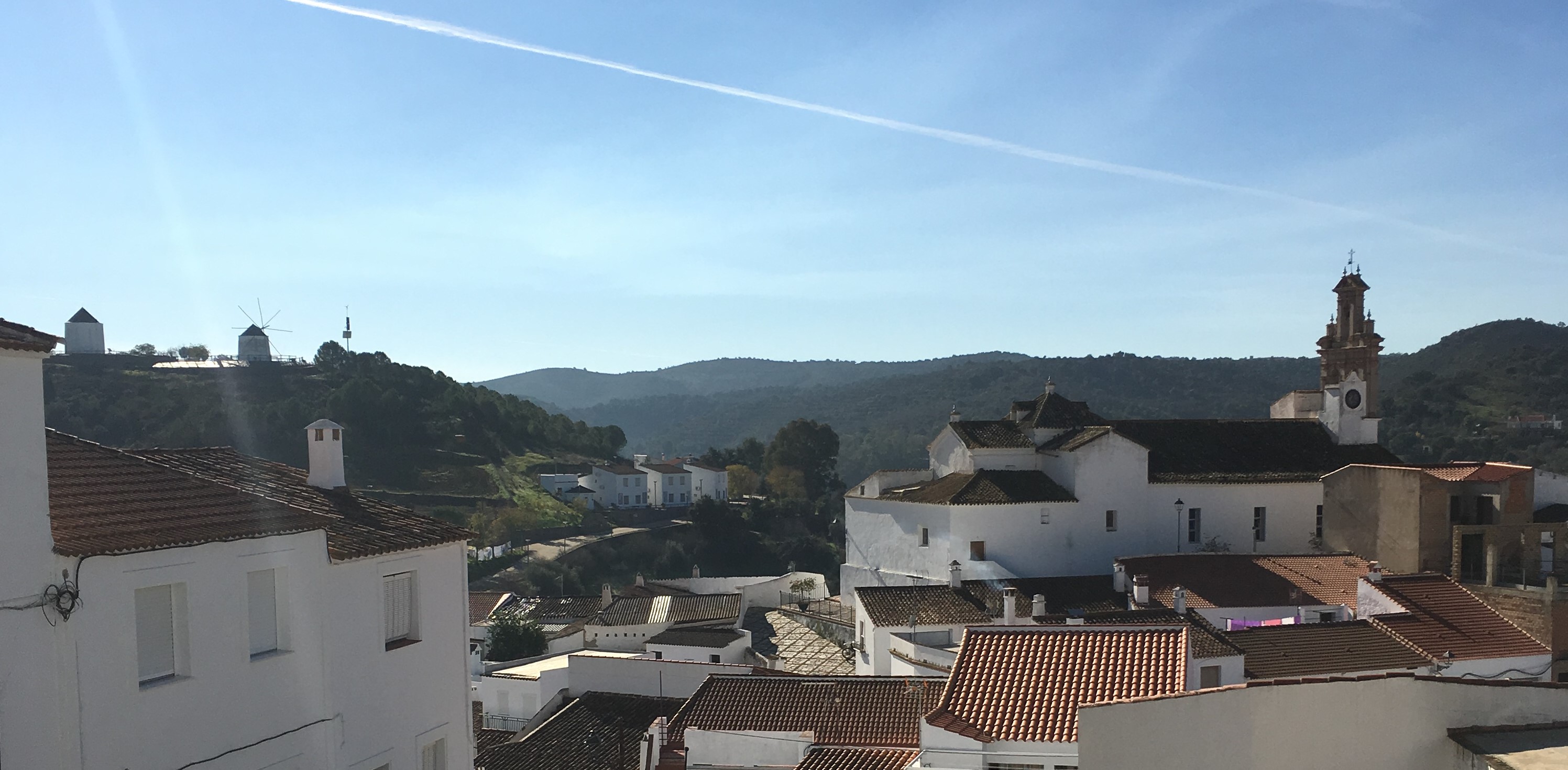
God knows, there are worse views. From high up in the village, our house looks southwest over the orange village rooftops and beyond. Below us lies the whitewashed church, perched on its own hill in the centre of the village, and beyond, up on the next hill, two picturesque windmills and the green field below where white and chestnut horses peacefully graze. I can’t see the river, but the hills of Portugal are almost within touching distance and the river runs between them and the village.

Home Feature

It’s like a scene from a Hollywood movie, a cardboard cutout of an idyllic southern European village. Imagine Mama Mia, or Chocolat, or Jeremy Irons in the final scene of Damage.

It’s just as well that it’s such a pleasant view. Since September I have been staring at that view for more time than I ever could have imagined. To coincide with moving into the house (indeed, because of moving into the house) I slipped a couple of discs in my lower back, leaving me severely incapacitated. I can’t walk very much, I can’t do most of the things I love to do. All those things that draw me to life in the village and the things that make me feel part of village life are, for the moment, out of reach. It’s a strange and unpleasant feeling to be in the village and yet not in the village.

But I have the view. Despite the picture postcard quality of the place, I know this is no cardboard cutout. Behind those pretty whitewashed walls and under those orange roof tiles there is love and laughter, joy and sorrow. And in the hills beyond, the seasons bring change, there are lambs and rock roses and wild flowers.

I am reminded of (though in no way compare myself to) Seamus Heaney’s poem Field of Vision* as I sit looking out on the view from my office desk or from the sitting room. For almost six months I have watched the seasons change, the parched sun-baked golden brown of summer giving way to the bright rain-fed greens of winter and spring. I’ve watched the sky, the bright blue empty sky, and the immense clouds sometimes bringing torrential showers of rain. These mornings I look down on fog, an inversion over the river, like steam rising from a witch’s cauldron.

The changing life of the village is harder to observe from this remove. Like those subtler changes in the landscape, one has to be in the village, rather than observing it from afar, to understand and appreciate its changing moods. I cherish those rare occasions these days, when I get out, when I feel sociable enough to be a part of village life again for an hour or two.

I long for a time when I can once again take a carefree stroll down to the bar and have a coffee or beer with whoever happens to be around, chat with my neighbours when we pass on the street, be spontaneous in my socializing. And I long to get beyond the village, to take long walks in the hills again, to be nose-to-nose with wild flowers, to row across the river in my little red dinghy and walk the smuggler’s trail in Portugal.

I am optimistic that all those things will come my way again. I expect I’ll appreciate them all the more for the months I have spent merely observing life through the frame of my front window.

*Field of Vision
Seamus Heaney

I remember this woman who sat for years
In a wheelchair, looking straight ahead
Out the window at sycamore trees unleafing
And leafing at the far end of the lane.

Straight out past the TV in the corner,
The stunted, agitated hawthorn bush,
The same small calves with their backs to wind and rain,
The same acre of ragwort, the same mountain.

She was steadfast as the big window itself.
Her brow was clear as the chrome bits of the chair.
She never lamented once and she never
Carried a spare ounce of emotional weight.

Face to face with her was an education
Of the sort you got across a well-braced gate —
One of those lean, clean, iron, roadside ones
Between two whitewashed pillars, where you could see

Deeper into the country than you expected
And discovered that the field behind the hedge
Grew more distinctly strange as you kept standing
Focused and drawn in by what barred the way.