99. Membrillo

I thought we’d missed the season. I was disappointed. I’ve been parsing out the last bit of membrillo (quince jelly) to Lily and Katie to eat with cheese. ‘Is there any more?’ they ask, when faced with the thin sliver of fragrant amber jelly on their plates. ‘That’s it,’ I say. ‘It’s nearly all gone.’

Since moving to Sanlúcar a decade ago, I have made quince jelly pretty much every year in late summer. First, I pick a large bagful from a couple of trees by the river on the land tended by lovely old Juan de Correos (who sadly passed away this summer), or I get some from the land of my friends, Paul and Diana.

Turning the hard pale green fruits into dark orange deliciousness is a Saturday morning’s work – washing the growth of fuzz off each fruit, peeling and coring them (they have nasty black sticky cores), chopping them into the saucepan and adding sugar and the tiniest bit of water. And then the magic happens. The quince gradually transform from something more akin to a potato than a pear in look and texture into the most fragrant, most floral, deepest orange mush. A quick blitz with the hand blender once the mush has reached setting temperature, and then I pour it into two trays to set. As it cools, it solidifies to a jelly and turns translucent. It’s magical. And the taste is heavenly. When it cools and sets, I cut it into blocks and store it for use throughout the year.

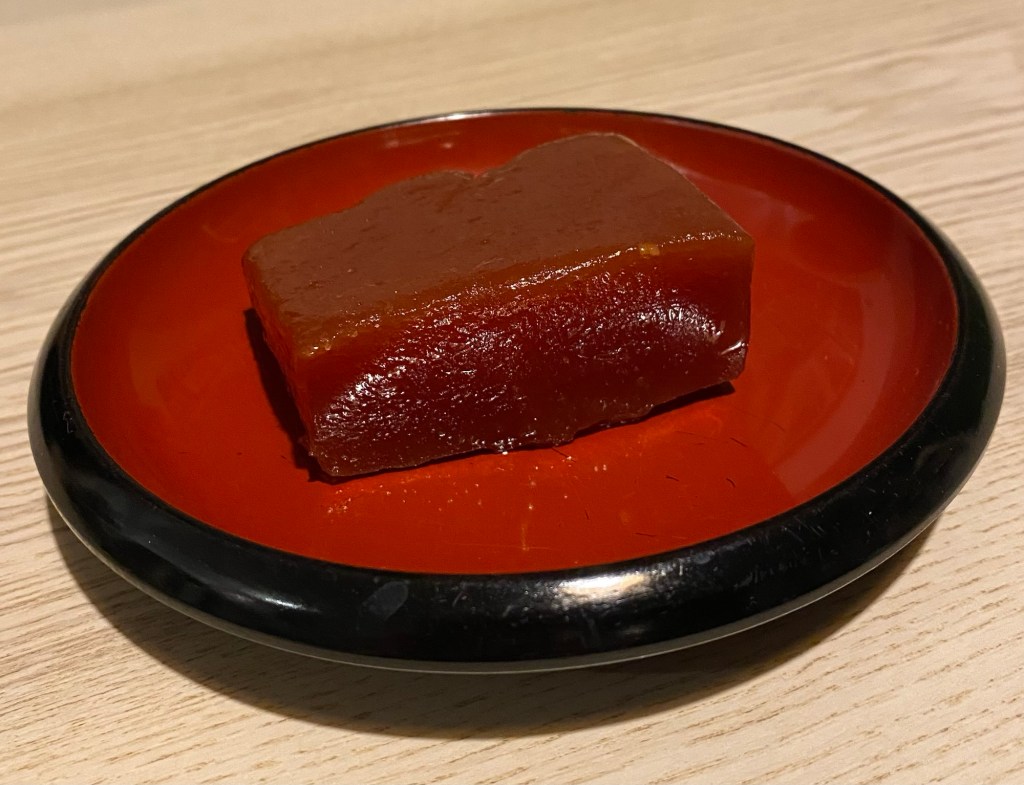
The last of last year’s membrillo

In my house, we eat it with cheese or sometimes on toast. I put it as a middle layer in homemade oat bars, and I even add it to apple pies.

So, imagine how I felt when I thought I’d missed the season. We’d been away for so long and I’m still kind of settling back in to life here, so making membrillo had slipped my mind. Until I realised we were down to our last block. A whole year without membrillo? Unimaginable!

This evening, Lady and I went out for our evening walk and I came to a membrillo tree, branches sagging under the weight of a healthy fruit crop. And then I remembered. This was the very tree that I had picked the quince from last year. This tree comes into fruit later than the other trees that I usually pick from and the fruit last year was much better – no rotten bits, no waspy bits, just perfect quinces.

The tree is on the edge of a field, with half its branches hanging out over the fence and over the edge of the road. It was ftom these branches that I picked last year. This evening, I made a mental note to come back tomorrow with my backpack and take what I need.

As I walked past the tree on the return leg of my walk, the man who owns the field was there. I asked if I could take some quinces tomorrow and told him I’d taken some last year. We got into a conversation about membrillo and it’s many delicious uses and he told me to take what I need.

So, tomorrow I’ll be back by the tree to forage some fruit and, although I’d planned to do something else, Saturday will be my annual membrillo-making day.

98. Boobs

I’m sitting in the waiting room waiting for a mammogram. Just a routine one – my second. The first one was two years ago, when I turned 50. That and the first colon cancer screening. It’s good that we get tested for all these things but, once again, Spanish health care surprises me.

I see that the radiographer conducting the mammogram is the same man as last time. He’s about my age, has a harried look about him, but I think it’s just because of his unkempt hair. The first time, I found it odd that (a) it was a man and (b) there was no female nurse or assistant in the room. At least I had a little changing room where I could strip off in private, unlike the time I went to the hospital a few years ago and had to drop my trousers in front of two males doctors (again, no female members of staff present) like some supremely untalented Gypsy Rose Lee.

Last time I came for a mammogram, the radiographer conducted a jolly conversation with me about the state of Irish rugby (something about which I know absolutely nothing) while he placed each of my boobs on the machine and squished and squeezed them into position. I guess the surreality of it all took my mind off the physical and emotional discomfort!! I wonder what he’ll talk about this time? I’m next in line…I’ll soon find out.

PS…I’m home now. He discussed the time of the once daily bus to Sanlúcar. Now that’s a topic I know something about.

84. Surprising emotions

Arriving into Sanlúcar de Guadiana last night, I was surprised at just how happy I felt to be home. Just a simple feeling of contentment at being back in my own home.

Our seventy-five days in the UK and Ireland were delightful from start to end. I haven’t enjoyed myself so much or for so long on previous holidays. England was a joy and I experienced very strong positive emotions when I was in Ireland, whereas in the past my feelings have often been mixed. Not because Ireland isn’t great and not because my family and friends aren’t great. It was just me and where I was in my life on previous visits home that made me enjoy being in Ireland on holiday but also eager to return to where I had come from. I didn’t feel that way this time. I enjoyed my time there, and had very mixed feelings about leaving, feeling more torn between the two places I call home than I’ve ever felt before.

So, what a surprise to feel the way I did about turning the key in the lock and walking through my front door last night. Like an exhalation…I’m home. My house is looking a bit the worse for wear after lying empty for seventy-five days and it’ll take us a few days to sweep away the cobwebs, get unpacked and feel properly settled in, but that simple uncomplicated sense of being home was there from the moment I opened the door.

Our lovely friends had been in and left some food in the fridge and our neighbour had hung a fresh homemade loaf of bread on the front door. Still, I needed to buy a few odds and ends this morning, so, after breakfast I threw on something not very presentable that I pulled out of my suitcase and went to the two shops in the village. Ten minutes of shopping took me about three quarters of an hour, from all the people I met, the welcome back hugs and kisses I received, the conversations I had comparing Spanish and Irish weather. I felt welcomed home by my adopted village.

And then, the icing on the cake – collecting Lady from her summer villa (with a swimming pool, no less) and taking her home. Now that our scruffy, dusty, hair in her eyes Lady is back, my little home is complete.

Who cares that our two kayaks are still taking up most of the living room and the suitcases are on our bedroom floors? Time enough moving them tomorrow.

A life lesson learned

The Spanish health care system has a pretty good reputation and most of my experiences with it confirm that. First of all, it’s free, which, coming from a country where a ten-minute consultation with your GP costs €70 for all but a minority, that’s a major bonus. Staff are generally caring and kind and referrals are reasonably prompt. In addition, prescription medications are heavily subsidized. Overall, I’m pretty happy with the health care system in my adopted country.

But…it’s different. The culture of care is unlike the one I grew up with and over the years I’ve had quite a few experiences that have jolted me because the processes and procedures are just…well…different.

Towards the end of last year I experienced a funny sensation in my left leg for a few weeks – pain in my calf, heaviness in my entire leg, occasional pins and needles throughout my leg. It’s something I’ve had on and off over the years and, being a bit of a hypochondriac, I always convince myself that I have deep vein thrombosis. But the pain always goes away before I do anything about it. This time, however, it lingered and, as the weekend approached, it worsened.

By midday on Saturday I’d convinced myself that I’d be dead by nightfall and I decided to go to the doctor. Being a Saturday, the health centre in the village was closed and I had to drive the 22km to the nearest 24-hour centre.

I was surprised to find the door to the health centre locked when I got there. A note stuck to the door had the centre’s phone number, so I called it. Before I had two words out, the grey metal door to my right opened and I was ushered in to the treatment room immediately behind the door. I tried to avert my gaze from the old man, shirt open, lying on the consulting table, being treated by a male member of staff. The woman who had opened the door to me turned out to be the doctor.

“Sit there,” she said, pointing to a chair only two metres from where the other patient was being treated. Shouldn’t he have some privacy, I thought. Shouldn’t I? I sat with my back to the man, trying not to listen as he was prepared for the ambulance that was to take him to the hospital, forty minutes away.

The doctor sat behind her desk and began her consultation with me. But before we got two sentences into it, there was another knock on the main door. The doctor opened the window beside her desk and shouted out, “Come in through the grey metal door.” There was no response, so she got up, walked around her desk, and let a middle-aged couple in. The treatment room was beginning to feel decidedly overcrowded.

The doctor directed the couple to the waiting room, but left the door between it and the treatment room open.

“I’ll have to see your leg,” she instructed me, after I had explained my symptoms and she’d asked me some preliminary questions.

With the door to the waiting room still open, the old man still on the treatment table and the male staff member beside him, and the grey door to the street now open to allow the ambulance crew in, I stood up, unbuckled my belt and dropped my jeans to the floor, my pink-knickered arse towards the old man. The doctor had a feel around my leg and asked me some more questions. She was sufficiently concerned to immediately send me to A&E at the big provincial hospital.

I didn’t want to go on my own, so I phoned a friend to ask if he’d drive me. Then I drove home, packed a few things in a bag, and was soon on the road to the hospital. The waiting room was large and airy and pretty comfortable as waiting rooms go, which was just as well, because I had a three hour wait.

Finally, my number appeared on the screen. I was to go to consultation room six. I walked into consultation room six to find a woman lying half-naked on the treatment table. “Go next door,” one of the staff told me. I went to consultation room seven and the woman sitting at the desk asked my name.

“You’re not Rosario?” she said, looking confused.

At that moment an extremely tall, very bald, bespectacled young doctor appeared at the door behind me.

“Martina?” he asked. “Ah, here you are. Follow me.”

I followed him to the other side of the corridor and into a large room that contained a number of beds. On one bed lay yet another old man, with his shirt open and his large belly on display. I tried to look anywhere but at the old man while the doctor consulted a computer and tried to find which room I was supposed to be in.

“Stay here,” he said and set off down the corridor, leaving me stranded. I looked at the television monitor and saw that I was assigned to both consultation rooms six and nine. Just then, the doctor popped his head out of room nine and indicated that I go there.

The brightly lit consultation room was cold enough that I commented on it to the young, dark-haired (and, admittedly, handsome) member of staff sitting behind the desk. The tall, bald doctor, whose white coat was askew and whose trousers didn’t reach to the top of his colourful socks, asked me where I’m from.

“Ireland,” I said.

“Ah, Holland,” he replied, a common mistake which must have something to do with the weird way I pronounce ‘ir’ in Spanish. I corrected him.

“Let’s do this in English, then,” he said, and switched to flawless English far superior to my Spanish.

I told him my symptoms and he asked me some further questions.

“I’m going to have to see it,” he said.

By now, the tall, bald doctor and the dark-haired, handsome doctor were both standing in front of me, as I sat on the consultation table. There didn’t seem to be anywhere for me to go to remove my trousers in a dignified manner, or a curtain to pull around to spare my blushes. I guessed I’d just have to get on with it.

With both men standing mere inches away from me and facing me, I removed my shoes and then my socks. A number of thoughts flashed through my head as I started to drop my trousers. 1. I haven’t shaved my legs in about two weeks. 2. I haven’t moisturized my legs in probably the same length of time. 3. Why am I wearing my mother’s hand-me-down knickers today? (Calm down…she hadn’t worn then…or so she swore to me)

With my trousers removed, I sat back on the table and the tall bald doctor proceeded to examine my hairy scaly left leg, pointing to a bruise on my thigh (I walked into the kitchen table) and another on my shin (an ungraceful scramble out of the dinghy). He talked his colleague through the examination and then used a very impressive hand-held ultrasound device that he plugged into his phone to look below the surface.

He assured me that all was fine. I didn’t have DVT, but I did have some damage to a surface vein. “Does that put me at greater risk of DVT?” I asked.

“Imagine your deep veins are the motorway,” he said, “going up to your heart and lungs. You have damaged a small country road. So, there’s not much to worry about. But, as you know, sometimes we get off the motorway and take a country road instead. So, yes, there’s a little risk.”

What a cool doctor. I felt sorry for him that he’d had to touch my troll-like leg. He’d asked me about my work and, as I got dressed – again, undignified and in front of the two of them, almost losing my balance as I put my right leg into my jeans – he gave me some sage advice. “Disco dance while you work. It’ll keep your legs moving.”

And that was it – undignified, lacking in privacy, lacking in an concerns about a woman patient stripping in a consultation room in front of two men and no female staff member present. I could have done anything to those two lovely doctors!

I returned home feeling reassured, and having learned some valuable lessons – disco dance while working and never, ever, leave my legs unshaved and unmoisturized again.

Definitely not chorizo

The road was dark and empty. Lonely. I wondered how long someone – me – might lie there unaided if their car ran off the road. How long before another car would come along. It could be hours. I knew I was driving too fast, the fall-away at the side of the road and the deer signs telling me I should slow down. But my tiredness and desire to get home pushed me on. What would the consequences be if I crashed? I could die. I could cause myself life-changing injuries. I could kill the dog.

I’d very nearly killed the dog once already today. That was why we were on this lonely road after midnight, with the Google maps woman telling me where to go long after I knew where I was and didn’t need her anymore. This lonely stretch of 16km, another lonely stretch of 13km, then the final lonely stretch of 8km.

I’d laid an old bedsheet on the back seat of the car in case Lady vomited. It had been a last-minute decision. She was already in the car; I’d packed what I was taking with me and I was about to get in when I thought about the potential for vomit. So, I ran back into the house and grabbed a sheet from the box of painting supplies on the high shelf in the utility room.

I expected her to vomit because, in the past hour, I’d force fed her 40mls of extremely salty water and, before that, 10mls of olive oil. She was miserable from all this manhandling and force feeding. Why was she being so horribly punished?  

She’d be dying unbeknownst to me right now if I hadn’t spotted her eating what I at first thought was a stolen slice of chorizo. Naughty girl, I thought, but I left her to it. Then I saw she had another one – or was it the same one? I couldn’t be sure. It seemed to be wrapped in plastic. I called her to me, prized it from her clenched jaws and started to remove what I thought was a plastic wrapper only, to my horror, to read the words, in Spanish, ‘raticida’. Rat poison. I took it to the bin and, as I did, she went back to the source, behind the bin, and found another one. I made her drop it and I wondered what to do. Had she eaten one already? Or was the one I removed from her mouth the first one? My walking buddy Jennifer calmly Googled what to do and said, ‘She needs Vitamin K.’ I left my half-full glass of beer on the table and walked home, calling the vet along the way.

The vet advised 10mls of olive oil, which should stop her absorbing the poison if there was any in her system. “Keep an eye on her,” she told me, “And if you see any changes in her, call me.”

I forced the olive oil into her and then Googled ‘My dog ate rat poison’. Without exception, every site urged going to the vet immediately: ‘Do not waste your time trying home remedies’.

I called the 24-hour emergency vet in Huelva for a second opinion. She advised me to force feed her very salty water. With a syringe. Sideways into her mouth so it wouldn’t go into her lungs. Based on how far away I live from Huelva and how long it had been since she’d possibly eaten the poison, if she didn’t vomit in an hour, I was to take her in. It’s critical that you don’t let too much time pass, she said.

I didn’t have a syringe. Someone with a small child is bound to have syringe, I thought. I phoned Egle because she has a three-year old son. Soon I had a syringe and I managed to get 40mls of water into Lady in the face of major opposition. Katie held her. I held her. I chased her around the kitchen table. She wriggled backways out of Katie’s grasp and under the table. Was 40mls enough? The vet hadn’t said how much was enough.

I didn’t want to wait to see if she’d vomit. I made supper for the girls, packed a few things in a bag – my book, wallet, doggy passport. My head was pounding and I could feel the world closing in around me in what felt like the start of a panic attack. I couldn’t imagine how bereft we’d be if the dog died. She’s been our rock of joy through so much in her short three and a bit years of life.

Forty minutes after I’d forced the salt water into her there was still no sign of her vomiting. I got in the car, grabbing the old sheet for the back seat, and set out on the one-hour drive to Huelva. It was a horrible night for driving. Rain on the windscreen, the inside of my old car misty with condensation, the roads wet and a seemingly endless stream of headlights of cars coming from the opposite direction.

The Google maps woman took me on a route that ultimately got me lost. I was losing precious minutes. I would have found the building easily on my own, had I looked at a map and not relied on that Google wan.

When I finally parked up, Lady jumped gleefully out of the car, expecting a walk. Her glee was short-lived, however, when she realized we were going to the vet. She’d never been to this vet before, so what was it about the place that made her stick her tail between her legs and try to escape back out the door? The vet’s clothes? The smell of the place? Whatever it was, Lady knew trouble was in store and I had to drag her in the door against her will.  

“I’m going to give her an injection that will force her to vomit,” the kindly-faced vet said. Lady struggled and screamed while one woman held her and the other stuck a long needle in the scruff of her neck.

“Where should we go?” I asked.

“Stay here. She can vomit on the floor. Animals are always vomiting on the floor here,” the vet said matter-of-factly. I sat on the long blue bench, and looked around at the blue plastic floor, imagining a room full of animals of all shapes and sizes simultaneously vomiting. Lady sat beside me, glued to my leg.

Two women came in, a mother and daughter, and natives of South America, I guessed. The older woman, red-eyed and still crying, carried in her arms a cat on a cat bed. The vet saw them into her office.

And that was when the vomiting started. Lady started to retch, making a hideous noise as she did so. First out of her mouth and onto the blue plastic floor were two packets of rat poison, still intact, both with the word ‘raticida’ still clear. The woman at reception came from behind her desk with a roll of paper towels, a bottle of bleach and a bin liner. We hunkered down together and peered at the vomit. The two sachets of poison certainly looked intact, but it was hard to tell if they’d been breached. Meanwhile, Lady was retching again and this time produced the chicken she’d had for lunch. As I cleaned up one pile of vomit, she produced another. I left the first pile where it was, for the vet to see when she came out.

The door to the consulting room opened and out came the vet and the two women, both sobbing, tears streaming down their cheeks, the cat nowhere in sight. The vet hunkered down and inspected the contents of the first pile of vomit.

Behind me I could hear the two women making arrangements for their dead cat with the woman at reception. “What name do you want?” she asked. Both women said the cat’s name a few times, but the receptionist couldn’t get it right. “I don’t want to get it wrong,” she said gently and handed the older woman a piece of paper. “You write it down.” Meanwhile, Lady stood by the legs of the younger woman, wretched and retching, and I thought, with horror, about to vomit onto the woman’s shoe. That’s all the poor woman needed – being vomited on by some stupid dog minutes after her cat had been put to sleep.

I grabbed Lady by the collar and pulled her to me, trying to keep her close – or at least away from the mother and daughter – while I cleaned up the vomit. As soon as I cleaned up one pile, Lady produced another.

The two women stood around, while the receptionist completed their paperwork. I didn’t know how to react to their grief. I wanted to console them, to say I was sorry for their loss, but the proper words in Spanish deserted me and all I could do was clean up and feel awful that they were grieving for their cat on a dog vomit-covered blue plastic floor.

“When should we come back?” the older woman asked the vet. “It’ll take a few days,” the vet said. “I’ll call you when it’s ready.” The ‘it’ I presumed referred to the cat’s ashes. The pair left, the cat basket under the older woman’s arm, empty. Their loneliness for the cat was palpable.

The vet gave Lady a second injection to quell the nausea and gave me a prescription for Vitamin K. I got lost twice or three times trying to find my way out of Huelva, despite (or because of) the Google woman. It was almost 2am by the time we got back to Sanlúcar.

In the days that followed, Lady showed no ill effects of the poison. It is likely she vomited it all up. For the next ten days, I forced her to take Vitamin K four times a day and an anti-nausea table to counteract the Vitamin K twice a day. She really hated me for those ten days, eying me suspiciously every time I went into the kitchen, for fear I’d return with the syringe or the pills.

Has she learned her lesson? Of course not. She’s a dog.